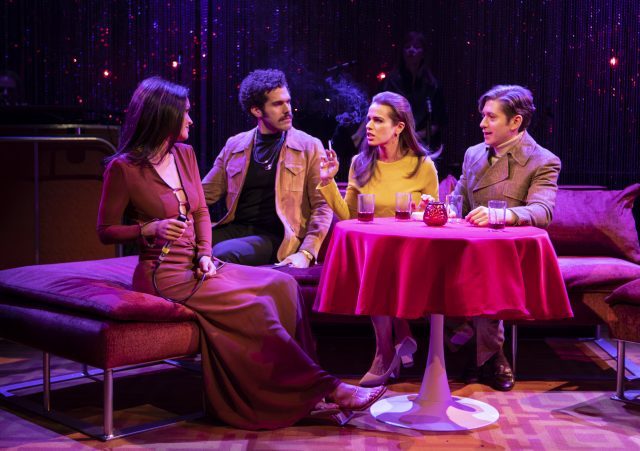
Carol (Jennifer Damiano) and Bob (Joél Pérez) and Alice (Ana Nogueira) and Ted (Michael Zegen) are seeking some new sexual adventures in Bob & Carol & Ted & Alice (photo by Monique Carboni)
The New Group at the Pershing Square Signature Center
The Romulus Linney Courtyard Theatre
480 West 42nd St. between between Ninth & Tenth Aves.
Tuesday – Sunday through March 22, $48-$133 thenewgroup.org
Paul Mazursky’s 1969 film Bob & Carol & Ted & Alice captured the zeitgeist of a nation high on the summer of love, glorying in the sexual revolution. Nominated for four Oscars, the film starred Robert Culp and Natalie Wood as Bob and Carol Sanders, an adventurous LA couple, while Elliott Gould and Dyan Cannon are their best friends, Ted and Alice Henderson, who are significantly more traditional. The New Group has now turned the script, written by Mazursky and Larry Tucker, into a fun, lighthearted play with music that opened tonight at the Pershing Square Signature Center for an extended run through March 22. (Mazursky’s daughter Jill served as a consultant on the show.)
The hundred-minute show opens with Bob (Joél Pérez) and Carol (Jennifer Damiano) on their way to a consciousness-raising weekend. Derek McLane’s set is arranged like an encounter group for the audience, which sits on three sides of a small stage that boasts a couch, several mod chairs, a pair of microphone stands and cushions, a beaded curtain at the back, and the band, consisting of music director and keyboardist Jason Hart, guitarist and bassist Simon Kafka, Noelle Rueschman on reeds, bassist and drummer Jamie Mohamdein, and the bandleader, wonderfully portrayed by iconic singer-songwriter Suzanne Vega, who took over after composer Duncan Sheik, who wrote the lyrics with Amanda Green, couldn’t take on the role in addition to his other responsibilities. Standing in the back, Vega also serves as emcee and narrator, talking to the characters and the audience as well as singing. Early on she says to Bob and Carol (and the audience): “Welcome to the Institute at Big Sur, home of the Human Potential Movement. . . . Don’t think. Feel. . . . Lose your mind. Come to your senses.”
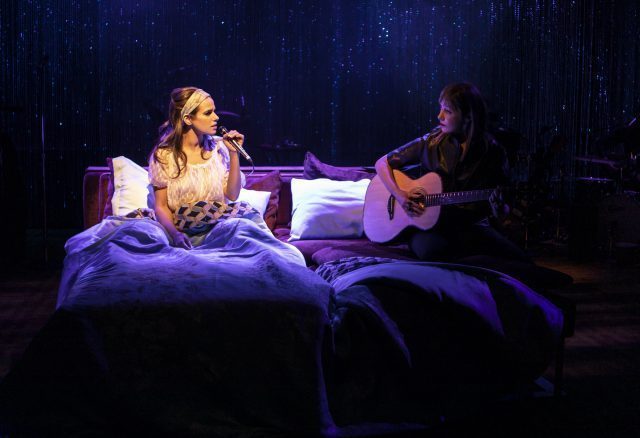
Alice (Ana Nogueira) and the bandleader (Suzanne Vega) share an intimate moment in New Group world premiere at the Signature (photo by Monique Carboni)
Bob is primarily there to make a documentary about the institute, but he is ultimately coaxed into participating in a marathon group therapy encounter session. Bob and Carol closely examine their marriage in ways they never did before. “I always accuse you of hiding your feelings, but I hide my feelings, Carol,” Bob admits. Carol responds, “I do hide my feelings, Bob. You’re not the only one hiding your feelings. I hide my feelings all the time. I came here because I felt like it. I wanted to come for me. But I couldn’t tell you. I’m — I’m sometimes afraid of you.” A weepy Bob replies, “Afraid of me? I love you. I love you so much, baby.” When Bob confesses to having an affair, they take their relationship to another, unexpected level. The now swinging couple share their new outlook on love and life with Ted (Michael Zegen) and Alice (Ana Nogueira), who are not so keen on all this openness. Bob and Carol invite Ted and Alice to Vegas for the weekend to see Tony Bennett, but there’s a special surprise in store.
Bob & Carol & Ted & Alice is a sweet-natured period piece, featuring not only groovy dialogue but classic late-1960s-era costumes by Jeff Mahshie, highlighted by Ted’s turtlenecks and the women’s mini dresses. Pérez (Fun Home,Sweet Charity) plays drums and channels Will Ferrell (and a little Elliott Gould), Tony nominee Damiano (Spring Awakening, Next to Normal) ups the sexy quotient, and Zegen (The Marvelous Mrs. Maisel,A View from the Bridge) and Nogueira (Engagements, Mala Hierba) are right-on as the more buttoned-up couple who just might break free of their societal constraints at any moment. Jonathan Marc Sherman’s (Clive,Knickerbocker) book is endearingly playful, as is Scott Elliott’s (The True,Mercury Fur) direction, which involves several willing audience members. When the characters break into song, Kelly Devine’s musical staging can feel out of place, especially when compared to Vega, whose songs have a natural, effervescent flow, and she also reveals some fine acting chops. (Vega previously starred in her own one-woman show, Carson McCullers Talks About Love, playing the title character.) The movie was revolutionary for its time, but this New Group world premiere does not have such lofty ambitions. Instead, it’s a frisky and flirtatious look at a bygone era, a kind of last gasp right before America would lose its innocence.
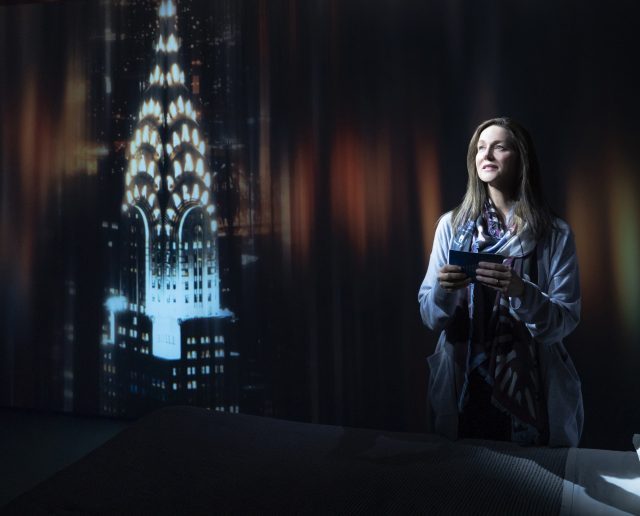
Lucy Barton (Laura Linney) recalls a significant time in her life in play based on Elizabeth Strout novel (photo by Matthew Murphy)
Manhattan Theatre Club at the Samuel J. Friedman Theatre
261 West 47th St. between Broadway & Eighth Aves.
Monday – Saturday through February 29, $70-$150 www.manhattantheatreclub.com lucybartonplay.com
It’s always a pleasure watching the exquisite Laura Linney, whether on television, in film, or onstage. Nominated for three Oscars and four Tonys and winner of four Emmys, the Manhattan native has an instantly infectious appeal; you want to be in her luminous presence. She is terrific once again in her latest Broadway play, the one-woman show My Name Is Lucy Barton, which is based on Elizabeth Strout’s 2016 novel and continues at MTC’s Samuel J. Friedman Theatre through February 29. Under Richard Eyre’s expert direction, she flows between sharing her story with the audience and portraying her mother. So why isn’t it better?
Born and raised in the rural town of Amgash, Illinois, Lucy is now reflecting on a critical time in her life, when she spent nearly nine weeks in a New York City hospital. Her husband hates hospitals, so he refuses to visit her, instead choosing to care for their two young daughters. She is estranged from her parents and siblings but is shocked when her mother, who she hasn’t seen in many years, unexpectedly arrives and spends days and days sitting in a chair in Lucy’s hospital room, mostly gossiping about people from the old neighborhood, quite disinterested in Lucy and her family. While her mother is there, Lucy recalls the physical and psychological abuse she suffered at the hands of her parents and discusses the life she led as a child, with no television, no newspapers or magazines, no books, no friends, no sense of personal identity. “How do you even know what you look like if the only mirror in the house is a tiny one high above the kitchen sink?” she says.
Laura Linney is once again exquisite in one-woman show on Broadway (photo by Matthew Murphy)
So she set out on a new course, moving to the big city but unable to shake a haunting loneliness. “I was lonely,” she explains. “Lonely was the first flavour I had tasted in my life, and it was always there, hidden inside the crevices of my mouth, reminding me.” It’s this loneliness that is at the center of the story, and primarily women’s loneliness. Her mother can’t stop talking about women like her friend Kathie Nicely and her cousin Harriet, who left their husbands or were left by them, and their often unsuccessful efforts to make new lives and establish their own identities.
But there’s also a lonely feeling watching the play; we wrap ourselves around Linney (The Little Foxes,The Big C,The Savages), not the narrative, which seems inconsequential for the most part, and the material lets down the rest of Eyre’s (Guys and Dolls, Notes on a Scandal) production, which is stellar. Bob Crowley’s pristine set consists of a chair and a hospital bed as well as three successively larger wall screens in the back on which video designer Luke Halls projects peaceful shots of corn and soybean fields in Illinois and the Chrysler Building and streets of New York City, with precise lighting by Peter Mumford as Linney shifts between characters.
Despite it being her story, Lucy is an unreliable narrator. She regularly says “I think,” not firm in what she is relating. At one point she says of her mother, “Maybe she didn’t say that. I don’t remember.” Later she admits, “I still am not sure it’s a true memory, except I do know it, I think. I mean: It is true.” It’s as if she’s doing a (wonderfully) staged reading of the book; Rona Munro’s (The James Plays, Bold Girls) adaptation sounds more like an audiobook you can listen to while driving. In fact, the play is presented “in association with” Penguin Random House Audio, which published the audiobook in 2016, read very differently by Kimberly Farr. But forgetting everything else, there is one main reason to see the play, and her name is Laura Linney.
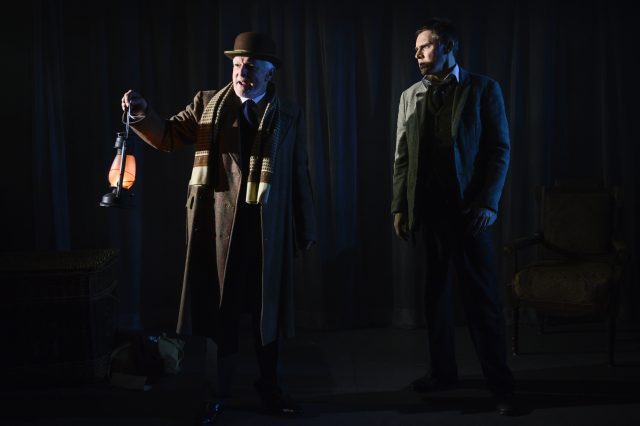
David Acton and Ben Porter reprise their London roles in New York debut of The Woman in Black (photo by Jenny Anderson)
The McKittrick Hotel
530 West 27th St. between Tenth & Eleventh Aves.
Wednesday – Monday through April 19, $85 mckittrickhotel.com
A few months ago, I finally gave in and saw The Perfect Crime, the mystery that’s been running in Manhattan since 1987 and features Catherine Russell; having racked up more than thirteen thousand performances in the same role, she’s now in the Guinness Book of World Records. Yet there was nothing special about it that made me understand its longevity. So it was with both trepidation and curiosity that I went to the New York premiere of The Woman in Black, which has been playing in London’s West End continuously since 1989. The two-act, 130-minute show is being staged in the McKittrick Hotel’s Club Car, the previous home of the National Theatre of Scotland’s fun, immersive drama The Strange Undoing of Prudencia Hart, among other presentations.
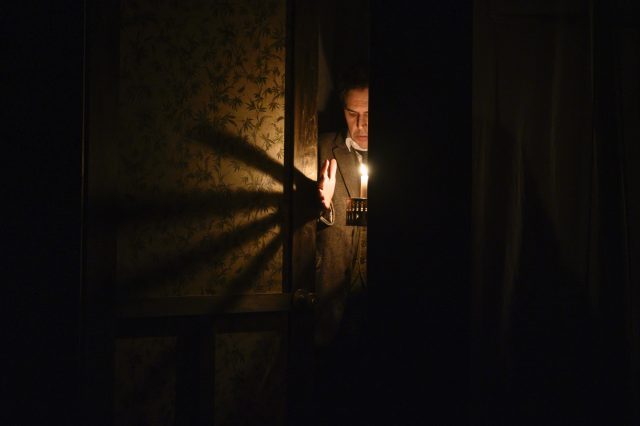
Adapted by Stephen Mallatratt from Susan Hill’s Gothic novel and directed by Robin Herford, The Woman in Black gets off to a slow start, establishing a play-within-a-play format that could use a jump to get things going. A finicky old man named Arthur Kipps (David Acton) has hired an actor (Ben Porter) to punch up a ghost story he has written, based on events that happened to him. “I recalled that the way to banish an old ghost that continues its hauntings is to exorcise it,” Kipps says. “Well, then. Mine should be exorcised. I should tell my tale. I should set it down on paper, with every care and in every detail. I would write my own ghost story, and then, that my family might know and that I might be forever purged of it, relive it through the telling. The first part, the writing, I have done. Now comes the telling. I pray for God’s protection on us all.”
Mr Kipps (Ben Porter) wonders what’s behind the locked door in Gothic drama at the McKittrick Hotel (photo by Jenny Anderson)
The first act introduces the audience to the setup: The old man has no sense of drama and repeatedly proclaims that he is not a performer, which is why he needs the Actor. (As in the script, Porter will heretofore be called Kipps, and Acton will be Actor.) In reciting the tale, the actor takes on the persona of Kipps as a young man, while Kipps juggles all the other roles, including a lawyer, a dapper gentleman with a dog, a landlord, a legal agent, and a carriage driver. Michael Holt’s set is spare, with a chair, a large wicker basket, and a curtain in the back that later reveals covered furniture behind it. Anshuman Bhatia’s lighting and Sebastian Frost’s sound play key parts in giving the show a bigger feel. Guests sit in chairs lined up in long rows; the bar features such cocktails as Woman in Black Punch, the Old McKittrick, and Mr Kipps. You can also have “Pie & a Pint”: a beer and a pub platter, pie & mash, or duck shepherd’s pie. A full dinner is available before the show.
The story that Kipps wants the Actor to tell is about himself as a young lawyer, as he travels to the end of nowhere, Eel Marsh House, for the funeral of a longtime client of his firm, the very much not-beloved Mrs Alice Drablow; in addition, he is to go through her papers to make sure her accounts are in order. As Kipps and the Actor play out the scenes, the latter often interrupts, concerned about how certain elements will be brought to life onstage. “There are so many things we cannot represent. How do we represent the dog, the sea, the causeway? How the pony and trap?” he asks. Kipps responds, “With imagination, Mr Kipps. Ours, and our audience’s.” He also notes that the unseen Mr Bunce will be using sound effects to further enhance the telling. The closer Kipps gets to Eel Marsh House, the creepier people act when they learn where he is going. And beware the Woman in Black, who’s liable to make you jump out of your skin.
The first act’s meta-discussion of stagecraft is repetitive and stodgy, but the show finally finds its groove in the second act, once Kipps arrives at his destination and dives into his research — and wonders what’s behind the locked door. After a bumpy beginning, the Actor settles into his responsibilities portraying numerous characters quite well while experiencing those long-gone days all over again. “I have a horror of it,” he tells Kipps. “Watching you, it is as if I relive it all, moment by moment . . . though you, of course, will never suffer as I did — I must always tell myself that.” Such is the nature of theater, which merely attempts to re-create and capture a sense of reality. There are plenty of scares as the denouement approaches; we were fortunate to have a screamer next to us, which was a bonus. Acton and Porter, who have performed the play in the West End, have an amiable camaraderie; Herford likes to keep things fresh, so he changes the cast in London every nine months (which is a far cry from the situation in The Perfect Crime). The Woman in Black is scheduled to run through March 8, but shows have a habit of extending at the McKittrick; Sleep No More has been playing there since 2011. [Ed. note: The Woman in Black has now been extended through April 19.] Of course, it looks like nothing will ever top The Mousetrap, the Agatha Christie show that has been running in the West End since 1952. Perhaps most important, The Woman in Black feels right at home in the Club Car, providing plenty of chills and thrills once the exposition gets out of the way.
THE WOOSTER GROUP: A PINK CHAIR (IN PLACE OF A FAKE ANTIQUE)
NYU Skirball Center for the Performing Arts
566 La Guardia Pl.
January 23 – February 2, $35-$50
212-992-8484 nyuskirball.org thewoostergroup.org
There are certain actors who just pull you in instantly; from the moment you first see them onstage, you’re hooked. For many, it might be Al Pacino or Nathan Lane, Audra MacDonald or Mary Louise Parker. Jim Fletcher is like that for a lot of intrepid, adventurous theatergoers. Tall, balding, and ruggedly handsome, the Ann Arbor native didn’t start acting until he was thirty-five, in 1998; previously he had been a teacher, a caseworker, a dogwalker, an art handler, and a pedicab driver, among other day jobs. For the past two decades he has performed extensively with some of the premier experimental theater groups in the city, most prominently Richard Maxwell’s NYC Players and Elizabeth LeCompte’s Wooster Group, in addition to collaborating with the art collective Bernadette Corporation. Among the shows Fletcher has appeared in are Elevator Repair Service’s Gatz, Maxwell’s Isolde, and Compagnie l’heliotrope’s Pollock.
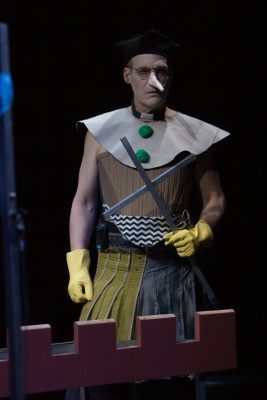
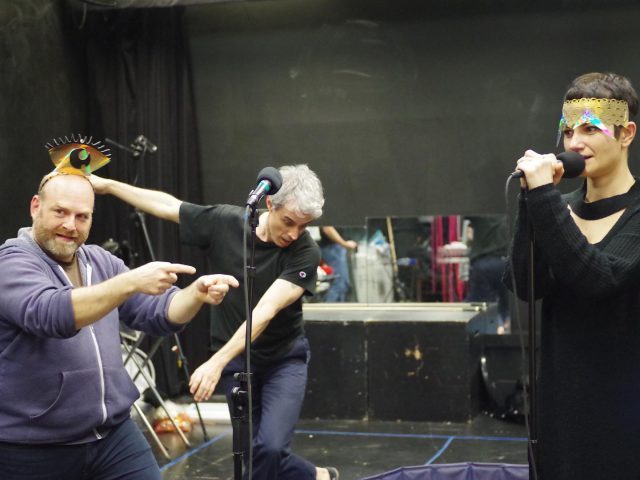
A poet as well, he’s also ridiculously busy; in the past few weeks, as we conducted this interview over email, he and Sean Lewis reprised Bro-Tox at La MaMa, he stopped by the Kitchen to check out Maxwell’s latest play, Queens Row, and he’s heavy into rehearsals for the Wooster Group’s A Pink Chair (In Place of a Fake Antique), which runs at the NYU Skirball Center January 23 through February 2. The production, which was previously seen at the company’s much smaller home, the Performing Garage in SoHo, is a tribute to Polish avant-garde theater director and artist Tadeusz Kantor, with Kantor’s daughter, Dorota Krakowska, serving as dramaturg. Fletcher plays a priest; there are some funny behind-the-scenes videos on the Wooster Group’s website in which he makes a cross and plays silly word games with the cast and crew. (The cast also features Zbigniew Bzymek, Enver Chakartash, Ari Fliakos, Gareth Hobbs, Andrew Maillet, Erin Mullin, Suzzy Roche, Danusia Trevino, and Kate Valk; to find out more about the Wooster Group, the Carriage Trade Gallery on Grand St. is hosting a multimedia retrospective of the company through January 26.) Below, Fletcher discusses, in his inimitable poetic style, his dream role, working with some of the most original creators in theater, and his carpentry skills.
twi-ny: I was at a lunch party a few months ago and got into a conversation with a woman about experimental theater. She burst out about how much she loves an actor named Jim Fletcher, and we proceeded to rave about various shows we’ve seen you in. It seems you have a cult fan club out there. How does that feel?
jim fletcher: It feels great. Please elaborate! Mind you, I’m going by what you’re saying. It sounds like there’s energy bouncing around. I love that. More. Surplus. Slurplus. You know, house rules. . . . There’s energy out there in the room, I love it too, I’m devoted too. Devotion is juicy.
twi-ny: Devotion is indeed juicy. You are part of several experimental collectives that have devoted fan bases of their own, primarily the New York City Players, the Wooster Group, and Bernadette Corporation. How did you get connected with them?
jf: I’m working with people I love. It seems I never asked myself what kind of work I wanted to do, and also never the follow-up question, who best to do it with. In that sense I’m not a productive person. I think when you get close to people, you spontaneously start working in some way . . . out of sheer energy or whatever it is. Surplus.
Jim Fletcher played Frankenstein’s monster in Tony Oursler’s Imponderable (photo courtesy Museum of Modern Art)
twi-ny: What are the main differences between working with Richard Maxwell and with Elizabeth LeCompte?
jf: It’s easier for me to say what they have in common. In both cases it’s deep water, bright, alive. Like swimming in the ocean. Limitless, often extremely simple. Always big. And buoyant. Potentially dangerous because there’s power and a lot of desire. I’ve been lucky to work with them both. Ever-fresh. Always something other than what I would have imagined.
With Rich, among so many other things (ongoing), I learned the practice of active listening in the room, with your body and with your subtle body for that matter . . . whatever body you can muster. Listening to time, listening to others, to minds, listening to story and to space, without withdrawing your energy or agency, your own reasons — what can that yield, where will it go? Honestly that’s something you can pursue for as many years and hours as you have available, with audience.
With Liz I saw the whole situation get put into motion. You get a little as if your feet are off the ground. Could go in any direction at any time. Dreaming of flight. Something’s gained in translation. Movement. And she employs very complex orchestration — of lighting, sound, voice. Language. Set design. Onstage behavior. Machinery. And yes, video. All indisputably unified by the principle of a single viewpoint, that of a person watching — specifically, of her watching. It’s quite thrilling. You know sometimes as a performer in these great stage architectures of hers I simply don’t get it until I see the videotape of us trying to do it. There’s no way to really perceive it or even imagine it from onstage.
twi-ny: For a nonproductive person, you seem to work nonstop in a wide variety of genres. Among the characters you’ve portrayed over the last few years are Jackson Pollock, Jay Gatsby, and Lemmy Caution. Do you have a dream character you’d love to play?
jf: When I was first getting to know the artist Tony Oursler, he asked me that same question over coffee, “What’s your dream role?” I said “Frankenstein,” meaning, of course, Frankenstein’s monster. Seems like a year later as I was going into his studio for a few hours’ work, his assistant Jack [Colton] said to me, “I think we’ll get you into the Frankenstein makeup first.” Total surprise. Zero preparation. No time to think about it. It was so much like a dream. And my text was a song that Tony had dreamed that night, “Spark of Life.” He’d woken up and recorded it as it had come to him and I listened to it several times while Enver Chakartash and Naomi Raddatz did a genius monster makeover on me, which took all of a half hour. Frankenstein the created being. I sang it into Tony’s camera and it was strange. When I finished he pulled his face from behind the monitor; there was a tear rolling down his cheek. The tear of Frankenstein.
twi-ny: Ah, that was Imponderable, which was the centerpiece of his big MoMA show. I saw him and Constance DeJong bring back Relatives at the Kitchen two years ago. You’ve been in numerous productions at the Kitchen, as well as La MaMa, Abrons Arts Center, and the Performing Garage. For the next two weekends, you’ll be at the Skirball Center with A Pink Chair, which was previously staged at La MaMa and REDCAT in LA. Skirball is doing amazing things under Jay Wegman. What has the process been like bringing A Pink Chair there?
jf: [Skirball director] Jay Wegman makes things flow. He makes a deal spontaneously, no head-scratching, and sticks to it. Sometimes you have to sort of check yourself and say, yes, he’s really doing this. You can feel the Wegman effect when you’re working inside the institution — it was like that at Abrons too when he was there. A lot of heart. A lotta lot. He doesn’t flinch. And he seems radically relaxed somehow.
Once I was meeting with him in his office at Abrons and I casually admired this or that thing on his wall or on the desk, to which he repeatedly replied, “Do you want it?” It was very disarming and somehow a challenge. A kind of destabilizing personal bounty. I think he was serious. That’s the wild effect he has. . . . He leaves you pondering that to yourself: “I think he was serious? . . .”
twi-ny: Have there been any major adjustments to A Pink Chair given the larger stage and much bigger house?
jf: The show is feeling great in Skirball. It was conceived on a large scale, so it looks at home here. Skirball is a great space. The crowds here somehow have a kind of living room feeling . . . rather than some kind of modeled civic space. It’s a civic space that’s not trying too hard to look like one. It just is one. Very comfortable. Not obsessed with being the last word in design.
But so many of the shows I’ve seen here look great! I have noticed as an audience member here that I feel I’m able to be in contact with people sitting all the way across the room from me. Not every theater has that. Is it the curved rows? The warm array of nipple-shaped glass lamps as ceiling lighting?
As far as adjustments, we are spending a lot of time getting the sound right. That’s a major adjustment for any new venue we go to. Liz plays the room like a hi-fi set.
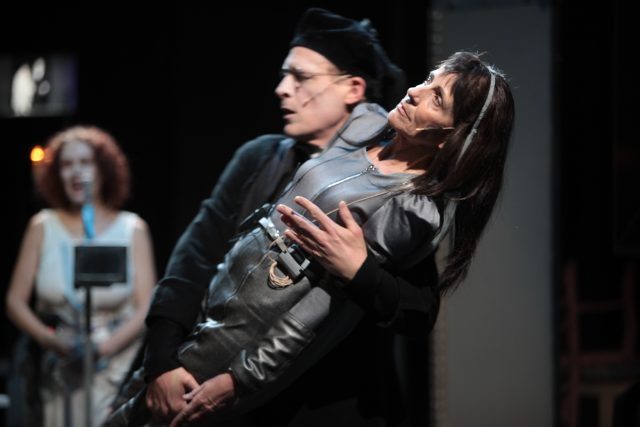
Jim Fletcher carries away Suzzy Roche in A Pink Chair (photo by Steve Gunther)
twi-ny: Speaking of being in the audience, when I am not in the audience watching you onstage, I often see you in the audience of other shows. What do you like to do on those rare occasions when you’re not in a theater?
jf: Burpees. Other stuff too. 🙂 Let’s spend some time together.
twi-ny: We’ll do so at Skirball, so getting back to A Pink Chair, can you talk a little about your character, the priest?
jf: About my character, I want to say up top, again: costumes by Enver Chakartash, in collaboration with Liz. When you swirl, it twirls. I have enough sense to know when a costume is doing the work for me, so I stay out of its way and let it do it.
The set is kind of like a territory, with different zones and thresholds, and a void, and a highly populated sector. In the most basic way I’d say A Pink Chair is a visit to the Underworld. A daughter (true story) engages a theater company (us) to help her go there to try to make contact with her father who was the great theater artist Tadeusz Kantor. How did we think to look there for him? That’s where he seemed to be headed in the final play he actually saw through to production, I Shall Never Return. The performers in A Pink Chair sometimes feel like pieces, subject to the zone they are in, and able to move in ways specific to each person. Mind you these are not explicit rules . . . it’s just how it has developed. Like laws of nature. What you’re seeing is a history of intelligent development . . . aimed at you, me, the unknown soldier, coming to see the show. My character the priest is one of those that is able to cross the void, for instance.
twi-ny: According to a behind-the-scenes video, it looks like you had a bit of a problem nailing your own cross; what are your carpentry skills like?
jf: I guess a crucifix is probably about the simplest thing you can make from wood. The rugged cross: Nail one piece of wood to another bisecting the smaller one, but not the larger one, at right angles. They say Christ was a carpenter. . . .
The Kitchen
512 West 19th St. between Tenth & Eleventh Aves.
Wednesday – Saturday through January 25, $20-$25
212-255-5793 ext11 thekitchen.org www.nycplayers.org
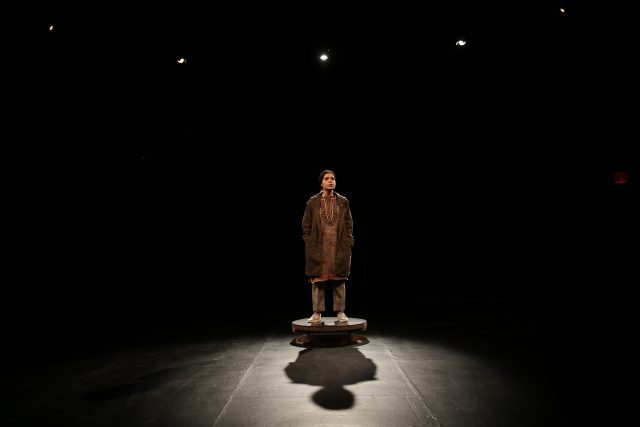
Experimental theater master Richard Maxwell’s Queens Row is a poetic meditation on loneliness in a postapocalyptic world. Continuing at the Kitchen through January 25, the sixty-minute show takes place in the Chelsea institution’s empty upstairs gallery space, a black box with an exposed sink area and a small balcony. The play consists of three monologues delivered by a trio of nonprofessional actors, sharing their characters’ deeply personal stories surrounding a shooting death, each woman somewhat more physical and emotional than the one before. First up is a woman (mixed-media artist Nazira Hanna) in a Native American-style top who is from the fictional town of Queens Row, Massachusetts; she stands stock-still on a small circular platform carved right out of the floor and lifted slightly by blocks of wood. Her words are cold and direct, her body rigid, as she announces, “I am a woman who had a child. I don’t have a name. I don’t have ID, and I never did, if you can imagine. There is no record of my fingertips or my eyeballs. . . . I was born and no one could stop that from happening. I had a child, and no one could stop that from happening. My son was killed, and no one could stop that from happening. And I exist in this place, asserting a certain right to exist, and to speak, and just like you, hopelessly existing.” She talks of a civil war, of riots “fueled by racism, xenophobia, foreign influence, class anger, and a simmering paranoia, hysteria on all sides.” The play was inspired by a dystopian dream Maxwell had, and her tale is like a nightmare, tinged with reality.
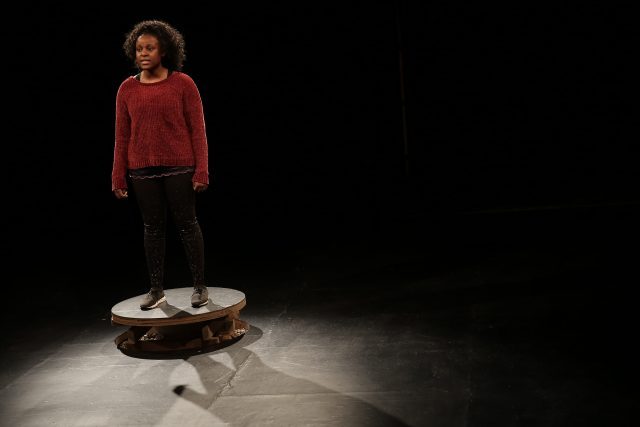
When she is done, she walks offstage through a door and is replaced by a second, younger woman (theater maker, facilitator, and PhD researcher Soraya Nabipour) from Odessa, Texas, wearing sneakers, black leggings, and a red sweater. She addresses a person no longer with us, bringing up seemingly random incidents from their past. “I string together memories as though it were some kind of lifeline,” she says. “Is it that we’re so much the same or that we need each other. We horrify each other but we’d die without each other, you know this, and you can’t stand it. Love is the thing you do when there’s nothing left to do. Love is the thing to do beyond words.” She is slightly more active although still appears confined, her past haunting her.
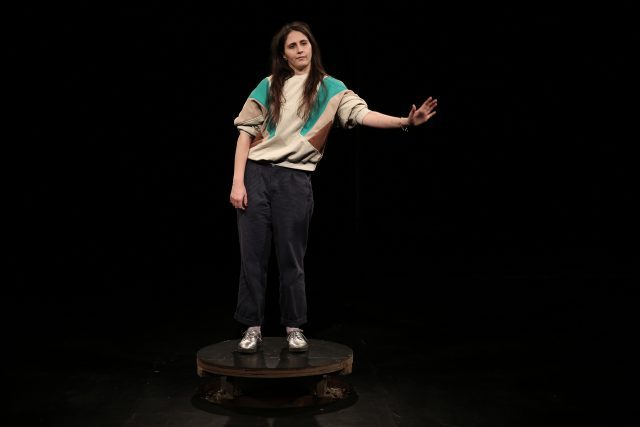
She is followed by a third woman (musician Antonia Summer, who recently trained at the National Youth Theatre in London) in a colorful shirt and long hair. She is from Las Cruces, New Mexico, and moves her body in herky-jerky ways that match her awkward speech patterns; she speaks as if she is learning language right in front of us. “t 6 d 5 6 s 5 6 e r r t s…………………… ient to fine a ja e, msrtik talking to …. pl this is right mao i, r;lorm r p & u.p.i. I,” she says before becoming understandable. “I get electrified with excitement when the towers which dot the horizon light up and connect together aligning that curve that arcs into me blasting my insides with light I am the offspring orphaned by fate and fatality My.” She talks of a father and a mother, of pain and desire, and asks, “whut is progeny?”
Written and directed by Maxwell, who previously presented The Evening,Natural Hero, and The End of Reality at the Kitchen with his NYC Players company, Queens Row is a gripping fantasy of a frightening near-future. Each character is circled above by a dozen lights, casting dramatic, often eerie shadows across the floor. (The set and lighting design is by Sascha van Riel, with costumes by Kaye Voyce.) The show isn’t so much a warning shot as an alternate reality that hovers just outside our purview; Maxwell includes several ghostly moments that are as scary as they are disconcerting. Hanna, Nabipour, and Summer — perhaps not uncoincidentally brown, black, and white — are each effective in her own right, the three of them interrelated by absence, implying how we all are connected in this dangerous universe, where dire actions have far-reaching consequences. As always with NYC Players, it is a challenging experience, told in uniquely Maxwellian style.
Experimental multimedia space opera lands You Are Under Our Space Control at La MaMa this week (photo courtesy Object Collection)
The Downstairs at La MaMa’s Annex
66 East Fourth St.
Thursday – Sunday, January 23 – February 2, $25
212-475-7710 lamama.org objectcollection.us
Brooklyn-based Object Collection returns to La MaMa this week after taking its Fugazi opera-in-suspension It’s All True to Norway, England, and Texas, with the utopian space opera You Are Under Our Space Control, making its world premiere January 23 – February 2. The company, whose “works upset habitual notions of time, pace, progression, and virtuosity. . . . [valuing] accumulation above cohesion,” goes on an adventure into the great unknown, exploring “space travel, transhumanism, astronautics, and the resurrection of the dead” in a world devoid of natural resources.
The show is written and directed by Object Collection cofounder Kara Feely, the text inspired by Sun Ra, the Russian Cosmists, and astronaut interviews; the music is by cofounder Travis Just, inspired by John Cage’s 1951 “Music of Changes.” The laboratory-like set design is by Peiyi Wong, with lighting by Jeanette Yew, video by Eric Magnus, sound by Robin Margolis, and streaming and programming by Scott Cazan. The multimedia piece will be performed by Steven Ali, Avi Glickstein, Yuki Kawahisa, Annie Kunjappy, Alessandro Magania, Daniel Allen Nelson, Nicolás Noreña, and Fulya Peker along with percussionist Shayna Dunkelman, guitarist Taylor Levine, and singer-songwriter Ava Mendoza. You can get a taste of what’s in store by checking out the music here, including such songs as “Full Contrast,” “Humans, Humans,” “Total Trance,” and “More Hospitable than Antarctica Might Be.” Once the run ends, video feeds will be posted online so you can create your own version of YAUOSC.
Timon (Kathryn Hunter) throws a feast fit for a queen in Timon of Athens (photo by Henry Grossman)
Theatre for a New Audience, Polonsky Shakespeare Center
262 Ashland Pl. between Lafayette Ave. & Fulton St.
Tuesday – Sunday through February 9, $90-$115
866-811-4111 www.tfana.org
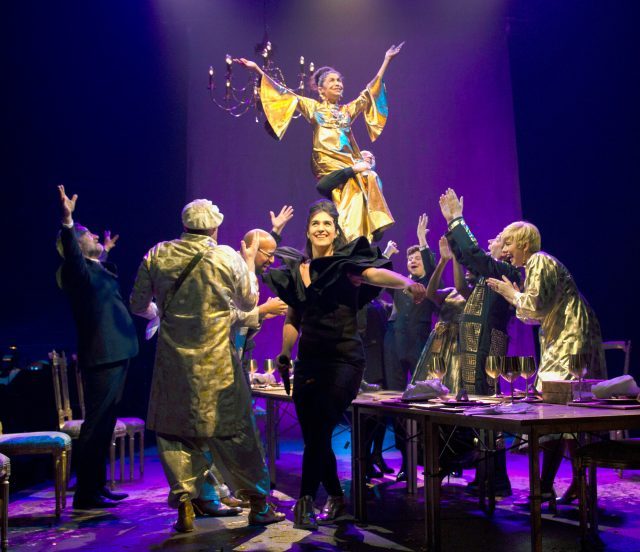
New York-born British actress Kathryn Hunter glitters and glows in William Shakespeare and Thomas Middleton’s Timon of Athens, which opened tonight at Theatre for a New Audience’s Polonsky Shakespeare Center in Fort Greene. Simon Godwin’s production, initiated at the Royal Shakespeare Company and presented here in association with DC’s Shakespeare Theatre Company, should become the gold standard for the rarely performed play, a penetrating and very funny evisceration of greed and true friendship centered around a lust for jewels above all things. The text has been edited by Emily Burns and Godwin to make the lead character female, and TFANA regular Hunter runs with it, delivering an unforgettable, voracious performance as Timon (rhymes with Simon), a widowed noblewoman who loves to host feasts in her mansion where guests bring her trinkets and flatter her to no end and she gives them piles of cash and valuable gems. Painter (Zachary Fine) gives her an absurd portrait, Poet (Yonatan Gebeyehu) heaps words of praise on her, and Jeweller (Julia Ogilvie) offers her a fine stone, and she recompenses them manyfold. Sempronius (Daniel Pearce) insists that Timon not allow one of her servants, Lucilius (Adam Langdon), to marry his daughter despite their being in love, but he changes his mind quickly when she promises him money as a kind of dowry/bribe.
Her loyal steward, Flavius (John Rothman), notifies her that her wealth is dwindling, and the cynical philosopher, Apemantus (Arnie Burton), warns her not to put her faith in these false friends, but she is too caught up in the revelry to pay attention. “I wonder men dare trust themselves with men, / Methinks they should invite them without knives — / Good for their meat and safer for their lives,” Apemantus, the only character not wearing shimmering black or gold but instead a Patti Smith T-shirt, tells the audience. A few moments later, after Timon asks him to be silent, he says, “So. / Thou wilt not hear me now; thou shalt not then. / I’ll lock thy heaven from thee. / O, that men’s ears should be / To counsel deaf, but not to flattery!” When she finally understands that her coffers are empty, she sends out Flaminia, Lucilius, and Flavius to Lucullus (Dave Quay), Sempronius, and Lucia (Shirine Babb), asking for loans, but the trio is cruelly denied. Furious at this drastic change of events, the formerly happy-go-lucky Timon turns her back on the life she so treasured and shared with others. “Nothing I’ll bear from thee / But nakedness, thou detestable town,” she says of Athens. “Take thou that too, with multiplying bans. / Timon will to the woods, where she shall find / Th’unkindest beast more kinder than mankind. / The gods confound — hear me, you good gods all! — / The citizens both within and out that wall, / And grant as Timon grows her hate may grow / To the whole race of mankind, high and low! / Amen.” In the second act, Timon, now in tattered rags, is a bitter woman who spends most of her days digging her own grave until she is discovered by visitors from her past, including Alcibiades (Elia Monte-Brown), who has become the leader of an angry mob protesting the Athenian government.
Timon of Athens is regendered in Simon Godwin’s glittering production at TFANA (photo by Henry Grossman)
Godwin’s sublime and timely interpretation of Timon of Athens addresses homelessness, income inequality, the dispossessed, an unsympathetic state, and humankind’s propensity for greed. Timon is a complex character, both antihero and cautionary figure of what can happen if wealth is all that matters and friends are available for purchase. I would say that Hunter is a revelation in the title role, but she’s been a revelation in almost everything I’ve seen her in, from Peter Brook and Marie-Hélène Estienne’s The Valley of Astonishment and Fragments to Hideki Nota’s The Bee and Colin Teevan’s The Emperor. Here she displays a ruggedly coarse physicality that is utterly majestic and downright enthralling, a force of nature unto itself, whether she’s being lifted by her sycophantic, hypocritical guests or carving her own epitaph. The glorious costumes, which range from ostentatious dresses to sleek black suits and, eventually, sackcloth and ashes, are by Soutra Gilmour, who also designed the impressive sets; the stage juts out far into the audience, who sit on three sides, with ramps leading off through two corners.
In the first act, opulence is on view, with a festive table, a large gold backdrop that serves as a doorway, and, later, a rug that apparently needs to be fastened more securely to the floor, as several actors tripped over different parts the night I went. The transformation to a forest for the second act is so dramatic you might want to stay in your seats and watch it instead of hurrying out for the restroom or a drink. At rear left, guitarist and bouzuki player Christopher Biesterfeldt, percussionist Philip Coiro, clarinetist Joshua Johnson, and singer Kristen Misthopoulos perform music by composer Michael Bruce, including one piece based on a Cretan peasant hymn and another from Shakespeare’s fifty-third sonnet. Monte-Brown and Rothman stand out in a strong cast, but it’s Hunter, who has previously portrayed King Lear, Richard III, and Cyrano, who will take your breath away while also making you wonder why you’ve never read or seen this play before.