this week in theater

OEDIPUS: Sex with Mum Was Blinding

(photo by Carol Rosegg)

Sound and image create a confusing cacophony in Elli Papakonstantinou’s OEDIPUS: Sex with Mum Was Blinding (photo by Carol Rosegg)

BAM Fisher, Fishman Space
321 Ashland Pl.
September 25-29, $30
718-636-4100
www.bam.org/oedipus

Shortly after Elli Papakonstantinou’s OEDIPUS: Sex with Mum Was Blinding begins, the sarcastic MC (Misha Piatigorsky), a cross between Joel Grey’s emcee from Cabaret and the Joker from Batman recently escaped from Arkham Asylum, brings up the topic of free will and declares, “Oh! Did I say? . . . You are not allowed to leave this room until this is over!” Not everyone inside BAM Fisher’s Fishman Space obeyed, as there were a handful of walk-outs during the ninety-minute production, but they would have fared better if they had stuck it out a little longer; while the first hour of this multimedia collaboration between the Athens-based ODC Ensemble and New York City’s the Directors Company is a chaotic mess, things improve significantly when Papakonstantinou, who is credited with the concept, stage direction, libretto, and lighting, turns her attention to the specific matter at hand: the tragic story of Oedipus (Lito Messini), his wife and mother, Jocasta (Nassia Gofa), and their children.

For much of the show, the audience has no idea where to look or what to listen to as ideas of responsibility, judgment, faith, and determinism are raised. A doctor (science adviser Manos Tsakiris) talks to a woman (Theodora Loukas) about a dream she had. A boy (Elias Husiak) can’t recognize his own face. A three-woman chorus (Anastasia Katsinavaki, Messini, Gofa) sings about riddles while wearing futuristic sci-fi helmets. Smoke drifts up from a tray of dry ice. A male-voiced Siri talks in mathematical equations. Audience members are practically forced to answer questions about their own image and relationship with their parents, then shout out four pieces of text that are in the program. And live footage of extreme close-ups of faces, hands, feet, and nostrils are projected onto a large rear screen along with shots of car traffic, causing yet more confusion. I was most riveted by the MC’s long, thin baton he used for conducting, hoping that, when he put it away in the front pocket of his shirt, it would not end up poking him in the eye. (This is Oedipus, after all.)

(photo by Carol Rosegg)

Misha Piatigorsky stars as a sarcastic piano-playing MC and conductor in OEDIPUS: Sex with Mum Was Blinding (photo by Carol Rosegg)

But then we reach Level Three and the actual story of Jocasta and Oedipus starts playing out onstage with the characters themselves (instead of being told to us in the third person), and we are lifted by Gofa’s lovely jazz phrasings and Messini’s beautiful soprano. The narrative suddenly wraps around us and we feel, for the first time, emotional resonance. The MC’s expert piano playing and co-composer Julia Kent’s splendid cello merge together in wonderful ways, as the earlier theories that were so much balderdash now make sense. It’s too bad this experimental Oedipus didn’t start off like this. “We are haunted by the myth of our potential,” the woman says, which could be about the show itself, the audience haunted by what could have been.

CAESAR & CLEOPATRA

(photo by Carol Rosegg)

Cleopatra (Teresa Avia Lim) and Caesar (Robert Cuccioli) share an intimate moment in Gingold production (photo by Carol Rosegg)

Theatre Row, Theatre One
410 West 42nd St. between Ninth & Tenth Aves.
Tuesday – Sunday through October 12, $69
gingoldgroup.org
www.theatrerow.org

Last week a friend of mine posted a photo on social media of his ridiculous view of the Gingold Theatrical Group’s presentation of Bernard Shaw’s Caesar & Cleopatra at Theatre Row; he was sitting behind a young man well over six feet tall, with a long neck, wide ears, and a topknot that added another six inches, blocking nearly two-thirds of the stage. My friend wasn’t missing much.

Written in 1898, Caesar and Cleopatra imagines a fictional meeting between Roman ruler Julius Caesar (Robert Cuccioli) and Egyptian queen Cleopatra (Teresa Avia Lim). Thirty years Cleopatra’s senior and far more versed in the ways of the world, Caesar is like Professor Higgins to her Eliza Doolittle. In fact, the play emerged out of an early draft of what would become Pygmalion. Caesar has arrived in Egypt ahead of his troops and at first does not believe that the young, whiny woman is who she claims to be; she doesn’t realize who he is as well. “Caesar’ll know that I’m a queen when he sees my crown and robes!” she declares. He responds, “He will know Cleopatra by her pride, her courage, her majesty, and her beauty.”

(photo by Carol Rosegg)

Politics takes center stage in Caesar & Cleopatra at Theatre Row (photo by Carol Rosegg)

But soon he is teaching her how to be a leader while she battles for control of Egypt against her brother, King Ptolemy, a puppet manipulated by his regent, Pothinus (Rajesh Bose). Caesar is joined by his humorless secretary, Britannus (Jonathan Hadley), and forthright military aide, Rufio (Jeff Applegate), while Cleopatra is nearly always accompanied by her mystical, protective nurse, Ftatateeta (Brenda Braxton). Later the dashing Apollodorus the Sicilian (Dan Domingues) devotes himself to her, but you’re unlikely to care by then.

Last year, Gingold turned the Lion Theatre into a London air-raid shelter during the Blitz for its scattershot version of Heartbreak House. The troupe is now back in the same space, renamed Theatre One after a renovation of Theatre Row, but they end up with the same unfortunate result. (Perhaps that specific room is doomed; I can’t remember the last time I saw something I liked in what was the Lion.) Director David Staller has done a deep dig into the history of the play, incorporating elements from letters, production notes, Shaw’s original handwritten manuscript, an early draft of the 1945 screenplay, and other sources, and perhaps that’s part of the problem; the show has no pace or rhythm. Brian Prather’s set is supposed to be an excavation site but looks more like unfinished scaffolding with plastic sheeting. It’s almost as if Staller, who has directed all of Shaw’s works, knows the play so well, and wanted to include so many unique touches, that he lost sight of the big picture. Cuccioli, as a smooth-talking superhero Caesar, and Lim, as a #metoo-era Cleopatra, never develop the necessary chemistry in choice parts previously played onstage and -screen by such pairs as Lionel Atwill and Helen Hayes, Cedric Hardwicke and Lilli Palmer, Hardwicke and Claire Bloom, Laurence Olivier and Vivien Leigh, Claude Rains and Leigh, Alec Guinness and Geneviève Bujold, Rex Harrison and Elizabeth Ashley, and Christopher Plummer and Nikki M. James. “We learn from history that we learn nothing from history,” Caesar says at one point. He’s more right about that than he realizes. If only “veni” and no “vidi”: Where was that tall guy with the topknot to block my view?

OEDIPUS: Sex with Mum Was Blinding

(photo by Elias Moraitis) OEDIPUS - Photos OEDIPUS

Elli Papakonstantinou’s multimedia, immersive adaptation of Oedipus Rex debuts at BAM this week (photo by Elias Moraitis)

BAM Fisher, Fishman Space
321 Ashland Pl.
September 25-29, $30
718-636-4100
www.bam.org/oedipus

Perhaps more than any other Greek tragedy, Sophocles’s Oedipus Rex lends itself to all kinds of adaptations. The violent tale of murder, suicide, incest, and self-mutilation has been turned into operas, films, oratorios, and plays in multiple languages around the world; among those who have tackled the 429 BCE work are Pier Paolo Pasolini (Edipo Re), Luis Alfaro (Oedipus El Rey), Toshio Matsumoto (Funeral Parade of Roses), Gabriel García Márquez (Edipo Alcalde), Ola Rotimi (The Gods Are Not to Blame), Peter Schickele (Oedipus Tex), Jean Cocteau (La Machine Infernale), Park Chan-wook (Oldboy), German comedian Bodo Wartke (könig ödipus), and many others, moving the story to South Central LA, the Philippines, Japan, Nigeria, Colombia, and even outer space.

 ( photo by © Karol Jarek)

Lito Messini stars as title character in OEDIPUS: Sex with Mum Was Blinding (photo by © Karol Jarek)

Greek avant-garde creator Elli Papakonstantinou transforms Sophocles’s play into an immersive hybrid opera for the multimedia OEDIPUS: Sex with Mum Was Blinding, running at the BAM Fisher September 25-29. The hundred-minute piece, a collaboration between the Athens-based ODC Ensemble and New York City’s the Directors Company, features a score composed by Tilemachos Moussas and Julia Kent and played live by Kent on cello, Misha Piatigorsky on piano, and Barbara Nerness on live electronics; real-time video by Hassan Estakhrian and Stephanie Sherriff, with cinematic environments by Sherriff; costumes by Jolene Richardson; and masks by Maritina Keleri and Chrysanthi Avloniti. Papakonstantinou, whose previous work includes Louisette: The Backstage of Revolution, Touching the Bottom of the Sea, and The Kindly Ones (at the Mauthausen Concentration Camp Memorial), is credited with the concept, stage direction, libretto, and lighting. Lito Messini stars as Oedipus, with Nassia Gofa as Jocasta, Elias Husiak as the boy, Anastasia Katsinavaki as Teiresias, Theodora Loukas as the woman, Misha Piatigorsky as the MC, and Manos Tsakiris as the researcher. Papakonstantinou developed parts of the show during a residency at Stanford’s Center for Computer Research in Music & Acoustics, where she worked with artists and scientists to address such questions as “Are we free?,” “Dο we experience free will?,” and “Are there real alternatives, or is all that takes place the outcome of necessity?” University of London professor Manos Tsakiris served as the scientific adviser for yet another unusual and original adaptation of this classic story.

MAC WELLMAN: PERFECT CATASTROPHES — BAD PENNY / SINCERITY FOREVER / THE INVENTION OF TRAGEDY

(photo by)

Kat (Emma Orne) points out some of society’s ills in strong revival of Mac Wellman’s Bad Penny at the Flea (photo by Allison Stock)

BAD PENNY
Flea Theater, the Pete
20 Thomas St. between Broadway & Church St.
Thursday – Monday through October 13, $17-$102
theflea.org

If there’s one thing to take away from the first three productions in the Flea’s five-play tribute to cofounder Mac Wellman, it’s to expect the unexpected. The seventy-four-year-old Cleveland-born Wellman, who started the Flea with Jim Simpson and Kyle Chepulis in 1996, eschews standard narrative conventions in his works, favoring unusual characters in unusual situations saying unusual things. You should kick off your Wellman adventure with 1989’s Bad Penny, a forty-five-minute site-specific piece originally staged in Central Park. Director Kristan Seemel has reimagined it for the Flea’s outdoor theater known as the Pete, a cramped space transformed by Jian Jung into a picnic area with a variety of chairs, tables, blankets, fake grass, and coolers. The oddball Kat (superbly played by Emma Orne) has picked up a tails-up penny and does not want it to ruin a perfectly fine day in the park, but she might not have a choice as she is joined by a group of ever-more-bizarre, surreal people who emerge from the audience. That person sitting next to you just might be the next actor to get up and pontificate on the state of the world; Emily White’s costumes are meant to mix them right in with us.

“I come here every day, every single day,” Kat says at the beginning. “I come here, to this spot, every single day and every single day, every single goddam day, it’s the same or it’s different or it rains or it’s clear or it snows or it’s bright and beautiful or it’s dark, rainy, and kinda foul. Or it’s like it is now, kinda strange. Sometimes the sky reminds me of home and sometimes the sky reminds me of the sea, or sometimes it doesn’t remind me of anything at all, much, and I pay no attention and sometimes the sky looks like its own reflection in an oily puddle of rain water, like nothing, nothing at all.” That covers about everything. Ray X (Joseph Huffman) is from Ugly, Montana, and is carrying a tire, looking for a gas station to fix his flat. Man #2 (Alex J. Moreno) thinks Ray X is crazy and a liar. Man #3 (Lambert Tamin) also doesn’t believe his story, accusing Ray X of being up to no good. Woman #2 (Bailie de Lacy) is suspicious of Kat, declaring, “There’s something the matter with you. Normal people don’t talk like you.” Meanwhile, a chorus of three women (Caroline Banks, Dana Placentra, and Katelyn Sabet) murmurs about the Dead Boatman of Bow Bridge (Ryan Wesley Stinnett), who just might be “coming to ferry the criminal to hell, the one who stole his penny, the one who thieved his bad penny, the one who thoughtlessly took what did not belong to him.”

(photo by)

Bad Penny takes place in the Flea’s outdoor space known as the Pete (photo by Allison Stock)

In Bad Penny, Wellman toys with audience expectations as monologues evolve into unpredictable diatribes, unfair judgments are made, and fear lurks close by. Performed by the Bats, the Flea’s resident company, the show features a mixed bag of acting, some good, some not so good, but it’s Wellman’s words, which he refers to as “objects,” that drive the story as he explores the mythology of the everyday and the “bad habits” we all “might acquire by hanging out with the wrong type of people, people not used to acting normal, people who act strange.” It’s an entertaining picnic in the park, enveloped in a warm and friendly weirdness that is as funny as it is intriguing and, well, strange. And yes, that actress is mimicking your movement.

(photo by)

The Bats revive Mac Wellman’s Sincerity Forever at the Flea (photo by Allison Stock)

SINCERITY FOREVER
Flea Theater, the Siggy
20 Thomas St. between Broadway & Church St.
Thursday – Monday through October 13, $17-$102
theflea.org

Wellman’s 1990 play Sincerity Forever presaged a key reason why Hillary Clinton lost the 2016 election to Donald Trump as well as predicting a defining moment in the latter’s presidency: Clinton’s use of the phrase “basket of deplorables” and Trump’s claim that there are “very fine people” among white supremacists, respectfully. However, what may have been satire thirty years ago now feels more like a tepid documentary, resulting in a show that falls flatter than some very fine conspiracy theorists believe the Earth to be. The sixty-five-minute play, which can be seen the same night as Bad Penny, takes place in the hellish contemporary American town of Hillsbottom, where white hoods and robes are standard wear. (The costumes are by Barbara Erin Delo, with the dark warehouse delivery set by Frank J. Oliva.) The story unfolds through a series of conversations local young folk, who would not be accused of being the brightest bulbs in the chandelier, have in cars, represented by side-by-side chairs pulled up to the very edge of the stage.

“Molly, do you know why God created the world the way he did? So complicated, I mean,” Judy (Malena Pennycook) asks Molly (Charly Dannis), who wonders, “Why else would we not know anything, unless there were an intelligent being out there, somewhere, whose cunning idea it was that you and I, Judy and Molly, should be forever ignorant of the true nature of things, ignorant forever in absolute sincerity. Does Dexter really have a crush on me, or did he just say he did?” With Jesus H. Christ (Amber Jaunai), appearing to them as a black woman with a metaphorical heavy bag, joining them, Tom (Vince Ryne) tells Hank (Nate DeCook), “Now me, I too, may be as dumb as a post, and unclear about the multiplication table, the boundaries of more than a half dozen states, and unable to repair my own toilet, but dammit, Hank, if the English language was good enough for Jesus H. Christ then it’s good enough for me. Furthermore, I do not feel compelled by reason to accept this theory of evolution, nor the periodic table of elements, nor the theory of global warming, nor the supposed crimes against the Jews attributed to one Rudolf Hitler. Nor the spherical nature of the earth, because it’s against the law of nature and we would fall off for sure and my motto is: Never explain, never apologize.”

(photo by)

Sincerity Forever features Klansmen, Furballs, Jesus H. Christ, and warehouse workers (photo by Allison Stock)

Others who share their thoughts are George (Peter McNally), Melvin (Alex Hazen Floyd), and a pair of furballs (Zac Porter and Neysa Lozano) who hate Hillsbottom and everyone in it, as the second one explains: “I mean, it’s all so fucking decent and god-fearing and goody-two-shoes and law-abiding and thankful and smarmy and sentimental and full of wishful thinking and sugar coated bad faith and chintzy, cheesy, boring mediocrity it makes me want to gag. I mean, all these totally square fuckheads who only care about God and family and communication and community and law and order and morality and safe sex and global warming and Jesus H. Christ and the whole moldy, worn-out crock of shit. It makes me want to spew and leave my lunch all over their well-manicured lawns.”

That may have played like acerbic wit in 1990, but in 2019 it hits a little too close to home and comes off as too-easy fodder. It’s all so clear and obvious, as well as repetitive; director Dina Vovsi is unable to add any nuance or legitimate conflict, so the narrative just stagnates, a bunch of vignettes about dumb racists saying dumb racist things without realizing it, its point long made as the characters go on and on until Jesus sums it all up in a grand finale. In his author’s note, Wellman — who dedicated the work to Sen. Jesse Helms, “for the fine job you are doing destroying civil liberties in These States” — takes a shot at the National Endowment for the Arts, which gave him a grant for the project but then demanded not to be credited because they had issues with the play. They’re not the only ones.

(photo by Hunter Canning)

Mac Wellman’s The Invention of Tragedy makes its long-awaited debut at the Flea (photo by Hunter Canning)

THE INVENTION OF TRAGEDY
Flea Theater, the Sam
20 Thomas St. between Broadway & Church St.
Thursday – Monday through October 14, $17-$102
theflea.org

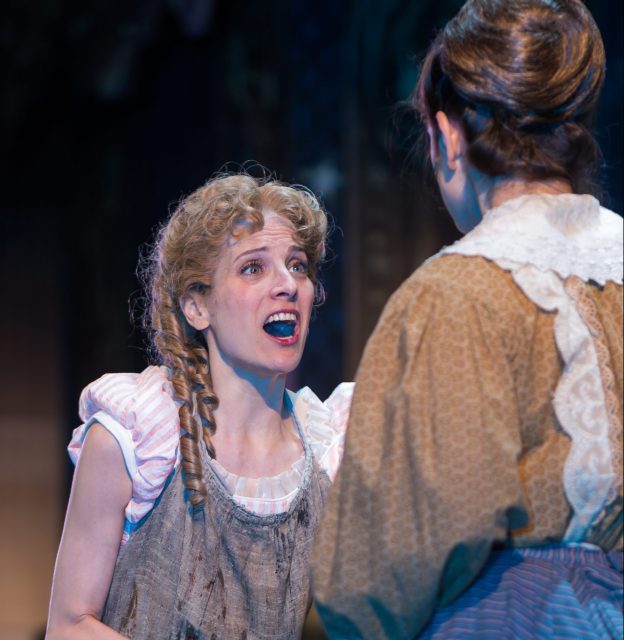
“Perfect Catastrophes” continues with the world premiere of Wellman’s The Invention of Tragedy, which was written in 2004 as a response to the Iraq War but is finally getting its debut staging appropriately during the Trump era, when fear of the other keeps gathering momentum, be it for a wall, a Muslim ban, an upsurge in hate crimes, undocumented workers being rounded up by ICE, refugee deportations tearing apart families, or “imagining a terrorist under every hat.” Running in the Flea’s Sam theater through October 14, the hourlong play uses elements of Greek tragedy mixed with the nonsense lyrical style of Lewis Carroll and Edward Lear and Kurt Schwitters’s “Ursonate” to skewer the America-first attitude that took over after 9/11 and runs rampant today. A chorus of seven young women (Sophia Aranda, Drita Kabashi, Mirra Kardonne, Susan Ly, Alice Marcondes, Ana Semedo, and Zoe Zimin) is disturbed when one of them, who becomes known as the Answerer (Kabashi), breaks away from the pack, followed shortly by the Enforcer, who morphs into the Hare (Ly). “This difference is a problem,” says the Narrator (Sarah Alice Shull), who offers details during each pause — or “paws,” as Wellman includes a never-ending stream of cat references — while playing a piano score by Michael Cassedy. Individuality is verboten in this world of mob mentality.

The second of a series of choruses chanted in unison declares in Orwellian groupspeak: “And chop the chails off all cats. The bird of alignment off to nuts grows grows a possum hell bore can’t do finger whole of a part yessir yessir yessiree at to on an island scamper way to benumbed fruitcake walk to lean to adventure whose whose which of the parterre o glad eyed speak, er, speech and say not to nothing but hinge grammaticus grammarye’s red boast o machine o machine break down de doom. O machine of the other the other imagining.” The chorus is troubled by the Answerer, as explained by the Narrator: “One step steps forth from the rest. Unlawfulness is revealed. Awfulness.” The chorus’s gobbledygook occasionally makes a more specific, understandable point as it soon adds, “Horror horror horror the world is broken broken and come to be fractured,” so the Enforcer is given an ax to take care of business.

(photo by Hunter Canning)

Trouble ensues when the Hare (Susan Ly) and the Answerer (Drita Kabashi) break away from the pack in The Invention of Tragedy (photo by Hunter Canning)

But the Answerer is not about to fall into line with everyone else. “I have become one for my own mind in thought,” she announces. “I perceive how cats have been mistreated in these parts. Fed with crap food. Despised and chased. Played cat in the bag with and other such. Dull the fur. I see them treed and often hopeless and puzzled. And then there is is the oft spoken threat of top er chop off the chails of. Er them.” Later the Hare, who previously was a sandwich man wearing “low and vulgar sandwich boards,” asks, “Is then the symbol the same as the thing symbolized?”

Adroitly directed by Meghan Finn with a keen sense of humor and choreographed by Chanon Judson, The Invention of Tragedy is a terrifically rendered allegory about post-9/11 America. It was written fifteen years ago but feels like it could have emerged today, particularly as partisanship rules the day and Fox News and Trumpists get behind nearly everything the president does and says. Dare to speak your own mind and you risk more than just your tail being chopped off. Wellman is telling us we are all trapped in a hellish fairy tale, albeit one with candy-colored costumes and an innate charm that is ultimately deceiving.

Mac Wellman (photo by Crystal Arnette)

Mac Wellman play series at the Flea also features a three-day symposium (photo by Crystal Arnette)

Up next in the Wellman festival are The Sandalwood Box and The Fez, presented together starting September 26. From October 4 to 6, the Flea will also host “The Art of Stacking the Deck: A Mac Wellman Symposium,” three days of panel discussions and performances with Wellman collaborators, protégés, and scholars.

Friday, October 4
Welcome Reception, 5:30

Saturday, October 5
Critical & Scholarly Discussion of Mac’s Work & Nontraditional Theater, with Kate Benson, Helen Shaw, Karinne Keithley Syers, and Anne Washburn, 10:00

Approaching Language in Mac’s Plays, with Claudia Brown, Meghan Finn, Jan Leslie Harding, David Lang, Paul Lazar, and Kristan Seemel, 11:30

Producing & Directing the Event in Mac’s Plays, with Elena Araoz, Kyle Chepulis, Meghan Finn, Anne Hamburger, Graham Sack, Kristan Seemel, and Maria Striar, 2:00

Performance of Terminal Hip, with Steve Mellor, 8:00

Sunday, October 6
Teaching and Learning Playwriting, with Eliza Bent, Erin Courtney, Kristine Haruna Lee, Young Jean Lee, and Sibyl Kempson, 10:00

A Conversation with Mac and Helen Shaw, 11:30

Performance of Terminal Hip, with Steve Mellor, 7:00

SUNDAY

(photo by Monique Carboni)

A group of close friends gather for their Sunday book club in world premiere at the Atlantic (photo by Monique Carboni)

Atlantic Theater Company
Linda Gross Theater
336 West 20th St. between Eighth & Ninth Aves.
Tuesday – Sunday through October 13, $66.50-$86.50
866-811-4111
atlantictheater.org

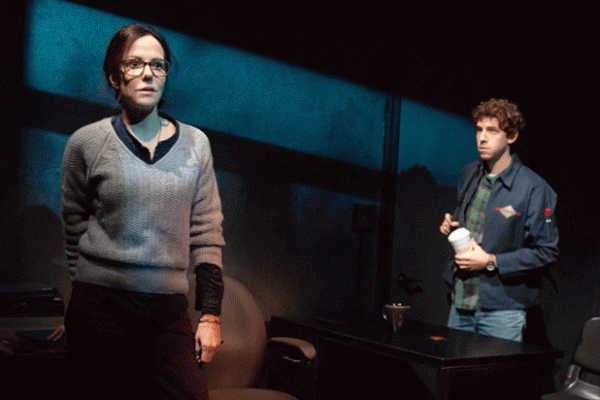
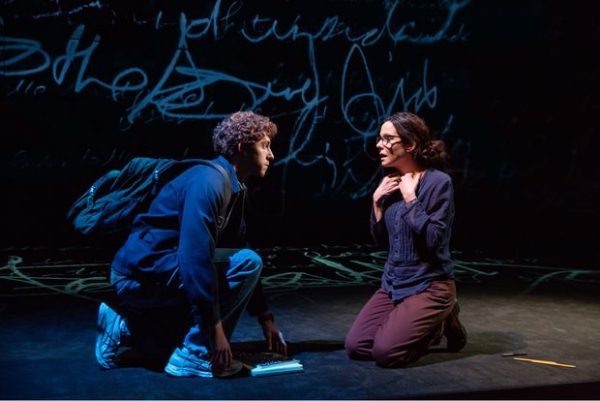
The first rule of book club should be: You do not talk about book club. Tony winner Jack Thorne has followed up his massive hit, Harry Potter and the Cursed Child, with the significantly smaller scale Sunday, an intimate drama, directed by Obie winner Lee Sunday Evans, set on a Sunday when a group of close friends meet for their book club. Self-obsessed millennials Alice (Ruby Frankel), Marie (Sadie Scott), Jill (Juliana Canfield), Keith (Christian Strange), and Milo (Zane Pais) have gathered in Jill and Marie’s cluttered New York City apartment supposedly to discuss Anne Tyler’s Dinner at the Homesick Restaurant but, much to Alice’s consternation, begin by talking about just about anything except the Pulitzer Prize winner’s classic work of fiction. Tyler’s book details a family’s survival after a father’s desertion; theatergoers may wish there were more than children in this narrative as well. It’s a memory play narrated by Alice, who at times sits in a high balcony in the back brick wall, watching the action as we are, sharing details about the characters and telling us about the “most defining moments” of their lives. “Marie is now twenty-four but everyone thinks she’s twenty-two,” Alice says. “She had to take two years off from college and rather than remember those years she’s decided they didn’t exist. She likes books, chicken, alcohol, her roommate, and the possibilities if not the reality of New York.”

(photo by Monique Carboni)

Downstairs neighbor Bill (Maurice Jones) shares his concerns with Marie (Sadie Scott) in Jack Thorne’s Sunday (photo by Monique Carboni)

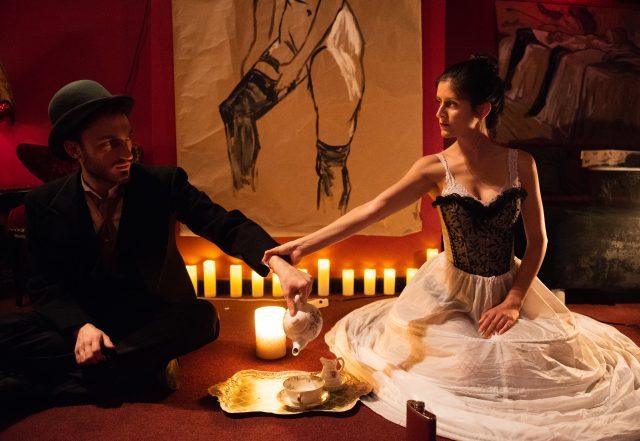
This kids are definitely home alone, and not really adults: Shortly before the book club meeting begins, Marie’s downstairs neighbor, an odd, awkward older man named Bill (Maurice Jones), comes by to tell her to keep the music down because he needs to get a good night’s sleep before work, something Marie wouldn’t know about, since her recent internship ended without the offer of a full-time job. Once the gang is together they discuss morality, trust, toxic masculinity, sincerity, sex, and whether they would relive their childhoods, which leads to some brutal battling. But it’s all nonsense spouted by self-absorbed twentysomethings wrestling with personal identity and self-pity, and it’s rarely dramatically compelling. The narrative occasionally stops, Masha Tsimring’s lighting shifts, and the characters break out into stylized dance movements choreographed by Evans to music by Daniel Kluger. It’s actually more exciting to see them facing their inner angst and demons this way than listening to them drone on about life and literature, which they do eventually get to. Brett J. Banakis’s set is centered by a mountainous wall of books, from Danielle Steel to David Foster Wallace; it also includes a working sink and toilet. The two scenes with Scott (Downtown Race Riot, CRSHD) and Jones (The Lifespan of a Fact, Linda) are the best in the play, especially the latter one, which has gorgeous moments, but Thorne (King Kong, The End of History) and Evans (Dance Nation, In the Green) can’t quite figure out how to conclude the play, which opened tonight at the Atlantic and runs through October 13. Of course, the second rule of book club is also: You do not talk about book club. And I’ve already said enough.

WIVES

(photo by Joan Marcus)

Diane de Poitiers (Aadya Bedi) and archrival Queen Catherine de’ Medici (Purva Bedi) fight over the affections of King Henri II (Sathya Sridharan) in Wives (photo by Joan Marcus)

Playwrights Horizons
Peter Jay Sharp Theater
416 West 42nd St. between Ninth & Tenth Aves.
Tuesday – Sunday through October 6, $49-$89
www.playwrightshorizons.org

Jaclyn Backhaus follows up her widely acclaimed Men on Boats and India Pale Ale, which earned her the Horton Foote Prize for Most Promising New American Play, with the world premiere of Wives, a disjointed, disappointing look at the women behind powerful men. The eighty-minute production, which opened Monday night at Playwrights Horizons, consists of four disparate scenes; the first three focus on the wives, ex-wives, and lovers of historical figures either near death or dead. In mid-sixteenth-century France, Queen Catherine de’ Medici (Purva Bedi), the wife of King Henri II (Sathya Sridharan), fights with his lover, Diane de Poitiers (Aadya Bedi), as he prepares for a jousting tournament, and the cook (Adina Verson) shares her secret for chopping onions. “Go to the larder and reach into a sack for a pair of yellow onions,” she says as if on a cooking show. “Find the ones that are not soggy because a soggy onion is a rotten onion and in sixteenth-century France a rotten onion will kill you.”

Four hundred years later, the recently deceased Ernest Hemingway (Sridharan) reads his own eulogy in Idaho, then his current and former spouses, Hadley Richardson (Purva Bedi), Martha Gellhorn (Aadya Bedi), and Mary Welsh (Verson), discuss various aspects of Big Ern’s life. “Don’t you just wonder like sometimes like how chewy and hot it would be to like be married to like such a thick slab of masculinity?” Martha says. “Just to like be tethered to a monolith that happens to be like the pinnacle of all manhood? But also, like, to own him? Like to be married is to be like property of someone but also like to own them is like the technical term. Sometimes I just totally fucking wondered what it would be for him to be mine. Well, he was mine for a time. It sucked.”

The action then shifts back to early-nineteenth-century Rajasthan, India, where hyper-moralistic British colonialist Aloysious Patterson (Verson) is spying on Maharajadhiraja Sawai Madho Singh II (Sridharan) to document his immorality with “his fave concubine, the noted witch Roop Rai” (Purva Bedi), despite being married to the Maharani (Aadya Bedi), who understands her husband’s needs and has no problem with his culturally acceptable visits to the zenana to seek additional sex partners. The Maharaja is ill and knows he is no longer in control. “Who are you dedicated to?” Roop Rai asks. “You,” the Maharaja answers. “Who do you serve?” she asks. “You,” he responds. “AGAIN!!” “YOU. YOU!!! You!!!”

(photo by Joan Marcus)

Maharajadhiraja Sawai Madho Singh II (Sridharan) seeks healing from Roop Rai (Purva Bedi) and his wife, the Maharani (Aadya Bedi), in world premiere at Playwrights Horizons (photo by Joan Marcus)

The first three acts don’t flow together smoothly but have smart, funny moments in this often slapstick battle of the sexes, but it all falls apart in a frustrating and tame finale. In my otherwise favorable review of India Pale Ale, I wrote, “The play is dragged down by late pedantic speeches by Deepa and Sunny that are wholly unnecessary, merely explaining what we’ve already seen.” I can say the same thing about Wives, which moves to the present, where Oxbridge junior Swarn (Aadya Bedi) arrives at a meeting of a commune of witches led by sophomore Clarisse (Verson) and overseen by a portrait of Virginia Woolf. When asked what she hopes to accomplish, Swarn says, “I want to untether myself from the visions made by men.” It’s an admirable desire that quickly devolves into dogmatic pretension. “We’re here to help you learn who you’ve been in order to help you see who you’ll be,” a character tells Swarn, seeking to empower her in clichéd and didactic ways.

Reid Thompson’s previous playful sets and Valérie Thérèse Bart’s adorable costumes now get serious and Margot Bordelon’s (Something Clean, Eddie and Dave) appropriately loosey-goosey direction becomes heavy-handed and unctuous as Backhaus is determined to make her point by driving it home over and over again. Wives began life as three separate plays, and the ending makes you feel that, anchored by a forced conclusion that preaches at an audience that the cast and crew have already won over.

FERN HILL

Close friends gather to talk about their future together in   (photo by Carol Rosegg)

Close friends gather to talk about their future together in Michael Tucker’s Fern Hill (photo by Carol Rosegg)

59E59 Theaters
59 East 59th St. between Park & Madison Aves.
Tuesday – Sunday through October 27, $75.50
212-279-4200
www.59e59.org

The Big Chill meets Cocoon and the Friends episode “The One Where Ross and Rachel Take a Break” in Michael Tucker’s wonderfully spry Fern Hill, which opened tonight at 59E59 in its New York City premiere. The play takes place at a farmhouse called Fern Hill, owned by Sunny (Jill Eikenberry) and Jer (Mark Blum). They have invited two other couples, longtime friends Billy (Mark Linn-Baker) and Michiko (Jodi Long) and Vincent (John Glover) and Darla (Ellen Parker), to celebrate the men’s milestone birthdays and also discuss the possibility of all six of them living together at the farmhouse, enjoying life and caring for one another as they face the inevitable: old age, sickness, and death. Jer, a philosopher and writer, is seventy that day; Billy, who is in a semi-successful classic rock band, will turn sixty the following week; and painter Vincent will hit the big eight-oh in a few months. The usually stoned Billy, always quick with a joke, refers to the three of them as “the father, the son, and the holy shit.” The six musketeers talk about wine, clam sauce, drugs, music, new hips, bourbon, art, and sex — they have a lot to say about sex, as the three couples are still getting busy in bed, apparently on a near-nightly basis. “What do you say, darling? Shall I bend you over the plow for a few minutes before we start dinner?” Jer asks Sunny.

One of the central questions is whether they will refer to their new living arrangements as an orphanage or a commune, almost as if they were children or young adults again. As Dylan Thomas wrote in his 1945 memory poem “Fern Hill,” which was published in his book Deaths and Entrances: “And as I was green and carefree, famous among the barns / About the happy yard and singing as the farm was home, / In the sun that is young once only, / Time let me play and be / Golden in the mercy of his means.” It’s all fun and games until an affair comes to light; the sexual betrayal has an immediate impact not only on that couple but on the future of all six of them. “How is it that we could be married for all these years and had sex — what? — fifty thousand times? — and still be so fucking dumb about it?” Sunny declares at the end of the first act.

(photo by Carol Rosegg)

A promising weekend turns sour for Jer (Mark Blum) and Sunny (Jill Eikenberry) in New York premiere at 59E59 (photo by Carol Rosegg)

It’s genuinely refreshing to watch six older, mature men and women discuss sex, sharing how often they get it and how good — or not so good — it can be. Not everyone is comfortable delving into the gory details, but these friends have long ago decided not to keep any secrets from one another, even about what’s going on under the covers, especially if they’re going to be spending their golden years together, living side-by-side-by-side. Jessica Parks’s kitchen set is charming and welcoming, and director Nadia Tass (Malcolm, e-baby) provides just the right gentle touches to Tucker’s (The M Spot, Living in a Foreign Language: A Memoir of Food, Wine, and Love in Italy) sharp dialogue. What could have been pompous and doctrinaire — listening to seemingly well-off drunk and high people theorize on how great their lives are — could have been torture, but instead it’s illuminating and insightful.

The chemistry among the stellar cast is superb, starting with Obie and Emmy winner Eikenberry (Lemon Sky, The Kid), Tucker’s wife and LA Law costar, whose vulnerability is the key to the drama, and she displays it beautifully, her youthful spirit intoxicating; a terrific Linn-Baker (Perfect Strangers, On the Twentieth Century) offers the comic relief, Obie winner Blum (Mozart in the Jungle, Gus and Al) is the dour naysayer, Long (Flower Drum Song, Long Story Short) is smart and alluring, Tony winner Glover (Smallville, Love! Valour! Compassion!) is as ineffable as ever, and Parker (The Heidi Chronicles, 20th Century Blues) is as steady as they come. It often feels like they’re six real friends hanging out, not six actors performing a fictional work to an audience. The ending is liable to lead to arguments about which characters are right, which are wrong, who gets off easy, and what will happen next; a few days after having seen the show, I’m still debating with the person I went with. And when theater can have that kind of an effect on you while also being vastly entertaining, it has more than done its job.