this week in theater

LITTLE SHOP OF HORRORS

(photo © Emilio Madrid-Kuser)

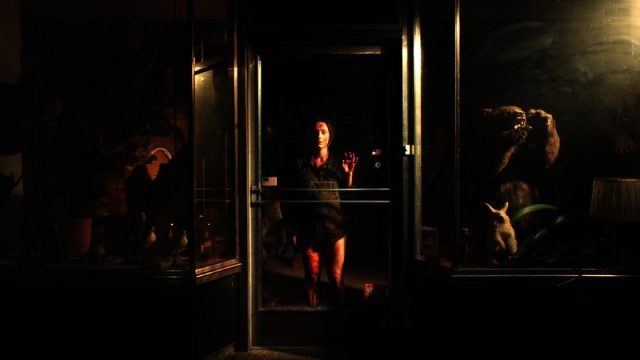
Seymour Krelborn (Jonathan Groff) suddenly discovers the bloody secret of Audrey Two in Little Shop of Horrors (photo © Emilio Madrid-Kuser)

Westside Theatre
407 West 43rd St. between Ninth & Tenth Aves.
Tuesday – Sunday through January 19, $69-$179
littleshopnyc.com

Little Shop of Horrors is back where it belongs, off Broadway, in Michael Mayer’s exhilarating adaptation continuing at the Westside Theatre through January 19. The 1982 satire of “science fiction, ‘B’ movies, musical comedy itself, and even the Faust legend,” as noted by book writer, lyricist, and original director Howard Ashman, debuted in 1982 at the WPA Theatre and soon moved to the Orpheum in the East Village, where it ran for more than five years. A smash hit that became one of the most-produced shows around the country, it was based on Roger Corman’s 1960 black-and-white comedy about a milquetoast floral assistant on Skid Row who is raising a rather odd plant. It was turned into a successful film by Frank Oz in 1986 and made it to Broadway — something Ashman, who died of AIDS complications in 1991 at the age of forty, was against — in 2003. But Mayer returns it to its roots (I know that phrase is part of the ad campaign, but it’s a darn good one), playing to sold-out houses in the Westside Theatre’s 270-seat upstairs space even though the star-studded musical easily could have done big business on the Great White Way.

Jonathan Groff is sweetly endearing as Seymour Krelborn, a schlemiel working in a failing flower shop on Skid Row owned by the gruff Mr. Mushnik (Tom Alan Robbins), who has raised the orphan Seymour since he was a child, although not with much love. Seymour pines for his coworker, Audrey (Tammy Blanchard), a squeaky redheaded bombshell who has an abusive boyfriend, black-leather-jacketed sadistic dentist Orin Scrivello (Christian Borle). The trio of Ronnette (Ari Groover), Crystal (Salome Smith), and Chiffon (Joy Woods) — yes, they are named for three popular 1960s girl groups, and they sing in that style — serve as a kind of Greek chorus, participating in some of the action as they hang out on a pair of grimy stoops. Mushnik is about to shut down the shop when a strange, unidentifiable plant that Seymour is nursing, which he calls Audrey Two (or Twoey), quickly becomes a local sensation; the store starts doing extremely well, and Seymour and Audrey’s drab existence is reinvigorated. The only problem is that Audrey Two, which is growing at an absurd rate, needs special food to survive: human blood. “Feed me,” Audrey Two, voiced by Kingsley Leggs, demands, not sounding at all like a destitute denizen of Skid Row.

(photo © Emilio Madrid-Kuser)

Orin Scrivello, DDS (Christian Borle) thinks he has Seymour (Jonathan Groff) just where he wants him in Michael Mayer adaptation (photo © Emilio Madrid-Kuser)

A riotous take on movies about monsters, aliens, and serial killers in addition to romantic comedies, Little Shop of Horrors is also a trenchant look at class and capitalism in post-depression America. The play is set on Skid Row, where bums sprawl out next to garbage cans and kids never finish school. When Mushnik asks the three girls how they intend to better themselves, they sing about their lack of hope: “You go downtown / Where the folks are broke / You go downtown / Where your life’s a joke / You go downtown / When you buy your token, you go — / Home to Skid Row . . . / Where the cabs don’t stop . . . / Where the food is slop . . . / Where the hop-heads flop in the snow!” It’s a far cry from the downtown lovingly portrayed by Petula Clark in 1965 (“The lights are much brighter there / You can forget all your troubles, forget all your cares . . . / Downtown, everything’s waiting for you.”)

Audrey desperately wants a traditional suburban life where she’s not poor and beaten down, physically and psychologically. “A matchbox of our own / A fence of real chain link / A grill out on the patio / Disposal in the sink,” she sings. “I’m his December bride / He’s father, he knows best / Our kids play Howdy Doody / As the sun sets in the West / A picture out of Better Homes / and Gardens magazine / Far from Skid Row / I dream we’ll go / Somewhere that’s . . . / Green.” It’s no coincidence that Audrey Two is green, offering them all a way out, although not the one they pray for.

(photo © Emilio Madrid-Kuser)

Seymour (Jonathan Groff) pines for Audrey (Tammy Blanchard) in Little Shop of Horrors (photo © Emilio Madrid-Kuser)

Two-time Tony nominee and Obie winner Groff (Spring Awakening, Hamilton) and Emmy winner and two-time Tony nominee Blanchard (Life with Judy Garland: Me and My Shadows, Gypsy) are adorable in roles originated onstage by Lee Wilkoff and Ellen Greene and onscreen by Rick Moranis and Greene. (The always terrific Gideon Glick will step in as Seymour from November 5 to 17.) It might not appear that Seymour and Audrey belong together at first, but then comes the beloved “Suddenly Seymour” and their love blossoms. Two-time Tony winner Borle (Peter and the Starcatcher, Something Rotten!) plays Orin and a bunch of other smaller roles with ketchup, mustard, and relish, devouring them with a sly wit, including several in just a few minutes, featuring hysterical, super-fast costume changes (the duds are by Tom Broecker) as Seymour and Audrey Two go viral the old-fashioned way, eons before social media and the 24/7 news cycle.

Tony winner Mayer (Hedwig and the Angry Inch, Spring Awakening) maintains a sweet intimacy, even as Audrey Two threatens to overtake Julian Crouch’s period set and the small theater itself. Ellenore Scott adds fun choreography harking back to 1960s pop; the puppet design is by Nicholas Mahon based on Martin P. Robinson’s original. The score, performed by an offstage four-piece band led by conductor and keyboardist Will Van Dyke, is chock full of nuggets, from the impossibly catchy title song and previously mentioned tunes to “Dentist” and “Da-Doo,” many of which will have you singing and dancing down the street afterward, which doesn’t happen often nowadays. “There will be a temptation to play it for camp and low-comedy,” Ashman, who also collaborated with Menken on Kurt Vonnegut’s God Bless You, Mr. Rosewater and the Disney animated films The Little Mermaid and Beauty and the Beast, explains in his author’s note in the script, adding, “When Little Shop of Horrors is at its most honest, it is also at its funniest and most enjoyable.” It’s hard to get rid of all the camp, but this Shop is nothing if not honest, funny, and most enjoyable.

PERFORMA 19

Sarah Friedland: CROWDS,

Sarah Friedland’s CROWDS will attract crowds at La MaMa as part of Performa Biennial

Multiple locations
November 1-24, free – $50
performa19.org/tickets

The eighth annual Performa Biennial kicks off today, celebrating the hundredth anniversary of the Staatliches Bauhaus, the German art school founded in 1919 by Walter Gropius that set in motion a major movement in art, architecture, and design around the world. There will be dozens of performances across disciplines, including film, dance, theater, music, installation, and unique hybrids, often incorporating architectural and sculptural elements, as well as conversations and panel discussions through November 24. The price for ticketed events range from $10 to $50, with most around $15-$25; among the highlights are artist Nairy Baghramian, dancer-choreographer Maria Hassabi, late modernist designer Janette Laverrière, and architect Carlo Mollino’s Entre Deux Actes (Ménage à Quatre), taking place on two floors of a Fifth Avenue town house; Lap-See Lam’s Phantom Banquet, a multimedia performance piece about ghosts and Chinese restaurants in Sweden; Pat’s You’re at Home, a one-night-only collaboration between Jacolby Satterwhite and Nick Weiss; Yvonne Rainer’s restaging of her seminal 1965 work Parts of Some Sextets, with new choreography and a recording of the original score; Huang Po-Chin’s Heaven on Fourth, which tells the story of a Chinese immigrant sex worker who committed suicide in Flushing in 2017; and the grand finale, Radio Voices, led by David J of Bauhaus and Love & Rockets with special guests Curse Mackey, Rona Rougeheart, Vangeline, and Heather Paauwe. But there are also dozens of free shows in cool locations, from museums and art galleries to outside on the street, most of which do not require advance RSVP; the full list is below.

Friday, November 1, 4:00 – 8:00
Saturday November 2, 4:00 – 8:00
Sunday, November 3, 2:00 – 6:00

Zakaria Almoutlak and Andros Zins-Browne: Atlas Unlimited: Acts VII–X, with the voices of Ganavya Doraiswamy and Aliana de la Guardia, 80 Washington Square East

Friday, November 1
through
Sunday, November 24

Ylva Snöfrid: Nostalgia — Acts of Vanitas, daily painting performance ritual, fifth-floor loft at 147 Spring St.

Saturday, November 2
Shu Lea Cheang, Matthew Fuller: SLEEP1237, Performa Hub, 47 Wooster St., 5:50 pm – 6:25 am

Gaetano Pesce: WORKINGALLERY, Salon 94 Design, 3 East Eighty-Ninth St., 2:00 – 4:00

Saturday, November 2
through
Sunday, November 24

Yu Cheng-Ta: “Fameme,” live and filmed performances about reality television, Wallplay, 321 Canal St.

Tuesday, November 5
Tara Subkoff: Deepfake, the Hole, 312 Bowery, 7:00

November 6, 13, 16, 20
Luca Veggetti with Moe Yoshida: From Weimar to Taipei (Roland Gebhardt-Mercedes Searer’s Selfdom, Luca Veggetti’s Fourth Character, Chin Chih Yang’s Black Hole, Rolando Peña’s Less Is More), WhiteBox Harlem, 213 East 121st St., 7:00

Thursday, November 7
Yahon Chang: Untitled, Performa Hub: Deitch Projects, 18 Wooster St., 5:00

Sarah Friedland: CROWDS, three-channel video installation of durational dance, La MaMa La Galleria, 47 Great Jones St., 6:00

Saturday, November 9
Pia Camil and Mobile Print Power: Screen Printing Workshop, Queens Museum, 1:00

Niels Bolbrinker and Thomas Tielsch: Bauhaus Spirit: 100 Years of Bauhaus, Goethe-Institut New York, 30 Irving Pl., 3:00

Duke Riley: Non-Essential Consultants, Inc., Red Hook Labs, 133 Imlay St., 6:00

LAP-SEE LAM, PHANTOM BANQUET, 2019. PRODUCTION STILL. COURTESY THE ARTIST AND GALERIE NORDENHAKE, STOCKHOLM.

Lap-See Lam’s Phantom Banquet takes place at Deitch Projects (photo courtesy the artist and Galerie Nordenhake, Stockholm)

Sunday, November 10
Glendalys Medina: No Microphone, Participant Inc., 253 East Houston St. #1, 4:00

Sunday, November 10, 17, 24
Glendalys Medina: The Shank Live, Participant Inc., 253 East Houston St. #1, 8:00 am

Monday, November 11
Nkisi: Listening Session, Performa Hub, 47 Wooster St., 6:00

Monday, November 11
through
Sunday, November 17

Dimitri Chamblas, Sigrid Pawelke: UNLIMITED BODIES, Performa Hub: Deitch Projects, 18 Wooster St., 12:00 and/or 1:00

Tuesday, November 12
Huang Po-Chih, Su Hui-Yu, Yu Cheng-Ta: “The Afterlife of Live Performance” Panel Discussion, Performa Hub, 47 Wooster St., 6:00

Adam Weinert: Monuments: Echoes in the Dance Archive, the New York Public Library for the Performing Arts, Bruno Walter Auditorium, 111 Amsterdam Ave., 6:00

Tuesday, November 12, 19
Glendalys Medina: Dear Me, Participant Inc., 253 East Houston St. #1, advance RSVP required, 4:00 – 9:00

Wednesday, November 13
Paul Maheke, Ligia Lewis, Nkisi: Levant, Goethe-Institut Cultural Residencies, Ludlow 38, 38 Ludlow St., 6:00

Thursday, November 14
The New Blockheads: The Brotherhood of the New Blockheads, the Mishkin Gallery, 135 East Twenty-Second St., 6:00

Friday, November 15
Bauhaus at the Margins: Gender, Queer, and Sexual Politics, Performa Hub, 47 Wooster St., 6:00

Heman Chong, Fyerool Darma, Ho Rui An, and Erika Tan: As the West Slept, Silver Art Projects, 4 World Trade Center, twenty-eighth floor, 7:00

Glendalys Medina: Dear Me, Participant Inc.,

Glendalys Medina’s Dear Me plays to one visitor at a time (photo courtesy the artist)

Saturday, November 16
“A School for Creating Humans”: Bauhaus Education and Aesthetics Revisited, Performa Hub, 47 Wooster St., 1:00

Sunday, November 17
Bodybuilding: Architecture and Performance Book Launch, including a lecture-performance by New Affiliates (Ivi Diamantopoulou and Jaffer Kolb), Performa Hub, 47 Wooster St., 4:00

Lap-See Lam in conversation with Charlene K. Lau, Performa Hub, 47 Wooster St., free with advance RSVP, 4:00

Tuesday, November 19, 6:00
through
Sunday, November 24, 8:00

Éva Mag: Dead Matter Moves, production of clay bodies, the Gym at Judson Memorial Church, 243 Thompson St., 1:00 – between 5:00 & 8:00

Tuesday, November 19, 6:00
Friday, November 22, 8:00

Torkwase Dyson: I Can Drink the Distance: Plantationocene in 2 Acts, multimedia performative installation, Pace Gallery, 540 West Twenty-Fifth St.

Thursday, November 21
Machine Dazzle, Narcissister and Rammellzee: Otherworldly: Performance, Costume and Difference, Aronson Gallery, Sheila Johnson Design Center at Parsons School of Design, 66 Fifth Ave., 6:00

Sarah Friedland: CROWDS — Conversation with Tess Takahashi, La MaMa La Galleria, 47 Great Jones St., 7:00

Thursday, November 21, 6:00
Saturday, November 23, 1:00 & 3:00
Sunday, November 24, 1:00 & 3:00

Tarik Kiswanson: AS DEEP AS I COULD REMEMBER, AS FAR AS I COULD SEE, featuring eleven-year-old children reading his writings, Alexander Hamilton US Custom House, 1 Bowling Green, free with advance tickets

Friday, November 22
Tarik Kiswanson: AS DEEP AS I COULD REMEMBER, AS FAR AS I COULD SEE: In Conversation with Performa Curator Charles Aubin, Performa Hub, 47 Wooster St., 5:00

Saturday, November 23
Cecilia Bengolea, Michèle Lamy: Untitled Performa Commission, featuring boxers and ballet, dancehall, vogue, and contemporary dancers, Performa Hub: Deitch Projects, 18 Wooster St., 4:00

Sunday, November 24, 8:00
Éva Mag: Dead Matter Moves — In Conversation with Camilla Larsson and Yuvinka Medina, the Gym at Judson Memorial Church, 243 Thompson St., 3:00

BAM NEXT WAVE: HAMNET / HE DID WHAT?

(photo by Ed Lefkowicz)

Dead Centre makes its BAM debut with Hamnet (photo by Ed Lefkowicz)

HAMNET
BAM Fisher, Fishman Space
321 Ashland Pl.
Through November 3, $25
718-636-4100
www.bam.org/hamnet
www.deadcentre.org

What is a son without a father? What is a father without a son? Those questions are at the heart of Dead Centre’s Hamnet, making its New York premiere this week at BAM. The sixty-minute multimedia show is part of new BAM artistic director David Binder’s inaugural Next Wave Festival consisting exclusively of BAM debuts, and this one is highlighted by a dynamite performance by Aran Murphy as the title character, in his professional acting debut. Murphy is a contemporary Hamnet, William Shakespeare’s only son, who died tragically in 1596 at the age of eleven. The boy is dressed in modern clothes, carries around a backpack, and regularly asks Google for information; it’s as if he’s been searching for his father, who abandoned him and his twin sister, Judith, and their mother, Anne Hathaway, in order to write his plays, for more than four hundred years. “To be, or not to be,” he declares several times, hoping that maybe his dad’s writings will help him find him.

Written and directed by Dead Centre founders Bush Moukarzel and Ben Kidd, Hamnet features a large screen at the back of the stage, where the audience is live-streamed through most of the show. Jose Miguel Jimenez’s innovative video design and Liv O’Donoghue’s choreography form a kind of magic as Hamnet roams Andrew Clancy’s set, sometimes disappearing onscreen even though he is right in front of us, or vice versa, and growing even more complex and eerie when the ghost of his father (Moukarzel) appears. The narrative at times becomes murky and confusing, but the technical wizardry and Murphy’s astounding portrayal overshadow its shortcomings. “Who would fardels bear, / To grunt and sweat under a weary life, / But that the dread of something after death, / The undiscovere’d country, from whose bourn / No traveller returns, puzzles the will, / And makes us rather bear those ills we have / Than fly to others that we know not of?” Hamlet asks. Hamnet is a hypnotic puzzle about death, grief, and personal identity, albeit one that is not easily unravele’d.

(photo by twi-ny/mdr)

BAM presents free animated street opera on building facade (photo by twi-ny/mdr)

HE DID WHAT?
Peter Jay Sharp Building
30 Lafayette Ave. at St. Felix St.
Through November 2, free, 7:00 – 10:00
718-636-4100
www.bam.org
www.dumbworld.co.uk

After seeing Hamnet, make your way around the corner to BAM’s main home, the Peter Jay Sharp Building, which houses the Howard Gilman Opera House, to catch the world premiere of Dumbworld and Irish National Opera’s He Did What? The ten-minute animated film, conceived and created by Brian Irvine and John McIlduff with video by Killan Waters and Conan McIvor, is projected onto the facade of the building at the corner of Lafayette Ave. and St. Felix St. The audience is given headsets through which they hear the hysterical story of three alter kockers with walkers parading slowly down the street, a man followed by two women. The two women are gossiping about him, as his wife recently caught him in bed with another woman and is deciding what to do about it. The characters are sung by Doreen Curran, Sylvia O’Brien, and Dan Reardon, with music composed by Irvine and played by the RTE Concert Orchestra, conducted by Fergus Shiel. The piece was written and directed by McIlduff; the riotous words also appear on the wall in goofy, graffiti-like type, complementing KAWS’s BAM mural and David Byrne’s bike rack across the street. While Hamnet will have you wondering, “How did they do that?,” the free presentation of He Did What?, running 7:00 to 10:00 nightly through November 2, will have you saying again and again, “He did what?” as well as “Oh no she didn’t. Oh yes she did.”

BELLA BELLA / A WOMAN OF THE WORLD

(photo by Carol Rosegg)

Kathleen Chalfant is radiant as Mabel Loomis Todd in A Woman of the World (photo by Carol Rosegg)

A WOMAN OF THE WORLD
59E59 Theaters
59 East 59th St. between Park & Madison Aves.
Tuesday – Sunday through November 17, $25-$35
212-279-4200
www.59e59.org

Currently two one-person shows about real women are running off Broadway, both with a feminist bent, both starring New York theater legends. Yet they could not be more different, one far superior to the other. At 59E59, five-time Obie winner Kathleen Chalfant is beautifully portraying Mabel Loomis Todd (1856–1932) in the Acting Company’s world premiere of Pulitzer Prize finalist Rebecca Gilman’s utterly delightful A Woman of the World. It’s 1931, and Todd is giving a lecture, “The Real Emily Dickinson,” at the Point Breeze Inn on Maine’s Hog Island. In the 1890s, Todd edited several collections of Dickinson’s poetry, published after the reclusive New England poet’s death in 1886 at the age of fifty-five, and Todd built a lucrative and unusual career around her association with Dickinson. Todd’s talk is supposed to be about Dickinson, but it ends up instead delving into Todd herself as she shares intimate stories about her own life, including her relationship with her husband, astronomer David Todd; her close friendship with Emily and her brother Austin; and her affection for Hog Island, much of which she owns.

(photo by Carol Rosegg)

Mabel Loomis Todd (Kathleen Chalfant) details her relationship with Emily Dickinson and her family in A Woman of the World (photo by Carol Rosegg)

“If you haven’t already, do step outside tonight and look at the sky. It’s one of those clear nights on Hog Island when the stars are so close you feel like you could reach out and touch Polaris,” she says wistfully. “And while you’re out there, listen closely and you’ll hear — well, besides the wind in the trees — and the waves on the rocks — which together comprise the most peaceful sound I know. . .” Margaret Montagna’s sound design includes chirping birds that add to the allure. Todd continually turns to her unseen daughter, Mrs. Millicent Bingham, who is signaling her from the back, particularly as her mother gets distracted and goes off topic, letting her personal biases and vengeful character show through, as well as her extreme self-aggrandizement. “I confess to you, it’s been something of a burden to me over the years that men have always found me impossible to resist. And it’s not because of anything I actively do to attract them,” she boasts. “It’s because the average man is rarely exposed to someone of my natural talents, and singular charm. When I was young, I was renowned for my beauty. But more than that, I was an accomplished artist.” There’s seemingly nothing Todd couldn’t do, and she wants the audience to know about it all.

But soon after she notes that “like all families, the Dickinsons had their secrets,” it’s the Todd family secrets that come pouring out, one after another, offering myriad surprises and more than a few shocks. Chalfant (Wit, Talking Heads) fully embodies the elegant and graceful Todd, wearing an ankle-length off-white dress with a long necklace and short hair like a second skin. (The costume is by Candice Donnelly.) She is captivating and beguiling as she slowly glides around Cate McCrea’s tiny yet cozy set, featuring a wooden bench, a pair of carpets, and two stacks of books on the floor, with framed pictures of plants on the wall and a window revealing clouds and sky. Gilman (Soups, Stews, and Casseroles: 1976; The Glory of Living) and director Valentina Fratti (Williston, R.U.R.) turn the 2019 audience at 59E59 into the 1931 crowd in the parlor at the Point Breeze Inn as we hang on Todd’s every word and movement, enraptured by the house of cards she has so carefully constructed. Todd was clearly ahead of her time, in more ways than one.

(photo by Jeremy Daniel)

Harvey Fierstein plays firebrand Bella Abzug in Bella Bella (photo by Jeremy Daniel)

BELLA BELLA
Manhattan Theatre Club
MTC at New York City Center
130 West 56th St. between Sixth & Seventh Aves.
Tuesday – Sunday through December 1, $99-$139
212-581-1212
www.manhattantheatreclub.com
bellabellaplay.com

Four-time Tony winner Harvey Fierstein pays tribute to another woman ahead of her time, Bella Savitsky Abzug (1920-98), in Bella Bella, an MTC production making its world premiere at New York City Center. Fierstein wrote the play, based on Battling Bella’s own words, and stars as the Bronx-born firebrand, an antiwar social activist, feminist, and lawyer who spent three terms as a US Congresswoman. It’s September 15, 1976, and Abzug is cooped up in the cluttered bathroom of a room at the Summit Hotel on West Fifty-Seventh St. while awaiting the returns in her Senate primary race against Daniel Patrick Moynihan. Her husband, Martin; daughters, Eve and Liz; sister, Helene; press secretary, Harry Holzer; and famous friends Shirley, Lily, and Gloria are all gathered outside the bathroom, cheering on the outspoken Abzug, who spends the time regaling the audience with anecdotes from her personal and professional life, focusing on how she has never backed away from a challenge.

“When I started this whole senatorial campaign,” she explains, “a pollster handed me a survey and was surprised when I threw it back in his face. ‘Would you vote for a woman if she was qualified?’ Now why the hell does a woman have to be qualified when a man only has to be a man?” Further regarding woman politicians, she declares, “We are not all good any more than all men are bad. But to my grave I will defend the right of a woman to be an unqualified asshole and still become president just like a man.”

(photo by Jeremy Daniel)

Harvey Fierstein wrote and stars in Bella Bella (photo by Jeremy Daniel)

The play is stuffed with such quotes, in addition to Yiddish phrases, and Fierstein (Torch Song Trilogy, Casa Valentina often mugs to the audience for extra laughs. It’s more like a series of gags than a compelling narrative. Fierstein first appears onstage silhouetted in the shower entrance, holding one of Abzug’s trademark large hats. The hat “kinda became my thing,” she later notes. “And the press, the only thing they wrote about was, ‘The hat. The hat. The hat.’ I finally said, ‘Anyone want to know what’s under the hat?’” But Fierstein puts away the hat after the beginning and chooses not to impersonate Abzug or her style; instead, he speaks like himself, and he wears a black shirt and pants, standing barefoot on the stage. (The costume is by Rita Ryack.) Thus, we’re all too well aware that we are watching Harvey Fierstein as Bella Abzug, a stark contrast to Kathleen Chalfant’s expert personification of Mabel Loomis Todd. Director Kimberly Senior (Disgraced, The Niceties) seems limited by John Lee Beatty’s busy set, which includes a stellar rendering of the facade of the Summit Hotel but nothing is done with it aside from a very brief, very tiny shadow of a person walking down the hall. Abzug was a central figure of life in New York City in the 1970s, a passionate leader and fighter, but Fierstein never grabs hold of the era or the woman, and neither do Caite Hevener’s period projections. We never get to know any more about what’s under the hat than we did when we came in, which is a shame, because there was no one else quite like Bella.

LINDA VISTA

Linda Vista (photo by Joan Marcus)

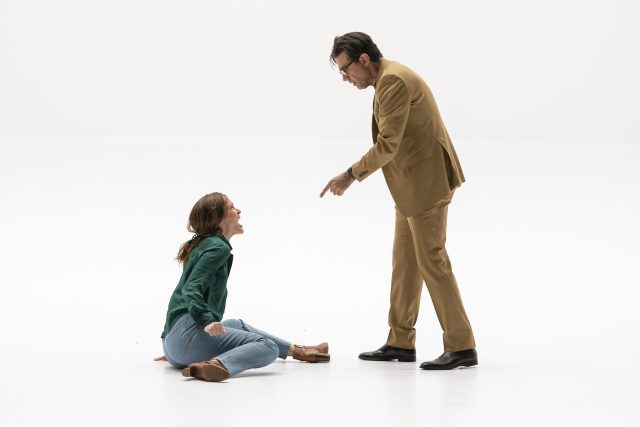
Dirty old men Wheeler (Ian Barford) and Michael (Troy West) can’t take their eyes off of Anita (Caroline Neff) in Linda Vista (photo by Joan Marcus)

Helen Hayes Theater
240 West 44th St. between Broadway & Eighth Ave.
Tuesday – Sunday through November 10, $79-$199
2st.com/shows/linda-vista

Tracy Letts details the midlife crisis of a fifty-year-old white man recognizing that life and love are passing him by in the darkly comic though ultimately unsatisfying Linda Vista, continuing at the Helen Hayes through November 10. The Pulitzer Prize–winning playwright (August: Osage County) and Tony-winning actor (Who’s Afraid of Virginia Woolf?) — the only person to earn both of those recognitions — started writing the play four years ago when he turned fifty and has incorporated many elements from his own life into the narrative. Let’s hope that most of what the main character, Dick Wheeler, broadly played by Letts’s onstage doppelganger, Ian Barford of August: Osage County, does to others is fictional.

Linda Vista (photo by Joan Marcus)

Paul (Jim True-Frost), Jules (Cora Vander Broek), Wheeler (Ian Barford), and Margaret (Sally Murphy) go on a double date in Linda Vista (photo by Joan Marcus)

Wheeler has just turned fifty and is going through a contentious divorce; he is moving into a San Diego apartment complex near the water with the help of his longtime friend Paul (Jim True-Frost). A former photojournalist, Wheeler put his lenses away long ago and has been working at a small camera shop run by Michael (Troy West), a slightly older man who lives with his mother and has never met a misogynist comment that was beneath him. They both have their eyes on Anita (Caroline Neff), a buxom young assistant who puts up with the verbal harassment because she needs the job. Paul and his wife, Margaret (Sally Murphy), set Wheeler up on a blind date with Jules Isch (Cora Vander Broek), a life coach who likes karaoke, and Wheeler is soon falling for her. Meanwhile, Wheeler, who has virtually no contact with his son, is helping take care of Minnie (Chantal Thuy), a pregnant Vietnamese American whose boyfriend skedaddled.

At both work and home, Wheeler starts making questionable decisions that jeopardize his happiness — if he can ever be happy. “Life is mostly disappointing,” he says to Anita. He is dour and cynical, whereas Anita is hopeful, Minnie is carefree, and Jules is forward thinking. “You have to learn to love the place you are,” Jules explains to him. His frame of reference — Ali McGraw, the Crypt Keeper, Mr. Coffee, New Coke — is a thing of the past. He’s a fervent believer in the truth — “I don’t lie,” he tells Paul — but he is living a lie, represented by his giving up documentary photography, which in theory captures reality, something he is ardently avoiding. He’s also a Stanley Kubrick fanatic; it’s no coincidence that Kubrick began his career as a street photographer and documentarian before making extraordinary fiction films. The number of Wheeler’s apartment is even 217, the room number from Stephen King’s The Shining where some bad things happen involving sex and aging. (The room number was changed to 237 for the Kubrick film.)

Linda Vista (photo by Joan Marcus)

Jules (Cora Vander Broek), Wheeler (Ian Barford), and Minnie (Chantal Thuy) discuss life, sex, and more in Tracy Letts play at the Helen Hayes (photo by Joan Marcus)

Unevenly directed by Dexter Bullard (Grace, Lady), Linda Vista features a terrific revolving set by Todd Rosenthal that rotates from apartment to camera store to bar or restaurant, evoking the circular nature of Wheeler’s life, going around and around but making no real progress. Barford (The Curious Incident of the Dog in the Nighttime, Letts’s The Minutes) is a natural for the role; he sounds and moves like Letts, who has appeared in such television shows and movies as Little Women, Homeland, Lady Bird, and The Sinner. But Letts, whose other plays include the wonderful Mary Page Marlowe and Man from Nebraska, has created a character so unlikable that you won’t want to spend much time with him — in this case, more than two and a half hours; in fact, all of the men have contemptible qualities, while the women are much smarter but still make implausible choices. Parenting is a key theme of the play; it’s probably best that several of these characters do not procreate. Barford and Vander Broek (All My Sons; Soups, Stews, and Casseroles: 1976) have steamy chemistry during their courtship, but it is only a brief respite from Wheeler’s annoying, self-destructive tendencies, and the same goes for the extremely graphic sex scenes. Letts has included snippets of Steely Dan songs throughout; in “Aja,” Donald Fagen sings, “Up on the hill / people never stare / They just don’t care.” At the end of Linda Vista, the audience cares — but judges, as well. And the verdict is not a favorable one.

BAM NEXT WAVE FESTIVAL: HAMNET

(photo by Ernesto Galan)

Dead Centre makes its BAM debut with Hamnet (photo by Ernesto Galan)

BAM Fisher, Fishman Space
321 Ashland Pl.
October 30 – November 3, $25
718-636-4100
www.bam.org/hamnet
www.deadcentre.org

New BAM artistic director David Binder continues his season of BAM debuts with Hamnet, presented by Ireland’s Dead Centre. In 1585, William Shakespeare’s wife, Anne Hathaway, gave birth to twins, son Hamnet and daughter Judith. Hamnet died tragically in 1596 at the age of eleven; three years later, the Bard wrote perhaps his greatest play, Hamlet, at least partly about a young man haunted by the death of his father. Founded in 2012 by Bush Moukarzel and Ben Kidd and based between Dublin and London, Dead Centre has previously staged Beckett’s Room, Lippy, (S)quark!, Souvenir, Chekhov’s First Play, and Shakespeare’s Last Play; all but Lippy deal with writers, including James Joyce and Marcel Proust in addition to Samuel Beckett, Anton Chekhov, and Shakespeare. It has long been debated whether Shakespeare wrote Hamlet specifically in reaction to the death of his son, or whether Hamnet also inspired part of other works. For example, in King John, published in 1623, Constance says, “Grief fills the room up of my absent child.”

“Over centuries of feverish speculation, the most compelling reflections on the presence of Shakespeare’s emotional life in his plays — preeminently, James Joyce’s brilliant pages in Ulysses, but there are many others — have focused on Hamlet,” Shakespeare expert Stephen Greenblatt wrote in 2014 in the New York Review of Books. “This biographical attention to a work deriving from recycled materials and written for the public stage would seem inherently implausible, were it not for the overwhelming impression on readers and spectators alike that the play must have emerged in an unusually direct way from the playwright’s inner life, indeed that at moments the playwright was barely in control of his materials. I will attempt in what follows to trace Hamlet back to a personal experience of grief and to sketch a long-term aesthetic strategy that seems to have emerged from this experience.” The sixty-minute multimedia piece, running October 30 to November 3 at BAM Fisher, features text and direction by Moukarzel and Kidd, with dramaturgy by Michael West, set design by Andrew Clancy, costumes by Grace O’Hara, lighting by Stephen Dodd, sound by Kevin Gleeson, video by Jose Miguel Jimenez, and choreography by Liv O’Donoghue. Aran Murphy plays Hamnet, addressing the audience directly as he shares his tragic tale.

ONLY HUMAN

(photo by Ahron R. Foster)

Only Human takes an unusual look behind the creation of people on earth (photo by Ahron R. Foster)

Theatre at St. Clement’s
423 West 46th St. between Ninth & Tenth Aves.
Wednesday – Monday through January 5, $39-$125
866-811-4111
www.onlyhumanmusical.com

During intermission of the new musical Only Human, which opened this week at the Theatre at St. Clement’s, a random fellow theatergoer approached me and said, “Well, that wasn’t as terrible as I’d expected.” But then we went back for the second act.

The main attraction of this world premiere production is the return to the stage of Oscar-nominated actor and musician Gary Busey — playing God. Stunt casting doesn’t get much better than that. The story begins in the early days of the planet, as God, in a casual suit, is in the process of creating the earth. He’s not quite an all-knowing, all-powerful supreme being but more of a doofy man-child with a support staff: the ambitious, self-obsessed Lou/Lucifer (Mike Squillante), the eager, talented, high-strung Maggie/Mary Magdalene (Kim Steele), and the slacker ne’er-do-well cursing druggie Jay/Jesus (Evan Maltby), the son of God. Lou has a detailed plan to put a new creature on the planet, humans, but everyone disagrees on just how to make them, arguing over the importance of free will, among other things. Lou is ultimately cast out of heaven and sets up shop in hell, leading to a second-act battle for the fate of the world.

(photo by Ahron R. Foster)

Lucifer (Mike Squillante) talks down to God (Gary Busey) in Only Human at the Theatre at St. Clement’s (photo by Ahron R. Foster)

First-time book writer Jess Carson and director NJ Agwuna can’t get a handle on the characters or the story, neither of which makes sense, requiring too many leaps of faith. “Who are you?” Lou and Jay ask each other in a duet; don’t ask me, because I have no idea. It’s impossible to figure out the motivations behind much of the action — and don’t even try to relate it to what is in the Bible itself. Time, space, and interpersonal relationships all are mixed up and regurgitated in head-scratching ways. The music and lyrics, by Squillante, lead singer of the band Running Lights, are mundane and clichéd, while Adrià Barbosa’s orchestrations and arrangements are tame and ordinary. Several of the songs in the second act are unnecessary reprises from the first act, adding nothing to the drama except slowing it down. One of the themes of the play is humanity’s “perfect imperfections,” but the musical’s imperfections are far from perfect. Everybody doesn’t always win; someone is going to lose.

A supernatural fight between God and Satan deserves much more excitement. Andrew Moerdyk’s set features a white wall in the back, the top right of which occasionally slides open to reveal God’s office, complete with computer, silly mottoes, and various ephemera. A gold ladder — a stairway to heaven? — allows the others to go up to meet with the supreme being, whom the script refers to as the boss. The ladder is occasionally wheeled around the stage as a prop, just for the heck of it; it’s always there, so why not use it, I guess.

The best part of the show by far are the minor angels played by Ben Bogen and Lili Thomas, who take care of menial tasks but also get to display their singing and dancing chops, making the most of Josue Jasmin’s limited choreography. Bogen brings down the house when he delivers a letter to Lou and really lets loose. But it’s impossible to not focus on the seventy-five-year-old Busey, a Texas native who started his career as a drummer before appearing in such films as Lethal Weapon, Point Break, and The Buddy Holly Story; he also performed in South Pacific and A Midsummer Night’s Dream eons ago. Busey suffered a serious motorcycle accident in 1988 and a drug overdose in 1995, leading to his participation on Celebrity Rehab in 2008. You spend much of the show hoping he doesn’t make any major mistakes, and he doesn’t, although he also doesn’t reveal much depth. He clasps his hands together a lot, repeatedly opens his eyes wide, and makes eye contact with as much of the audience as he can, bringing us into his corner as we root for him. He even sings near the end, but it’s not like the old days. Alas, we are all only human, every one of us, imperfections be damned.