this week in theater

JUDGMENT DAY

(photo by Stephanie Berger)

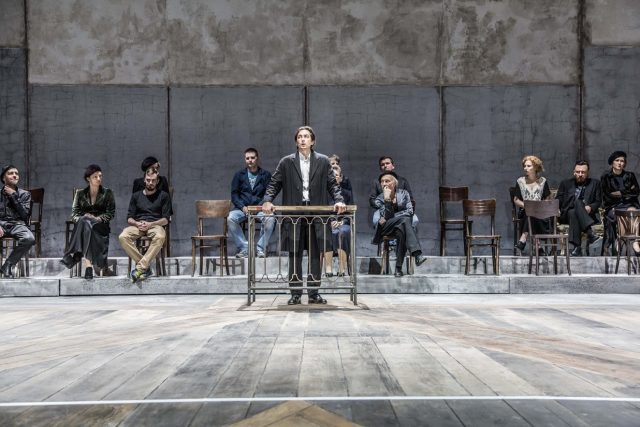
Stationmaster Thomas Hudetz (Luke Kirby) salutes as train passes by in Judgment Day (photo by Stephanie Berger)

Park Ave. Armory, Wade Thompson Drill Hall
643 Park Ave. at 67th St.
Monday – Saturday through January 10, $55-$195
212-933-5812
www.armoryonpark.org

In his 1936–37 work Judgment Day, Austro-Hungarian novelist and playwright Ödön von Horváth warns of the rise of fascism in Germany, comparing it to a speeding train approaching a station that has no idea it’s coming. That’s the central motif in Richard Jones’s admirable if uneven new production, adapted by Christopher Shinn, that opened today at Park Ave. Armory for a run through January 10. Jones, who presented a fierce version of Eugene O’Neill’s The Hairy Ape at the armory in 2017, once again makes unique use of the building’s vast Wade Thompson Drill Hall; Paul Steinberg’s set features oversized, flat, painted plywood trees around the back, sides, and corners and two giant, movable blocks of unpainted wood, like a child’s toys, one in the shape of an arch, the other flat and angled like a stray wall from The Cabinet of Dr. Caligari. Mimi Jordan Sherin’s stark lighting creates distinct reflections on the shiny black floor, like the characters’ souls on display.

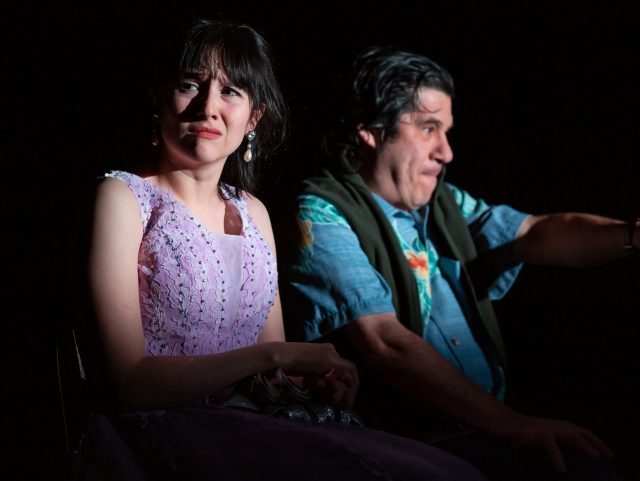
It’s the 1930s, and a lumberjack (Andy Murray), the gossipy Frau Leimgruber (Harriet Harris), and a traveling salesman (Jason O’Connell) are waiting for a local train. Stationmaster Thomas Hudetz (Luke Kirby) emerges only to ring the signal bell, standing at attention and saluting as the express roars by, thrillingly portrayed by Drew Levy’s immersive sound design and the actors’ dramatic reactions. After seeing off her fiancé, butcher Ferdinand (Alex Breaux), ingénue Anna (Susannah Perkins) teases the straitlaced Hudetz as his shrewish wife, Frau Hudetz (Alyssa Bresnahan), watches from above. Anna makes an unexpected and unwelcome move, beginning a chain of events that leads to the death of eighteen people, including a track worker (O’Connell) and train driver Pokorny (Maurice Jones) but leaving a witness, stoker Herr Kohut (George Merrick).

(photo by Stephanie Berger)

Paul Steinberg’s set features two large movable wooden structures (photo by Stephanie Berger)

A policeman (Charles Brice) and detective (Joe Wegner) arrive to find out what happened, but falsehood, deception, and long-simmering desires and grievances soon boil over. “I’m telling the truth! I swear to everything!” Frau Hudetz argues. Frau Hudetz’s brother, pharmacist Alfons (Henry Stram), becomes an outcast even after he disowns his sister. “Everything is connected,” he insists, but no one is listening to him. Guilt and mob mentality tear at the fabric of this small community, resulting in yet more death and destruction. “People are so fickle,” waitress Leni (Jeena Yi) says. “Who gives a shit about people,” Hudetz responds.

(photo by Stephanie Berger)

Paul Steinberg’s set steals the show in new production at Park Ave. Armory (photo by Stephanie Berger)

Jones’s staging often makes the characters look like little figures in a dollhouse, dwarfed by the two wooden blocks, as if they’re being manipulated by unseen forces. In his sharp uniform (the costumes are by Antony McDonald) and direct speech, Hudetz resembles a Nazi. “I was always a diligent official!” he says over and over, reminiscent of what would later become the Third Reich excuse “I was only following orders.” Judgment Day is a biting indictment of prewar German morality, written by Horváth after he had fled Germany and shortly before he died in Paris when struck by a tree branch during a thunderstorm at the age of thirty-six. The parable can’t quite carry the weight of the production through its ninety minutes, drifting between Expressionism and realism while evoking the style of Bertolt Brecht and a streamlined Robert Wilson, sometimes getting stuck in between. But there are numerous breathtaking moments as Jones (Into the Woods, The Trojans), Shinn (Dying City, Where Do We Live), and Horváth (Tales from the Vienna Woods, Youth without God) take aim at the spread of fascism and groupthink, in the 1930s and now.

HALFWAY BITCHES GO STRAIGHT TO HEAVEN

(photo © Monique Carboni)

Stephen Adly Guirgis’s Halfway Bitches Go Straight to Heaven features another large cast of well-drawn characters (photo © Monique Carboni)

Atlantic Theater Company
Linda Gross Theater
336 West 20th St. between Eighth & Ninth Aves.
Tuesday – Sunday through December 29, $81.50
866-811-4111
atlantictheater.org

New York City native Stephen Adly Guirgis has spent much of his career creating wickedly funny, socially relevant plays set in minority communities where the underrepresented, the underserved, and the marginalized confront religion, law enforcement, poverty, racism, systemic institutions, and family dynamics as they battle against a system set up to keep them down. Most of his plays, including Our Lady of 121st Street, In Arabia, We’d All Be Kings, and The Little Flower of East Orange, feature large ensembles that form tight-knit communities onstage. Such is the case with Guirgis’s return to the Atlantic, where his Pulitzer Prize-winning play, Between Riverside and Crazy, debuted in 2014, with the world premiere of the fiendishly hilarious and hard-hitting Halfway Bitches Go Straight to Heaven, which opened last night at the Linda Gross Theater.

(photo © Monique Carboni)

A woman’s residence is the setting for new play by Pulitzer Prize winner Stephen Adly Guirgis (photo © Monique Carboni)

The three-hour LAByrinth Theater coproduction, which flies by with one intermission, takes place in Hope House, a government-funded women’s residence for addicts, the abused, the mentally ill, and survivors of domestic violence. It is run by the strict, serious Miss Rivera (Elizabeth Rodriguez) and Nigerian social worker Mr. Mobo (Neil Tyrone Pritchard). Among those who find shelter at the home are the tough-talking Sarge (Liza Colón-Zayas); her single-mother girlfriend, Bella (Andrea Syglowski); teenage poet Little Melba Diaz (Kara Young); the foul-smelling Betty Woods (Kristina Poe); ex-con Queen Sugar (Benja Kay Thomas) and her bestie, Munchies (Pernell Walker); the lonely, alcoholic Rockaway Rosie (Elizabeth Canavan); the wheelchair-bound rule-breaker Wanda Wheels (Patrice Johnson Chevannes); the trans Venus Ramirez (Esteban Andres Cruz); and the twentysomething Taina (Viviana Valeria), who takes care of her mentally ill mother, Happy Meal Sonia (Wilemina Olivia-Garcia). Also on the staff are eager white millennial social worker Jennifer (Molly Collier); ex-con janitor Joey Fresco (Victor Almanzar); and Father Miguel (David Anzuelo), who has a dark secret in his past. Seventeen-year-old Mateo (Sean Carvajal), whose mother is staying at the home, often helps out, allowed to hang around as the women share their often very private concerns about their troubled lives.

Narelle Sissons’s bilevel set consists of the main gathering room, a stoop, an outdoor bench, a dark alley, a balcony, and a concrete front space where the residents gossip and drink and smoke in defiance of the regulations. LAByrinth artistic director John Ortiz (Guinea Pig Solo, Jack Goes Boating) infuses the proceedings with tremendous vitality as Guirgis’s well-developed characters fight for survival. Taina has a chance to go back to school but is terrified of leaving her mother. Venus insists on staying even though several residents cruelly reject her claim to female identity, accusing her of unfairly invading their safe space. Father Miguel jostles with a man (Greg Keller) who demands to see his wife, who has a restraining order against him. Miss Rivera isn’t sure that Jennifer has what it takes to deal with the residents, who can be harsh and unforgiving. Wanda Wheels seems determined to drink herself to death. And at the center of it all is Sarge, superbly played by Guirgis regular and Tony nominee Rodriguez (Orange Is the New Black, The Motherf**ker with the Hat). A veteran with PTSD, Sarge is fierce and unrelenting, quick to brutally insult people, especially Venus and Betty, but she sometimes lets her more tender and loving side show through. She tells Bella, “I commanded a platoon. I survived combat. Kept my people safe. Took care of the villagers as much as I could. I looked death in the eye — twice — and I didn’t flinch. I can do this, Bella. I can do this with you. If you let me.” Sarge approaches her life like she’s embroiled in a never-ending war, which is true of many of the women living there.

(photo © Monique Carboni)

Ex-cons Queen Sugar (Benja Kay Thomas) and Joey Fresco (Victor Almanzar) face off in Halfway Bitches Go Straight to Heaven (photo © Monique Carboni)

The title comes from a poem Little Melba Diaz reads that sums up much of what the play is about, the difficulties and challenges these women can’t break free from: “Halfway Bitches go straight to Heaven / I ex-caped foster care and met a boy named Kevin / He was the apple of my eye but nigga turned into a lemon . . . No money in my pocket, I was feeling kinda low. . . . Words are turds and rhymes are crimes / Memories mere summaries, / Though I might some day share some of these,” she declares. Despite getting a little syrupy as it winds down, Halfway Bitches Go Straight to Heaven is another deeply affecting, honest, and gutsy work that lays bare the lives of too many women who rightfully doubt there’s any light at the end of the tunnel for them.

ONE NOVEMBER YANKEE

(photo by Matt Urban at NüPOINT Marketing)

Harry Hamlin and Stefanie Powers play a trio of siblings in One November Yankee (photo by Matt Urban at NüPOINT Marketing)

59E59 Theaters
59 East 59th St. between Park & Madison Aves.
Tuesday – Sunday through December 29, $75.50
212-279-4200
www.59e59.org

Writer-director Joshua Ravetch’s One November Yankee is literally and figuratively about flying, but the Delaware Theatre Company production, making its New York City debut at 59E59 with Harry Hamlin and Stefanie Powers, never gets off the ground. As the audience enters the theater, the sound system plays pop songs about air travel, and a small screen at the upper left shows videos of early, mostly comedic attempts to soar through the sky. Dana Moran Williams’s set is primarily the remains of a full-size yellow single-engine Piper Cub plane nose down, one of the wings badly damaged. Overwhelming the entire space, it leaves the actors only the cramped margins of the stage for their extensive dialogue and limited movement. In the first act, the plane is a MoMA art installation by Ralph Newman (Hamlin), an out-of-town artist and a favorite in Alaska and South Dakota who has yet to break through in New York. His older sister and agent, an aggressive curator named Maggie (Powers), is giving him a very hard time about it.

Ralph explains that the artwork, which he calls Crumpled Plane and describes as depicting “civilization in ruin,” is based on a real crash in which a brother and sister, and their plane, disappeared. In the second scene, Hamlin and Powers become those siblings, Harry and Margo Preston, respectively, who have crashed in the New Hampshire woods on their way to Florida for their father’s wedding. Like Ralph and Maggie, they are prone to dig at each other and throw hard-hitting barbs as they consider their chances for survival. In the third scene, it is sometime after the crash as hiking sibs Ronnie (Hamlin) and Mia (Powers) discover the plane in a vast forest and look around for clues about its destination, possible passengers, and pilot.

(photo by Matt Urban at NüPOINT Marketing)

A sister (Stefanie Powers) and brother (Harry Hamlin) huddle together in Joshua Ravetch play about family and flying (photo by Matt Urban at NüPOINT Marketing)

Throughout the eighty-minute play, Ravetch (Wishful Drinking, Chasing Mem’ries: A Different Kind of Musical) makes repeated references to time, smoke and fire, fish, dentistry, hypothermia, and needles in haystacks in a thickly veiled attempt to bring the stories together and make various points about art imitating life imitating art, but extracting compelling continuity and relevance from the narrative is like, well, searching for that proverbial needle in a haystack. Ravetch has made a career of working with older television actors in the theater; since 2006, he has written (and often directed) works starring Dick van Dyke, Shirley Jones, Robert Forster, Brooke Shields, Tyne Daly, and Holland Taylor. Powers previously appeared in Ravetch’s one-woman show One from the Hart in 2006, and Hamlin teamed up with Loretta Swit for the 2012 debut of One November Yankee in North Hollywood.

In this iteration, which opened today at 59E59 and continues through December 29, the sixty-eight-year-old Hamlin (L.A. Law, Mad Men), who made his Broadway debut in 1982 in Clifford Odets’s Awake and Sing! and was last on the Great White Way in 1996 in Tennessee Williams’s Summer and Smoke, and the seventy-seven-year-old Powers (Hart to Hart, Die! Die! My Darling!), who has spent much of the last three decades onstage, appearing in such shows as The King and I, Applause, Looped, Matador, and 84 Charing Cross Road, in England and the US but not in New York City, are fine, both looking fabulous, but they are severely hampered by Ravetch’s often simplistic, repetitive dialogue, endless puns, and mundane plot. “The simplicity of the title is reflective of the simplicity of the art,” Ralph tells Maggie. “Tell that to your damn critics if you need something smart to say tonight. Watch my lips: ‘The simplicity of the title is reflective of the simplicity of the art!’ Would you like me to write it down?” Ralph, consider it done.

THE COURTROOM: A RE-ENACTMENT OF DEPORTATION PROCEEDINGS

The Courtroom details a hot-button immigration case (photo by Maria Baranova)

The Courtroom details a hot-button immigration case (photo by Maria Baranova)

The Great Hall at the Cooper Union
7 East Seventh St.
Monday, December 9, free with advance RSVP, 7:00
waterwell.org
cooper.edu

In 2006, Filipino immigrant Elizabeth Keathley, whose husband is an American citizen, voted in Indiana elections. The next year, after a government official learned at a citizenship interview that she had done so despite not being a citizen herself, the Department of Homeland Security demanded her deportation. Her breakthrough legal case is dramatized in Waterwell founder Arian Moayed’s The Courtroom: A Re-enactment of Deportation Proceedings, a traveling free show that comes to the Great Hall at the Cooper Union on December 9. The stellar cast features five-time Obie winner and Tony nominee Kathleen Chalfant (Wit, Angels in America), two-time Obie winner J. Smith-Cameron (As Bees in Honey Drown, Succession), Happy Anderson, Hanna Cheek, Michael Bryan French, Mick Hilgers, Linda Powell, Jason Ralph, and Kristin Villanueva. All of the dialogue is taken verbatim from court transcripts; the ninety-minute play is directed by Waterwell artistic director Lee Sunday Evans (Dance Nation, Intractable Woman). Admission is free with advance RSVP, but it is strongly encouraged that you arrive early to grab a seat, as the civic-minded, socially conscious Waterwell (The Flores Exhibits, Fleet Week Follies) generally overbooks to make sure the house is full.

THE BUILDERS ASSOCIATION: ELEMENTS OF OZ

Unique app is key part of multimedia Elements of Oz

The Builders Association is restaging multimedia Elements of Oz at Skirball Center this weekend

NYU Skirball Center for the Performing Arts
566 La Guardia Pl.
December 7-8, $20-$25
212-992-8484
www.elementsofoz.com
nyuskirball.org

Three years ago, we saw the Builders Association’s multimedia Elements of Oz at the 3LD Art and Technology Center. The multimedia presentation is now back for three shows at NYU Skirball, December 7 at 3:00 and 7:30 and December 8 at 3:00, closing out Skirball’s yearlong celebration of the fiftieth anniversary of Stonewall. Below is our slightly amended review of the December 2016 production.

The Builders Association (Sontag:Reborn, Invisible Cities) takes audiences on a wild trip down the yellow brick road as it deconstructs and reconstructs The Wizard of Oz in its fun and innovative multimedia experimental production Elements of Oz. Conceived by Marianne Weems, Moe Angelos, and James Gibbs, directed by Weems, and cowritten by Gibbs and Angelos, Elements of Oz delves into the legend and legacy of the classic 1939 film, sharing little-known stories, reenacting key scenes, and examining its online presence, including theories about how the book and movie are metaphors for the U.S. monetary system and gold standard. The show presents a small corp of actors who reenact and reshoot key scenes, creating a new version via multiple monitors that project what is happening onstage and freeze-frames taken from previous scenes. The piece is performed by Angelos, Sean Donovan, and Hannah Heller, who each portray several characters — all three play Dorothy Gale at various points. They not only switch roles, they also shift from commenting on the film to acting in its re-creation, and from past to present, telling tales of 1939 moviemaking and its ongoing reverberations in popular culture.

Following a YouTube overture, Angelos delivers the first of many “talking points,” giving inside information to the audience. “It’s a masterpiece,” she says about the film, “but all we see is the magic. We don’t see all the brutal work and failure.” Elements of Oz reveals how much of that magic was made as stage manager April Sigler, associate lighting designer Elliott Jenetopulos, video designer Austin Switser, production manager Brendan Regimbal, and technical director Carl Whipple set up and break down Neal Wilkinson’s sets, filming short scenes that are then edited live to mimic the original, shot by shot, and played back on a large onstage screen as well as the monitors that fill the theater. Meanwhile, Moe relates stories about Margaret Hamilton and her double, Betty Denko, suffering major injuries; how “Somewhere Over the Rainbow” was almost left on the cutting-room floor; that some of the munchkins were repurposed as flying monkeys; and what really happened when the film went from black-and-white to color.

Just as The Wizard of Oz made use of cutting-edge technology, so does Elements of Oz, which has a unique innovation of its own. During the show, which is based on both the film and the book by L. Frank Baum, there are moments that are best viewed through your smart phone or tablet via a free augmented reality app, designed by John Cleater, that enhances what you’re watching by adding visual and aural effects, from snow to giggling munchkins to other cool surprises. Angelos (the Five Lesbian Brothers), Donovan (Thank You for Coming: Play), and Heller (The World Is Round) are hysterical as they change from role to role, with Angelos as Dorothy and Glinda, the mustachioed Donovan as Dorothy, Uncle Henry, Mike Wallace, the Scarecrow, the Tin Man, Salman Rushdie, and the Wizard, and Heller as Dorothy, Aunt Em, the Wicked Witch, the Scarecrow, Judy Garland, and Ayn Rand. (The costumes are by Andreea Mincic, with lighting by Jennifer Tipton, sound design and original music by Dan Dobson, and interactive design and programming by Jesse Garrison.) Originally presented by Peak Performances @ Montclair State University, the goofy and charming Elements of Oz is probably about twenty minutes too long, as things get a little repetitive, and as fun as the app is, you’ll find yourself at times looking at your phone, waiting for the next bit of AR to take place, instead of watching what is happening onstage. But like the original book and film, Elements of Oz is an enjoyable mind-expanding journey — and be sure to keep that app on as you exit Skirball and head toward Washington Square Park.

A BRIGHT ROOM CALLED DAY

(photo by Joan Marcus)

Xillah (Jonathan Hadary) and Zillah (Crystal Lucas-Perry) flank Agnes Eggling (Nikki M. James), in Tony Kushner’s revisiting of A Bright Room Called Day (photo by Joan Marcus)

Anspacher Theater, the Public Theater
425 Lafayette St. at Astor Pl.
Tuesday through Sunday through December 22, $85
212-539-8500
publictheater.org

In October 1987, Tony Kushner’s first play, A Bright Room Called Day, premiered in San Francisco, directed by Oskar Eustis. Inspired by Bertolt Brecht’s 1938 anti-Nazi work The Private Life of the Master Race, Kushner’s play compared the rise of fascism in Germany in 1932–33 with the right-wing Reagan Revolution of the mid-1980s. With fascism and authoritarianism again on the march throughout the world — and, according to many, here in America as well under President Donald J. Trump — Kushner and Eustis are revisiting the drama in an enticing new version continuing at the Public’s Anspacher Theater through December 22. In the original production, the character of Zillah, a young Long Island black woman from the mid-1980s, interrupts the story of a group of bohemians in 1932–33 who are worried where Germany is heading. For this updated iteration, Kushner has drastically rewritten the part of Zillah and has added his alter ego, Xillah, an older white man representing Kushner himself in 2019.

The three-hour play begins with a prologue on January 1, 1932, at a small New Year’s Eve party with actress Agnes Eggling (Nikki M. James), her Hungarian Trotskyite partner, Vealtninc Husz (Michael Esper), opium-smoking actress Paulinka Erdnuss (Grace Gummer), avowed communist Annabella Gotchling (Linda Emond), and the gay Gregor Bazwald (Michael Urie), who may or may not be sleeping with Nazis. Xillah (Jonathan Hadary) first appears in scene two, as Agnes and Paulinka discuss Nazi filmmaking and politics. Xillah walks onto David Rockwell’s cramped, appropriately dingy living room set and says directly to the audience, “Ignore me. I’m not here.” He points at Agnes, who cannot see him, and adds, “She’s about to tell her friend about a meeting she went to, she’s very excited, she — Just watch the scene.” A moment later he explains, “This play, it’s my first play. I wrote it thirty-four years ago. I made this up: the inhabitant of this room, her friends, the room itself, this German room, where it’s 1932 and 1933, and” — he pauses as Zillah (Crystal Lucas-Perry) enters. “Long time no see,” she says to him. He goes on, “I made her up too. She’s this . . . woman in New York, in Reagan America, 1984, 1985. She interrupts the play, at certain intervals she —.” Zillah then cuts Xillah off and tells the audience, “I’m this author-surrogate interruptive-oppositional someone-or-other to whom the playwright neglected to give even a trace of a backstory or anything oppositional to do, to actually do except creep in between the Berlin scenes.” They keep on bickering about whether the original play worked. “Are you here to fix it? Finally?” asks this more potent Zillah, who does a lot more than just creep around.

(photo by Joan Marcus)

Baz (Michael Urie) and Husz (Michael Esper) have a disagreement as Agnes (Nikki M. James) looks on in Tony Kushner play at the Public (photo by Joan Marcus)

The answer, of course, is yes. Although I haven’t seen the play before, this new version feels like it has been fixed — in fact, Kushner might have overplayed his hand, as Xillah and Zillah steal the show. While the Weimar Germany characters discuss how to proceed, joined by communist party representatives Rosa Malek (Nadine Malouf) and Emil Traum (Max Woertendyke), an old ghost from Agnes’s dreams (Estelle Parsons), and the devilish Gottfried Swetts (Mark Margolis) — you’ll be eagerly awaiting Xillah and Zillah’s next interruption. The 1930s material is okay but needs the thrilling energy that the anachronistic characters bring to break up the narrative, especially as performed by the wonderful, grandfatherly Hadary (Gypsy, As Is), who is wise and gentle as Xillah, and the powerful, unstoppable force that is Lucas-Perry Ain’t No Mo’, Bull in a China Shop), a charismatic dynamo as Zillah, taking over the stage every time she appears, injecting humor and potent insight.

“It’s 1932, and they’re placing power above the rule of law. It’s 1985, and they’re cynically exploiting racism and economic anxiety and fear of change,” she declares. “It’s 1932, it’s 1985, and they’re propagating a politics of anti-politics, a hatred of the idea of government itself. They’re replacing history with myths of new mornings, dreams of blood purity, of race and gender and sexual purity. It’s 1932, and it’s 1985, and we are in danger.” Left unsaid is that all of that is true again in 2019, and we are in danger once more.

(photo by Joan Marcus)

Director Oskar Eustis and playwright Tony Kushner take a break during reboot of A Bright Room Called Day after thirty-four years (photo by Joan Marcus)

Kushner (The Intelligent Homosexual’s Guide to Capitalism and Socialism with a Key to the Scriptures; Caroline, or Change), who won the Pulitzer and two Tonys for Angels in America, and Eustis, the artistic director of the Public who helmed the world premieres of Angels and Kushner’s Homebody/Kabul in addition to the controversial anti-Trump adaptation of Julius Caesar at the Delacorte in the summer of 2017, keep politics at the forefront of their work, but here they successfully avoid didacticism, allowing the audience to figure out most of the parallels between the 1930s, the 1980s, and today, but they do get their digs in. Early on, Xillah says, “Most likely Donald Trump — and this is the last time his name will be mentioned tonight because it is a name that is hateful to God — most likely when you leave the theater in a reasonably little while, he will still be president and you will go to bed unhappy.” When you wake up the next morning, Trump will indeed still be president, but A Bright Room Called Day is likely to have given you a fresh new perspective.

THE UNDERLYING CHRIS

(photo by Joan Marcus)

New parents (Hannah Cabell and Howard Overshown) marvel at their bundle of joy in The Underlying Chris (photo by Joan Marcus)

2econd Stage Theater
Tony Kiser Theater
305 West 43rd St. between Eighth & Ninth Aves.
Tuesday – Sunday through December 15, $30-$89
2st.com

In the summer of 2018, Second Stage presented the New York premiere of Tracy Letts’s magnificent Mary Page Marlowe, a ninety-minute intermissionless play in which six actresses portrayed the title character, with a few slight name changes, through eleven nonchronological scenes from her rather ordinary existence. Second Stage is currently running Will Eno’s The Underlying Chris, an extremely clever but not wholly successful eighty-minute intermissionless play in which six actors portray the title character, each time with a slightly different name, through twelve chronological scenes from Chris’s rather ordinary existence. I don’t bring this up to claim that The Underlying Chris is derivative of Mary Page Marlowe, but the similar structure and focus are uncanny as two of the theater’s best writers tackle a similar subject and format.

The Underlying Chris opens with a young girl (Isabella Russo) delivering exit information and introducing the show; she states: “As for the play, the subject is life on Earth. . . . A little more specifically, our story is — it’s a story about, let’s see . . . Identity? Change, maybe. Continuality, if that’s a word. Newness and renewal. Those are words. It’s a story about the moments that shape a life, and the people who shape a moment. And the things we don’t have names for. The essence, I guess, the spirit. And also, mystery. And, meaning.” Having set himself up for big-time responsibility, Eno then proceeds to follow the life of one person from infancy to burial, with a different actor in the title role in each scene, switching genders and color along with names as the protagonist matures from Chris, Christopher, Christine, Kris, and Kristin to Topher, Krista, Kit, Christiana, and Khris, dealing with tragedy, career choices, major and minor milestones, medical conditions, and other key moments that help determine who the character is, was, and will be.

(photo by Joan Marcus)

Louise (Hannah Cabell) and Christopher (Luis Vega) discuss their futures in Will Eno play (photo by Joan Marcus)

It’s not always immediately apparent in each successive scene who the “Chris” character is, but there are several threads that continue through the narrative to maintain continuity; in addition to the protagonist’s name, some kind of take on “Chris,” they experience twinges of back pain while also referencing elements from past scenes, which involve such other figures as Dr. Rivington (Howard Overshown), nurse Gabriella (Lenne Klingaman), young Philip (Nicholas Hutchinson), veterinarian Louise (Hannah Cabell), a radio host (Michael Countryman), amateur actor Roderick (Countryman), the elderly Reggie (Charles Turner), and daughter Joan (Russo and Nidra Sous La Terre). Arnulfo Maldonado’s sets change from a living room and a café to a hospital and a park bench, sliding to one side of the stage or the other as a horizontal black curtain opens and closes (not always all the way), as if the audience blinks and time and space magically shift. “I sometimes feel surprised, being here — like I walked through a door into someone else’s life,” Krista (Lizbeth Mackay) says. And Kristin (Sous La Terre) points out, “Bodies come and go, but the spirit, that’s what I was always interested in. Or, the soul, whatever it is, people’s ideas and feelings, the part of people that moves through the world and changes but also lasts,” which gets to the heart of Eno’s central concern: not so much humanity’s physical presence but our essence, our spirit. “I can see your spirit in these pictures. I see your spirit in you,” Jenny (Cabell) tells Christiana (Denise Burse) while looking at family photographs.

(photo by Joan Marcus)

Kit (Michael Countryman) and Joan (Nidra Sous La Terre) have trouble at the DMV in The Underlying Chris (photo by Joan Marcus)

Directed by Tony winner Kenny Leon (A Raisin in the Sun, the complete August Wilson Century Cycle) The Underlying Chris drags too much, repeating itself and never connecting with the audience the way it so desperately wants to, seeming longer than its eighty minutes. The large cast is fine but no one makes that necessary impact, and the pace is choppy. Eno is a brilliant writer, as shown in such previous works as Thom Pain (based on nothing), The Open House, Wakey, Wakey, and his Broadway debut, The Realistic Joneses, displaying a sharp wit and a skillful cunning in storytelling and character development, but there’s a dissociation between the plot and characters in Chris that is never resolved, keeping us at too much of a distance. We never get a firm grasp on Christopher’s identity, and neither does he, which is part of the point but also leaves a dramatic gap. It’s also a bit confusing in that the story takes place in a timeless present; over the course of eighty years, there are no visible social, political, cultural, economic, or, perhaps most evident, technical advances. “Like with evolution, and most other good ideas, we will go forward looking backward, not knowing our destination until the day we get there, or years later or never,” the girl says in her introduction. Despite some engaging moments, The Underlying Chris doesn’t quite reach its desired destination.