A parade of Broadway stars will celebrate Stephen Sondheim’s ninetieth birthday Sunday night on YouTube
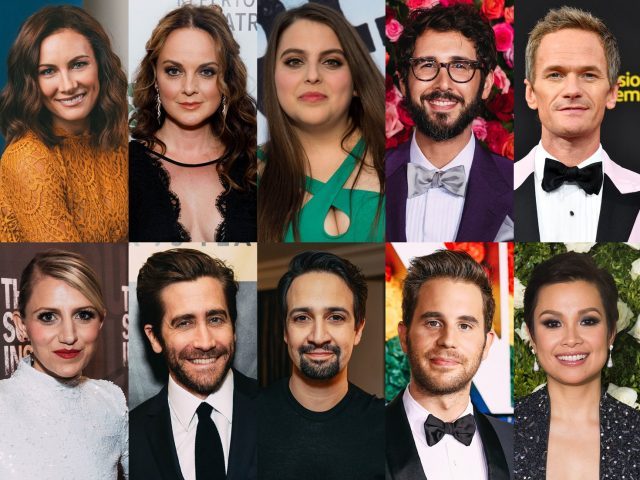
Who: Meryl Streep, Bernadette Peters, Patti LuPone, Audra McDonald, Mandy Patinkin, Christine Baranski, Donna Murphy, Kristin Chenoweth, Sutton Foster, Brian Stokes Mitchell, Kelli O’Hara, Aaron Tveit, Maria Friedman, Iain Armitage, Katrina Lenk, Michael Cerveris, Brandon Uranowitz, Stephen Schwartz, Elizabeth Stanley, Chip Zien, Alexander Gemignani, Melissa Errico, Ann Harada, Austin Ku, Kelvin Moon Loh Thom Sesma, Annaleigh Ashford, Laura Benanti, Beanie Feldstein, Josh Groban, Jake Gyllenhaal, Neil Patrick Harris, Judy Kuhn, Linda Lavin, Lin-Manuel Miranda, Ben Platt, Randy Rainbow, Lea Salonga, Victor Garber, Joanna Gleason, Nathan Lane, Steven Spielberg, Raúl Esparza What: Live online celebration of Stephen Sondheim’s ninetieth birthday Where:Broadway.com YouTube channel When: Sunday, April 26, free, 8:00 Why: Stephen Joshua Sondheim was born in New York City on March 22, 1930. Over his long career, the Oscar, Tony, and Grammy winner has written the music and lyrics for such shows as West Side Story, Gypsy, A Funny Thing Happened on the Way to the Forum, Company, Follies, A Little Night Music, Pacific Overtures, Sweeney Todd, Sunday in the Park with George, Into the Woods, and many others. A much-lauded revival of Company was set to hit Broadway on March 22, joining a revival of West Side Story, but both shows were closed down when Broadway went dark March 12 because of the coronavirus. But an all-star lineup will be paying tribute to Sondheim from their homes with “Take Me to the World: A Sondheim 90th Birthday Celebration,” a gala event being held on April 26 at 8:00. Sponsored by Broadway.com, the party will be streamed live on YouTube for free, but watchers are encouraged to donate to ASTEP (Artists Striving to End Poverty), an NYC Service organization that seeks to “unite New Yorkers in service to advance lifelong civic engagement for a more equitable and inclusive city.” Above is the remarkable guest list of performers and well-wishers; the evening will be hosted by Tony winner Raúl Esparza, a veteran of Sunday in the Park with George and Company. Sondheim might be ninety, but we got used to seeing him all the time at the theater, as an audience member. Sunday night he’ll take center stage, where he belongs.
Tovah Feldshuh and Ed Asner will talk about anti-Semitism and the Holocaust as part of Yom HaShoah commemoration
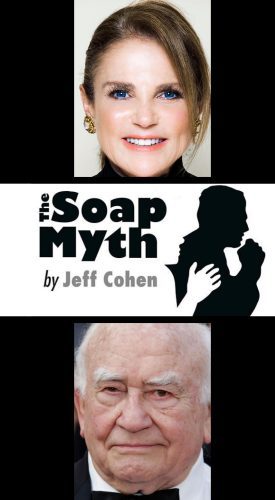
Who: Ed Asner, Tovah Feldshuh, Jeff Cohen, Rabbi Joshua M. Davidson, Arnold Mittelman, Michael Berenbaum, Ira Forman, Richard Salomon What: Panel discussion about The Soap Myth in honor of Yom HaShoah (Holocaust Remembrance Day) Where: Temple Emanuel Streicker Center website When: Monday, April 20, free with advance registration, 6:30 Why: In commemoration of Yom HaShoah (Holocaust Remembrance Day), the Temple Emanu-El Streicker Center, the National Jewish Theater Foundation, and the Illinois Holocaust Museum & Education Center have teamed up to present a live online panel discussion exploring anti-Semitism, the Holocaust, and the historical record as brought up in Jeff Cohen’s poignant play The Soap Myth, which looks at the claim that the Nazis made soap from the bodies of dead Jews. I saw a full staging of the work in 2012, calling it “an emotionally moving production [that] offers an intriguing look into the speculative nature of history and one man’s furious dedication to setting the record straight.” Ed Asner and Tovah Feldshuh have been touring with the play for several years, performing staged readings directed by Pamela Berlin, one of which was taped for PBS, where it can be seen for free as part of WNET’s All Arts.
You’ll want to watch it before tuning in to the live event on April 20 at 6:30, when Asner, Feldshuh, and Cohen will be joined by Holocaust scholar Dr. Michael Berenbaum, former special envoy for monitoring and combating anti-Semitism Ira N. Forman, and moderator Rick Salomon of the Illinois Holocaust Museum. The program will be introduced by Rabbi Joshua M. Davidson of Temple Emanu-El and Arnold Mittelman of the National Jewish Theater, who directed the production I saw. Advance registration is required here.
Who: Red Bull Theater company What: Unrehearsed reading of John Ford’s ‘Tis Pity She’s a Whore Where:Red Bull Theater website When: Monday, April 20, donation suggested, 7:30 Why: In the spring of 2015, the New York-based Red Bull Theater company staged a revival of John Ford’s rarely performed 1630s classic, ‘Tis Pity She’s a Whore, at the Duke on 42nd Street. In my review, I called the production of the Jacobean drama “glorious,” “a bold, brash, violent, and very funny riff on Romeo and Juliet,” raving about the acting, Jesse Berger’s direction, Sara Jean Tosetti’s costumes, and David M. Barber’s set. (You can read my review here.) On April 20 at 7:30, Red Bull will be presenting an unrehearsed reading of the play with the full, original cast, but this time they will be performing in their own clothing from wherever they’re sheltering in place, with Amelia Pedlow as Annabella, Matthew Amendt as Giovanni, Kelley Curran as Hippolita, Christopher Innvar as Friar Bonaventura, Franchelle Stewart Dorn as Putana, Clifton Duncan as Lord Soranzo, Tramell Tillmann as Grimaldi, Rocco Sisto as the Cardinal, Derek Smith as Vasques, Philip Goodwin as Florio, Ryan Garbayo as Bergetto, Everett Quinton as Donado, Auden Thornton as Philotis, and Marc Vietor as Richardetto. It’s free to watch, but if you’d like to donate to the company, you can do so here.
Who: Michael Urie, Nathan Winkelstein What:Live discussion of “Queen Mab” speech from Romeo & Juliet Where:Red Bull Theater’s website,Vimeo,Facebook (and Zoom for up to fifty participants; requires advance registration here) When: Monday, April 13, free, 7:30 Why: Red Bull Theater’s RemarkaBULL Podversations streaming series kicks off April 13 at 7:30 with actor Michael Urie discussing Mercutio’s “Queen Mab” speech from William Shakespeare’s Romeo & Juliet with host Nathan Winkelstein, the company’s associate producer. Red Bull specializes in Jacobean and Shakespearean works; Urie (Ugly Betty, Buyer & Cellar) starred in the troupe’s 2017 adaptation of Nikolai Gogol’s 1836 satire, The Government Inspector. The monologue, delivered in Act 1, Scene 4, begins: “O, then, I see Queen Mab hath been with you. / She is the fairies’ midwife, and she comes / In shape no bigger than an agate-stone / On the fore-finger of an alderman, / Drawn with a team of little atomies / Athwart men’s noses as they lie asleep.” Urie portrayed Mercutio in Folger Theatre’s 2005 production of the play, directed by PJ Paparelli. If you want to participate in the live chat, you need to register in advance for the Zoom feed here.
Since May 2001, twi-ny has been recommending cool things to do throughout the five boroughs, popular and under-the-radar events that draw people out of their homes to experience film, theater, dance, art, literature, music, food, comedy, and more as part of a live audience in the most vibrant community on Earth.
With the spread of Covid-19 and the closing of all cultural institutions, sports venues, bars, and restaurants (for dining in), we feel it is our duty to prioritize the health and well-being of our loyal readers. So, for the next several weeks at least, we won’t be covering any public events in which men, women, and children must congregate in groups, a more unlikely scenario day by day anyway.
That said, as George Bernard Shaw once noted, “Without art, the crudeness of reality would make the world unbearable.”
Some parks are still open, great places to breathe in fresh air, feel the sunshine, and watch the changing of winter into spring. We will occasionally be pointing out various statues, sculptures, and installations, but check them out only if you are already going outside and will happen to be nearby.
You don’t have to shut yourself away completely for the next weeks and months — for now, you can still go grocery shopping and pick up takeout — but do think of others as you go about your daily life, which is going to be very different for a while. We want each and every one of you to take care of yourselves and your families, follow the guidelines for social distancing, and consider the health and well-being of those around you.
We look forward to seeing you indoors and at festivals and major outdoor events as soon as possible, once New York, America, and the rest of the planet are ready to get back to business. Until then, you can find us every so often under the sun, moon, clouds, and stars, finding respite in this amazing city now in crisis.
Young Jean Lee’s We’re Gonna Die has been gloriously remounted by Raja Feather Kelly at Second Stage (photo by Joan Marcus)
2econd Stage Theater, Tony Kiser Theater
305 West 43rd St. between Eighth & Ninth Aves.
Tuesday – Sunday through March 22, $69-$125 2st.com/shows
“There’s a very good chance you’re not going to die,” President Trump said when news about the coronavirus crisis was first spreading. While that might be true when it comes to Covid-19, it’s not true in general, as mightily declared by Young Jean Lee in Raja Feather Kelly’s glorious remounting of her one-act play with music, We’re Gonna Die, continuing at Second Stage’s Tony Kiser Theater through March 22. The sixty-five-minute work consists of stories about loneliness and death that Lee collected from friends and relatives and transformed into a series of monologues delivered by one woman, as if all these awful events happened to her. Lee first presented the show at Joe’s Pub and then at Lincoln Center’s Clare Tow Theater, where she was the lead, backed by her rock band, Future Wife.
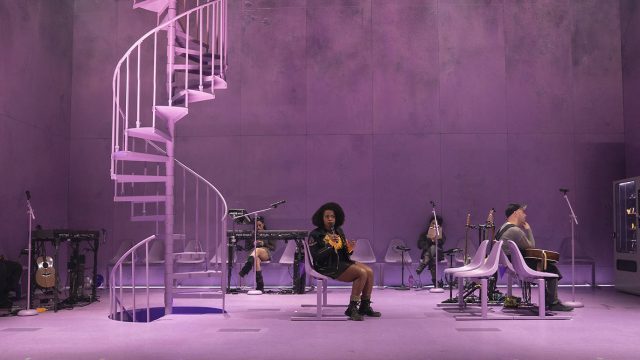
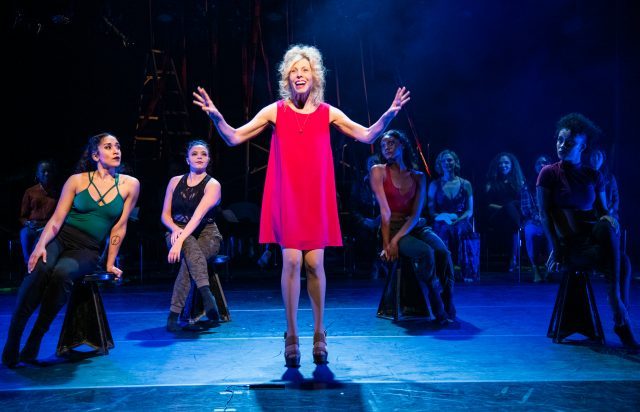
Janelle McDermoth now takes over, and she is dazzling as she relates poignant tales and blasts out songs both gentle and fierce across David Zinn’s calming, antiseptic set, a kind of hospital waiting room with a vending machine, lots of empty chairs and a central spiral staircase that goes through the ceiling and the floor, evoking a way station. As you enter the theater, a large-scale neon sign of the title moves slowly back and forth in front of the stage, a reminder of what is going to eventually happen to each and every one of us. Guitarists Freddy Hall and bandleader Kevin Ramessar, keyboardist and dance captain Ximone Rose, and bassist Debbie Christine Tjong enter and sit down, while drummer Marques Walls plays in a separate room off to stage left. As the show continues, balloons occasionally drop from above, accumulating in a far corner, telling us that even though this might be about the inevitability of death, it doesn’t mean we can’t have some fun.
The stories are told chronologically, as if belonging to one life, beginning with the presenter as a little girl trying to understand her weird uncle and why her two best friends shunned her, then considering dating and partnering relationships with men and caring for her ailing father. The songs, which pour forth from a wide range of genres — the arrangements are by Remy Kurs, with orchestrations by Cian McCarthy — relate directly to the tales, beginning with the opening number, “Lullaby for the Miserable,” in which the singer remembers something her mother told her when she was unable to get to sleep as a child: “When your brain’s had enough / And your body gives up / You will sleep / By and by / By and by / You will sleep / By and by / You are not the only one / You are not the only one / You are not the only one / You are not the only one.” That repetition serves as a leitmotif for the rest of the show, which emphasizes that no one is spared from life’s problems and, eventually, death itself.
Later, the singer recalls, “About a year ago, I went back home for a younger cousin’s wedding, and while I was at home, I found my first white hair. Now, I had never been a person who worried at all about getting older or losing my looks — I just never thought about that stuff. So it all just kind of hit me in this one moment. . . . I had reached the point in my life where everything from here on out was going to be a downward decline towards deterioration and sickness and death. And this had never occurred to me before, so I was really traumatized.” She follows that up with a funky, funny number about something her grandmother told her mother: “When you get old / You will lose your mind! / And everything will hurt all the time! Uh-huh / Uh-huh / . . . / When you get old / All your friends will die! / And you will be a burden to the world! / Uh-huh / Uh-huh.” Among the other songs, whose titles sum things up pretty clearly, are “I Still Have You,” “Comfort of the Lonely,” and “Horrible Things.” Even the Korean-born Lee’s full name, Young Jean Lee, seems relevant, suggesting a youthfulness even though the “Young” is an Americanization of her surname.
In 2016, the Brooklyn-based Lee — a multitalented writer and performer whose previous plays include Straight White Men,Lear,The Shipment, and Untitled Feminist Show — and Future Wife released a DVD of readings and songs from the show with such special guests as Colin Stetson, Kathleen Hanna, Adam Horovitz, Sara Neufeld, David Byrne, and Laurie Anderson, but there’s nothing like seeing it with one singer, and McDermoth (A Bronx Tale, Soul Doctor) is a revelation. Dressed in cool yellow and black leather (the costumes are by Naoko Nagata), she struts around with an infectious determination and a nod and a wink, winning over the audience immediately and never letting go; she is us, and we are her. Kelly, who has choreographed such plays as Fairview, A Strange Loop, The House That Will Not Stand, and Girls, explodes We’re Gonna Die to the next level, transforming it from an involving song cycle to a more fully fledged theatrical production. There’s a clock onstage that depicts the real time, minutes and seconds ticking away not just in our lives but, more important, on the show itself. I found myself filled with sadness as the sixty-minute mark approached, knowing it would soon be over. But I was also energized and invigorated by the fantastic finale, in which everyone participates and caution is thrown to the wind. Yeah, so we’re all gonna die. That shouldn’t mean that we can’t make the most of every moment we’re still here.
Chris Henry’s Women on Fire: Stories from the Frontlines is based on true stories about women in today’s America (photo by Russ Rowland)
Royal Family Performing Arts Space
145 West 46th St. between Sixth & Seventh Aves., third floor
Friday – Monday through March 16, $30-$250 www.royalfamilyproductions.org
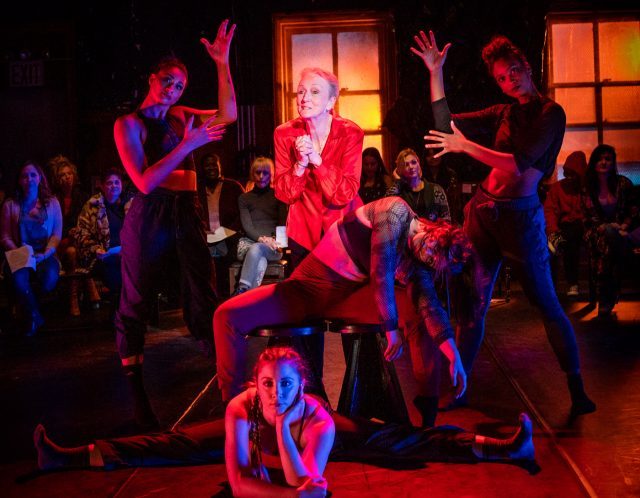
Chris Henry’s Women on Fire: Stories from the Frontlines is meant to be an empowering call to action. Unfortunately, it too often resembles an intense Facebook thread in which the majority of the participants are firmly on the left, arguing with a couple of right-wing Trump supporters. But the eighty-minute work is terrifically acted by a diverse cast of fifteen actresses and features dynamic choreography performed by four powerful dancers who serve as a kind of Greek chorus of movement (and occasionally sound).
As you enter the Royal Family Performing Arts Space, yellow caution tape separates the audience from the set, a postapocalyptic scene with black plastic bags partially blocking exposed brick walls and lightbulbs precariously dangling from the ceiling. Women are sitting on chairs and benches in the dark. The caution tape is ripped apart as if declaring, “Here we come!” And one by one, the women walk front and center holding a piece of paper and delivering monologues about rape, misogyny, sexism, abortion, race, discrimination, sexual assault, and other hard-hitting issues. Each story is based on interviews Henry conducted. “I feel like I’m in The Handmaid’s Tale and I can’t get out,” Offred (Stephanie J. Block) says. “1, 2, buckle my shoe / 3, 4, close the door / 5, 6, pick up sticks / 7, 8, lay them straight / 9, 10, big fat hen. That’s how I got through sex,” Kara (Gina Naomi Baez) confesses. “Okay, here’s the deal. You don’t get to be a Roman Polanski fan anymore,” Lisa (Alysia Reiner) shouts. Julia rails against the philosophy behind Pretty Woman. Jo praises Hillary Clinton but lambasts Bill as a sexual predator. The most moving story comes from Maya (Gargi Mukherjee), who details a sexual assault at a threading parlor.
Maddie Corman is part of rotating cast of incendiary Women on Fire (photo by Russ Rowland)
On the other side, Courtney (Maddie Corman) explains, “I think people get so worked up about silly things; I mean, boys will be boys,” Taty accuses the Democrats of being dangerously wrong on Cuba, and Charle (Cynthia Mace) doesn’t understand why Black Lives Matter is more important than Blue Lives Matter. After speaking their peace, the women put their paper into a mini-cauldron. Each segment is preceded by a ferocious interpretive dance by Samantha Butts, Emily Anne Davis, Erica Misilo, Samantha Warner, and/or Mariah Reive, who occasionally interact with the other performers. The effective set design, lighting, and costumes are by Cheyenne Sykes, with original music by Lars Jacobsen; Henry codirects the play with choreographer Lorna Ventura. The impressive rotating cast also includes Kathy Brier, Andréa Burns, Rosa Curry, Paige Gilbert, Judy Gold, Julie Halston, Simone Harrison, Cady Huffman, Steffanie Leigh, Rebecca Nelson, Olivia Oguma, Portia, Connie Ray, Laila Robins, Debra Jo Rupp, Constance Shulman, Lianah Sta. Ana, Desi Waters, and Ashley Williams.
“This play is not meant to be perfect. . . . This is just a pebble in a giant ocean of stories,” Henry explains in a program note. She’s more right than she realizes. Too many of the tales, though true, are clichéd and obvious, preaching to the choir, starting with the first monologue, when Margaret reads a long list of Donald Trump’s shameful deeds while campaigning and then as president. We are familiar with every one of them, so there are no surprises; it feels like we’re watching MSNBC or reading a social media post from Mother Jones. The night I went, the ritual finale did not catch fire because of a faulty lighter. But that did not stop the play’s inner fury, best represented by Rachel, who delivers a profanity-laced tirade against the treatment of women in today’s America.