this week in theater

MOULIN ROUGE! THE MUSICAL!

(photo © Matthew Murphy, 2019)

Danny Burstein stars as nightclub owner and ringleader Harold Zidler in Moulin Rouge! The Musical! (photo © Matthew Murphy, 2019)

Al Hirschfeld Theatre
302 West 45th St. between Eighth & Ninth Aves.
Tuesday – Sunday through November 8, $179 – $799
moulinrougemusical.com

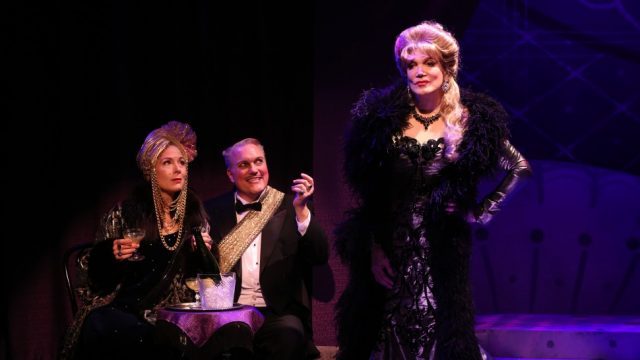
Just about all you need to know about Moulin Rouge! The Musical! is that, yes, there are two exclamation points in the title. If you thought Baz Luhrmann’s 2001 movie was over the top and filled to excess, wait till you see the Broadway show. Actually, let me take that back; just trust me and skip it unless you’re looking to toss away between $179 and $799 on a bright red saccharine bonbon. As you enter the Al Hirschfeld Theatre, you’re immersed in the sexy, velvety world of the Moulin Rouge, to great effect. (The set design is by the masterful Derek McLane.) Sultry men and women are there to greet and entice you at the sides of the stage, a large windmill beckons from above (“Moulin Rouge” means “red mill”), but beware the big blue elephant in the room. (Literally.) The opening number shows promise, with Danny Burstein leading the adult circus as nightclub owner and ringleader Harold Zidler, who declares, “Hello, chickens! Yes, it’s me. Your own beloved Harold Zidler. In the flesh. Welcome, you gorgeous collection of reprobates and rascals, artistes and arrivistes, soubrettes and sodomites, welcome to the Moulin Rouge!” He continues, “No matter your sin, you’re welcome here. No matter your desire, you’re welcome here. For this is more than a nightclub. The Moulin Rouge is a state of mind. It is that part of your soul which throbs and pulses, it is that corner of your mind where your fantasies live.” Well, not my fantasies, at least.

(photo © Matthew Murphy, 2019)

Satine (Karen Olivo) and Christian (Aaron Tveit) fight for love in misguided musical (photo © Matthew Murphy, 2019)

The sails come off the mill quickly after that, as the innocent and penniless Christian (Aaron Tveit) tumbles head over heels in love with Moulin Rouge star Satine (Karen Olivo), whom Zidler has already given to the Duke (Tam Mutu) in exchange for money that will help keep the club open. Meanwhile, French artist Toulouse-Lautrec (Sahr Ngaujah) follows along, commenting from a Montmartre café. “Face it, Toulouse. We’re not songwriters,” his friend Santiago (Ricky Rojas) says. Lautrec replies, “How hard can it be, for God sake?! June, spoon, moon — done!” Apparently, it’s pretty darn hard, as Moulin Rouge! The Musical! is stuffed to the gills with snippets of more than seventy hits that are either annoying in their brevity or severely overdramatized; just as in the film, the gimmick grows tired fast, even with familiar tunes by Talking Heads, David Bowie, Bob Dylan, Lourde, U2, Sia, the Rolling Stones, and Edith Piaf.

Directed by two-time Tony nominee Alex Timbers (Bloody Bloody Andrew Jackson, Here Lies Love) and with a predictable book by Tony winner and three-time Oscar nominee John Logan (Red, The Last Ship), the show is all glitz and glamour (the costumes are by Catherine Zuber, the choreography by Sonya Tayeh) with no chemistry whatsoever between the characters; not only will you not care about what happens to Christian, Satine, and the Duke, you’ll actively root for them to just make up their minds already and put us out of our misery. (The bloviated production runs just over two and a half hours.) And don’t fall for all the tongue-in-cheek self-referential and anachronistic pop-culture blather. Early on, Christian tells Lautrec and Santiago, “So it turns out they were in the midst of writing a theatrical play with some songs in it. They wanted me to go to the Moulin Rouge and sing one of my songs for the star there, sort of an audition. If she liked my music then she’d get the club to put on their show, which they called Bohemian Rhapsody. I swear, they were like two knockabout vaudevillians escaped from the nearest asylum and the whole thing was the single most insane idea I’d ever heard.” Hey, he said it, not me.

SEARED

(photo by Joan Marcus)

Temperamental chef Harry (Raúl Esparza) closely examines his fare in Theresa Rebeck’s sizzling Seared (photo by Joan Marcus)

Susan & Ronald Frankel Theater, the Robert W. Wilson MCC Theater Space
511 West 52nd St. between Tenth & Eleventh Aves.
Tuesday – Sunday through December 22, $66-$96
mcctheater.org/tix/seared

Theresa Rebeck heats up MCC’s Susan & Ronald Frankel Theater with the East Coast premiere of the sizzling hot Seared. The very tasty show is set in the cramped kitchen of a small Park Slope restaurant that is seeing a lightning-fast rise in clientele following a New York magazine rave about its scallop dish. But chef Harry (Raúl Esparza), who co-owns the eatery with his best friend, Mike (David Mason), who handles the front of the house and the business side, refuses to ever make those scallops again, resisting the pressure to become a star linked to just one specific entrée. “All my food is good,” he tells server and sometimes sous chef Rodney (W. Tré Davis). Arguing about the critic’s review, Rodney says, “He called you a hidden jewel, Harry,” to which Harry responds, “What’s a hidden jewel?” Rodney: “You know what a hidden jewel is.” Harry: “I know what an idiot is, too.”

On the heels of their burgeoning success, Harry and Mike are visited by Emily Lowes (Krysta Rodriguez), an impeccably dressed young consultant who wants to work with the restaurant to take it to the next level. While Mike is fully in favor of bringing her in, explaining that a potential rent increase could shut them down, Harry is dead-set against even listening to her initial proposal. “She’d like to help us,” Mike says. “Do we need help?” Harry replies sharply. A moment later, an ever-angrier Harry says, “Wow. You help people get what they want?” Emily answers, “I do.” Harry responds dismissively, “Yeah, but the problem is, I have what I want. So I don’t need anybody to help me get what I want. Sorry.” Then Mike chimes in, “I don’t have what I want. Let me get you a seat, Emily.” Their disagreement grows more heated as Mike begins to implement some of Emily’s ideas and Harry boils over in frustration while still insisting to not make the scallops, as scallop orders roll in from customer after customer.

(photo by Joan Marcus)

Harry (Raúl Esparza), Rodney (W. Tré Davis), Mike (David Mason), and Emily (Krysta Rodriguez) debate future of Park Slope restaurant in Seared (photo by Joan Marcus)

Despite there being nothing particularly new about the plot itself, which is like standard diner fare, Rebeck (Downstairs, Seminar) and director Moritz von Stuelpnagel (Hand to God, Rebeck’s Bernhardt/Hamlet) transform the top-notch ingredients into a hidden jewel, a thoroughly satisfying and full-bodied two-act meal that incorporates the sights, sounds, and smells of a New York City restaurant — Harry almost always has something cooking on the stove, taunting the audience’s taste buds from Tim Mackabee’s deliciously cramped set. Four-time Tony nominee Esparza (Company, Speed-the-Plow) is robust and spicy as the mercurial and demanding Harry, a masterful chef who has issues with fame and prosperity, while Mason (Rebeck’s The Nest and Dig) has just the right chops as Mike to stand up to the hotheaded Harry. Davis (Carnaval, Zooman and the Sign) is sweet and savory as the Zen-like Rodney, and Rodriguez (Hercules, What We’re Up Against) is tangy and zestful as the piquant Emily. Yes, I might be running out of culinary references, but Seared continues to tempt my palate, for high-quality food as well as high-quality theater.

TINA: THE TINA TURNER MUSICAL

(photo by Manuel Harlan)

Adrienne Warren dazzles as rock ‘n’ roll queen Tina Turner in jukebox musical (photo by Manuel Harlan)

Lunt-Fontanne Theatre
205 West 46th St. between Seventh & Eighth Aves.
Tuesday – Sunday through September 20, $79-$229
tinaonbroadway.com

Queen of Rock ‘n’ Roll Tina Turner turns eighty today, a major milestone in a complicated, difficult life that is currently under the microscope on Broadway in Tina: The Tina Turner Musical, continuing through next September at the Lunt-Fontanne Theatre. Adrienne Warren is explosive in the title role, giving a dazzling performance as Tina transforms herself from little Anna Mae Bullock (Skye Dakota Turner) singing in church to joining Ike Turner’s (Daniel J. Watts) band to ultimately carving out a memorable second-half-of-life career after being physically and psychologically abused and supposedly being washed up at the age of forty. Presented in “association with Tina Turner,” it’s an inspiring rags-to-riches-to-rags-to-riches story that is a step above the recent spate of mediocre (or worse) biographical jukebox musicals that includes Summer: The Donna Summer Musical, The Cher Show, Beautiful: The Carole King Musical, and Aint Too Proud to Beg: The Life and Times of the Temptations.

(photo by Manuel Harlan)

Little Anna Mae Bullock (Skye Dakota Turner) prepares for a remarkable career in Tina on Broadway (photo by Manuel Harlan)

The book is by rising African American playwright Katori Hall (Our Lady of Kibeho, Hurt Village) with Frank Ketelaar and Kees Prins (Hij Gelooft in Mij), and the show is directed by Phyllida Lloyd, who has helmed Mamma Mia! and The Iron Lady as well as a well-received all-female Shakespeare trilogy. Tina is paced like a concert, with a strong, fast beginning, some slower moments in the middle, and a grand finale. Not all of it works, particularly as the second act drips into Hallmark territory as Tina’s mother, Zelma (Dawnn Lewis), gets sick. Another problem is that instead of the songs appearing more or less in chronological order as the story unfolds, they are squeezed into scenes because of their content, not when they were recorded, so, for example, her 1983 version of Al Green’s “Let’s Stay Together” is followed, in succession, by 1984’s “Better Be Good to Me,” 1970’s “I Want to Take You Higher,” 1966’s “River Deep — Mountain High,” 1989’s “Be Tender with Me, Baby,” 1971’s “Proud Mary,” and 1993’s “I Don’t Wanna Fight No More.” Tina didn’t write any of these songs, so they don’t relate to her state of mind at the time, and, even more important, the narrative is by then only up to the early 1980s, several years before she meets manager Roger Davies (Charlie Franklin) and starts her comeback with some of the very tunes we’ve now already heard. It might be a great concert setlist but it muddies the waters of a chronological tale. And don’t even get me started on the prominence of “We Don’t Need Another Hero”; did anyone listen to the end of the chorus and wonder where the line “All we want is life beyond Thunderdome” fits into Tina’s life (particularly without mentioning the Mad Max film it’s from)?

(photo by Manuel Harlan)

Tina Turner (Adrienne Warren) takes center stage with Ike and the Ikettes in Tina (photo by Manuel Harlan)

That said, Mark Thompson’s sets and costumes shine, Anthony van Laast’s choreography glints and glimmers, and Nicholas Skilbeck’s arrangements and Ethan Popp’s orchestrations, performed by an eleven-piece rock band, do justice to the originals. In addition to Warren’s star turn as Tina — prepare to be awed at how she makes her way up and down the staircase in heels during the encores — Myra Lucretia Taylor is heartwarming as Tina’s grandmother, Gran Georgeanna; Holli’ Conway, Kayla Davion, Destinee Rea, and Mars Rucker have fun as the Ikettes; Dakota Turner reveals quite a strong voice as the young Anna Mae; and Watts does not make Ike pure evil, though you still might consider hissing at him at the curtain call. But the show is really all about Warren (Shuffle Along, Bring It On: The Musical), who commands the stage with a magnetic presence and instantly wins over the audience with her unceasing energy, flashy movement, and magical voice, just like the woman she is portraying has done for decades. Happy birthday, Tina!

FEFU AND HER FRIENDS

(photo by Henry Grossman)

A group of diverse women gathers in an elegant home in María Irene Fornés’s astonishing Fefu and Her Friends (photo by Henry Grossman)

Theatre for a New Audience, Polonsky Shakespeare Center
262 Ashland Pl. between Lafayette Ave. & Fulton St.
Through December 8, $70-$90
866-811-4111
www.tfana.org

María Irene Fornés’s Fefu and Her Friends is a brilliant work of utter genius. Unseen in New York since its debut more than forty years ago, the revolutionary play is part art happening, part theatrical reinvention, now brought back in a dazzling revival by director Lileana Blain-Cruz that opened November 24 at Theatre for a New Audience’s Polonsky Shakespeare Center. It unfolds in three sections: The first on a conventional stage, with the audience watching from standard seating. For the second part, the audience gets up and moves around the space, following four scenes that occur simultaneously but separately, each offering close-up looks at the characters as the crowd goes from bedroom to study to kitchen to lawn before returning to their regular seats for the finale. It’s avant-garde promenade theater at its finest, embedding us in the abstract narrative while also making us feel like we’re spying on extremely personal moments.

The story takes place in the spring of 1935 in the elegant New England country home of Fefu (Amelia Workman), who has invited over seven women for a rehearsal of an upcoming school fundraiser. The title might sound like it’s a family-friendly show, but it’s an insightful and often shocking mature dissection of women’s roles in society, both with and without men. “My husband married me to have a constant reminder of how loathsome women are,” Fefu tells Cindy (Jennifer Lim) and Christina (Juliana Canfield) at the very beginning, shortly before firing a double-barrel shotgun in the offstage direction of Phillip, her husband. The gun might or might not be loaded. “She’s crazy,” Christina says. “A little. She has a strange marriage,” Cindy replies.

(photo byGerry Goodstein)

Cindy (Jennifer Lim) and Christina (Juliana Canfield) are concerned as Fefu (Amelia Workman) stands in the back in TFANA revival (photo by Gerry Goodstein)

They are soon joined by Emma (Helen Cespedes), Sue (Ronete Levenson), Paula (Lindsay Rico), Cecilia (Carmen Zilles), and Julia (Brittany Bradford), the eight of them as a unit representing the many aspects of the feminine while avoiding trite stereotypes. Over the course of two thrilling hours, the women talk about love affairs, genitals, pain, anarchist Voltairine de Cleyre, actress, writer, and teacher Emma Sheridan Fry, happiness, and fear, but they are not the catty characters of Clare Boothe Luce’s The Women or the melodramatic ladies of Steel Magnolias. They are also not heroic or iconic figures; they each have their flaws that they either flaunt or hide. No men appear in the play, nor are they the primary subject of discussion, but they hover on the periphery. “I still like men better than women,” Fefu says. “I envy them. I like being like a man. Thinking like a man. Feeling like a man. They are well together. Women are not.” Fefu is arguably the most masculine of the women, shooting guns and fixing a broken toilet. At the other end of the spectrum is the wheelchair-bound Julia, who was paralyzed when standing near a deer that was shot, even though no bullet ever struck her. Thus, in Fornés’s world, women are both hunter and hunted. Adam Rigg’s sets further that idea, as all the rooms feature elements of nature, from wallpaper decorated with plants and flowers to animal lamps, from leaves surrounding Julia’s bed to drawings of plants and animals — along with men and women — hung in the living room.

(photo by Gerry Goodstein)

Julia (Brittany Bradford), Emma (Helen Cespedes), and Christina (Juliana Canfield) share a happy moment in María Irene Fornés masterpiece (photo by Gerry Goodstein)

“We each have our own system of receiving information, placing it, responding to it,” Cecilia says at the start of part three. “That system can function with such a bias that it could take any situation and translate it into one formula. That is, I think, the main reason for stupidity or even madness, not being able to tell the difference between things.” That statement succinctly sums up how the audience experiences the nonformulaic play, which has constructed a unique theatrical environment, “immersive” well before that became its own genre. Montana Levi Blanco’s costumes dazzle, while Palmer Hefferan’s sound design during the second part results in a cacophony of voices as bits of conversation from the other concurrent scenes can be picked up, like in real life. Two-time Obie winner Blain-Cruz (Marys Seacole, The Death of the Last Black Man in the Whole Entire World) beautifully leads the engaging cast and the audience through the Cuban-born Fornés’s (Drowning, The Conduct of Life) masterpiece, which earned her the second of her nine Obies. It’s a stirring journey through time and space, a one-of-a-kind play that must be seen; it will blow your mind.

THE YOUNG MAN FROM ATLANTA

(photo by Monique Carboni)

Aidan Quinn stars as Will Kidder in Signature revival of Horton Foote’s The Young Man from Atlanta (photo by Monique Carboni)

The Pershing Square Signature Center
The Irene Diamond Stage
480 West 42nd St. between Tenth & Eleventh Aves.
Tuesday-Sunday through December 15, $35
212-244-7529
www.signaturetheatre.org

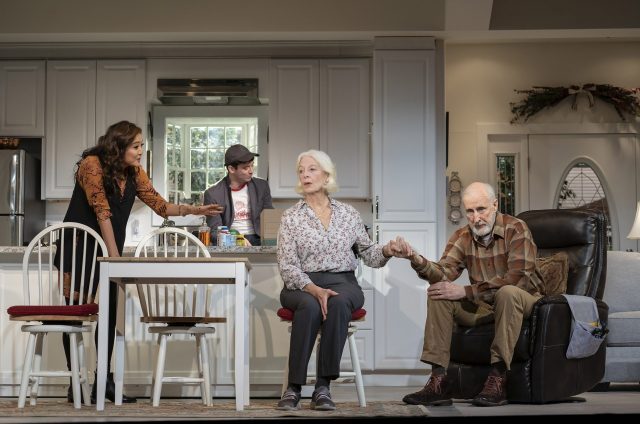
In 1995, Horton Foote’s The Young Man from Atlanta premiered at the Signature Theatre as part of a season dedicated to the Texas native, which also included Talking Pictures, Night Seasons, and Laura Dennis. The play went on to earn the Pulitzer Prize and garner a Tony nomination for the two-time Oscar winner (who also won an Emmy in 1997). The Young Man from Atlanta is now back at the Signature, where it opened tonight at the Irene Diamond Stage in a revival directed by longtime Foote collaborator Michael Wilson that makes it hard to understand what all the fuss was about in the first place.

It’s the spring of 1950 in Houston, Texas, and sixty-one-year-old Will Kidder (Aidan Quinn) thinks he is living the American dream, rising from poverty to become a corporate success story who has just bought a large, expensive home. “There is no finer house in Houston. We have the best of everything,” he boasts to Tom Jackson (Dan Bittner), his handpicked protégé at the Sunshine Southern Wholesale Grocery. “I live in the best country in the world. I live in the best city. I have the finest wife a man could have, work for the best wholesale produce company,” he adds, but as it turns out, he and his wife, Lily Dale (Kristine Nielsen), are failing to face the reality that their carefully cultivated life is falling apart.

After thirty-seven years of dedicated service, Will is summarily dismissed by his boss, Ted Cleveland Jr. (Devon Abner), for being out of touch with the present. Six months before, Will and Lily Dale’s thirty-seven-year-old son and only child, Bill, drowned; while Will believes it might have been a suicide, the Bible-thumping Lily Dale steadfastly refuses to consider that possibility. The couple is being contacted nonstop by Bill’s Atlanta roommate, Randy Carter, who was a surprise visitor at Bill’s funeral. “He’s nervy. I’ll say that,” Will tells Tom early on. “He calls once a week to talk to me. God knows what he wants. Money, I suppose. Although he tells my secretary he just wants to stay in touch with Bill’s dad. Maybe next time he calls I’ll tell him just to keep the hell away from us.”

(photo by Monique Carboni)

Will (Aidan Quinn) and Lily Dale (Kristine Nielsen) are joined by her stepfather (Stephen Payne) as their American dream starts to crumble (photo by Monique Carboni)

Will is furious when he finds out that Lily Dale has been sending Randy money, especially now that he needs cash to start his own business. But what’s left unsaid by everyone — including Lily Dale’s stepfather, Pete Davenport (Stephen Payne), and Pete’s great-nephew, Carson (Jon Orsini), who stayed at the same YMCA as Bill and Randy — is that it is very likely that Randy and Bill were lovers, but the words “gay” and “homosexual” are verboten in the Kidders’ seemingly idyllic existence (as well as in 1950s America). Will also has old-fashioned views on slavery; he claims that the Civil War was fought primarily over states’ rights, and when their current black maid, Clara (Harriett D. Foy), brings over one of their former black maids, Etta Doris (Pat Bowie), for a visit, Will has no memory of her whatsoever, even though she played a key role in Bill’s upbringing.

Wilson, who previously helmed such Foote plays as The Orphans’ Home Cycle, The Old Friends, The Trip to Bountiful, and The Carpetbagger’s Children, can’t inject any energy into the droll proceedings, which feel stagnant and repetitive as the same themes are reiterated over and over again. Quinn (A Streetcar Named Desire, Avalon) underplays Will, while two-time Obie winner and two-time Tony nominee Nielsen (Vanya and Sonia and Masha and Spike, Gary: A Sequel to Titus Andronicus) overplays Lily Dale; her trademark jittery, nervous style is out of place here, calling too much attention to itself. (Foote fans might recognize some of the characters, as they appear in several parts of the Orphans plays.) Meanwhile, Payne (Straight White Men, Superior Donuts) struggles with the rhythm of his line readings, and the talented Orsini (The Nance, The Whirligig) doesn’t have enough to do. The best part of the show is Jeff Cowie’s set, which begins as a narrow, claustrophobic office before opening up into the elegant living room in the Kidders’ new house, which is now filled with so much hurt and pain.

HISTORY OF VIOLENCE

(photo by Teddy Wolff)

Thomas Ostermeier’s complex multimedia adaptation of Édouard Louis’s History of Violence features inventive camerawork (photo by Teddy Wolff)

St. Ann’s Warehouse
45 Water St.
Tuesday – Sunday through December 1, $46-$56
718-254-8779
stannswarehouse.org
www.schaubuehne.de/en

Thomas Ostermeier is one of the world’s most ingenious and unique theater directors, able to take a narrative and shape and twist it into something wholly unusual and unexpected. In 2017, his Schaubühne Berlin company, where he has been resident director since 1999, delivered a literally electrifying version of Richard III, while last year they brought their self-reflexive, multilayered Returning to Reims, based on Didier Eribon’s 2009 memoir, to St. Ann’s Warehouse. Ostermeier and Schaubühne are now back at St. Ann’s with History of Violence, a radical, highly inventive multimedia interpretation of the 2016 nonfiction novel by Édouard Louis, a close friend of Eribon’s; the bestselling book is based on a brutal attack Louis suffered on a Christmas Eve and its traumatic aftermath.

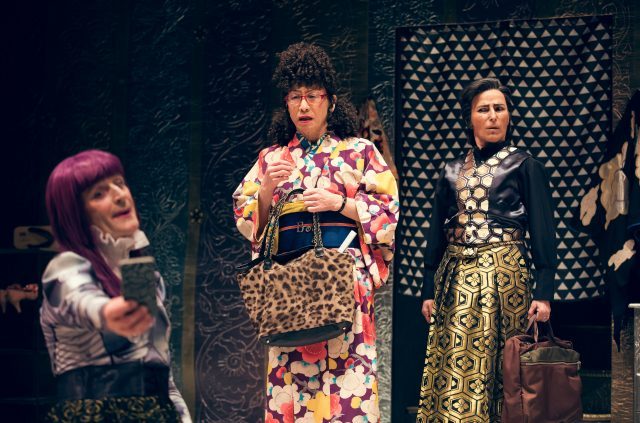
As the audience enters the theater, Édouard (Laurenz Laufenberg) is seated on a chair up against a large wall with a screen, looking exasperated. The play begins with three characters (Christoph Gawenda, Renato Schuch, and Alina Stiegler) conducting an intricate forensic investigation of a crime scene, in full protective gear like astronauts on the moon, using a cellphone camera and electric duster to find fingerprints as Édouard watches and Thomas Witte plays the drums stage left. The camera images are projected in stark, often uncomfortable close-ups on the rear screen; the video design is by Sébastien Dupouey, the coldly efficient, multifaceted set by Nina Wetzel.

Over the course of two intermissionless hours, the dark tale of what happened to Édouard is told in flashback, with Édouard, his sister, Clara (Stiegler), Clara’s husband, Alain (Gawend), and Édouard’s attacker, Reda (Schuch), either re-creating real-life scenes or speaking directly to the audience in the present through microphones, in both first and third person. Édouard openly shares the violation he experienced and the fear that has built up inside him, which has left him with an intense animosity for humanity. “I hated everyone. / I thought: / how can you. / That morning after Reda left, / I woke up with a strange taste in my mouth. / With the knowledge that I’d never / be able to bear the slightest trace / of anything that looked like happiness. / I could’ve slapped the next / smiling person I saw. / I’d have grabbed them by their lapels, / shaken them as hard as I could, / even children, / the frail or the disabled, / I’d have liked to shake them / and spit in their faces, / scratched them until I drew blood, / scratched their faces off, until all the faces disappeared.”

The reaction of the police and hospital personnel to the events results in a certain consternation because Édouard invited Reda to his apartment, while issues of class, sexual orientation, and race come to the fore. “The question wasn’t: / is he going to kill me? But rather: / how is he going to kill me?” Édouard explains, adding, “Later on the police and Clara / congratulated me for my bravery. / Nothing seems to me more alien to that night / than the concept of bravery.” At the hospital, he says, “I waited. / But nobody came. / I sat there feeling like / I was an extra in a story that wasn’t my own, / but had happened to someone else / that I didn’t know.”

A coproduction with Théâtre de la Ville Paris and Théâtre National Wallonie-Bruxelles, History of Violence is another audiovisual stunner from Ostermeier, who deserves the kind of attention that is lavished on Ivo van Hove, the Belgian multimedia mastermind. The show is part of a series of Louis-related events that included the BAM Next Wave presentation of a work based on his 2014 memoir, The End of Eddy, which ran at the Fishman last week and also deals with sex and power. History of Violence, which continues at St. Ann’s through December 1, is a work for our time, telling a poignant, deeply intimate true story using cutting-edge twenty-first-century techniques with an innovative style, holding nothing back as it explores trauma in extraordinary ways.

CLASSIC STAGE COMPANY: MACBETH

(photo by Joan Marcus)

Married couple Nadia Bowers and Corey Stoll star as a sexy married couple with devilish ambitions in Classic Stage adaptation of Macbeth (photo by Joan Marcus)

Classic Stage Company, Lynn F. Angelson Theater
136 East 13th St. between Third & Fourth Aves.
Tuesday – Sunday through December 15, $82-$127
classicstage.org/shows/macbethcsc

Manhattan native and NYU grad Corey Stoll has quickly become a go-to Shakespearean actor in the city, playing Ulysses in Troilus and Cressida in 2016, Brutus in Julius Caesar in 2017, and Iago in Othello in 2018, all for Shakespeare in the Park at the Delacorte. His easygoing manner brings a compelling humanity to his performances, which also include runs in Law & Order: LA, House of Cards, The Strain, and The Deuce. And that humanity is again evident as he stars as the title character in John Doyle’s streamlined adaptation of the Bard’s Macbeth, continuing at Classic Stage through December 15.

Doyle’s spare set is a rectangular platform with a large wooden throne at one end; above it is a balcony. The actors are always visible, either onstage or standing in the back, watching and waiting. They are dressed in Ann Hould-Ward’s dark Tartan costumes, although it is difficult to tell the individual clans apart or when an actor is playing a different role, as several have multiple parts without costume changes. (The witches are played by most of the company, not a trio of actors.) Lady Macbeth is played by Nadia Bowers (Describe the Night, Life Sucks.), Stoll’s real-life wife, lending a sweet intimacy to their scenes together even as they plot murder most foul. Their sexuality heats up the stage, even as some sly jokes might be a bit much; for example, when Lady Macbeth says, “Come you spirits / That tend on mortal thoughts, unsex me here, / And fill me from the crown to the toe, top-full / Of direst cruelty. Make thick my blood, / Stop up th’access and passage to remorse,” Bowers, sitting on the floor, grabs her crotch in a rather un-Shakespearean manner.

(photo by Joan Marcus)

Erik Lochtefeld plays a contemplative Banquo in John Doyle’s Shakespeare adaptation (photo by Joan Marcus)

Barzin Akhavan is a fine Macduff, Erik Lochtefeld a touching Banquo, Tony nominee Mary Beth Peil a quietly regal Duncan, and Raffi Barsoumian a solid Malcolm; the cast also features N’Jameh Camara as Lady Macduff, Barbara Walsh as Ross, and Antonio Michael Woodard as Fleance, but it’s harder for them to establish their characters, who get lost in the shuffle. Tony winner Doyle (Sweeney Todd, Company), the Scottish director who went to school near Cawdor Castle, where much of the play takes place, has trimmed the show to a muddled hundred minutes, sacrificing too much of its necessary building energy as evil ambition overwhelms Macbeth. Even such a flourish as a bowl of water where Macbeth and Lady Macbeth wash the blood off their hands remains onstage too long, going impossibly unseen in front of others.

There are various versions of the Scottish play one can experience now or soon, including the Roundabout’s musical adaptation, Scotland, PA, at the Laura Pels through December 8, the long-running Sleep No More at the McKittrick Hotel, a return engagement of Erica Schmidt’s Red Bull schoolgirl version by the Hunter Theater Project starting in January, and Primary Stages’ Peerless, set in the world of college admissions, next spring. But you won’t go wrong with Stoll, who rises above Doyle’s messy confusion, delivering a compelling and even cathartic Macbeth, who could be any of us, lured in by power. When he says, “Is this a dagger which I see before me, / The handle toward my hand? Come, let me clutch thee,” we all see it, and consider reaching for its glittering promise.