this week in lectures, signings, panel discussions, workshops, and Q&As

COAL COUNTRY

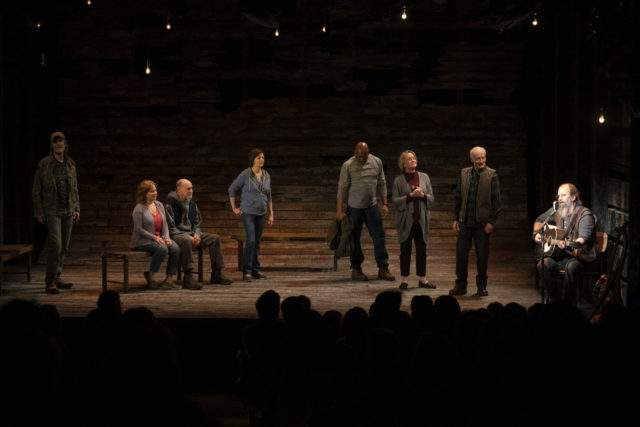
The characters of Coal Country listen to Steve Earle sing about a horrific mining disaster (photo by Joan Marcus)

COAL COUNTRY
Cherry Lane Mainstage Theatre
38 Commerce St.
Tuesday – Sunday through April 17, $39-$77
212-989-2020
www.cherrylanetheatre.org
coalcountrymusical.com

Coal Country is a damning portrait of much that’s wrong in America today, a tale of corporate greed, corruption, union busting, an unequal justice system, and a lack of compassion for one’s fellow human beings. And it’s all true.

On April 5, 2010, more than two dozen men died in the Upper Big Branch Mine disaster in Raleigh County, West Virginia. Jessica Blank and Erik Jensen’s documentary play is set at the end of the trial of Massey Energy CEO Don Blankenship, who ran the mine. The action begins as Judge Berger (Kym Gomes) has opened the floor for relatives and colleagues to share their stories of what happened before, during, and after the horrific event, the worst mining disaster in the United States in forty years. The audience serves as a kind of jury as the characters speak verbatim dialogue, word for word what the real men and women of Raleigh County said.

Patti Stover (Mary Bacon) talks about her chance at second love with Gregory Steven Brock, who went to the mine that day even though he wasn’t feeling well because he couldn’t afford to take time off. Tommy Davis (Michael Laurence) worked in the mines with his brother Timmy and nephews Cory and Josh; like many people who lived in the company town, mining went back generations.

Roosevelt Lynch Jr. (Ezra Knight) would pass by his father every morning, one having just finished a shift, the other about to start one. Dr. Judy Petersen’s (Deirdre Madigan) brother Dean did everything with his twin brother, Gene, but shortly after they both began in the mine, Gene quit while Dean stayed on.
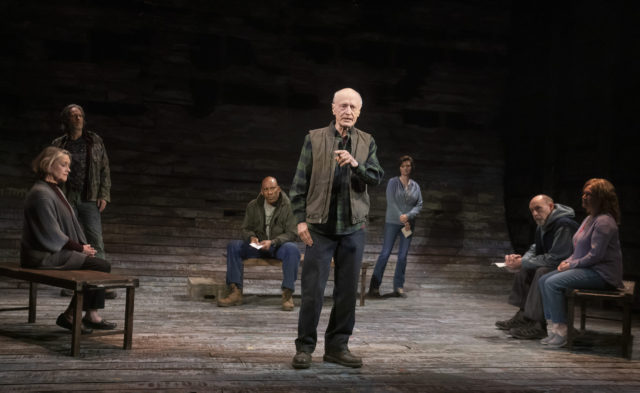
Gary Quarles (Thomas Kopache) shares the story of his son in Coal Country (photo by Joan Marcus)

Gary Quarles’s (Thomas Kopache) son was tired of working off the dangerous longwall. “I’d say Massey ran outlaw from the day Blankenship brought ’em in,” Gary says about the hiring of nonunion employees. “We always said that Massey Energy was his third world country, and Don was the dictator.”

The de-facto leader of the group is Stanley Stewart, known as Goose (Carl Palmer), a third-generation miner whose grandfather was killed on the job. Goose told his wife, Mindi (Amelia Campbell), about how he could see trouble was brewing because of how the new ownership was dealing with basic health and safety issues. “My first twenty years was union. This was the strongest union place in the world before Massey came in,” Goose says. Gary adds, “And I’ll tell you what, you didn’t worry ’bout gettin’ fired by speakin’ up.”

Throughout the play, Grammy-winning folk-country-rock troubadour and activist Steve Earle plays related songs from his chair in the front right corner of the stage, switching between acoustic guitar and banjo. He sometimes gets up and joins the cast, who occasionally sing lines and choruses with him. Earle’s score ranges from the traditional folk song “John Henry,” about an African American “steel drivin’ man” battling a steam drill in the Big Bend Tunnel in West Virginia in the nineteenth century, to “Heaven Ain’t Goin Nowhere,” “The Devil Put the Coal in the Ground,” and “It’s About Blood.”

In “Union, God, and Country,” Earle asks the audience to sing along to these key lines: “Union, god, and country / West Virginia gold and blue / Union, god, and country / was all we ever knew.” Earle also performs his 2013 bluegrass song “The Mountain,” in which he explains, “I was born on this mountain / This mountain’s my home / And she holds me and keeps me from worry and woe / Well, they took everything that she gave / Now they’re gone / But I’ll die on this mountain / This mountain’s my home.” I’ve seen Earle numerous times over the years, from the Ritz and the Bottom Line to the Blue Note, the Lone Star Roadhouse, and Judson Church, and he is an inspired choice for Coal Country; he also served as composer and onstage narrator in Richard Maxwell’s existential Western Samara for Soho Rep. in 2017. On April 5, 2020, Earle played the songs of Coal Country in a free Facebook Live concert and has recorded them for the album Ghosts of West Virginia. (Wednesday night shows will be followed by a discussion with Earle on March 16 and 30 and Blank and members of the cast on March 23 and April 6.)
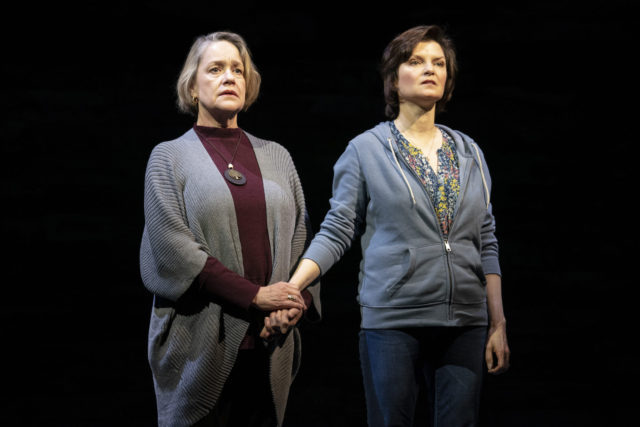
Dr. Judy Petersen (Deirdre Madigan) and Mindi Stewart (Amelia Campbell) wait for word of their relatives in Coal Country (photo by Joan Marcus)

An Audible production that had to cut short its premiere run at the Public in March 2020 because of the pandemic lockdown, the ninety-minute Coal Country has made a successful transition to the Cherry Lane. Richard Hoover’s wood-based set at times places the audience inside the mine, with David Lander’s lighting signaling trouble behind the slats of broken wood in the back. Movement director Adesola Osakalumi guides the actors on- and offstage as they rearrange various benches, providing much-needed breaks between emotional moments.

Married partners Blank and Jensen previously collaborated on such projects as The Exonerated, in which an ensemble reads the words of innocent men and women on death row, and The Line, a virtual Public Theater presentation from July 2020 in which an all-star cast told the verbatim stories of health-care workers and first responders in the early days of the Covid-19 crisis.

In Coal Country, Blank and Jensen do a magnificent job of integrating the individual stories, weaving them together to form a compelling narrative that will have you at the edge of your seat, even if you know exactly what happened. The scenes in which the characters are waiting on news of the fate of their loved ones are unforgettable, especially seen now, after two years of a global health crisis that has killed nearly a million Americans, many of whom died alone, their relatives forbidden to be with them. It’s a uniquely American tale, one that comes amid extreme partisanship, polarization, and divisiveness, but it doesn’t matter where you fall on the political spectrum to be deeply moved and infuriated by its overarching message.

As Earle sings, “It’s about fathers / It’s about sons / It’s about lovers / Wakin’ up in the middle of the night alone / It’s about muscle / It’s about bone / It’s about a river running thicker than water ’cause / It’s about blood.”
UPLOAD

UPLOAD
Park Ave. Armory, Wade Thompson Drill Hall
643 Park Ave. at Sixty-Seventh St.
March 22-30, $45-$150, 7:30 / 8:00
www.armoryonpark.org
www.vanderaa.net

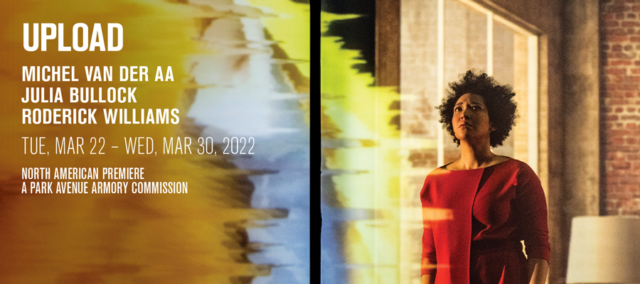
Dutch composer Michel van der Aa returns to Park Ave. Armory this month with the North American premiere of Upload, a multimedia opera running March 22-30 in the Wade Thompson Drill Hall. The hybrid work uses film and motion capture technology to tell the story of a father and daughter seeking digital consciousness, an exciting follow-up to Rashaad Newsome’s recently concluded Assembly installation at the armory, which was hosted by the AI known as Being the Digital Griot.

Previously presented at the Dutch National Opera and the Bregenz Festival in Austria, the eighty-five-minute Upload features soprano Julia Bullock as the daughter and baritone Roderick Williams as the father in person, with Katja Herbers as a psychiatrist and Ashley Zukerman as a CEO in prerecorded flashbacks shot by cinematographer Joost Rietdijk. The score is performed by the Cologne-based Ensemble Musikfabrik under the direction of Otto Tausk; the set and lighting are by Theun Mosk, with motion capture and graphics by Darien Brito and special effects by Julius Horsthuis.

Composer, director, and librettist van der Aa was last at the armory with 2017’s Blank Out, in which Williams appeared onscreen in a story loosely based on the life and career of bilingual South African poet Ingrid Jonker. “Park Ave. Armory is one of my favorite performance spaces in the world,” van der Aa said in a statement. “When it presented Blank Out, I was inspired by the response from the armory’s open-minded and diverse audiences. Upload was developed with the Armory in mind.” There will be an artist talk with van der Aa, moderated by performance artist Marina Abramović, on March 22 at 6:00 ($15).

JANE BY CHARLOTTE

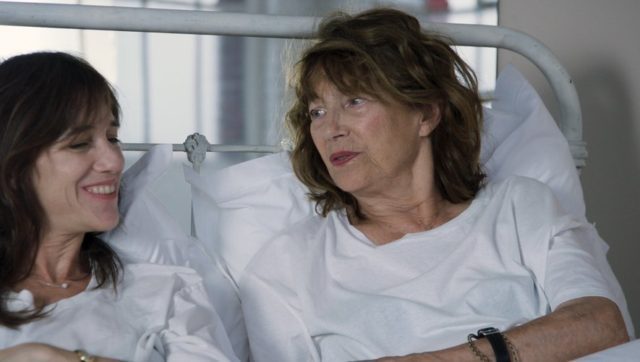
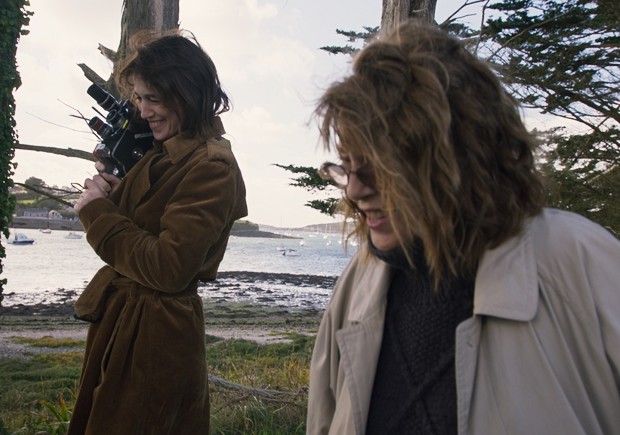
Jane Birkin is seen through the eyes of her daughter in Jane by Charlotte

JANE BY CHARLOTTE (Charlotte Gainsbourg, 2021)
Quad Cinema
34 West 13th St.
Opens Thursday, March 17
212-255-2243
quadcinema.com

Jane by Charlotte is a documentary that only a daughter could make about her mother, a movie about two women who are always being looked at looking at each other.

In 1988, French New Wave auteur Agnès Varda made Jane B. par Agnès V., in which the director herself was a character in the film, showing London-born French singer, actress, and fashion icon Jane Birkin galivanting through imaginative and playful set pieces as Varda photographed her, with Varda sometimes revealing herself in front of and behind the camera. She had just finished Kung Fu Master, a family affair starring Birkin, her daughters Charlotte Gainsbourg (who also appeared in the documentary) and Lou Doillon, and Varda’s son Mathieu Demy.

Charlotte, the actress and singer who is the daughter of Birkin and French pop star and heartthrob Serge Gainsbourgh, now picks up the camera to delve into her complicated relationship with her mother in another family affair, Jane by Charlotte, opening March 17 at the Quad. Charlotte will be at the theater for Q&As after the 7:00 and 7:30 screenings Thursday night. It’s a deeply personal film in which mother and daughter share intimate details of their lives together, the good and the bad, while also avoiding certain topics as they head toward milestones, with Jane approaching seventy-five and Charlotte fifty.

Daughter and mother take a break in bed by Jane by Charlotte

“Filming you with a camera is basically an excuse to just look at you. That’s a brief explanation of the process, OK?” Charlotte tells her mother, who has been looked at most of her life. Birkin has been a public figure since she was a teenager as an international model in the 1960s, her name immortalized in the treasured Hermés Birkin bag. She’s released some twenty albums and appeared in such films as Blowup, Je t’aime moi non plus, La Belle Noiseuse, and Death on the Nile. Charlotte is no stranger to the limelight either, starring in such films as Lars von Trier’s Antichrist, Melancholia, and Nymphomaniac, Franco Zeffirelli’s Jane Eyre, Alejandro González Iñárritu’s 21 Grams, and Michel Gondry’s The Science of Sleep and releasing five records of her own.

Cinematographer Adrien Bertolle follows Jane, Charlotte, and, occasionally, Charlotte’s young daughter, Jo, as they roam from Paris and New York City to Brittany, visiting the beach, a Manhattan rooftop, and, for the first time in many years, the home Jane and Charlotte lived in with Serge, who passed away in 1991 at the age of sixty-two. They are shown rehearsing a duet at the Beacon for the touring concert “Birkin Gainsbourg: Le Symphonique,” performing Serge’s song “Ballade de Johnny-Jane.” [ed. note: Birkin will be performing at the Town Hall on June 22 in support of her December 2020 record, Oh! Pardon tu dormais. . . .] The soundtrack also features snippets of Birkin’s “F.R.U.I.T.,” “Max,” and “Je voulais être une telle perfection pour toi!” and Charlotte’s “Lying with You” and “Kate.”

Jane often poses for her daughter, who takes still shots and movies of her mother, who speaks openly about her aging as Charlotte snaps close-ups of her mother’s wrinkled face, arms, and hands. They lie together in bed, all in a heavenly white, as Jane talks about her insomnia and her longstanding near-addiction to sleeping pills.

Jane had one child with each of her major relationships: She had Kate with her husband, conductor and film composer John Barry, in 1967; Charlotte with Serge, who she never married, in 1971; and singer, actress, and model Lou with director Jacques Doillon in 1982. But mother and daughter carefully avoid several details. They discuss Jane’s recent illness without ever naming it as leukemia. And although they often mention Kate, they never speak of her as being dead; a fashion photographer, Kate died in 2013 at the age of forty-six, perhaps by suicide. Both Jane and Charlotte divide their lives into two segments, before and after Kate, a haunting presence who hovers over them.

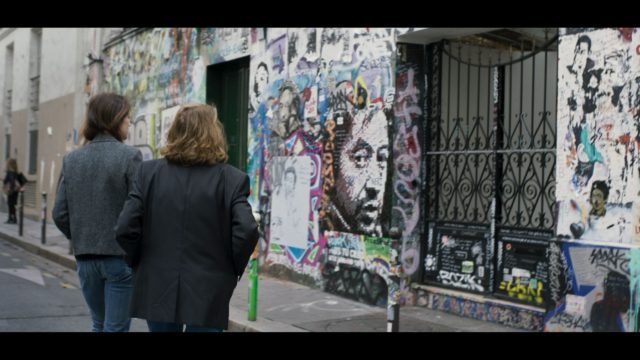
Charlotte Gainsbourgh and Jane Birkin stroll through Paris in intimate documentary

Jane, who suffered a minor stroke in September, has come to terms with getting older. “We don’t have much of a choice, you know,” she says. “I’m very lucky.” She also admits to making mistakes with Charlotte and in other parts of her life. “I never wanted to do wrong in regards to you,” she tells her. “You were so private, and so . . . secretive. I didn’t have any clues.” Later, sitting in front of projections of home movies, Jane confesses, “I think I’m always tormented by guilt. I often wonder if it was all my fault, if I should have done differently, in regards to everything.”

Ultimately, in her directorial debut, Charlotte makes some confessions of her own, revealing what she still needs from her mother. It’s a poignant and emotional, wholly French finale, evoking Truffaut as we watch Jane on a beach, her hair blowing in the wind. The two of them then hug as if they never want to let go, Charlotte’s Bolex camera dangling over her shoulder.

FIRST LOOK 2022: ZERO FUCKS GIVEN

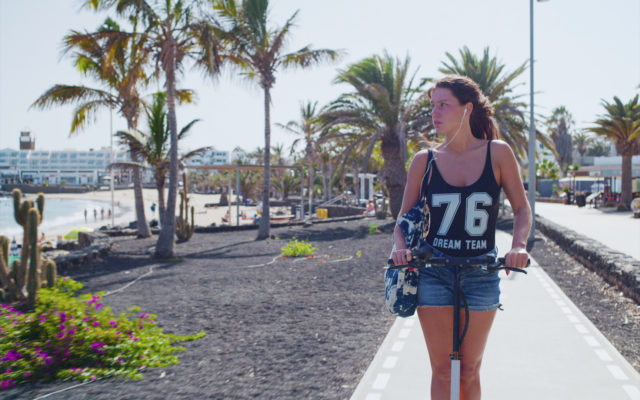
Adèle Exarchopoulos stars as a flight attendant going nowhere in Zero Fucks Given

FIRST LOOK 2022: ZERO FUCKS GIVEN (RIEN À FOUTRE) (Julie Lecoustre & Emmanuel Marre, 2021)
Museum of the Moving Image
35th Ave. at 36th St., Astoria
Friday, March 18, 7:00
Festival runs March 16-20; weekend pass $60; festival pass $120
718-777-6800
movingimage.us

Adèle Exarchopoulos is magnetic as a flight attendant with a loose grip on her life in Zero Fucks Given, the debut directorial collaboration between Paris- and Brussels-based cowriters and producers Emmanuel Marre and Julie Lecoustre. The film makes its New York premiere as part of the Museum of the Moving Image’s eleventh “First Look” festival, consisting of more than three dozen international shorts and features in addition to a gallery presentation and a live virtual reality performance.

Exarchopoulos (Blue Is the Warmest Color, Mandibles) stars as Cassandre, a twentysomething woman who’s unable to commit to anything, but it doesn’t seem to bother her. She considers herself a free spirit, but she doesn’t do much with that freedom. She is based at an airport in Lanzarote in the Canary Islands and wants to get a better airline job in Dubai; she might travel the world, but she spends most of her time in airport hotels and nightclubs, swiping right and left on her cellphone for company. “I like people for two hours and then it’s goodbye,” she tells friends.

As a flight attendant for Wing, she downs vodka before takeoff, usually does the bare minimum at work, and regularly breaks the rules, which she thinks don’t apply to her; when she is offered a promotion, she asserts that she doesn’t want any more responsibilities. After partying, she often wakes up in a blackout about the night before. She might claim to not care, but she is clearly haunted by the death of her mother, who died in a horrific car crash. She has trouble communicating with her father, Jean (Alexandre Perrier), who was devastated by the loss and is trying to sue someone, anyone. When Cassandre — whose name references the Greek mythological figure who was cursed with the ability to prophesize doom that no one listens to — eventually has to return home, suppressed emotions bubble to the surface.

Zero Fucks Given has an infectious, freewheeling atmosphere; the cast includes nonprofessional actors and actual airline personnel, and Perrier, who plays Cassandre’s distraught dad, is one of the associate producers. Marre and Lecoustre (Castle to Castle) eschew rehearsals and encourage significant improvisation while shooting on location with extended breaks in between filming scenes. Exarchopoulos even does her own hair and makeup and wears her own clothing to give the film a more realistic feeling.

Cinematographer Olivier Boonjing zooms in on Cassandre’s face and body as she pretends not to care about what she’s doing, but there’s more to her than she’s allowing herself to acknowledge. “I’m rather lucky,” she says, but she’s going nowhere. She rarely has time to experience the ritzy cities she flies to, traveling back and forth in the enclosed space of airplanes, breathing recycled air. Her mother died in a roundabout, unable to get out of a traffic circle, a stark metaphor for how Cassandre is stuck in life. You might not give a fuck about Cassandre at the beginning, but by the end you’ll be giving more than a few.

Zero Fucks Given is screening at MoMI on March 18 at 7:00. “First Look 2022” runs March 16-20, kicking off with Antoneta Alamat Kusijanović’s Croatia-set Murina, preceded by Tsai Ming-liang’s Hong Kong short The Night. The closing night selection is Pawel Lozinski’s documentary The Balcony Movie. Among the other films are Kirill Serebrennikov’s Petrov’s Flu, Sergei Loznitza Babi Yar. Context, Valentyn Vasyanovych’s Reflection, Qiu Jiongjiong’s A New Old Play, Edwin’s Vengeance Is Mine, All Others Pay Cash, Omar El Zohairy’s Feathers, and Radu Jude’s Semiotic Plastic. There will also be daily “Working on It” lab sessions with live presentations, panel discussions, and screenings, followed by receptions with festival guests

WAVES ACROSS TIME: TRADITIONAL DANCE AND MUSIC OF OKINAWA

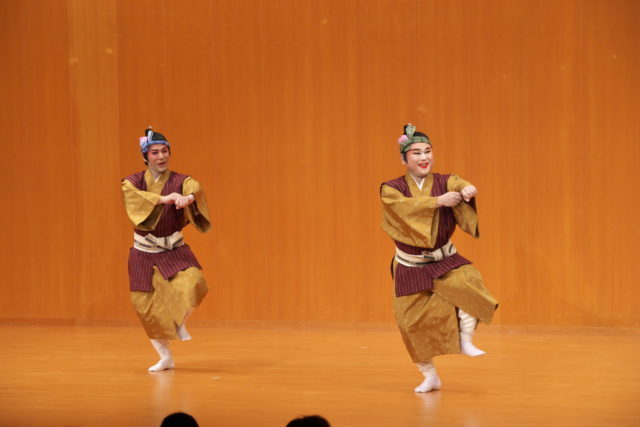
“Waves Across Time: Traditional Dance and Music of Okinawa” comes to Japan Society March 18-19 (photo © Yohei Oshiro)

Who: Okinawan dancers and musicians
What: Performance honoring the golden anniversary of Okinawa being returned to Japan following US WWII occupation
Where: Japan Society, 333 East 47th St. at First Ave.
When: Friday, March 18, and Saturday, March 19, $42, 7:30
Why: On June 17, 1971, the last of the Ryukyu Islands was returned to Japanese control. “Waves Across Time: Traditional Dance and Music of Okinawa” is touring the United States, paying tribute to the fiftieth anniversary of that event with an evening of traditional music and dance that comes to Japan Society on March 18 and 19. Michihiko Kakazu, the artistic director of the National Theatre Okinawa, has curated a diverse program that includes several types of traditional storytelling featuring a select group of performers wearing lavish, colorful bingata costumes, created using a unique Okinawan dyeing process.

“Waves Across Time” begins with excerpts from the noh-inspired kumiodori masterpiece Manzai Techiuchi; “Sakamoto-bushi” features two women using castanets called yotsudake, followed by a dance between brothers disguised as buskers, and concluding with “Shinobi no ba,” a secret rendezvous that includes solos for the thirteen-stringed koto and the fue. The program continues with several zo odori works, folk dances that originated in the nineteenth century and grew in popularity in the late 1920s after the Meiji era, consisting of solos, duets, and ensemble pieces about traditional village life (Murasakae), true love, and martial arts. The music will be performed live on the snakeskin-covered three-stringed sanshin and other traditional instruments. Each performance will be preceded by a lecture on Okinawa by ethnomusicologist Dr. James Rhys Edwards at 6:30; Japan Society will also host the workshop “Introduction to Okinawan Dance,” led by Kakazu and members of the troupe, on March 19 at 11:00 ($50) and “Okinawan Dance Workshop for Families” on March 20 at 10:30 ($40 per family).

MARINA ABRAMOVIĆ IN CONVERSATION: PERFORMATIVE (POSTPONED)

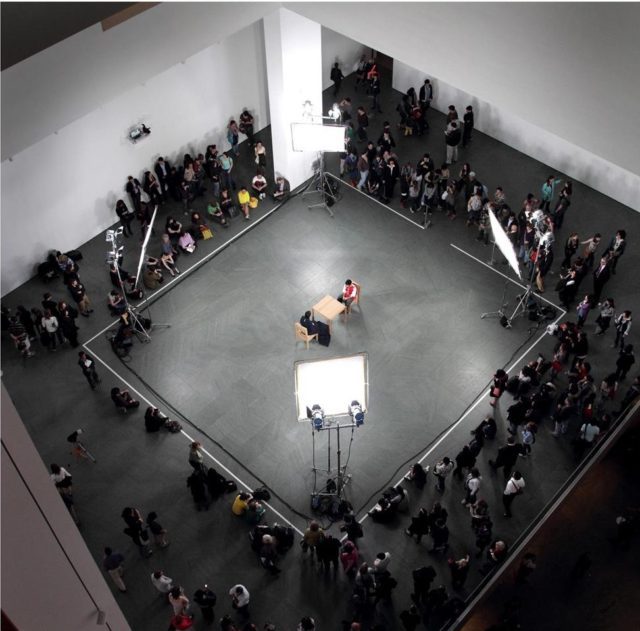
Marina Abramović, The Artist Is Present, MoMA performance, 2010 (photo by Marco Anelli / courtesy of the Marina Abramović Archives)

Who: Marina Abramović, Glenn Lowry, Marco Anelli
What: Livestreamed discussions in conjunction with new gallery show, “Performative”
Where: Sean Kelly Gallery YouTube, MoMA online
When: Tuesday, March 15, free with RSVP, 6:15 [now postponed]; Thursday, March 24, free with RSVP, 7:30
Why: In 2010, MoMA staged the widely hailed immersive exhibition “Marina Abramović: The Artist Is Present,” a chronological career survey highlighted by the re-creation of many of the Belgrade-born artist’s performance pieces, centered by the title work, in which she and a visitor sat across from one another, staring into each other’ eyes for as long as possible as the audience watched. In conjunction with the new Sean Kelly exhibit “Marina Abramović: Performative,” which explores four key turning points in Abramović’s oeuvre, the gallery is presenting a pair of live discussions between and Abramović and special guests, sitting down together but most likely not having a staring contest.

On March 15 at 6:15, Abramović will be at Sean Kelly with Glenn Lowry, the longtime MoMA director who oversaw the 2010 show; the livestream will be available on YouTube. [ed note: This event has been postponed because of the knife attack at MoMA over the weekend.] On March 24 at 7:30, Abramović will be at MoMA for a virtual conversation with Italian photographer Marco Anelli. “Performative,” consisting of photographs, video, objects, and ephemera, is on view at Sean Kelly Gallery at 475 Tenth Ave. through April 16, featuring looks at Abramović’s Rhythm 10, The Artist Is Present, the participatory Transitory Objects, and Seven Deaths.

AN EVENING WITH CHARLES RAY: FIGURE GROUND

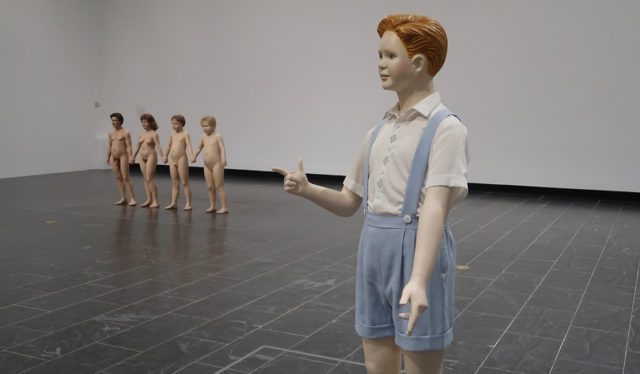
Charles Ray’s Boy points out Family romance at the Met (photo by twi-ny/mdr)

Who: Charles Ray, Hamza Walker, Kelly Baum, Leon Polsky
Brinda Kumar
What: Live panel discussion on exhibition “Charles Ray: Figure Ground”
Where: Grace Rainey Rogers Auditorium, Metropolitan Museum of Art, 1000 Fifth Ave. at 82nd St.
When: Tuesday, March 15, free with RSVP, 6:30 (will be recorded for on-demand viewing)
Why: In his essay in “A Questionnaire on Materialisms,” Chicago-born, LA-based sculptor, photographer, and performance artist Charles Ray wrote of encountering an odd phenomenon every time he approached a particular rock with his flashlight during his every-day early morning walk: The flashlight would always suddenly turn off. He becomes obsessed with discovering why it keeps happening, with no success at first. “Could there be a spirit or a ghost about, some being traumatized in the vicinity of this rock, and I was disturbing it every morning with my light? And was it this specter that was turning the light off?” he ponders. When he eventually finds out why it is turning off by the same rock every day, he admits, “I had found the location of my problem, and somehow it was still just as scary as before I knew the solution.”

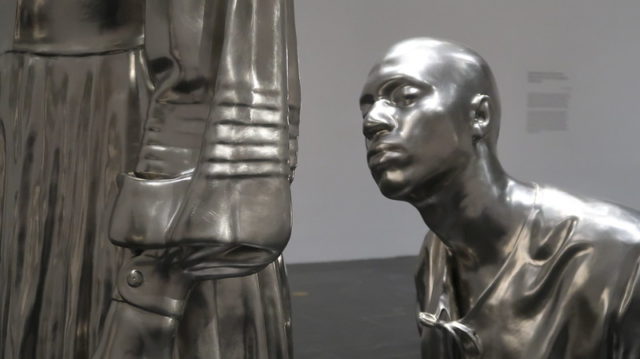
Detail, Charles Ray, Sarah Williams, stainless steel, 2021 (photo by twi-ny/mdr)

Ray’s relationship with the rock is not unlike viewers’ relationship with his art, particularly his sculptures, which range from ultrarealistic works that you will double check to make sure they’re not breathing to oversized and undersized depictions of characters in shiny metal or wood. Nineteen such objects are on display in “Charles Ray: Figure Ground,” continuing at the Met Fifth Ave. through June 5. The show opens with No, what appears to be a photograph of Ray but is actually a picture of a mold of his head and torso fitted with a wig and his glasses and shirt, letting us know from the very start that not everything we are about to see is what we think it is.

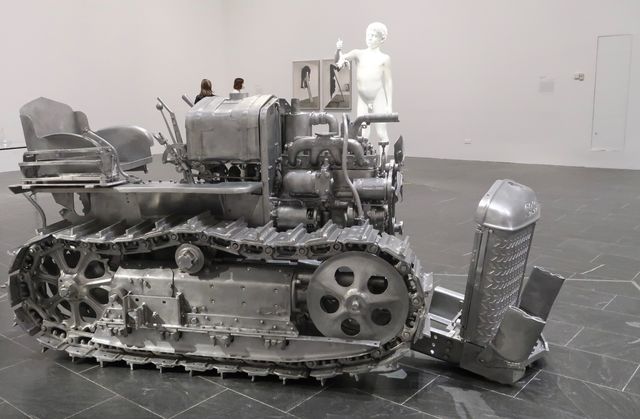
“Figure Ground” is a menagerie of sculptural objects that both confuse and delight. Boy is an adult-size mannequin-like child pointing away, questioning conventions of race, gender, and sexuality. Family romance consists of a naked mother, father, son, and daughter all the same size, holding hands, their faces not appearing to be too happy. For Tractor, Ray reconstructed an existing vintage farm vehicle part by part out of clay and wax, then cast it in aluminum, restoring a childhood memory. A vitrine containing the small sculptures Chicken, Hand Holding Egg, and Handheld Bird bring up ideas of birth and creation, nature and nurture, as well as the fragility of life; Chicken was designed to be touched but it is now too brittle.

Charles Ray’s Boy with Frog stands behind Tractor in Met exhibit (photo by twi-ny/mdr)

Boy with Frog, a large-scale stainless-steel sculpture of a boy dangling a frog from his right hand, is painted white to evoke classical marble statuary. The stainless-steel Huck and Jim is left in glittering, reflective metal; both are naked, with Huck bent over, Jim’s hand almost touching Huck’s back, thoughts of monument destruction, homoeroticism, and cancel culture coming to mind. Mark Twain’s Adventures of Huckleberry Finn is also the impetus for Sarah Williams, in which Jim is on his knees behind Huck, who is disguised as a woman, a scene from chapter ten. Ray references Henri Matisse and Henry Moore in Reclining woman, which is like a Renaissance painting come to life in stainless steel, machined in stunning detail. Archangel was carved out of one block of Japanese cypress, a large-scale male who is a new kind of mythological figure, wearing flip-flops and rolled-up jeans and sporting a man bun. And you’re likely going to have to look at least twice to spot Rotating circle, a slowly spinning circle cut out of the wall that is scaled to Ray’s precise height, as if we are seeing it through his eyes.

In conjunction with “Charles Ray: Figure Ground,” the Met is hosting “An Evening with Charles Ray,” a panel discussion on March 15 at 6:30 in Grace Rainey Rogers Auditorium with Ray, Met curator Kelly Baum, and Met associate curator Brinda Kumar. If you can’t make it in person, it will be recorded and available for on-demand viewing afterward. Just be sure to see the show itself, which is captivating and beautifully curated, with the works spread out to give them maximum affect.