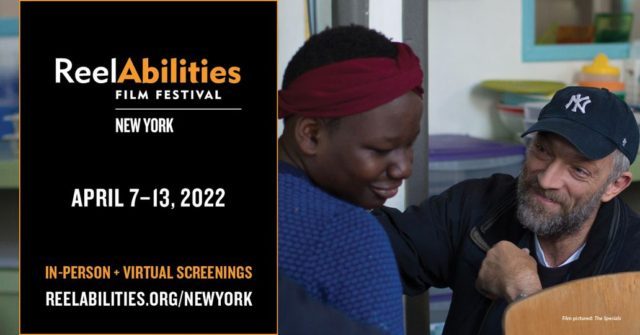
Who:ReelAbilities Film Festival: New York What: Annual festival of films celebrating stories of people with disabilities Where:Marlene Meyerson JCC Manhattan and other venues as well as online When: April 7-13, free – $15 Why: Since 2007, the ReelAbilities Film Festival has been showcasing shorts, features, and animated works from around the world to continue its mission “dedicated to promoting awareness and appreciation of the lives, stories, and artistic expressions of people with disabilities.” The fourteenth annual event takes place at the host venue, the Marlene Meyerson JCC Manhattan, as well as Lincoln Center, the IAC Building, the Museum of the Moving Image, the Maysles Documentary Center, the Intrepid Sea, Air & Space Museum, and online. The opening-night selection is Olivier Nakache and Éric Toledano’s The Specials, about caregivers of autistic youths in underprivileged areas, starring Vincent Cassel, Reda Kateb, and Hélène Vincent; Victor Calise, former commissioner of the New York City Mayor’s Office for People with Disabilities, will be the guest honoree. The closing-night film is Brian Malone and Regan Linton’s imperfect, about a theater group staging Chicago; the screening will be followed by a Q&A with the directors moderated by actor Gregg Mozgala and the presentation of the ReelAbilities Spotlight Award to deaf actress Lauren Ridloff.
Among the other full-length films are Marc Schiller’s deeply personal No Bone: Scars of Survival, Jim Bernfield’s Me to Play, Margaret Byrne’s Any Given Day, Lynn Montgomery’s Amazing Grace, Teemu Nikki’s The Blind Man Who Did Not Want to See Titanic, Linda Niccol’s Poppy, and Jack Youngelson’s Here. Is. Better.; the films deal with such issues as stroke, Parkinson’s disease, mental illness, Acute Flaccid Myelitis, multiple sclerosis, Down syndrome, deafness, ADHD, and PTSD. In addition, there will be workshops on film puppetry and storytelling, an accessibility summit, a solo musical by Anita Hollander, a conversation with Deaf Utopia author Nyle DiMarco, the panel discussion “Just Do It?: The Impact of Perfectionism & Productivity on Mental Health and Disability,” and such shorts programs as “Out of the Box,” “Relationships,” and “Autism.” Many of the screenings will be followed by a Q&A with the filmmakers, actors, documentary subjects, and health experts.
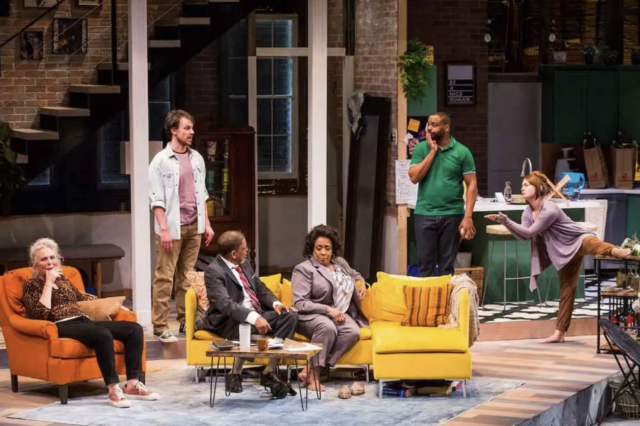
Baltimore Center Stage world premiere of R. Eric Thomas’s The Folks at Home will be livestreamed April 6-10 (photo by J Fannon)
Who:Baltimore Center Stage What: Hybrid production of R. Eric Thomas play Where: Baltimore Center Stage online When: April 6-10, $30 Why: During the pandemic lockdown, I watched hundreds of plays from around the world online; one of my favorite discoveries was Baltimore Center Stage, which presented such shows as The Glorious World of Crowns, Kinks and Curls and The Garden, filmed in the company’s theater and broadcast virtually. Founded in 1963 and located in Baltimore’s Mount Vernon Cultural District since 1975, BCS is currently staging the world premiere of R. Eric Thomas’s comedy The Folks at Home, a 1970s-sitcom-style work about an interracial couple facing various problems, from money and parents to a possible ghost. While it might seem autobiographical, Thomas, who now lives in Baltimore, wrote in 2017, “Okay, first of all, this play is not my life. So, yes, it’s about an interracial gay couple and I am one-half of an interracial gay couple. And yes, it takes place in South Philly, where I also live. But in The Folks at Home, the central couple, Brandon and Roger, own their house, whereas I rent. So there.”
Directed by Obie winner Stevie Walker-Webb (one in two,Ain’t No Mo’), the play stars Alexis Bronkovic, Brandon E. Burton, E. Faye Butler, Jane Kaczmarek, Eugene Lee, and Christopher Sears. Thomas has previously written the national bestseller Here for It, or, How to Save Your Soul in America as well as such plays as Backing Track,Crying on Television, and Mrs. Harrison and episodes of the television series Dickinson and Better Things; Bronkovic, Butler, Lee, and Sears have appeared on many TV series, while seven-time Emmy nominee Kaczmarek has starred on such shows as Malcolm in the Middle,Felicity,Equal Justice, and The Paper Chase. Five of the performances of The Folks at Home — which, of course, has its own theme song — will be livestreamed from April 6 to 10, with a Q&A following the April 7 show.
Dancer Kayla Hamilton is not about to let visual impairment get in the way of her career in Vision Portraits (photo by Kjerstin Rossi)
Who:Moving Body — Moving Image What:ScreenDance Film Festival Where: Barnard College Department of Dance Movement Lab, Glicker Milstein Theatre in the Diana Center, 3009 Broadway at 116th St., and online When: Sunday, April 3, free with advance RSVP, noon – 6:00 pm (festival continues through April 11) Why: The Moving Body — Moving Image Biennale Festival was founded in 2018 by choreographer, dancer, teacher, filmmaker, and curator Gabri Christa to “give voice to social and social justice themes,” two years before dance films began reaching new heights of creativity during the pandemic lockdown, with a concerted focus also on social justice. The third iteration, “The Moving Body with Disabilities,” is underway now at Barnard College, with an international collection of six installation films, eight shorts, one feature, and three online-only works. On Sunday, April 3, Barnard’s Glicker Milstein Theatre will host a full in-person afternoon at its Morningside Heights home, with screenings of all films in addition to a panel discussion. “We are stunned by how much demand there was for the festival films among the global audiences,” Christa, whose now-wheelchair-bound mother was a special ed teacher, said in a statement. “Also, I hope that the pandemic isolation brought greater awareness around social inequity and perhaps more understanding of racism, ageism, and ableism.” The themes of the previous festivals were “Moving Brown Body” in 2018 and “Aging & Othering” in 2020.
The festival begins at noon with welcome remarks, followed by two shorts programs, at 12:30 and 2:00. Part I consists of Robert Dekkers’s Flutter (with AXIS Dance Company and others), Stephen Featherstone’s Stopgap in Stop Motion (with Stopgap Dance Company), Katrina MacPherson’s Uath Lochans (with Marc Brew), and Karina Epperlein’s Phoenix Dance (with Homer Avila, Andrea Flores, and choreographer Alonzo King). The second program comprises Ralph Klisiewicz’s Moods in Three Movements (with Kris Lenzo), Pioneer Winter’s Gimp Gait (with Marjorie Burnett and Pioneer Winter), Alison Ferrao’s From Me (with the Dancer Development Course at Magpie Dance), and Katherine Helen Fisher’s One + One Makes Three (with Jerron Herman, Laurel Lawson, Brandon Kazen-Maddox, Catherine Nelson, and choreographer Alice Sheppard). The feature presentation at 3:00 is Rodney Evans’s 2019 documentary, Vision Portraits, about three artists with vision impairment, made by the blind Evans. Admission is free with advance registration. If you can’t make it to Barnard, all of the films and events will be available online through April 11, including Anna-Lena Ponath’s Eudaimonia, Yannis Bletas’s How to Train an Antihero, and Alexandros Chantzis’s Who Is Honorine Platzer?
Filmmaker Rodney Evans explores his increasing blindness in Vision Portraits (photo by Kjerstin Rossi)
VISION PORTRAITS (Rodney Evans, 2019)
Barnard College, Glicker Milstein Theatre in the Diana Center, 3009 Broadway at 116th St.
Sunday, April 3, free with advance RSVP, 3:00 www.thefilmcollaborative.org
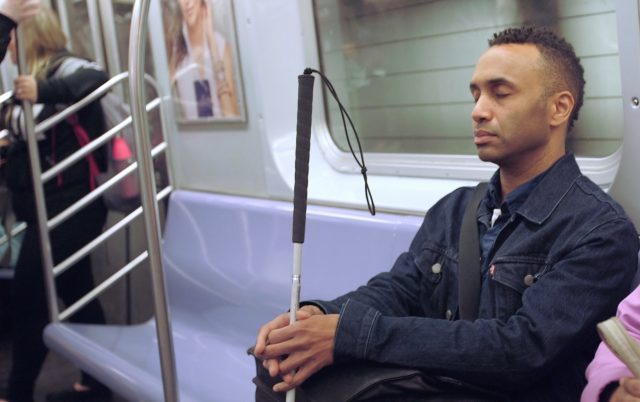
“In a lot of ways, I feel like I’m just looking for guidance in how to be a blind artist,” filmmaker Rodney Evans says in Vision Portraits, his remarkable documentary. Evans follows three artists as they deal with severe visual impairment but refuse to give up on their dreams as he seeks experimental treatment for his retinitis pigmentosa. Manhattan photographer John Dugdale lost most of his eyesight from CMV retinitis when he was thirty-two but is using his supposed disability to his advantage, taking stunning photos bathed in blue, inspired by the aurora borealis he sees when he closes his eyes. “Proving to myself that I could still function in a way that was not expected of a blind person was really gonna be the thing,” he says. “It’s fun to live in this bliss.” Bronx dancer Kayla Hamilton was born with no vision in one eye and developed iritis and glaucoma in the other, but she is shown working on a new piece called Nearly Sighted that incorporates the audience into her story. “How can I use my art form as a way of sharing what it is that I’m experiencing?” she asks.
Canadian writer Ryan Knighton lost his eyesight on his eighteenth birthday due to retinitis pigmentosa, but he teaches at a college and presents short stories about his condition at literary gatherings. “I had that moment where I had a point of view now, like, I realized blindness is a point of view on the world; it’s not something I should avoid, it’s something I should look from, and I should make it my writerly point of view,” Knighton explains. Meanwhile, Evans heads to the Restore Vision Clinic in Berlin to see if Dr. Anton Fedorov can stop or reverse his visual impairment, which is getting worse.
Vision Portraits is an intimate, honest look at eyesight and art and how people adapt to what could have been devastating situations. Evans, who wrote and directed the narrative features Brother to Brother and The Happy Sad, also includes animated segments that attempt to replicate what the subjects see, from slivers of light to star-laden alternate universes. The Moving Body — Moving Image screening at Barnard will be followed by a discussion with Evans and Hamilton.
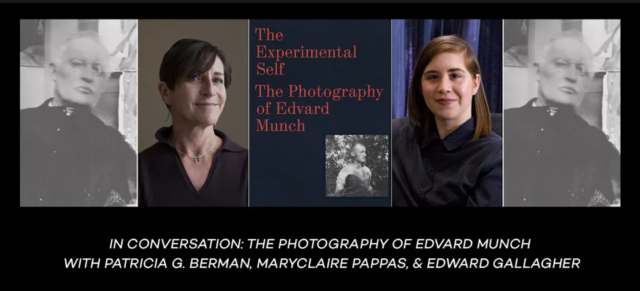
Who: Patricia G. Berman, MaryClaire Pappas, Edward Gallagher What: Live virtual discussion and exhibition tour Where: Scandinavia House YouTube When: Saturday, April 2, free, 1:00 (exhibition continues at 58 Park Ave. at 38th St. through June 4) Why: Norwegian painter and sculptor Edvard Munch “seems to have been one of the first artists in history to take ‘selfies,’” notes the introductory wall text to the Scandinavia House exhibition “The Experimental Self: Edvard Munch’s Photography.” As the free show — which has been brought back, with some wonderful design changes that provide deeper perspective, for an encore run extended through June 4 — reveals, that statement does not just refer to Munch’s penchant for self-portraiture, as demonstrated in the 2018 Met exhibit “Edvard Munch: Between the Clock and the Bed,” which included a detailed look at Munch’s depiction of himself over the years. “Munch painted self-portraits throughout his career, but with increased intensity and frequency after 1900,” Gary Garrels, Jon-Ove Steihaug, and Sheena Wagstaff write in the introduction to the Met catalog. “These ‘self-scrutinies,’ as he called them, provide insight into his perceptions of his role as an artist, as a man in society, and as a protagonist in his relationships with others, especially women. . . . Using himself as subject but always allowing technique to influence effect, Munch was able to powerfully investigate the interplay between depicting external reality and meditating on painterly means.”
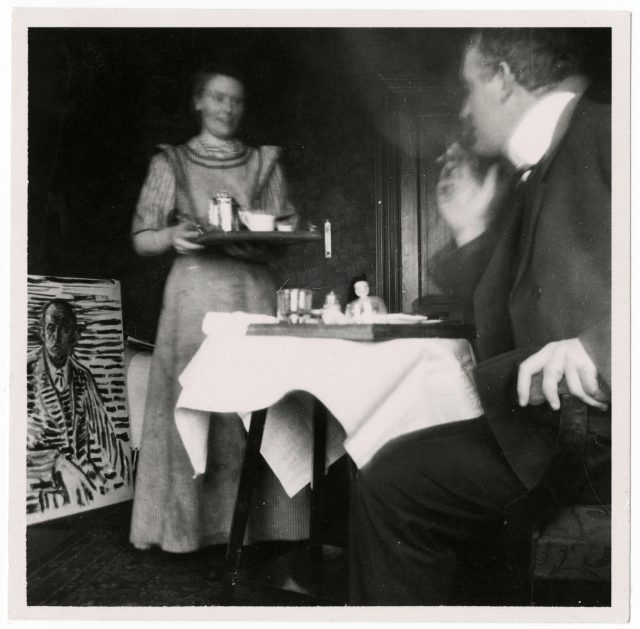
Edvard Munch, “Self-Portrait at the Breakfast Table at Dr. Jacobson’s Clinic,” gelatin silver contact print, 1908-09 (courtesy of Munch Museum)
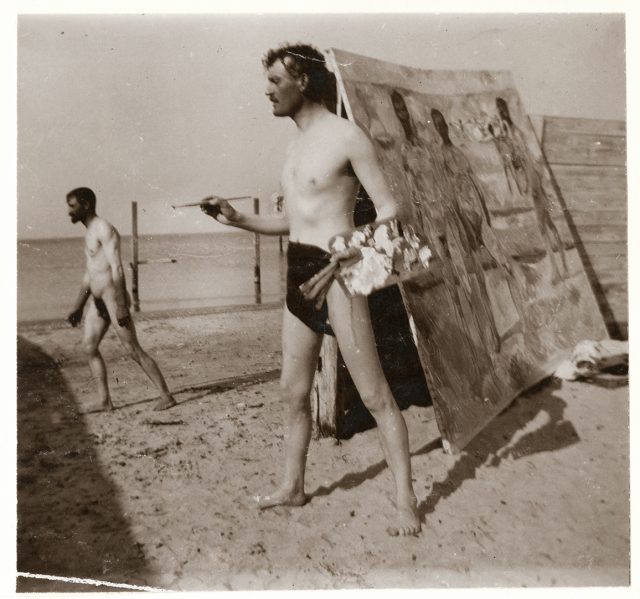
At Scandinavia House, this is evident in his fascination with photography, which he took up during two periods of his life that were fraught with physical and health issues. Munch snapped photographs between 1902 and 1910, after his lover, Tulla Larsen, shot him in the left finger, and again from 1927 to the mid-1930s, suffering a hemorrhage in his right eye in 1930. He also took home movies with a camera in 1927. As in his paintings and particularly his prints, Munch experimented with photographic images, playing with exposure length, camera angles, movement, and shadows for his Fatal Destiny portfolio and individual works. He is purposely blurry in “Self-Portrait in Profile Indoors in Åsgårdstrand,” “Self-Portrait at the Breakfast Table at Dr. Jacobson’s Clinic,” and “Self-Portrait ‘à la Marat,’ Beside a Bathtub at Dr. Jacobson’s Clinic.” He is completely naked, holding a sword in 1903’s “Edvard Munch Posing Nude in Åsgårdstrand,” a kind of companion piece to 1907’s “Self-Portrait on Beach with Brushes and Palette in Warnemünde,” in which he holds a paintbrush. The woman in “Nurse in Black, Jacobson’s Clinic,” from 1908-09, has a lot in common with Munch’s 1891 oil painting, “Lady in Black.” There are multiple, ghostly images of both subjects in 1907’s “Edvard Munch and Rosa Meissner in Warnemünde,” evoking the phantasmic bodies in several prints on view, including “Moonlight II.”
On April 2, American-Scandinavian Foundation president Edward Gallagher will moderate a special live, online presentation with curator Patricia G. Berman giving an up-close look at several photographs in the show, ASF Research Fellow MaryClaire Pappas talking about Munch’s self-portraiture, and a panel discussion on Munch’s relevance to twenty-first-century photography. You can check out the exhibit from home using the new virtual tour here.
Edvard Munch, “Self-Portrait on Beach with Brushes and Palette in Warnemünde,” Collodion contact print, 1907 (courtesy of Munch Museum)
In the Met catalog, in her essay “The Untimely Face of Munch,” Allison Morehead explains, “‘He is not attached to any school or any direction,’ wrote the Norwegian critic and art historian Jappe Nilssen in 1916, ‘because he himself is one of those who advances and creates his own school and forges his own direction.’ Surely with Munch’s complicity, Nilssen described his friend as both stereotypical avant-garde outsider and chronological anomaly, as an art history unto himself, his own school, his own doctrine, and his own teleology. Perhaps then it is little wonder that Munch made so many self-portraits from the beginning to the end of his career, regularly depicting himself in paintings, prints, drawings, and photographs, and also little wonder that art historians have found them so preoccupying.’”
The Scandinavia House show, which has added a case of vintage camera equipment and a short video by Berman and is divided into such sections as “Landscape of Healing,” “Munch’s Selfies,” and “The Amateur Photographer,” concludes with a short compilation of home movies Munch shot with a Pathé-Baby camera, in which the artist once again focuses on himself as his subject. “I have an old camera with which I have taken countless pictures of myself, often with amazing results,” he said in 1930. “Some day when I am old, and I have nothing better to do than write my autobiography, all my self-portraits will see the light of day again.” It’s fascinating to consider just what Munch, who died in 1944 at the age of eighty, would have thought of contemporary social media and the selfie, offering new opportunities to shine a light on himself.
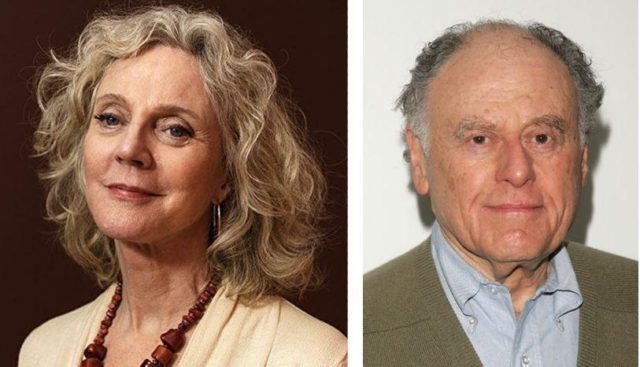
Blythe Danner and Bob Dishy team up again in one-act plays for Food for Thought
Who:Food for Thought Productions What: In-person and livestreamed performance of three one-act plays Where:Theatre 80 St. Marks, 80 St. Marks Pl. at First Ave., and online When: Monday, March 28, free with RSVP for in-person (646-366-9340, info@foodforthoughtproductions.com), 2:00; available online March 28 and April 3 Why: Food for Thought Productions has presented more than a thousand one-act plays since 2000, featuring all-star casts in lesser-known works by major playwrights. Its twenty-second season kicks off March 28 at 2:00 with “An Afternoon of Comedic Delights,” three short plays featuring the incomparable Tony and two-time Emmy winner Blythe Danner and the inestimable Bob Dishy, directed by Antony Marselli, live in person at Theatre 80 St. Marks and online; you can also catch the stream on April 3. The Brooklyn-born eighty-eight-year-old Dishy (Lovers and Other Strangers,Sly Fox,Damn Yankees) and the Philadelphia-born seventy-nine-year-old Danner (Butterflies Are Free,Betrayal,Huff) will first team up for George S. Kaufman and Leueen MacGrath’s Amicable Parting, about a young couple, Bill and Alicia Reynolds, going through their possessions as they plan to separate; in the foreword, the authors explain, “This is meant to be high comedy. It should be played lightly, gayly. Never heavily. Never emotionally. Thank you.”
Early on, Alicia points out a specific painting. “I would like to have this one, if you don’t mind, Bill,” she says. “Suits me,” he replies. “Now, Bill, you’re sure? — I mean, that you don’t want it? Of course, I love it, but then you love it too,” she explains. Bill: “No, Sweetie — you saw it first — I remember very clearly. Paris, ’53. What was the name of the restaurant? Chez Something.” Alicia: “Nico.” Bill: “Chez Nico. Too much to eat, too much to drink, too much for this painting.” Ah, memories.
Bob Dishy and Blythe Danner deal with family issues in Brighton Beach Memoirs
Next up is Peter Stone’s Commercial Break, which has been previously performed by Lauren Bacall and Robert Preston and was initially written for Audrey Hepburn in Charade, then revised for Cary Grant in Father Goose, ending up on the cutting-room floor both times. In the play, Tony, Oscar, Emmy, and Edgar winner Stone (Kean,1776,Woman of the Year) introduces us to Catherine and Harry Crocker; the couple finds itself in quite a predicament when she accuses him of being unfaithful. Dishy presented Stone’s My Doctor the Box with Judy Graubart at a 2007 FFT tribute to Stone, who passed away in 2003 at the age of seventy-three. The third relationship play is Tallulah Finds Her Kitchen, which Neil Simon, Danny Simon, and Joseph Stein wrote for the one and only Tallulah Bankhead, a monologue that takes place, well, in her kitchen. The festivities conclude with a Q&A with Danner and Dishy, who appeared together in Brighton Beach Memoirs in 1986 and in FFT’s December 2021 production of Arthur Miller’s I Can’t Remember.
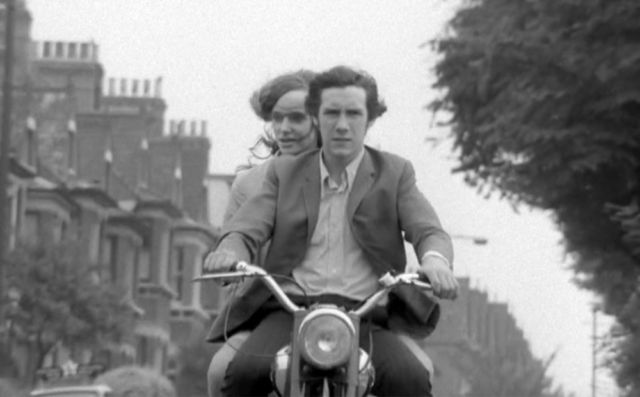
Del (Del Walker) takes Irene (Anne Gooding) on a ride to nowhere in Bronco Bullfrog
BRONCO BULLFROG (Barney Platts-Mills, 1969)
Film Forum
209 West Houston St.
March 25-31
212-727-8110 filmforum.org
It’s a shame that writer-director Barney Platts-Mills won’t be around for the US theatrical premiere of the 2K restoration of his remarkable, long-forgotten 1970 underground black-and-white cult favorite, Bronco Bullfrog. But the British auteur, who passed away in October at the age of seventy-six, did supervise the restoration, and the film’s cinematographer, Adam Barker-Mill, will be at the 7:00 show at Film Forum on opening night, March 25, to talk about the making of the kitchen sink drama, the British neorealist subgenre that included such works as Tony Richardson’s Look Back in Anger, Ken Loach’s Kes, and Jack Clayton’s Room at the Top.
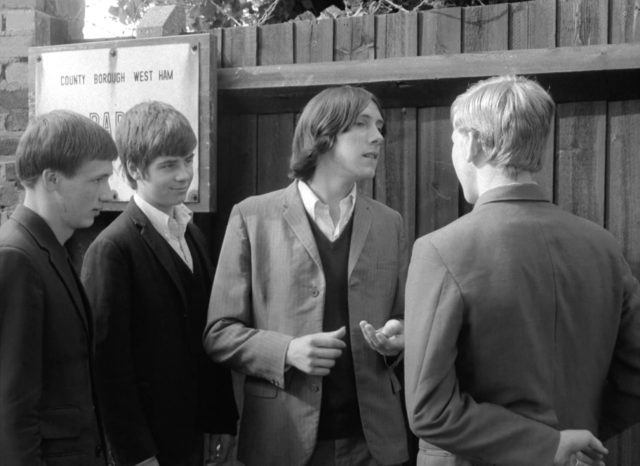
The story takes place in the shabby East End of London, where a group of boys battle malaise and boredom by sneaking into the movies, pulling off petty robberies, and fighting a gang of well-dressed, better-educated guys led by Parker (J. Hughes Jr.). Del Quant (Del Walker) is a seventeen-year-old welding apprentice who hangs around with his ne’er-do-well buddies, Roy (Roy Haywood), Chris (Chris Shepherd), and Geoff (Geoffrey Wincott). When Del meets Chris’s cousin, Tina (Tina Syer), and her fifteen-year-old friend, Irene Richardson (Anne Gooding), Del and Irene start seeing each other, but with little money they don’t exactly go out on the town; sometimes they merely head to the group’s hideout, a ramshackle space with dirty words and magazine pictures of naked women on the walls.
When local legend Jo Saville (Sam Shepherd), also known as Bronco Bullfrog, gets out of reform school, he offers Del a chance to make some fast cash, but they’re not exactly a crackerjack bunch of thieves; Jo, Del, Roy, and Chris are not even the droogs from Stanley Kubrick’s A Clockwork Orange, which came out the following year. In fact, the films have several elements in common; perhaps Platts-Mills was familiar with Anthony Burgess’s 1962 novel. Like Clockwork,Bronco Bullfrog has its own language and features heavy accents, so subtitles are often used, which has also been the case with many of Loach’s films. (In Platts-Mills’s second film, the more free-wheeling Private Road, the protagonists go to see Kubrick’s Spartacus.)
Neither Del’s father (Dick Philpott) nor Irene’s mother (Freda Shepherd) is happy about the kids’ relationship, especially when Sergeant Johnson (Stuart Stones) shows an interest in Del. But Del and Irene keep doing their thing, not talking or doing much as they try to figure out if there’s anything out there in the world for them; they know what they don’t want but not what they do, their lives devoid of the promise of a happy future while they seek out instant, temporary kicks.
Bronco Bullfrog is a wonderfully drawn study of teen angst and ennui. The characters wander aimlessly through empty, decrepit streets and alleys, every turn leading nowhere. Much of the poetic and deeply romantic film is improvised and shot on location where the nonprofessional actors live; it was made for a mere eighteen thousand pounds. Platts-Mills himself ran away from his expensive public school when he was fifteen; his father, John Platts-Mills, was a prominent barrister and member of Parliament.
The idea for the film came from Walker and his friends, who had participated in theater director Joan Littlewood’s workshop at the Play Barn, which was depicted in Platts-Mills’s 1969 documentary, Everybody’s an Actor, Shakespeare Said. They needed something to do, so Walker asked the director to make a movie with them.
Four East End teens battle malaise in Barney Platts-Mills’s Bronco Bullfrog
Although there was a script, the disenfranchised youth, neither mods nor rockers, just go about a fictionalized version of their lives, making it up on the fly as Platts-Mills and Barker-Mill — who became a successful installation artist — keep the cameras rolling. The charmless Del fancies himself a ladies’ man, but the scene in which he meets Irene is hysterical. He and Chris sit opposite Irene and Tina in a small tea shop, with nothing to say; Roy, playing pinball, looks over as if he’s jealous that his pals are talking to girls, but he’s not ready for that either and goes back to his game. On another date, Del, who recently bought a used motorbike, sits with Irene outside the fence of a motocross race, watching the kind of excitement that never comes his way.
Meanwhile, Bronco Bullfrog is no tough gang leader; he’s a bit of a doofus and maybe even just a nice guy who’s lost, which is perhaps why Platts-Mills named the film after him, because he’s a relatively minor character. He’s so thoughtful and gentle with his landlady (E. E. Blundell) that it’s easy to see through his supposed tough exterior. And the battles with Parker and his friends are pathetic; after Del and his group lamely push one of them to the ground, they later brag about how they beat him up.
The 2K restoration, made from the original 35mm print that was saved out of the garbage, is stark and sharp, capturing the feel of the teens’ mundane existence in this downtrodden corner of British society. The soundtrack is by drummer Tony Connor, saxophonist Keith Gemmell, bassist Trevor Williams, and guitarist Howard Werth of the British art-rock band Audience, adding to the late-1960s vibe. The multi-award-winning Platts-Mills went on to make the 1982 sword and sorcery film Hero and the 2010 drama Zohra: A Moroccan Fairy Tale, also about teen lovers. But it all started with Bronco Bullfrog, a landmark of British cinema that is finally getting its due here in America.
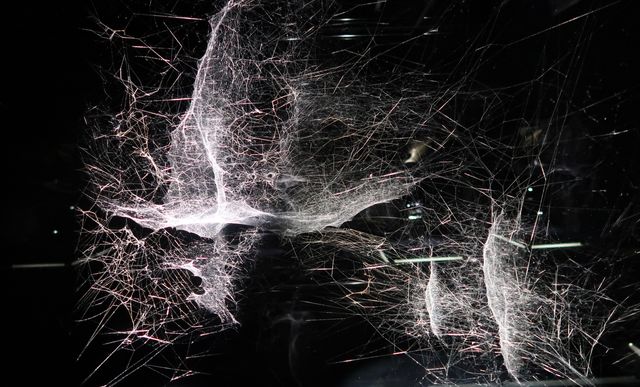
Spiders and their webs are at the center of Tomás Saraceno’s immersive, multimedia exhibitions at the Shed and Tanya Bonakdar Gallery (photo by twi-ny/mdr)
TOMÁS SARACENO: PARTICULAR MATTER(S)
The Shed
545 West 30th St. at Eleventh Ave.
Tuesday – Sunday through April 17
Upper level + gallery: $42; lower level + gallery: $35; gallery exhibition only: $12
646-455-3494 theshed.org studiotomassaraceno.org
The integration of art, technology, nature, and the environment is central to Argentina-born artist Tomás Saraceno’s discipline, currently on display in a pair of complex immersive exhibitions in the city. In “Silent Autumn” at Tanya Bonakdar in Chelsea and “Particular Matter(s)” at the Shed in Hudson Yards, Saraceno investigates toxic air and water, the reuse of plastic bags, rampant consumerism, and, most of all, spiders though collaborations with MIT and NASA, among others, attempting to find ways to fix a broken planet in this out-of-control Capitalocene era.
In a 2014 lecture he gave at MIT, Saraceno discussed the “sociability” of spiders. “It’s very similar to humans,” he said. “Spiders are social because they have enough space and food. But if you put a lot of social spiders in a very tiny space, they are not social. They eat each other. They’re pretty much like humans. There are forty-three thousand species of spider and only twenty are social. Knowing that sociability is a big trend for the survival of the planet, no one really understands this. What we do is try to make [the spiders] operate and work, one with the other, the solitary and the social.” It sounds all too close as humanity emerges from a global pandemic.
Continuing through April 17, “Particular Matter(s)” leads visitors on an audiovisual journey through the kingdom of the spiders. Webs of At-tent(s)ion consists of seven encased hybrid spider webs, hanging in midair and lit so it appears that they’re glowing in the dark. Each case is like its own universe, with different species of spider building on what others started, resulting in magical architectural structures made of spider silk and carbon fibers.
Radio Galena turns a crystal into a wireless radio receptor. Printed Matter(s) reproduces cosmic dust from 1982 in a series of ten photos printed using black carbon PM2.5 pollution extracted from the air in Mumbai; they are arranged loosely on a wall, as if they might blow away and break up into shreds, like the atmosphere being destroyed by pollution. Particular Matter(s) is a light beam that reveals how much dust is in the air that we breathe, poisoned by the burning of fossil fuels.
Arachnomancy features a deck of thirty-three tarot-like meteorological “oracle” cards, printed on carbon-footprint-neutral paper, spread out across a table, based on the beliefs of the spider diviners of Somié, Cameroon, who make cards out of leaves, forecasting weather events. The cards include images of maps, plants, human figures, and webs, with such titles as “Bad News,” “Planetary Drift,” “Invertebrate Rights,” “Entanglement,” and “Fortunate Webbing.” Dangling above the table is a web built by two Cyrtophora citricola spiders that looks like you could rip it apart with a soft breath.
Inspired by the writings of science journalist Harriet A. Washington,We Do Not All Breathe the Same Air uses black carbon, soot, and PM2.5 and PM10 to reveal how pollution impacts air quality in different parts of the country, adversely affecting BIPOC and poorer areas. A red sliding sheet laser brings spider webs to life in a long horizontal window in How to entangle the universe in a spider/web,? which resembles a trip through the human circulatory system or into a far-off galaxy. The concept of spider ballooning and visitors’ movement combine to create music in Sounding the Air, an installation in which five threads of spider silk form an aeolian instrument that emits sonic frequencies when it encounters heat, wind, body movement, and other elements.
A Thermodynamic Imaginary is a room filled with many wonders of Saraceno’s oeuvre, a fantasy world comprising sculpture, projected video (Tata Inti and Living at the bottom of the ocean of air), shadows, reflections, large bubbles, and more, like its own galaxy in what the artist calls the Aerocene: “a stateless state, both tethered and free floating; a community, an open source initiative; a name for change, and an era to live and breathe in.”
On the fourth floor, you have to remove your shoes to walk into Museo Aero Solar, devised by Saraceno and Alberto Pesavento in 2007, an ecological balloon composed of plastic bags sewn together, their brands and trademarks visible, seeking to eventually eliminate the use of fossil fuels by providing sustainable, free-floating options. The gallery also includes documentation of the project and such items as an Aerocene Backpack and flight starter kits.
The centerpiece of “Particular Matter(s)” is Free the Air: How to hear the universe in a spider/web, a live eight-minute concert held in an almost blindingly white two-level, ninety-five-foot diameter floating sculpture, commissioned by the Shed for this exhibition. The limited audience gets misted as they enter the foggy space, which contains 450,000 cubic feet of air and features a large-scale net made of steel and thick wire that evokes a giant spider web on which people lie down; it’s a rather tenuous trampoline with gaps in it, so if you jump, it will affect not only your balance but others’ as well, so don’t play around too much. If you’re on the lower level, you can look up to see the people above you, almost walking on air.
Darkness ensues and the concert in four movements begins, prerecorded sound waves and vibrations of spiders interacting with their webs that are impacted by the audience’s presence, incorporating Sounding the Air,Webs of At-tent(s)ion, and other items in “Particular Matter(s).” It’s a welcoming atmosphere of interspecies communion and coexistence that plots a course for ways to save our increasingly fragile planet using our innate spider-sense and expanding our idea of what home is.
Advance tickets are necessary for the special experience and sell out quickly, so act fast. As part of the Shed program “Matter(s) for Conversation and Action,” on March 30 at 6:00 there will be a free Zoom panel discussion, “Invention, Experimentation, and Radical Imagination,” with MIT professor Caroline A. Jones, climate scientist Dr. Kate Marvel, and Vassar professor Molly Nesbit, moderated by designer, teacher, and entrepreneur Sandra Goldmark, followed on April 13 at noon by “Rights of Nature, Activism, and Change” with lawyer Alicia Chalabe, Dartmouth professor N. Bruce Duthu, and sociologist and writer Maristella Svampa, moderated by Columbia Law School professor Michael B. Gerrard.
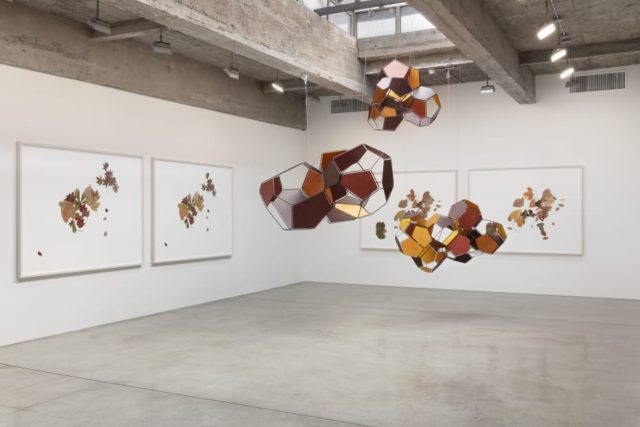
Tomás Saraceno gallery show at Tanya Bonakdar complements Shed exhibition (photo courtesy Tanya Bonakdar Gallery)
TOMÁS SARACENO: SILENT AUTUMN
Tanya Bonakdar Gallery
521 West 21st St. between Tenth & Eleventh Aves.
Tuesday – Saturday through March 26, free, 10:00 am – 6:00 pm www.tanyabonakdargallery.com
In conjunction with the Shed show, Tanya Bonakdar is presenting “Silent Autumn” through March 26. The title plays off Rachel Carson’s seminal 1962 book, Silent Spring, a “fable for tomorrow” that called for the elimination of such chemicals as DDT in order to maintain a living, breathing Earth. The exhibit begins with An Open Letter for Invertebrate Rights, in which Spider/Webs explain, “Do not be afraid. Let us move from arachnophobia to arachnophilia by sensing new threads of connectivity, or else face the eternal silence of extinction.”
Visitors must put booties over their shoes in order to enter Algo-r(h)i(y)thms, a musical instrument comprising a vast network of webs, the strings of which make warming sounds when plucked. You can either create your own solo or work in tandem with others for a more ornate score. Surrounding the instrument are Arachne’s handwoven Spider/Web Map of Andrómeda, with a duet of Nephila inaurata — four weeks and ensemble of Cyrtophora citricola — three weeks and Cosmic Filaments, intricate black-and-white architectural drawings of web universes.
The title diptychs (and one triptych) pair framed leaves glued to inkjet paper next to framed photographs of the leaves; the two works initially look identical, but over time the real leaves will fade and disintegrate while the picture endures. Silent Spring comprises four panels of pressed poppy flowers from contaminated soil near Saraceno’s Berlin-Rummelsburg studio, with shutters that protect them from the sun, although they too will fade; the dirt was polluted by a photographic film and dye manufacturer, so the piece is very much part of Saraceno’s personalized mission of recycling and sustainability.
In the same room, three stainless-steel and wood sculptures hang from the ceiling at different heights, evoking the much larger structures Saraceno installed on the Met roof for “Cloud City” in 2012 as well as the Silent Autumn framed leaves. In a smaller room, the blown glass pieces Pneuma,Aeolus,Aeroscale, and Aerosolar Serpens probe breathing, physical presence, and the brittleness of existence. Other works continue Saraceno’s exploration of overconsumption, pollution, climate change, and the future of life on the planet — and throughout the universe.
Saraceno is a genius at bringing us into his world by creating fascinating objects that are ravishing to look at, then hitting us with the heavily researched science behind it all as he attempts to save the world. But he can only do it with our help.