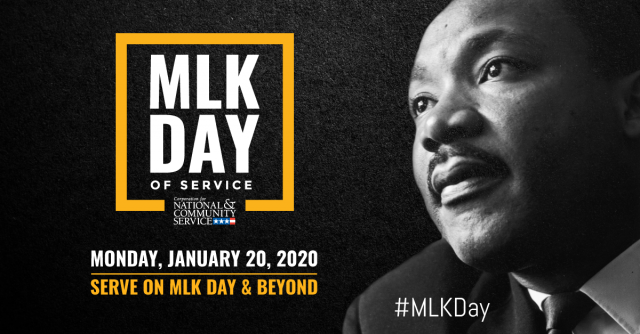
The Rev. Dr. Martin Luther King Jr. would have turned ninety-one years old on January 15; he was only thirty-nine when he was assassinated. In 1983, the third Monday in January was officially recognized as Martin Luther King Jr. Day, honoring the birthday of the civil rights leader who was shot and killed in Memphis on April 4, 1968. You can celebrate his legacy on Monday by participating in the twenty-fifth annual Martin Luther King, Jr., Day of Service or attending one of numerous special events taking place around the city all weekend long. Below are some of the highlights.
Saturday, January 18
BAMcafé Live 2020: The 1865 w/ Major Taylor, curated by Black Rock Coalition, BAM Peter Jay Sharp Building, 30 Lafayette Ave., free, 9:00
Saturday, January 18
through
Monday, January 20 BCM Celebrates Dr. Martin Luther King Jr., with Volunteer Projects with Repair the World, Create a Peace Box workshop in ColorLab, Storytelling in the Sensory Room, and the Heart of a King Shadow Puppetry Workshop, $13, 11:00 am – 5:00 pm
Sunday, January 19 Martin Luther King Day Choral Eucharist, with the Cathedral Choir, volunteer Chorale and Boy and Girl Choristers, and poet in residence emerita Marilyn Nelson, 11:00 am followed by a Spirituals SING led by Alice Parker, Cathedral of St. John the Divine, 1047 Amsterdam Ave. at 2:00, free
Soul to Soul, with IMPACT Repertory Theatre, Lisa Fishman, Cantor Magda Fishman, Elmore James, and Tony Perry, conceived and directed by Zalmen Mlotek, Museum of Jewish Heritage, 36 Battery Pl., $35-$65, 2:00
Monday, January 20 Dr. Martin Luther King, Jr. Commemorative March: “Equity Now: Today’s Youth Speak Out for Social Change,” Harriet Tubman Memorial Triangle on 122nd St. at 10:00 am to Manhattan Country School at 150 West 85th St. at 2:00, free
Thirty-Fourth Annual Brooklyn Tribute to Dr. Martin Luther King, Jr., with keynote speaker Nikole Hannah-Jones, performances by Son Little and the Brooklyn Interdenominational Choir, the art exhibition “Picture the Dream,” and a screening of Aretha Franklin documentary Amazing Grace (Alan Elliott & Sydney Pollack, 2018), BAM Howard Gilman Opera House, 30 Lafayette Ave., free, 10:30 am
Honoring Dr. Martin Luther King Jr., including a scavenger hunt in the “Activist New York” exhibit, storytelling, and art workshops, Museum of the City of New York, 1220 Fifth Ave at 103rd St., free with museum admission of $14-$20 (under twenty free), 11:00 am – 2:00 pm
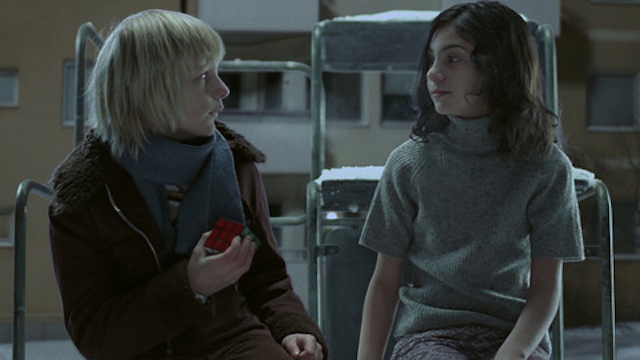
Oskar (Kåre Hedebrant) and Eli (Lina Leandersson) discover a different kind of love in Let the Right One In
LET THE RIGHT ONE IN (LÅT DEN RÄTTE KOMMA IN) (Tomas Alfredson, 2008)
Nitehawk Cinema Prospect Park
188 Prospect Park West
Tuesday, January 21, $95, 7:15 nitehawkcinema.com
If you have a taste for the ghoulish, you’re likely to get sucked in by Nitehawk’s latest Film Feast, in which a multicourse meal accompanies a movie for the cinematic gourmand. On January 21, Nitehawk’s Prospect Park branch will be serving up a delicious gem, the original Swedish thriller Let the Right One In, a chilling yet tender coming-of-age story about friendship and the meaning of family. In a snow-covered Stockholm suburb, twelve-year-old Oskar (Kåre Hedebrant) is severely bullied by Conny (Patrik Rydmark), Andreas (Johan Sömnes), and Martin (Mikael Erhardsson). The frail, blond Oskar dreams of getting even, but he always backs down. But then he meets the dark-haired, somewhat feral Eli (Lina Leandersson, dubbed by Elif Ceylan), who has moved in next door in their apartment complex. While Oskar lives with his divorced mother (Karin Bergquist) — his father (Henrik Dahl) has moved out to the country — Eli lives with Håkan (Per Ragnar), an older father figure who goes out to gather what Eli needs to survive: blood. But the aging Håkan begins encountering difficulties, forcing Eli to go out and hunt down her own food. As people start to go missing in the small community, Eli and Oskar’s friendship begins to blossom, two outsiders coming to terms with who they are. But when Oskar suddenly strikes back, Conny’s older brother, Jimmy (Rasmus Luthander), gets involved, and the steaks, er, stakes, get a whole lot higher.
Based on the 2004 novel by John Ajvide Lindqvist, Let the Right One In is a gripping horror film that is one of the best of the young century. By making the protagonists children with common adolescent problems, Lindqvist, who wrote the screenplay, and director Tomas Alfredson (Tinker Tailor Soldier Spy, The Snowman) create a more realistic setting, so the scares are that much more intense. Hedebrant and Leandersson have a magical chemistry, their tentativeness and fears intoxicating. They exist in a world that is meant only for them; all of the adults are essentially peripheral, whether parents, teachers, or community members wondering what is going on, and the other kids are merely in their way. And it’s all about that very moment; they both might be twelve, but Eli is going to be that age forever while Oskar gets older.
The atmosphere is thick and tense throughout, elevated by Hoyte van Hoytema’s inventive cinematography and Johan Söderqvist’s dramatic score, performed by the Slovak National Symphony Orchestra. Despite some very memorable scenes involving shocking violence, at its heart Let the Right One In is a sweetly innocent love story, albeit with a few unusual complications. Matt Reeves directed a 2010 English-language remake starring Kodi Smit-McPhee and Chloë Grace Moretz, and the National Theatre of Scotland staged a terrific theatrical adaptation that played at St. Ann’s Warehouse in 2015, but there’s still nothing like the original, a visually stunning and psychologically adept fresh new take on the vampire legend.
The five-course feast, with each dish and cocktail named after a part of the film, consists of “”A Little About Drugs” (black cherry, lemon infused Absolut, clarified lemon juice, black shaved ice) with “Good Job Pig” (caraway scented pork belly, pickled carrots, rosemary parsnip purée); “You Smell Funny” (lingonberry, Swedish punsch, allspice, cinnamon, Absolut, Amaro Pasubio, violets, Laphroaig 10 Yr.) with “the Sled Drag” (blodpudding, celery root, Napa cabbage, lingonberry); “Oskar, Do You Like Me?” (acid adjusted apple juice, dill infused Absolut, pine, Salers, pickled apple) with “I’m Trapped” (Swedish meatballs with pour it yourself Absolut gravy); “Virginia!” (Absolut, banana, cream, walnut, caraway, served ice cold) with “Blood Brothers” (rye bröd, gravlax, apple, dill crème fraîche, beet reduction splatter), and “Thank You” (frozen chocolate and espresso martini, white shaved ice) with a “Bloody Kiss” (Hallongrotta, Absolut Pear whipped cream, powdered sugar). Smaklig måltid!
The life and times of Aulcie Perry on and off the court are documented in New York Jewish Film Festival opener
AULCIE (Dani Menkin, 2019)
Walter Reade Theater, Film at Lincoln Center
165 West 65th St. between Broadway & Amsterdam Aves.
Thursday, January 16, 8:30
Festival runs January 15-28
212-875-5050 www.filmlinc.org thejewishmuseum.org
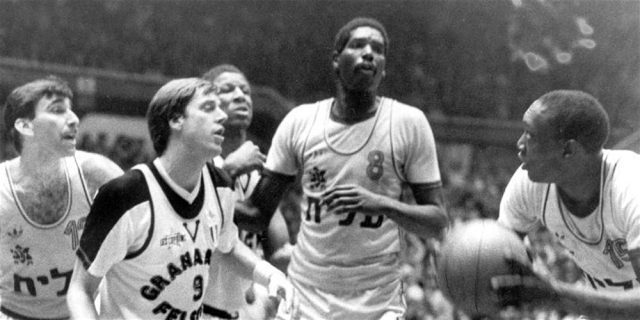
Israeli director Dani Menkin follows up his 2016 documentary, On the Map, about Maccabi Elite Tel Aviv’s unlikely victory in the 1976-77 European Champions Cup, with an inside look into the life of one of its stars in Aulcie, the opening night selection of the New York Jewish Film Festival. After being the last man cut from the New York Knicks in 1976, Newark native Aulcie Perry was recruited to play for Maccabi in Israel, where the 6-10 black man — an unusual sight in the Land of Milk and Honey — quickly became a superstar, helping the team to championships, falling in love with top model Tami Ben Ami, and hanging out in hot clubs, living the high life. But it all came tumbling down in a haze of drugs, and Menkin traces Perry’s attempt to put it all back together, primarily by finding the daughter he has not seen since she was a baby.
The film is set up as Perry’s confession to that daughter, Cierra Musungay. “I always knew one thing: that I wanted to tell you my story, the way it is, with the good and the bad,” he says at the beginning. “So where do I start? People say you start at the beginning. But I wanted to start at the end, or when I thought the end was coming.” He was inspired to track her down after facing a serious health scare. “I think, that only when I almost died, I started to really live. And that’s when I wanted to find you and, maybe in some ways, find myself,” he adds.
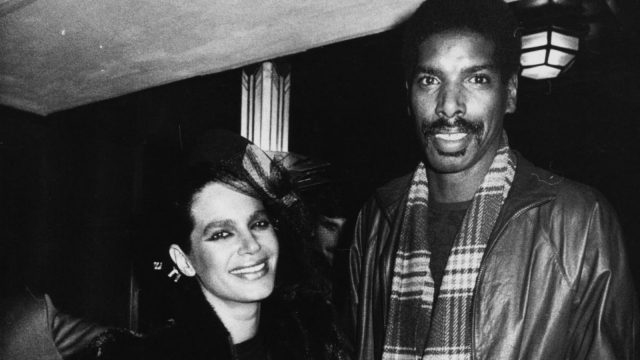
Top model Tami Ben Ami and basketball superstar Aulcie Perry are shown as the hot couple in Aulcie
Menkin goes back and forth between archival footage, animation by Assaf Zellner, and interviews with Aulcie’s sister Bernadine Lewis, his friends Wayne Tyre and Roy Young, his ex-girlfriend Juanita Jackson, his son Aulcie Perry Jr., and many men from his Maccabi family, including former teammates Earl Williams and Tal Brody, team president Shimon Mizrahi, co-owner Oudi Recanati, coach Zvi Sherf, and manager Shamluk Maharovsky, who was like a father to him. “In Israel, there wasn’t that much prejudice against black players, and he felt at home here,” NBA commentator Simmy Reguer says. “Aulcie came in like a blessing from the gods,” fellow Jersey native and team captain Brody recalls. And Sports Illustrated writer Alexander Wolff explains, “At Maccabi Tel Aviv, Aulcie Perry was Michael Jordan, Kareem Abdul-Jabbar rolled into one.”
Now sixty-nine, Perry is honest and forthright thorughout, admitting his failings and wanting to make up for lost time. He makes no excuses for his precipitous fall, and he’s not seeking sympathy. He’s a man who made mistakes and wants a chance to set things right. Aulcie is a cautionary tale of redemption with heart and soul, focusing on the need to be part of a family, no matter how different and unexpected it may be. Aulcie is having its New York City premiere January 16 at 8:30 at the Walter Reade Theater, with Perry, Menkin, and producer Nancy Spielberg (brother of Steven) participating in a Q&A. Aulcie might be the opening selection of the New York Jewish Film Festival, but the twenty-ninth annual fest actually kicks off a day earlier with Picture of His Life, a documentary codirected by Menkin and Yonatan Nir about Yom Kippur War veteran and underwater photographer Amos Nachoum, showing on January 15 at 1:00, with Menkin, Spielberg, and Nachoum present. A joint presentation of Film at Lincoln Center and the Jewish Museum, the festival continues through January 28 with such other works as Marceline Loridan-Ivens’s centerpiece The Birch Tree Meadow, starring Anouk Aimée and August Diehl, a fiftieth anniversary presentation of Vittorio De Sica’s The Garden of the Finzi-Continis, and Dror Zahavi’s closing night selection, Crescendo, about an attempt to establish an Israeli-Palestinian youth orchestra.
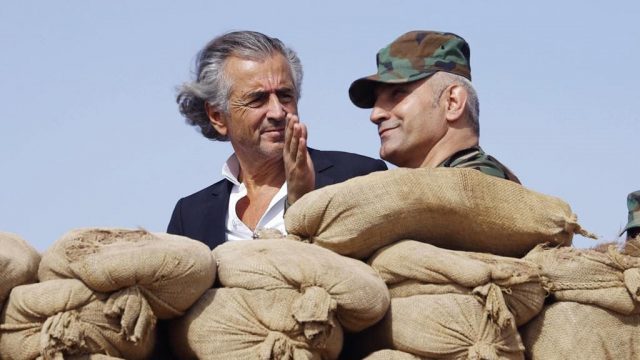
Bernard-Henri Lévy speaks with General Maghdid Harki in gripping war documentary Peshmerga
Quad Cinema
34 West 13th St. between Fifth & Sixth Aves.
January 10-16
212-255-2243 quadcinema.com
In the introduction to his most recent book, The Empire and the Five Kings: America’s Abdication and the Fate of the World, published in February 2019, controversial and provocative Algerian-born French Jewish philosopher Bernard-Henri Lévy writes, “When I review the reasons why, at this stage of my life, I poured so much energy into the cause of the Kurds and Kurdistan, this is what comes to mind. The justice of the fight, of course. . . .
“Next, there is the debt they are owed. The indelible debt that the world owes to the only armed force that, when ISIS appeared and the region was frozen stiff with terror, dared fight it face-to-face. It was because I was aware of this debt that I, with a small band of friends, came to the region between July and December 2015 to shoot a documentary film, Peshmerga, along the six-hundred-mile front that the Kurds were holding, alone, against the fanatics of the Islamic State. It was because I was aware that these men and women — the Peshmerga includes battalions of women — were the first line of defense not only of Kurdistan but of the world, that I left Europe again in November 2016, on the first day of the fight for Mosul, to make a second documentary, The Battle of Mosul, about the liberation of the most important city of the Caliphate. And it was for the same reasons that I personally promoted these films wherever anyone was willing to show them, that I brought the first of them to the very symbolic great hall of the United Nations building in New York and to the hallowed dome of Congress in Washington, and that I lived those two years in step with the Peshmerga and their aspirations. These fighters were sentinels against barbarism, the world’s outposts and shields. The film crew and I deemed it essential to be the witnesses of that.”
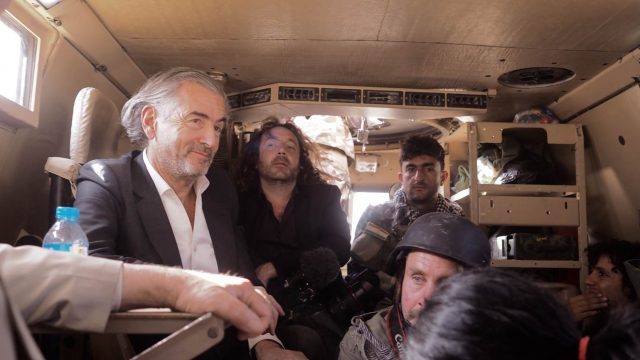
Bernard-Henri Lévy embeds himself with Kurdish troops in The Battle for Mosul
What Lévy and his brave crew were witnesses to can be seen at the Quad, which will be hosting the series “Bernard-Henri Lévy x 4,” with the seventy-one-year-old Lévy, popularly known as BHL, making four appearances at the Thirteenth St. theater this weekend. The festival begins with the weeklong theatrical release of 2016’s Peshmerga and 2017’s The Battle of Mosul, shown as a double feature; the 7:00 screenings on January 10 and 11 will be followed by Q&As with Lévy, the first moderated by Adam Gopnik, the latter by Ben Cohen. In addition, on January 11, Lévy will introduce the 2:15 screening of 1994’s Bosnia-set Bosna! and the 4:45 screening of 2012’s The Oath of Tobruk, about the fall of Muammar Gaddafi.
Peshmerga and The Battle of Mosul are remarkable inside looks at war; Lévy, who has also directed the romance Day and Night and written such books as Who Killed Daniel Pearl?, In the Footsteps of Tocqueville, and In the Spirit of Judaism, embeds himself with the Peshmerga, troops dedicated to ridding the world of ISIS, aka Daesh; the name Peshmerga translates as “Those who stand in the face of death,” and that’s just what happens throughout the two films. Lévy rides with the Kurdish military, joining the somewhat ragtag but dedicated group of fighters as they investigate villages, journey into tunnels, and get shot at in bunkers. Along the way from Kirkuk to Erbil and Mosul, he encounters such brave men and women as General Kemal Kirkuki, General Maghdid Harki, Mike Barzani, Dr. Jacques Bérès, Prime Minister Nechirvan Barzani, Iraqi general Fazeel Barwari, counterterrorism leader Abdulwahab al-Saadi, and Helly Luv, the Kurdish Madonna who makes anti-Daesh music videos. “Daesh is the enemy of the whole world,” one soldier says, explaining why they do what they do — and are extremely successful at it. Lévy risks his life and that of his crew, which includes cinematographers Ala Hoshyar Tayyeb, Olivier Jacquin, and Camille Lotteau, one of whom gets caught in an explosion. He thankfully chooses not to show the killing of one general, who gets shot in the head while using sandbags for cover, something Lévy will never forget.
The films feature gripping scores by Nicolas Ker, Jean-Fabien Dijoud, Henri Graetz, and Jeff D., with sound by Jean-Daniel Bécache and editing by Camille Lotteau that make you feel like you’re part of the action, the threat of snipers, booby-trapped vehicles, and IEDs ever present. “Good God, how ugly, dirty, and foul war is!” Lévy cries out, but he also sees reason for hope. “The spirit of Bashiqa, the timeless alliance between Yezidis, Muslims, and Christians, promptly flourishes again,” he says at one point while also showing villagers’ respect for the history of the region’s now-departed Jewish population.
“We witnessed the astonishing spectacle of the world’s leading power consenting to the defeat and humiliation of its staunchest ally in the region,” he continues in the book’s introduction. “We saw the same President Trump, who had just declared Iran to be enemy number one in the complicated Middle East, voice no objection as Major General Qasem Soleimani, head of the Quds Force, the elite unit of the Iranian revolutionary Guards responsible for Iran’s external operations, came and went, parading around the field of battle like a conqueror and posing for photographers. . . . The Kurds perceived this nonintervention as a terrifying enigma.” It should be fascinating to hear what he has to say about Trump and Soleimani now. Lévy also notes of the fighters who lined up to vote at the ballot box, “Like them, I was thinking that this affair bore an unmistakable odor of betrayal. Like them, I was shocked by the mixture of amateurism, fecklessness, and absence of vision of the U.S. and European administrations.”
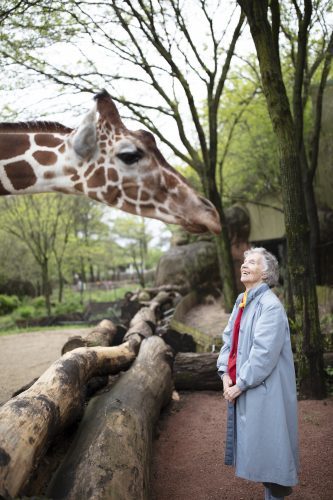
Anne Innis Dagg returns to where it all started in The Woman Who Loves Giraffes
THE WOMAN WHO LOVES GIRAFFES (Alison Reid, 2019)
Quad Cinema
34 West 13th St. between Fifth & Sixth Aves.
Opens Friday, January 10
212-255-2243 quadcinema.com
Before Jane Goodall went to Tanzania to study chimpanzees and Dian Fossey headed to Rwanda to study mountain gorillas, Canadian biologist Anne Innis Dagg was in South Africa, studying giraffes. Her delightful yet infuriating story is told in Alison Reid’s The Woman Who Loves Giraffes, which opens January 10 at the Quad, where the eighty-six-year-old Dagg will participate in Q&As with Reid at six screenings on Friday and Saturday. Dagg fell in love with giraffes when she was three and first saw them at the Brookfield Zoo in Chicago. In 1956, when she was twenty-three, she set off for the Fleur de Lys ranch near Kruger National Park. That trip was quite a victory, based on a bit of subterfuge; in her application to manager Alexander Matthew, she didn’t identify herself as female because she had been previously rejected by many other locations that claimed that “Africa is no place for a young woman.”
She spent a year taking meticulous notes on the social and sexual behavior of giraffes, essentially making up her methods as she went. “No one had ever really studied an African animal in the wild, or pretty well any animal in the wild,” she says in the film. “So I was sort of breaking ground without realizing it.” But when she returned to Toronto, Dagg, the daughter of a university professor father and an economic historian mother, both of whom were widely published writers, was met with a frightening amount of misogyny in the scientific and education communities; she failed to get tenure or other prominent teaching positions, which led her to become a feminist activist in the 1970s. “She ran into the old boys’ network and I think it destroyed her career,” says former University of Guelph professor Sandy Middleton, the only member of the tenure committee that supported Dagg. All these years later, the head of the committee, former dean Keith Ronald, still adamantly defends his decision against Dagg.
It wasn’t until 2010 that Dagg, who uses “giraffe” as both a singular and a plural, reentered the giraffe fold, mainly because of women such as San Francisco Zoo curator Amy Phelps, who says, “I was the little girl that that woman was a hero for, and so it was really important to me that we be able to find her. . . . We were searching for Anne because we really didn’t know if she was alive.” Reid follows Dagg as she is celebrated at the Giraffe Care Conference in Arizona, then goes back to Africa for the first time since the mid-1950s to attend a Giraffe Indaba near Fleur de Lys, bringing her daughter, Mary, with her. Reid and editors Mike Munn and Caroline Christie heartwarmingly intercut footage Dagg took in 1956, photographs and 16mm film, with new scenes of her in the same exact places. Reid also includes narration of Dagg’s extensive letters and writings — she’s written more than twenty books, most importantly The Giraffe: Its Biology, Behavior, and Ecology, considered the bible on the subject — with the voices of Tatiana Maslany as Dagg, Victor Garber as Matthew, David Chinchilla as Anne’s husband, Ian, and Lindsay Leese as Dagg’s mother, Mary Quayle Innis.
The previously little-known Dagg — who in 1965 stumped the To Tell the Truth panel, a clip of which begins the documentary — revels in her newfound semicelebrity and has delved right back into her research. “I always wanted to be a scientist,” she says. The documentary has an inconsistent pace and treacly music, but it’s a thrill watching Dagg look back at her past as she heads into the future; it’s also hard not to think about what could have been had she not been thwarted time and time again because of her gender.
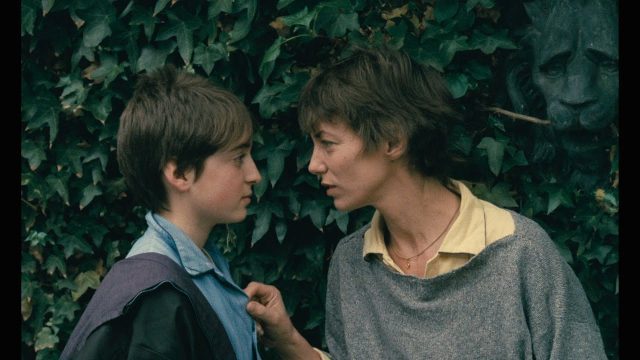
Julien (Mathieu Demy) and Mary-Jane (Jane Birkin) fall for each other in Agnès Varda’s Kung-Fu Master!
KUNG-FU MASTER! (LE PETIT AMOUR) (Agnès Varda, 1988)
Film at Lincoln Center, Walter Reade Theater
165 West 65th St. between Eighth Ave. & Broadway
Monday, January 6, 9:15
Series continues through January 8 www.filmlinc.org
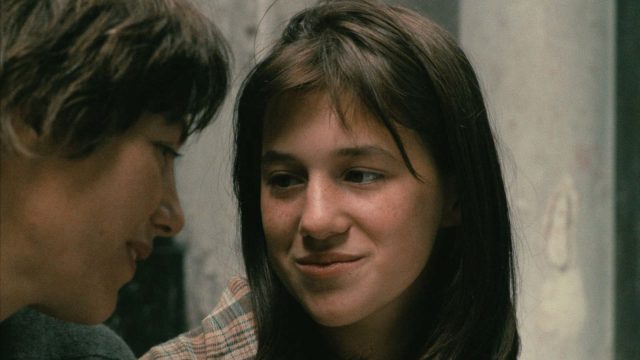
Film at Lincoln Center’s “Varda: A Retrospective” continues January 6 with a real family affair, Agnès Varda’s curiously compelling 1988 drama Kung-Fu Master!, the French title of which is the more appropriate Le petit amour, or “The Little Love.” Written by Varda and English actress, model, and singer-songwriter Jane Birkin from Birkin’s idea, the film stars Birkin as Mary-Jane, a divorced forty-year-old woman living with her fourteen-year-old daughter, Lucy, portrayed with wide-eyed innocence by Charlotte Gainsbourg, Birkin’s real-life daughter with French superstar Serge Gainsbourg, and her younger child, Lou, played by Lou Doillon, Birkin’s daughter with French director Jacques Doillon. Mary-Jane falls in love practically at first sight with one of Lucy’s classmates, fourteen-year-old Julien, portrayed by Mathieu Demy, Varda’s son with French auteur Jacques Demy. Birkin’s parents, actress and playwright Judy Campbell and fine artist and actor David Birkin, play Mary-Jane’s mother and father, while Birkin’s brother, screenwriter Andrew Birkin, plays her brother. And Varda’s daughter, costume designer, actress, and producer Rosalie Varda, will be at the Walter Reade Theater on January 6 to introduce the screening. Varda often liked to blur the line between fiction and nonfiction, but don’t let all that reality confuse you: Kung-Fu Master! is most certainly not a documentary, thank goodness.
Mother and daughter Jane Birkin and Charlotte Gainsbourg star as mother and daughter in Kung-Fu Master!
Somewhat reminiscent of Bertrand Blier’s 1981 Beau-père, in which thirty-year-old Rémi (Patrick Dewaere) falls for his fourteen-year-old stepdaughter, Marion (Ariel Besse), Kung-Fu Master! treads in dangerous territory, exploring a taboo love, even as it does so with care and sensitivity and a tender performance by Birkin. Mary-Jane is well aware that she should not be considering a relationship with a young boy, but she has a yearning to explore the furthest boundaries of desire. However, her choice of Julien is beyond strange, as he is an ordinary teen, who plays Dungeons and Dragons and the arcade game Kung-Fu Master! and has banal conversations with his peers; he is not some hulking, mature figure who is smart and sophisticated for his age. “I know I won’t be around when you start shaving,” Mary-Jane tells Julien. The film also refers repeatedly to the AIDS crisis, which the teenagers are only just learning about and dismiss as somebody else’s problem. Varda never brings the AIDS subplot full circle; perhaps it’s there primarily to emphasize the dangers sex can bring, but she leaves that thread hanging. You’re likely to feel dirty watching Kung-Fu Master!, but you also won’t be able to look away. (Birkin/Gainsbourg fans will also want to check out “Birkin Gainsbourg The Symphonic Starring Jane Birkin” at the Beacon Theatre on March 6, with special guests Iggy Pop and Charlotte Gainsbourg.)
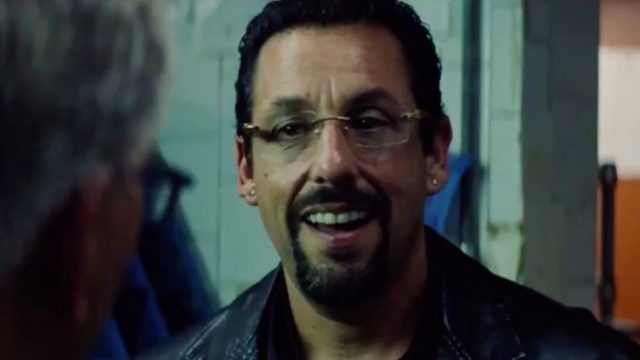
Adam Sandler plays a diamond dealer in danger in Uncut Gems
UNCUT GEMS (Josh Safdie & Benny Safdie, 2018)
MoMA, Museum of Modern Art
11 West 53rd St. between Fifth & Sixth Aves.
Friday, January 3, 7:00
Series continues through January 8 www.moma.org a24films.com
“That was manic, pure mania,” the Safdie brothers narrate at the end of a trailer for their latest film, Uncut Gems. You can hear Josh Safdie and Benny Safdie say more about the film, a manic gem, when they discuss it following the January 3 screening at MoMA as part of the “Contenders” series, consisting of 2019 films that the institution believes will stand the test of time. Uncut Gems is a furious, unrelenting movie that sucks you into its claustrophobic frenzy and never lets go. Adam Sandler is a force, reaching new heights as Howard Ratner, a Diamond District dealer with a gambling addiction. He’s deep in debt to Arno (Eric Bogosian), who has sent his two goons, Phil (Keith Williams Richards) and Nico (Tommy Kominik), to make sure Howard knows just how much trouble he is in. His wife, Dinah (Idina Menzel), is fed up with him, not in the least because he has an apartment with his mistress, the much younger Julia (Julia Fox), and is not the most reliable father to their children, Eddie (Jonathan Aranbayev, who was discovered on Forty-Seventh St. in front of his parents’ jewelry store), Beni (Jacob Igielski), and Marcel (Noa Fisher).
Howard has a master plan to break free of all his problems by selling a chunk of Ethiopian black opals at an auction, with the help of one of his assistants, Demany (Lakeith Stanfield), who has lured in Boston Celtics center Kevin Garnett (terrific in his acting debut), who is fascinated by the rare, uncut gems, which sparkle with promise. The last half hour of the film is a brilliant, claustrophobic tour-de-force in which everyone onscreen is physically trapped, just like the audience is pinned to their seats, holding on for dear life. The Safdies, whose father worked in the Diamond District, use a mix of professional and nonprofessional actors as well as famous people playing themselves; the cast includes sports-radio legend Mike Francesa as a bookie, Garment District legend Wayne Diamond as a big-time gambler, Judd Hirsch as Howard’s father, Natasha Lyonne and Tilda Swinton as phone voices, and restaurant owner Nino Selimaj, writer Larry “Ratso” Sloman, actor John Amos, the Weeknd, and others as themselves.
Written by the Safdies (Daddy Longlegs, Heaven Knows What) with longtime collaborator Ronald Bronstein, Uncut Gems, which has been in process for ten years, is anchored by a career-redefining performance by Sandler, who previously revealed his significant acting chops in Paul Thomas Anderson’s 2002 Punch-Drunk Love and Judd Apatow’s 2009 Funny People. In a performance that will make you forgive him for The Waterboy, Big Daddy, Little Nicky, and Mr. Deeds, among other silly effluvia, Sandler is a whirlwind throughout the film’s 135 minutes, which fly by. Darius Khondji’s camera is practically glued to him, Sandler’s unshaven, gruff face a character unto itself, Howard’s eyes always at least one step ahead of what’s happening in front of him. He’s a dreamer, and although you can’t not root for him, he is far from a likable hero. He is singlehandedly responsible for the dangerous mess he’s in, whether he admits it to himself or not. But he is also a kind of everyman, peering through the looking glass (in this case, the seductive, multicolored opals in the stone), trying to survive in a hectic, frenetic world that can be overwhelming and spin out of control at any moment. You can’t just sit back, relax, and enjoy Uncut Gems; instead, you can’t help but be fully immersed in its nonstop, feverish intensity. “The Contenders 2019” continues through January 8 with such other recent, well-received as Jérémy Clapin’s adult anime I Lost My Body, Sam Mendes’s WWI drama 1917, and Melina Matsoukas’s Queen and Slim.