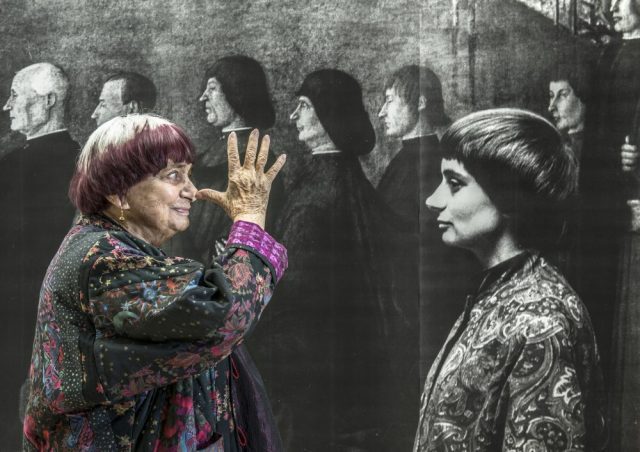
The remarkable life and career of Agnès Varda is being celebrated by Film at Lincoln Center (Agnès Varda © Cine Tamaris)
Film at Lincoln Center, Walter Reade Theater
165 West 65th St. between Eighth Ave. & Broadway
December 20 – January 6
www.filmlinc.org
“I live in cinema. I feel I’ve lived here forever,” Agnès Varda memorably said. The Belgian-born French filmmaker, photographer, and visual artist died earlier this year at the age of ninety, leaving behind an innovative and influential legacy that is being celebrated by Lincoln Center as we say goodbye to 2019 and welcome in 2020, albeit without one of the greatest of all time. “Varda: A Retrospective” is already under way at Film at Lincoln Center, comprising more than two dozen features, documentaries, and shorts, from 1955’s La Pointe Courte to 2019’s Varda by Agnès, and boasting such unique and astounding works as Le bonheur, Cléo from 5 to 7, The Gleaners and I, Vagabond, and, yes, Kung-Fu Master! (with Jane Birkin and Charlotte Gainsbourg!). Every afternoon beginning at 1:00, “Free Loop: Agnès Varda Q&As at Film at Lincoln Center” will be shown for free in the Elinor Bunin Munroe Film Center Amphitheater, while the five-part series Agnès Varda: From Here to There will screen in the Walter Reade Theater December 22 at 12:30, December 23 at 2:00, and December 24 at 1:00, free with advance registration. There is also a free gallery exhibition with rare archival footage, photographs, and ephemera related to Varda and her remarkable career and life, which included a nearly thirty-year marriage to auteur Jacques Demy, with whom she had two children, producer and costume designer Rosalie Varda and actor and director Mathieu Demy. Varda’s The Young Girls Turn 25, which creates a reunion of the cast and crew of her husband’s The Young Girls of Rochefort where that classic was shot, can be seen December 27 and January 2. Below are only some of Varda’s best; as a bonus, from January 4 to 6, Rosalie Varda will introduce and/or participate in Q&As at half a dozen screenings.
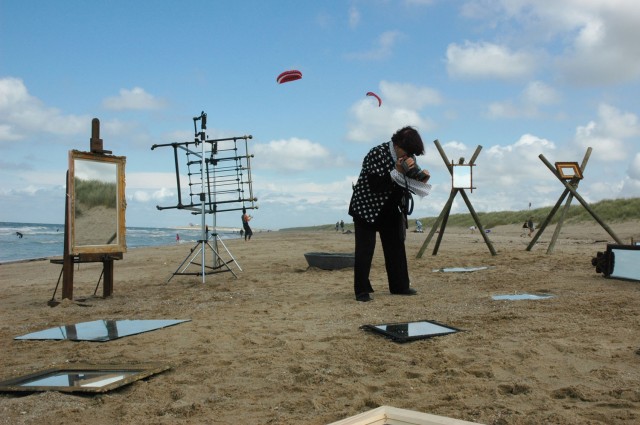
Agnès Varda takes an unusual approach to autobiography in The Beaches of Agnès
THE BEACHES OF AGNÈS (LES PLAGES D’AGNÈS) (Agnès Varda, 2008)
Tuesday, December 24, 4:15
Sunday, December 29, 6:00
Sunday, January 5, 6:00 (introduced by Rosalie Varda)
www.filmlinc.org
 “The whole idea of fragmentation appeals to me,” Agnès Varda says in the middle of her unusual cinematic autobiography, the César-winning documentary The Beaches of Agnès. “It corresponds so naturally to questions of memory. Is it possible to reconstitute this personality, this person Jean Vilar, who was so exceptional?” She might have been referring to her friend, the French actor and theater director, but the exceptional Belgian-French Varda might as well have been referring to herself. Later she explains, “My memories swarm around me like confused flies. I hesitate to remember all that. I don’t want to.” Fortunately for viewers, Varda (Jacquot de Nantes, One Hundred and One Nights) does delve into her past in the film, sharing choice tidbits from throughout her life and career, in creative and offbeat ways that are charmingly self-effacing. Using cleverly arranged film clips, re-creations, photographs, and an array of frames and mirrors, the eighty-year-old Varda discusses such colleagues as Jean-Luc Godard, Chris Marker, and Alain Resnais; shares personal details of her long relationship with Jacques Demy; visits her childhood home; rebuilds an old film set; speaks with her daughter, Rosalie Varda, and son, Mathieu Demy; talks about several of her classic films, including La Pointe Courte, Cléo from 5 to 7, and Vagabond; and, in her ever-present bangs, walks barefoot along beaches, fully aware that the camera is following her every move and reveling in it while also feigning occasional shyness. Filmmakers don’t generally write and direct documentaries about themselves, but unsurprisingly, the Nouvelle Vague legend and first woman to win an honorary Palme d’or makes The Beaches of Agnès about as artistic as it can get without becoming pretentious and laudatory. The January 5 screening will be introduced by Rosalie Varda.
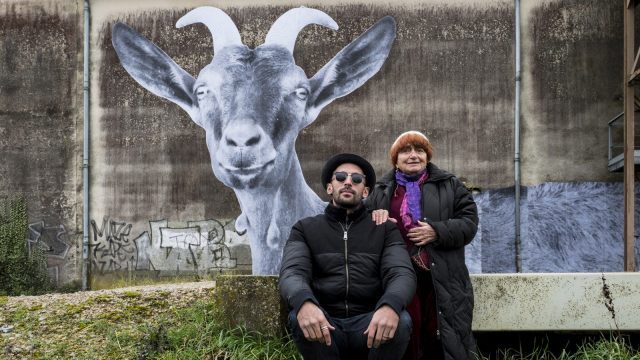
JR and Agnès Varda have a blast with people and animals in the masterful Faces and Places
FACES PLACES (VISAGES VILLAGES) (Agnès Varda & JR, 2017)
Tuesday, December 24, 2:15
Monday, December 30, 8:30
Wednesday, January 1, 8:45
www.filmlinc.org
cohenmediagroup.tumblr.com
 “We’ll have fun making a film,” legendary eighty-eight-year-old Belgian-born French auteur Agnès Varda tells thirty-three-year-old French photographer and street artist JR in Faces Places (Visages Villages), a masterful road movie that may very well be the most fun film of 2017. The unlikely pair first met when Varda accepted an invitation from JR, whose practice involves wheat-pasting giant black-and-white photos of men, women, and children on architectural structures, to visit his Paris studio. (JR brought his “Inside Out” art project to Times Square in 2013.) When Varda saw JR’s blow-up of a 1960 self-portrait Varda shot of herself standing in front of a Bellini painting in Venice, the two instantly hit it off and decided to make a film together, heading out in JR’s small photo-booth truck to team up with people in small towns throughout France, including coal miners, dockworkers, farmers, a church-bell ringer, and factory workers. The reactions of the villagers — shrewd, curious, flattered — to JR’s enormous wheat-pasted blow-ups of themselves on their neighborhood walls, barns, abandoned housing, containers, water towers, and other locations are fascinating. “JR is fulfilling my greatest desire. To meet new faces and photograph them, so they don’t fall down the holes of my memory,” Varda, who edited the film with Maxime Pozzi-Garcia, says. Varda and JR make a formidable duo, finding a childlike innocence in their collaboration that is simply captivating to watch.
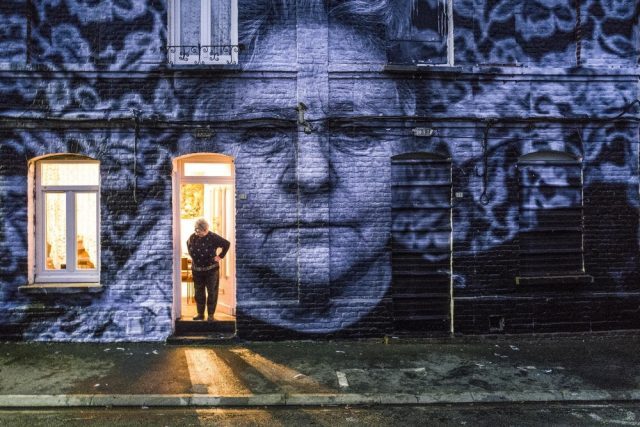
Cinematic collaboration between Agnès Varda and JR results in stunning visions of humanity
Varda continually tries to get JR to remove his ever-present dark glasses, remembering how her friend and colleague Jean-Luc Godard once let her take pictures of him without glasses, but JR prefers to maintain his mystery, a man who photographs tens of thousands of people’s faces around the world while never fully showing his own. Varda, who relies on the “power of imagination,” even sets up an afternoon with Godard at his home in Switzerland, preparing by having JR roll her furiously through the same Louvre galleries the protagonists run through in Godard’s Band of Outsiders, but of course nothing with Godard ever goes quite as planned. “Chance has always been my best asset,” Varda proclaims in the film, and it is chance, and the willingness to enthusiastically embrace every moment of life, that helps give Faces Places its immeasurable charm. The film, which features a playful score by Matthieu Chedid (‑M-) and was executive produced by Varda’s daughter, Rosalie Varda-Demy, subtly tackles socioeconomic issues but is primarily a marvelous celebration of genuine humanity.
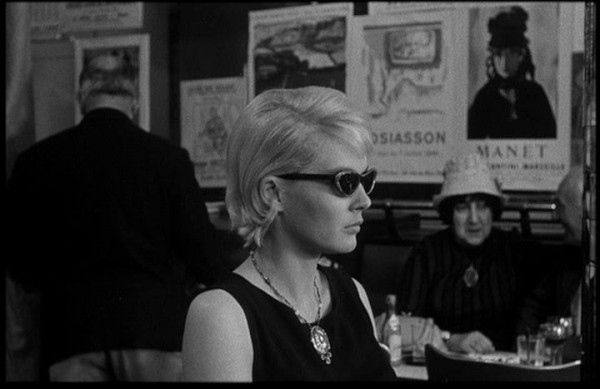
Cléo (Corinne Marchand) looks back at her life in Agnès Varda’s Nouvelle Vague classic
CLEO FROM 5 TO 7 (CLÉO DE 5 À 7) (Agnès Varda, 1962)
Wednesday, December 25, 8:30
Saturday, December 28, 4:30
Saturday, January 4, 7:00 (introduced by Rosalie Varda)
www.filmlinc.org
 After getting a biopsy taken and drawing the death card while consulting a fortune-teller, popular French singer Cléo (Corinne Marchand) begins looking back at her life — and wondering just what’s left of it — while awaiting the dreaded results. The blonde beauty talks with old friends, asks her piano player (Michel Legrand, who composed the score) to write her a song, and meets a dapper gentleman in the park, becoming both participant and viewer in her own existence. As Cléo makes her way around town, director (and former photographer) Agnès Varda (Jacquot de Nantes, Lions Love [. . . and Lies]) shows off early 1960s Paris, expertly winding her camera through the Rive Gauche. Just as Cléo seeks to find out what’s real (her actual name is Florence and that gorgeous hair is a wig), Varda shoots the film in a cinema verité style, almost as if it’s a documentary. She even sets the film in real time (adding chapter titles with a clock update), enhancing the audience’s connection with Cléo as she awaits her fate, but the movie runs only ninety minutes, adding mystery to what is to become of Cléo, as if she exists both on-screen and off, alongside the viewer. A central film in the French Nouvelle Vague and one of the first to be made by a woman, Cléo de 5 à 7 is an influential classic even as it has lost a step or two over the years. The January 4 screening will be introduced by Varda’s daughter, Rosalie Varda.
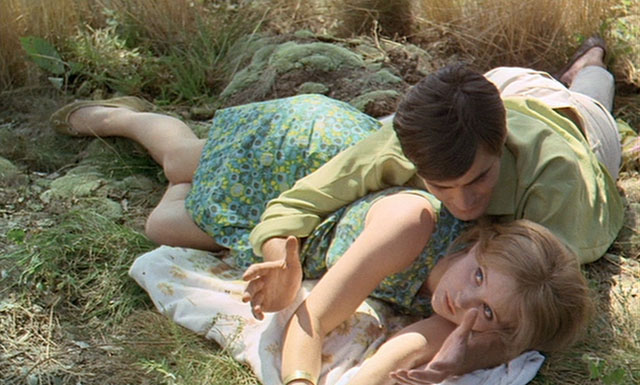
François (Jean-Claude Drouot) tries to convince Thérèse (Claire Drouot, his real-life wife), that he has plenty of happiness to spread around in Le Bonheur
LE BONHEUR (HAPPINESS) (Agnès Varda, 1965)
Thursday, December 26, 3:00
Saturday, January 4, 9:00 (introduced by Rosalie Varda)
www.filmlinc.org/films/le-bonheur
In 1965, French Nouvelle Vague auteur Agnès Varda said about her third film, Le Bonheur, which translates as Happiness: “Happiness is mistaken sadness, and the film will be subversive in its great sweetness. It will be a beautiful summer fruit with a worm inside. Happiness adds up; torment does too.” That is all true nearly fifty years later, as the film still invites divided reaction from critics. “Miss Varda’s dissection of amour, as French as any of Collette’s works, is strikingly adult and unembarrassed in its depiction of the variety of love, but it is as illogical as a child’s dream,” A. H. Weiler wrote in the New York Times in May 1966. “Her ‘Happiness,’ a seeming idyll sheathed in irony, is obvious and tender, irresponsible and shocking and continuously provocative.” All these decades later, the brief eighty-minute film is all that and more, save for the claim that it is illogical. In a patriarchal society, it actually makes perfect, though infuriating, sense.
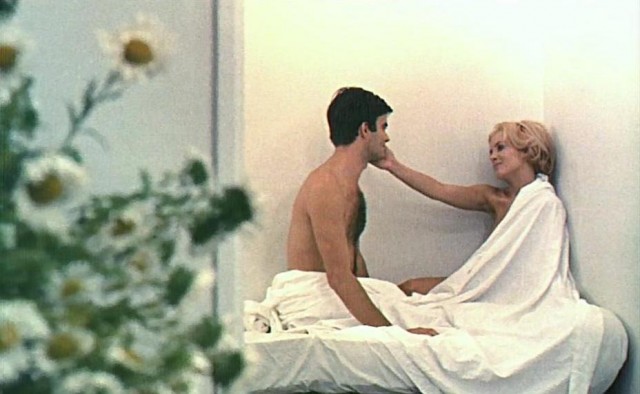
François (Jean-Claude Drouot) and Émilie (Marie-France Boyer) seek out their own happiness in Nouvelle Vague classic
French television star Jean-Claude Drouot (Thierry La Fronde) stars as the handsome François, who is leading an idyllic life with his beautiful wife, Thérèse (Claire Drouot), and their delightful kids, Pierrot (Olivier Drouot) and Gisou (Sandrine Drouot), in the small, tight-knit Parisian suburb of Fontenay. While away on a job, François meets the beautiful Émilie (Marie-France Boyer), a postal clerk who connects him to his wife via long-distance telephone, flirting with him although she knows he is happily married. And despite being happily married, François returns the flirtation, offering to help with her shelves when she moves into an apartment in Fontenay. Both François and Émilie believe that there is more than enough happiness to go around for everyone, without any complications. “Be happy too, don’t worry,” Émilie tells him. “I’m free, happy, and you’re not the first,” to which he soon adds, “Such happiness!” And it turns out that even tragedy won’t put a stop to the happiness, in a plot point that angered, disappointed, confused, and upset many critics as well as the audience but is key to Varda’s modern-day fairy tale. The January 4 screening will be introduced by Varda’s daughter, Rosalie Varda.
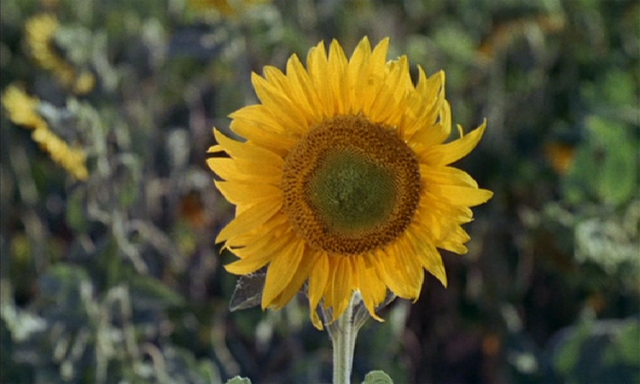
The beauty of nature plays a key role in Le Bonheur
Le Bonheur is Varda’s first film in color, and she seems to have been heavily influenced by her husband, Jacques Demy (The Umbrellas of Cherbourg, The Young Girls of Rochefort), bathing the film in stunning hues that mimic Impressionist paintings, particularly the work of Pierre-Auguste Renoir, in a series of picnics and flower-filled vases. In a sly nod, at one point a black-and-white television is playing the 1959 film Le Déjeuner Sur L’herbe (“Picnic on the Grass”), which was directed by Jean Renoir, one of Auguste’s sons, and also deals with sex, passion, procreation, and nature. Le Bonheur also features numerous scenes that dissolve out in singular blocks of color that take over the entire screen. Cinematographers Claude Beausoleil and Jean Rabier shoot the film as if it takes place in a candy-colored Garden of Eden, all set to the music of Mozart, performed by Jean-Michel Defaye. Varda doesn’t allow any detail to get away from her; even the protagonists’ jobs are critical to the story: François is a carpenter who helps builds new lives for people; Thérèse is a seamstress who is in the midst of making a wedding gown; and Émilie works in the post office, an intermediary for keeping people together. As a final touch, François, who represents aspects of France as a nation under Charles de Gaulle, and his family are played by the actual Drouot clan: Jean-Claude and Claire are married in real life (and still are husband and wife after nearly sixty years later), and Olivier and Sandrine are their actual children, so Le Bonheur ends up being a family affair in more ways than one.
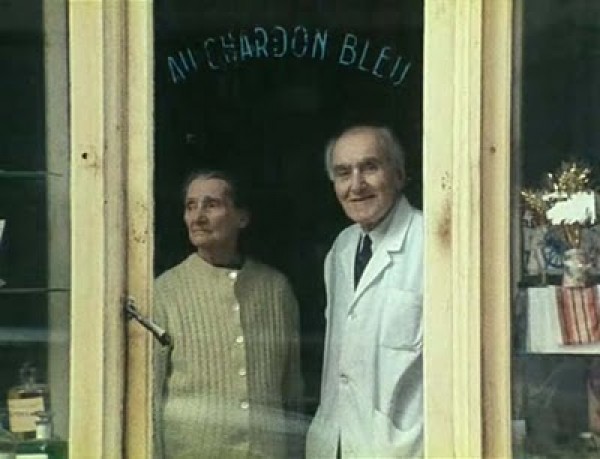
Agnès Varda looks back at her past in charming Daguerréotypes
DAGUERRÉOTYPES (Agnès Varda, 1975)
Tuesday, December 31, 4:00
www.filmlinc.org
 Legendary auteur Agnès Varda’s eighty-minute documentary, Daguerréotypes, which only received its official U.S. theatrical release in 2011 at the Maysles Cinema, is an absolutely charming look at Varda’s longtime Parisian community. In the film, Varda turns her camera on the people she and husband Jacques Demy lived with along the Rue Daguerre in Paris’s 14th arrondissement. Varda, who also narrates the film, primarily stands in the background while capturing local shopkeepers talking about their businesses and how they met their spouses as customers stop by, picking up bread, meat, perfume, and other items. Varda uses a goofy, low-rent magic show as a centerpiece, with many of the characters attending this major cultural event; the magician references the magic of both life and cinema itself, with Varda, a former photographer, titling the film not only after the street where she lives but also directly evoking the revolutionary photographic process developed by Louis Daguerre in the 1820s and ’30s. Daguerréotypes has quite a different impact now than it did back in the mid-1970s, depicting a time that already felt like the past but now feels like a long-forgotten era, when neighbors knew one another and lived as a tight-knit community.