Justine (Kirsten Dunst) faces the end of the world in Lars von Trier’s dazzling Melancholia
CinéSalon: MELANCHOLIA (Lars von Trier, 2011)
French Institute Alliance Française, Florence Gould Hall
55 East 59th St. between Madison & Park Aves.
Tuesday, December 3, 7:30
Series continues Tuesday nights through December 17
212-355-6100 fiaf.org
Danish writer-director Lars von Trier has nothing less than the end of the world on his mind in his controversial 2011 drama, Melancholia, which is screening December 3 at 7:30 in the FIAF CinéSalon series “Charlotte Forever: Gainsbourg on Film.” Yet another of Von Trier’s love-it-or-hate-it cinematic forays opens with epic Kubrickian grandeur, introducing characters in marvelously composed slow-motion and still shots (courtesy of cinematographer Manuel Alberto Claro) as an apocalyptic collision threatens the earth and a Wagner overture dominates the soundtrack. Kirsten Dunst won the Best Actress award at Cannes for her portrayal of Justine, a seemingly carefree young woman celebrating her wedding day who soon turns out to be battling a debilitating mental illness. Her husband, Michael (Alexander Skarsgård), is madly in love with her and does not know quite what he has gotten himself into, especially as the partying continues and Justine’s motley crew of family and friends get caught up in various forms of intrigue, including Gaby, her marriage-hating mother (Charlotte Rampling), Dexter, her never serious father (John Hurt), Jack, her pompous boss (Stellan Skarsgård), Claire, her married sister (Charlotte Gainsbourg), and Claire’s filthy rich husband, John (Kiefer Sutherland), who is hosting the event at his massive waterfront estate.
While most of the film focuses on the wildly unpredictable Justine, the latter section turns its attention on Claire, who is terrified that a newly discovered planet named Melancholia is on its way to destroy the world. But Melancholia is not just about sadness, depression, family dysfunction, and the end of the world. It’s about the search for real love and truth, things that are disappearing from the earth by the minute. Justine works as an advertising copywriter, attaching tag lines to photographs to help sell product; at the wedding, Jack is determined to get one more great line of copy from her, even siccing his young, inexperienced nephew, Tim (Brady Corbet), on her to make sure she delivers. But what she ends up delivering is not what either man expected. Perhaps the only character who really sees what is going on is a wedding planner played by the great Udo Kier, who continually, and comically, shields his eyes from Justine, unable to watch the impending disaster. Just as in the film, as some characters get out their telescopes to watch the approaching planet and others refuse to look, there are sure to be many in the moviegoing public who will shield their eyes from Melancholia, choosing not to view yet another polemical film from a director who likes to antagonize his audience. They don’t know what they’re missing.
Laurie Anderson and Nicole Krauss will be at the Morgan Library on December 5 for latest Le Conversazioni presentation (photos by Ebru Yildiz and Goni Riskin)
Morgan Library & Museum
225 Madison Ave. at 36th St.
Thursday, December 5, $20, 7:00
212-685-0008 www.themorgan.org
The ongoing series “Le Conversazioni: Films of My Life” continues December 5 at the Morgan Library with Laurie Anderson and Nicole Krauss sitting down for a discussion with moderator Antonio Monda, the artistic director and cofounder of Le Conversazioni, an Italian festival started in 2006 dedicated to literature but which has since spread to include other disciplines. Anderson is an Illinois-born, New York-based, Grammy-winning musician, filmmaker, composer, and multimedia performance and spoken-word artist who has released such records as Big Science and Mister Heartbreak, made such films as Home of the Brave and Heart of a Dog, and staged such cutting-edge shows as United States Live,Moby-Dick, and The End of the Moon. Krauss is the Manhattan-born award-winning author of Man Walks into a Room, The History of Love, Great House, and Forest Dark. They will be discussing films that influenced their work. The 7:00 event is being held in conjunction with the Morgan exhibition “Verdi: Creating Otello and Falstaff — Highlights from the Ricordi Archive,” which will be open at 6:00 for ticket holders.
Letizia Battaglia’s stunning photographs of the Cosa Nostra are shown in Shooting the Mafia
SHOOTING THE MAFIA (Kim Longinotto, 2019)
Quad Cinema
34 West 13th St. between Fifth & Sixth Aves.
Through December 5
212-255-2243 quadcinema.com
Palermo native Letizia Battaglia took a major turn at the midpoint of her life, becoming a photojournalist at the age of forty, concentrating on brutal crime scenes often involving the Mafia. Now, at the age of eighty-four, her engrossing story is being told in the documentary Shooting the Mafia. The first female photographer to work for a daily Italian newspaper, Battaglia is a bold presence, dominating the screen, displaying a series of distinctive hair colors as she talks about her life and career, discussing her love affair with photography. “The camera changed my life. I began to find myself. Before that, I wasn’t a real person,” she tells director Kim Longinotto. But she wasn’t taking pictures of death for the thrill of it, or for sensationalism. She was determined to show everyone what was happening in Sicily, how the mob operated, leaving a bloody trail behind it as the police, the courts, and the local community looked away. “Photographing trauma is embarrassing. You love these people, but you have to take photos. I couldn’t tell them I was doing it with love,” she says while also explaining that people should not be ruled by fear.
The fearless Letizia Battaglia takes on the Palermo mob in Shooting the Mafia
At one point, in the town of Corleone, she sets up an outdoor exhibit of her black-and-white photos of Mafia killings and suspected Cosa Nostra leaders; showing such images in public breaks the code of silence and puts her own safety at risk as she receives death threats. She also enters politics as a Green Party councilor. “I wanted to build a better society,” she says. The latter parts of the film focus on the 1986-87 efforts of judges and prosecutors Giovanni Falcone and Paolo Borsellino as they arrest and try a huge group of mafiosos led by Luciano Liggio and Totò Riina. Longinotto (Gaea Girls, Runaway, Dreamcatcher) and editor Ollie Huddleston interweave new interviews with Battaglia, her assistant, Maria Chiara Di Trapani, Battaglia’s former lovers and fellow photographers Santi Caleca, Eduardo Rebulla, and Franco Zecchin, and her current partner, Roberto Timperi, with archival news reports, home movies, family photographs, and clips from Alberto Lattuada’s 1951 film about sin and redemption, Anna. Through it all are Battaglia herself and her stunning photos, haunting pictures that you can’t look away from. “I want to take away the beauty that others see in them,” she says. “I want to destroy them.” Thank goodness she didn’t.
The Film Society of Lincoln Center focuses on Hur Jin-ho’s Christmas in August and other South Korean fare from 1996 to 2003 in “Relentless Invention”
Film Society of Lincoln Center
Walter Reade Theater
165 West 65th St. between Broadway & Amsterdam Aves.
Series continues through December 4
212-875-5600 www.filmlinc.org
Under elected presidents Kim Young-sam (1993-98) and Kim Dae-jung (1998–2003), freedom in South Korea flourished as military rule ended. Nowhere was that more evident than in movie theaters; while North Korean supreme leader Kim Jong-il was trying to create his own propaganda film industry in North Korea, such South Korean auteurs as Bong Joon-ho, Hong Sang-soo, and Park Chan-wook began making genre-redefining works that quickly gained international attention. The Film Society of Lincoln Center pays tribute to this artistic revolution in “Relentless Invention: New Korean Cinema, 1996–2003,” a twelve-day, twenty-one-film salute continuing at the Walter Reade Theater through December 4. Below is a look at four of the selections; the festival also includes Bong Joon-ho’s debut, Barking Dogs Never Bite, Hong Sang-soo’s The Day a Pig Fell into the Well, Kim Sang-jin’s Attack the Gas Station, and Jeong Jae-eun’s Take Care of My Cat, among others.
Sgt. Lee Soo-hyeok (Lee Byung-hun) and Sgt. Oh Kyeong-pil (Song Kang-ho) see things from different sides in Joint Security Area
JOINT SECURITY AREA (Park Chan-wook, 2000)
Thursday, November 28, 7:00 www.filmlinc.org
Park Chan-wook’s Joint Security Area takes place at the DMZ Joint Security Area known as Panmunjeom, the dividing line between North and South Korea and where soldiers from each country actually face one another directly. Major Sophie Jean of the Neutral Nations Supervisory Commission (Lee Young-Ae) has arrived to investigate the violent murder of two North Korean officers but discovers during her inquiry that key facts are missing involving South Korean hero Sgt. Lee Soo-hyeok’s (Lee Byung-hun) relationship to injured North Korean Sgt. Oh Kyeong-pil (Song Kang-ho). Told in a series of flashbacks, the gripping story deals with duty, honor, courage, and brotherhood — as well as the absurdity that war and politics inject into individual behavior and common human decency. As always, Song Kang-ho’s (The Host, Thirst) big, round face dominates the screen, his hulking figure at the center of the controversy.
Local detectives are searching for a serial killer in Memories of Murder
MEMORIES OF MURDER (SALINUI CHUEOK) (Bong Joon-ho, 2003)
Thursday, November 28, 2:00
Sunday, December 2, 7:00
Monday, December 3, 1:15 www.filmlinc.org
In 2006, South Korean writer-director Bong Joon-ho burst onto the international cinematic landscape with the sleeper hit The Host, a modern-day monster movie with a lot of heart. He followed that up with the touching segment “Shaking Tokyo” in the compilation film Tokyo!, and Mother, the futuristic thriller Snowpiercer, and Okja, about an extraordinary pig. Inspired by actual events, Bong’s second film, 2003’s Memories of Murder, is a psychological thriller set in a rural South Korean town. With a serial killer on the loose, Seoul sends experienced inspector Suh (Kim Sang-kyung) to help with the case, which is being bungled by local detectives Park (Song Kang-ho) and Cho (Kim Roe-ha), who consistently tamper with evidence, bring in the wrong suspects, and torture them in both brutal and ridiculously funny ways. But as the frustration level builds and more victims are found, even Suh starts considering throwing away the book and doing whatever is necessary to catch the killer. Bong’s first major success, earning multiple awards at film festivals around the world, Memories of Murder is a well-paced police procedural that contains just enough surprises to overcome a few too many genre clichés. The film is beautifully shot by Kim Hyung-gu, from wide-open landscapes to a busy, crowded factory. But the film is dominated by Song’s unforgettable face, a physical and emotional wonder whether he’s goofing around with a prisoner or dead-set on catching a criminal.
Revenge, kidnapping, and intense violence are all part of Park Chan-wook’s Sympathy for Mr. Vengeance
SYMPATHY FOR MR. VENGEANCE (Park Chan-wook, 2002)
Saturday, December 1, 6:00
Tuesday, December 4, 4:00 www.filmlinc.org
Park Chan-wook kicked off his revenge trilogy with Sympathy for Mr. Vengeance (even though the second film, Oldboy, was the first one released in the States), a creepy, quirky tale that lays low for quite a while before busting loose with a massive splattering of the old ultra-violence. After deaf-mute Ryu (Shin Ha-kyun) fails miserably in a desperate, ridiculous attempt to get his dying sister (Lim Ji-eun) a kidney, the recently laid-off Ryu is convinced by his anarchist girlfriend, Youngmin (Bae Doo-na), to kidnap the four-year-old daughter (Han Bo-bae) of Park (Song Kang-ho), the man who owned the factory that kicked him out. But when the plan goes awry, both Ryu and Park become obsessed with avenging their torn-apart lives. Although the first half of the film is too slow and heads off in too many directions, the second half brings everything together, chock full of the kind of violence promised by the title.
Choi Min-sik is at his creepy best in the second part of Park Chan-wook’s Vengeance trilogy
OLDBOY (Park Chan-wook, 2003)
Tuesday, December 4, 9:00 www.filmlinc.org
The second in director Park Chan-wook’s revenge trilogy (in between Sympathy for Mr. Vengeance and the 2005 New York Film Festival selection Sympathy for Lady Vengeance), Oldboy is a twisted, perverse psychological thriller that won the Grand Prix de Jury at Cannes, among many other international awards. Choi Min-sik (Chihwaseon) stars as Oh Dae-su, a man who has been imprisoned for fifteen years — but he doesn’t know why, or by whom. When he is finally released, his search for the truth becomes part of a conspiracy game, as he can seemingly trust no one. As he gets closer to finding everything out, the gore and terror continue to increase. Choi is outstanding as the wild-haired Dae-su in Park’s awesome rampage of a film, which is not for the faint of heart.
Louis Mazzini (Dennis Price) is sick and tired of being bossed around by the D’Ascoynes (Alec Guinness in multiple roles) and decides to take extreme action in Kind Hearts and Coronets
KIND HEARTS AND CORONETS (Robert Hamer, 1949)
Film Forum
209 West Houston St.
Wednesday, November 27 – Thursday, December 5
212-727-8110 filmforum.org
After being spurned by their aristocrat family and watching the wealthy D’Ascoynes turn their back on his mother even in death, Louis Mazzini (Dennis Price) decides that he is not going to let them get away with such awful treatment. So Louis, the tenth Duke of Chalfont, comes up with a plot to get rid of the eight D’Ascoynes standing between him and the dukedom. In Robert Hamer’s wickedly funny black comedy Kind Hearts and Coronets — screening at Film Forum November 27 through December 5 in a seventieth anniversary 4K restoration — each one of those haughty D’Ascoynes is played by Alec Guinness, young and old, male and female, to deservedly great acclaim.
The film is told in flashback as an elegant, distinguished Louis is writing his memoirs in prison on the eve of his execution. He eloquently describes the details of his multiple murders, as well as his unending yearning for the questionably prim and proper Sibella (Joan Greenwood), who continues her flirtations with him even after she marries Louis’s former schoolmate Lionel (John Penrose), as well as his relationship with Edith (Valerie Hobson), the wife of one of the D’Ascoynes he kills on his march to power, glory, and revenge. But his hubris leads to his downfall — and one of the most delicious twist endings in film history.
Based on Roy Horniman’s 1907 novel, Israel Rank: The Autobiography of a Criminal, and adapted by Hamer (The Spider and the Fly, School for Scoundrels) and cowriter John Dighton (The Barretts of Wimpole Street), Kind Hearts and Coronets — which was turned into the Tony-winning musical A Gentleman’s Guide to Love and Murder — takes on British high society, class conflict, royalty, and hypocrisy with a brash dose of cynical humor and more than a hint of eroticism, pushing the sexual envelope amid all the laughter. Price is terrific as the dapper Louis, but it’s impossible to steal the show from Guinness, who is a riot as the succession of doomed D’Ascoynes. Guinness was originally asked to play four of the roles but suggested that he do them all, and thankfully Ealing Studios agreed; one of the key shots in the film is when six of the D’Ascoynes are seen together. In conjunction with Kind Hearts and Coronets, Film Forum is also showing three other classics starring the ever-graceful Alec Guinness de Cuffe, The Lavender Hill Mob, The Man in the White Suit, and The Ladykillers.
Goofy chemist Sid Stratton (Alec Guinness) is looking to revolutionize the textile industry in the Ealing classic The Man in the White Suit
THE MAN IN THE WHITE SUIT (Alexander Mackendrick, 1951)
Film Forum
209 West Houston St.
Wednesday, November 27, 2:40, 8:50
Sunday, December 1, 6:15
Wednesday, December 4, 2:40, 8:50
212-727-8110 filmforum.org
Alexander Mackendrick’s splendid 1951 Ealing comedy The Man in the White Suit is a hysterical Marxist fantasy about corporations, unions, and the working man that doesn’t feel dated in the least. Alec Guinness stars as Sidney Stratton, a brilliant scientist relegated to lower-class jobs at textile mills while he works feverishly on a secret product that he believes will revolutionize the industry — and the world. After being fired by Michael Corland (Michael Gough) at one factory, Sid goes over to Birnley’s, run by Alan Birnley (Cecil Parker, whose voiceover narration begins and ends the film). As Sid develops his groundbreaking product, he also develops a liking for Birnley’s daughter, Daphne (Joan Greenwood), who is preparing to marry Corland. Meanwhile, tough-talking union leader Bertha (Vida Hope) also takes a shine to the absentminded chemist, who soon finds himself on the run, chased by just about everyone he’s ever met, not understanding why they all are so against him.
Guinness is at his goofy best as Sid, a loner obsessed with the challenge he has set for himself; his makeshift, Rube Goldberg-like chemistry sets are a riot, bubbling over with silly noises like they’re in a cartoon. But at the heart of the film lies some fascinating insight on the nature of big business that is still relevant today. Nominated for an Oscar for Best Screenplay, The Man in the White Suit is an extremely witty film, expertly directed (and cowritten) by Mackendrick, who would go on to make such other great pictures as The Ladykillers and Sweet Smell of Success. It’s easy to imagine that if someone in a textile mill today came up with a similar invention as Stratton’s, the same arguments against it would arise, suppressing progress in favor of personal interest and preservation.
Jack Sim is on a mission to bring clean toilets to India, China, and the rest of the world
MR. TOILET: THE WORLD’S #2 MAN (Lily Zepeda, 2019)
Village East Cinema
181-189 Second Ave. at 12th St.
Opens Friday, November 22
212-529-6799 mrtoiletfilm.com www.villageeastcinema.com
Jack Sim is my new hero. Known as Mr. Toilet, the Singapore native and former construction entrepreneur travels around the globe preaching the gospel of poo, promoting safe and healthy sanitation in countries where bathrooms are scarce and open defecation leads to rampant disease and even crime, especially against women and children, who find themselves particularly vulnerable when they must relieve themselves outside in remote areas. Lily Zepeda tells Sim’s story in her first feature film, the vastly entertaining and important documentary Mr. Toilet: The World’s #2 Man. “The toilet is a spiritual room, a place to cherish and rejoice,” Sim explains at the beginning of the film. “When you go and let go, you’re connected with the universe. That’s why good ideas come up from the toilet. If you survey people before and after they use the toilet, ninety-nine percent of them will be much happier than before they go to the toilet. When you open the toilet door, it’s not the toilet inside; it’s your future.” Sim must go a lot, because he is one happy guy.
Zepeda follows the eccentric Sim as he meets with government officials, local leaders, young students, and the general public in Singapore, China, India, and the United Nations, lobbying for more toilets, particularly for schoolchildren and women. He has a never-ending array of fecal puns (one of his mottoes is “Getting People to Give a Shit”), rides around on a scooter, uses a toilet brush to comb his hair, swims with a poo emoji float, and often dresses up in costume as a man sitting on a toilet, doing his business; the playful animation Zepeda includes highlights Sim’s youthful qualities. Now sixty-two, he is away from home a lot, which disappoints his loyal wife, Julie Teng, and their four kids, daughters Faith and Earth and sons Worth and Truth, who consider their father “a twelve-year-old trapped in a sixty-year-old man’s body.” Sim does things his own way, with little regard for the consequences; he believes strongly in civil disobedience, feeling that certain rules don’t apply to him. “I’m very naughty,” he admits.
Sim is nearly all laughs and smiles until there are rumbles of dissatisfaction with some board members of his nonprofit, the World Toilet Organization, which boasts such fans as Oscar winner Matt Damon, Bollywood star Salman Khan, and “Indian King of Toilets” Dr. Bindeshwar Parhak. “I support his movement, but for me, frankly, the task for Jack is too big,” notes former Singapore prime minister Goh Chok Tong, not necessarily realizing his own fecal pun. But as goofy as Sim is — and he’s plenty goofy — he knows his shit and is very serious about changing the planet’s perception of poop, one toilet, and one crappy joke, at a time. Mr. Toilet: The World’s #2 Man opens November 22 at Village East Cinema, with Zepeda and Sim participating in Q&As after the 7:00 shows on Friday and Saturday.
Anamaria Marinca stars in Cristian Mungiu’s harrowing 4 Months, 3 Weeks and 2 Days,, part of Film Forum celebration of the last three decades of Romanian cinema
Film Forum
209 West Houston St.
Through November 26
212-727-8110 filmforum.org
On December 25, 1989, Romanian dictator Nicolae Ceaușescu and his wife, Elena, were executed by a firing squad after being found guilty of corruption and genocide. In the wake of his death, the Romanian film industry reinvented itself, and Film Forum pays tribute to that change with “The Romanians: 30 Years of Cinema Revolution,” consisting of thirty films screening over twelve days through November 26. Several shows will be followed by Q&As with the director and/or actor. In addition to the below four recommendations, the series includes Nae Caranfil’s Do Not Lean Out the Window, Radu Mihaileanu’s Train of Life, Alexandru Solomon’s The Great Communist Bank Robbery, and Constantin Popescu’s Pororoca.
4 MONTHS, 3 WEEKS AND 2 DAYS (Cristian Mungiu, 2007)
Friday, November 22, 3:30, 7:45 filmforum.org
Winner of the Palme D’Or at the 2007 Cannes Film Festival, Cristian Mungiu’s 4 Months, 3 Weeks and 2 Days is a harrowing look at personal freedom at the end of the Ceaușescu regime in late-’80s Romania. Anamaria Marinca gives a powerful performance as Otilia, a young woman risking her own safety to help her best friend, Gabita (Laura Vasiliu), out of a difficult, dangerous situation. Their lives get even more complicated when they turn to Bebe (Vlad Ivanov) to take care of things. Cinematographer Oleg Mutu, who shot Cristi Puiu’s brilliant The Death of Mr. Lazarescu, keeps the camera relatively steady for long scenes, without cuts, pans, dollies, or zooms, as the actors walk in and out of view, giving the film a heightened level of believability without looking like a documentary. Set in a restrictive era with a burgeoning black market, 4 Months goes from mystery to psychological drama to thriller with remarkable ease — and the less you know about the plot, the better.
Father (Teodor Corban) and son (Mihai Comānoiu) hunt for a runaway slave in wickedly funny Aferim!
Romanian director Radu Jude won the Silver Bear as Best Director at the 2015 Berlin International Film Festival for Aferim!, his savagely funny blacker-than-black comic Western about bigotry, infidelity, and frontier justice in 1835 Wallachia. Lawkeeper Costandin (Teodor Corban) and his son, Ionitā (Mihai Comānoiu), are galloping through the local countryside, searching for runaway Gypsy slave Carfin (Cuzin Toma), who Boyar Iordache Cindescu (Alexandru Dabija) has accused of having an affair with his wife, Sultana (Mihaela Sîrbu). The surly Costandin leads the hunt, verbally cutting down everyone he meets, from random old women to abbots to fellow lawmen, with wicked barbs, calling them filthy whores, crows, and other foul names while spouting ridiculous theories about honor and religion; he even batters his son, saying he’s “a waste of bread” and that “if you slap him, he’ll die of grief.” It’s a cruel, cholera-filled time in which even the monks beat the poor, where Costandin regales a priest with the telling riddle, “Lifeless out of life, life out of lifeless,” which the priest thinks refers to the coming doomsday.
Cowritten by Jude (The Happiest Girl in the World, Everybody in Our Family) and novelist Florin Lăzărescu (Our Special Envoy, Numbness), who previously collaborated on the short film The Tube with a Hat, and shot in gloriously stark black-and-white by Marius Panduru (12:08 East of Bucharest; Police, Adjective), the Romanian / Bulgarian / Czech coproduction is an absurdist combination of Monty Python and the Holy Grail, Andrei Tarkovsky’s Andrei Rublev, Hal Ashby’s The Last Detail, and John Ford’s The Searchers, skewering everything in its path, either overtly or under its wide-reaching breath. Even Dana Pāpāruz’s costumes are a genuine riot, especially the boyar’s majestically ridiculous hat. But Aferim! is more than just a clever parody of period films and nineteenth-century Eastern European culture and social mores; it is also a brilliant exploration of the nature of racism, discrimination, misogyny, and the aristocracy that directly relates to what’s going on around the world today as well as how Romania has dealt with its own sorry past of enslaving the Romani people. Jude was inspired by real events and historical documents, setting the film immediately after the 1834 Russian occupation, which adds to its razor-sharp observations. “Aferim! is an attempt to gaze into the past, to take a journey inside the mentalities of the beginning of the nineteenth century — all epistemological imperfections inherent to such an enterprise included,” Jude says in his director’s statement. “It is obvious that such an effort would be pointless should we not believe that this hazy past holds the explanation for certain present issues.” Don’t miss this absolute gem of a film, which was Romania’s submission for the Academy Awards.
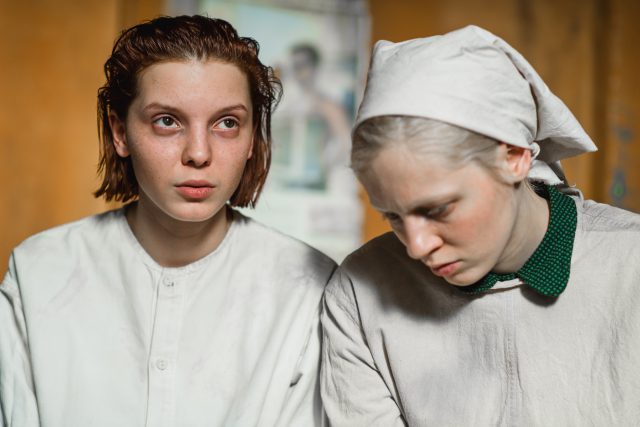
Voichita (Cosmina Stratan) must choose between her faith and her best friend in Cristian Mungiu’s Beyond the Hills
BEYOND THE HILLS (DUPA DEALURI) (Cristian Mungiu, 2012)
Sunday, November 24, 7:30
Monday, November 25, 12:40 filmforum.org
Inspired by a true story detailed in a pair of nonfiction novels by Romanian journalist Tatiana Niculescu Bran, Cristian Mungiu’s Beyond the Hills is a powerful, emotional study of love, friendship, dedication, devotion, and sexual repression. In a barren section of modern-day Romania, Alina (Cristina Flutur) arrives at a poverty-stricken Orthodox monastery, where her childhood friend Voichita (Cosmina Stratan) has become a nun. Both young women grew up in a poor orphanage, and both still have no real place in society. Alina has come to try to convince Voichita — possibly her former lover — to leave the flock and go with her to Germany, where they can live and work together freely. Early on, Voichita rubs a tired Alina’s bare back; when Alina turns over, Voichita just stops short of massaging her friend’s chest, the sexual tension nearly exploding in a scene of quiet beauty that speaks volumes about their relationship. Despite Alina’s pleading, Voichita, apparently filled with deep inner guilt, refuses to turn her back on the priest (Valeriu Andriuţă), whom all the nuns refer to as Pa, and her newfound vocation. Unable to accept her friend’s decision, Alina begins acting out in threatening ways to both herself and the true believers, leading to shocking, tragic consequences.
Mungiu’s feature-film follow-up to the 2007 Palme d’Or winner 4 Months, 3 Weeks and 2 Days is another harrowing examination of characters trapped in a devastating situation. The two-and-a-half-hour film seems to take place in a different era, far away from contemporary towns and cities, cell phones and even electricity. Mungiu, who won the Best Screenplay award at Cannes for the film, is careful not to condemn or belittle Pa, Ma (Dana Tapalagă), and their faith, but he doesn’t praise them either, leaving it up to viewers to decide for themselves. In their feature-film debuts, Flutur and Stratan, who are both from Mungiu’s hometown of Iasi and shared the Best Actress award at Cannes, are exceptional, their eyes filled with fear and longing as Alina and Voichita try to find a balance in their opposing worlds.
Luminița Gheorghiu plays a controlling, domineering mother in Călin Peter Netzer’s award-winning Child’s Pose
Luminita Gheorghiu, grand dame of the Romanian New Wave, was nominated for Best Actress at the European Film Awards for her devastating portrayal of a domineering mother in Călin Peter Netzer’s Child’s Pose. Gheorghiu (The Death of Mister Lazarescu;4 Months, 3 Weeks and 2 Days) stars as Cornelia Kerenes, an elegant, cigarette-smoking architect who immediately jumps into action when her son, Barbu (Bogdan Dumitrache), is involved in a terrible car accident, killing a child. Despite their recent estrangement — Cornelia and Barbu have rarely spoken since he married Carmen (Ilinca Goia) — Cornelia starts constructing a scenario, like designing one of her buildings, to keep Barbu out of jail. She and her surgeon husband, Reli (Florin Zamfirescu), along with her sister, Olga (Nataşa Raab), start calling in favors and doling out bribes while showing a stunning lack of concern for the family of the boy who Barbu killed. As the child’s funeral approaches, relationships come together and fall apart as parents try to deal with what has happened to their children. Winner of the Golden Bear at the Berlinale, Child’s Pose is a searing examination of class, corruption, and power.
Reminiscent of Lucrecia Martel’s The Headless Woman, in which María Onetto gives a mesmerizing performance as an Argentine upper-class wife and mother who looks the other way when it appears that she might have run over a local boy, Child’s Pose is a penetrating character study that centers around the wide gap between the rich and the poor. Early on in the film, Cornelia, who her husband at one point calls “Controlia,” sits down with her dour cleaning woman and offers her a pair of used shoes, expecting her to rejoice in such wonderful charity. The scene sets the stage for what occurs later, as Cornelia believes money is the primary route to Barbu’s freedom, but it’s a path littered with more than just one young child’s body. The taut, razor-sharp script was written by Netzer (Maria, Medal of Honor) and Răzvan Rădulescu, who has worked on such other Romanian New Wave films as The Death of Mister Lazarescu, Stuff and Dough, and Tuesday, After Christmas. In Cornelia, they have created a woman worthy of joining the pantheon of classic domineering cinematic mothers.