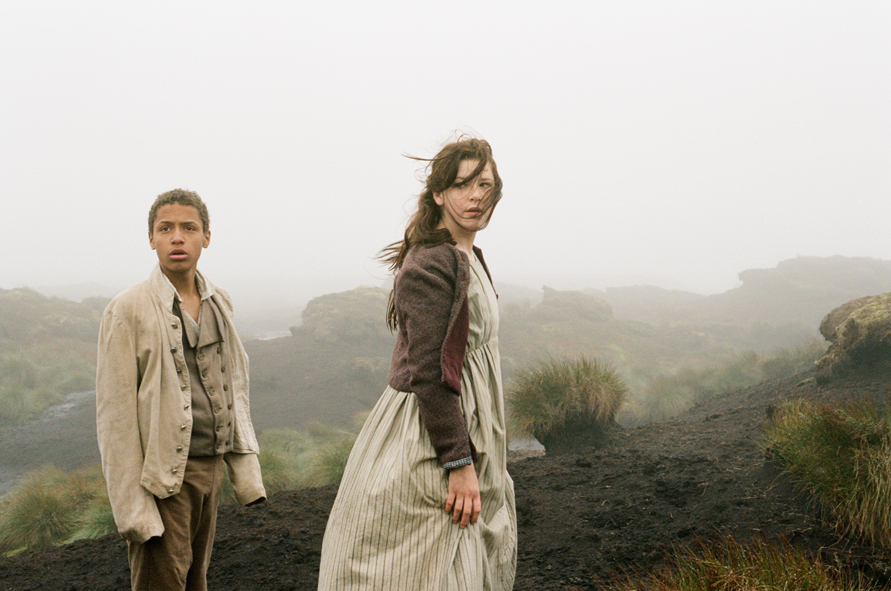
Heathcliffe (Solomon Glave) and Cathy (Shannon Beer) explore forbidden love in new version of classic novel (photo by Agatha Nitecka)
WUTHERING HEIGHTS (Andrea Arnold, 2011)
IndieScreen
285 Kent Ave. at South Second St.
November 23-29
347-227-8030
www.indiescreen.us
www.oscilloscope.net
 Digging deep into Emily Brontё’s classic — and only — novel, writer-director Andrea Arnold creates a radically different Wuthering Heights from such previous versions starring Laurence Olivier and Merle Oberon (1939), Keith Michell and Claire Bloom (1962), and Ralph Fiennes and Juliette Binoche (1992). Setting the bar high following her exceptional first two films, Red Road and Fish Tank, Arnold’s Wuthering Heights is told from the point of view of a black Heathcliffe, played as a teenager by Solomon Glave and an adult by James Howson, both of whom make their acting debut in the film. Although Cathy (newcomer Shannon Beer, then Kaya Scodelario) takes a nearly instant liking to the poor Heathcliffe, who has been brought in off the streets by her father, Earnshaw (Paul Hilton), her brother, Hindley (Lee Shaw), treats Heathcliffe like a slave, continually beating him and shouting racial epithets at him. Heathcliffe and Cathy try to take advantage of their every stolen moment together by wandering across the Yorkshire moors, but when he learns that she is considering marrying Edgar (Jonathan Powell, then James Northcote), Heathcliffe disappears, only to return later a changed man with a new mission.
Working with Oscar-nominated screenwriter Olivia Hetreed (Girl with a Pearl Earring), Arnold streamlines Wuthering Heights down to its bare emotions, eschewing an epic costume drama in favor of a more intimate story that is often more faithful to the book. Shot by Robbie Ryan, who won the Best Cinematography award at the 2011 Venice Film Festival, Wuthering Heights has a look that is dark and captivating, focusing more on character than period dress and sweeping locations. Unfortunately, however, Heathcliffe is significantly lacking in character; his younger self, in particular, broods about, rarely speaking, letting things happen to him and not fighting back. He might be in a precarious situation, but his continued silence grows tired fast, detracting from the overall impact of the film, a shortcoming that is nearly overridden by Beer’s more energetic and interesting Cathy. This might not be a Wuthering Heights for the ages, but it most certainly is a fascinating version of a familiar, sometimes misunderstood classic romantic drama. Following its theatrical release last month at Film Forum, Wuthering Heights is moving to Brooklyn for a week-long run at IndieScreen.
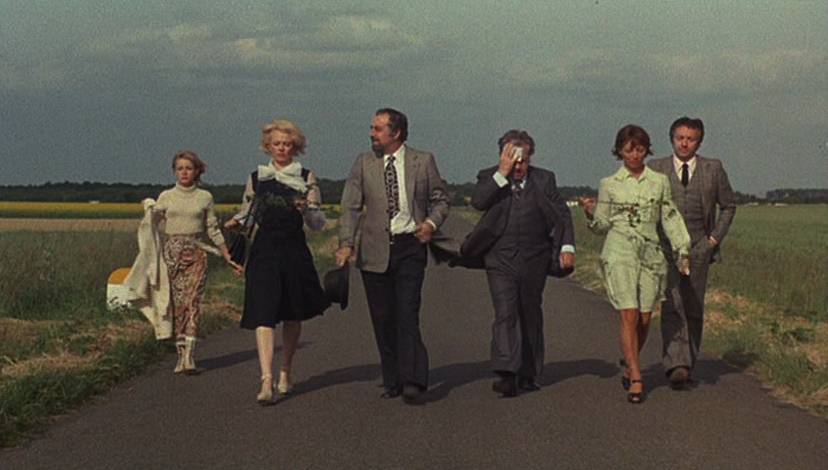
 Winner of the 1972 Oscar for Best Foreign Language Film, Luis Buñuel’s The Discreet Charm of the Bourgeoisie is a sharp, cynical skewering of the European power structure, taking on the high-falutin’ hypocrisy of the government, the military, religion, and, primarily, the wealthy class in hysterical vignettes that center around a group of rich friends trying to sit down and enjoy a meal. But every time they get close, they are ultimately thwarted by miscommunication, a corpse, army maneuvers, terrorists, and, perhaps most bizarrely, fake stage chicken. Buñuel regular Fernando Rey is a hoot as Rafael Acosta, the cocaine-dealing ambassador of Miranda who doesn’t take insults well. Stéphane Audran and Jean-Pierre Cassel play the Sénéchals, a lustful couple desperate to finish a romantic rendezvous even as their guests wait, Julien Bertheau is the local bishop who moonlights as a gardener, Claude Piéplu is an erudite colonel not afraid to share his opinion at a haughty cocktail party, and Maria Gabriella Maione is a sexy stranger who might or might not be a revolutionary after Acosta. Meanwhile, Acosta doesn’t mind making a play for Simone Thévenot (Delphine Seyrig) right under her husband’s (Paul Frankeur) nose. And Ines (Milena Vukotic), one of the Sénéchals’ maids, watches it all with a wonderfully subtle disdain. As if the first half of the film were not surreal enough, the second half includes a series of riotous dream sequences involving ghostly apparitions and a bit of the old ultra-violence, either outwardly related by characters or as cinematic surprises dished out by the masterful Buñuel. None too discreet about its myriad charms, The Discreet Charm of the Bourgeoisie is having a week-long fortieth-anniversary engagement at the Film Society of Lincoln Center in advance of the annual Spanish Cinema Now series, which runs December 7-16 and includes a special sidebar of Buñuel’s Land Without Bread, Tristana, and Viridiana; when you buy a ticket to Discreet Charm, you can get tickets for any Spanish Cinema Now screening for nine dollars by selecting the “Affiliate” option online or showing your ticket stub at the box office.

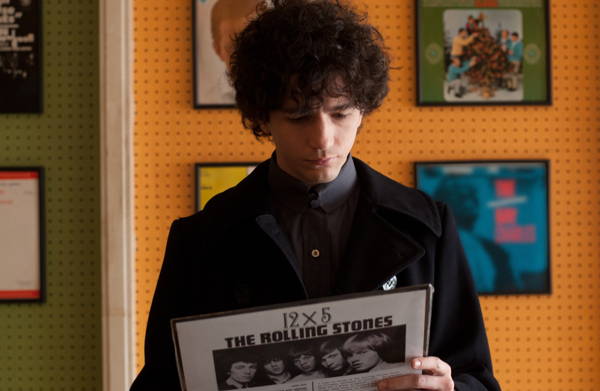
 Inspired by his brief stint as a suburban New Jersey garage-band drummer with rock-and-roll dreams, Sopranos creator David Chase makes his feature-film debt with the musical coming-of-age drama Not Fade Away. Written and directed by Chase, the film focuses on Douglas (John Magaro), a suburban New Jersey high school kid obsessed with music and The Twilight Zone. It’s the early 1960s, and Douglas soon becomes transformed when he first hears the Beatles and the Stones — while also noticing how girls go for musicians, particularly Grace (Bella Heathcote), whom he has an intense crush on but who only seems to date guys in bands. When his friends Eugene (Jack Huston) and Wells (Will Brill) ask him to join their group, Douglas jumps at the chance, but it’s not until he gets the opportunity to sing lead one night that he really begins to think that music — and Grace — could be his life. Not Fade Away has all the trappings of being just another clichéd sex, drugs, and rock-and-roll movie, but Chase and musical supervisor (and executive producer) Steven “Silvio” Van Zandt circumvent genre expectations and limitations by, first and foremost, nailing the music. Van Zandt spent three months teaching the main actors how to sing, play their instruments, and, essentially, be a band, making the film feel real as the unnamed group goes from British Invasion covers to writing their own song. Even Douglas’s fights with his conservative middle-class father (James Gandolfini) and his battle with Eugene over the direction of the band are handled with an intelligence and sensitivity not usually seen in these kinds of films. Not Fade Away does make a few wrong turns along the way, but it always gets right back on track, leading to an open-ended conclusion that celebrates the power, the glory, and, ultimately, the mystery of rock and roll. Not Fade Away, which was the centerpiece of the fiftieth