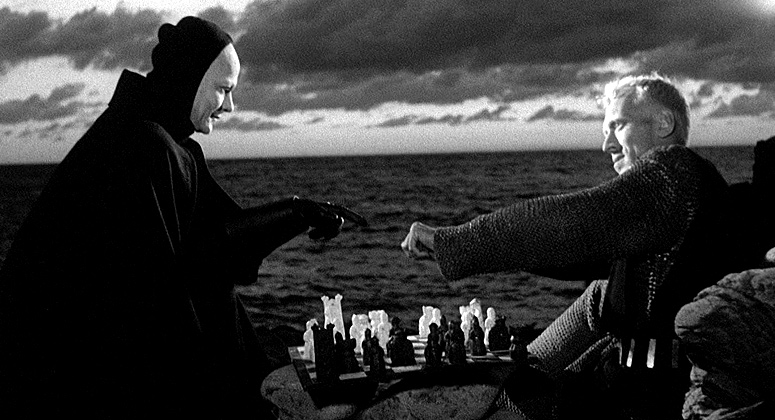
Antonius Block (Max von Sydow) sits down with Death (Bengt Ekerot) for a friendly game of chess in Bergman classic
THE SEVENTH SEAL (Ingmar Bergman, 1957)
BAMcinématek, BAM Rose Cinemas
30 Lafayette Ave. between Ashland Pl. & St. Felix St.
Tuesday, November 27, 4:30, 6:50, 9:15
Series runs November 27 – December 14
718-636-4100
www.bam.org
 It’s almost impossible to watch Ingmar Bergman’s The Seventh Seal without being aware of the meta surrounding the film, which has influenced so many other works and been paid homage to and playfully mocked. Over the years, it has gained a reputation as a deep, philosophical paean to death. However, amid all the talk about emptiness, doomsday, the Black Plague, and the devil, The Seventh Seal is a very funny movie. In fourteenth-century Sweden, knight Antonius Block (Max von Sydow) is returning home from the Crusades with his trusty squire, Jöns (Gunnar Björnstrand). Block soon meets Death (Bengt Ekerot) and, to prolong his life, challenges him to a game of chess. While the on-again, off-again battle of wits continues, Death seeks alternate victims while Block meets a young family and a small troupe of actors putting on a show. Rape, infidelity, murder, and other forms of evil rise to the surface as Block proclaims “To believe is to suffer,” questioning God and faith, and Jöns opines that “love is the blackest plague of all.” Based on Bergman’s own play inspired by a painting of Death playing chess by Albertus Pictor (played in the film by Gunnar Olsson), The Seventh Seal, winner of a Special Jury Prize at Cannes, is one of the most entertaining films ever made. (Bergman fans will get an extra treat out of the knight being offered some wild strawberries at one point.) The Seventh Seal is screening November 27 at BAM, kicking off the BAMcinématek series “Max von Sydow,” consisting of twenty-two wide-ranging films celebrating the outstanding career of the now-eighty-three-year-old Swedish actor. Von Sydow has appeared in such other serious fare as Bergman’s The Virgin Spring and Shame, such thrillers as Sydney Pollack’s Three Days of the Condor and Martin Scorsese’s Shutter Island, such epics as Bille August’s Pelle the Conqueror and Jan Troell’s The Emigrants, and such comedies as Rick Moranis and Dave Thomas’s Strange Brew and Woody Allen’s Hannah and Her Sisters. In addition, he’s been in two of the biggest bombs ever, Mike Gordon’s Flash Gordon (as Ming the Merciless!) and David Lynch’s Dune, was the older priest in William Friedkin’s The Exorcist, and he even played Blofeld in Irvin Kershner’s Never Say Never Again opposite Sean Connery’s James Bond. Of course, no matter what the project, Sydow brings an elegance and grace to it, lifting it up and always making it a whole lot better just for his presence.

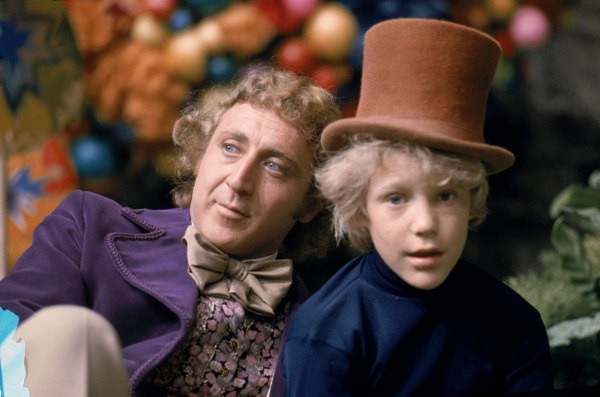
 Based on a 1964 Roald Dahl novel, Willy Wonka & the Chocolate Factory is a fanciful frolic through a children’s wonderland, filled with fear, trepidation, love, and lots of candy, both sweet and sour. Charlie Bucket (Peter Ostrum, in his only film appearance) lives with his dirt-poor family in a ramshackle room, where Grandpa Joe (Jack Albertson) can’t even get out of bed. But when goodhearted Charlie finds one of the golden tickets that will allow him to join a once-in-a-lifetime tour of Willy Wonka’s chocolate factory, Grandpa Joe is suddenly up and about, singing and dancing, and so will you be. Among the other kids with the golden tickets are the spoiled Veruca Salt (Julie Dawn Cole), the selfish Violet Beauregarde (Denise Nickerson), the tube-loving Mike Teevee (Paris Themmen), and the rather sloppy Augustus Gloop (Michael Bollner). As they are led through this dreamland by the unpredictable Willy Wonka (Gene Wilder), they encounter chocolate rivers, bubble machines that make people float, and small Oompa Loompas who are quick to clean up any messes. The soundtrack of this thoroughly entertaining, charming family film includes “The Candy Man Can,” “(I’ve Got a) Golden Ticket,” “Pure Imagination,” and, of course, “Oompa Loompa, Doompa-Dee-Do.” Directed by Mel Stuart, who passed away in August after a career that also included Wattstax, Four Days in November, and If It’s Tuesday, This Must Be Belgium, the film was remade by Tim Burton in 2005 starring Johnny Depp as Wonka with mixed results, but you can catch the original at the Nitehawk Cinema this weekend, with special family screenings at 11:45 am Saturday and Sunday.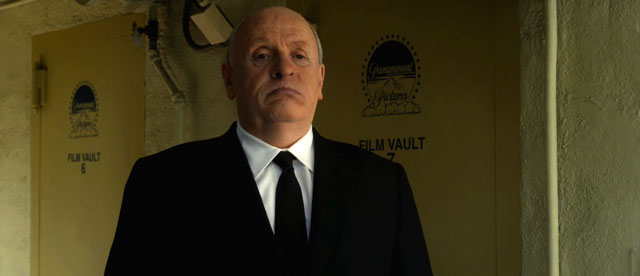
 In 2006, Toby Jones portrayed Truman Capote in Infamous, but he had already been upstaged by Philip Seymour Hoffman, who had won the Best Actor Oscar earlier that year for playing the social gadfly in the 2005 biopic Capote. Well, history is likely to repeat itself; Jones can currently be seen on HBO playing Alfred Hitchcock in Julian Jarrold’s The Girl, which follows the Master of Suspense as he obsesses over Tippi Hedren (Sienna Miller) while making The Birds and Marnie, under the careful watch of his wife, Alma Reville (Imelda Staunton). It’s a slight film, but Jones does a fine job as the creepy Hitch. However, his performance is liable to get lost with the theatrical release of Sacha Gervasi’s Hitchcock, in which the great British director is played by the inimitable Sir Anthony Hopkins, with Helen Mirren taking on the role of Alma as they struggle to make what would become their biggest success, Psycho. Unfortunately, it’s nearly impossible for the audience to separate Hitchcock from Hopkins, a central failing that, compounded by a lifeless subplot involving a potential romance between Alma and writer Whitfield Cook (Danny Huston), leaves the film rather dry and boring. It is fascinating to watch Hitch battle the studio (and the censors) over the financing and distribution of what was an extremely controversial film at the time, but the imaginary scenes with serial killer Ed Gein (Michael Wincott) are forced and unnecessary, and while James D’Arcy does a good job playing the quirky Anthony Perkins, Scarlett Johansson and Jessica Biel are wasted as Janet Leigh and Vera Miles, respectively. And yes, that’s Ralph Macchio as writer Joseph Stefano. Based on Stephen Rebello’s well-received 1990 book Alfred Hitchcock and the Making of Psycho, Gervasi’s feature debut — he previously wrote and directed the 2009 documentary Anvil! The Story of Anvil — is like a fair-to-middling Hitchcock flick or an average episode of Alfred Hitchcock Presents, containing interesting tidbits but never really achieving the captivating sense of mystery and romance (and fun!) that made his films and himself so special. It’s a shame that with two pictures tracing Hitchcock’s unique working process during a seminal period in his career, both fall relatively flat.

 For forty years, Belgrade-born performance artist Marina Abramović has been presenting cutting-edge, often controversial live works that redefine what art is. For her highly anticipated major career retrospective at MoMA in 2010,