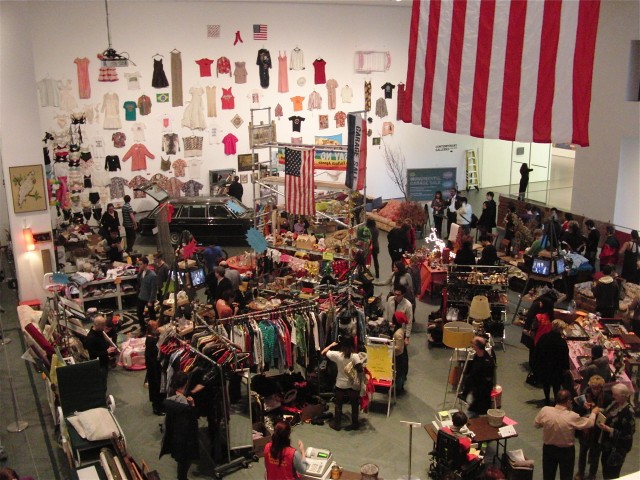
Martha Rosler’s “Meta-Monumental Garage Sale” invites visitors to haggle over donated items in interactive MoMA installation (photo by twi-ny/mdr)
Museum of Modern Art
The Donald B. and Catherine C. Marron Atrium, second floor
11 West 53rd St. between Fifth & Sixth Aves.
Wednesday-Thursday & Saturday–Monday 12 noon – 5:30, Friday 12 noon – 7:30 (closed Tuesdays & Thanksgiving Day)
Museum admission: $22.50 ($12 can be applied to the purchase of a film ticket within thirty days)
212-708-9400
www.moma.org
meta-monumental garage sale slideshow
Does Brooklyn-born multimedia conceptual performance artist Martha Rosler have a deal for you! For her first solo exhibition at MoMA, Rosler (“Semiotics of the Kitchen,” “Bringing the War Home: House Beautiful”) is staging the most American of events, a garage sale. (A huge American flag hovers over the installation like the hand of god.) From May through September, Rosler accumulated everyday objects, both her own and through public donations, that she will be selling in MoMA’s second-floor atrium through November 30. Visitors are encouraged to approach Rosler and haggle over items they are interested in, which will be available at whatever price the sixty-nine-year-old Greenpoint-based artist wants to sell them for. And be prepared: Rosler is a tough negotiator. You can also watch the transactions in real time at the sale’s official website. A comment on community, capitalism, and the art market itself, particularly in these difficult economic times, this “Meta-Monumental Garage Sale” is the latest in a series of sales Rosler has been conducting since its debut, at the University of California, San Diego, back in 1973, when she was a graduate student there; New York experienced this previously in 2000 at the New Museum. The space at MoMA resembles a cluttered house, evoking a statement Rosler wrote on a chalkboard all those years ago in San Diego: “Maybe the Garage Sale is a metaphor for the mind.” It’s also a wonderful way to meet a highly influential artist and walk out of MoMA with a unique object that can’t be found in the museum store. Rosler isn’t saying where the money she collects will be going, other than to explain it won’t go into her or the museum’s pockets. (However, one hour’s proceeds from each day’s sales will go directly to the Hurricane Sandy relief effort.) There are several special programs associated with the exhibition: On November 19, a psychic, a stylist, and an art conservator will come together for “Meta-Monumental Garage Sale: Exploring Value Systems”; on November 26, “An Evening with Martha Rosler” will feature Rosler in conversation with curator Sabine Breitwieser, talking about “Meta-Monumental Garage Sale” as well as “She Sees in Herself a New Woman Every Day,” an audiovisual installation that is part of the current “Performing Histories (1)” exhibit; and on November 29, panel and round-table discussions will examine “Meta-Monumental Garage Sale: Women, Labor, and Work.”
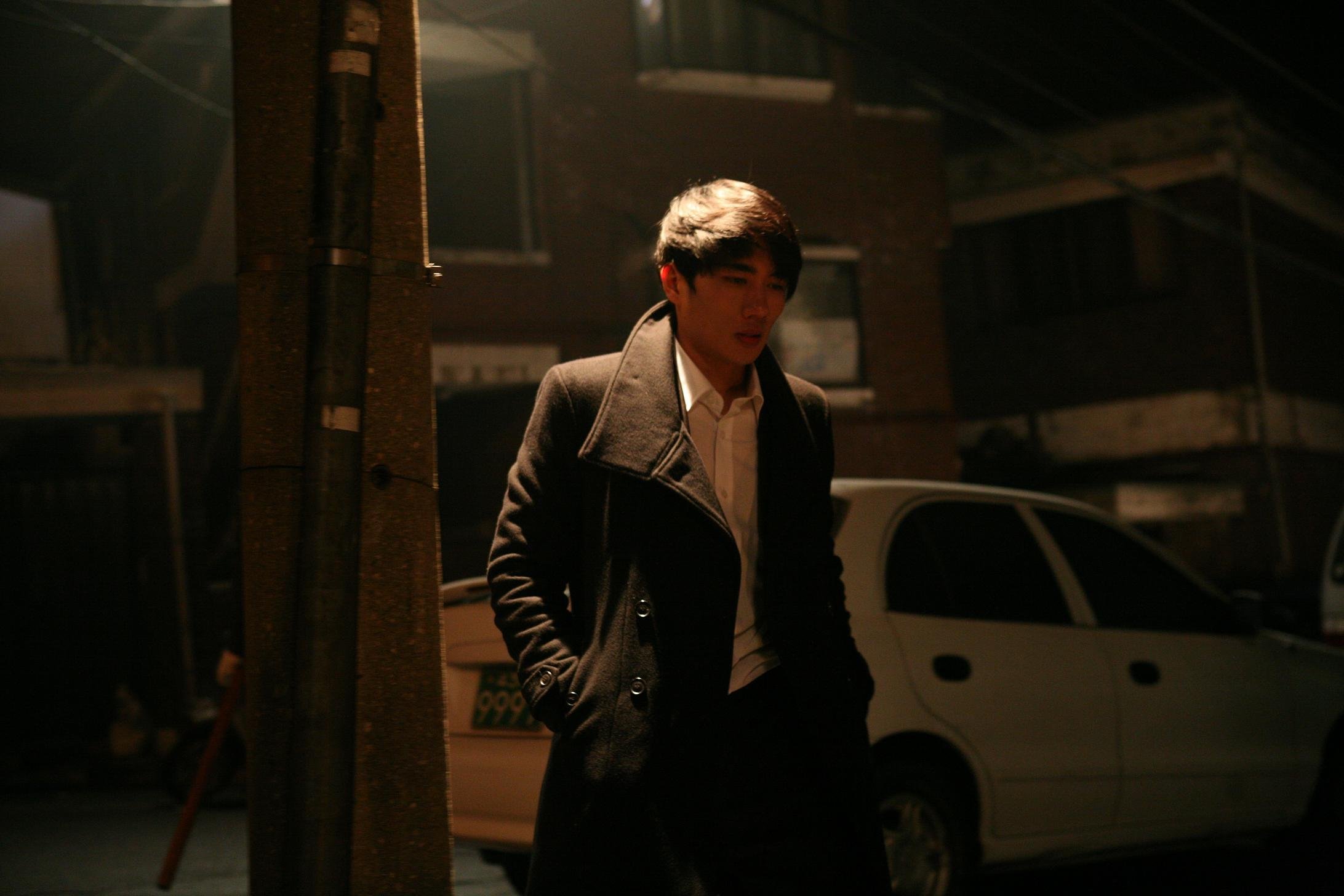
 After his mother’s (Kil Hae-yeon) get-rich-quick scheme doesn’t quite work out as planned, she disappears, leaving her laconic son, Kwon Youn-ho (Um Tae-goo), to continually fight off her ever-more-crazed business partner, Seo-hee (Park Se-jin), a divorced mother desperate to get back the money she claims she is owed. Meanwhile, Youn-ho is trying to make a life for himself and his fiancée, Se-kyung (Yoon Che-yong), but her mother doesn’t approve of his job in reconstruction — he convinces people to leave their homes with small payments so that buildings can be knocked down and fancier residences put up in their place. But neither Youn-ho nor Seo-hee is evil; both have been cast in difficult situations that lead to extreme measures that they regret as they try to put their lives back together. Kim Joon-hyun’s first feature film is a patiently paced drama that subtly examines how the global financial crisis affects families in both large and small ways. Everyone in the film is seeking to maintain or renew a relationship with a loved one, be it a parent, a child, a sibling, or a lover, but money complicates their situations. Um is excellent as Youn-ho, a young man seemingly disinterested in his own existence, letting life just happen to him, a fine counterpart to Park’s Seo-hee, a woman willing to do just about anything to prevent her life from getting completely away from her. Choked is screening November 18 at 5:00 as part of the Museum of the Moving Image series Korean Cinema Showcase: Filmmakers of the Future, which highlights the work of three young, independent Korean directors: Kim, Lee Han, whose Punch was shown in October, and Lee Sang-woo’s Barbie, which is playing December 16 at 5:00.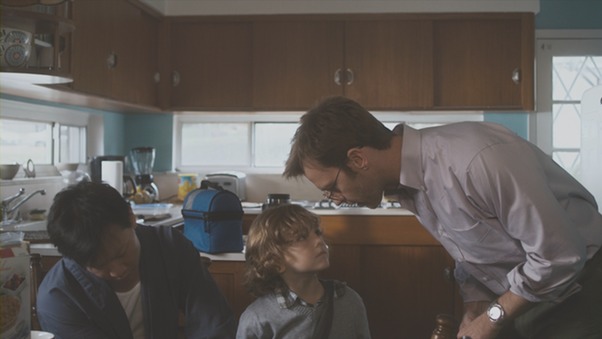
 First-time writer director Patrick Wang proves to be a quadruple threat in his extraordinary feature-film debut, In the Family. An actor, theater director, and economist with an MIT degree, Wang, who is also the star of the film and one of the producers, reveals a smart economy in the quietly powerful drama, despite its 169 minutes. Wang plays Joey Williams, an Asian-American contractor living in Tennessee with his partner, teacher Cody Hines (Trevor St. John), and Cody’s young son, Chip (Sebastian Brodziak), from a previous marriage. They are a happy family, but when Cody suddenly dies in a tragic car accident, Joey’s life slowly starts to fall apart as he discovers he has no legal rights to any of Cody’s holdings and possessions, including Chip. Joey faces his dilemma with an almost Zen-like demeanor, calmly believing that everything will work out and that Cody’s family — sister Eileen (Kelly McAndrew), brother-in-law Dave (Peter Hermann), and mother Sally (Park Overall) — will do the right thing. But as he soon finds out, that isn’t the case, so he considers taking legal action, but without any footing, no lawyer will represent him. While he sits alone in the house that used to be so filled with life and hope, Joey recalls happier times, as flashbacks show how he and Cody first met and eventually fell in love. Wang and cinematographer Frank Barrera (Runaway, As Good as Dead) barely move the camera during the contemporary scenes, allowing the audience to feel the pain building inside Joey, while the flashbacks are shot with a shaky handheld camera that evokes the turmoil to come. Wang avoids genre clichés, wisely choosing not to make grand statements about same-sex marriage, civil unions, and gay rights, instead letting the story play out in a lyrical yet heartbreaking way. First and foremost, Joey, Cody, and Chip were a family — not a gay or mixed-race family — and Joey can’t understand why they are being treated differently than if they were a supposedly more traditional husband, wife, and child. The acting is solid throughout, with a documentary-like quality — Wang cites Ingmar Bergman’s Scenes from a Marriage and John Cassavetes’s A Woman Under the Influence as major inspirations — highlighted by a fine turn by multiple Tony nominee Brian Murray as a client of Joey’s. Don’t let the length scare you away — In the Family is a gripping, involving movie that will make you forget all about time. Nominated for Best First Feature at the 2012 Independent Spirit Awards, In the Family opens November 16 at Cinema Village, playing daily at 4:40, with Murray appearing opening day and Brodziak on hand Saturday and Sunday.
 In 2004, musician and composer Antony Hegarty and film and video pioneer Charles Atlas premiered their multimedia collaboration, Turning, at the Whitney Biennial. The performance featured