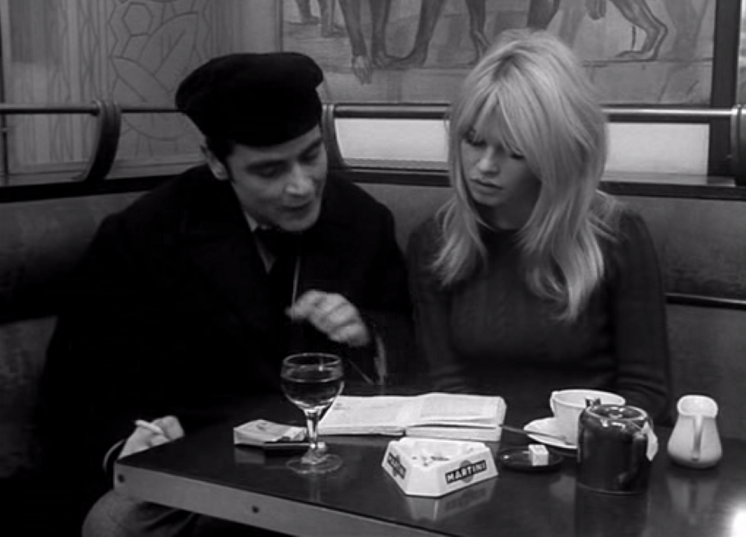
Brigitte Bardot makes an unexpected cameo in MASCULIN FEMININ
CinémaTuesdays: MASCULIN FÉMININ (Jean-Luc Godard, 1966)
French Institute Alliance Française, Tinker Auditorium
55 East 59th St. between Madison & Park Aves.
Tuesday, December 4, $10, 7:00
212-355-6160
www.fiaf.org
 In a 1966 interview with Pierre Daix about Masculin feminin, director Jean-Luc Godard said, “When I made this film, I didn’t have the least idea of what I wanted.” Initially to be based on the Guy de Maupassant short stories “The Signal” and “Paul’s Mistress,” the film ended up being a revolutionary examination of the emerging youth culture in France, which Godard identifies as “the children of Marx and Coca-Cola.” Godard threw away the script and worked on the fly to make the film, which stars Jean-Pierre Léaud as Paul, a peculiar young man who quickly becomes obsessed with budding pop star Madeleine, played by real-life Yé-yé singer Chantal Goya. (Godard discovered her on a television variety show.) Paul chases Madeleine, getting a job at the same company, going to the movies and nightclubs with her and her friends, and meeting her in cafés, where he wants to talk about the troubles of contemporary society and she just wants to have a good time. “Man’s conscience doesn’t determine his existence. His social being determines his conscience,” Paul proclaims. He continually argues that there is nothing going on even as strange events occur around him to which he is completely oblivious, including a lover’s spat in which a woman guns down a man in broad daylight. (Sounds of rapid-fire bullets can be heard over the intertitles for each of the film’s fifteen faits précis, evoking a sense of impending doom.) Paul has bizarre conversations with his best friend, Robert (Michel Debord), a radical who asks him to help put up anarchist posters. Posing as a journalist, Paul brutally interviews Miss 19 (Elsa Leroy), a young model with a very different view of society and politics. Godard has also included a playful battle of the sexes in the center of it all: Paul wants Madeleine, much to the consternation of Madeleine’s roommate, Elisabeth (Marlène Jobert), who also has designs on her; meanwhile, Robert goes out with another of Madeleine’s friends, the more grounded Catherine (Catherine-Isabelle Duport), who is interested in Paul. It all makes for great fun, taking place in a surreal black-and-white world dominated by rampant consumerism. In addition, Godard comments on the state of cinema itself. As they watch a Bergman-esque Swedish erotic film (directed by Godard and starring Eva-Britt Strandberg and Birger Malmsten), Paul dashes off to the projectionist, arguing that the aspect ratio is wrong. And in a café scene, French starlet Brigitte Bardot and theater director Antoine Bourseiller sit in a booth, playing themselves as they go over a script, bringing together the real and the imaginary. “I no longer have any idea where I am from the point of view of cinema,” Godard told Daix. “I am in search of cinema. It seems to me that I have lost it.” Well, he apparently found it again with the seminal Masculin feminin, which kicks off FIAF’s December CinémaTuesdays series “Brigitte Bardot, Femme Fatale” and also includes Roger Vadim’s . . . And God Created Woman and Godard’s Contempt on December 11 and René Clair’s The Grand Maneuver on December 18.


 John Boorman’s Point Blank is an oxymoronic psychedelic film noir, a violent psychological thriller about a determined man dead set on vengeance. Lee Marvin — on quite a hot streak following Cat Ballou, Ship of Fools, The Professionals, and The Dirty Dozen — stars as the one-named Walker, a sincere, old-fashioned man who is double-crossed by his wife, Lynne (Sharon Acker), and friend, Mal Reese (John Vernon, in his film debut), when a deal goes bad on Alcatraz. Searching for Reese, Walker hooks up with Lynne’s sister, Chris (Angie Dickinson), a sexy femme fatale who owns a hot club in the Bay Area. As Walker makes his way up the criminal organization ladder in his quest to get the $93,000 he’s owed, he leaves behind a bloody trail that keeps getting messier and messier. Adapted by Alexander Jacobs and David and Rafe Newhouse from Donald Westlake’s first Parker novel, The Hunter, Boorman’s film is like the antihero Walker himself, purposefully out of time and place. Walker is essentially an anachronism as he makes his way through Point Blank, evoking John Wayne’s Ethan Edwards in John Ford’s classic Western The Searchers. The Summer of Love seems to have had no effect on Walker, who still primarily dresses in dull colors — until Chris brings out the color in him, particularly in one memorable scene in which they both are wearing bright yellow and spy on Reese’s hideaway through a yellow telescope. Film noir is by definition set in a black-and-white world, but Walker can’t hide from the old ways anymore, as he shows when groovy colored lights flash on him in Chris’s club.
 Contemporary activists stand to learn a lot from the gripping documentary How to Survive a Plague. For his directorial debut, longtime journalist David France, one of the first reporters to cover the AIDS crisis that began in the early 1980s, scoured through more than seven hundred hours of mostly never-before-seen archival footage and home movies of protests, meetings, public actions, and other elements of the concerted effort to get politicians and the pharmaceutical industry to recognize the growing health epidemic and do something as the death toll quickly rose into the millions. Focusing on radical groups ACT UP and TAG (Treatment Action Group), France follows such activist leaders as Peter Staley, Mark Harrington, Larry Kramer, Bob Rafsky, and Dr. Iris Long as they attack the policies of President George H. W. Bush, famously heckle presidential candidate Bill Clinton, and battle to get drug companies to create affordable, effective AIDS medicine, all while continuing to bury loved ones in both public and private ceremonies. France includes new interviews with many key activists who reveal surprising details about the movement, providing a sort of fight-the-power primer about how to get things done. The film also shines a light on lesser-known heroes, several filled with anger and rage, others much calmer, who fought through tremendous adversity to make a difference and ultimately save millions of lives. How to Survive a Plague is being shown on World AIDS Day, December 1, at 7:00 as part of MoMA’s annual series “The Contenders,” consisting of exemplary films they believe will stand the test of time, with France on hand to participate in a postscreening discussion; upcoming entries include Peter Ramsey’s Rise of the Guardians, Ben Lewin’s The Sessions, and Behn Zeitlin’s Beasts of the Southern Wild.