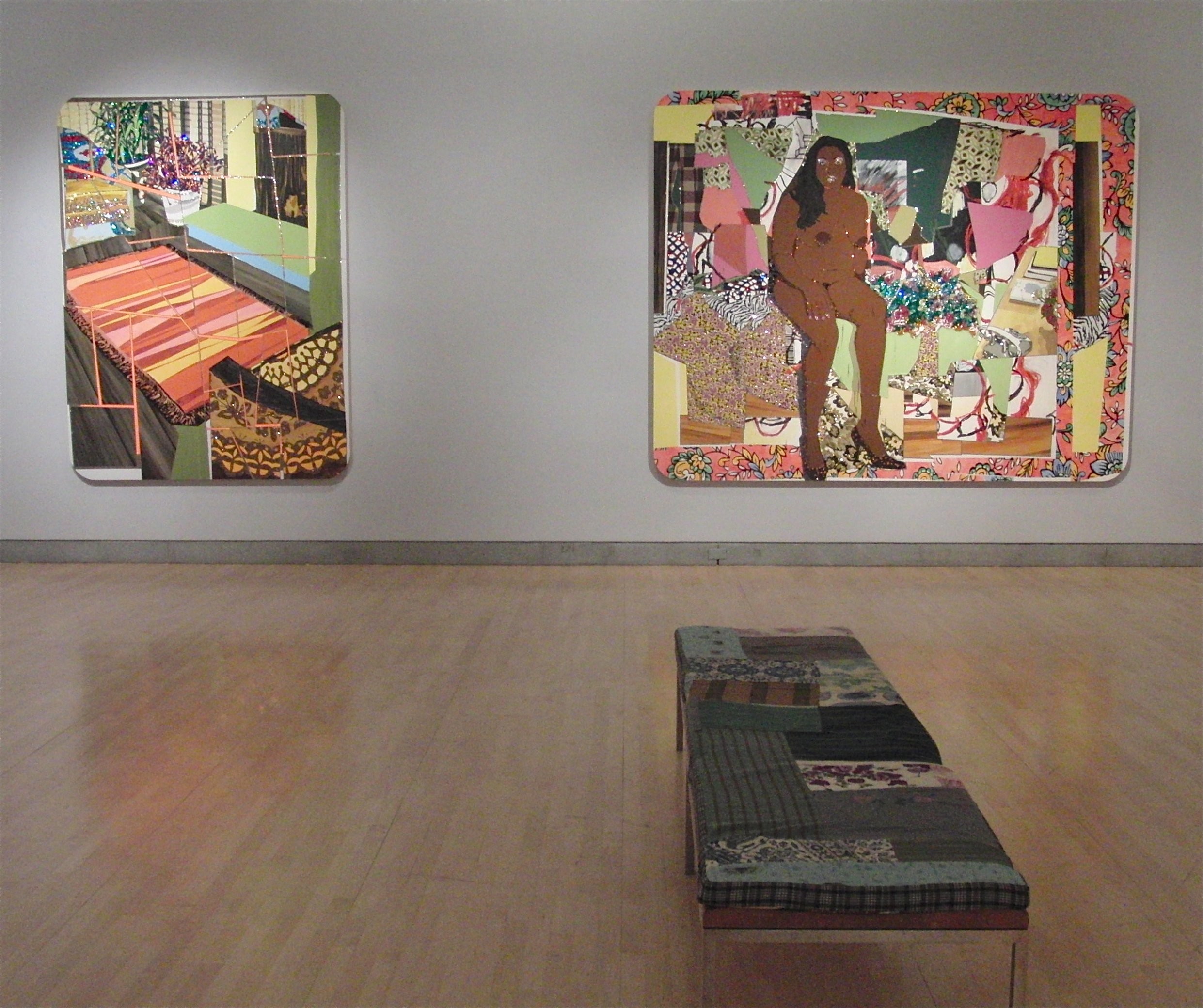
Mickalene Thomas exhibit at Brooklyn Museum includes colorful interiors, portraits, and even decorated benches (photo by twi-ny/mdr)
Brooklyn Museum
200 Eastern Parkway at Washington St.
Wednesday – Sunday through January 20, suggested contribution $10
718-638-5000
www.brooklynmuseum.org
Lehmann Maupin
540 West 26th St. / 201 Chrystie St.
Tuesday – Saturday through January 5, free
212-255-2924/212-254-0054
www.lehmannmaupin.com
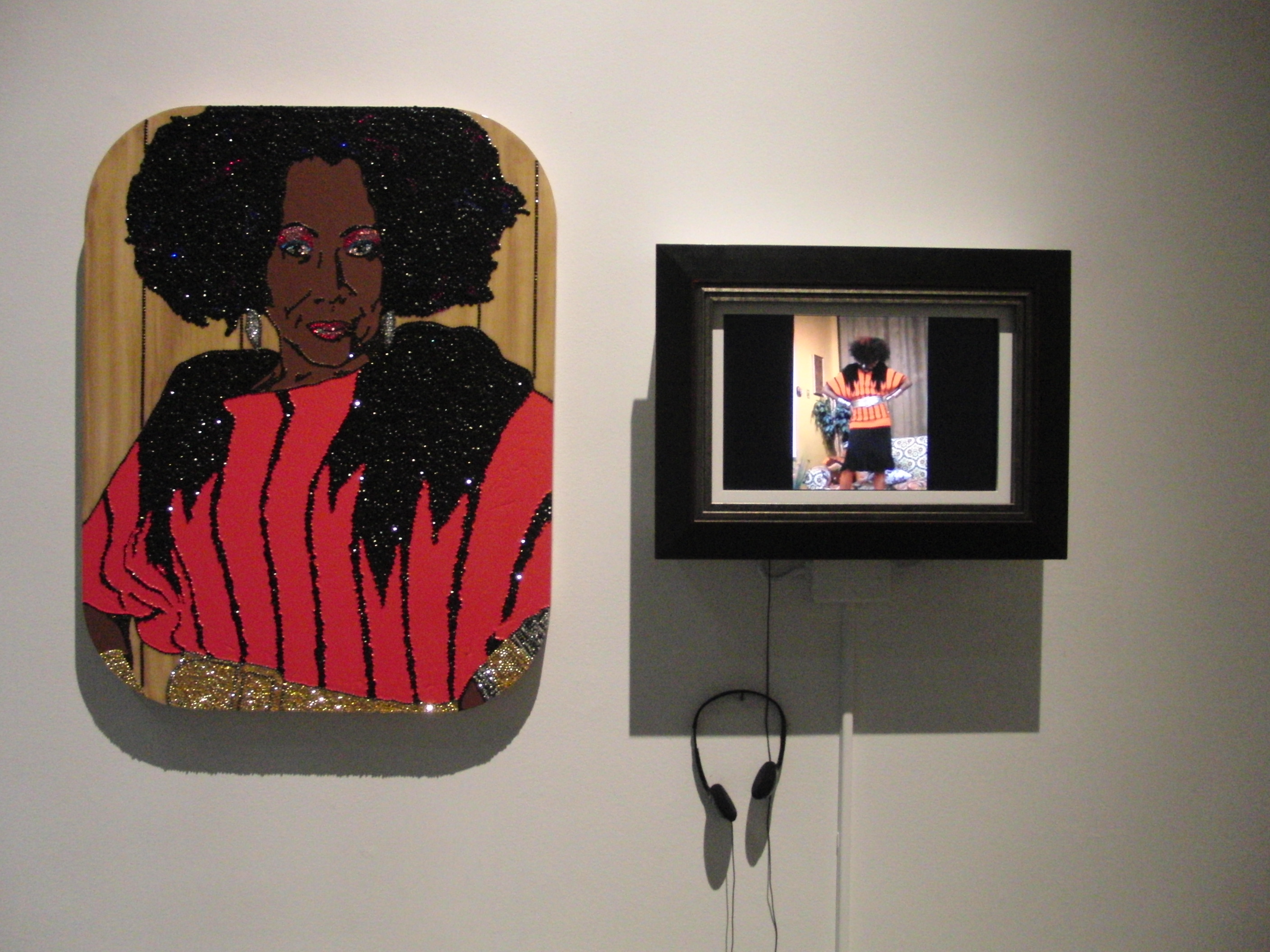
Prepare to be bedazzled. It’s been quite a fall for Camden-born, Brooklyn-based artist Mickalene Thomas, who is in the midst of a quartet of exhibitions in New York City. First and foremost is “Origin of the Universe,” her first solo museum show. Continuing at the Brooklyn Museum through January 20, it consists of one hundred works, focusing on her familiar, brightly colored large-scale portraits of African American women in enamel, acrylic, and glittering rhinestones, in addition to her newer interiors and landscapes. Thomas examines both art history and the image and perception of the black woman in her work, directly referencing such paintings as Gustave Courbet’s “Le Sommeil (Sleep)” and “L’Origine du monde (The Origin of the World)” and Edouard Manet’s “Dejeuner sur l’herbe (Luncheon on the Grass),” replacing the original figures with big, bold black women often wearing afros and 1970s-style clothing (when wearing anything at all). Influenced by Carrie Mae Weems, several photographs of her models depict her subjects naked, staring directly at the viewer. Thomas creates stunning backdrops for her paintings, made up of couches, chairs, pillows, and other items influenced by the 1970-72 multivolume series The Practical Encyclopedia of Good Decorating and Home Improvement. The Brooklyn show also includes four heavily detailed interiors filled with photos, tables, lamps, books and records by black writers and musicians, and other personal elements. Thomas’s central muse, her mother, Sandra, or Mama Bush, is seen in a number of pieces, most revealingly in “Ain’t I a Woman, Sandra,” a 2009 painting paired with a short video of the photo shoot that led to the final work.
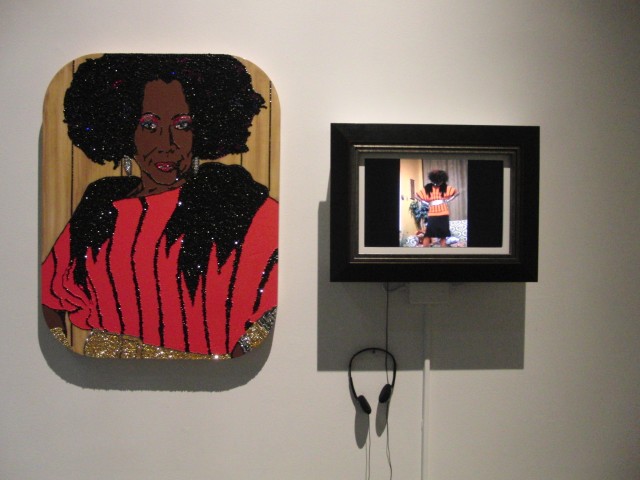
Mickalene Thomas, “Ain’t I a Woman, Sandra,” DVD and framed monitor, rhinestones, acrylic, and enamel on wood panel, 2009 (photo by twi-ny/mdr)
Thomas’s mother is the focus of the Chelsea half of the two-part “How to Organize a Room Around a Striking Piece of Art,” running at both Lehmann Maupin galleries through January 5. The West 26th St. display is anchored by the twenty-three-minute documentary Happy Birthday to a Beautiful Woman, which visitors can watch while sitting in a chair or on a couch in one of Thomas’s re-created rooms. The film looks back at the fascinating life of Sandra Bush, who can be seen in the front room in photographs and paintings. What was meant to be a loving, living tribute to her mother has now become more of a memorial, as Bush, who was battling kidney disease, passed away on November 7 at the age of sixty-one. In fact, it is hard to recognize the woman in the film, gaunt yet still elegant, as the same woman who served as her daughter’s longtime muse. The film plays continuously; it will also have a special screening November 29 at 7:00 at the Brooklyn Museum in the Iris and B. Gerald Cantor Auditorium, preceded at 6:00 by a guided tour of “Origin of the Universe.” (The film can also be seen regularly at the museum in a smaller room.)
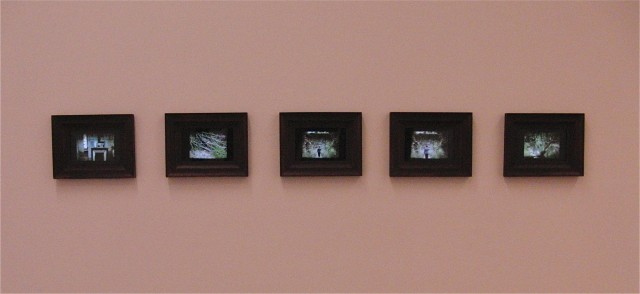
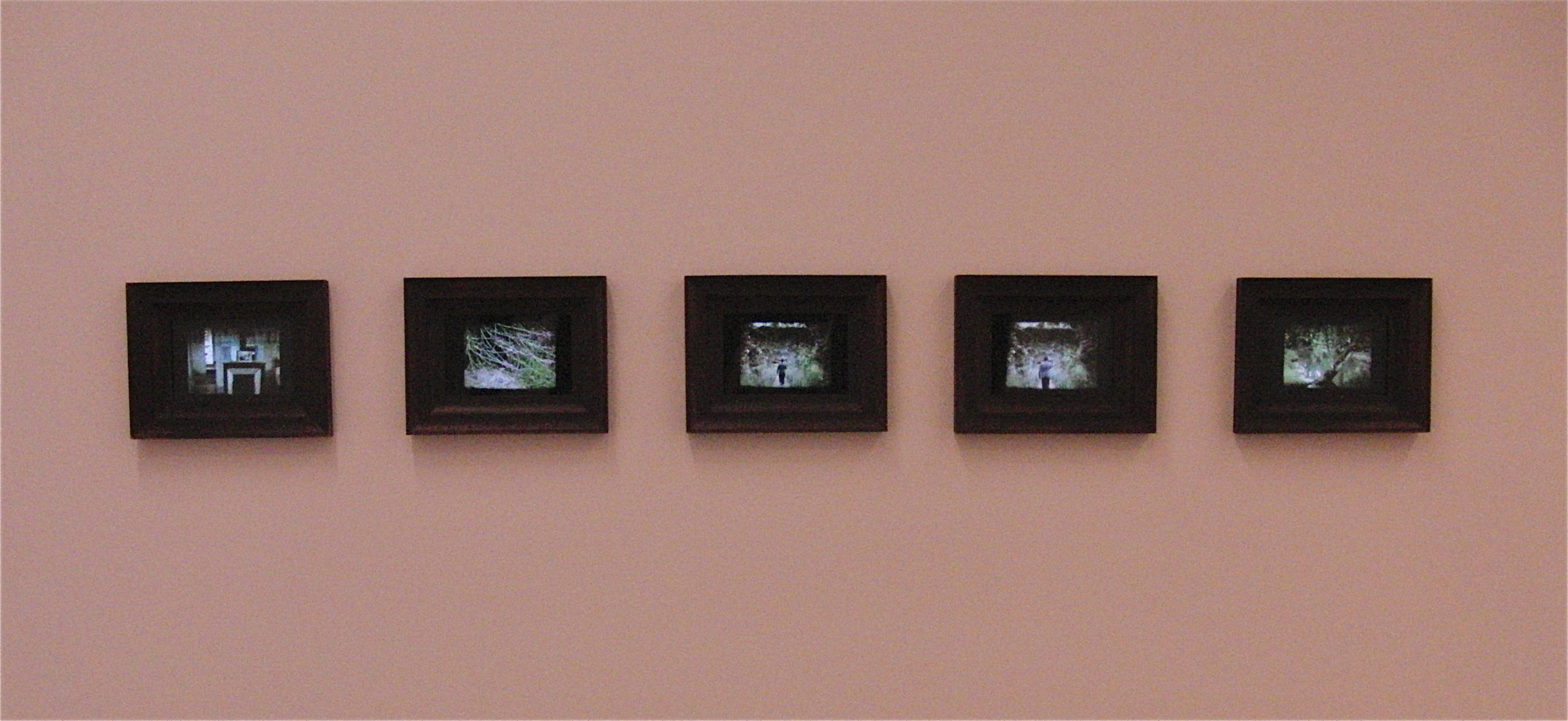
Five-channel video was made during Thomas’s residency at Giverny (photo by twi-ny/mdr)
“How to Organize a Room Around a Striking Piece of Art” continues at Lehmann Maupin’s Lower East Side gallery on Chrystie St. with four of Thomas’s 2011-12 interiors and landscapes, including “Monet’s Blue Foyer,” in addition to a five-channel video she made during her 2010 residency at Giverny. (Her wall mural “Le Jardin d’Eau de Monet” greets visitors to the Brooklyn Museum exhibition.) Thomas’s interiors and landscapes might be devoid of people, but they are no less thrilling, incorporating cubist elements, van Gogh, and Hockney in their inviting collages. One painting sits on an easel on the floor instead of hanging on the wall, as if it is an in-process oil painting of an unseen world outside the studio. The final part of Thomas’s visual assault on New York City is a 120-foot vinyl mural that was commissioned for the new Barclays Center at the intersection of Flatbush and Atlantic Aves., in which Thomas combines a brownstone, the Brooklyn Bridge, and other highlights of the borough. Overall, Thomas’s work reveals an extremely talented, multifaceted artist who is able to look backward while reaching forward, a bold woman with a strong sense of self, honoring history while forging an exciting future.

Mickalene Thomas, detail, “Qusuquzah, Une Trés Belle Négresse 2,” rhinestone, acrylic and oil on wood panel, 2011-12 (photo by twi-ny/mdr)
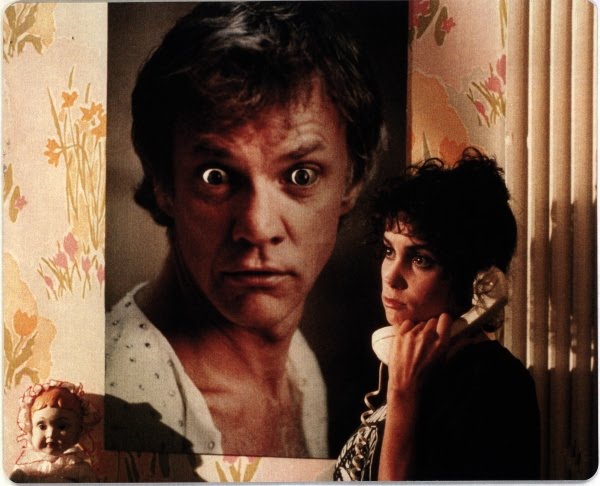
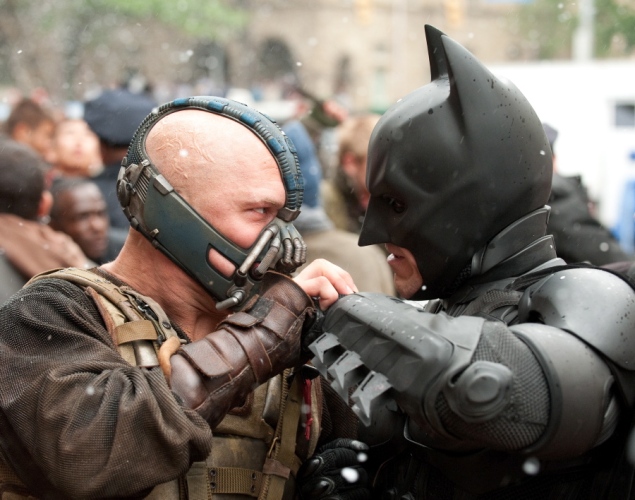
 Christopher Nolan’s dazzling Dark Knight Trilogy comes to a rousing conclusion with The Dark Knight Rises. It’s been eight years since the death of Harvey Dent (Aaron Eckhart), and things have been relatively quiet in Gotham City under a new prison initiative enacted by Commissioner Jim Gordon (Gary Oldman). The Bat Man has disappeared, believed to have gone into hiding after being accused of murdering Dent in cold blood, with the real story kept buried by Gordon. Meanwhile, Bruce Wayne (Christian Bale) has become a Howard Hughes-like recluse, limping around stately Wayne Manor with a cane and refusing to see anyone as his grand fortune wastes away. But the sudden appearance of a new master criminal, the Darth Vader-esque Bane (Tom Hardy), a crafty cat burglar named Selina Kyle (Anne Hathaway), and a potential hostile takeover of Wayne Industries brings the Bat Man back to try to save the city against seemingly impossible odds. The Dark Knight Rises is the darkest Batman movie yet, as Wayne searches even deeper into his soul to find his reason for being and to determine his future — and that of his beloved city. He is joined by financial wizard Miranda Tate (Marion Cotillard), Wayne Industries technical mastermind Lucius Fox (Morgan Freeman), and determined cop John Blake (Joseph Gordon-Levitt) in a race against time, something they have precious little of. Various plot elements and imagery evoke such previous movie series as Star Wars, Star Trek, and Mad Max while, to the film’s detriment, also calling up the 9/11 terrorist attacks and even the Occupy Wall Street movement. But the film gets past those faults as it rises up to an absolutely breathtaking, sensational finale. Nolan wraps things up brilliantly, even bringing back Ra’s Al Ghul (Liam Neeson) and giving a cool cameo to Cillian Murphy (a veteran now of all three movies), but it’s Bale’s complex performance as a man in search of his identity that is the driving force behind what has been a magnificent trilogy. The Dark Knight Rises is being shown November 30 at 7:00 as part of MoMA’s annual series “The Contenders,” consisting of exemplary films they believe will stand the test of time, with Nolan on hand to participate in a postscreening discussion; upcoming entries include Peter Ramsey’s Rise of the Guardians, Ben Lewin’s The Sessions, David France’s How to Survive a Plague, and Behn Zeitlin’s Beasts of the Southern Wild.
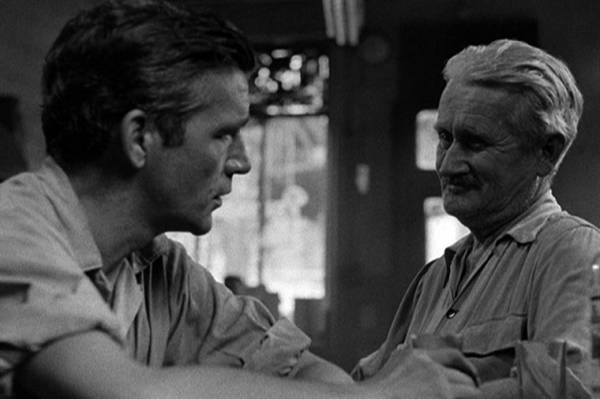
 One of the greatest documentaries ever made about New York City can now be seen in a recently restored 35mm print, offering a new look at an underground classic. Lionel Rogosin’s On the Bowery caused quite a stir upon its release in 1956, winning prizes at the Venice Film Festival while earning criticism at home for daring to portray the grim reality of America’s dark underbelly. After spending six months living with the poor, destitute alcoholics on Skid Row as research, idealistic young filmmaker Rogosin spent the next four months making On the Bowery, a remarkable examination of the forgotten men of New York, ne’er-do-wells who can’t find jobs, sleep on the street, and will do just about anything for another drink. Rogosin centers the film around the true story of Ray Salyer, a journeyman railroad drifter stopping off in New York City seeking temporary employment. Salyer is quickly befriended by Gorman Hendricks, who not only shows Salyer the ropes but also manages to slyly take advantage of him. Although the film follows a general structure scripted by Mark Sufrin, much of it is improvised and shot on the sly, in glorious black and white by Richard Bagley. The sections in which Bagley turns his camera on the streets, showing the decrepit neighborhood under the El, set to Charles Mills’s subtle, jazzy score and marvelously edited by Carl Lerner, are pure poetry, yet another reason why On the Bowery is an American treasure. The film is screening November 28 & 29 at 1:30 as part of MoMA’s continuing series “An Auteurist History of Film,” along with a pair of seminal silent shorts also set in New York City, Rudy Burckhardt’s 1953 Under the Brooklyn Bridge and Helen Levitt and James Agee’s 1952 In the Street; interestingly, Rogosin tried unsuccessfully to get Agee to work on On the Bowery and fired Levitt as the film’s editor.

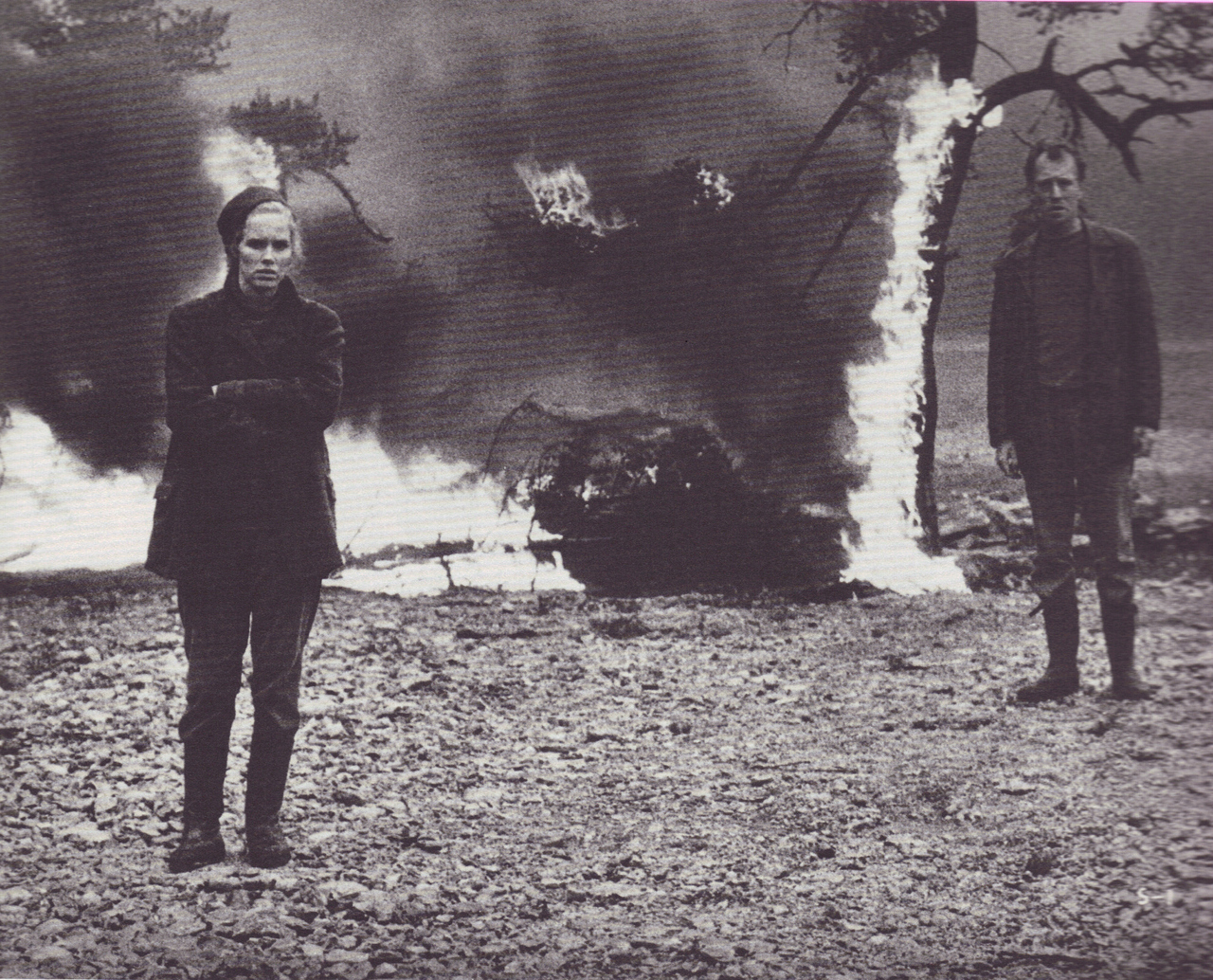
 Ingmar Bergman’s Shame is a brilliant examination of the physical and psychological impact of war, as seen through the eyes of a happily married couple who innocently get caught in the middle of the brutality. Jan (Max von Sydow) and Eva Rosenberg (Liv Ullmann) have isolated themselves from society, living without a television and with a broken radio, maintaining a modest farm on a relatively desolate island a ferry ride from the mainland. As the film opens, they are shown to be a somewhat ordinary husband and wife, brushing their teeth, making coffee, and discussing having a child. But soon they are thrust into a horrific battle between two unnamed sides, fighting for reasons that are never given. As Jan and Eva struggle to survive, they are forced to make decisions that threaten to destroy everything they have built together. Shot in stark black-and-white by master cinematographer Sven Nykvist, Shame is a powerful, emotional antiwar statement that makes its point through intense visual scenes rather than narrative rhetoric. Jan and Eva huddle in corners or nearly get lost in crowds, then are seen traversing a smoky, postapocalyptic landscape riddled with dead bodies. Made during the Vietnam War, Shame is Bergman’s most violent, action-filled film; bullets can be heard over the opening credits, announcing from the very beginning that this is going to be something different from a director best known for searing personal dramas. However, at its core, Shame is just that, a gripping, intense tale of a man and a woman who try to preserve their love in impossible times. Ullmann and von Sydow both give superb, complex performances, creating believable characters who will break your heart. Shame is screening November 30 at BAM as part of the BAMcinématek series “Max von Sydow,” consisting of twenty-two wide-ranging films celebrating the outstanding career of the now-eighty-three-year-old Swedish actor; the festival continues with such other works as William Friedkin’s The Exorcist, Bille August’s Pelle the Conqueror,, Woody Allen’s Hannah and Her Sisters, John Milius’s Conan the Barbarian, and, yes, Mike Gordon’s Flash Gordon, with von Sydow playing Ming the Merciless.