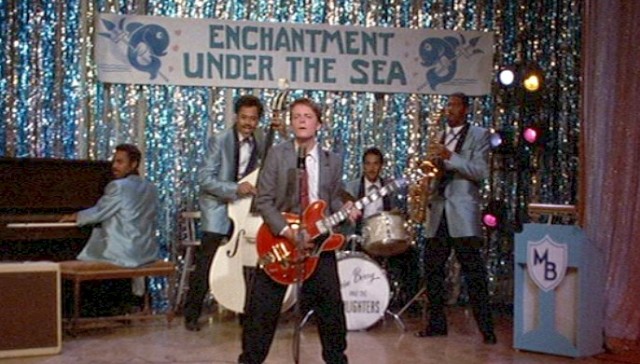
Marty McFly (Michael J. Fox) has to save himself and his family at the Enchantment Under the Sea dance
BACK TO THE FUTURE (Robert Zemeckis, 1985)
St. Patrick’s Gymnasium
268 Mulberry St.
Saturday, March 22, 7:00, $45
Sunday, March 23, 6:00, $38
www.bbqfilms.com/enchantment
Get that flux capacitor ready and prepare for 1.21 gigawatts of inspired fun at the Back to the Enchantment Under the Sea Dance. On March 22 & 23, BBQ Films, the team that turns movie screenings into interactive participatory events, are this time going back to the crazy days of 1985 — and 1955 — as Marty McFly (Michael J. Fox) tries to save his family’s future without bedding his hot-to-trot mother (Lea Thompson) while attempting to pair him up with his ultra-nerdy father (Crispin Glover) by the time of the Enchantment Under the Sea high school dance. And the only way Marty can accomplish this desperate task is with the help of mad scientist Doc Brown (Christopher Lloyd) and a specially outfitted DeLorean. Each night, the re-created prom will begin an hour before the screening of Robert Zemeckis’s runaway hit, Back to the Future, with appropriate 1950s attire recommended for all attendees. There will be live music from the Tee-Tones (no relation to Chuck Berry), beer from Brooklyn Brewery and wine from Vinos Libres (the first drink is free), a photobooth, a swing dance demonstration, futuristic 3D glasses, giveaways, an event poster, and gourmet popcorn in addition to an after-party with Mr. Nice, DJ sets from a place both wonderful and strange and GHOST COP, and freaky visuals courtesy of CHNNLS. Tickets go fast for all BBQ Films gatherings, so you might have to hit eighty-eight miles an hour to get them in time. A portion of the proceeds will be donated to the Michael J. Fox Foundation for Parkinson’s Research.
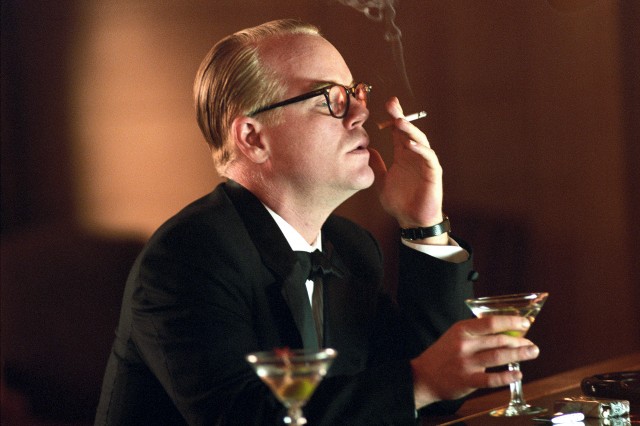
 In November 1959, Richard Hickock (Mark Pellegrino) and Perry Smith (Clifton Collins Jr.) brutally murdered a Kansas family. After reading a small piece about the killings in the New York Times, New Yorker writer Truman Capote (Philip Seymour Hoffman) sets out with his research assistant, Harper “Nell” Lee (Catherine Keener), to cover the story from a unique angle, which soon becomes the workings of the classic nonfiction novel In Cold Blood. Capote tells police chief Alvin Dewey (Chris Cooper) right off the bat that he cares only about the story, not what happens to the killers, which does not endear him to the local force. But when the murderers are captured, Capote begins a dangerous relationship with Smith, who comes to think of the writer as a true friend, while Capote gets caught up deeper than he ever thought possible. Based on the exhaustive biography by Gerald Clarke, Capote is a slow-moving character study featuring excellent acting and some interesting surprises, even for those who thought they knew a lot about the party-loving chronicler of high society and high living. Hoffman, who just died from a drug overdose, earned an Oscar for portraying the socialite author, who was played the following year by Toby Jones in Douglas McGrath’s Infamous, which was based on a book by George Plimpton. Capote, which was also nominated for Best Picture, Best Director (Bennett Miller), Best Supporting Actress (Keener), and Best Adapted Screenplay (Dan Futterman), is screening for free on March 8 at 2:00 at the NYPL’s recently renovated St. Agnes branch on the Upper West Side in a special tribute to Hoffman, a native New Yorker who left us well before his time, playing a longtime New Yorker who also died too young.
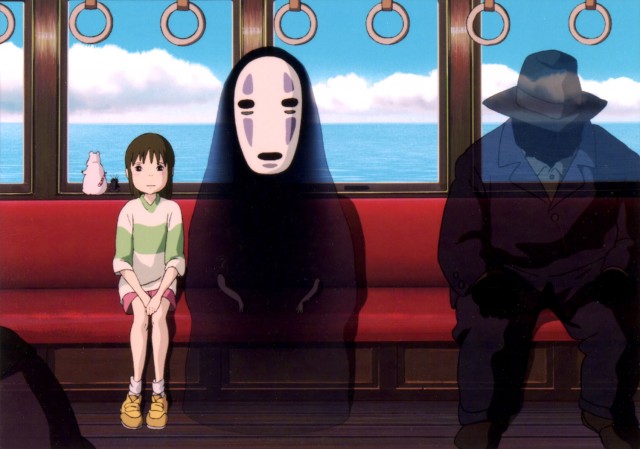
 Prepare to have your spirits lifted up and away in this sensational animated feature from Japanese master Hayao Miyazaki. Ten-year-old Chihiro (Rumi Hiiragi) is unhappy about moving to a new home despite her parents’ best efforts to convince her otherwise. When her father (Takashi Naito) takes a wrong turn on the road, the family ends up in an oddly deserted village that Chihiro soon finds out is a lot more than it seems. Chihiro’s adventures through this dreamlike, surreal, magical place filled with bizarre characters and evil beings are unforgettable, with nuances and references from such diverse works as The Wizard Of Oz and The Seventh Seal. The sheer visual beauty of the animation is staggering; many of the backgrounds are reminiscent of Impressionism. Joe Hisaishi’s maudlin music is way overpraised, as usual, but this Japanese box-office champ deservedly won the Golden Bear at the Berlin International Film Festival and was named Best Asian Film at the Hong Kong Film Awards. As with the best animated films, you don’t have to be a kid to fall in love with Spirited Away, which explains why the Landmark Sunshine is screening the Japanese-language version, with English subtitles, on March 7-8 as part of its ongoing Sunshine at Midnight series, held in conjunction with the theatrical release of what might be Miyazaki’s swan song, The Wind Rises.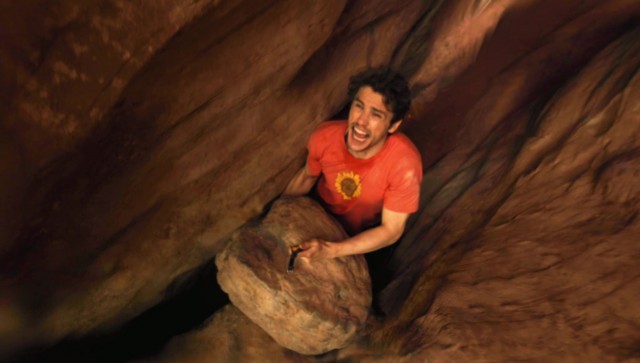
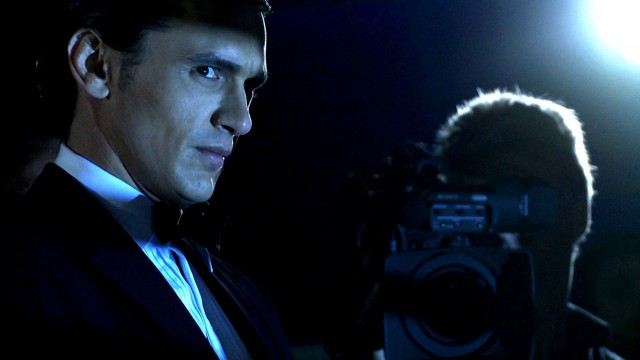
 The prospect of sitting through a ninety-five-minute movie that primarily takes place in close quarters as a young hiker tries to break free of a rock that has pinned him near the bottom of an isolated crevice in Utah’s Blue John Canyon for five days is not exactly promising, whether you suffer from claustrophobia or can take only so much James Franco in one sitting. In addition, you’re likely to know pretty much everything that happens, since the story of Aron Ralston’s true-life fight for survival was all over the news back in 2003 and became a bestselling autobiography, Between a Rock and a Hard Place. But in the hands of Oscar-winning director Danny Boyle, the visual mastermind behind such films as Trainspotting, 28 Days Later, the underrated Sunshine, and Slumdog Millionaire, 127 Hours keeps the suspense in high gear, anchored by Franco’s raw, emotional, Oscar-nominated performance as adventurer Ralston. Over the course of more than five days, Ralston records video diary entries for his parents, carefully preserves his tiny water supply, gets excited when he can stick his foot out to catch a brief ray of sunlight, and uses a dull knife to try to cut through his arm. Every morning a raven flies overhead, as if waiting for him to die so he can scavenge his body. But Ralston immerses himself in fantasies and memories, attempting to keep his mind operating to come up with a way to get free. Watching the film is both agonizing and exhilarating; don’t be surprised if you feel guilty gulping your large soda and munching on your supersized popcorn while Ralston preciously measures his liquid intake by the milliliter. 127 Hours is another cinematic triumph by one of today’s most innovative directors, starring twenty-first-century-man Franco, who writes poetry and short stories, appears in avant-garde videos, curates art exhibitions, adapts classic novels into offbeat films, directs dance theater, is studying for his PhD at Yale and teaching at other colleges, is a novelist, and will soon be on Broadway playing George in Of Mice and Men — and he’s still only in his midthirties. The IFC Center is paying tribute to the unstoppable Franco — he is so ubiquitous that a few months ago, we were discussing his version of As I Lay Dying while we were on our way to see an off Broadway show, and when we sat down, it turned out that we were sitting right behind Mr. Franco. FrancoFest runs March 5-12 with screenings of 127 Hours, Rob Epstein and Jeffrey Friedman’s Howl (in which Franco plays Allen Ginsberg), Harmony Korine’s Spring Breakers, William Friedkin’s Cruising, Gus Van Sant’s My Own Private Idaho, and such Franco-directed flicks as Sal, My Own Private River, Good Time Max, The Broken Tower, As I Lay Dying, The Ape,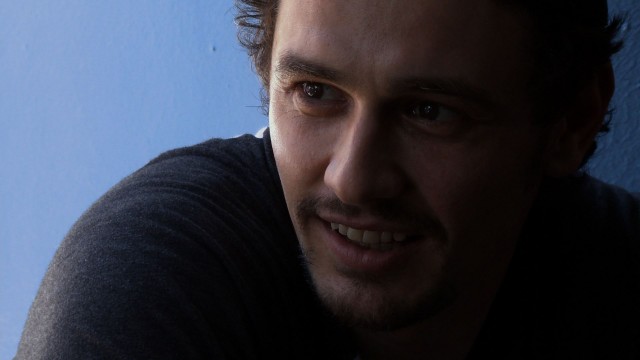
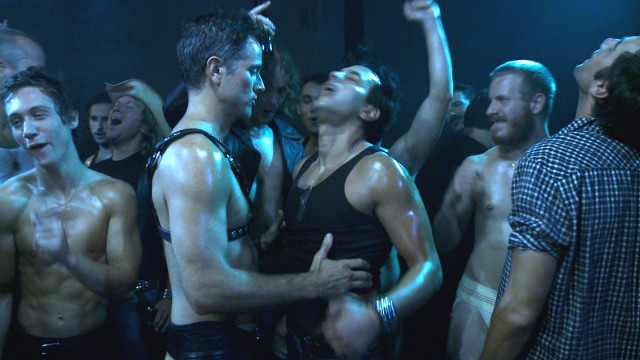
 In his 2013 autobiography, The Friedkin Connection, writer-director William Friedkin delves into his controversial 1980 film, Cruising, explaining, “I cut at least half an hour from the club scenes and the murder scenes. I had purposely let these scenes of pornography and violence run long, knowing they’d be cut and I’d be left with the story I wanted to tell. Despite these cuts, the film pushes the boundaries of what is acceptable in an R-rated film, something the critics were quick to point out.” Cruising, which stars Al Pacino as an undercover cop hunting a serial killer in New York City’s underground gay community, was a critical and financial flop; the Variety reviewer wrote, “If this is an R, then the only X left is actual hardcore.”