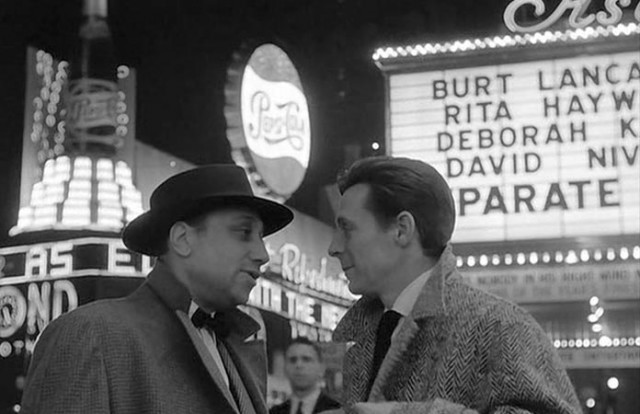
Jean-Pierre Melville and Pierre Grasset are involved in a lurid cover-up in Melville’s TWO MEN IN MANHATTAN
CINÉSALON: TWO MEN IN MANHATTAN (DEUX HOMMES DANS MANHATTAN) (Jean-Pierre Melville, 1959)
French Institute Alliance Française, Florence Gould Hall
55 East 59th St. between Madison & Park Aves.
Tuesday, March 4, $13, 4:00 & 7:30
Series continues Tuesdays through March 18
212-355-6100
www.fiaf.org
 When French U.N. delegate Fèvre-Berthier goes missing in director Jean-Pierre Melville’s 1959 noir, Two Men in Manhattan, reporter Moreau (Melville) of the French Press Agency and freelance photographer Pierre Delmas (Pierre Grasset) go out on the town, trying to find out what happened. While Moreau is seeking the truth, Delmas is after a sensationalist photograph he can sell to the highest bidder. They meet up with several women who knew the married diplomat — some much better than others — including his secretary, Françoise Bonnot (Colette Fleury), actress Judith Nelson (Ginger Hall), stripper Bessie Reid (Michèle Bailly), and jazz singer Virginia Graham (Glenda Leigh). As the men make their way through Rockefeller Plaza, Times Square, Greenwich Village, Broadway, the subway, and the United Nations, Marial Solal’s and Christian Chevallier’s jazzy score dominates the outdoor scenes, soaking the viewer in the New York at night atmosphere. And all the while, the reporter and photographer are trailed by someone in a mysterious car. As they get closer to their destination, they are faced with some serious ethical choices, not just about journalism, but about life itself. Nearly fifty-five years after its release, Two Men in Manhattan feels as stiff and dated as Melville’s (Bob le Flambeur, Le Doulos, Le Samouraï) lead performance, his only starring role and his sole appearance in one of his own films. It’s difficult to tell if Two Men in Manhattan is a serious procedural, an homage to classic noirs, a tribute to New York City, or a sly genre parody — perhaps it’s all of them, but far too many of the twists and turns are hard to swallow, especially when it comes to Delmas’s selfish decisions and Moreau’s often absurd brainstorms that seem to exist just to quicken the plot despite their incredulity. Still, it’s beautifully shot in shadowy darkness by Nicholas Hayer, and it was proclaimed by Jean-Luc Godard to be the second best film of the year. A digitally remastered version of Two Men in Manhattan is screening March 4 at 4:00 & 7:30 as part of the FIAF CinéSalon series “Remastered & Restored: Treasures of French Cinema”; the later screening will be presented by Phillip Lopate, and both shows will be followed by a wine reception. The three-month festival continues March 11 with Claire Denis’s Chocolat, introduced by African Film Festival founder Mahen Bonetti, before concluding March 18 with Henri-Georges Clouzot’s The Truth.
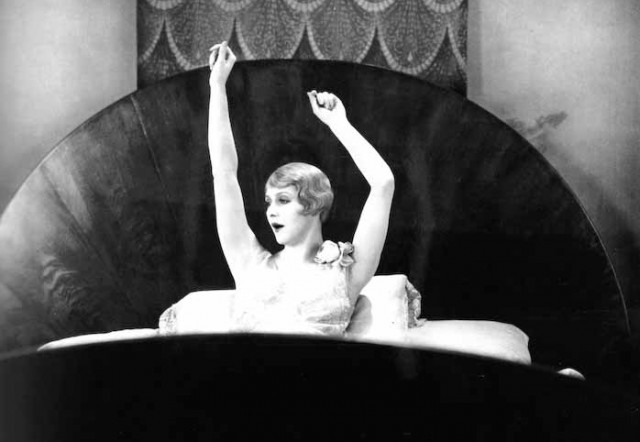
 Loosely based on a Noël Coward play that was recently made into a film starring Colin Firth, Jessica Biel, and Kristin Scott Thomas, Alfred Hitchcock’s Easy Virtue is another of the Master of Suspense’s cleverly told melodramas, a risqué tale of a woman unfairly placed in a lurid situation. Isabel Jeans stars as Larita Filton, a loving wife whose husband, Aubrey (Franklin Dyall), has commissioned her portrait by painter Claude Robson (Eric Bransby Williams). Just as Claude makes a play for Larita, she fights him off and Aubrey walks in. He misinterprets the scene, shots ring out, the artist is dead, and Claude files for a highly publicized divorce case in which Larita is found guilty of misconduct. Trying to put her notorious past behind her, she heads for the Mediterranean, where she meets John Whittaker (Robin Irvine), a wealthy mama’s boy who falls instantly in love with her and brings her back to his parents’ country estate. But once there, Whittaker’s nasty mother (Violet Farebrother) and conniving sisters (Dacia Deane and Dorothy Boyd) do everything they can to ruin the relationship, seeking to uncover Larita’s history while also attempting to put her son back together with longtime family friend Sarah (Enid Stamp Taylor). Easy Virtue, which features yet another Hitchcock blonde, is a gripping film about honesty, reputation, individuality, and character as an innocent woman is forced to face undeserved consequences in the superficial world of high society. Hitchcock, who makes his cameo holding a walking stick, gliding past Larita while she sits by a tennis court, includes several wonderful touches involving circles and ovals, from a close-up of a judge’s wig to a shot through a tennis racket’s strings to a dining room dominated by a group of elongated, haloed saints on one wall. Easy Virtue is also one of Hitchcock’s dourest silent melodramas, lacking any comic relief as a wronged woman desperately tries to right her life. Easy Virtue is screening on March 4 at 6:45 as part of the Film Forum series “The Hitchcock 9,” with live piano music by Steve Sterner. “The Hitchcock 9” continues through May 4 with Blackmail, The Pleasure Garden, Champagne, The Farmer’s Wife, The Ring, Downhill, and The Manxman (all featuring Sterner on piano), in conjunction with “The Complete Hitchcock,” which runs through March 27 and includes all of Sir Alfred’s feature narratives. In addition, the Paley Center will be hosting
 In Exposed, visual artist Beth B, who got her start in the 1970s underground scene in New York City, invites viewers into the inner world of burlesque, going behind the scenes with eight current performers who share intimate details about their lives and their shows. Beth B (Two Small Bodies, An Unlikely Terrorist), who wrote, directed, produced, edited (with Keith Reamer), and photographed (with Dan Karlok) the seventy-six-minute documentary, goes backstage at such New York venues as the Slipper Room, Le Poisson Rouge, the Cutting Room, Dixon Place, P.S. 122, Galapagos Art Space, and Coney Island’s Sideshows by the Seashore as burlesque performers discuss issues of gender, control, freedom, disabilities, power, nudity, femininity, personal and professional identity, and more. “What the world projects as normal, it’s just such an illusion, it’s such a fantasy,” Bunny Love says, “and I love that fantasy.” UK comedian and cabaret performer Mat Fraser, who was born with “flippers” for hands, explains, “If you can make them laugh and make a political point that fuels your outrage, all the better.” And Rose Wood adds, “I’ve tried to present my audience with an indelible picture of the body seen in another way, seen in a way that’s different than they see themselves. They have ideas of what’s normal — what a man does, what a woman does, what a heterosexual does, what a gay person does — and I try to present them with another way of seeing the body.” Among the other performers who share their stories are Tigger!, who uses burlesque as a kind of sexual political theater; Dirty Martini, who pays tribute to such early stars of the wordless art form as Dixie Evans and Vickie Lynn; Bambi the Mermaid, who produces Coney Island’s popular Burlesque at the Beach series; Julie Atlas Muz, who honors Pina Bausch in her performance art; and World Famous *BOB*, who points out, “I never lie to people. People would say, ‘Are you a man or a woman?’ And I would say yes. That quick wit was something that I learned from my drag family, that quick wit, that ability to turn anything that hurts you inside into something that’s funny.”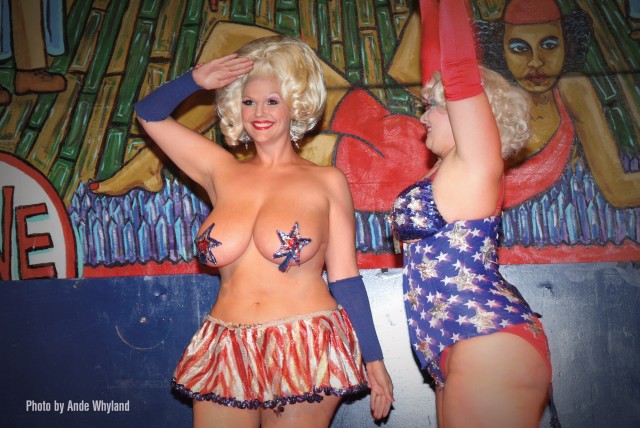
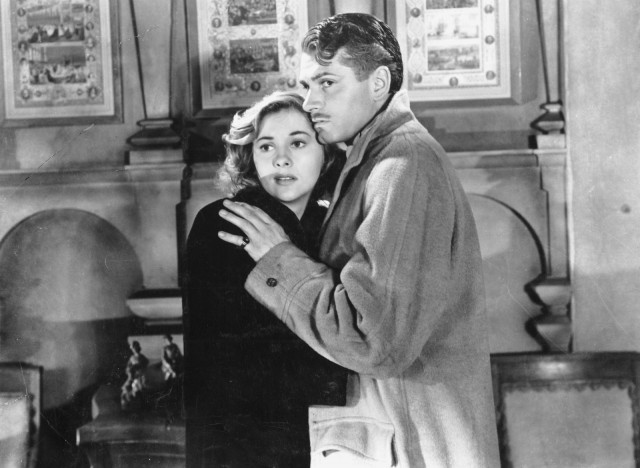
 “Last night I dreamt I went to Manderley again.” The opening line of Rebecca, Alfred Hitchcock’s first Hollywood picture, instantly sends chills down the spine of anyone who has seen the film or read the book on which it is based, Daphne du Maurier’s 1938 novel of the same name. The line is spoken in voice-over by the second Mrs. de Winter (Joan Fontaine), so haunted by the first Mrs. de Winter, the recently deceased Rebecca, that she never even gets a first name, depriving her of her own identity. While serving as a paid companion to snooty wealthy matron Edythe Van Hopper (Florence Bates) on a trip to Monte Carlo, the orphaned young woman meets the dapper but dark Maxim de Winter (Laurence Olivier), an elegant widower who takes a liking to her. Following a whirlwind courtship, they are married, and Maxim takes his mousey bride to his castlelike Cornwall estate, Manderley, where she is constantly compared to and overshadowed by the ghost of Rebecca, idolized as the perfect woman by the large staff, in particular the grim housekeeper, Mrs. Danvers (Judith Anderson), who relentlessly tortures the second Mrs. de Winter. “You wouldn’t think she’d been gone so long, would you?” Mrs. Danvers tells her. “Sometimes, when I walk along the corridor, I fancy I hear her just behind me. That quick light step, I couldn’t mistake it anywhere. It’s not only in this room, it’s in all the rooms in the house. I can almost hear it now.” But just as the second Mrs. de Winter finally tries to establish herself — “I am Mrs. de Winter now” she declares to Mrs. Danvers — Maxim shares a shocking truth about the first Mrs. de Winter that turns her world inside out.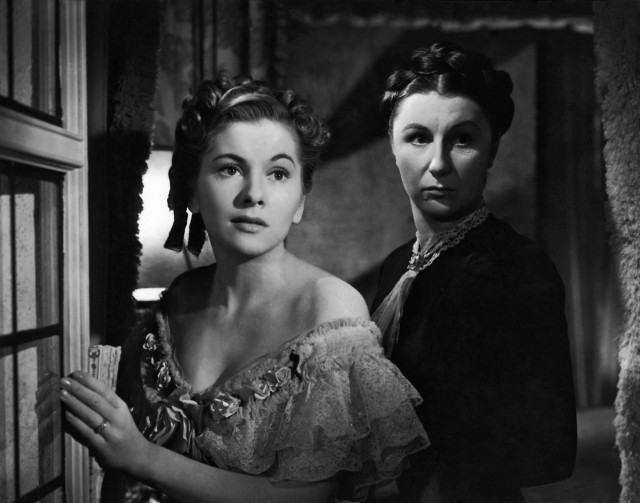
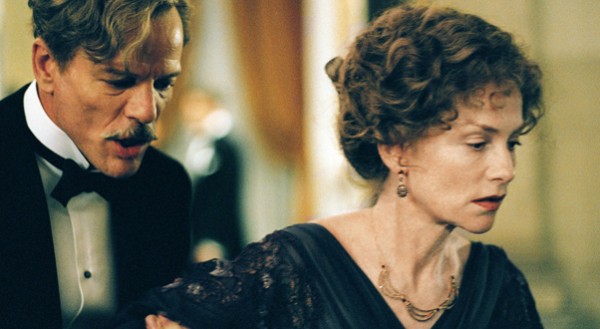
 Jean Hervey (Pascal Greggory) thinks he has the perfect life. He is a wealthy businessman with a beautiful home and a gorgeous wife, Gabrielle (Isabelle Huppert). At their fancy Thursday-night dinner parties, he gets to show off everything he has to all the right people. But then one day he comes home from work to find a letter waiting for him: Gabrielle has left him for another man. Suddenly his carefully constructed world — including a sexless marriage and servants who dress and undress him — comes tumbling down in an instant, only to be turned upside down again when Gabrielle immediately returns, having changed her mind, but not necessarily for the most loving of reasons. For the rest of the film, Greggory and Huppert act up a storm as they try to deal with the tragic consequences both publicly and privately. Based on the Joseph Conrad short story “The Return,” Gabrielle is a powerful, gripping turn-of-the-century drama that is staged theatrically by director and cowriter Patrice Chéreau, who knows how to get inside his characters (see Intimacy, Queen Margot, or The Wounded Man). While Hervey delivers monotone voice-over monologues in black-and-white, the more lively Gabrielle is depicted in color, her red hair a striking contrast to her bland, brown-gray husband. Most of the film takes place within the confines of their fabulous home, which becomes more and more like a prison as they fight for survival. A stunning achievement — though not an easy film to watch — Gabrielle is screening March 2 at 3:20 as part of the Film Society of Lincoln Center series “Patrice Chéreau: The Love That Dares,” which pays tribute to the stage and film director, who passed away in October at the age of sixty-eight. The festival continues through March 5 with such other Chéreau works as Intimacy, Queen Margot, The Flesh of the Orchid, and The Wounded Man.