Cate Blanchett is being honored at MoMA with an eight-film tribute series this month
BLUE JASMINE (Woody Allen, 2013)
MoMA Film, Museum of Modern Art
11 West 53rd St. between Fifth & Sixth Aves.
Friday November 6, 4:30
Series runs November 5-15
Tickets: $12, may be applied to museum admission within thirty days
212-708-9400
www.moma.org
www.sonyclassics.com
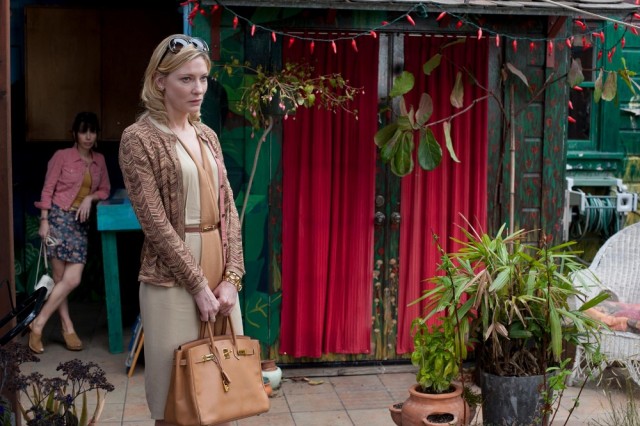
 Woody Allen’s best film in years, Blue Jasmine is a modern-day Streetcar Named Desire filtered through the Bernie Madoff scandal. Cate Blanchett won an Oscar for her marvelously nuanced and deeply textured performance as Jasmine French, an elegant socialite whose immensely wealthy husband, Hal (a wonderfully smarmy Alec Baldwin), amassed his fortune the new-fashioned way: by lying and cheating—only he was the rare financier who got caught and ended up in jail. Now broke and distraught, Jasmine moves in with her sister, Ginger (the delightful Sally Hawkins), a single mother with two kids living in a cramped apartment in San Francisco. Ginger and her ex-husband, Augie (an excellent Andrew Dice Clay), lost all their money by investing with Hal, and she is now trying to rebuild her life, working as a cashier and dating the gruff but dedicated Chili (a strong Bobby Cannavale). Not used to taking care of herself, Jasmine seems lost in a world that no longer treats her like a princess; she takes a job working for a dentist (Michael Stuhlbarg) and attends a computer class, but she is determined to regain her previous status. And that chance comes when she meets Dwight (a gentle Peter Sarsgaard), a man with grand plans who just might be the one to lead her back to the level to which she is accustomed.
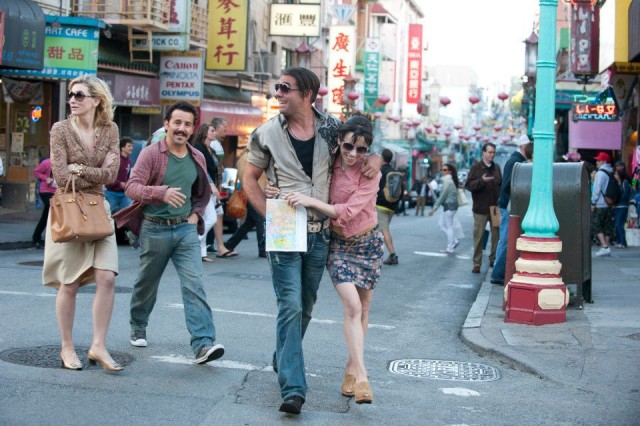
Sisters Jasmine (Cate Blanchett) and Ginger (Sally Hawkins) go on an awkward double date in San Francisco
With Blue Jasmine, Allen has written his best screenplay since 1989’s Crimes and Misdemeanors, creating a complex, multilayered narrative that intelligently examines both sides of the financial crisis, as the rich Jasmine loses everything and the lower-middle-class Ginger can’t quite reach the next level. The relationship between the two sisters is bittersweet, evoking Tennessee Williams’s Blanche and Stella, with Jasmine the delusional sibling and Ginger as the much more realistic one, in this case dealing with a pair of Stanley Kowalski-type brutes. The story travels seamlessly back and forth between the past and the present, concentrating on Jasmine’s downward emotional and psychological spiral, which is supremely evident in Suzy Benzinger’s dazzling costume design and the detailed makeup, which focuses particularly on Blanchett’s stunningly emotive eyes. She physically dominates the screen like no previous Allen leading lady, with cinematographer Javier Aguirresarobe (Vicky Cristina Barcelona) making sure she fills the screen again and again. It’s a sensational star turn in a film loaded with superb acting. Blue Jasmine is a joy to watch from beginning to end, a deft commentary from a master back at the very top of his game. Blue Jasmine is screening November 6 at 4:30 as part of the MoMA series “Cate Blanchett: A Tribute,” consisting of eight films by the Oscar-winning actress, who was the honoree at this year’s MoMA Film Benefit, including Shekhar Kapur’s Elizabeth, Richard Eyre’s Notes on a Scandal, Steven Soderbergh’s The Good German, and Peter Jackson’s The Lord of the Rings: The Fellowship of the Ring.

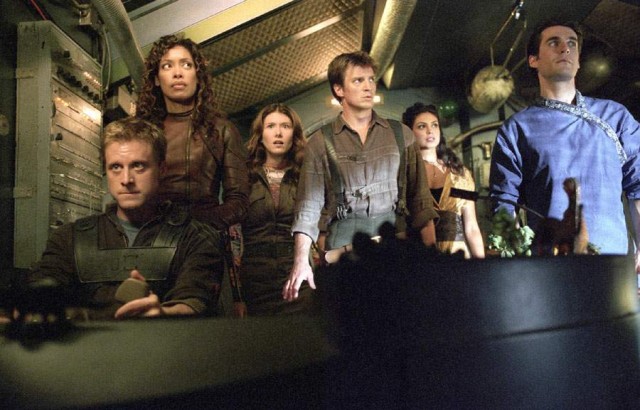
 We were huge fans of Joss Whedon’s Buffy the Vampire Slayer and Angel, so it was with much disappointment that we watched his 2002 TV show, Firefly, come and go so quickly. But the diehard fans, known as Browncoats, wanted more than the Fox network gave them, so Whedon delivered this exciting feature-length film for Universal, reuniting the cast, including Nathan Fillion as Mal, Gina Torres as Zoe, Alan Tudyk as Wash, Morena Baccarin as Inara, Adam Baldwin as Jayne, Jewel Staite as Kaylee, Sean Maher as Simon, Summer Glau as River, and Ron Glass (yes, the guy from Barney Miller) as Shepherd. The bad guy this time around is known simply as the Operative (Chiwetel Ejiofor), a cold-blooded killing machine out to destroy River, who has very dangerous special powers that the Alliance wants silenced. Also getting in the crew’s way are the Reavers, vile creatures who prefer to eat their prey alive. While the Browncoats should be thrilled with the film, so should newbies to this world, as Whedon has managed to make Serenity an involving stand-alone space Western that sci-fi fans can enjoy without knowing anything about Firefly. But after you see this thoroughly enjoyable flick, you’re likely to rush to catch up on everything you missed. Serenity is screening November 7 at as part of the Nitehawk Cinema series “Country Brunchin’” and “Sci-Fighters” and will be preceded by a live performance by the Brooklyn country band
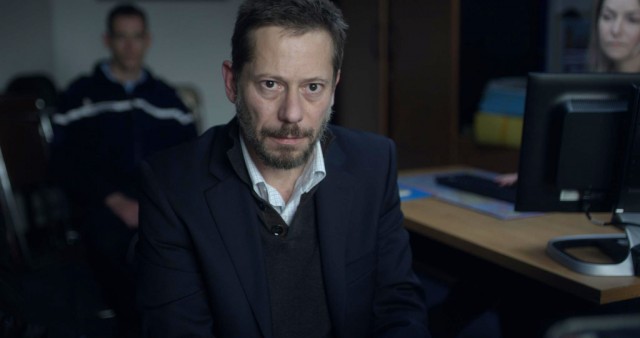
 Real-life partners Mathieu Amalric and Stéphanie Cléau strip Georges Simenon’s short 1955 novel The Blue Room to its bare essentials — and we do mean bare — in their intimate, claustrophobic modern noir adaptation, which kicks off FIAF’s six-week tribute to Amalric, consisting of the eight-film CinéSalon series “Mathieu Amalric: Renaissance Man” and the special two-night theatrical presentation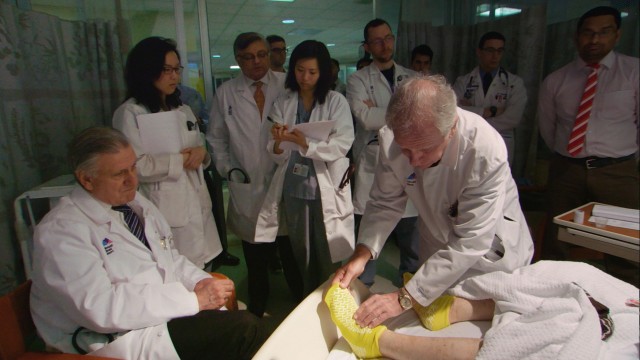
 Over the last several decades, the U.S. health care system has grown increasingly impersonal because of technological advancement, the pharmaceutical boom, and the privatization of public hospitals. But two old-time doctors at Mount Sinai Heart are keeping the human touch alive, and not just for nostalgia’s sake. Muffie Meyer’s sweet-natured, important documentary, Making Rounds, follows Dr. Valentin Fuster, the director of Mount Sinai Heart, and Dr. Herschel Sklaroff, clinical professor of medicine, cardiology, as they lead residents from room to room in the Cardiac Care Unit at New York City’s Mount Sinai Hospital, diagnosing patients with a refreshing lack of reliance on technology. “We both have the philosophy that the number one objective in medicine is the patient,” Dr. Fuster explains. “We both believe that most of what you learn about a particular patient is at the bedside, not with machines.” Dr. Sklaroff adds, “Dr. Fuster and I make rounds the old-fashioned way. The first thing that we do is go to the patient and hold his hand. With that touch you establish rapport instantly. We were trained to go to the bedside and talk to the patients, and take the perfect history, do the perfect physical, from which one ought to be able to make a diagnosis or come close to a diagnosis, maybe ninety percent of the time.” They display a warm, caring bedside manner as they talk, touch, listen, and teach, examining a sixty-seven-year-old woman with coronary heart disease, a twenty-two-year-old single mother who needs a heart transplant, and a fifty-one-year-old man with cardiomyopathy who resists treatment.