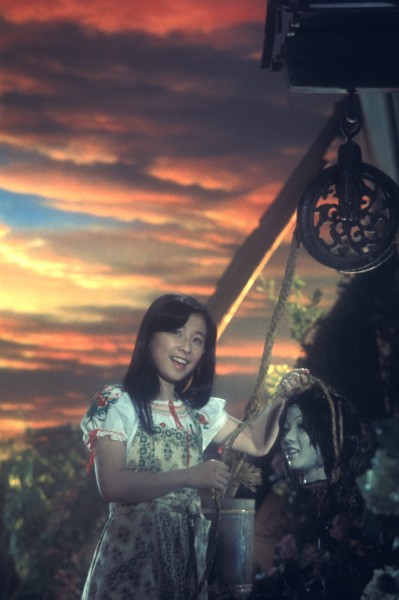
Nobuhiko Obayashi’s wild and crazy HAUSU kicks off Japan Society retrospective of the unique filmmaker
HOUSE (HAUSU) (Nobuhiko Obayashi, 1977)
Japan Society
333 East 47th St. at First Ave.
Friday, November 20, $15, 7:00
212-715-1258
www.japansociety.org
www.janusfilms.com
 Japan Society kicks off its retrospective of pioneering Japanese experimental filmmaker Nobuhiko Obayashi with one of the craziest movies ever made, Obayashi’s 1977 cult classic, House (Hausu), which took more than three decades to get its U.S. theatrical release, in a new 35mm print in 2009. Truly one of those things that has to be seen to be believed, House is a psychedelic black horror comedy musical about Gorgeous (Kimiko Ikegami) and six of her high school friends who choose to spend part of their summer vacation at Gorgeous’s aunt’s (Yoko Minamida) very strange house. Gorgeous, whose mother died when she was little and whose father (Saho Sasazawa) is about to get married to Ryoko (Haruko Wanibuchi), brings along her playful friends Melody (Eriko Ikegami), Fantasy (Kumiko Oba), Prof (Ai Matsubara), Sweet (Masayo Miyako), Kung Fu (Miki Jinbo), and Mac (Mieko Sato), who quickly start disappearing like ten little Indians. House is a ceaselessly entertaining head trip of a movie, a tongue-in-chic celebration of genre with spectacular set designs by Kazuo Satsuya, beautiful cinematography by Yoshitaka Sakamoto, and a fab score by Asei Kobayashi and Mickie Yoshino. The original story actually came from the mind of Obayashi’s eleven-year-old daughter, Chigumi, who clearly has one heck of an imagination. Oh, and we can’t forget about the evil cat, a demonic feline to end all demonic felines. The film was released in 2009 prior to its appearance on DVD from Janus, the same company that puts out such classic fare as Federico Fellini’s Amarcord, Akira Kurosawa’s Rashomon, Jacques Tati’s M. Hulot’s Holiday, François Truffaut’s Shoot the Piano Player, Jean Renoir’s The Rules of the Game, and Jean-Luc Godard’s Vivre sa Vie, so House has joined some very prestigious company. And who are we to say it doesn’t deserve it? House is screening at Japan Society on November 20 at 7:00 with Obayashi’s 1964 silent short, Complexe; Obayashi will introduce the films and participate in a Q&A afterward, followed by what should be a wild Hausu Party. “Nobuhiko Obayashi: A Retrospective” continues through December 6 with such other films as Bound for the Fields, the Mountains, and the Seacoast; I Are You, You Am Me; Sada; The Discarnates; and Obayashi’s latest, the three-hour epic Seven Weeks, in addition to a special conversation and audience Q&A with Obayashi, moderated by series curator Aaron Gerow, on November 21 at 1:00 ($12). As a special early bonus, on November 18, Japan Society will present the New York premiere of Chigumi Obayashi’s 2014 documentary, A Dialogue: Living Harmony, followed by a discussion with the debut director and Richard McCarthy of Slow Food USA and a reception.

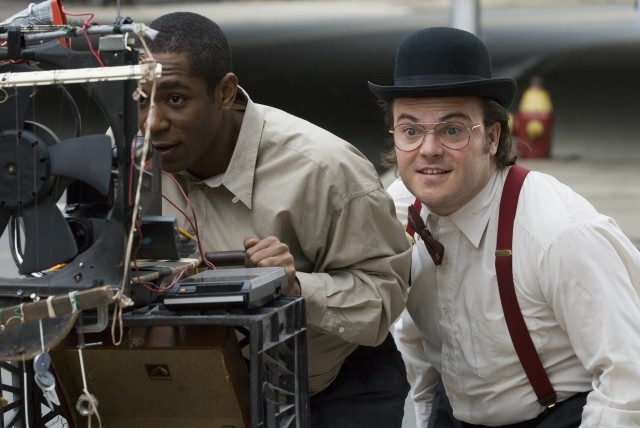
 When old man Fletcher (Danny Glover) takes off for a week, leaving Mike (Mos Def) in charge of his soon-to-be-demolished video store called Be Kind Rewind (they don’t have any DVDs or recent movies), his most important rule is to “Keep Jerry Out.” Jerry (Jack Black) is a crazy conspiracy theorist who covers himself in metal to ward off alien rays. After a botched attack on the local power plant, Jerry becomes a walking magnet (in a laugh-out-loud hysterical scene) and unknowingly erases all the videos in the store. Taking a page from the Little Rascals plots when Spanky and Alfalfa would suddenly put on a show for some local cause, Mike and Jerry recruit Alma (Melonie Diaz) as they proceed on their very strange attempts at Sweding — making their own versions of such films as Ghostbusters, Rush Hour 2, and Robocop and renting them out as if they were the real thing. Following the brilliant Eternal Sunshine of the Spotless Mind and the extremely strange The Science of Sleep, writer-director Michel Gondry has fashioned a really stupid movie that has an overabundance of heart and charm. Glover and Mos Def are soft and gentle in this Capra-esque comedy, offsetting Black’s hyperactivity. Every time you’re ready to write the film off as being just too silly and ridiculous, something comes along to make you double over in laughter. Be Kind Rewind kicks off the Museum of the Moving Image series “Walkers: Hollywood Afterlives in Art and Artifact,” being held in conjunction with the

 To use George Roundy’s favorite adjective, Shampoo, is “great.” In this ’70s classic, Warren Beatty, who cowrote the screenplay with Robert Towne, stars as George, a Beverly Hills hairdresser who gives his wealthy clients more than just a cut-and-blow-dry. The film takes place primarily on November 4, 1968, as Nixon is battling Humphrey for the presidency, and George can’t keep it in his pants, running back and forth between Felicia (Lee Grant), Jackie (Julie Christie), and Lorna (Carrie Fisher) while trying to open his own shop, with help from business tycoon Lester (Jack Warden) — Felicia’s husband, Jackie’s lover, and Lorna’s father. The clothing is magnificent, as, of course, are the hairstyles. Ashby’s biting comedy wonderfully captures the sexual awakening of the 1970s in all its glory — and in all its vapidity. Horror fans should keep an eye out for Lester’s friend Sid Roth, who is played by gimmickmeister William Castle. Ashby, who died in 1988 at the age of fifty-nine, made only eleven narrative films and two concert documentaries in his too-brief life and career. Shampoo is screening in a new 4K digital restoration November 6 & 9 in the MoMA series “To Save and Project: The 13th MoMA International Festival of Film Preservation,” with the first show introduced by Sony Pictures executive Grover Crisp. The series, which celebrates newly preserved and restored films, runs November 4-25 and includes a wide variety of works, from the original theatrical version of Herk Harvey’s Carnival of Souls and William K. Howard’s Don’t Bet on Women to Otto Rippert’s silent Homunculus and the director’s cut of Helma Sanders-Brahms’s Deutschland blieche Mutter, in addition to “The Unknown Orson Welles,” including scenes from The Other Side of the Wind and The Dreamers introduced by Welles’s longtime partner, Oja Kodar, and Munich Filmmuseum director Stefan Droessler.