this week in film and television

PASOLINI 40 YEARS LATER: WITH ALFREDO JAAR AND NORMAN MacAFEE

Alfredo Jaar. The Ashes of Pasolini, 2009. Video: 38:00. Courtesy the artist, New York.

Alfredo Jaar, THE ASHES OF PASOLINI, 2009. Video: 38:00 (Courtesy the artist, New York)

Anthology Film Archives
32 Second Ave. at Second St.
Sunday, November 1, free, 12:30 pm
646-336-5771
anthologyfilmarchives.org
www.alfredojaar.net

Chilean artist, architect, and filmmaker Alfredo Jaar honors the fortieth anniversary of the mysterious murder of Pier Paolo Pasolini with a special presentation at Anthology Film Archives on November 1. “Pasolini 40 Years Later: with Alfredo Jaar and Norman MacAfee” consists of a screening of Jaar’s 2009 documentary, The Ashes of Pasolini, the launch of a new artist book, Pier Paolo Pasolini: The Ashes of Gramsci, readings from the iconoclastic Italian writer and director’s poetry, and a discussion about Pasolini’s life and work. Jaar will be joined by writer, visual artist, literary translator, and freelance book editor Norman MacAfee for the event. Jaar has written that The Ashes of Pasolini — a eulogy for Pasolini inspired by Pasolini’s poem “The Ashes of Gramsci,” which was a eulogy for Italian theoretician Antonio Gramsci — “is a modest film about the death of an extraordinary intellectual. . . . As you know, it is still unclear who killed him. But for me, it has always been clear why: it was because of fear. Fear of his voice, fear of his life style, fear of his ideas, fear of his opinions, fear of his intellect. He was the totally complete intellectual: a filmmaker, a poet, a writer, a journalist, a critic, a polemist. He was totally involved in the cultural and political life of his time. As an artist he took risks, broke the rules, he created his own rules.” The tribute will be followed by a book signing and reception; the book will be available for purchase for $10.

MATHIEU AMALRIC — RENAISSANCE MAN: KINGS AND QUEEN

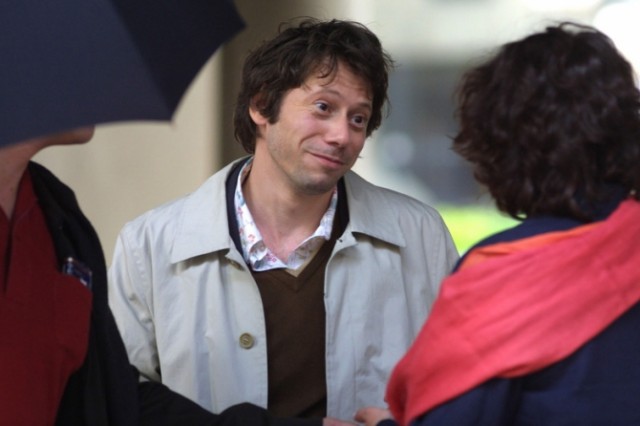
Mathieu Amalric

The always-engaging Mathieu Amalric is being feted by Anthology Film Archives and the French Institute Alliance Française

KINGS AND QUEEN (ROIS ET REINE) (Arnaud Desplechin, 2004)
Anthology Film Archives
32 Second Ave. at Second St.
Saturday, October 31, 6:00, and Saturday, November 7, 8:30
Series runs October 29 – November 8 (companion series at FIAF runs November 3 – December 15)
212-505-5181
anthologyfilmarchives.org

Award-winning French actor-director Mathieu Amalric is celebrating his fiftieth birthday with an exciting invasion of New York City, where he is being honored in a pair of terrific companion film series and will also star in a theatrical production. FIAF’s CinéSalon tribute runs on Tuesday nights through December 15, beginning November 3 with a screening of his 2014 film The Blue Room, followed by a Q&A with Amalric and costar and cowriter Stéphanie Cléau, who is also his real-life partner; Amalric will also star in Fight or Flight (Le Moral des Ménages), Cléau’s stage adaptation of the novel by Eric Reinhardt. But the big festivities begin at Anthology Film Archives, where “Mathieu Amalric: Renaissance Man” runs October 29 through November 8, featuring ten of his films, including Otar Iosseliani’s 1984 Favorites of the Moon, in which he makes his film debut, and 2001’s Eat Your Soup, his first directorial effort.

Mathieu Amalric won a César for his starring role in KINGS AND QUEEN

Mathieu Amalric won a César for his starring role in Arnaud Desplechin’s KINGS AND QUEEN

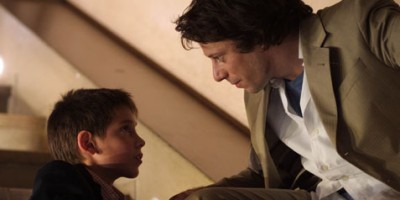
Amalric has made several films with Arnaud Desplechin (A Christmas Tale, My Sex Life . . . or How I Got into an Argument), and one of the best is being shown October 31 and November 7 at Anthology. In Kings and Queen, Emmanuelle Devos is spectacular as Nora, a divorced single mother with a ten-year-old son (Valentin Lelong), an ailing father (Maurice Garrel), a troubled sister (Nathalie Boutefeu), a straitlaced, boring fiance (Olivier Rabourdin), a dead ex-husband who appears as a ghost (Joachim Salinger), a manic, tax-evading ex-husband who is institutionalized (a fabulous Amalric), and a deep-seated survival instinct that is infectious. Throw in a suicidal woman (Magalie Woch) who can’t get enough sex, an alluring doctor (Catherine Deneuve), a drug-addicted lawyer (Hippolyte Girardot), a remarkably calm, gun-toting convenience-store owner (Jean-Paul Roussillon), and other unusual characters and plotlines and you have one highly entertaining, complex, and marvelously original French drama that will fly by much faster than its two-and-a-half-hour length would lead you to believe. Amalric won his first César for the role; he won his second three years later for The Diving Bell and the Butterfly. Amalric will be at Anthology to introduce the October 31 screening of Roman Polanski’s Venus in Fur.

THEATER & CINEMA: THE LAST METRO

THE LAST METRO

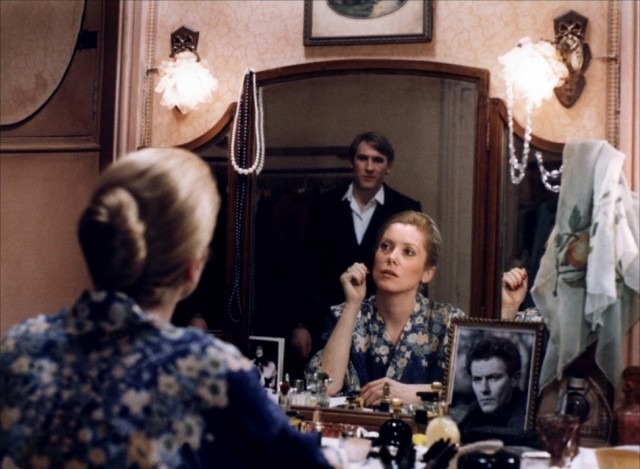
Catherine Deneuve and Gérard Depardieu star in François Truffaut’s gripping WWII melodrama THE LAST METRO

CINÉSALON: THE LAST METRO (LE DERNIER METRO) (François Truffaut, 1980)
French Institute Alliance Française, Florence Gould Hall
55 East 59th St. between Madison & Park Aves.
Tuesday, October 27, $14, 4:00 & 7:30 (later screening introduced by Olivia Bransbourg)
212-355-6100
www.fiaf.org

FIAF’s CinéSalon series “Theater & Cinema” concludes October 27 with François Truffaut’s powerful Oscar-nominated WWII melodrama, The Last Metro. Set in Vichy France during the German occupation, the film takes place in and around the Théâtre Montmartre, which has been taken over by movie-star actress (and non-Jew) Marion Steiner (Catherine Deneuve) after her husband, Jewish theater director Lucas Steiner (Heinz Bennent), has apparently escaped the Nazi regime. But in fact Lucas is hiding out in the theater’s basement, where he has translated a Norwegian play, aptly titled Disappearance, and is directing it from below. The cast and crew of Disappearance include ladies’ man Bernard Granger (Gérard Depardieu) as Marion’s love interest; costume designer Arlette Guillaume (Andréa Ferréol), who refuses Bernard’s advances because of a secret reason; young actress Nadine Marsac (Sabine Haudepin), who will do just about anything to get parts; stage manager Raymond Boursier (Maurice Risch), who is deeply dedicated to the theater; and Jean-Loup Cottins (Jean Poiret), the stand-in director for Lucas. Only Marion knows where Lucas is, but danger grows when critic, publisher, and Nazi collaborator Daxiat (Jean-Louis Richard) starts sniffing around a little too much.

THE LAST METRO

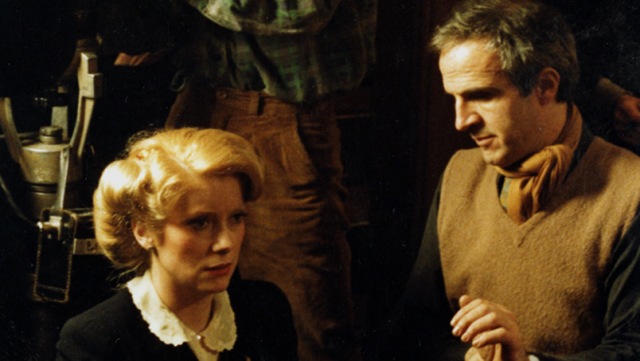
Catherine Deneuve on-set with director François Truffaut during the making of THE LAST METRO

Genre lover Truffaut reaches deep into his cinematic bag of tricks in The Last Metro, paying tribute to film noir, romantic melodrama, war movies, and even musicals as he references Casablanca, The Phantom of the Opera, The Diary of Anne Frank, Gaslight, To Be or Not to Be, The Golden Coach, Notorious, and Cabaret. He takes on anti-Semitism, anti-homosexuality, and anti-humanism in general while setting up a compelling love triangle that is echoed in the play-within-a movie, which is staged on a dramatic, surreal pink Expressionistic set. Depardieu and Deneuve, who went on to make such other films together as Claude Berri’s Fort Saganne, André Téchiné’s Changing Times, and François Ozon’s Potiche, might not be Bogart and Bergman, but they are a magnetic duo, Depardieu’s hulking, brutishly handsome presence dominating confined spaces, Deneuve’s refined, radiant beauty glowing amid a predominantly drab palette. The film uses the metaphor of theater as a way to escape reality, whether on an individual basis or during an international crisis, but of course Truffaut is also citing film as its own escape, a place where people flock to when times are both good and bad. The Last Metro — the title refers to the final train of the night, which passengers must catch in order to not break the strict curfew — is a beautifully made picture, the second in Truffaut’s planned trilogy of films about entertainment, following 1973’s Day for Night and preceding the never-finished L’Agence Magique. Winner of a 1990 César for Best Film of the 1980s in addition to ten previous Césars, including Best Film, Best Director (Truffaut), Best Actor (Depardieu), Best Actress (Deneuve), Best Cinematography (Nestor Almendros), Best Music (Georges Delerue), Best Production Design (Jean-Pierre Kohut-Svelko), and Best Writing (Truffaut and Suzanne Schiffman), The Last Metro is screening at 4:00 and 7:30 on October 27 in Florence Gould Hall; the later show will be introduced by French publisher and fragrance designer Olivia Bransbourg.

TOP SPIN

Ariel Singh

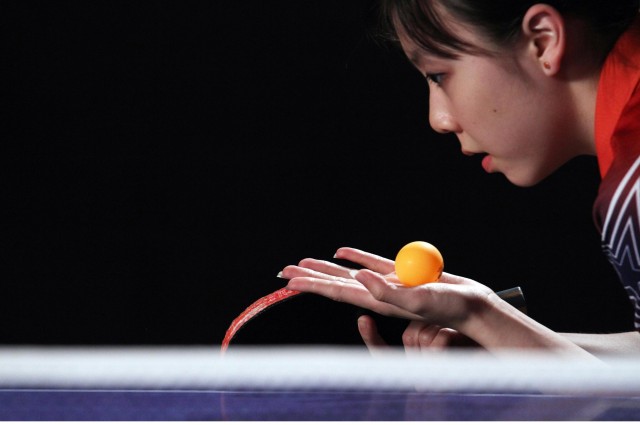
Ariel Hsing is one of three young Ping-Pong players with Olympic dreams in table-tennis documentary

TOP SPIN (Sara Newens & Mina T. Son, 2014)
Cinema Village
22 East 12th St. between University Pl. & Fifth Ave.
Opens Friday, October 23
212-924-3363
www.topspinmovie.com
www.cinemavillage.com

Unless you’re a dedicated fan of table tennis, you’ve never seen Ping-Pong played quite like this. In Top Spin, first-time feature-film documentarians Sara Newens and Mina T. Son follow a trio of young Americans through the tournaments necessary to qualify for the 2012 U.S. Olympic team and compete in the London Games. At sixteen, Fremont, California, native Ariel Hsing is the youngest women’s national champion, a two-wing attacker who calls both Bill Gates and Warren Buffet “Uncle.” Seventeen-year-old Mineola, New York–born Michael Landers is a two-wing looper who is the youngest men’s national champion. And Lily Zhang is a fifteen-year-old all-around attacker from Palo Alto and the world #2 in under-fifteen girls, usually finishing right behind Ariel. Director-editor Newens and director-producer Son speak extensively with the three players and their parents, coaches, teachers, trainers, and friends while counting down the days to each event, fierce competitions in which Ariel, Michael, and Lily play against opponents who are sometimes more than twice their age. They dedicate their lives to their Olympic dreams, spending large amounts of time away from school and their friends and family as they attempt to make the low-ranked American Olympic squad that has little chance for a medal, without even a high-paying professional league in their future. Yet they battle on, despite the heavy odds against them. Much of the Ping-Pong action is mind-blowing, particularly a late match in which Michael returns slam after slam with amazing acumen and accuracy. The film is executive-produced by Jonathan Bricklin and Franck Raharinosy, cofounders of SPiN, the Ping-Pong social club on East Twenty-Third St. that is partly owned by Susan Sarandon, who appeared in Michael Tully’s indie film Ping Pong Summer last year. Top Spin opens October 23 at Cinema Village, with Newens and Son participating in a Q&A moderated by crossword-puzzle maven Will Shortz at the 9:15 show Friday night.

PERFORMA 15

(photo by Alan Prada / courtesy of LUomo Vogue)

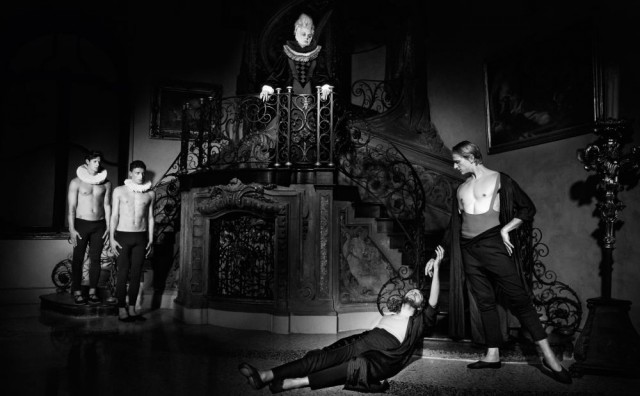
Francesco Vezzoli and David Hallberg’s FORTUNA DESPERATA kicks off tenth anniversary of biannual Performa arts festival (photo by Alan Prada / courtesy of L’Uomo Vogue)

Multiple venues
November 1-22, free – $500
15.performa-arts.org

Performa is celebrating the tenth anniversary of its biennial with another diverse lineup of live, cutting-edge performances, taking place at venues in Manhattan and Brooklyn. The festivities begin November 1 with a special opening-night benefit gala presentation ($250-$500) of Francesco Vezzoli and David Hallberg’s Renaissance-inspired Performa commission, Fortuna Desperata, at St. Bart’s and conclude November 22 with a Grand Finale party ($45) at Hôtel Americano, with the awarding of the Malcolm McLaren prize, which has previously gone to Ragnar Kjartansson and Ryan McNamara. One of the key participants this year is dancer and choreographer Jérôme Bel, whose Ballet (New York) ($15-$25) will be at the Marian Goodman Gallery November 6-7, the Martha Graham Studio Theater November 14-15, and El Museo del Barrio November 19; Bel will also teach a free Artist Class on November 5 at the Performa Hub at 47 Walker St. and will sit down for the free conversation “Don’t Just Sit There; Talking About Dance” with Performa head RoseLee Goldberg and the great Yvonne Rainer at Albertine on November 8. Meanwhile, from November 1 to November 18, Ryan Gander’s Ernest Hawker will feature an actor portraying the British artist’s future self at various Performa events; he will also give a free Artist Talk at the Performa Hub on November 2 at 3:00 with curator Mark Beasley. Below are ten other highlights of this always fascinating festival.

Friday, November 6
and
Saturday, November 7

Volmir Cordeiro: Inês, Danspace Project, $15-$20, 9:00

Saturday, November 7
Simon Fujiwara and Christodoulos Panayiotou: Lafayette Anticipation Session, featuring welcome speeches, screening of Fujiwara’s New Pompidou followed by a discussion with Fujiwara and Stuart Comer, and Panayiotou’s lecture-performance Dying on Stage with Jean Capeille, Performa Hub, free, 3:00 – 7:00

Opening of My Silent One (In the Sweetness of Time), live exhibition environment by Doveman and Tom Kalin, Participant Inc., free, 6:00 pm – 12 midnight

Saturday, November 7
and
Sunday, November 8

Arnold Schönberg’s Erwartung — A Performance by Robin Rhode, Times Square between Forty-Second & Forty-Third Sts., free, 4:30

Thursday, November 12
and
Friday, November 13

Erika Vogt: Artist Theater Program, live exhibition with collaborators Math Bass, Shannon Ebner, and Adam Putnam, Roulette, $20-$25, 9:00
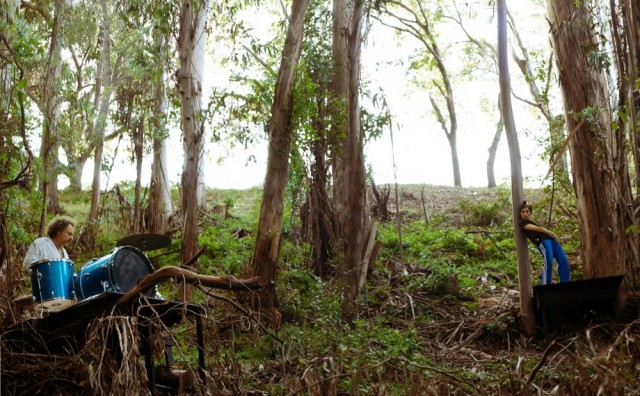
Claudia de Serpa Soares, Jim White, and Eve Sussman join together for MORE UP A TREE at BAM (photo by Eve Sussman)

Claudia de Serpa Soares, Jim White, and Eve Sussman join together for MORE UP A TREE at BAM (photo by Eve Sussman)

Friday, November 13
through
Sunday, November 15

Jesper Just: Untitled multimedia performance installation in collaboration with FOS, venue and price to be announced, 5:30

Monday, November 16
through
Sunday, November 22

Oscar Murillo: Lucky dip, live work about production, protest, and displacement, Alexander Hamilton U.S. Custom House, free, 12 noon – 5:00 pm

Thursday, November 19
“Unorthodox: On Art II,” with Austė, Brian Belott, Meriem Bennani, Brian DeGraw, Tommy Hartung, Nick Payne, Jeni Spota, Jamian Juliano Villani, and others, the Jewish Museum, free with pay-what-you-wish admission, 6:00

Thursday, November 19
through
Saturday, November 21

More up a Tree, by Claudia de Serpa Soares, Eve Sussman, and Jim White, BAM Next Wave Festival, BAM Fisher Fishman Space, $25, 7:30

Saturday, November 21
Ilija Šoškić: Maximum Energy — Minimum Time, re-creation of past works in commemoration of the suicide of Russian Soviet poet Vladimir Mayakovsky, WhiteBox, free, 6:00
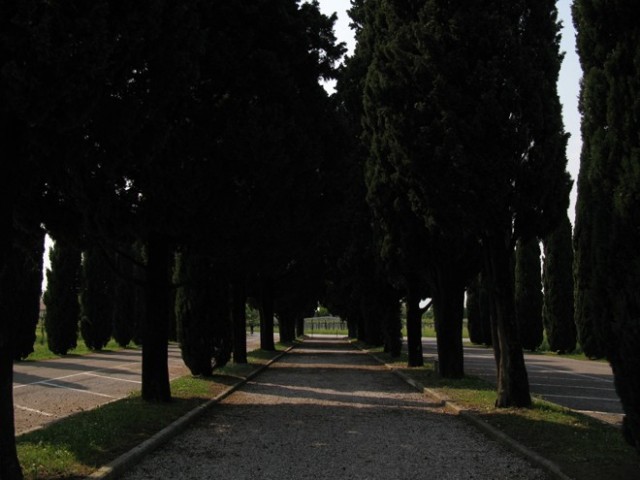
HEART OF A DOG

HEART OF A DOG

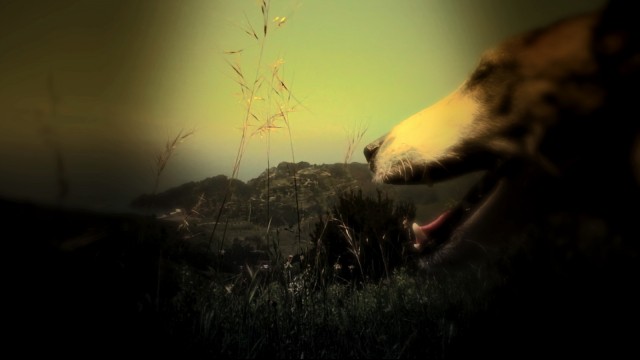
Laurie Anderson meditates on life and death in intimately personal HEART OF A DOG

HEART OF A DOG (Laurie Anderson, 2015)
Film Forum
209 West Houston St.
October 21 – November 3
212-727-8110
www.filmforum.org
www.heartofadogfilm.com

Multimedia artist Laurie Anderson’s first full-length film in nearly thirty years, Heart of a Dog, is a deeply personal poetic meditation on death, yet it avoids being mournful and melancholy and is instead a wistful tribute to life. Anderson, who directed her concert film, Home of the Brave, in 1986, details the story of her beloved rat terrier, Lolabelle, as the “mall dog” ages, goes blind, and dies. Using clips from home movies, archival footage, animation, and re-creations, Anderson delves into the nature of time, memory, beauty, and the process of grieving, referencing Wittgenstein, Kierkegaard, and David Foster Wallace as she narrates the tale in her familiar dramatic voice. The film is also about communication and language, two of her favorite topics, which come to the fore when she describes going to the mountains in Northern California with Lolabelle. “The idea was to take a trip and spend some time with her and do a kind of experiment to see if I could learn to talk with her. Now, I’d heard that rat terriers could understand about five hundred words, and I wanted to see which ones they were.” The story takes a fascinating turn when Anderson recognizes that Lolabelle, who she identifies as a painter, a pianist, and a protector, understands that circling hawks are a threat to her, that the dog is prey to them, a direct reference to Americans’ fear in a post-9/11 world, where armed soldiers are everywhere to guard against terrorist attacks, especially from the sky. Anderson goes back to her past, talking about a horrific childhood accident that almost left her paralyzed and led her to realize “that most adults have no idea what they’re talking about.” She also discusses her awkward relationship with her mother, subversive software, her obsession with JFK, the Tibetan Book of the Dead, ghosts, dreams, and sadness, explaining that her Tibetan teacher, Mingyur Rinpoche, once told her that “you should try to learn how to feel sad without being sad,’” which, Anderson notes, “is actually really hard to do.”

Avoiding over-self-indulgence, Anderson tells this autobiographical “story about a story” with a diverse range of compelling imagery, from lovely scenes of snowy woods and birds in trees to scratched, distorted avante-garde footage and many scenes of rain, as if the camera is gently crying. The soundtrack, primarily Anderson on violin, is mostly elegiac, tinged with heartbreak as she philosophizes about life and death, though it is ultimately an uplifting experience. Anderson dedicates the film “to the magnificent spirit of my husband Lou Reed,” who makes a brief appearance as a doctor and is shown later on the beach, his bare feet in the sand; he also sings “Turning Time Around,” a song from his 2000 album, Ecstasy, over the closing credits, in which the punk godfather, who passed away in 2013 at the age of seventy-one, explains, “My time is your time when you’re in love / and time is what you never have enough of / You can’t see or hold it / It’s exactly like love.” Following its special screening at the New York Film Festival, Heart of a Dog is playing October 21 through November 3 at Film Forum, with Anderson, whose stunning immersive multimedia installation “Habeas Corpus” recently finished its short run at the Park Avenue Armory, present to talk about the film at select screenings on October 21, 23, 24, and 25.

FRIDA KAHLO: ART, GARDEN, LIFE

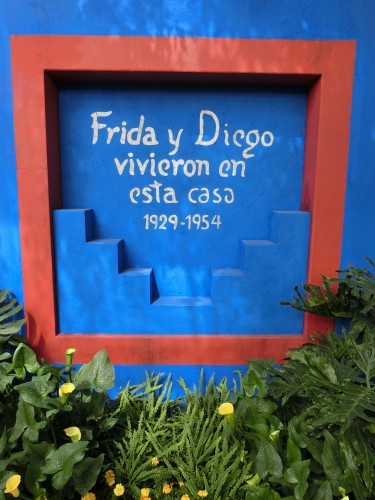
New York Botanical Garden re-creates Frida Kahlos Casa Azul studio and garden (photo by twi-ny/mdr)

New York Botanical Garden re-creates Frida Kahlo and Diego Rivera’s Casa Azul studio and garden (photo by twi-ny/mdr)

The New York Botanical Garden
Enid A. Haupt Conservatory
2900 Southern Blvd., Bronx
Tuesday – Sunday through November 1, $8-$25
718-817-8700
www.nybg.org/frida
frida kahlo: art garden life slideshow

Don’t let the cold weather scare you away from seeing the New York Botanical Garden’s beautiful celebration of Mexican painter Frida Kahlo’s passionate relationship with the natural world. “Frida Kahlo: Art, Garden, Life,” on view at the Bronx institution through November 1, is a wide-ranging tribute to the artist, including paintings, photographs, a historical timeline, a re-creation of her garden and studio, known as La Casa Azul, and special programs. “When we began to research Frida Kahlo, we wanted to delve into the story of the woman who has been examined through her pain and suffering and paint her in a different light,” NYBG associate vice president of exhibitions and public engagement Karen Daubmann writes in her catalog essay, “Making Frida Kahlo’s Garden in New York: The Conservatory Exhibition.” She continues, “We wanted to learn more about the iconic face that is emblazoned on canvases, the strong and fierce-looking dark-haired, dark-eyed woman who used to be known as Diego Rivera’s wife and is now known simply as Frida. The more we researched, the more intrigued we became. . . . We were fascinated by the incredible detail of Kahlo’s curated life.” That curated life is lovingly explored in the exhibition, which features fourteen of the artist’s paintings in the LuEsther T. Mertz Library’s art gallery, including “Portrait of Luther Burbank,” in which Kahlo depicts the famed botanist emerging from the root of a tree; the vulvic “Sun and Life”; “Two Nudes in the Forest,” which was originally called “The Earth Itself”; and the sensational “Self-Portrait with Thorn Necklace and Hummingbird,” in which Kahlo, in between her first and second marriages to Rivera, paints herself surrounded by flowers, a dead hummingbird, a monkey, butterflies, and a black cat, a symbolic representation of life, death, and rebirth. The path to the next part of the show, in the Enid A. Haupt Conservatory, is lined with poems by Nobel Prize–winning Mexican poet Octavio Paz, including “The Religious Fig” and “Nightfall.” Paz was in fact not a big fan of Kahlo’s and Rivera’s; “Diego and Frida ought not to be subjects of beatification but objects of study — and of repentance . . . the weaknesses, taints, and defects that show up in the works of Diego and Frida are moral in origin,” Paz wrote in Essays on Mexican Art. “The two of them betrayed their great gifts, and this can be seen in their painting.”

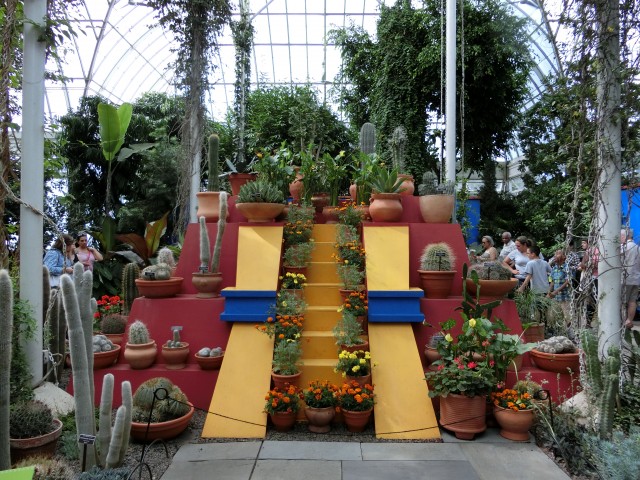
Pyramid is centerpiece of Casa Azul re-creation (photo by twi-ny/mdr)

Pyramid is centerpiece of Casa Azul re-creation (photo by twi-ny/mdr)

The centerpiece of the exhibition is La Casa Azul, a reconstruction of Kahlo’s studio and garden at her family home in Mexico City, which is now a museum. The conservatory is filled with folk art objects, religious ex-voto paintings, Mexican plants described in both English and Spanish (and inspired by archival photographs), and re-creations of the Frog Fountain with its mosaic floor, Kahlo’s desk and easel, and the strikingly colorful Casa Azul pyramid, holding dozens of Mexican cacti and succulents. The conservatory exhibition was designed by Scott Pask, the three-time Tony-winning designer of The Book of Mormon, The Coast of Utopia, and The Pillowman. Outside the conservatory, by the lily pond, is a fence of organ pipe cacti, like the one Kahlo had at her San Ángel house. “Frida Kahlo: Art, Garden, Life” immerses you in the world of this fascinating artist, who passed away in 1954 at the age of forty-seven. In conjunction with the exhibition, the NYBG is hosting special programming through closing day. On Saturdays and Sundays at 1:00, there is live music and dance in Ross Hall and throughout the garden, with performances by such groups as Mexico Beyond Mariachi, the Villalobos Brothers, Flor de Toloache, and Calpulli Danza Mexicana. “Cooking with Frida” takes place in the Ruth Rea Howell Family Garden on Wednesdays, Saturday, and Sundays at 2:00 & 4:00. The daily “Frida’s Fall Harvest” consists of family-friendly activities in the Everett Children’s Adventure Garden, including a puppet show and playhouse kitchen; the children’s garden will be open till 9:30 on October 23 for “Frida for Families: A Spooky Nighttime Adventure.” Also daily (but not for kids), “Spotlight on Agave: A Tequila Story” presents the history and tradition of the Mexican spirit. October 22 is “Frida al Fresco Evening” LGBT Night, with live music, stilt dancers, and Mexican food and drink. On October 24-25 and October 31 – November 1, things get scary with Día De Los Muertos Weekends, featuring skeletal processions, stilt dancers, skull face painting, and more. The “¡Cámara, Acción!” film series continues on Sundays at 3:00 in Ross Hall with Alonso Ruiz Palacios’s Güeros on October 25 and Francisco Franco’s Last Call on November 1. Also on November 1, there will be a live performance by two male models interacting with Humberto Spíndola’s “Two Fridas” sculptural installation, based on Kahlo’s 1939 double portrait in which two versions of her sit next to each other, holding hands.