Kiyoshi Kurosawa’s remake of his own Serpent’s Path is another suspense gem
SERPENT’S PATH (『蛇の道』) (HEBI NO MICHI) (LA VOIE DU SERPENT) (Kiyoshi Kurosawa, 2024)
IFC Center
323 Sixth Ave. at West Third St.
September 11-17 www.ifccenter.com
When Kiyoshi Kurosawa was asked by a studio in France to remake one of his earlier films, he opted to revisit his 1998 straight-to-video thriller Serpent’s Path, which was written by Hiroshi Takahashi (Ringu,Sodom the Killer) and starred Show Aikawa and Teruyuki Kagawa. He cowrote the new script with French journalist Aurélien Ferenczi, who passed away in October 2024 at the age of sixty-one. The result is a brutal, gripping white-knuckle shocker that you won’t be able to turn away from, no matter how much you might want to.
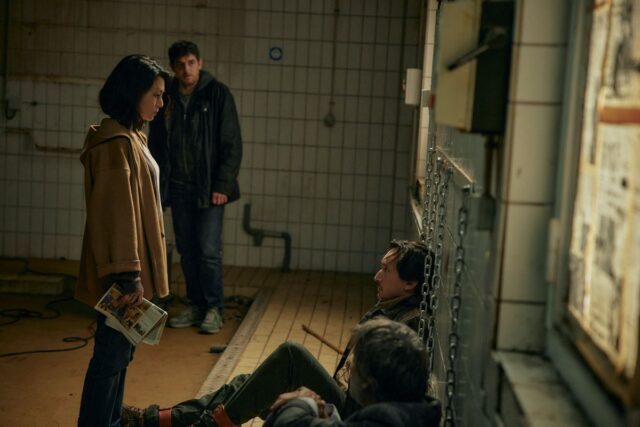
Albert Bacheret (Damien Bonnard) is a disheveled, distraught man who is determined to find whoever murdered and dismembered his eight-year-old daughter, Marie (Hélène Caputo). He is helped by Sayoko Mijima (Ko Shibasaki), a calm, composed hospital psychiatrist who is treating Yoshimura (Hidetoshi Nishijima), a Japanese man having trouble adjusting to life in France. Sayoko has also moved from Japan to Paris, leaving behind her partner, Soichiro (Munetaka Aoki).
Albert and Sayoko are not criminal masterminds, but they expertly kidnap Laval (Mathieu Amalric) and chain him to a wall in an abandoned warehouse. Albert accuses Laval of having killed Marie, but Laval adamantly denies he had anything to do with it, claiming he is just an accountant at the Minard Foundation, an institution that we slowly learn more about, none of it good. Deprived of food, drink, and a bathroom, Laval eventually gives up his boss, Pierre Guérin (Grégoire Colin), who Albert and Sayoko decide to capture as well. Like Laval, Pierre is not forthcoming at first, but torture has a way of making people talk, whether it be truth or lies, and the plot thickens, offering more and more surprises along with more and more violence.
Albert Bacheret (Damien Bonnard) and Sayoko Mijima (Ko Shibasaki) hunt for a killer in Serpent’s Path
Throughout the film, Albert, who became estranged from his wife, Lola (Vimala Pons), after the tragic incident, shows a short video of Marie playing the piano and roller skating as he reads a newspaper report that details exactly what happened to her, making Laval, Pierre, and, later, Christian Samy (Slimane Dazi) watch it — but the audience as well, as if inuring us to the atrocity while also feeling Albert’s torment. Kurosawa (Wife of a Spy,Tokyo Sonata) and cinematographer Alex Kavyrchine have created a fascinating dichotomy between the kind of violence we see onscreen, whether a movie in a theater or a video on a smartphone or laptop, and the kind we are not shown but only have to imagine, especially when it involves children. We cringe every time Albert narrates the video but not at what Albert and Sayoko do; in fact, we are rooting for them. As the body count rises, so do humorous shots of the victims, eliciting uncomfortable yet necessary laughter. The original film clocked in at eighty-five minutes; the French remake adds more than twenty minutes, ratcheting up the tension.
Bonnard (Staying Vertical,Les Misérables) is terrific as Albert, ably portraying a laser-focused but perhaps misguided man who has disconnected from society, impulsive and restless, turning to screens to redefine his purpose. His unease is so palpable you just want to give him a giant hug — but maybe not when he’s armed. Actress and singer Shibasaki (One Missed Call,xxxHolic) adds just the right amount of mystery to Sayoko, who might be more than she seems. Meanwhile, the mighty Amalric (Kings and Queen,The Grand Budapest Hotel) once again proves why he’s one of the best actors on the planet.
At one point, when Yoshimura talks to Sayoko about facing the end, she replies, “The end? The end of what? Are you afraid of the end? Isn’t the hardest part when there is no end?”
Or, in other words, be careful what you wish for.
[Mark Rifkin is a Brooklyn-born, Manhattan-based writer and editor; you can follow him on Substack here.]
RADICAL CHIAROSCURO: THE WORK OF DARIUS KHONDJI
Metrograph
7 Ludlow St. between Canal & Hester Sts.
Begins September 4 metrograph.com
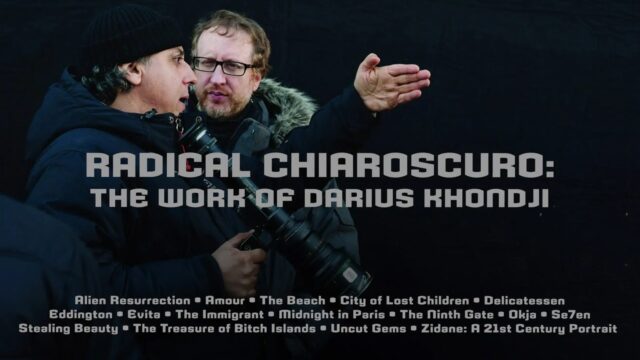
Eight years ago, Metrograph held a retrospective of the wide-ranging and diverse work of Iranian-born, Paris-raised cinematographer Darius Khondji, and now they’re bringing him back for “Radical Chiaroscuro,” as he continues to make films that capture the imagination of the public and the industry. The series begins September 4 and includes Jean-Pierre Jeunet’s Alien Resurrection (“a very different kind of Alien movie,” Khondji explains in a program note), Danny Boyle’s The Beach (“a very sharp movie, and I always felt the story was like a blade that cuts and causes you to bleed: There’s blood on the sand and sharks in the water, and the people themselves behave like sharks.”), Alan Parker’s Evita (“a very visual movie, and Alan Parker is probably one of the most exciting and visual directors I have ever worked with.”), Bong Joon-ho’s Okja (“represents a departure toward a different type of image, a different texture and look: Something very blue and metallic, with lots of compressed cityscapes and a bit of gold in the flesh tones.”), and F. J. Ossang’s The Treasure of the Bitch Islands (“The shoot was madness, and some of us risked our lives a few times, especially while doing a scene on the edge of this huge volcano. Ossang was really more like a rock star than a film director. . . . I shot the film completely inspired by him and his energy, even if I was sometimes terrified.”).
Also on the bill are David Fincher’s Se7en, Bernardo Bertolucci’s Stealing Beauty, James Gray’s The Immigrant, and the below films. Khondji will be at Metrograph for Q&As following screenings of Douglas Gordon and Philippe Parreno’s Zidane: A 21st Century Portrait on September 19 and Ari Aster’s underappreciated Eddington on September 26 (joined by Aster).
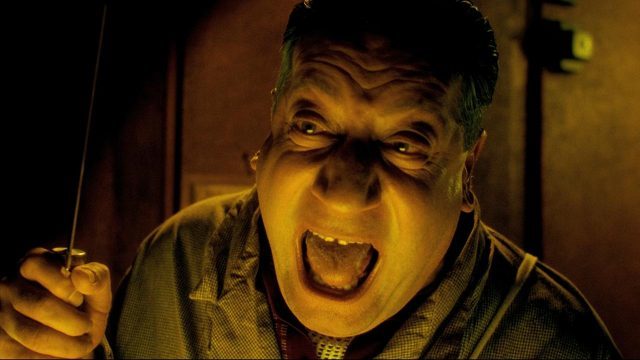
Butcher-landlord Clapet (Jean-Claude Dreyfus) has a unique way of taking care of his tenant-customers in Delicatessen
DELICATESSEN (Marc Caro & Jean-Pierre Jeunet, 1991)
Friday, September 4, 9:35
Monday, September 7, 4:20 metrograph.com
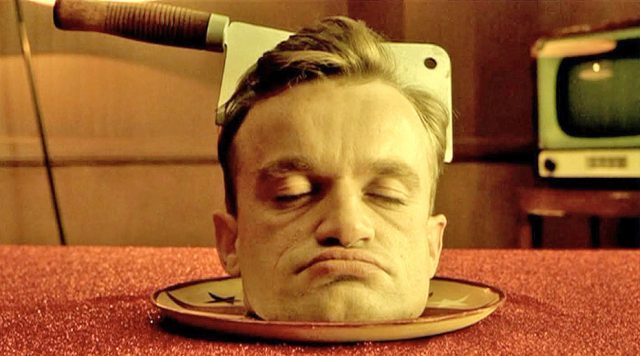
The Metrograph festival kicks off with Marc Caro and Jean-Pierre Jeunet’s epic masterpiece, City of Lost Children, and their delicious debut, Delicatessen. In a bizarre, postapocalyptic future, one apartment complex is surviving via its ground-floor butcher shop, where landlord Clapet (Jean-Claude Dreyfus) carefully wields his giant cleaver, hiring desperate, lonely men to do odd jobs for him before carving them up and selling their flesh and bones to his hungry customers. His latest potential victim is Louison (Dominique Pinon), a mild-mannered clown struggling to get by. But when Clapet’s shy daughter, Julie (Marie-Laure Dougnac), takes a liking to Louison, the butcher has to decide whether someone else should be their next meal. Meanwhile, Aurore Interligator (Silvie Laguna) keeps devising Rube Goldberg-esque ways to kill herself, Marcel Tapioca (Ticky Holgado) tries to prevent Clapet from making mincemeat of his mother-in-law (Edith Kerr), Frog Man (Howard Vernon) has come up with his own curious menu, Clapet gives special treatment to sexpot Mademoiselle Plusse (Karin Viard), and an underground group of Troglodistes are preparing for revolution.
Louison (Dominique Pinon) clowns around in Marc Caro and Jean-Pierre Genet’s brilliant audiovisual feast
Inspired by the work of Terry Gilliam, Delicatessen is a brilliant audiovisual feast, with every sound and image orchestrated for maximum absurdity, courtesy of cinematographer Darius Khondji (Seven, Stealing Beauty), longtime Marguerite Duras composer Carlos d’Alessio (India Song, The Children), and art director Miljen Kreka Klakovic (The Pillars of the Earth, The Order). Caro also did the gorgeous production design and makes a cameo as Fox. Several scenes turn into wildly inventive, hysterical musical numbers with a vaudevillian sensibility. Winner of four César Awards, the film is wickedly funny, taking place in a grim, fantastical, surreal vision of the future that is part Road Warrior, part Brazil, part Monty Python, where even methods of surveillance are downright strange. The cast is appropriately weird, none more so than Caro and Jeunet regular Pinon and his familiar, oddball face. The directors went on to collaborate on the stunning sci-fi gem The City of Lost Children (also screening September 4 and 7) before going their separate ways, Jeunet making such films as Alien: Resurrection, A Very Long Engagement, and Amélie and Caro writing and directing Dante 01.
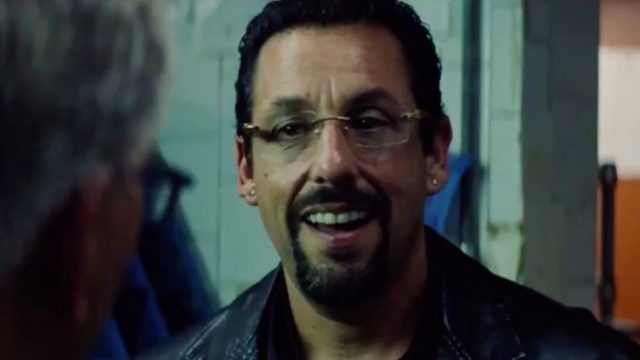
Adam Sandler plays a diamond dealer in danger in Uncut Gems
UNCUT GEMS (Josh Safdie & Benny Safdie, 2018)
Friday, September 11, 10:45
Sunday, September 13, 9:00 metrograph.com a24films.com
“That was manic, pure mania,” the Safdie brothers narrate at the end of a trailer for Uncut Gems, which itself is a magic gem. The film is a furious, unrelenting movie that sucks you into its claustrophobic frenzy and never lets go. Adam Sandler is a force, reaching new heights as Howard Ratner, a Diamond District dealer with a gambling addiction. He’s deep in debt to Arno (Eric Bogosian), who has sent his two goons, Phil (Keith Williams Richards) and Nico (Tommy Kominik), to make sure Howard knows just how much trouble he is in. His wife, Dinah (Idina Menzel), is fed up with him, not in the least because he has an apartment with his mistress, the much younger Julia (Julia Fox), and is not the most reliable father to their children, Eddie (Jonathan Aranbayev, who was discovered on Forty-Seventh St. in front of his parents’ jewelry store), Beni (Jacob Igielski), and Marcel (Noa Fisher).
Howard has a master plan to break free of all his problems by selling a chunk of Ethiopian black opals at an auction, with the help of one of his assistants, Demany (Lakeith Stanfield), who has lured in Boston Celtics center Kevin Garnett (terrific in his acting debut), who is fascinated by the rare, uncut gems, which sparkle with promise. The last half hour of the film is a brilliant, claustrophobic tour-de-force in which everyone onscreen is physically trapped, just like the audience is pinned to their seats, holding on for dear life. The Safdies, whose father worked in the Diamond District, use a mix of professional and nonprofessional actors as well as famous people playing themselves; the cast includes sports-radio legend Mike Francesa as a bookie, Garment District legend Wayne Diamond as a big-time gambler, Judd Hirsch as Howard’s father, Natasha Lyonne and Tilda Swinton as phone voices, and restaurant owner Nino Selimaj, writer Larry “Ratso” Sloman, actor John Amos, the Weeknd, and others as themselves.
Written by the Safdies (Daddy Longlegs, Heaven Knows What) with longtime collaborator Ronald Bronstein, Uncut Gems, which has been in process for ten years, is anchored by a career-redefining performance by Sandler, who previously revealed his significant acting chops in Paul Thomas Anderson’s 2002 Punch-Drunk Love and Judd Apatow’s 2009 Funny People. In a performance that will make you forgive him for The Waterboy, Big Daddy, Little Nicky, and Mr. Deeds, among other silly effluvia, Sandler is a whirlwind throughout the film’s 135 minutes, which fly by. Darius Khondji’s camera is practically glued to him, Sandler’s unshaven, gruff face a character unto itself, Howard’s eyes always at least one step ahead of what’s happening in front of him. He’s a dreamer, and although you can’t not root for him, he is far from a likable hero. He is singlehandedly responsible for the dangerous mess he’s in, whether he admits it to himself or not. But he is also a kind of everyman, peering through the looking glass (in this case, the seductive, multicolored opals in the stone), trying to survive in a hectic, frenetic world that can be overwhelming and spin out of control at any moment. You can’t just sit back, relax, and enjoy Uncut Gems; instead, you can’t help but be fully immersed in its nonstop, feverish intensity. “It was completely unlike anything I’ve done. I would never have thought I would photograph one day a movie like this. But it ended up being my favorite work, probably,” Khondji says.
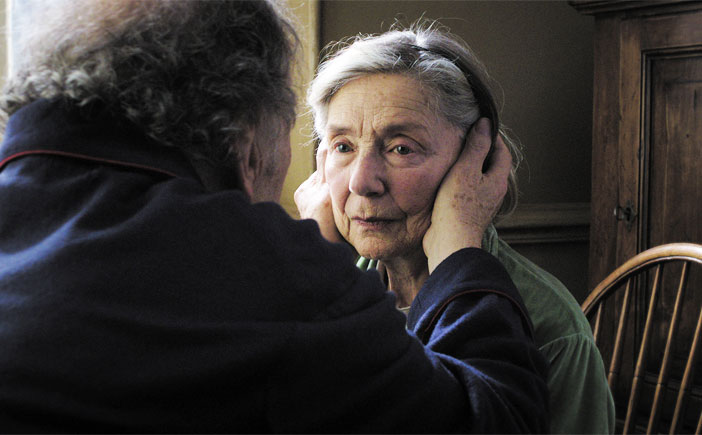
Jean-Louis Trintignant and Emmanuelle Riva play a married couple facing tragedy in Michael Haneke’s brilliant Amour
Legendary French actor Jean-Louis Trintignant puts an exclamation point on his long, distinguished career with Amour, one of the most beautiful love stories ever told. In his first film in nearly a decade, Trintignant, the star of such classics as Z, My Night at Maud’s, A Man and a Woman, and The Conformist, plays Georges, an octogenarian who is immediately concerned when his wife, Anne (Emmanuelle Riva), suddenly freezes for a few moments, unable to speak, hear, move, or recognize anything. So begins a downward spiral in which Georges takes care of his ailing wife by himself, refusing help from his daughter, Eva (Isabelle Huppert), as he faces the grim situation with grace and dignity. A genuine romance for the ages, Amour is brilliantly written and directed by Michael Haneke, earning the German filmmaker his second Palme d’Or, following 2009’s The White Ribbon. Haneke (Cache, The Piano Teacher) and cinematographer Darius Khondji allow the heartbreaking tale to unfold in long interior shots with very little camera movement, spread across more than two hours.
Despite its length, the film is far from torturous; instead, it is filled with quietly beautiful moments. Trintignant, who was eighty-two when the film was released, is magnificent as Georges, his every physical movement and eye glance rendered with powerful yet gentle emotions, whether he’s preparing food for Anne or trying to catch a bird that has flown into the apartment. It’s an unforgettable performance in an unforgettable film. “I’m actually the one who initially talked to Michael about shooting Amour on digital,” Khondji notes about the film in a Metrograph series note. “I tried to explain to him that for me, Amour was really like a recording, a recording of the lives of these two characters during their final six months together. . . . We could just keep recording with them until the very end.”
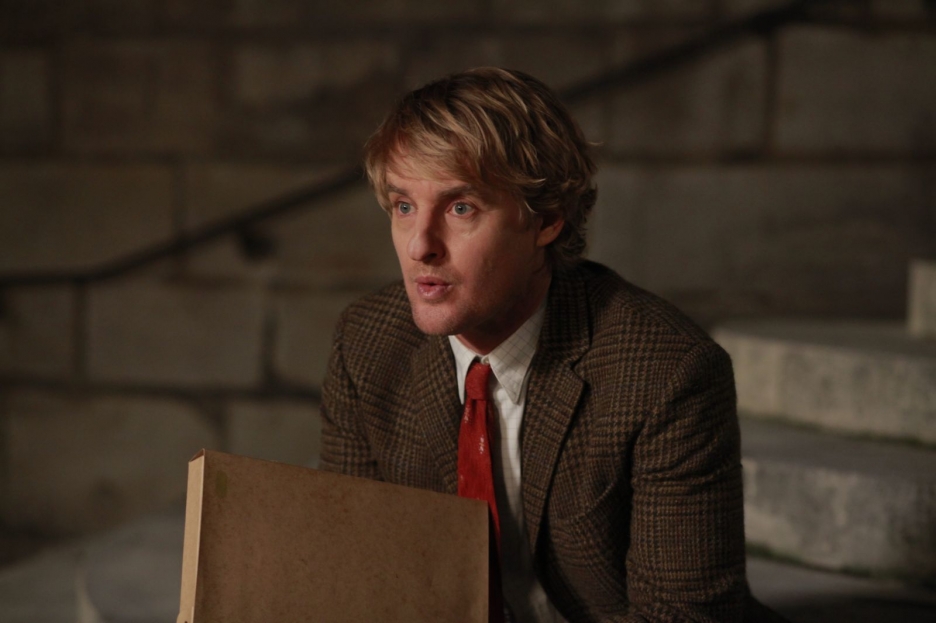
Writer Gil Pender (Owen Wilson) waits to mingle with the Lost Generation in Woody Allen’s Midnight in Paris
In 1979, Woody Allen and master cinematographer Gordon Willis made love to New York City architecture in gorgeous black and white in the stunning opening section of Manhattan set to George Gershwin’s “Rhapsody in Blue.” Allen’s Midnight in Paris begins with Allen and cinematographer Darius Khondji getting intimate with the City of Light in lush color, scanning familiar Parisian landmarks to Cole Porter’s “Let’s Do It, Let’s Fall in Love.” In this beautifully shot love letter to Paris, Owen Wilson stars as Gil Pender, a Hollywood hack screenwriter working on his first novel, about a nostalgia dealer. He and his fiancée, Inez (Rachel McAdams), are vacationing in Paris with her parents, the wealthy, ultraconservative John (Kurt Fuller) and Helen (Mimi Kennedy), who think their daughter can do much better. Gil and Inez bump into their friends Carol (Nina Arianda) and Paul (Michael Sheen), the latter a pedantic know-it-all who begins many an observation with “If I’m not mistaken” and whom Gil can’t stand. Gil is hoping Paris will get his creative juices flowing, and that’s exactly what happens late one evening when he is walking the streets alone at midnight and is invited into an old-fashioned car and taken to what appears to be a throwback party — until he meets F. Scott and Zelda Fitzgerald (Tom Hiddleston and Alison Pill), Cole Porter (Yves Heck), Ernest Hemingway (Corey Stoll), and fashion designer and Picasso muse Adriana (Marion Cotillard). Suddenly he feels more at ease in the swinging ’20s than the 2010s, heading out each night to the same spot, hoping to hang out more with the Fitzgeralds, Hemingway, Gertrude Stein (Kathy Bates), Picasso (Marcial Di Fonzo), and, most importantly, Adriana.
Nostalgia for the past and the promise of the future collide as Gil searches deep inside himself, trying to discover just what it is that he wants and needs out of life. Combining elements of such previous films as The Purple Rose of Cairo, Alice, Everything You Ever Wanted to Know About Sex*, and Everyone Says I Love You with a rather standard Twilight Zone-esque setup and a nod to his mid-’60s Lost Generation joke — in which he hangs out with Hemingway, the Fitzgeralds, Picasso, and Stein talking about art and literature, with a series of punch lines involving Allen getting punched in the mouth — Midnight in Paris is a charming, if at times overwrought and just plain silly, romantic fantasy that evokes Allen’s own fondness for nostalgia and the past. As more and more famous artists keep showing up, it gets more than a tad ridiculous, although it is also kinda fun. Midnight in Paris, which opened the 2011 Cannes Film Festival, follows four Allen films set in London (Match Point, Scoop, Cassandra’s Dream, and You Will Meet a Tall Dark Stranger), one in Barcelona (Vicky Christina Barcelona), and only one in New York (Whatever Works) as Allen continues to travel the world after experiencing a dwindling audience and scandal back home. Wilson is excellent as the nostalgic writer, playing him with an edgy uncomfortablilty that makes him endearing, and Cotillard is sexy and alluring as the quintessential artistic muse. And in an inspired bit of casting, then–French first lady Carla Bruni plays a tour guide who butts heads with the smarmy Paul when discussing Rodin’s The Thinker.
[Mark Rifkin is a Brooklyn-born, Manhattan-based writer; you can follow him on Substack here.]
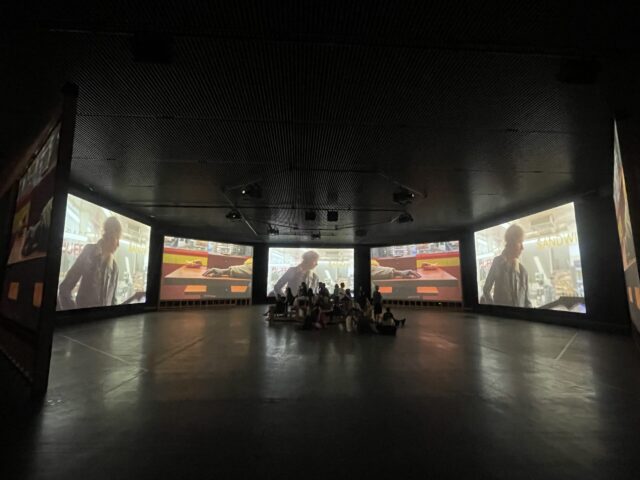
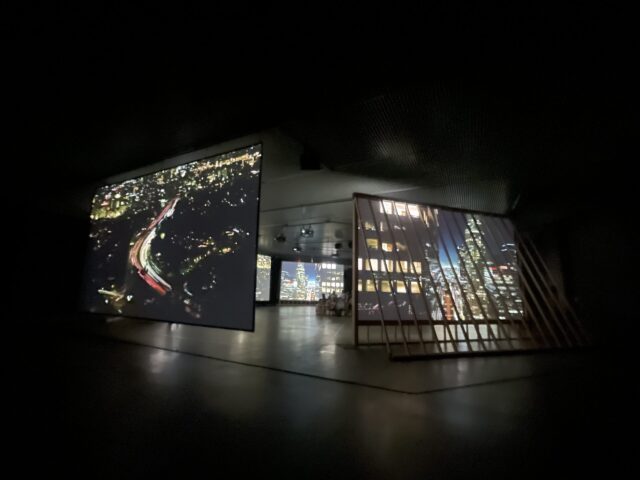
The audience can sit on a central wooden platform or move about the space to experience Doug Aitken’s Lightscape (photo by twi-ny/mdr)
DOUG AITKEN: LIGHTSCAPE
The Shed
545 West 30th St. at Eleventh Ave.
Tuesday – Sunday through September 13, pay-what-you-wish (suggested $10) theshed.org www.lightscapeart.org
“All of this will never make sense,” one of the characters says in Doug Aitken’s Lightscape, a seven-screen immersive installation at the Shed that is an audiovisual tone poem about the old and the new, nature and technology, and America itself — where we were, where we are, and where we’re heading. Gorgeously photographed by Chris Hadland and Aitken, it’s beautiful to watch and listen to; it makes you want to stop and look and treasure what you have, what’s around you right now.
A cowboy (Christopher Duke Blassman) hovers on the periphery before riding to a gas station in the desert. Two dancers (Daphne Fernberger and Konkrete) subtly move about in an Amazon factory. A couple (Natasha Lyonne and Bryn Mooser) contemplate their relationship in a high-rise hotel. A man (Nikki Haas) keeps running, more toward something than away. Potentially dangerous animals lurk.
The cast also features Ray Braungart as the diving man, Megan Renee as the city driver, Benjamin Earl as the truck stop drifter, Victoria Martinez as the sleeping young woman, and Beck as the man in the donut shop. The images swirl across the screens, with shots reminiscent of the work of Robert Smithson, Andreas Gursky, Edward Burtynsky, and David Hockney, occasionally offering different angles of the same scene. Music by Philip Glass, Steve Reich, Meredith Monk, Beck, LA LOM, and Aitken with Grant Gershon echoes throughout the room, performed by the Los Angeles Philharmonic and the LA Master Chorale.
Doug Aitken’s Lightscape continues at the Shed through September 13 (photo by twi-ny/mdr)
Characters rarely speak but when they do, they offer up such bons mots as “One day I’ll slip away,” “It just keeps going and going,” and “You can get lost in the blink of an eye.”
The audience can sit on the platform, facing any direction, or walk around the room; I advise checking out some of the film from behind the screens. It’s on a sixty-five-minute loop, and the abstract narrative has no obvious beginning, middle, and end, so you can enter at any time. As a woman tells us, “It’s all connected.”
A Redondo Beach native based in California and New York City, Aitken has previously presented such shows as Sleepwalkers, a multichannel video starring Donald Sutherland and Tilda Swinton created for MoMA’s sculpture garden and facade, 100 Yrs, which concluded with the destruction of 303 Gallery, New Horizon, involving a gondola and a hot air balloon rising into the night sky, and Station to Station, which took place on a moving transcontinental train.
With Lightscape, previously seen in unique iterations at Disney Hall and the Marciano Art Foundation, Aitken continues his investigation of art’s role in a changing world. The work doesn’t condemn the future, but it questions how we’re getting there, emphasizing how everything is connected but all of it will never make sense, able to slip away in the blink of an eye as it keeps going and going.
[Mark Rifkin is a Brooklyn-born, Manhattan-based writer; you can follow him on Substack here.]
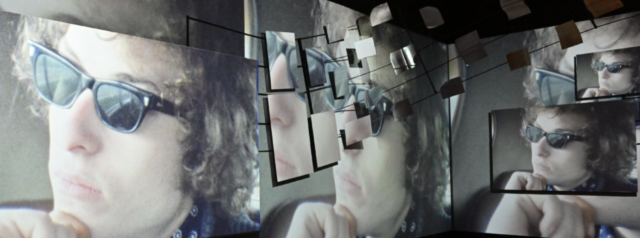
“Stepping into the Unknown” features rare and previously unreleased footage and special live performances
STEPPING INTO THE UNKNOWN: FILMS FROM THE BOB DYLAN CENTER
Paris Theater
4 West Fifty-Eighth St. at Fifth Ave.
Wednesday, September 2, $15-$17, 7:00 paristheaternyc.com bobdylancenter.com
My first Bob Dylan show was in September 1978 at the Nassau Coliseum. At one point relatively early on, I could see that my best friend was looking uncomfortable. “I don’t know any of these songs,” he said. “When is he going to play ‘Tangled Up in Blue’?” I hesitated before telling him, “Um, he just played that.”
I’ve since seen Dylan — with whom I share a birthday — about twenty times, with the Grateful Dead and Tom Petty, at Forest Hills, the Beacon, and the Jones Beach Theater, with such opening acts as Mavis Staples, Patti Smith, and Lucinda Williams. I camped outside overnight to get tickets to the 1992 Bobfest at the Garden. I was at the 2012 Prospect Park concert where he shared a brief memory about having once lived nearby in Brooklyn. “He knows where he is!” I called out.
During the pandemic, I watched Shadow Kingdom: The Early Songs of Bob Dylan, his mysterious concert film that had a wild live chat, questioning just about everything we were seeing and hearing. I devoured his 2005 memoir, Chronicles: Volume 1, glorying in the vastly entertaining fictionalization of stories from his life (while understanding that just because he called it Volume 1 didn’t mean there would be a Volume 2). I was impressed by Timothée Chalamet in A Complete Unknown and tried not to let all the factual inaccuracies get in the way of a good movie. I can’t hear “A Hard Rain’s a‐Gonna Fall” without remembering the excitement I felt watching the 1976 Hard Rain film on NBC documenting the Rolling Thunder Revue. Heck, I once let the nails of my thumbs grow ridiculously long because Bob’s were like that on the cover of the 1978 tour book.
And then there are the shows on Dylan’s Never Ending Tour, in which he constantly reinvents songs, sometimes making them all but unrecognizable. He stands back from the stage, wearing a hat or a hoodie, in low lighting so his face is hard to see. He doesn’t allow any video or photography and he rarely speaks to the audience except for announcing his band, which lately has been changing without explanation. At every concert, a handful of the uninitiated leave when they realize he’s not going to play many of his most famous songs, and when he does they sound very different. But we faithful love every twist and turn, following the master’s superb vocal phrasings and precise enunciations emanating from his raspier and raspier voice.
Which brings us to the Bob Dylan Center (BDC), his archive that opened in Tulsa, Oklahoma, in May 2022. Why Tulsa? One answer is because it’s Dylan, so why ask. But Dylan himself said, “There’s more vibrations on the coasts, for sure. But I’m from Minnesota and I like the casual hum of the heartland.”
On September 2, the Bob Dylan Archive comes to the Paris Theater for the special program “Stepping into the Unknown: Films from the Bob Dylan Center.” The event, presented by BDC director Steven Jenkins, will feature rare and previously unreleased material and will be followed by a Q&A and a live solo-electric performance by jazz guitarist extraordinaire Bill Frisell, who has recorded several Dylan songs and recently celebrated his seventy-fifth birthday by playing a show at BDC that included tunes by Dylan and Woody Guthrie.
“Stepping into the Unknown” is part of the Paris Theater’s annual “Big & Loud” series, consisting of 70mm screenings and 4K restorations of more than forty classics, from 2001: A Space Odyssey and Elevator to the Gallows to Fight Club and the Lord of the Rings trilogy, with such special guests as Sofia Coppola and Isabella Rossellini.
You can also catch “Stepping into the Unknown” on September 1 at the Nitehawk in Williamsburg, followed by a Q&A with Jenkins and a performance by Steve Wynn from the Dream Syndicate and the Baseball Project, and on September 3 at the Jacob Burns Film Center in Pleasantville with a Jenkins Q&A and a performance by Traveling Medicine Man with Luke Havranek.
[Mark Rifkin is a Brooklyn-born, Manhattan-based writer; you can follow him on Substack here.]
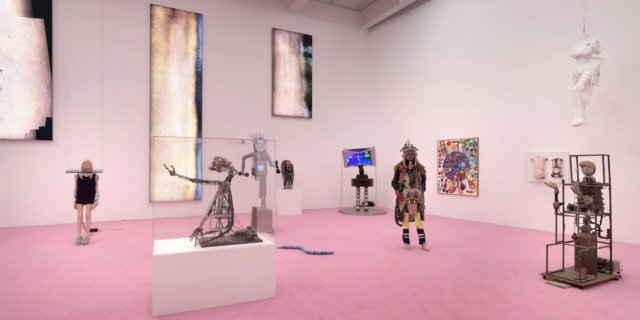
The expanded New Museum’s inaugural exhibition “New Humans: Memories of the Future” is closing over the next few weeks, floor by floor (photo by Dario Lasagni / courtesy New Museum)
NEW HUMANS: MEMORIES OF THE FUTURE
New Museum
235 Bowery at Prince St.
Tuesday – Sunday through August 9, 23, 30, $19-$25 (eighteen and under free) www.newmuseum.org
Following a two-year renovation, the New Museum reopened in March with an exciting look at what’s next for the interaction between people and art; this is the last weekend to catch all of “New Humans: Memories of the Future,” three floors of works by more than two hundred international artists and scientists that explore technological shifts impacting life on this planet. The fourth floor closes August 9, followed by the third on August 23 and the second on August 30.
Pieces by such older figures as James Tilly Matthews (1770–1815), Albert Robida (1848–1926), Frank Gilbreth (1868–1924), Valentine de Saint-Point (1875–1953), Henrique Alvim Corrêa (1876–1910), Constantin Brâncuși (1876–1957), Max Ernst (1891–1976), Benedetta (1897–1977), Erwin Blumenfeld (1897–1969), Hans Bellmer (1902–75), and Francis Bacon (1909–82) to such living artists as Barbara Chase-Riboud, Lynn Hershman Leeson, Lee Bul, Wangechi Mutu, Philippe Parreno, Mika Rottenberg, Hito Steyerl, Alice Wang, WangShui, and the youngest in the show, Pol Taburet, who was born in 1997. The wide range of years emphasizes the ever-growing celebration and worries that comes with major steps forward, especially today as AI and robotics are dominating conversations. Among the other familiar names represented are Salvador Dalí, Agnes Denes, Jean Dubuffet, Marcel Duchamp, Alberto Giacometti, H. R. Giger, Eva Hesse, Fernand Léger, Nam June Paik, Francis Picabia, Man Ray, and Jean Tinguely.
Be careful where you walk; a snake might reach for your ankle, or that person you say “Excuse me” to may not actually be a person. Be sure to scour everywhere; there are treats on the floors, walls, ceilings, and nooks. Be on the lookout for Andro Wekua’s untitled installation of a woman slightly levitating, her chin balancing on a sheet of glass; Anicka Yi’s In Love with the World, balloonlike spacecraft that float over your head; Pierre Huyghe’s creepy Human Mask film; LuYang’s digital videos DOKU Heaven — God Mode and DOKU Hell — God Mode in an elevator; Precious Okoyomon’s singing stairway surprise When the Lambs Rise Up Against the Bird of Prey; Catalina Ouyang’s disturbing fairy tale gone wrong otherwise, spite: 1. whores at the end of the world / 2. from every drop of his blood another demon arose (1829–1840); glowing creatures in Christopher Kulendran Thomas’s The Finesse; Jordan Wolfson’s dangling puppet Red Sculpture; and Tishan Hsu’s wall mural ears-screen-skin: New York.
On Saturday and Sunday visitors can use Rirkrit Tiravanija’s silk-screened ping pong table untitled (mañana es la cuestión) and Caoi Fei’s full-length film Nova will be screened; in addition, there will be a collage workshop on Saturday afternoon.
[Mark Rifkin is a Brooklyn-born, Manhattan-based writer; you can follow him on Substack here.]
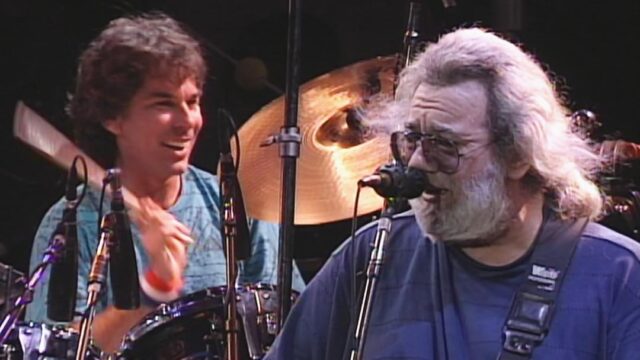
The Days Between include special meet-up screenings of the Grateful Dead’s 6/17/91 Giants stadium show
MEET-UP AT THE MOVIES: GRATEFUL DEAD GIANTS STADIUM 6/17/91
Multiple venues
August 8 & 10 www.meetupatthemovies.com
August 1 marked what would have been Grateful Dead cofounder Jerry Garcia’s eighty-fourth birthday; this Sunday, August 9, marks what will be the thirty-first anniversary of Garcia’s death in his home state of California at the age of fifty-three. This period is known as the Days Between.
To mark the occasion, Trafalgar Releasing and Rhino Entertainment are presenting the latest “Meet-Up at the Movies,” showing the Grateful Dead’s June 17, 1991, concert at Giants Stadium in theaters across the country, including here in New York City on August 8 and 10 at such locations as the Alamo Drafthouse in Staten Island, the IPIC at Fulton Market, and the AMC Kips Bay, AMC 34th Street, and AMC Empire 25.
Since Garcia’s death, various remaining GD members have toured as the Other Ones, the Dead, Furthur, Dead & Company, and Phil & Friends. But everything changed on January 10 when cofounder Bob Weir said farewell at the age of seventy-eight, joining Garcia, Donna Jean Godchaux (1947–2025), Phil Lesh (1940–2024), Vince Welnick (1951–2006), Brent Mydland (1952–90), Keith Godchaux (1948–80), and Ron McKernan (1945–73). The only remaining longtime members are drummers Mickey Hart and cofounder Bill Kreutzmann, who are not expected to put together a touring band affiliated in some way with the Grateful Dead.
We’re nowhere near ready for a summer without the band, so the only chance you have is to catch one of these special screenings of a show that opened with “Eyes of the World,” included such faves as “Brown Eyed Women,” “Cassidy,” and “Uncle John’s Band,” and concluded with “The Weight.” Also on the bill are a sneak preview of “Shakedown Street” from Merriweather 6/30/85 and an intro from Grateful Dead legacy manager and archivist David Lemieux.
“The summer tour of 1991 was widely considered one of the best of the 1990s, and the June 17, 1991, show at Giants Stadium was nearly universally acclaimed as the best of the tour. From the ‘Eyes of the World’ opener to the sixpack of ‘Dark Star’ teases woven throughout the night, the one show from 1991 whose reputation grew as time went on was this concert,” Lemieux said in a statement. “Because it’s one of only two shows captured on forty-eight-track analog tape, the audio quality is spectacular. Hearing this mix in a theater with fellow fans is going to be transportive, and we’re thrilled to sweeten the pot with an exclusive look at ‘Shakedown Street’ from the upcoming ’85 Merriweather release.”
As lyricist Robert Hunter wrote in his and Garcia’s 1990s song “Days Between”:
“There were days, and there were days / And there were days between / Summer flies and August dies / The world grows dark and mean / Comes the shimmer of the moon / On black infested trees / The singing man is at his song / The holy on their knees / The reckless are out wrecking / The timid plead their pleas / No one knows much more of this / Than anyone can see / Anyone can see.”
[Mark Rifkin is a Brooklyn-born, Manhattan-based writer; you can follow him on Substack here.]
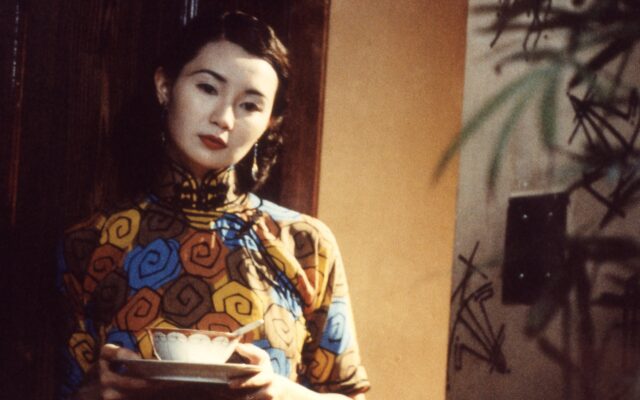
“Isn’t she a replica of myself?” Maggie Cheung says of Chinese actress Ruan Ling-yu in 1991’s Center Stage, in which Cheung plays Ruan as well as herself. “Maggie, may I ask if you wish to be remembered half a century later?” a man asks, to which Cheung responds, “That’s not so important to me. If future people do remember me, it won’t be the same as Ruan Ling-yu, as she halted her career at the age of twenty-five, when she was at her most glorious. Now she is a legend.” The Hong Kong–born Cheung, a former model and beauty queen, has long been a legend herself, having made more than ninety films since her career began in 1984, when she was nineteen; current and future people are sure to remember the glamorous superstar who continues to help spread Chinese cinema around the world even though she retired from acting in 2010.
In Center Stage, Cheung is radiant as both herself and Ruan as director Stanley Kwan goes back and forth between the present, as Cheung is making the film, and the past, as she portrays Ruan rising from an extra to a star in the late 1920s and early 1930s, at the same time Japan is mounting attacks against China. Cheung, who was named Best Actress at prestigious film festivals in Berlin, Chicago, Taiwan, and Hong Kong for the role, is joined by a stellar cast, including Chen Yen-yen, Lily Li, Tony Leung Ka-fai, Carina Lau, and Chin Han; the real Ruan is seen in archival footage.
For its thirty-fifth anniversary, Center Stage, also known simply as Actress, is screening in a new 4K restoration at Film Forum from August 7 to 13; Kwan, who has also directed such films as Women,Full Moon in New York, and First Night Nerves, will be on hand for Q&As following the 6:30 shows on August 7 and 8, copresented by the New York Asian Film Festival. Alas, Cheung, who makes very rare public appearances and eschews interviews, will not be there.
[Mark Rifkin is a Brooklyn-born, Manhattan-based writer; you can follow him on Substack here.]