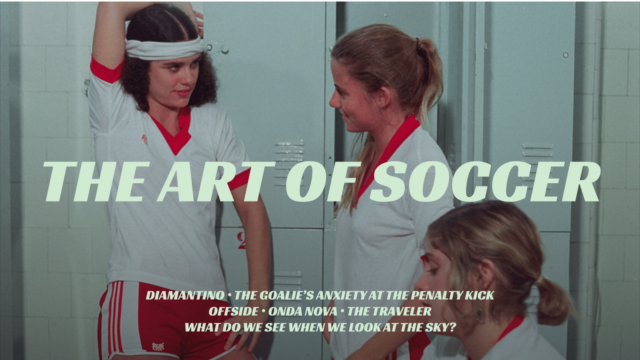
THE ART OF SOCCER
Metrograph
7 Ludlow St. between Canal & Hester Sts.
June 12 – July 5
metrograph.com
It may take a few days for World Cup fever to take over New York City, which is currently owned by the Knicks, but the international game of soccer is being celebrated just about everywhere you look. At Metrograph, “The Art of Soccer” consists of a half dozen fútbol classics, beginning June 12 with Wim Wenders’s 1972 The Goalie’s Anxiety at the Penalty Kick and continuing with a new restoration of José Antonio Garcia and Ícaro Martins’s once-banned 1983 Onda Nova, Jafar Panahi’s 2006 Offside, Alexandre Koberidze’s 2021 What Do We See When We Look at the Sky?, Abbas Kiarostami’s 1974 The Traveler, and Daniel Schmidt and Gabriel Abrantes’s 2018 Diamantino.

Giant fluffy puppies get in the way of a Portuguese soccer star’s dreams in Diamantino
DIAMANTINO (Daniel Schmidt & Gabriel Abrantes, 2018)
Metrograph
Dates to come
metrograph.com/art-of-soccer
www.kinolorber.com
At the fifty-sixth annual New York Film Festival in 2018, you could catch a documentary, foreign-language picture, political thriller, high-tech crime chiller, comedy, romantic melodrama, fantasy and sci-fi, and more — all in one wildly entertaining film. Diamantino, Gabriel Abrantes and Daniel Schmidt’s full-length feature debut, is an absurdist multigenre mashup that is as tense as it is funny, an unpredictable romp that evokes Ernst Lubitsch, Howard Hawks, Michel Gondry, Philip K. Dick, South Park, Cinderella, James Bond, Being There, Minority Report, and Au Hasard Balthazar while feeling wholly original. Carloto Cotta stars as the title character, Diamantino Matamouros, a Portuguese soccer star à la Cristiano Ronaldo (pre-sexual assault allegations) who sees giant fluffy puppies when he is on the field. After botching a penalty kick in the World Cup Final, the stupendously beautiful star learns that his beloved father and mentor (Chico Chapas) has died. His evil twin sisters, Sónia (Anabela Moreira) and Natasha (Margarida Moreira), become his agents and make a secret deal with the mysterious Dr. Lamborghini (Carla Maciel) and a government minister (Silva Joana). Meanwhile, investigators Aisha Brito (Cleo Tavares) and Lucia (Vargas Maria Leite) — lovers who are soon to be married — are looking into Diamantino’s finances and devise a plan to get close to him by having Aisha pose as a male refugee named Rahim who Diamantino adopts as his son.

Diamantino Matamouros (Carloto Cotta) is surrounded by images of himself in Gabriel Abrantes and Daniel Schmidt’s dazzling feature debut
Everyone except his sisters, who know better, thinks he is some kind of genius mastermind, but Diamantino is actually an addled simpleton who understands very little about life. He enjoyed playing soccer, likes eating Nutella and whipped cream sandwiches, and, following his tearful retirement, hangs out with his cat, Mittens, and dedicates himself to raising Rahim, who he does not realize is actually a grown woman. He’s reminiscent of Chance the Gardener (Peter Sellers) in Being There, but his airheaded statements — which are outrageously funny — are seldom mistaken for brilliance, except when he’s manipulated into making fascistic political statements he doesn’t understand. Winner of the Grand Jury Prize at Cannes Critics’ Week, Diamantino is stunningly photographed by Charles Ackley Anderson, who quickly adapts the film’s visual style as it switches from fantasy to love story to futuristic thriller, with numerous memorable shots, including Lucia in a white nun’s habit on a motorbike, Diamantino and Rahim sleeping on pillows with large images of the soccer star’s head, and a huge fluffy puppy playing goal in the championship game. American-born directors and longtime collaborators Abrantes and Schmidt, who edited the film with Raphaëlle Martin-Holger, show a deep love and respect for movies, infusing Diamantino with charm and energy, humor and compassion, honoring, in their own way, the history of cinema. The rest of the cast and crew do their part as well, from art director Bruno Duarte and composers Ulysse Klotz and Adriana Holtz to the Moreira sisters and multidisciplinary Portuguese star Manuela Moura Guedes as television interviewer Gisele.

A group of women risk their freedom to watch a soccer match in Jafar Panahi’s Offside
OFFSIDE (Jafar Panahi, 2006)
Metrograph
Dates to come
metrograph.com/art-of-soccer
www.sonyclassics.com
Filmed on location in and around Tehran’s Azadi Stadium and featuring a talented cast of nonprofessional actors, Jafar Panahi’s Offside is a brilliant look at gender disparity in modern-day Iran. Although it was illegal at the time for girls to go to soccer games in Iran — because, among other reasons, the government did not think it was appropriate for females to be in the company of screaming men who might be cursing and saying other nasty things (the regulations have been somewhat loosened recently) — many try to get in, facing arrest if they get caught. Offside is set during an actual match between Iran and Bahrain; a win will put Iran in the 2006 World Cup. High up in the stadium, a small group of girls, dressed in various types of disguises, have been captured and are cordoned off, guarded closely by some soldiers who would rather be watching the match themselves or back home tending to their sheep. The girls, who can hear the crowd noise, beg for one of the men to narrate the game for them.
Meanwhile, an old man is desperately trying to find his daughter to save her from some very real punishment that her brothers would dish out to her for shaming them by trying to get into the stadium. Despite its timely and poignant subject matter, Offside is a very funny film, with fine performances by Sima Mobarak Shahi, Shayesteh Irani, Ida Sadeghi, Golnaz Farmani, Mahnaz Zabihi, and Nazanin Sedighzadeh as the girls and M. Kheymeh Kabood as one of the soldiers. The film was selected for the 2006 New York Film Festival, but Panahi, who was supposed to attend the opening, experienced visa problems when trying to come to America and was later arrested by the Iranian government for his support of the opposition Green movement; he was sentenced to six years in prison and given a twenty-year ban on making new films, something he comments on ingeniously in This Is Not a Film.
[Mark Rifkin is a Brooklyn-born, Manhattan-based writer; you can follow him on Substack here.]