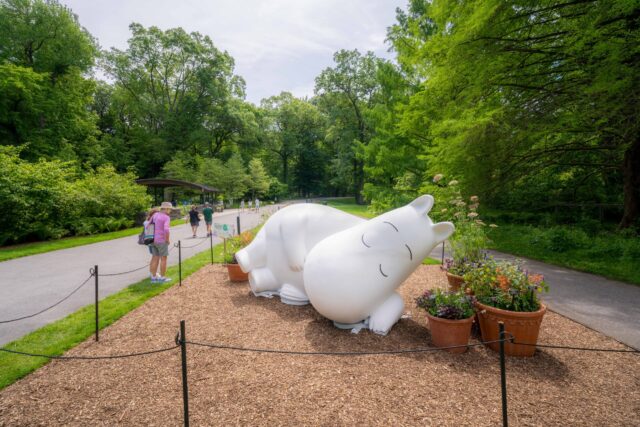
“Summer of Moomin” continues at New York Botanical Garden through September 13 (photo by Marlon Co. / courtesy the New York Botanical Garden)
SUMMER OF MOOMIN
The New York Botanical Garden
Everett Children’s Adventure Garden
2900 Southern Blvd., Bronx
August 8-9, noon – 5:30, $17 children two to twelve, $35 students and seniors, $39 adults
Exhibit on view through September 13 www.nybg.org
The New York Botanical Garden’s “Summer of Moomin” has a special Moomin’s Day Weekend planned for August 8 and 9, two days of culinary adventures, cooking demonstrations, planting, maker stations, and more in the Edible Academy.
Begun in 1945 by Finnish painter, author, and illustrator Tove Jansson, the Moomin books, comic strips, stage productions, animated television series, and movies share the tales of such beloved characters as Moomintroll, Snufkin, Snorkmaiden, Hemulen, Moominpappa, Moominmamma, and Little My, all of whom you can find along a winding trail through Moominvalley in the Everett Children’s Adventure Garden filled with quotes, toys, plants and flowers, a tent, book excerpts, crafts, a kitchen, interactive elements, a puppet theater, and other fun surprises. There is also a booklet with games and activities and details about the world of Moomin.
“The stories offer a very happy and peaceful way to deal with some very complex issues of life and living and being together in a way that we don’t even notice, but we’re learning,” Tove’s niece Sophia Jansson said at the opening of the exhibit. “But Tove had some very important core values that were all about tolerance, friendship, and respect for nature.”
While at the NYBG, don’t miss the colorful, wide-ranging “Flower Power” exhibition, celebrating peace and love in the 1960s with paintings, photographs, music, drum circles, craft workshops, ornately designed VW buses, psychedelic nature displays, archival news reports, sound baths, and film screenings.
[Mark Rifkin is a Brooklyn-born, Manhattan-based writer; you can follow him on Substack here.]
New Penny Lane documentary details Flaco the owl’s unique New York City adventure
WILD INSIDE (Penny Lane, 2026)
IFC Center
323 Sixth Ave. at West Third St.
Opens Friday, July 31 www.ifccenter.com
On February 2, 2023, an unexpected animal suddenly appeared on a Fifth Ave. sidewalk, becoming an instant sensation.
No, it wasn’t a groundhog looking for its shadow. It was a glorious Eurasian eagle-owl named Flaco, who had escaped from the Central Park Zoo after someone had cut a hole in his steel mesh cage. The thirteen-year-old bird captivated the city, the country, and the world for more than a year as he traversed Manhattan, adapting to his newfound freedom by learning how to survive on his own, unfazed by — or perhaps reveling in — the media attention and the dozens of owlers who tracked his every move with binoculars and high-powered cameras.
Documentarian Penny Lane shares the remarkable tale of Flaco in the gently warm and touching — and ravishingly dramatic — Wild Inside, making its world premiere at IFC Center on July 31. Incorporating crowd-sourced photos and videos, news reports, eyewitness accounts, cute animation, and expert opinions, Lane and editor Hannah Buck transform the adventure into a compelling narrative of love and loneliness, of obsession and desperation, an apt metaphor for who we are and what we want and need in the twenty-first century. Birder after birder projects their fears and desires onto Flaco and his journey, an odyssey that goes well beyond Free Willy territory.
“The first time I saw him, I felt protective of him,” Jacqueline Emery says.
“I felt his pain,” JP Borum, known as the Bunny Lady because she rescues rabbits in the park, explains.
“After little more than a week, people were relating to Flaco. They were identifying with him and seeing him as a hero,” David Barrett points out.
As these birders celebrate Flaco’s reinvigorated life, one expresses his concern. “I think I came to this story with an understanding of really the dangers owls face being in Manhattan. . . . There were a lot of people there that night the zoo almost got him that were excited that he got free, and I was just like, ‘No, he’s going to die,’” D. Bruce Yolton admits, referring to the zoo’s attempt to capture Flaco and bring him back to his previous enclosure, efforts they abandoned after a week.
Lane, an avid birder who has made such previous well-regarded nonfiction features as Hail Satan?,Our Nixon, and “Nuts!,” was drawn into the proceedings from the very beginning, when a friend, the first person to see Flaco outside his cage, texted her photos of Flaco the night he was discovered on the street. “It’s rare that a story just falls into my lap and is so immediately capable of demanding my full attention,” she notes in her director’s statement. “Flaco was writing his own story and the rest of us were just watching. And yes, we were watching!”
We were watching, and Wild Inside gives us the chance to watch yet again, this time much more up close and intimately. It’s impossible not to form an emotional bond with Flaco as Lane takes us from the zoo to the park, from the Lower East Side to the Upper West, as Flaco explores his burgeoning independence and searches for a companion, roosting on rooftop edges of tall buildings and hooting out love calls like they’re the Bat signal.
A tight-knit community forms around Flaco, including a man and a woman who get married. When Flaco disappears for a few days, people grow despondent. Sarah Bramwell became so involved that her family was concerned for her mental health. “I had been so worried about him. I mean, so worried, like a mother would be worried, right?” she concedes.
Even though owls are predators who are not often friendly or affectionate with humans, Flaco seems to be making a direct connection to his dedicated fans, as shown in two stunning scenes in which — well, to reveal more would spoil some of the many surprises the film has in store for viewers.
Lane also raises a key issue and a source of much disagreement: Would Flaco be better off back in the zoo, where most of his needs were met on a daily basis, or flying free in the wilds of Manhattan, where danger awaits around every corner? It’s a question many of us ask ourselves when we consider our lives, both personal and professional, whether we can or should take certain risks to find out who we truly are. We cannot watch Wild Inside and not internalize Flaco’s story ourselves; when it comes down to it, we are Flaco, and Flaco is us. We need Flaco — but does Flaco need us?
“The moment you doubt whether you can fly, you cease for ever to be able to do it,” J. M. Barrie wrote in Peter Pan.
Flaco gives us all hope that one day, maybe, we can fly as well.
[Several screenings from July 31 to August 4 will be followed by Q&As with Lane, DOC NYC artistic director Jaie Laplante, and Emery and Lei as well as Village birdwatching tours. Mark Rifkin is a Brooklyn-born, Manhattan-based writer; you can follow him on Substack here.]
Walking tour of Harlem is part of special exhibition programming at Poster House
POSTER HOUSE WALKING TOUR WITH HISTORIAN JOHN T. REDDICK
Poster House
119 West Twenty-Third St. (tour starting point given upon ticket purchase)
Saturday, July 18, $25, 11:00 am to 1:00 pm
Exhibition runs through September 6 posterhouse.org
In September 2024, longtime Harlem resident, preservationist, and Yale University School of Architecture graduate John T. Reddick gave me a tour of the exhibit “Illustrating Tin Pan Alley: From Ragtime to Jazz” at the Society of Illustrators, consisting of his remarkable collection of sheet music art from the Tin Pan Alley era, focusing on Black composers, musicians, and performers. He told me that while doing his research, “It was just shocking; as I bought sheet music or got to see the names, I realized they all lived in Harlem during the same time period.”
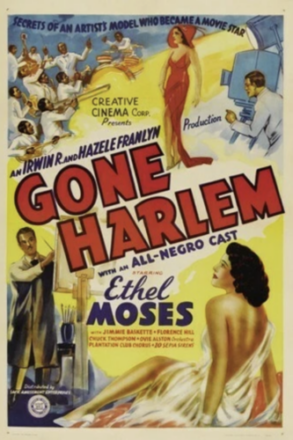
Reddick is now collaborating with Poster House on a walking tour of Harlem in conjunction with the institution’s “Act Black: Posters from Black American Stage & Screen,” comprising promotional posters for musical revues, theatrical presentations, and movies featuring Black performers from the 1870s to the 1940s (including from Cabin in the Sky,Zouzou, and Imitation of Life). The one-hour tour will visit Strivers’ Row, the Schomburg Center, and Harlem Hospital’s WPA murals, among other locations that played a role in the Harlem Renaissance.
Reddick, who is a member of the Board of Directors of the Tin Pan Alley American Popular Music Project, is an engaging storyteller and a font of knowledge, so this should be a special adventure; tickets are $25, and the starting point will be given upon purchase.
[Mark Rifkin is a Brooklyn-born, Manhattan-based writer; you can follow him on Substack here.]
Hirokazu Koreeda’s Sheep in the Box closes the 2026 Japan Cuts festival
JAPAN CUTS: FESTIVAL OF NEW JAPANESE FILM
Japan Society
333 East 47th St. at First Ave.
July 8–19, $16-$20 www.japansociety.org
“The world is full of strange things,” a narrator says in one of the films that make up this year’s “Japan Cuts: Festival of New Japanese Film,” running July 8–19 at Japan Society. As always, the nineteenth edition of the hotly anticipated series is chock full of strange things, as well as things of beauty — and often both at the same time.
Japanese films may come in all genres, but the best of the best tend to veer off track into their own indefinable categories, and the 2026 iteration is no different, with more than its share of exciting, unusual, frightening, romantic, bloodthirsty, chilling, touching, and gorgeous works. There are twenty-seven programs divided into five sections: “Feature Slate,” “Next Generation,” “Classics,” “Documentaries,” and “New Directions in Japanese Cinema.”
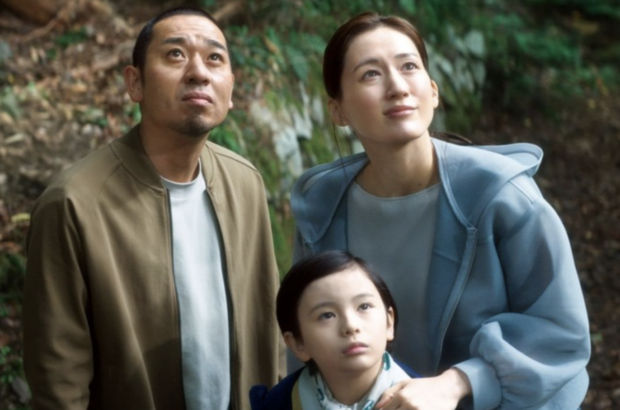
The festival opens July 8 with Yoji Yamada’s ninety-first full-length film, Tokyo Taxi, followed by a reception with Twisty BonBon. The centerpiece selection is Kei Ishikawa’s A Pale View of Hills, followed by a Q&A and reception with star Suzu Hirose, winner of the Cut Above award. The closing-night film is Hirokazu Koreeda’s Sheep in the Box, followed by a Q&A and reception with the director.
Below is a look at some of the other highlights, with more strangeness to come.
SHUFFLE (『シャッフル』) (Gakuryu Ishii, 1981) THE MASTER OF SHIATSU (『指圧王者』; SHIATSU OJA) (Gakuryu Ishii as Sogo Ishii, 1989)
Saturday, July 11, 5:30 japansociety.org
One of the myriad reasons to check out Japan Cuts is for double features such as this wild one, the world premieres of 4K restorations of Gakuryu Ishii’s 1981 thirty-seven-minute Shuffle and 1989 thirteen-minute The Master of Shiatsu.
The Master of Shiatsu begins with a close-up of a woman’s left hand stroking a man’s right hand in what appears to be an elegant bar. Bright lights glow from the contact, a crazy laugh is heard, and the opening credits roll, the title in a wacky design reminiscent of 1970s wuxia films. Ishii then cuts to a feather floating into a candle and a woman (Anna Hole) getting a deep, erotic massage from an older man (Tokujiro Namikoshi, the real-life Father of Shiatsu). Wonderfully cheesy special effects take them both to another dimension, leading to a very strange but optimistic finale.
Inspired by Katsuhiro Otomo’s manga Run, the mostly black-and-white Shuffle begins with a close-up of a young punk, Hiroshi Kobayashi (Yosuke Nakajima), cutting off his hair when a small earthquake hits, knocking down some of the bullets next to a handgun. He peers out his window at two men in suits surveilling the area, then heads outside, where he is spotted by one of the detectives (Tatsuya Mori). What ensues is one of the wildest foot chases you’ve ever seen, a brilliantly filmed frenetic pursuit, set to Hikashu’s propulsive score, in which neither man is willing to give up. The action cuts away a few times to reveal a back story involving a femme fatale, Naomi (Shigeru Muroi), and a gangster, Kimura (Genjirō Arato), but keeps returning to the seemingly endless hunt, with Kobayashi hallucinating, in color, moments from his past.
Both films create fantastical realities with characters immersed in activities that release endorphins and dopamine that the audience tunes in to, The Master of Shiatsu slowly paced and intimate, Shuffle a marathon sprint Ishii called “a portrait of my generation.” I dare you to not think about these films the next time you get a massage or go running, for whatever reason.
Four sisters come together after their father’s death in another masterpiece from Hirokazu Koreeda
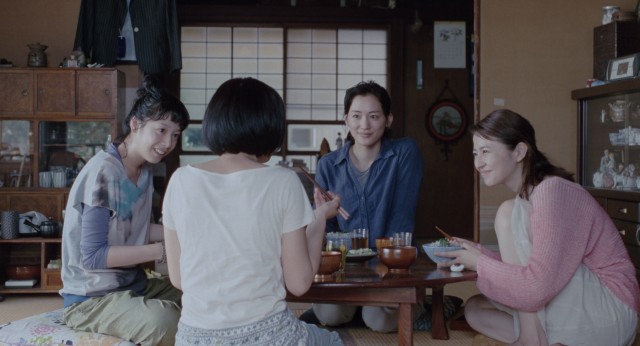
In such films as Still Walking,Nobody Knows, and Like Father, Like Son, Japanese writer-director-editor Hirokazu Koreeda has crafted beautifully told tales of parents and children, of estrangement and divorce, of death and ritual and the unbreakable bonds between siblings. In yet another minimalist masterpiece, Our Little Sister, he focuses on the women of the happily dysfunctional Kōda family in the scenic city of Kamakura. Sachi (Haruka Ayase), Yoshino (Masami Nagasawa), and Chika (Kaho) live together in a large house, where they go about their days with the normal trials and tribulations of twentysomething women. Sachi, the oldest, is a nurse who acts as a surrogate mother to her younger sisters, since their real mother plays almost no role in their lives. Yoshino, the middle sister, works in a bank and likes to stay out late drinking and partying. And Chika, the baby of the trio, is sweet and goofy, but not as goofy as her mountain-climbing boyfriend. When their long-estranged father dies, they decide to attend the funeral, where they meet their dad’s thirteen-year-old daughter from his second of three marriages, Suzu Asano (Suzu Hirose), a solid, smart girl who seems a bit lost now that both of her parents are dead. So the three older sisters invite her to move in with them in Kamakura and extend their family. The four immediately grow close as they live their daily lives, going to work or school, eating together, interacting with the opposite sex, and honoring their deceased ancestors. Suzu also regales them with tales of their father, some of which surprise them. Not a whole lot happens except a series of heartfelt, realistic scenes that audiences of all kinds can relate to.
Freely adapted from Akimi Yoshida’s josei manga Umimachi Diary,Our Little Sister simmers with the beauty and energy of real life, as Koreeda offers viewers a fly-on-the-wall look at four exquisite women living day by day. Koreeda once again blends documentary techniques with the intimate style of Yasujirō Ozu to fully develop his delightful characters, from the four sisters to their great-aunt to a student smitten with Suzu to local diner owner Sachiko Ninomiya (Jun Fubuki), who serves as a kind of tenderhearted matriarchal figure to the community. Yoko Kanno’s sweet music and Mikiya Takimoto’s lovely cinematography make it all a visual and aural pleasure, along with a fabulous cast that acts with an infectious naturalism. No one makes family dramas like Koreeda, who skillfully avoids treacly plot twists in favor of simplicity, making it all seem easy. If you’ve never seen a Koreeda film, Our Little Sister is a great place to start, and if you have experienced any of his previous work, this one is another gentle, graceful, and immensely engaging tour de force from one of the world’s most talented and original filmmakers. His latest, Sheep in the Box, closes “Japan Cuts” on July 19.
Kura (Kei Nakafuji) and Kishida (Kai Fujita) are reunited high school friends in Gingerboy
GINGERBOY (『ジンジャーボーイ』; JINJABOI; SEPARATED) (Miki Tanaka, 2024) NAOMI OUT OF SYNC (『空回りする直美』; KARAMAWARI SURU NAOMI) (Fuku Nakazato, 2025)
Tuesday, July 14, 9:00 japansociety.org
The North American premiere of Miki Tanaka’s forty-eight-minute Gingerboy and the international premiere of Fuku Nakazato’s forty-four-minute Naomi Out of Sync make for a strangely compelling double feature. Part of “Next Generation,” in which one filmmaker will take home a three-thousand-dollar stipend, the movies both explore offbeat relationships, obsession, and physiological and neurodevelopmental conditions.
Winner of a joint third prize La Cinéf Selection award at Cannes, Gingerboy reunites high school friends Kishida (Kai Fujita) and Kura (Kei Nakafuji), whose lives have gone in opposite directions. The former is a regional banker who has been transferred to Tokyo, while the latter is an aspiring ne’er-do-well filmmaker. Kishida puts on a suit for work and has a girlfriend back home; he is quiet and unassuming, serious about his career. “I’m not nice,” he admits to a coworker. “It’s just a hassle to say no.” Kura is unpredictable and unkempt, wasting away the days and partying at night with booze and women. At first Kishida goes out with Kura, but he soon makes some discoveries about his roommate that complicate their friendship, even as Kura grows more dependent on him. Nakazato creates unique characters in knotty situations in a tense narrative that builds to a moving conclusion that provides no easy answers.
Naomi (Kono Adachi) and Shingo (Masafumi Shinohara) try the best they can in Naomi Out of Sync
In Naomi Out of Sync, Kono Adachi is delightful in the title role, an eighteen-year-old part-time employee caring for her her older brother, Shingo (Masafumi Shinohara), who has debilitating Tourette’s, while her father (Wataru Ohshige) is away. Naomi works at a supermarket but has trouble focusing on her job; when she gets disciplined, it looks like she’s not taking it seriously, but that’s just the way she approaches life. “What goes on in her head? And she always smiles when I scold her. What is she grinning about?” her boss asks another manager. When Shingo sells her clothes so he can buy a plastic toy, instead of getting mad, Naomi slurps down noodles she and Shingo slide through the toy. Naomi’s main responsibility is to make sure Shingo takes his medication, but when that goes awry, serious problems arise. But as her T-shirt says: “Fully honest: Believe in yourself.”
Winner of the Grand Prize at the PIA Film Festival, Naomi Out of Sync is an affecting drama about a dysfunctional family in which the two kids are trying to do the best they can, not unlike Kishida and Kura in Gingerboy. Kono is mesmerizing as Naomi; even when Naomi makes questionable decisions, you can’t help but be charmed by her, rooting her on as she stands by her choices. And oh, that surprise ending, one that is deeper than you might first imagine.
[Mark Rifkin is a Brooklyn-born, Manhattan-based writer; you can follow him on Substack here.]
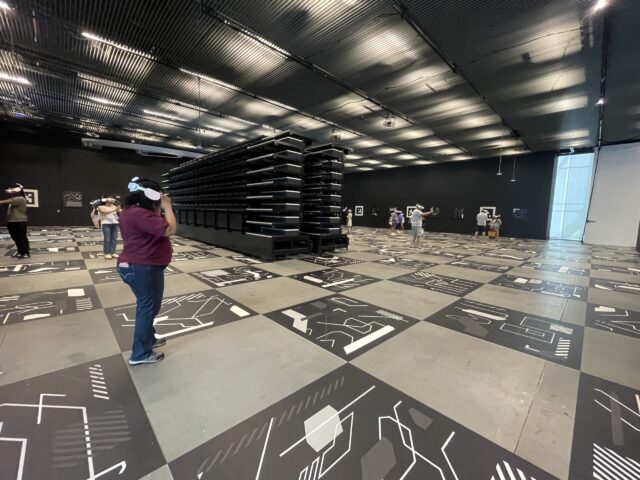
The Black Mirror Experience takes place on a special grid at the Shed (photo by twi-ny/mdr)
THE BLACK MIRROR EXPERIENCE
The Shed
545 West 30th St. at Eleventh Ave.
Tuesday – Sunday through September 6, $56.35-$79.35 (approx. 10% discount for groups of four to six; priority access for VIP) theshed.org nyc.theblackmirrorexperience.com
The Black Mirror Experience is an ultracool interactive, immersive, participatory, multimedia, AI-generated, virtual reality presentation at the Shed that puts you inside an episode of the hit streaming series.
Inspired by The Twilight Zone,Black Mirror is an Emmy-winning British anthology show created in 2011 by Charlie Brooker; there have been thirty-two episodes across seven seasons in addition to two specials, with a dedicated focus on how advancements in technology impact the future of humanity.
In The Black Mirror Experience, which earned a Special Mention at the 2026 Cannes Film Festival and is concurrently taking place in Montreal and Madrid as well as New York City, groups of up to six people at a time, wearing VR headsets, enter the mysterious world of Phaethon Labs. Each person has their biometrics scanned in order to create their own LifeAgent, a lifelike avatar, and then is thrust into an original story by Brooker that introduces the LifeAgent Integration Pathway, leading from a store, a life goals selection, and general orientation to a neural mapping facility, the LifeAgent Customization Centre, a testing playground, and final delivery. Its motto: “Do less. Live more.”
“At Phaethon, we believe in reversing time’s decline, because your LifeAgent exists to give you back what time has taken: space, clarity, energy, and self. Which is why our origin story imagines these ancient ages in reverse,” Phaethon Labs founder Dakota “Cody” Winters explains.
Phaethon is named after the Greek demigod who searched for his father, Helios, and traveled too close to the sun, an apt metaphor for the dangers of AI. A chart details Phaethon’s brief history from the Genesis Iron Age in 2025, the Breakthrough Age of Heroes in 2027, and the Revelation Bronze Age in 2028 to the Evolution Silver Age in 2029 and the Revolution Underway Golden Age in 2030 and beyond. Various items are on display, including a PhaethonVault, which stores thoughts and memories; PhaethonSync neural implants for communicating with your LifeAgent; and an Emotional Intelligence Filter.
“I wasn’t trying to create a new kind of AI. I was just trying to understand how my own brain worked,” Winters states.
The journey into the AI world is a VR marvel. I had two companions in my group; we boarded a shuttle that moved us into various fantastical realms, where we competed in a game show, formed a band, danced, painted, and spoke with Sigmund Freud. Through it all, we were accompanied by our LifeAgent, which gets pretty creepy, for reasons I won’t divulge here. Just when you think the credits are going to roll — without ever having kicked into overdrive — a spectacular twist sends you deep into a darkly threatening society from which escape will not come easily. It’s absolutely thrilling as you battle strange creatures, claustrophobic rooms, and yourself, desperately attempting to survive against ever-mounting odds.
Depending on your answers to several questions, some of the details of your adventure will be different from those of your friends, just like in real life. At one point, I was luxuriating in a gorgeous mountain mansion, a tiger by my side, while my wife was advising a small cult in Bhutan.
The narrative reaches its epic conclusion after about fifty minutes; when you return your headset, you get to see others in the midst of the odyssey, which is in itself a fun revelation.
“Is that we looked like?” I asked a member of the staff.
“Yup,” she responded with a smile.
I’m not a video-game player, but I had a blast. I am a big fan of Black Mirror, but you don’t have to know anything about it to get caught up in these proceedings. (However, you should watch the show, which casts a sharp reflection on who we are and where we are going; I suggest starting with “The National Anthem,” “San Junipero,” and “USS Callister.”)
On the way out, you are given a link to a video that re-creates your actions not the way you saw them but how the technology has re-created it.
Like most of us, I have severe suspicions about the future of AI, but when it is used for such astonishing, harmless exhilaration as The Black Mirror Experience, count me in as one of the converted.
[Mark Rifkin is a Brooklyn-born, Manhattan-based writer; you can follow him on Substack here.]
Dennis Hopper found himself in Hollywood exile after making The Last Movie
EXPERIMENTAL WESTERNS, PART 1: AVANT-GARDE WESTERNS: THE LAST MOVIE (Dennis Hopper, 1971)
Anthology Film Archives
32 Second Ave. at Second St.
Saturday, July 4, 9:00
Saturday, July 18, 6:00
Sunday, July 19, 8:00
Series runs July 3-26 anthologyfilmarchives.org arbelosfilms.com
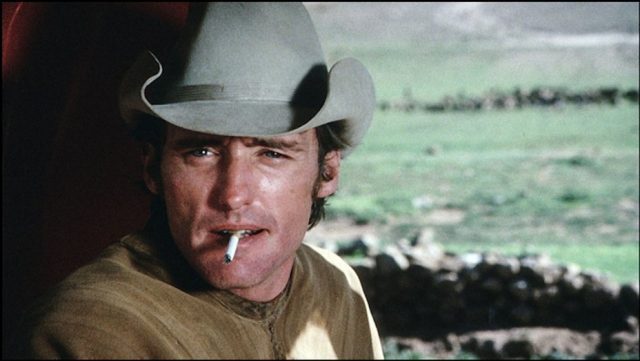
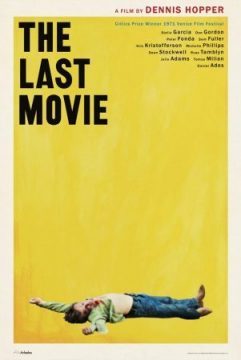
Flying high off his international success with Easy Rider in 1969, cowriter, director, and star Dennis Hopper was given carte blanche by Universal for his next film, 1971’s The Last Movie, a controversial picture that, despite winning the Critics Prize at the Venice Film Festival, led to Hopper’s unofficial exile from Hollywood for nearly a decade. The Last Movie was finally released in 2018 in a gorgeous 4K digital restoration made by Il Cinema Ritrovata from the original 35mm camera negative, screening at Anthology as part of the series “Experimental Westerns, Part 1: Avant-Garde Westerns.” As documented in Nick Ebeling’s 2017 Along for the Ride and elsewhere, The Last Movie was a longtime labor of love for Hopper and his cowriter, Stewart Stern (who had penned Rebel without a Cause, in which Hopper played a key role), but it ended up being a critical and financial flop. Over the years, there have been occasional rare screenings as the film’s legend grew, and the restoration proves that the mythos was fully justified. Hopper stars as Kansas, a movie wrangler working on a Western about Pat Garrett (Rod Cameron) and Billy the Kid (Dean Stockwell) in Chinchero, Peru, directed by one of the toughest auteurs of them all, the great, cigar-chomping Samuel Fuller (Pickup on South Street, Shock Corridor). Kansas is with former prostitute Maria (Stella Garcia), but he is instantly attracted to the fur-wearing Mrs. Anderson (Julie Adams), the wife of a wealthy factory owner (Roy Engel). Kansas’s best friend, Neville Robey (Don Gordon), wants Mr. Anderson to invest in his gold mine while both Anderson and Maria become jealous of Kansas’s romantic interest in Mrs. Anderson. In addition, following the accidental death of a stunt man during a dangerous scene, the local community of Chinchero blames Kansas and begins making their own movie directed by the vengeful Tomas Mercado (Daniel Ades), using real violence and fake equipment, creating a kind of passion play with Kansas at the center, much to the chagrin of the concerned priest (Tomas Milian), who was never in favor of Hollywood bringing its decadence to his town. It all leads to a stunning, unforgettable finale that questions much of what has come before.
Hopper, who was also a photographer and painter, said about the film, “The Last Movie is something that I made in Peru. I won the Venice Film Festival with it, and Universal Pictures wouldn’t distribute it. You should think about [Jean-Luc] Godard a little when you watch it. I made it because I’d read him say that movies should have a beginning, a middle, and an end — but not necessarily in that order. I was trying to use film like an Abstract Expressionist would use paint as paint. I’m constantly reminding you that we’re making a movie — I’m constantly making references to the fact that maybe you’re just being silly sitting in an audience, being sucked into a movie and starting to believe it — and then I jar you out of it. It’s not a very pleasant experience for most audiences.” But things have changed significantly over the last half-century, and audiences are now more attuned to watching nonlinear, more unorthodox films that merge fiction and reality and challenge them with purposely confusing plot twists and character development. Some scenes repeat, while others might have been lost — several times a title card identifies that a scene is missing, but it is impossible to know whether that is true or Hopper is playing with the viewer yet again. (The film was edited by David Berlatsky, Antranig Mahakian, and Hopper.) In fact, Tomas and the priest regularly refer to moviemaking as a game. It’s also not always clear when we’re watching the film, the film-within-a-film, or even a different film as Hopper explodes genre tropes to continually defy expectations. At one point the soundtrack features Kris Kristofferson singing “Me and Bobby McGee,” but the camera soon finds Kristofferson himself, guitar in hand, warbling away. Thus, when we later hear a song by John Buck Wilkin, we look for him as well.
Beautifully photographed by László Kovács, The Last Movie turns Kansas into a kind of Jesus figure. Both text and image often reference various stories from the Bible, directly and indirectly, including Jesus being whipped, his relationship with prostitute Mary Magdalene, a celebration around a golden calf, Jesus rising from a cave, and Christ being led to the cross. All seven deadly sins — gluttony, lust, greed, sloth, wrath, envy, and pride — enter the narrative. The color red plays a significant role, as if staining the land with blood, from fake movie blood to the color of Kansas’s truck. Everyone ends up guilty of something, with some paying a higher price than others; as the original 1971 production notes explain: “Every character in the film is an innocent. Only as they are tarnished by their participation in the games do they become agents of their own destruction. The dreams that they succumb to are all encompassed in or produced by the American dream. Their sin, however, is the movies.” Hollywood has done them in, as it will Hopper himself, who filled the cast with such nonconventional, mostly non-Hollywood actors as Henry Jaglom, Toni Basil, Severn Darden, Sylvia Miles, Warren Finnerty, Peter Fonda, Clint Kimbrough, John Phillip Law, Russ Tamblyn, and Michelle Phillips, who was married to Hopper for eight days. The two-time Oscar-nominated Hopper went on to direct such films as Out of the Blue, Colors, and The Hot Spot and appear in such works as Apocalypse Now, Blue Velvet, Hoosiers, True Romance, and Speed before passing away in May 2010 at the age of seventy-four. His legacy is now cemented with the restoration of The Last Movie, a masterpiece that has, at last, received the due it, and Hopper, deserves.
“Experimental Westerns, Part 1: Avant-Garde Westerns” runs July 3–26 and includes such other gems and rarities as Robert Downey Sr.’s Greaser’s Palace, Adolfas Mekas’s The Double-Barrelled Detective Story, Matthew Barney’s Cremaster 2 with Mary Lucier’s Arabesque, and Andy Warhol’s Horse celebrating a different take on the American genre for the nation’s 250th anniversary.
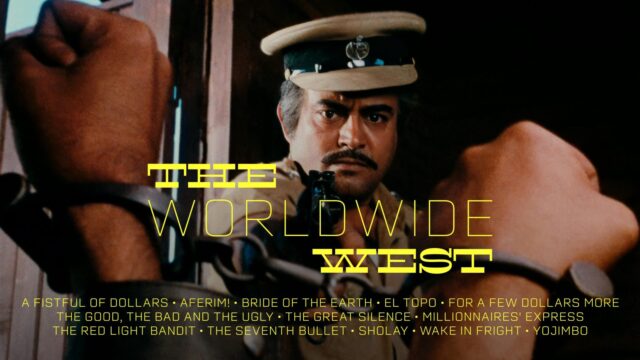
For cool international Westerns, check out the concurrent Metrograph series “The Worldwide West” here.
[Mark Rifkin is a Brooklyn-born, Manhattan-based writer; you can follow him on Substack here.]
THE WORLDWIDE WEST
Metrograph
7 Ludlow St. between Canal & Hester Sts.
July 3 – August 2 metrograph.com
Film doesn’t get much more American than the Western, and Metrograph is paying tribute to the art form with “The Worldwide West,” a celebration of international movies that reimagine the US frontier for their countries. In honor of the 250th birthday of the United States, Metrograph is screening works by Yılmaz Güney (Kurdish), Sammo Kam-Bo Hung (Hong Kong), Alejandro Jodorowsky (Chile and France), Radu Jude (Romania), Ted Kotcheff (Canada), Akira Kurosawa (Japan), Sergio Leone (Italy), Ramesh Sippy (India), Ali Khamraev (Uzbekistan), and Rogério Sganzerla (Brazil).
The thirteen films will be shown July 3 to August 2; below is a look at some of the highlights. For cool avant-garde Westerns, check out the concurrent Anthology series “Experimental Westerns, Part 1: Avant-Garde Westerns” here.
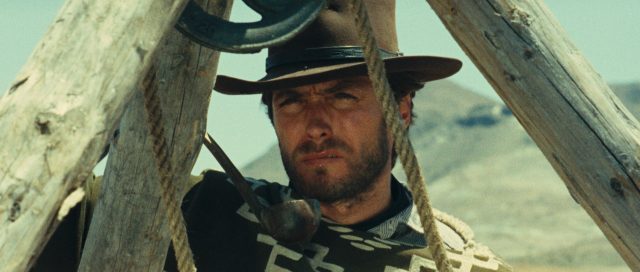
Clint Eastwood introduces the Man with No Name in Sergio Leone’s A Fistful of Dollars (photo courtesy MGM / Cineteca di Bologna / Park Circus)
A FISTFUL OF DOLLARS (PER UN PUGNO DI DOLLARI) (Sergio Leone, 1964)
Friday, July 3, 3:35
Sunday, July 5, 2:00
Wednesday, July 8, 4:00 metrograph.com
Clint Eastwood made a name for himself on the big screen playing the Man with No Name in Sergio Leone’s 1964 spaghetti Western, A Fistful of Dollars. In his first lead movie role, Eastwood, the costar of the television series Rawhide, is a gunslinger draped in a poncho and smoking a small cigar who rides on a mule into San Miguel, a tiny town in the middle of nowhere, home to an ongoing feud between the gun-running Baxters and the liquor-dealing Rojos. The stranger decides to play both sides against the middle, caring only that he earns lots of cash. “Never saw a town as dead as this one,” the stranger tells saloon owner Silvanito (Jose Calvo), who explains, “The place is only widows. Here you can only get respect by killing other men, so nobody works anymore.” The stranger hears the sound of banging outside and says, “Somebody doesn’t share your opinion.” Silvanito opens the window to reveal old man Piripero (Joe Edger) making coffins. “You’ll be a customer,” Silvanito tells the stranger with assurance. The stranger goes back and forth between the Baxters, led by the sheriff (W. Lukschy), and the Rojos, who follow the dangerous, unpredictable Ramón (Gian Maria Volontè). Also caught up in the Hatfield-McCoy battle are the sheriff’s wife, Consuelo (Margherita Lozano), and brother, Antonio (Bruno Carotenuto), along with Rojo brothers Benito (Antonio Prieto) and Esteban (S. Rupp) and their enforcer, Chico (Richard Stuyvesant). Ramón, meanwhile, has his eyes set on Marisol (Marianne Koch), who is married to Julio (Daniel Martín), who does not want to get involved in any fighting. Carefully watching it all is Juan de Díos (Raf Baldassarre), who rings the church bell at every death.
The Italian-German-Spanish production is a remake of Akira Kurosawa’s Yojimbo, which led to legal entanglements when the Japanese auteur demanded, well, a fistful of dollars in financial compensation. According to Christopher Frayling’s Sergio Leone — Something to Do with Death, Leone received a note from Kurosawa that read, “Signor Leone — I have just had the chance to see your film. It is a very fine film, but it is my film. Since Japan is a signatory of the Berne Convention on international copyright, you must pay me.” Frayling also suggests that Leone was influenced by Dashiell Hammett’s Red Harvest and Carlo Goldoni’s Servant of Two Masters and did not feel he was stealing only from Kurosawa. In The BFI Companion to the Western, Frayling quotes Leone as saying, “Kurosawa’s Yojimbo was inspired by an American novel of the serie-noire so I was really taking the story back home again.” (For a montage of similarities between the two films, check out this video.). Regardless, A Fistful of Dollars, made for about two hundred grand, set the standard for the new genre, and Eastwood was its antihero. He and Leone would team up again on the sequel, For a Few Dollars More, which is not a direct remake of Kurosawa’s Yojimbo follow-up, Sanjuro, as well as The Good, the Bad, and the Ugly, the best of the Dollars Trilogy.
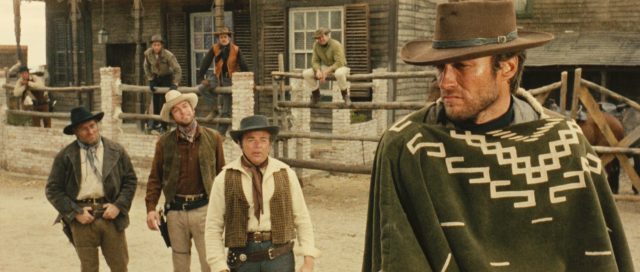
Clint Eastwood watches his back in first of the Dollars Trilogy (photo courtesy MGM / Cineteca di Bologna / Park Circus)
Fistful is steeped in violence and death, from Iginio Lardani’s rad title sequence of silhouettes in black, white, and blood red to an early shot of the stranger riding under a noose and giving it a long look. Whereas Toshirô Mifune played the bodyguard in Yojimbo with a devilish glee, Eastwood — in a role that had been previously offered to Henry Fonda, Charles Bronson, James Coburn, and others — is much more serious as the Man with No Name, who would become more sympathetic in future outings. The extremely poor dubbing only adds to the film’s magnificence. To enhance its foreign appeal to American audiences, several members of the cast and crew appear under pseudonyms in the credits, including Leone (Bob Robertson), cinematographer Massimo Dallamano (Jack Dalmas), actor Gian Maria Volontè (John Wells), and composer Ennio Morricone (Leo Nichols or Dan Savio). There is no mention of Kurosawa or Yojimbo anywhere.
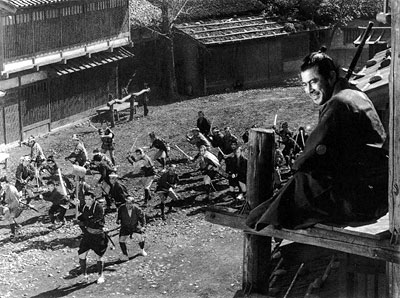
Toshirō Mifune can’t believe what he sees in Akira Kurosawa’s Yojimbo
YOJIMBO (Akira Kurosawa, 1961)
Friday, July 3, 1:15
Sunday, July 5, 11:30 am
Saturday, July 11, 11:30 am metrograph.com
Kuwabatake Sanjuro (Toshirō Mifune) is a lone samurai on the road following the end of the Tokugawa dynasty in yet another of Akira Kurosawa’s unforgettable masterpieces, which was inspired by Dashiell Hammett’s Red Harvest. Sanjuro comes to a town with two warring factions and plays each one off the other as a hired hand. Neo’s battles with myriad Agent Smiths are nothing compared to Yojimbo’s magnificent swordfights against growing bands of warriors that include the evil Unosuke (Tatsuya Nakadai), who is in possession of a new weapon that shoots bullets. Try watching this film and not think of several Clint Eastwood Westerns (including Sergio Leone’s pasta remake, A Fistful of Dollars) as well as High Noon.
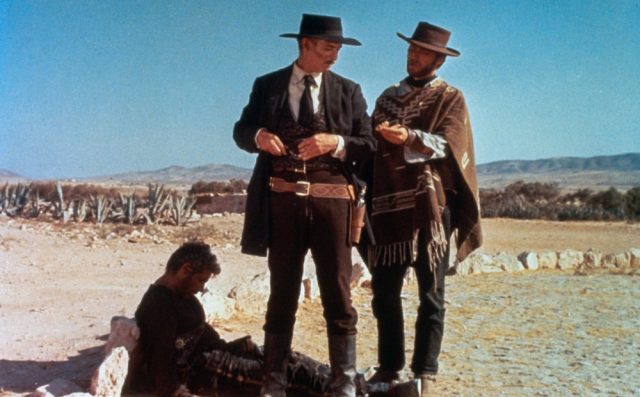
Rival bounty killers colonel Douglas Mortimer (Lee Van Cleef) and Manco (Clint Eastwood) join forces in Sergio Leone’s For a Few Dollars More
FOR A FEW DOLLARS MORE (PER QUALCHE DOLLARO IN PIÙ) (Sergio Leone, 1965)
Saturday, July 4, 1:10
Sunday, July 5, 4:15
Sunday, July 12, 11:15 am metrograph.com
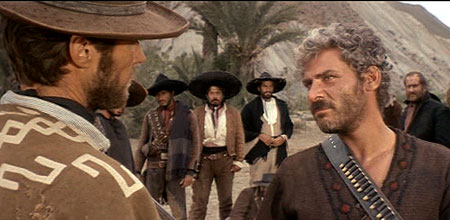
Determined to capitalize on the immediate success of A Fistful of Dollars, director and cowriter Sergio Leone and stars Clint Eastwood and Gian Maria Volonté quickly got back in the saddle to make the initially underrated, now celebrated follow-up, For a Few Dollars More. In the 1965 spaghetti Western, filmed in Almería, Spain, and at Rome’s Cinecittà Studios — and featuring a town doubling as El Paso built by production designer Carlo Simi that still stands today, part of the MiniHollywood theme park in Tabernas — Eastwood is a bounty killer that some call Manco, but he is essentially the Man with No Name again. He travels from wretched place to wretched place with his horse, poncho, cigar, squinty eyes, and guns, shooting criminals and collecting rewards. When he encounters a rival, former Confederate colonel Douglas Mortimer (Lee Van Cleef), they are initially at odds, going after the same trophies, but they ultimately decide to join forces to capture and kill El Indio (Volonté), a murderous psychopath who likes to use a pocket watch that plays a gentle tune when opened when he is getting ready to shoot someone, an element from his past (involving a mystery woman played by Rosemary Dexter) that haunts him. Manco embeds himself with Indio’s mangy gang, which includes Groggy (Luigi Pistilli), Niño (Mario Brega), Cuchillo (Aldo Sambrell), Tomaso (Lorenzo Robledo), Sancho Perez (Panos Papadopulos), Slim (Werner Abrolat), Blackie (Frank Braña), Chico (José Canalejas), Frisco (Antonio Molino Rojo), Hughie (Benito Stefanelli, who was in all three Dollars films), and Wild (the one and only Klaus Kinski). As Indio prepares to rob a bank in El Paso, a series of double crosses and personal vengeance lead to a memorable ending.
Manco (Clint Eastwood) becomes part of Indio’s (Gian Maria Volonté) gang in For a Few Dollars More
Written by Leone and Luciano Vincenzoni with added dialogue by Sergio Donati, For a Few Dollars More fits right in between A Fistful of Dollars and The Good, the Bad, and the Ugly, from its overall look and mood to Ennio Morricone’s stupendous score and Massimo Dallamano’s beautiful cinematography, both veterans of Fistful. Eastwood further established his ability to carry a film as a compelling antihero, Van Cleef (How the West Was Won, Escape from New York) earned one of the three title roles in Ugly, and Volonté, who would go on to make such classics as A Bullet for the General, Investigation of a Citizen Above Suspicion, and Christ Stopped at Eboli, is superbly grimy as a brutal villain hiding a soft spot. Genre tropes abound, highlighted by Leone’s love of close-ups of his characters’ eyes, shifting from one side to the other as they face their destinies.
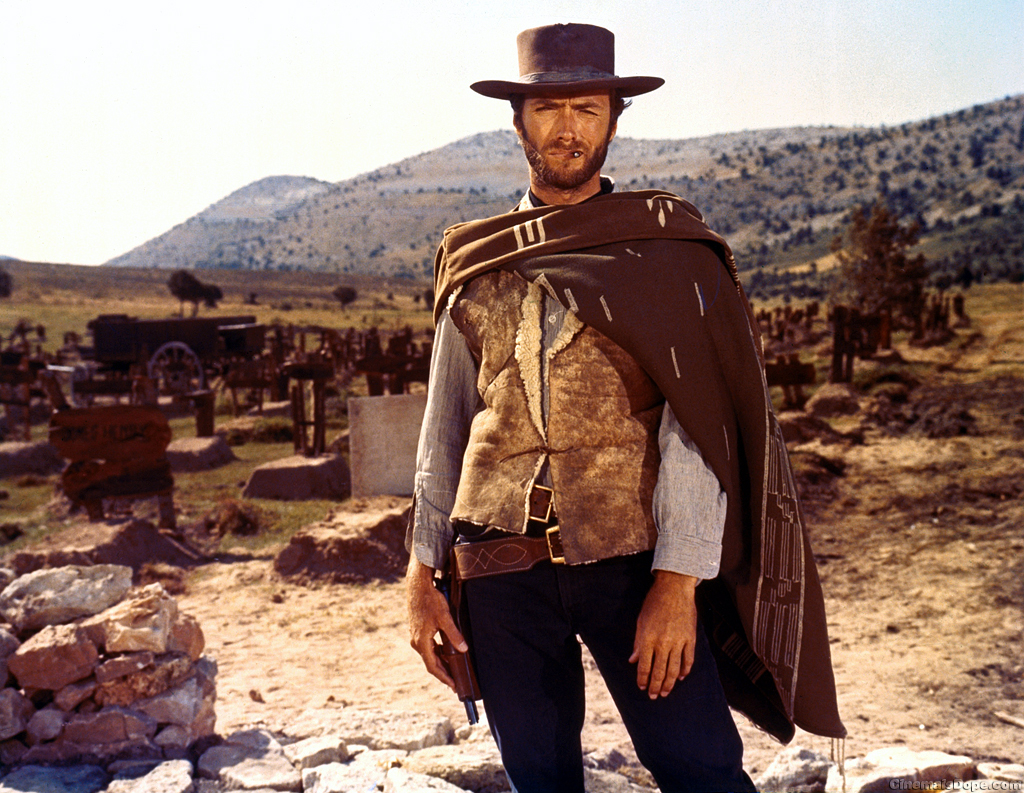
Clint Eastwood is the Good in classic Sergio Leone operatic oater
THE GOOD, THE BAD AND THE UGLY (Sergio Leone, 1966)
Friday, July 10, 2:30
Sunday, July 12, 2:00 metrograph.com
One of the all-time-great spaghetti Westerns, Sergio Leone’s dusty three-hour operatic oater stars Clint Eastwood as the Good (Blondie), Lee Van Cleef as the Bad (Angel Eyes), and Eli Wallach as the Ugly (Tuco Benedicto Pacifico Juan Maria Ramirez, whose list of criminal offenses is a riot), three unique individuals after $200,000 in Confederate gold buried in a cemetery in the middle of nowhere. Nearly twenty minutes of never-before-seen footage was added to the film several years ago, with Wallach and Eastwood overdubbing brand-new dialogue, so if you haven’t seen it in a while, it might just be time to catch it again. Ennio Morricone’s unforgettable score and Torino delli Colli’s gorgeous widescreen cinematography were also marvelously enhanced; their work in the scene when Tuco first comes upon the graveyard will make you dizzy with delight. And then comes one of the greatest finales in cinema history.
Jean-Louis Trintignant stars as a mute antihero in Sergio Corbucci’s The Great Silence
THE GREAT SILENCE (IL GRANDE SILENZIO) (Sergio Corbucci, 1968)
Friday, July 17, 1:50
Saturday, July 18, 3:35
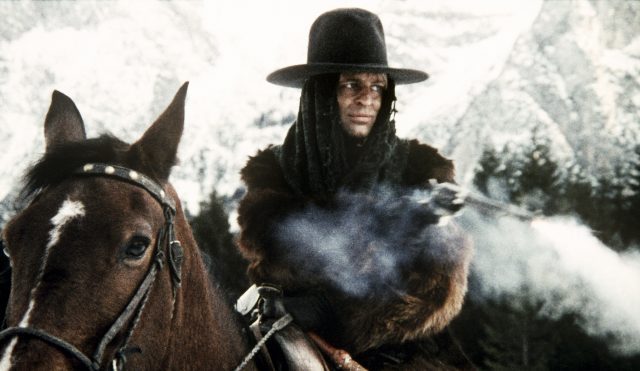
After half a century, Sergio Corbucci’s underseen masterpiece, The Great Silence, was finally released in the United States in 2018, in a gorgeous fiftieth anniversary restoration. Corbucci’s revisionist spaghetti Western was shot by Silvano Ippoliti in the Dolomites in northeastern Italy, where luxurious white snow (actually shaving cream) goes on forever until it is stained with so much blood. French star Jean-Louis Trintignant plays a variation of the quiet hero who lets his guns do his talking; Trintignant, who did not speak English, is Silence, who, as a young boy, witnessed the merciless murder of his parents by bounty killers and is rendered mute with a knife to prevent his testimony. Years later, now an adult, Silence, with his unusual Mauser C96, roams the land in search of bounty killers, getting them to draw first so he can then fire back in self-defense, shooting off their thumbs so they can never use a gun again. It’s 1898, and hard times have come to Snow Hill, leading many average citizens to break laws just to put food on the table. Greedy banker Henry Pollicut (Luigi Pistilli) puts a price on their heads, wanted dead or alive, attracting various bounty killers, including the notorious Loco (German star Klaus Kinski), aka Tigrero, who never brings his targets in breathing, no matter how minor their crimes. Relatively hapless sheriff Gideon Burnett (Frank Wolff) is caught somewhere in the middle, as it’s Loco who is on the right side of the law and Silence who is walking a fine line about what’s legal. After Loco kills James Middleton, his widow, Pauline (Vonetta McGee), hires Silence to gain revenge, setting the stage for one of the most brutal endings in the history of cinema.
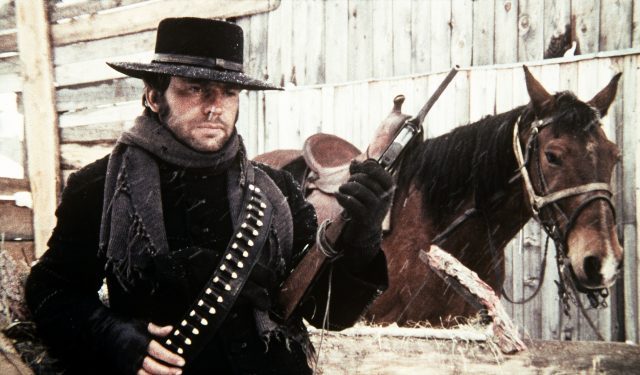
Klaus Kinski is a vicious bounty killer on the right side of the law in Corbucci masterpiece
The pairing of Trintignant, who had gained international fame in Claude Lelouch’s A Man and a Woman, and Kinski, who had made such previous Westerns as Damiano Damiani’s A Bullet for the General and Sergio Leone’s For a Few Dollars More, has a dark magic, particularly since their characters are not clear representations of good vs. evil. Each one uses their eyes to intense dramatic effect, with Trintignant particularly effective since he doesn’t speak a word — just wait till you see him scream. In her film debut, McGee (Blacula, Repo Man) brings a stark sensitivity to Pauline; her interracial love scene was shocking for the genre, especially with Corbucci (Django, Navajo Joe) handling it in such a gentle way. Meanwhile, composer Ennio Morricone (Once Upon a Time in the West; The Good, the Bad, and the Ugly) delivers one of his most emotional and wide-ranging scores. Fifty years on, The Great Silence can still be read as a parable attacking rampant injustice in society while also subverting the Western genre itself, a dark and bleak tale about the hopelessness of life. (If the ending is too much for you, you can watch the absurdly ridiculous alternate happy ending made for some foreign markets here.)
Father (Teodor Corban) and son (Mihai Comānoiu) hunt for a runaway slave in wickedly funny Aferim!
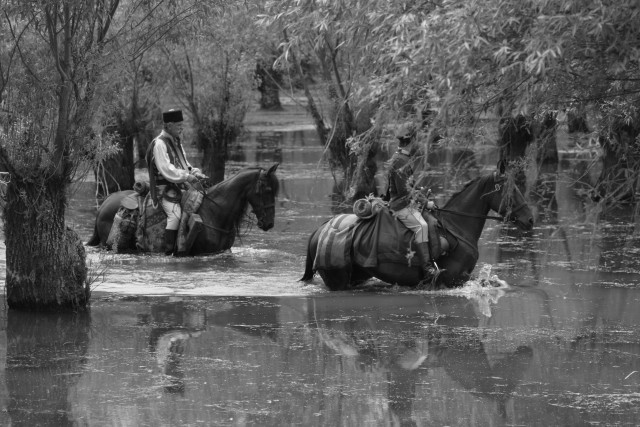
Romanian director Radu Jude won the Silver Bear as Best Director at the 2015 Berlin International Film Festival for Aferim!, his savagely funny blacker-than-black comic Western about bigotry, infidelity, and frontier justice in 1835 Wallachia. Lawkeeper Costandin (Teodor Corban) and his son, Ionitā (Mihai Comānoiu), are galloping through the local countryside, searching for runaway Gypsy slave Carfin (Cuzin Toma), who Boyar Iordache Cindescu (Alexandru Dabija) has accused of having an affair with his wife, Sultana (Mihaela Sîrbu). The surly Costandin leads the hunt, verbally cutting down everyone he meets, from random old women to abbots to fellow lawmen, with wicked barbs, calling them filthy whores, crows, and other foul names while spouting ridiculous theories about honor and religion; he even batters his son, saying he’s “a waste of bread” and that “if you slap him, he’ll die of grief.” It’s a cruel, cholera-filled time in which even the monks beat the poor, where Costandin regales a priest with the telling riddle, “Lifeless out of life, life out of lifeless,” which the priest thinks refers to the coming doomsday.
Cowritten by Jude (The Happiest Girl in the World, Everybody in Our Family) and novelist Florin Lăzărescu (Our Special Envoy, Numbness), who previously collaborated on the short film The Tube with a Hat, and shot in gloriously stark black-and-white by Marius Panduru (12:08 East of Bucharest; Police, Adjective), the Romanian / Bulgarian / Czech coproduction is an absurdist combination of Monty Python and the Holy Grail, Andrei Tarkovsky’s Andrei Rublev, Hal Ashby’s The Last Detail, and John Ford’s The Searchers, skewering everything in its path, either overtly or under its wide-reaching breath. Even Dana Pāpāruz’s costumes are a genuine riot, especially the boyar’s majestically ridiculous hat. But Aferim! is more than just a clever parody of period films and nineteenth-century Eastern European culture and social mores; it is also a brilliant exploration of the nature of racism, discrimination, misogyny, and the aristocracy that directly relates to what’s going on around the world today as well as how Romania has dealt with its own sorry past of enslaving the Romani people. Jude was inspired by real events and historical documents, setting the film immediately after the 1834 Russian occupation, which adds to its razor-sharp observations. “Aferim! is an attempt to gaze into the past, to take a journey inside the mentalities of the beginning of the nineteenth century — all epistemological imperfections inherent to such an enterprise included,” Jude says in his director’s statement. “It is obvious that such an effort would be pointless should we not believe that this hazy past holds the explanation for certain present issues.” Don’t miss this absolute gem of a film, Romania’s submission for the Academy Awards.
Alejandro Jodorowsky takes viewers on quite an acid trip in surreal Western El Topo
EL TOPO (Alejandro Jodorowsky, 1970)
Friday, July 24, 10:40
Sunday, July 26, 1:00 metrograph.com
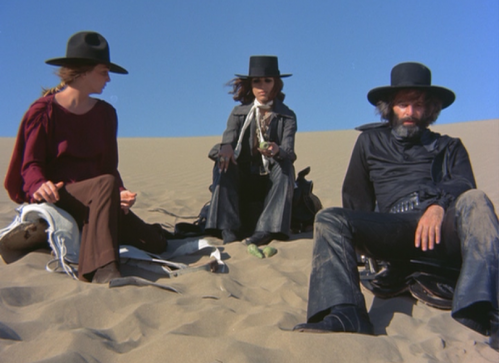
Chilean-born French filmmaker Alejandro Jodorowsky’s El Topo is a psychedelic head trip, an acid Western that will blow your mind. Jodorowsky stars as the title character, a gunslinger traveling through a deserted landscape accompanied by his naked young son, who already knows his way around a firearm. After coming upon a town that has been decimated by a nasty group of marauders working for the Colonel, El Topo seeks violent revenge, eventually taking off with a woman and leaving his boy behind as he meets four masters on his path to proving he is the best there is. But soon El Topo is praying for redemption with a community of inbred cripples trapped in a cave.
El Topo is a wild and bizarre journey through religious imagery, romance, and vengeance, a surreal spaghetti Western strained through the mad mind of Jodorowsky, widely hailed as the creator of the midnight movie. The film melds Bergman with Leone, Tod Browning’s Freaks with Hiroshi Inagaki’s Samurai Trilogy, filtered through Kazuo Koike and Goseki Kojima’s Lone Wolf and Cub. It’s like nothing you’ve ever seen before and, despite your better instincts, will lure you into the cult of Jodorowsky.
[Mark Rifkin is a Brooklyn-born, Manhattan-based writer; you can follow him on Substack here.]