
South Korean writer-director Hong Sang-soo is celebrated in three-weekend retrospective at Museum of the Moving Image (photo courtesy Festival del film Locarno)
Museum of the Moving Image
35th Ave. at 36th St., Astoria
June 3-19
718-777-6888
www.movingimage.us
The Museum of the Moving Image’s seventeen-day, eighteen-film retrospective of the work of South Korean auteur Hong Sang-soo heads into its second weekend with a string of half a dozen highly original flicks made between 2006 and 2011, as Hong continues his exploration of the creation of art and cinema itself. (The museum previously celebrated Hong’s oeuvre with a 2012 series that consisted of five films.) You can watch as his storytelling abilities and character development continue to grow, even as they remain abstract and mysterious. The festival began with such works as The Day a Pig Fell into the Well, On the Occasion of Remembering the Turning Gate, and Virgin Stripped Bare by Her Bachelors and concludes June 17-19 with such more recent fare as Our Sunhi, Nobody’s Daughter Haewon, and Hill of Freedom.

Hong Sang-soo’s WOMAN ON THE BEACH in another beautifully shot but overly long drama about art and love
WOMAN ON THE BEACH (HAEBYEONUI YEOIN) (Hong Sang-soo, 2006)
Friday, June 10, 7:00
www.movingimage.us
 Director Joong-rae (Kim Seung-woo) is having trouble with the script for his next film, so he gets production designer Chang-wook (Ki Tae-woo) to drive him out to Shinduri Beach for some quiet relaxation, away from the hustle and bustle of Seoul. Chang-wook brings along his girlfriend, Moon-sook (Ko Hyun-joung), an aspiring composer and singer who is immediately attracted to Joong-rae. As Chang-wook’s jealousy grows and Moon-sook and Joong-rae wonder if they have a future together, the director meets Sun-hee (Song Sun-mi), a soon-to-be divorcée who also has eyes for Joong-rae. Writer-director Hong Sang-soo’s moving romantic comedy features beautiful locations shot by Kim Hyung-koo, a sweet score by Jeong Yong-jin, and unusual but believable characters. At 127 minutes, the film, which was selected for the 2006 New York Film Festival, is far too long, not quite knowing how to end, but stick with it nonetheless.
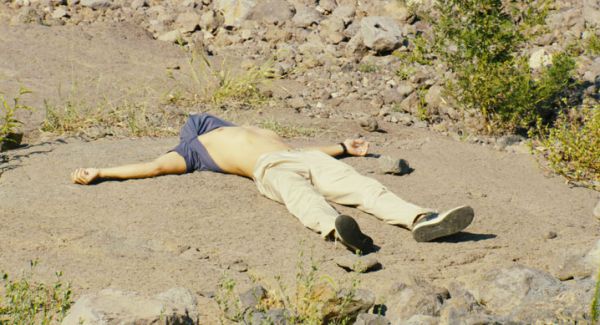
Kim Tae-woo is outstanding as annoying, self-obsessed auteur in Hong Sang-soo’s LIKE YOU KNOW IT ALL
LIKE YOU KNOW IT ALL (JAL ALJIDO MOT HAMYEONSUH) (Hong Sang-soo, 2009)
Saturday, June 11, 1:00
www.movingimage.us
 South Korean auteur Hong Sang-soo’s 2009 film about a South Korean auteur, Like You Know It All, is another intriguing examination of art and sex in contemporary society, following Night and Day (2008), Woman on the Beach (2006), Tale of Cinema (2005), and Woman Is the Future of Man (2004). Hong, who has served as a juror at several film festivals and whose work has screened at fests all over the world, sets his latest self-reflexive story at the real Jecheon International Music and Film Festival, where director Ku will be part of the jury. But it turns out that Ku is a self-absorbed, insensitive, and subtly obnoxious filmmaker who cares only about himself, walking away from fans and colleagues in the middle of a conversation or in the midst of signing an autograph, interested only in listening to people praise his own talent, which has been relegated to art-house films that few people see and even fewer understand. After leaving the festival to teach a class at a school on Jeju Island, he visits with a famous painter and former mentor who has unknowingly married Ku’s first love, setting the stage for the creepy Ku to perform yet more selfish acts. Kim Tae-woo is outstanding in the lead role, playing the self-obsessed director with an unerring casualness that makes him more absurdly ridiculous than conniving and mean-spirited. With a little bit of Federico Fellini’s 8½ here and a touch of Woody Allen’s Stardust Memories there, Hong once again reveals the soft underbelly of ego within the film industry, but he also needs to edit himself more, as the bittersweet, slyly ironic Like You Know It All, made for a mere $100,000, is yet another of his films to clock in at more than two hours (though it feels longer).
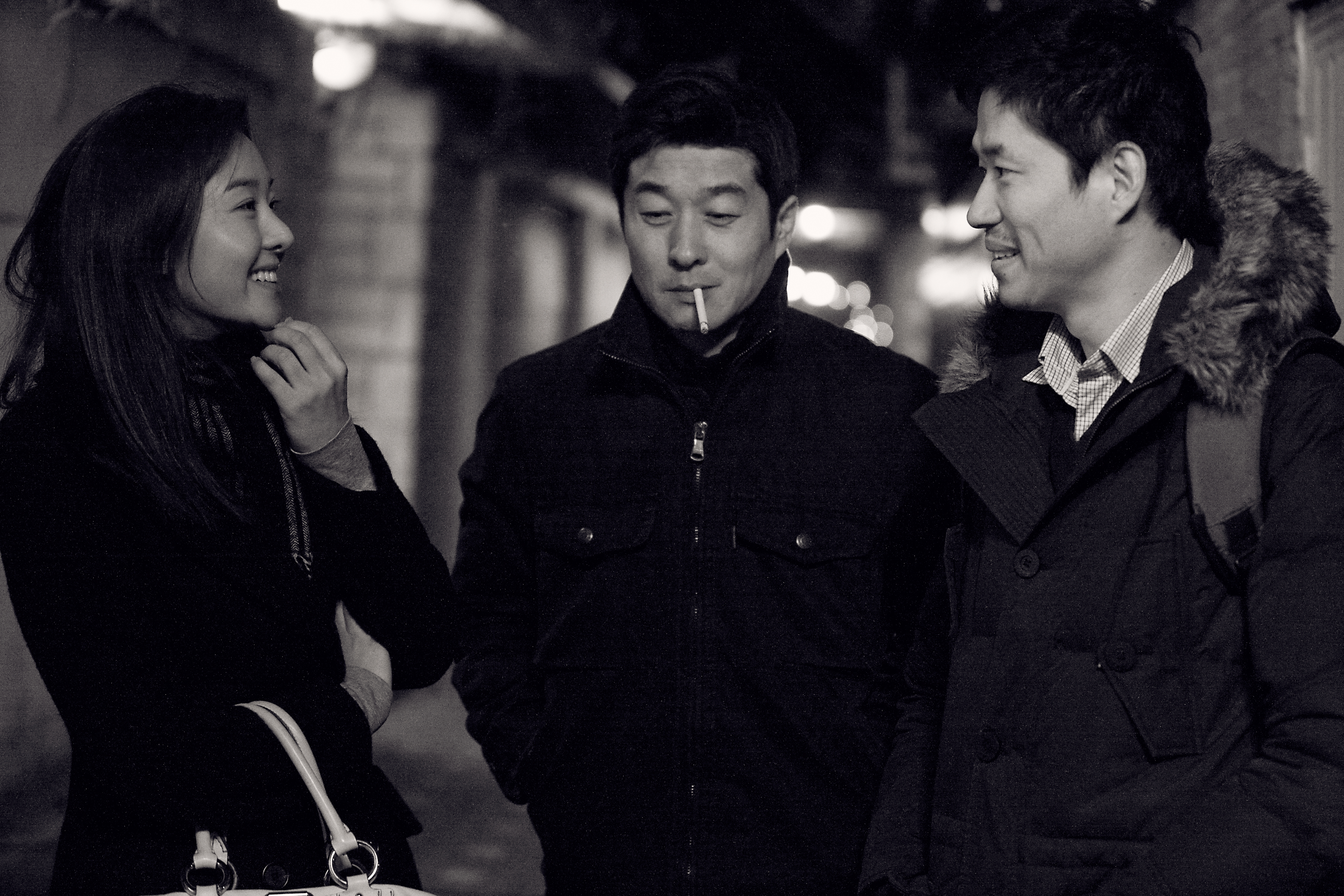
Boram (Song Sun-mi), Youngho (Kim Sang-joong), and Seongjun (Yu Jun-sang) examine their lives in fascinating ways in Hong Sang-soo’s THE DAY HE ARRIVES
THE DAY HE ARRIVES (BUKCHON BANGHYANG) (Hong Sang-soo, 2011)
Saturday, June 11, 3:30, and Sunday, June 12, 4:00
www.movingimage.us
 For most of his career, South Korean auteur Hong Sang-soo has been making films about filmmakers, although not always about the filmmaking process itself. In such works as Woman on the Beach, Like You Know It All, Tale of Cinema, and Oki’s Movie, he’s delved into the more personal side of lead characters who are established or emerging directors. Hong reaches a career peek with his latest, The Day He Arrives, a deeply intuitive, vastly intelligent, and surprisingly existential exploration of a young man at a crossroads in his life. After having made four little-seen films and deciding to become a country teacher instead, director Seongjun (Yu Jun-sang) returns to his hometown in Seoul to visit his friend Youngho (Kim Sang-joong), a film critic who has just left his wife and is hanging out with a film teacher named Boram (Song Sun-mi). Seongjun stops by to visit his old girlfriend, Kyungjin (Kim Bok-yung), keeps bumping into an actress who appeared in one of his films, goes drinking with a trio of fans, and meets Yejeon (also played by Kim Bok-yung), the owner of a local bar where Youngho and Boram take him. As all of the main characters examine their lives, each one lacking something important, Hong has several scenes repeat multiple times with slight differences, as if they are alternate takes imbued with new meaning as the audience continues to learn more about the protagonists. Each revised scene contributes more insight and develops the characters further, even if the story seems to have backtracked in time. The nonlinear narrative and Kim Hyung-koo’s beautiful black-and-white cinematography evoke aspects of Woody Allen’s Stardust Memories, Harold Ramis’s Groundhog Day, and François Truffaut’s Day for Night, exceptional films that, like The Day He Arrives, carefully balance fantasy and reality, fiction and nonfiction while depicting the inherent dual nature of cinema and humanity. Earlier in his career, Hong seemed to have trouble ending his films, which would linger on well past the two-hour mark, but with the outstanding, poetic Oki’s Movie and its follow-up, The Day He Arrives, both of which run approximately eighty minutes, he has found an excellent length for his work — one that now almost feels too short, as he clearly has so much to say. The Day He Arrives will be preceded by Hong’s 2011 short List.

Sungam (Kim Young-ho) battles displacement and loneliness in Hong Sang-soo’s NIGHT AND DAY
NIGHT AND DAY (BAM GUAN NAT) (Hong Sang-soo, 2008)
Saturday, June 11, 6:30
www.movingimage.us
Hong Sang-soo returned to the New York Film Festival for the fifth time with Night and Day, a character-driven tale about displacement and loneliness. Kim Young-ho stars as Sungam, a married painter in his forties who flees South Korea for France after having been turned in for smoking marijuana with U.S. tourists. A fish out of water in Paris, he settles into a Korean neighborhood, spending most of his time with two young art students, Yujeong (Park Eun-hye) and Hyunju (Seo Min-jeong). He also meets an old girlfriend, Minsun (Kim You-jin), who is still attracted to him. And every night he calls his wife, Sungin (Hwang Su-jung), wondering when he’ll be able to return home. Hong tells the story in a diary-like manner, with interstitials acting like calendar pages. Sometimes a day can be filled with talk of art, a party, and a chance encounter, while others can consist of a brief, random event with no real bearing on the plot, reminiscent of Jim Jarmusch’s Stranger Than Paradise, just without the existential cynicism and dark humor. As with 2006’s Woman on the Beach, Hong lets Night and Day go on too long (it clocks in at 141 minutes), with too many inconsequential (even if entertaining) vignettes, but it’s so much fun watching Kim Young-ho’s compelling performance that you just might not care about the length.

Oki (Jung Yumi) walks the fine line between fiction and reality in OKI’S MOVIE
OKI’S MOVIE (OK-HUI-UI YEONGHWA) (Hong Sang-soo, 2010)
Sunday, June 12, 7:00
www.movingimage.us
In works such as Like You Know It All, Woman on the Beach, Tale of Cinema, and Woman Is the Future of Man, Hong Sang-soo has explored the nature of his craft, using the creative process of filmmaking as a setting for his relationship-driven dramas. He examines the theme again in Oki’s Movie, a beautifully told tale told in four sections built around film professor Song (Moon Sung-keun) and students Jingu (Lee Sun-kyun) and Oki (Jung Yumi). Each chapter — “A Day for Chanting,” “King of Kiss,” “After the Snowstorm,” and “Oki’s Movie” — features a different point of view with a different narrator while walking the fine line between fiction and nonfiction. As in Tale of Cinema, certain parts are films within the film, shorts made by the characters for their class. Hong keeps viewers guessing what’s real as Oki balances a possible love triangle between her, Jingu, and Song; the final segment is a poetic masterpiece that brings everything together. In an intriguing twist — and emblematic of the realistic quality of Hong’s oeuvre — Oki’s Movie had its official U.S. theatrical release at the Maysles Cinema, the Harlem institution devoted to documentaries.

 In his 2014 documentary,
 The main image used to promote James Solomon’s debut documentary, The Witness, is a 1961 black-and-white photograph of Kitty Genovese. In the portrait, she stares back at the viewer almost accusingly; in light of her famous death three years later, it is as if she is calling us all out for the events that happened during and after her murder. In 1964, Genovese was killed by an assailant on a Kew Gardens street while, as the New York Times reported, thirty-eight neighbors heard the screams, looked out their windows, and did nothing. Forty years later, the paper reexamined the case and their coverage and found numerous holes in their original story. That set Kitty’s brother, Bill Genovese, who was sixteen when his sister was killed, on an obsessive mission to find out the truth about what really went down on March 13, 1964, and afterward, when New York City was publicly decried across the world as an awful oasis of urban apathy. Genovese hooked up with screenwriter Solomon (The Conspirator, The Bronx Is Burning) and spent eleven years reinvestigating the case — the two men had actually met in 1999, when Solomon was collaborating on a never-realized fictionalization of the story with Joe Berlinger and Alfred Uhry for HBO. The Witness plays out like a police procedural as Genovese follows every crumb he possibly can, meeting with witnesses, detectives, his sisters’ friends, and such journalists as Gabe Pressman, Mike Wallace, and Abe Rosenthal, the Times editor who wrote the book Thirty-Eight Witnesses: The Kitty Genovese Case, which helped turn the sordid tale into legend. “The story doesn’t make any sense to me,” Pressman admitted he thought back in 1964, although no one would question the Newspaper of Record. But Genovese does just that, and what he discovers is nothing short of shocking.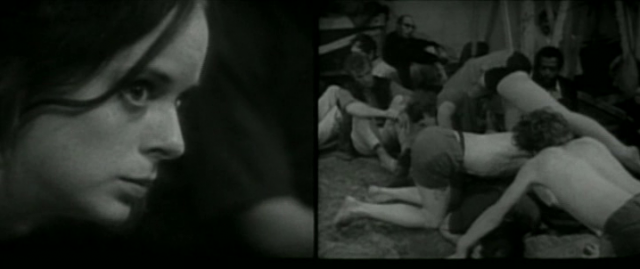

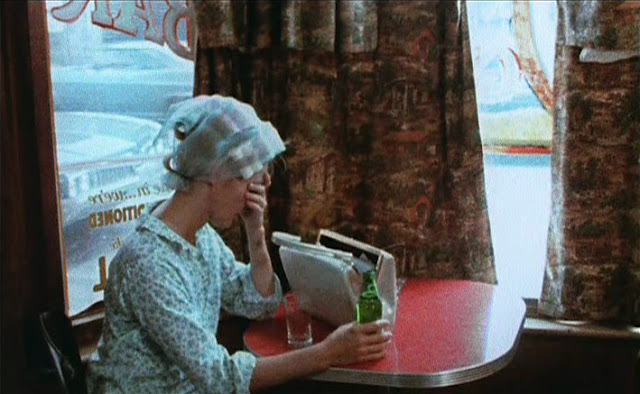
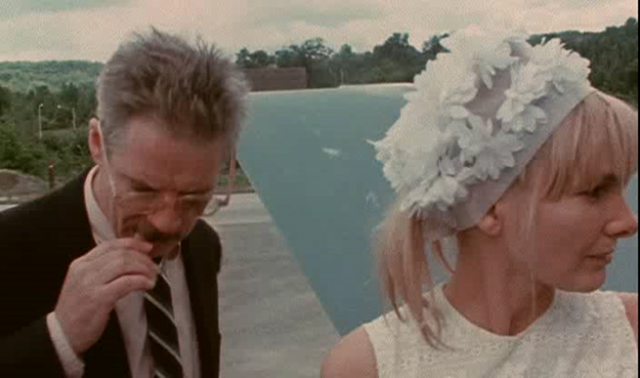

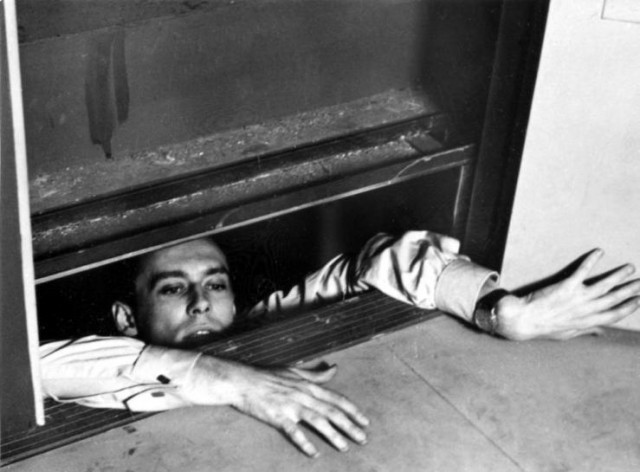
 Louis Malle’s first feature-length fiction film, following The Silent World (made with Jacques Cousteau), is a classic French noir that comes with all the trimmings — and was recently restored in an excellent 35mm print with new subtitles. Jeanne Moreau stars as Florence Carala, who is married to ruthless business tycoon Simon (Jean Wall) but is carrying on an affair with Simon’s right-hand man, Julien Tavernier (Maurice Ronet). Julien plans the perfect murder — or so he thinks, until he has to go back to retrieve a crucial piece of evidence and gets trapped on the elevator. While he struggles to find a way out and Florence waits for him anxiously at a neighborhood bistro, young couple Louis (Georges Poujouly) and Veronique (Yori Bertin) take off in Julien’s convertible and get into some serious trouble of their own. Mistaken identity, cold-blooded killings, jealousy, and one of the greatest film scores ever — by Miles Davis, recorded in one overnight session — make Elevator to the Gallows a splendid debut from one of the world’s finest filmmakers. The film is screening June as part of the Rubin Museum Cabaret Cinema series “Rain,” being held in conjunction with the