this week in film and television

THE MUSIC OF STRANGERS: YO-YO MA AND THE SILK ROAD ENSEMBLE

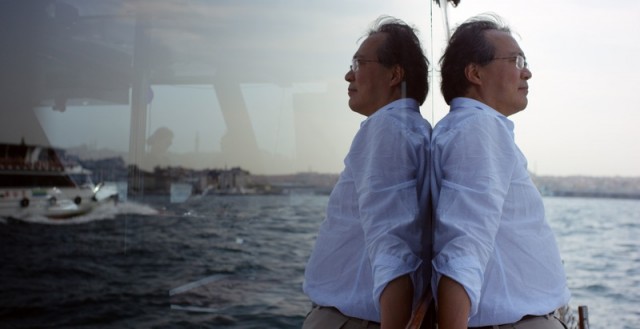
Yo-Yo Ma

Yo-Yo Ma leads the Silk Road Ensemble around the world in Morgan Neville documentary

THE MUSIC OF STRANGERS: YO-YO MA AND THE SILK ROAD ENSEMBLE (Morgan Neville, 2016)
Angelika Film Center, 18 West Houston St. at Mercer St., 212-995-2570
Lincoln Plaza Cinema, 1886 Broadway between 62nd & 63rd Sts., 212-757-2280
Opens Friday, June 10
themusicofstrangers.film

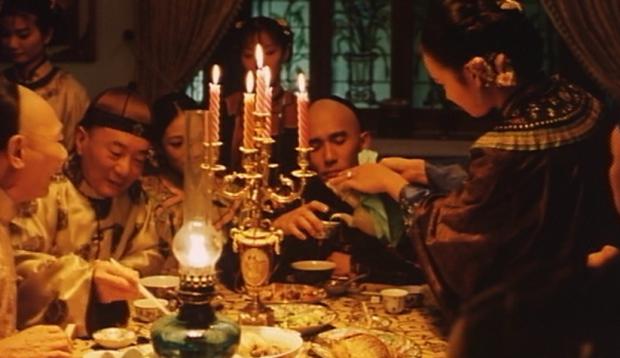
About midway through The Music of Strangers: Yo-Yo Ma and the Silk Road Ensemble, the renowned international group performs an exhilarating song in a studio that leaves them just as thrilled as the audience. Renowned cellist Ma might be the heart of the ensemble, but it’s the joy of creating and playing music no matter what that makes this documentary soar. And music is something that director Morgan Neville clearly understands, having previously made the Oscar-winning 20 Feet from Stardom as well as Muddy Waters: Can’t Be Satisfied, Respect Yourself: The Stax Records Story, and Johnny Cash’s America. In The Music of Strangers, Neville traces the history of the Silk Road Ensemble, named for the thousands-of-years-old trading route across Asia, from China to the Mediterranean. Born as an improvised gathering of musicians at Tanglewood in 2000, it became a venture that tours the world, promoting collaboration and celebrating international interaction. “The idea of culture is not so much to preserve tradition but to keep things alive and to evolve things,” says Ma, who has had to deal with accusations of cultural appropriation and dilution. Neville focuses on five members of the ensemble: Ma, the Paris-born Chinese-American cellist who has been a star his whole life (archival footage shows him at age seven with Leonard Bernstein, performing for President Kennedy and first lady Jacqueline); Chinese pipa virtuoso Wu Man, the first Chinese artist to play at the White House; Kinan Azmeh, a Syrian clarinetist who is the artistic director of the Damascus Festival Chamber Music Ensemble; Cristina Pato, a rock star on the gaita, the Galician bagpipe; and Iranian Kayhan Kalhor, a three-time Grammy nominee who is an expert on the kamancheh, the Persian bowed lute. Each shares stories of their personal history, focusing on their relationship with their native countries, which have undergone major changes over the last fifteen years.

They also explain how they almost didn’t continue after the events of 9/11, fearful of their Arabic connections and wondering whether proceeding with their mission was the right thing to do. “Everybody in the face of disaster reexamines who they are and their purpose,” Ma says, referring to their decision to go on. But their music transcends genre, history, and politics. “My intention is to represent my culture and the contribution that this very old culture made to human life,” Kalhor, who has been exiled from Iran, notes. And Ma adds, “The clearest reason for music, for culture, is it gives us meaning.” But Wu Man sums it all up: “There’s no East or West; it’s just a globe.”The Music of Strangers opens June 10 a the Angelika and Lincoln Plaza; Azmeh will give a special performance and participate in a Q&A following the 7:05 show on June 11 at Lincoln Plaza and the 5:00 show on June 12 at the Angelika, moderated by World Music Institute artistic director Par Neiburger. The Silk Road Ensemble has also released a companion album, Sing Me Home, which features such songs as “Green (Vincent’s Tune),” “Little Birdie,” “Ichichila,” “St. James Infirmary Blues,” and “Going Home,” featuring such guest artists as Bill Frisell, Abigail Washburn, Toumani Diabate, Sarah Jarosz, Gregory Porter, and Roomful of Teeth.

HUMAN RIGHTS WATCH FILM FESTIVAL 2016: ALMOST SUNRISE

ALMOST SUNRISE

Anthony Anderson and Tom Voss go for a long walk to promote military veterans’ health issues in ALMOST SUNRISE

ALMOST SUNRISE (Michael Collins, 2016)
Saturday, June 11, 9:15, Film Society of Lincoln Center, Walter Reade Theater, 165 West 65th St. between Eighth Ave. & Broadway, 212-875-5050
Monday, June 13, 6:30, IFC Center, 323 Sixth Ave. at West Third St., 212-924-7771
Festival runs June 10-19
ff.hrw.org/new-york
sunrisedocumentary.com

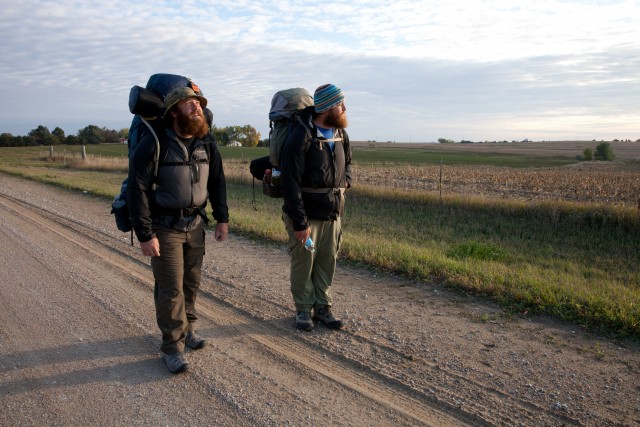
Michael Collins’s emotionally gripping documentary, Almost Sunrise, is built around an absolutely shocking statistic: According to the Department of Veteran Affairs, twenty-two U.S. veterans commit suicide every day. That’s one self-inflicted death every sixty-five minutes. In the film, two young veterans of Operation Iraqi Freedom, facing depression and suicidal thoughts themselves, decide to walk from their homes in Milwaukee, Wisconsin, to Los Angeles, California, in order to clear their own heads and raise awareness of this horrifying issue. Tom Voss and Anthony Anderson, a pair of big, bushy-haired men, became media darlings as they continued what became known as Veterans Trek, meeting with local press along the way and occasionally being joined by other veterans and supporters for parts of the 2,700-mile walk. But for much of the time, it’s just them against the elements, wandering across long stretches of deserted highways in the middle of nowhere, photographed beautifully by Clarissa de los Reyes. The two men intimately open up to Collins, who is with them every step of the pilgrimage; they share their thoughts about their families and speak dramatically about “moral injury,” a form of PTSD that the film describes as “a wound to the soul, caused by participation in events that violate one’s deeply held sense of right and wrong.” Similar distress is examined in Sonia Kenneback’s National Bird, in which military personnel working in the U.S. drone program try to deal with how they will never know the results of their classified operations, whether they hit the correct targets or whether they caused so-called collateral damage to innocent civilians.

In Almost Sunrise, Emmett Cullen, a close friend of Voss’s who served alongside him in Iraq, explains, “After you see enough people getting hurt, and see other people get killed, you start to write yourself off in a way. You’re kind of resigned to the fact that you might as well just consider yourself already dead, and if you make it home, you’re lucky. ’Cause that’s the only real mental shift you can make to make it through those kinds of scenarios without kind of freaking out,” adding, “Mentally, you’re processing the situation you’re in, and the dangers, but you’re not feeling it. So that carries over to civilian life when you get out.” Both Voss and Anderson share their struggles with that transition, reaching deep inside themselves. The section near the end in which Voss turns to holistic breathing techniques feels tacked on, almost like an infomercial for that specific healing process, regardless of its success. But the rest of Almost Sunrise, which features a score by Adam Crystal and music by Yuka Honda and Nels Cline, is a sobering look at what soldiers go through in war and some of the profound psychological issues they have to face when they come home. Almost Sunrise is screening twice at the 2016 Human Rights Watch Film Festival, on June 11 at 9:15 at IFC Center and June 13 at 6:30 at the Walter Reade Theater, both followed by a Q&A with Collins, producer Marty Syjuco, Voss, and Anderson, with his wife, Holly.

HUMAN RIGHTS WATCH FILM FESTIVAL 2016: HOOLIGAN SPARROW

HOOLIGAN SPARROW

Hooligan Sparrow risks her freedom and her life for protesting for women’s rights in China

HOOLIGAN SPARROW (Nanfu Wang, 2016)
Film Society of Lincoln Center, Walter Reade Theater
165 West 65th St. between Eighth Ave. & Broadway
Friday, June 10, 6:30
Series runs June 10-19
212-875-5050
ff.hrw.org/new-york
hooligansparrow.com

The 2016 Human Rights Watch Film Festival kicks off at Lincoln Center’s Walter Reade Theater on June 10 with Nanfu Wang’s alarming debut feature documentary, Hooligan Sparrow. Wang won the annual Nestor Almendros Award for courage in filmmaking with this brave, disquieting look at Chinese activist Ye Haiyan, better known as Hooligan Sparrow, an advocate for sex workers’ rights, as she leads protests against a school principal who sexually abused six elementary school girls. “If you film us, we’ll smash your camera,” a man tells Wang at the beginning. Later she’s told she will be beaten if she doesn’t hand over her equipment. But she’s determined to keep telling the story any way she can. Sparrow, who gained notoriety for a project in which she offered free sex to migrant workers, is joined by Shan Lihua, Tang Jitian, Jia Lingmin, Wang Yu, and lawyer Wang Jianfen as she battles law enforcement, the government, and brothel owners, her safety and freedom in constant jeopardy. “If I believe something is right and I’m obliged to do it, they can’t stop me by arresting me or even killing me,” she defiantly says. She and her daughter, Lan Yaxin, keep getting evicted from their homes and banned from numerous provinces, but that doesn’t prevent her from protesting with such signs as “All China’s Women’s Federation Is a Farce. China’s Women’s Rights Are Dead” and “You Can Kill Me, But You Can’t Kill the Truth.” Born and raised in a remote Chinese farming village and currently based in New York City, Wang, who directed, produced, photographed, and edited Hooligan Sparrow, never backs down even as she meets with Chinese officials and is followed everywhere she goes, forced to become suspicious of nearly everyone she encounters. “Just because you’re paranoid doesn’t mean they aren’t after you,” Joseph Heller wrote in Catch-22. Wang clearly has reason to be paranoid.

The film is executive produced by Andy Cohen and Alison Klayman, who collaborated on the award-winning documentary Ai Weiwei: Never Sorry; the Chinese artist and activist, who has been under long-term house arrest, took up Hooligan’s cause, and he included her belongings in an installation in his 2014 Brooklyn Museum retrospective, “According to What?” Wang, who has three master’s degrees, cowrote the film with Mark Monroe, who wrote the Oscar-nominated documentary The Cove and numerous Sundance winners. Hooligan Sparrow also features a subtly ominous score by Nathan Halpern and Chris Ruggiero that helps keep you on the edge of your seat as Hooligan and her group continue to fight the power, despite each of them being detained and imprisoned at one point or another — and some still are. Hooligan Sparrow is the opening-night selection of the 2016 Human Rights Watch Film Festival, screening June 10 at 6:30 at the Walter Reade Theater; it will be followed by a discussion with Wang, HRW Women’s Rights division director Liesl Gerntholtz, and HRW China director Sophie Richardson, moderated by HRW Global Initiatives director Minky Worden.

CLASSIC IFC CENTER: LOVES OF A BLONDE

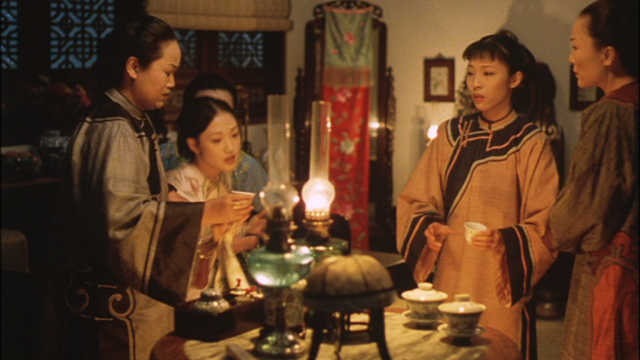
Elizabeth T. has chosen Miloš Forman’s LOVES OF A BLONDE for “Classic IFC Center” series

LOVES OF A BLONDE (LÁSKY JEDNÉ PLAVOVLÁSKY) (Miloš Forman, 1965)
IFC Center
323 Sixth Ave. at West Third St.
Friday, June 10, through Sunday, June 12, 11:00 am
212-924-7771
www.ifccenter.com

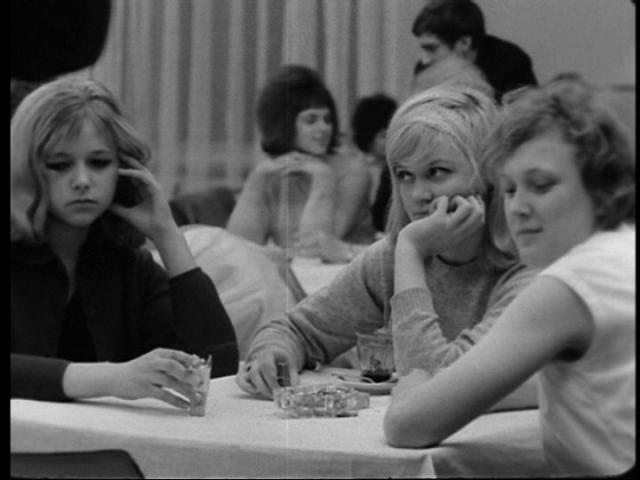
Released a few years before the Summer of Love and Prague Spring, Miloš Forman’s Loves of a Blonde is a very funny romantic black comedy that also has a lot to say about women’s burgeoning sexual freedom. The delightful Hanu Brejchovou stars as Andula, a young factory worker whose sexual liberation is ahead of its time in an old-fashioned small town. When a trainload of military reservists arrives, most of the single women do their best to attract the uniformed men at a big party, but Andula is more interested in pianist Milda (Vladimíra Pucholta). In a scene for the ages, three men try to pick up Andula and her two friends, with hysterical results. Later, when Andula visits Milda in Prague, she meets the piano player’s parents (Milada Jezková and Josef Sebánek), who are a droll riot. A Czech New Wave classic that evokes Godard and Truffaut, Loves of a Blonde, which was nominated for an Oscar for Best Foreign Language Film, caused a sensation when it played the New York Film Festival and introduced Forman (One Flew Over the Cuckoo’s Nest, Amadeus) to the world. Notably, assistant director and cowriter Ivan Passer, who also worked with Forman on The Firemen’s Ball, defected to America following Prague Spring and went on to make such films as Born to Win and Cutter’s Way. Loves of a Blonde is screening June 10-12 at 11:00 in the morning in the “Classic IFC Center” series, in which members of the staff select personal favorites; this one was chosen by Elizabeth T. in membership. The series continues June 17-19 with Alfonso Cuarón’s A Little Princess before concluding June 24-26 with Susan Seidelman’s Desperately Seeking Susan.

TALES OF CINEMA: THE FILMS OF HONG SANG-SOO

South Korean writer-director Hong Sang-soo is celebrated in three-weekend retrospective at Museum of the Moving Image (photo courtesy Festival del film Locarno)

South Korean writer-director Hong Sang-soo is celebrated in three-weekend retrospective at Museum of the Moving Image (photo courtesy Festival del film Locarno)

Museum of the Moving Image
35th Ave. at 36th St., Astoria
June 3-19
718-777-6888
www.movingimage.us

The Museum of the Moving Image’s seventeen-day, eighteen-film retrospective of the work of South Korean auteur Hong Sang-soo heads into its second weekend with a string of half a dozen highly original flicks made between 2006 and 2011, as Hong continues his exploration of the creation of art and cinema itself. (The museum previously celebrated Hong’s oeuvre with a 2012 series that consisted of five films.) You can watch as his storytelling abilities and character development continue to grow, even as they remain abstract and mysterious. The festival began with such works as The Day a Pig Fell into the Well, On the Occasion of Remembering the Turning Gate, and Virgin Stripped Bare by Her Bachelors and concludes June 17-19 with such more recent fare as Our Sunhi, Nobody’s Daughter Haewon, and Hill of Freedom.

Hong Sang-soo’s WOMAN ON THE BEACH in another beautifully shot but overly long drama about art and love

WOMAN ON THE BEACH (HAEBYEONUI YEOIN) (Hong Sang-soo, 2006)
Friday, June 10, 7:00
www.movingimage.us

Director Joong-rae (Kim Seung-woo) is having trouble with the script for his next film, so he gets production designer Chang-wook (Ki Tae-woo) to drive him out to Shinduri Beach for some quiet relaxation, away from the hustle and bustle of Seoul. Chang-wook brings along his girlfriend, Moon-sook (Ko Hyun-joung), an aspiring composer and singer who is immediately attracted to Joong-rae. As Chang-wook’s jealousy grows and Moon-sook and Joong-rae wonder if they have a future together, the director meets Sun-hee (Song Sun-mi), a soon-to-be divorcée who also has eyes for Joong-rae. Writer-director Hong Sang-soo’s moving romantic comedy features beautiful locations shot by Kim Hyung-koo, a sweet score by Jeong Yong-jin, and unusual but believable characters. At 127 minutes, the film, which was selected for the 2006 New York Film Festival, is far too long, not quite knowing how to end, but stick with it nonetheless.

Kim Tae-woo is outstanding as annoying, self-obsessed auteur in Hong Sang-soo’s LIKE YOU KNOW IT ALL

Kim Tae-woo is outstanding as annoying, self-obsessed auteur in Hong Sang-soo’s LIKE YOU KNOW IT ALL

LIKE YOU KNOW IT ALL (JAL ALJIDO MOT HAMYEONSUH) (Hong Sang-soo, 2009)
Saturday, June 11, 1:00
www.movingimage.us

South Korean auteur Hong Sang-soo’s 2009 film about a South Korean auteur, Like You Know It All, is another intriguing examination of art and sex in contemporary society, following Night and Day (2008), Woman on the Beach (2006), Tale of Cinema (2005), and Woman Is the Future of Man (2004). Hong, who has served as a juror at several film festivals and whose work has screened at fests all over the world, sets his latest self-reflexive story at the real Jecheon International Music and Film Festival, where director Ku will be part of the jury. But it turns out that Ku is a self-absorbed, insensitive, and subtly obnoxious filmmaker who cares only about himself, walking away from fans and colleagues in the middle of a conversation or in the midst of signing an autograph, interested only in listening to people praise his own talent, which has been relegated to art-house films that few people see and even fewer understand. After leaving the festival to teach a class at a school on Jeju Island, he visits with a famous painter and former mentor who has unknowingly married Ku’s first love, setting the stage for the creepy Ku to perform yet more selfish acts. Kim Tae-woo is outstanding in the lead role, playing the self-obsessed director with an unerring casualness that makes him more absurdly ridiculous than conniving and mean-spirited. With a little bit of Federico Fellini’s here and a touch of Woody Allen’s Stardust Memories there, Hong once again reveals the soft underbelly of ego within the film industry, but he also needs to edit himself more, as the bittersweet, slyly ironic Like You Know It All, made for a mere $100,000, is yet another of his films to clock in at more than two hours (though it feels longer).

Boram (Song Sun-mi), Youngho (Kim Sang-joong), and Seongjun (Yu Jun-sang) examine their lives in fascinating ways in Hong Sang-soo’s THE DAY HE ARRIVES

THE DAY HE ARRIVES (BUKCHON BANGHYANG) (Hong Sang-soo, 2011)
Saturday, June 11, 3:30, and Sunday, June 12, 4:00
www.movingimage.us

For most of his career, South Korean auteur Hong Sang-soo has been making films about filmmakers, although not always about the filmmaking process itself. In such works as Woman on the Beach, Like You Know It All, Tale of Cinema, and Oki’s Movie, he’s delved into the more personal side of lead characters who are established or emerging directors. Hong reaches a career peek with his latest, The Day He Arrives, a deeply intuitive, vastly intelligent, and surprisingly existential exploration of a young man at a crossroads in his life. After having made four little-seen films and deciding to become a country teacher instead, director Seongjun (Yu Jun-sang) returns to his hometown in Seoul to visit his friend Youngho (Kim Sang-joong), a film critic who has just left his wife and is hanging out with a film teacher named Boram (Song Sun-mi). Seongjun stops by to visit his old girlfriend, Kyungjin (Kim Bok-yung), keeps bumping into an actress who appeared in one of his films, goes drinking with a trio of fans, and meets Yejeon (also played by Kim Bok-yung), the owner of a local bar where Youngho and Boram take him. As all of the main characters examine their lives, each one lacking something important, Hong has several scenes repeat multiple times with slight differences, as if they are alternate takes imbued with new meaning as the audience continues to learn more about the protagonists. Each revised scene contributes more insight and develops the characters further, even if the story seems to have backtracked in time. The nonlinear narrative and Kim Hyung-koo’s beautiful black-and-white cinematography evoke aspects of Woody Allen’s Stardust Memories, Harold Ramis’s Groundhog Day, and François Truffaut’s Day for Night, exceptional films that, like The Day He Arrives, carefully balance fantasy and reality, fiction and nonfiction while depicting the inherent dual nature of cinema and humanity. Earlier in his career, Hong seemed to have trouble ending his films, which would linger on well past the two-hour mark, but with the outstanding, poetic Oki’s Movie and its follow-up, The Day He Arrives, both of which run approximately eighty minutes, he has found an excellent length for his work — one that now almost feels too short, as he clearly has so much to say. The Day He Arrives will be preceded by Hong’s 2011 short List.

Sungam (Kim Young-ho) battles displacement and loneliness in Hong Sang-soo’s NIGHT AND DAY

NIGHT AND DAY (BAM GUAN NAT) (Hong Sang-soo, 2008)
Saturday, June 11, 6:30
www.movingimage.us

Hong Sang-soo returned to the New York Film Festival for the fifth time with Night and Day, a character-driven tale about displacement and loneliness. Kim Young-ho stars as Sungam, a married painter in his forties who flees South Korea for France after having been turned in for smoking marijuana with U.S. tourists. A fish out of water in Paris, he settles into a Korean neighborhood, spending most of his time with two young art students, Yujeong (Park Eun-hye) and Hyunju (Seo Min-jeong). He also meets an old girlfriend, Minsun (Kim You-jin), who is still attracted to him. And every night he calls his wife, Sungin (Hwang Su-jung), wondering when he’ll be able to return home. Hong tells the story in a diary-like manner, with interstitials acting like calendar pages. Sometimes a day can be filled with talk of art, a party, and a chance encounter, while others can consist of a brief, random event with no real bearing on the plot, reminiscent of Jim Jarmusch’s Stranger Than Paradise, just without the existential cynicism and dark humor. As with 2006’s Woman on the Beach, Hong lets Night and Day go on too long (it clocks in at 141 minutes), with too many inconsequential (even if entertaining) vignettes, but it’s so much fun watching Kim Young-ho’s compelling performance that you just might not care about the length.

Oki (Jung Yumi) walks the fine line between fiction and reality in OKI’S MOVIE

OKI’S MOVIE (OK-HUI-UI YEONGHWA) (Hong Sang-soo, 2010)
Sunday, June 12, 7:00
www.movingimage.us

In works such as Like You Know It All, Woman on the Beach, Tale of Cinema, and Woman Is the Future of Man, Hong Sang-soo has explored the nature of his craft, using the creative process of filmmaking as a setting for his relationship-driven dramas. He examines the theme again in Oki’s Movie, a beautifully told tale told in four sections built around film professor Song (Moon Sung-keun) and students Jingu (Lee Sun-kyun) and Oki (Jung Yumi). Each chapter — “A Day for Chanting,” “King of Kiss,” “After the Snowstorm,” and “Oki’s Movie” — features a different point of view with a different narrator while walking the fine line between fiction and nonfiction. As in Tale of Cinema, certain parts are films within the film, shorts made by the characters for their class. Hong keeps viewers guessing what’s real as Oki balances a possible love triangle between her, Jingu, and Song; the final segment is a poetic masterpiece that brings everything together. In an intriguing twist — and emblematic of the realistic quality of Hong’s oeuvre — Oki’s Movie had its official U.S. theatrical release at the Maysles Cinema, the Harlem institution devoted to documentaries.

THE GOD CELLS

THE GOD CELLS

A patient receives a controversial treatment in THE GOD CELLS

THE GOD CELLS: FETAL STEM CELL CONTROVERSY (Eric Merola, 2016)
Cinema Village
22 East 12th St. between University Pl. & Fifth Ave.
Opens Friday, June 3
212-529-6799
stemcellsmovie.com
www.cinemavillage.com

In his 2014 documentary, Second Opinion: Laetrile at Sloan Kettering, writer, director, producer, and coeditor Eric Merola investigated the controversy over Laetrile, focusing on Memorial Sloan Kettering science writer Ralph W. Moss, PhD, and the banning of the cancer drug, which resulted in patients flocking to Mexico to receive treatment. Now Merola, whose two-part Burzynski explored the cancer therapy Antineoplastons, turns his attention to the stem-cell controversy in The God Cells, another important documentary that, unfortunately, suffers from some of the same filmmaking problems Second Opinion did. The pacing is awkward, the narrative overly biased, and alternating front and side shots of various speakers are needlessly disconcerting. The film also plays out like an infomercial for stem-cell treatment, which is banned in the United States, so Merola follows numerous patients to Mexico, where they receive the shots and many have experienced remarkable results. Although Merola does note the antiabortion movement’s religion-based fight against the use of stem cells, he instead reveals that the bigger issue in preventing their use in the U.S. is that the FDA is making it as difficult as possible to get the treatment approved because of its potential financial impact on Big Pharma and doctors, who benefit from people taking more and more drugs and coming back again and again for various other, arguably less-successful treatments.

Merola meets with men, women, and children who suffer from lupus, muscular dystrophy, multiple sclerosis, chronic lymphocytic leukemia, severe arthritis, and Parkinson’s, among other diseases, and who report nearly instantaneous recovery after stem-cell injections; in fact, they are shown golfing, rowing, and participating in other sports activities when previously they had trouble just walking. Also singing the praises of stem cells are former football quarterbacks John Brodie and Jerry Kramer and Laugh-In creator George Schlatter. While some doctors go on the record in support of stem cells, others are more hesitant, fearful of retribution from colleagues and the American medical industry. Merola spends too much time with CIRM, the California Institute for Regenerative Medicine, and celebrity doctor William C. Rader of Stem Cell of America, outspoken proponents of stem-cell research. And the film features an overly long section on television director and producer David Barrett (Blue Bloods, Cold Case), who talks about how stem cells saved his life as well as that of his grandfather, ninety-nine-year-old Dave McCoy, who might be deserving of his own documentary. Interestingly, Barrett is the executive producer of The God Cells. Still, it’s a critically vital film that will open your eyes on yet another medical controversy that raises the question: Is corporate moneymaking more important than the health of the individual? The film opens at Cinema Village on June 3, with Merola and special guests participating in a Q&A following the 7:10 show that night.

THE WITNESS

Kitty Genovese

The murder of Kitty Genovese is reinvestigated by one of her brothers in THE WITNESS

THE WITNESS (James Solomon, 2015)
IFC Center
323 Sixth Ave. at West Third St.
Opens Friday, June 3
212-924-7771
www.ifccenter.com
www.thewitness-film.com

The main image used to promote James Solomon’s debut documentary, The Witness, is a 1961 black-and-white photograph of Kitty Genovese. In the portrait, she stares back at the viewer almost accusingly; in light of her famous death three years later, it is as if she is calling us all out for the events that happened during and after her murder. In 1964, Genovese was killed by an assailant on a Kew Gardens street while, as the New York Times reported, thirty-eight neighbors heard the screams, looked out their windows, and did nothing. Forty years later, the paper reexamined the case and their coverage and found numerous holes in their original story. That set Kitty’s brother, Bill Genovese, who was sixteen when his sister was killed, on an obsessive mission to find out the truth about what really went down on March 13, 1964, and afterward, when New York City was publicly decried across the world as an awful oasis of urban apathy. Genovese hooked up with screenwriter Solomon (The Conspirator, The Bronx Is Burning) and spent eleven years reinvestigating the case — the two men had actually met in 1999, when Solomon was collaborating on a never-realized fictionalization of the story with Joe Berlinger and Alfred Uhry for HBO. The Witness plays out like a police procedural as Genovese follows every crumb he possibly can, meeting with witnesses, detectives, his sisters’ friends, and such journalists as Gabe Pressman, Mike Wallace, and Abe Rosenthal, the Times editor who wrote the book Thirty-Eight Witnesses: The Kitty Genovese Case, which helped turn the sordid tale into legend. “The story doesn’t make any sense to me,” Pressman admitted he thought back in 1964, although no one would question the Newspaper of Record. But Genovese does just that, and what he discovers is nothing short of shocking.

While The Witness sheds fascinating new light on the case — among the things that Genovese finds out is that the police were called and that his sister did not die alone in an apartment vestibule — it also, at long last, humanizes Kitty Genovese. No longer is she a mysterious figure whose unanswered screams came to represent all that was wrong with New York City in the 1960s but instead is revealed as a gregarious, popular young woman with a zest for life. By no means a criminal, she’s been memorialized by that 1961 photo, actually a mug shot taken after she was arrested on minor charges for bookmaking, having been a small player in a numbers racket from the lively bar where she worked. And that’s not the only way her character has been misrepresented over the years. However, the film moves way too slowly, and just as some of Bill’s siblings want him to stop his obsessive pursuit, there are many moments when you’ll want him to stop as well, particularly when he’s meeting with Steven Moseley, the son of Kitty’s killer, Winston Moseley, and when Bill and Solomon re-create the murder with an actress. Genovese was so deeply wounded by his sister’s death that he enlisted in the Marines and ended up losing both legs in Vietnam; he is seen at times making his way up stairs and driving and getting out of his car, inspirational moments that will have you cheering for him. Ultimately, The Witness proves that we can’t always believe what we read, even if it’s in the New York Times, while also absolving the city of at least some of its perceived sins of the past. The Witness opens at IFC Center on June 3; director James Solomon and Bill Genovese will be on hand for Q&As following the 7:05 show on June 3 (moderated by Sarah Heyward), the 7:05 show on June 4 (moderated by Clyde Haberman), and the 2:50 show on June 5 (moderated by Richard Price).