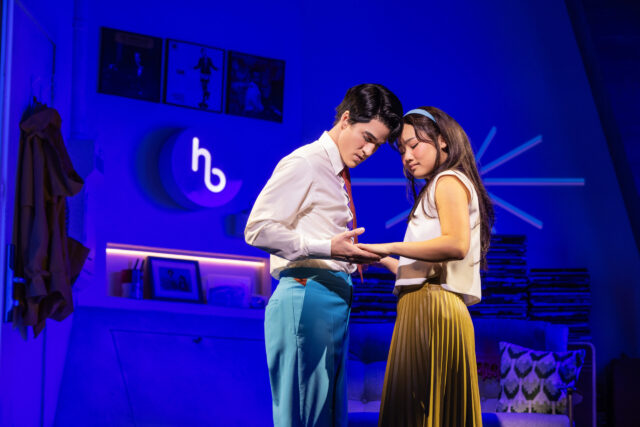
this week in broadway

FROM NASHVILLE TO NEW ORLEANS: TWO JUKEBOX MUSICALS HEADING IN DIFFERENT DIRECTIONS

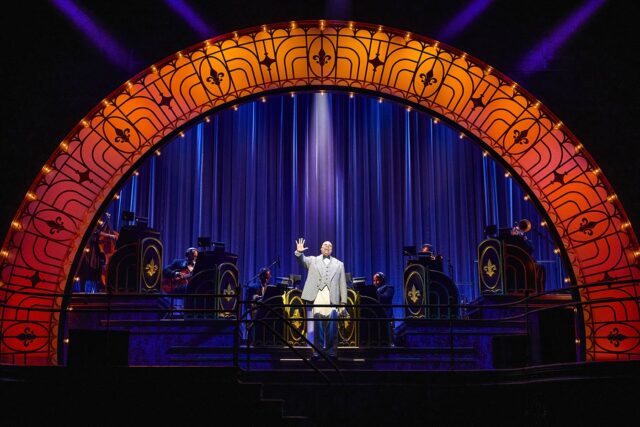
Louis Armstrong (James Monroe Iglehart) waves goodbye to Broadway in A Wonderful World (photo by Jeremy Daniel)

A WONDERFUL WORLD: THE LOUIS ARMSTRONG MUSICAL
Studio 54
254 West 54th St. between Seventh & Eighth Aves.
Tuesday – Sunday through February 23, $69-$278
louisarmstrongmusical.com

Jukebox musicals generally come in two basic kinds of flavors: somewhat-fact-based accounts of superstars (Tina Turner, Cher, the Temptations, Michael Jackson, Neil Diamond, Frankie Valli and the Four Seasons, Carole King) and original narratives based on the work of one composer, performer, or era (Alanis Morissette, Jagged Little Pill; Britney Spears, Once Upon a One More Time; Max Martin, & Juliet; the Go-Go’s, Head Over Heels; the 1970s, Rock of Ages).

A pair of current shows use contrasting approaches, but while one has been extended several times, the other has posted an early closing notice.

At Studio 54, A Wonderful World: The Louis Armstrong Musical tells the fact-based story of the American trumpeter and singer known as Satchmo (James Monroe Iglehart), concentrating on the songs he performed throughout his career, while at the West End Theatre, Music City relates a fictional contemporary tale of the search for fame and love, consisting of tunes by country songwriter J. T. Harding, who has penned hits for Uncle Kracker, Kenny Chesney, Keith Urban, Blake Shelton, Dierks Bentley, Darius Rucker, and others.

A Wonderful World features nearly thirty jazz and jazz-adjacent tunes as the narrative divides Armstrong’s story into four sections, each with a different woman by his side: tough-talking prostitute Daisy Parker (Dionne Figgins) in New Orleans, jazz pianist Lil Hardin (Jennie Harney-Fleming) in Chicago, dancer Alpha Smith (Kim Exum) in Hollywood, and Cotton Club performer Lucille Wilson (Darlesia Cearcy) in New York. Although the song list is impressive, with such numbers as “Basin Street Blues/Bourbon Street Parade,” “Up a Lazy River,” “Black and Blue,” “Heebie Jeebies,” “Do You Know What It Means to Miss New Orleans,” and “After You’re Gone,” many of them are given short shrift rather than full renditions, matching the lack of insight into what made Armstrong the larger-than-life figure he was.

Aside from finding out about his four wives, there is little new audiences will learn about Louis; even when it deals with racism, the focus gets lost, outshone by Armstrong’s huge showmanship and popular success and all his preening. Adam Koch and Steven Royal’s heavily blue sets are glitzy and Toni-Leslie James’s costumes are flashy, but the book, by Aurin Squire, conceived by Andrew Delaplaine and Christopher Renshaw, merely brushes the surface, and the direction, by Iglehart and Christina Sajous, is worshipful where it should be articulate.

Figgins (Memphis, Motown), Harney-Fleming (Hamilton, The Color Purple), Exum (The Book of Mormon), and Cearcy (The Color Purple, Ragtime) steal the show from Tony winner Iglehart (Aladdin, Hamilton), who seems to be playing a caricature of Armstrong, never reaching the necessary depth. Dewitt Fleming Jr. (The Tap Dance Kid, Pearl) gives nuance to Lincoln Perry, better known as Stepin Fetchit, while Gavin Gregory (The Gershwins’ Porgy & Bess, The Color Purple) plays hard-luck bandleader “King” Oliver.

A Wonderful World recently announced that it will be closing early, on February 23; overall, it was a missed opportunity.
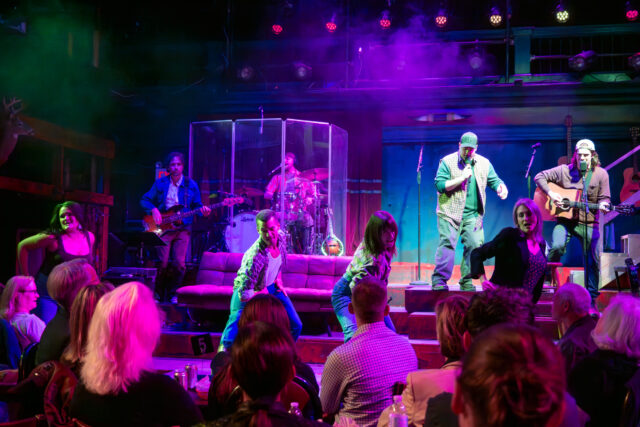
Music City brings Nashville to the Upper West Side (photo by Ashley Garrett)

MUSIC CITY
West End Theatre
Church of St. Paul and St. Andrew
263 West Eighty-Sixth St. at West End Ave.
Tuesday – Sunday through March 2, $68 – $130.50
bedlam.org

Despite an exciting, promising first act, Bedlam’s Music City: A New Musical, which opened on November 17 and has been extended three times, the latest until March 2, also ends up being a missed opportunity.

Last year, I visited Nashville with friends and fell in love with the live music pouring out of every bar, club, and honky tonk and into the crowded streets, where people were partying well into the night. Director Eric Tucker and book writer Peter Zinn capture that energy on Clifton Chadick’s lifelike set, which transforms the theater at the Church of St. Paul and St. Andrew on the Upper West Side into the Wicked Tickle, a seedy watering hole in East Nashville. The audience sits at small tables as if they are guests at the club, where they can get drinks, check out the (fake) memorabilia on the walls, and whoop it up as the narrative unfolds around them.

About a half hour before curtain, an open mic begins, introducing some of the characters, so get there early and soak in the realistic atmosphere. The show proper begins with brothers TJ (Stephen Michael Spencer) and Drew (Jonathan Judge-Russo) performing their rousing “Y’allsome,” in which they declare, “Y’all ain’t scared to have a little fun. / Whiskey shots from a water gun. / Ain’t slowing down — / And here comes the sun! / Y‘allsome party people. / Y’allsome crazy mothers. / Y’allsome freakin’ good lookin’ country music lovers! / Hankin’ and drankin’ all wrecking ball shaking the walls.”

When they’re done, Drew, who comes up with the titles and ideas for the songs, and TJ, who writes the music and lyrics, are approached by Leeanne (Leenya Rideout), a slick record executive who wants to hear their demo, as she’s scouting tunes for country superstar Stucky Stiles’s (Andrew Rothenberg) next tour and album.

They don’t have a demo, so Drew decides to ask local drug dealer and open-mic regular Benjamin Bakerman (Rothenberg) to invest two grand in their band so they can afford studio time. Bakerman instead offers them the opportunity to earn the cash by delivering “cookies” for him. TJ is initially against the plan, but Drew talks him into it.

Soon TJ is handing off bags of meth to such junkies as Tammy (Rideout), a former wannabe country star. “Bet you think you’re gonna be a big ol’ star one day just like everyone else in this shithole town,” she says, lighting up her pipe. “I remember when I used to walk around Nashville with a guitar on my back. I wish somebody woulda told me back then how ridiculous I looked.”

At the next open mic, TJ instantly falls for a young woman named 23 (Casey Shuler) as she plays a deeply personal ballad, singing, “Like soldiers coming home from war / Who am I to want something more?”

With money in their pockets, TJ and Drew start working on their demo in drummer Newt’s (Drew Bastian) studio. Meanwhile, Stucky wants to be recording his own songs instead of party tunes written by others, but Leeanne tells him that ship has sailed.

TJ and 23 connect and start writing together, Stucky comes to the Wicked Tickle, and relationships get twisted and complicated as Bakerman keeps putting pressure on TJ to sell his product.
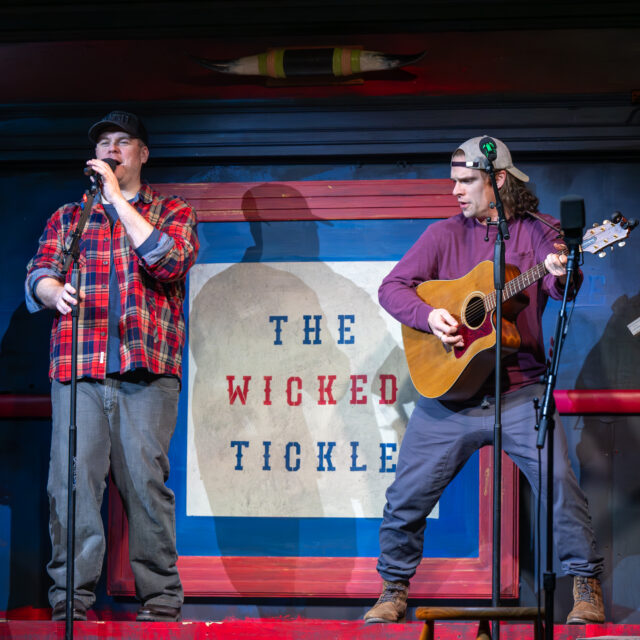
Drew (Jonathan Judge-Russo) and TJ (Stephen Michael Spencer) contemplate a shot at the big time in Music City (photo by Ashley Garrett)

Unfortunately, Tucker (Uncle Romeo Vanya Juliet, Sense and Sensibility) and Zinn (Rumspringa, Somewhere with You) throw in the kitchen sink in the second act, heaping on trauma after trauma, leading to a mind-boggling finale that comes out of nowhere and pulls everything that happened before down with it. In addition, John Heginbotham’s choreography, performed by Corry J Ethridge and Holly Wilder, seems to have come from a completely different show.

It’s a shame, because nearly all the other elements are in place: The backup band, featuring Ann Klein on guitars, Tony Tino on bass, Bastian on drums, and emcee and music director Julianne B. Merrill on keyboards, is excellent, keeping things hopping throughout, and the cast is charming and engaging, especially Spencer (Clyde’s, Julius Caesar) and Shuler (Titanic, Robin Hood), who make an adorable couple. The twenty songs, which include “Smile” (a hit for Uncle Kracker), “Somewhere with You” (Chesney), and “Alone with You” (Jake Owen), range across the country spectrum like a live jukebox, although “Sangria” (Shelton), which gets the spotlight, doesn’t carry enough weight here.

Then again, the PBRs are cheap, the staging is fun, and, hey, it’s Nashville in New York, which is some kind of wonderful.

[Mark Rifkin is a Brooklyn-born, Manhattan-based writer and editor; you can follow him on Substack here.]
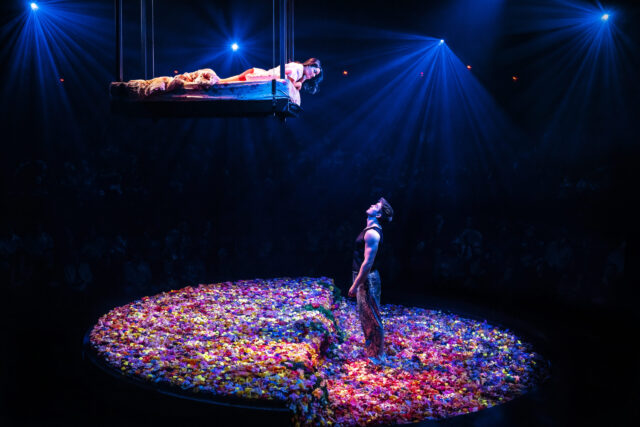
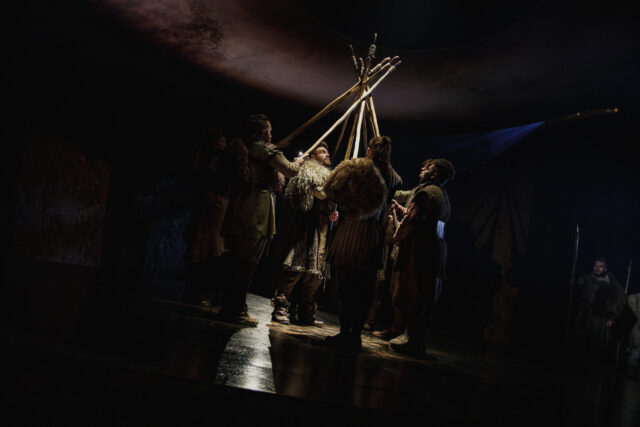
ROMEO + JULIET ON BROADWAY CONQUERS KING LEAR AT THE SHED

Sam Gold’s Romeo + Juliet is made for Gen Z but can be enjoyed by all (photo by Matthew Murphy and Evan Zimmerman)

ROMEO + JULIET
Circle in the Square Theatre
1633 Broadway at 50th St.
Tuesday – Sunday through February 16, $159-$1002
romeoandjulietnyc.com

Last fall, when I saw Sam Gold’s Romeo + Juliet at Circle in the Square and Kenneth Branagh’s King Lear at the Shed, I was not anticipating being charmed by the former and disappointed in the latter.

Tony and Obie winner Gold has had decidedly mixed results with controversial and often confusing star-driven adaptations of such Shakespeare plays as Macbeth and King Lear on Broadway, Othello at New York Theatre Workshop, and Hamlet at the Public.

Meanwhile, Branagh is widely considered the finest interpreter of the Bard since Laurence Olivier, both onstage, such as his immersive version of Macbeth at Park Ave. Armory and his 1987 and 2016 takes on Romeo and Juliet, and his well-received cinematic adaptations of Henry V and Much Ado About Nothing.

Lear is a personal favorite of mine; Branagh’s is the eighth major production I’ve seen in the last twenty years. I have not had as much luck with R&J, from David Leveaux’s flat 2013 Broadway revival to Hansol Jung’s profoundly perplexing 2023 effort at the Lynn Angelson, although I adored Michael Mayer’s & Juliet, a musical imagining of what might have happened if Juliet had survived.

Closing February 16, Gold’s Romeo + Juliet is a plush and lively, radical AMSR presentation tailored for Gen Z, complete with an Insta-friendly plethora of stuffed teddy bears onstage and in the lobby. When the audience enters the theater in the round, the actors are already hanging out, talking, dancing, and dissing with each other, pushing around a shopping cart of stuffed animals, skateboarding, and lounging on plastic furniture. They wear sneakers, hoodies, and a Hello Kitty backpack. On one side, a giant pink teddy bear watches in silence while across the space a DJ spins Jack Antonoff’s thumping music.

The youthful cast features the hot Rachel Zegler as Juliet and the even hotter Kit Connor as Romeo, with Tony nominee Gabby Beans as Mercutio and the friar, Sola Fadiran as both Capulet and Lady Capulet, Taheen Modak as Benvolio, Tommy Dorfman as the nurse and Tybalt, and Gían Pérez as Samson, Paris, and Peter. The doubling and tripling often makes it hard to know who is who, and some actors do better with the tweaked dialogue than others. Two songs are completely unnecessary, and the use of a handheld microphone is baffling, as is the handling of a poison jug.

But much of the staging is dazzling, from Juliet’s bed, which drops slowly from the rafters, to a colorful expanse of flowers that emerges from the floor. Yes, the F-bomb appears twice, but surprises await those who fully invest themselves in this contemporary tale made for this moment in time.

Kenneth Branagh’s ritualistic King Lear goes astray early (photo by Marc J. Franklin / courtesy the Shed)

Unfortunately, Branagh, codirecting with Rob Ashford and Lucy Skilbeck, struggles with his streamlined adaptation, which, at a rushed two hours without intermission, has cut several key scenes and famous lines, and without the proper character development it’s often hard to differentiate among the minor characters, who are played by recent graduates of the Royal Academy of Dramatic Arts and look like survivors from Game of Thrones. Branagh, who is sixty-four, does not portray Lear as an aged, failing man but as a younger warrior, which alters the plot’s narrative center.

Like Gold’s R+J, Branagh’s staging involves a large sphere, in this case an imposing UFO-like disc that hovers over the action, occasionally moving and tilting, onto which ominous weather patterns are projected. (The script identifies the setting as “outer space.”) It also leaves in one of the songs, which feels extraneous given the show’s shortened length.

Thus, my initial thoughts that Gold would pale in comparison to Branagh were misbegotten.

“O teach me how I should forget to think!” Romeo tells Benvolio.

Who woulda thunk it?

[Mark Rifkin is a Brooklyn-born, Manhattan-based writer and editor; you can follow him on Substack here.]
CHRISTMAS IN CONNECTICUT: A (DYS)FUNCTIONAL FAMILY SATIRE

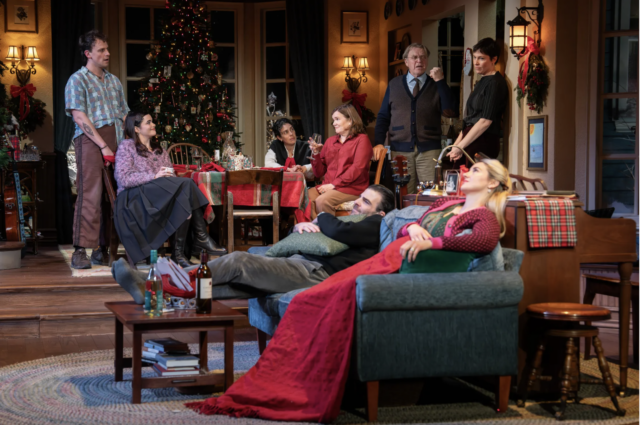
The Dahls have a Christmas to remember — or forget — in Cult of Love (photo by Joan Marcus)

CULT OF LOVE
Hayes Theater
240 West 44th St. between Broadway & Eighth Ave.
Through February 2
2st.com

I started to call Leslye Headland’s hilarious, on-target Broadway debut, Cult of Love, the story of a dysfunctional family at Christmas, but I stopped myself because it sounded redundant; has there ever been a holiday-themed play about a functional family?

Directed with plenty of pizzazz and panache by Obie winner and two-time Tony nominee Trip Cullman, the hundred-minute satire introduces us to the musical Dahl family, who come together on Christmas Eve at their farmhouse in Connecticut to sing songs and do battle. Patriarch Bill (David Rasche) is a piano-playing Pollyanna and a hugger who prefers to avoid arguments; his children think he might be suffering from dementia, because how else can he be so positive? Matriarch Ginny (Mare Winningham) strums the guitar, sings songs about Jesus, and plays favorites with her children, even though she fails to see it.

The Dahls’ eldest progeny, Mark (Zachary Quinto), is a law clerk in DC, almost became a priest before abandoning Christianity, and is having marital problems with his wife, Rachel (Molly Bernard), who converted from Judaism and drinks too much at family events.

Older daughter Evie (Rebecca Henderson) recently got back from her Italian honeymoon with her new spouse, Pippa Ferguson (Roberta Colindrez); both have successful careers in brand management.

Third child Johnny (Christopher Sears) is the ever-late prodigal son who has been in and out of rehab for years; everyone is excited when they learn he is bringing a mystery guest, Loren Montgomery (Barbie Ferreira).

The baby of the group, twentysomething Diana Dahl Bennett (Shailene Woodley), is a Bible thumper with a six-month old son with her husband, Episcopal priest James Bennett (Christopher Lowell), and she is pregnant again.

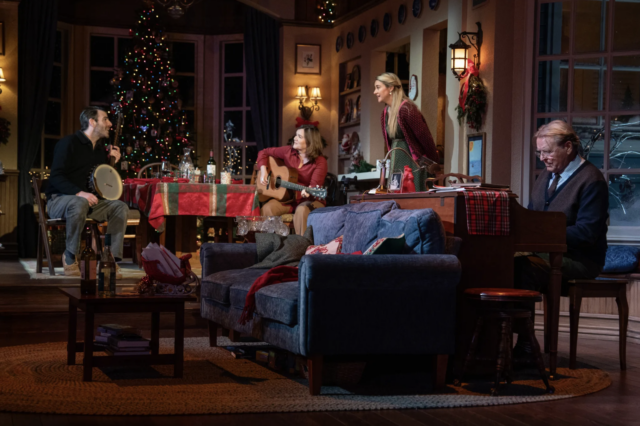
Music is the only thing a Connecticut family can agree on in hilarious Broadway satire (photo by Joan Marcus)

Over the course of a fretful, highly volatile evening, the Dahls and their significant others discuss racism, homophobia, smoking, molestation, mental health, the Mexican wedding cookies known as polvorones, and tolerance in between picking up instruments (guitars, banjo, ukulele, melodica, washboard, sleigh bells, maracas) and breaking into traditional religious songs as well as tunes by Radiohead, the Fleet Foxes, and Sufjan Stevens, displaying gorgeous harmonies and pure joy that, momentarily, put aside their seemingly endless issues with one another.

“Evie! Are you picking a fight during Christmas carols?” Mark cries out. Evie responds, “I’m questioning the problematic lyrics, Mark!” Diana concludes, “You ruin it when you do that.”

When Evie wants to talk about Bill’s health, Mark argues, “Is Christmas really the best time for that?” Evie explains, “Christmas is exactly the time to talk about the things we never talk about.”

John Lee Beatty’s cluttered Christmas-themed set feels homey and lived in, with windows and glass doors that offer peaks at what is going on in the outside world, where perhaps sanity is possible. Jacinth Greywoode’s expert musical direction will make you wonder if there will be a cast album. The ensemble is terrific as Cullman guides them through an ever-more-claustrophobic situation.

“You must be having a wonderful time,” Bill says to Loren, who answers for her and the audience when she replies, “Oh, sure. I love the singing, the lesbian drama. It’s all great.”

[Mark Rifkin is a Brooklyn-born, Manhattan-based writer and editor; you can follow him on Substack here.]
EUREKA! STRIKING GOLD ON BROADWAY

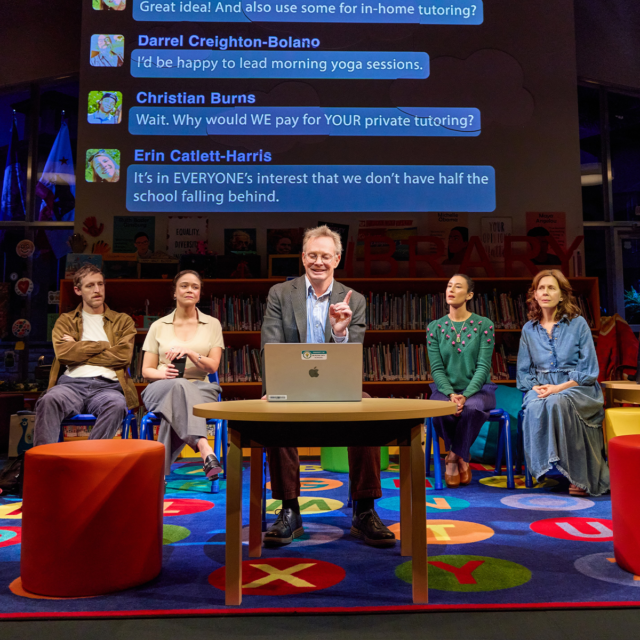
The executive committee at Eureka Day School has its work cut out for it (photo by Jeremy Daniel)

EUREKA DAY
Samuel J. Friedman Theatre
261 West Forty-Seventh St. between Broadway & Eighth Ave.
Tuesday – Sunday through February 16, $48-$321
www.manhattantheatreclub.com

Jonathan Spector’s Eureka Day is the funniest play of the year.

Five years ago, I called Colt Coeur’s East Coast premiere of Eureka Day at walkerspace an “uproarious satire.” It’s even better in the Broadway debut of the Manhattan Theatre Club production at the Samuel J. Friedman, succeeding where a similarly themed show, Larissa FastHorse’s The Thanksgiving Play, about a woke quartet of grown-ups trying to put on an acceptable, PC holiday show for young schoolchildren, failed. The fall 2018 iteration of The Thanksgiving Play at Playwrights Horizons was fresh and original and utterly hilarious; its 2023 Broadway version was stale and outdated, like dried-out leftovers.

That doesn’t happen with Eureka Day, which strikes gold for the second time.

The story takes place in the fall of 2018 in the library of the Eureka Day School in Berkeley, California. The executive committee is meeting, and the opening dialogue sets the stage for what’s to come.

Meiko: Personally no / I don’t find it offensive / the term itself is not offensive.
Eli: It’s descriptive.
Suzanne: I think she’s saying / I’m not putting words in your mouth / she’s saying it’s not offensive / but when you contextualize it in that way. . . .
Meiko: I find / the best way not to put words in someone’s mouth? / is not to put words in their mouth.
Don: Okay okay.
Suzanne: Sorry sorry.
Meiko: It’s fine / what I meant was / that we’d want to make it absolutely clear that it’s optional / that it’s not / Either / Or.
Suzanne: Right / and also / that the inclusion of the term on this list at all is / I think / inappropriate? / and that some people may / With Good Reason / find its inclusion offensive.
Eli: No no yeah / I just wonder though / by leaving it off / is it possible some people would find its absence offensive?
Don: You’re concerned / that it could be a sort of / erasure / of people’s experience?
Eli: Right / if our Core Operating Principle here is that everyone should / Feel Seen / by this community.
Suzanne: There’s no benefit in Feeling Seen if you’re simultaneously Being Othered / right?
Meiko: Well / no yeah.
Don: Carina, did you want to / do you want to / offer anything?
Carina: Oh, I / I’m happy to defer / I don’t know that I’ve really formed a strong [opinion.]
Don: That’s perfectly all right / even just your gut instinct is [welcomed] / this is an Open Room / we welcome your unique perspective.

The discussion is about what to include in the school’s online dropdown menu where parents are supposed to click off their kid’s race/ethnicity/heritage, but it could deal with so many other subjects that are part of the committee’s efforts to be as inclusive as possible in any and all situations.

“Sounds like there’s a lot to unpack here,” Don says, but there’s a lot to unpack everywhere in this outrageously hilarious satire.

The white, childless Don (Bill Irwin) is the head of the committee and prefers not to take sides, ending each meeting with a quote from the thirteenth-century Sufi poet Rumi. The well-off, white Suzanne (Jessica Hecht) is a longtime board member who has put each of her six children through Eureka Day and regularly supplies the library with books. The white, Jewish Eli (Thomas Middleditch) is a wealthy tech bro with an open marriage and one son in the school. He is secretly dating the half-Japanese Meiko (Chelsea Yakura-Kurtz), who has a daughter in the school and spends much of her time knitting rather than actively participating in the committee’s proceedings. And the biracial Carina (Amber Gray) is filling the spot saved for the new member, hesitant to share her views until she can’t stop herself as it all becomes ridiculously absurd.

When a student contracts the mumps and the health department sends an official notice explaining that nonvaccinated children will be barred from attending school until they get their shot, the committee calls for a hybrid Community Activated Conversation, with parents commenting from home on the chat, which delves into vaccination efficacy, conspiracy theories, personal and public responsibility, and plenty of vicious name-calling.

Christian Burns: Wait. HALF the school is antivaxxers? Seriously????
Sandra Blaise: “Anti-vaxxer” is not really a term I’m comfortable with. It’s actually something said out of IGNORANCE.
Karen Sapp: Exactly! Protect your children by EDUCATING YOURSELVES.
Tyler Coppins: OR, Protect your children by VACCINATING THEM.
Courtney Riley: Wait what???? Why should we be forced to keep our kids home because you CHOOSE to endanger yours?
Doug Wong: Okay here’s another idea: what if we made the quarantine days OPTIONAL.
Orson Mankel: Doug, that’s idiotic. If the “problem” is that we won’t have enough kids in class, why make the problem worse???
Christian Burns: TRUE FACTS: Moonlanding wasn’t faked. 9/11 wasn’t an inside job. Global Warming is real. Vaccines Don’t Cause Autism.
Karen Stacin: Mock all you want, but I saw so many bad things as a nurse. That’s why I decided I would NEVER subject my children to Western Medicine of any kind.
Christian Burns: Remember that time I got crippled from polio? Oh, no, wait. I didn’t. Cause I got FUCKING VACCINATED.

Things only devolve from there in side-splitting ways that are even funnier — and more frightening — now that President-elect Donald Trump has nominated the controversial Robert F. Kennedy Jr. to run the Department of Health and Human Services.

Community Activated Conversation at Eureka Day goes terribly wrong in hilarious Broadway play (photo by Jeremy Daniel)

Ancient Greek polymath Archimedes is often credited with coining the exclamation Eureka! upon discovering what became known as the Archimedes Principle, a scientific theory about buoyancy. So it makes sense that Spector has named the woke school in question Eureka Day. Todd Rosenthal’s set features blue chairs, red, orange, and yellow trapezoid tables that are rearranged into geometric shapes, posters of Ruth Bader Ginsburg, Albert Einstein, Maya Angelou, Sandra Day O’Connor, and Michelle Obama, and a sign that reads “Social Justice” under a placard that proclaims, “Berkeley Stands United Against Hate.” Clint Ramos’s naturalistic suburban costumes are highlighted by the long, fussy frocks worn by Suzanne.

Tony winner Anna D. Shapiro (August: Osage County, This Is Our Youth) directs with a sweet glee, while sound designers Rob Milburn and Michael Bodeen know just when the laughs are coming, particularly during the Community Activated Conversation, when David Bengali’s projections take over and the characters’ discussion fades into the background.

The ensemble is outstanding: Tony nominee Gray (Natasha, Pierre, and the Great Comet of 1812, Hadestown) is cool and collected as the determined Carina, who can’t believe what the board is doing; two-time Tony nominee Hecht (Summer, 1976, Fiddler on the Roof) is delightful as the nervous, jittery Suzanne, punctuating her dialogue with wonderful sighs and grunts; Tony winner Irwin (Who’s Afraid of Virginia Woolf?, On Beckett) is tender as the mild-mannered, oblivious Don; Emmy nominee Middleditch (Silicon Valley) adds humanity to the selfish Eli; and Chelsea Yakura-Kurtz (How the Light Gets In, Unrivaled) beautifully captures Meiko’s evolving value system as she reconsiders being part of the team.

As funny as Eureka Day is, it tackles some hard-hitting subjects, from race and income inequality to religion and health care; the executive committee is so wrapped up in DEI that they miss what is right in front of them, stirring up more trouble with their inability to follow old-fashioned rules and face the truth of what is really happening in their school, to the students.

At one point, the other members of the committee explain to Carina how there was controversy over a recent eighth-grade production of Peter Pan. “I don’t know what they were thinking,” Suzanne recalls. “We came to what I thought was a very [good agreement] / we set the production in Outer Space / and that really solved the [problem],” Don says. “So then all the kids got to fly,” Eli adds, as if that were the only solution, while Carina can barely accept what she has gotten herself into.

Fortunately, Eureka Day does not have to worry about any such controversies, as it gets it all right, flying high from start to finish.

[Mark Rifkin is a Brooklyn-born, Manhattan-based writer and editor; you can follow him on Substack here.]

SURVIVAL AT SEA AND ON BROADWAY: SWEPT AWAY

A talented cast tries to stay afloat in Swept Away (photo by Emilio Madrid)

SWEPT AWAY
Longacre Theatre
220 West 48th St. between Broadway & Eighth Aves.
Tuesday – Sunday through December 29, $56-$216
sweptawaymusical.com

When I first heard that a show called Swept Away was coming to Broadway, I wondered how — and why — anyone would make a musical out of Lina Wertmüller’s 1974 class-clash shipwreck romantic comedy, Swept Away . . . by an Unusual Destiny in the Blue Sea of August, which was remade in 2002 by Guy Ritchie starring his then-wife, Madonna. I eventually found out that it is in fact based primarily on Mignonette, the 2004 album by Americana roots-rock favorites the Avett Brothers, inspired by the true story of an English yacht that sank in 1884, leaving the crew of four men struggling to survive in a lifeboat, including the captain and teenage cabin boy Richard Parker — the name given to the Bengal tiger in the fictional shipwreck tale The Life of Pi. (There are also songs from such other Avett Brothers records as Emotionalism, The Carpenter, and True Sadness.)

Swept Away is now experiencing a different, unexpected type of survival. Last week, the ninety-minute show, starring Tony winner John Gallagher Jr. (Spring Awakening) and Tony nominee Stark Sands (Kinky Boots) and featuring a book by Tony winner John Logan (Red, Moulin Rouge! The Musical), direction by Tony winner Michael Mayer (Spring Awakening, American Idiot), and choreography by Tony nominee David Neumann (Hadestown), posted an early closing notice, explaining that the sails would be taken down after only twenty previews and thirty-two regular performances. It was as if the cast and crew were in their own lifeboat, lost at sea.

But on December 11, first Sands at the matinee and then Gallagher in the evening (the show I saw) gleefully announced at the curtain calls that, because of overwhelming audience response and a series of sell-outs, the “dark and risky” musical has a little more life left in it, extending two weeks. (Gallagher dared the audience to spread the word and maybe get another two weeks, but the website currently says “must end December 29.”)

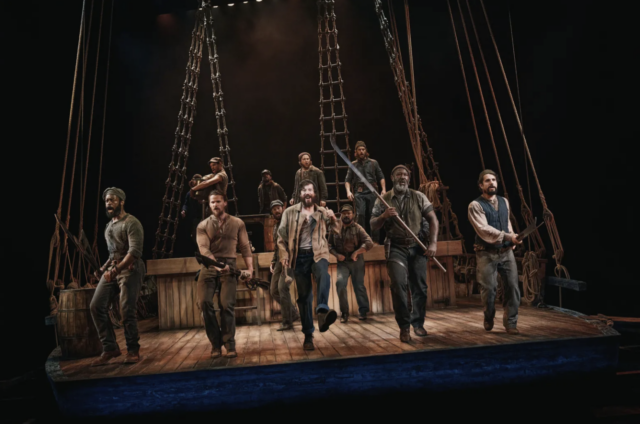
The little musical that could premiered in 2022 at Berkeley Rep and moved to Arena Stage in DC last fall before cruising to Broadway. Swept Away looks and sounds great. The narrative unfolds on Tony-winning designer Rachel Hauck’s duly impressive set, a large ship on its final voyage — it is going to be sold for scrap — that juts out toward the audience and, later, stunningly capsizes, using mirrors on its underside to reveal what is happening in the lifeboat. All the technical aspects are exceptional, from Tony winner Susan Hilferty’s seafaring costumes to four-time Tony winner Kevin Adams’s lighting, Tony winner John Shivers’s sound, and the music arranging, orchestrations, and direction, by Chris Miller, Brian Usifer, and conductor and multi-instrumentalist Will Van Dyke.

The plot could use some course correction, although it is often saved by the stomping music and rousing choreography. A young man known as Little Brother (Adrian Blake Enscoe) has run away from his family farm to go on an adventure at sea, hoping to see the world, then return home and marry his childhood sweetheart, Melody Anne. His older brother (Sands) tracks him down and tries to prevent him from boarding the ship, but soon both of them are on their way to hunt whales, a dying occupation because of the invention and widespread use of paraffin and kerosene.

The captain (Wayne Duvall) is a stern, bearded fellow who insists on being called “sir” by his second mate (Gallagher), a salty sailor who takes Little Brother under his wing as they interact with the extremely well cast crew of men’s men (Josh Breckenridge, Hunter Brown, Matt DeAngelis, John Michael Finley, Cameron Johnson, Brandon Kalm, Rico LeBron, Michael J. Mainwaring, Orville Mendoza, Chase Peacock, Robert Pendilla, Tyrone L. Robinson, David Rowen, and John Sygar).

“We’re pagans and idolators here, waiting to whore ourselves from one pox-ridden port to another,” the mate says to the pious Big Brother, who wants everyone to join him in worship on a Sunday. “We’re sailors and workers; we got no time and no inclination for your pious bullshit, so do not embarrass yourself in front of the crew, and do not inflict your unforgiving sonofabitch G-d on the rest of us.”

Following a fierce squall, the two brothers, the captain, and the second mate are adrift at sea, going weeks without any food and water, growing hungrier and hungrier by the minute, recalling not only Pi Patel’s frightful journey in Life of Pi but Monty Python’s hilarious lifeboat sketch.

The musical doesn’t shy away from taking chances, although not all of them succeed, particularly involving Big Brother and religion. However, such splendidly rendered numbers as “Hard Worker,” “No Hard Feelings,” “May It Last,” and the title song keep everything afloat.

All of their prayers may not have been answered, but getting a reprieve at least through the Christmas holiday is something to sing about, with or without Madonna.

[Mark Rifkin is a Brooklyn-born, Manhattan-based writer and editor; you can follow him on Substack here.]
THE WRONG KIND OF FAITH: TAMMY FAYE ON BROADWAY

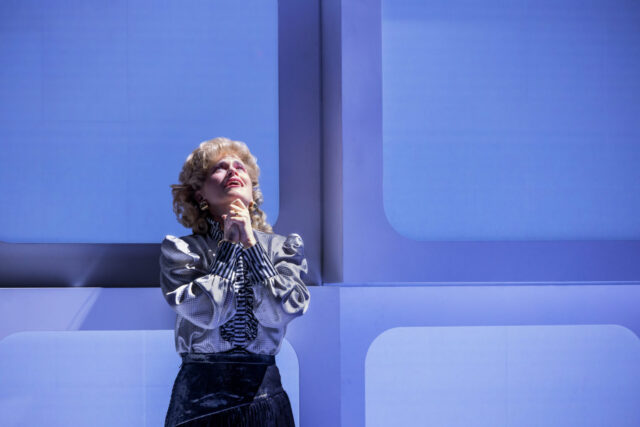
Katie Brayben’s prayers for Broadway musical go unanswered (photo by Matthew Murphy)

TAMMY FAYE
Palace Theatre
1564 Broadway at Forty-Seventh St.
Through December 8, $59.75-$119
tammyfayebway.com

It’s extremely rare for a professional critic to see and review a new Broadway show that has already posted its closing notice. Two years ago, I saw KPOP at Circle in the Square; it announced it was closing a few days later, right before my review went up.

But I ended up seeing Tammy Faye — the much-heralded British import that had been nominated for four Olivier Awards across the pond, including Best New Musical, and won for Best Actress and Best Supporting Actor — shortly after the news came that it would be cutting its run frightfully short, following twenty-four previews and only twenty-nine regular performances. I was determined to not let that information impact my experience, but it was nearly impossible to avoid the sad truth.

Tammy Faye is the first fully fledged show in the beautifully renovated Palace Theatre, which was built in 1913; it is well worth a walk up to the top to get a bird’s-eye view of its grandiose splendor. Unfortunately, the same cannot be said for the less-than-heavenly production on the stage, which bills itself as “the story of a traveling preacher’s wife who beamed into homes with a message of hope . . . and stole the country’s heart.”

Perhaps British audiences and critics were not as familiar with the lurid story of televangelist couple Jim Bakker (Christian Borle) and Tammy Faye LaValley (Katie Brayben), who rose to stardom in the 1970s and ’80s through their satellite network, The PTL Club (Praise the Lord), backed by Ted Turner (Andy Taylor) and also featuring Trinity Broadcasting Network founders Paul Crouch (Nick Bailey) and his wife, Jan (Allison Guinn). The premise of the musical is misguided from the start, attempting to literally and figuratively raise Tammy Faye high on a pedestal and celebrate her as a feminist icon even though much of America considers her and Jim a key part of the intrusion of Christian fundamentalism into politics. The show — and the intrusion — also involves such Electric Church preachers as Jerry Falwell (Michael Cerveris), Billy Graham (Mark Evans), Marvin Gorman (Max Gordon Moore), Pat Robertson (Taylor), and Jimmy Swaggart (Ian Lassiter).

One plot point revolves around California gubernatorial candidate Ronald Reagan’s (Lassiter) appearance on The PTL Club; when Jim and Tammy Faye do not officially endorse him, their rival Falwell, who is determined to bring the Bakkers down by any means necessary, informs Reagan, “Sir, it’s time to put G-d in the White House.” Reagan replies, “Isn’t that against the Founding Father’s intentions,” to which Falwell responds, “There is only One True Founding Father, sir.” The two men then talk about returning America to “greatness again,” a reference to Donald Trump that falls with a thud.

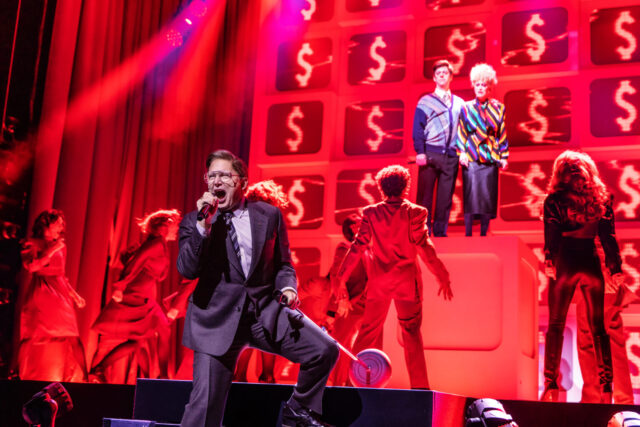
Jerry Falwell (Michael Cerveris) is out to stop Jim and Tammy Faye Bakker and The PTL Club (photo by Matthew Murphy)

The book, by James Graham (Dear England, Finding Neverland), is a paint-by-numbers retelling of Jim and Tammy Faye’s personal and professional relationship, from their meet cute at an event led by Graham — “My brothers and sisters, I cannot do this alone! So, who will join this new Christian army? Stand up and be counted!” — to Jim’s sexual misconduct with church secretary Jessica Hahn (Alana Pollard) and allegations of fraud with his right-hand man, John Fletcher (Raymond J. Lee). Tammy Faye is portrayed as an innocent throughout as well as a free-thinking conservative, especially when, on live television, she hugs Steve Pieters (Charl Brown), a gay pastor who has AIDS, sending Robertson and Falwell into a tizzy and running to Reagan for help.

Elton John’s (The Lion King, Billy Elliot) music is surprisingly bland and uninspired, while the lyrics, by Jake Shears (Tales of the City) of the Scissor Sisters, make excuses for Tammy Faye. “Now that I hear angels calling me home / What’s left of the debt to be paid / Could I have done better / Is the blame mine alone / Will I be forgiven / Or should I be afraid?” she sings in a hospital after being told she has cancer. “You’ve shown me where to find my wings / But I don’t know if they fly / Heavy is the weight of my shame / Questions run like rivers / In the tears that I cry / Will you make me answer for my name?”

Two-time Olivier winner Brayben (Beautiful: The Carole King Musical, Girl from the North Country) has been widely hailed for her performance as Tammy Faye, and it can be electrifying, but there’s a disingenuousness to it; Tammy Faye was a Christian music favorite, releasing such albums as Love Never Gives Up, We’re Blest, and Enough Is Enough, but Brayben plays her as a superstar, as if she were a pop goddess with Janis Joplin talent. There would have been no show at all if director Rupert Goold (American Psycho, Enron) had Brayben sing more like Tammy Faye, but it would have been more honest. Two-time Tony winner Borle (Some Like It Hot!, Something Rotten!) is miscast yet again, failing to capture Bakker’s boring nature, while two-time Tony winner Cerveris (Assassins, Fun Home) can’t get out from under his bad wig.

The set, by Bunny Christie, resembles a 1960s game show, with a large board of squares, like television screens, that occasionally open up to reveal characters; if only Goldie Hawn, Ruth Buzzi, Arte Johnson, or other stalwarts of Rowan & Martin’s Laugh-In could appear to provide a good laugh.

The night I went, the most exciting moment was when two-time Tony nominee Andrew Rannells (The Book of Mormon, The Boys in the Band) held court during intermission from his tenth-row-center seat; Rannells was nominated for an Olivier for playing Jim Bakker in the London production, but he opted not to continue the role on Broadway, citing a contract dispute, although perhaps he also saw the writing on the wall.

Meanwhile, the temperature in the theater never rose past lukewarm. Audience response was tepid at best, and not just because there were a lot of empty seats. It was embarrassing when the actors asked for applause, as if we were watching a broadcast of The PTL Club, and not much came. And Finn Ross’s video design is hectic and inconsistent — and downright annoying when live projections reveal Tammy Faye getting ready in her dressing room, applying makeup and singing, her voice not synched exactly to the video, a prime example of how off-kilter everything is.

It’s always sad when a show closes early, leaving many hardworking and talented people out of a job. But just as the Bakkers accepted millions of dollars from their true believers and were busted for fraud, it would be hard to justify spending any of your money on this all-around-disappointing musical.

“Just reach out and open your hands,” Tammy Faye sings in “Open Hands — Right Kind of Faith.” In “If Only Love,” she promises, “We all possess the strength we need / If you believe, then you’ll succeed.” But it takes much more than just open hands and faith.

[Mark Rifkin is a Brooklyn-born, Manhattan-based writer and editor; you can follow him on Substack here.]
UNHAPPY ENDINGS: THE LONELINESS OF THE WELL-MEANING THEATER CRITIC

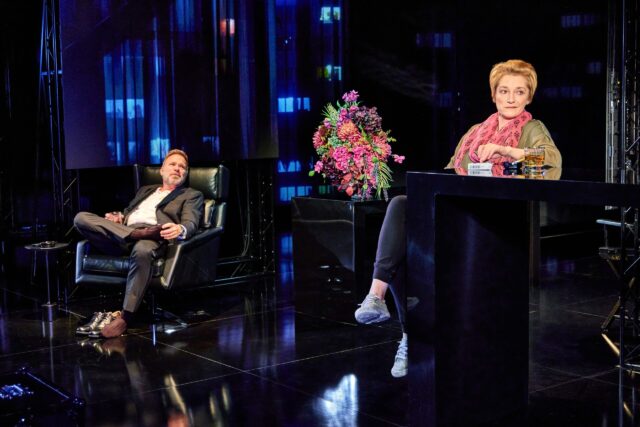
Peter Gallagher and Juliana Margulies star in Delia Ephron’s Left on Tenth (photo by Joan Marcus)

One of the most fun parts of being a theater critic is engaging with your fellow stage pundits. We greet one another before and after shows and during intermissions, discussing what we’ve seen lately that we’ve liked — and what we haven’t.

We have an unofficial community on social media, where we post our reviews and comment on those of others. While some appreciate different opinions, acknowledging that we all approach theater with personal biases, both conscious and unconscious, others are more insistent that their take is right and anyone who disagrees got it wrong.

One particular critic becomes dismayed on those rare occasions when she and I actually agree on a show.

Like I said, it’s fun.

But it can become disheartening when you find yourself on the opposite side of the fence from nearly all of your respected colleagues, which has happened to me often these last few extremely busy weeks.

I was charmed and delighted by author and screenwriter Delia Ephron’s Left on Tenth at the James Earl Jones Theatre, her adaptation of her 2022 memoir about finding love at the age of seventy-two shortly after losing her husband, Peter Kass, and right before finding out she has acute myeloid leukemia (AML). Julia Margulies stars as Delia, who often breaks the fourth wall and talks directly to the audience. Speaking of her childhood, she explains early on, “Every time I said something funny, my dad shouted, that’s a great line write it down. All four of us sisters grew up to be writers. But my parents were also angry alcoholics. My childhood was scary, often violent. With Jerry, I found my first true home. My first safe place. Now he wasn’t going to be here . . . Now . . . what?”

After writing an article in the Times about the trouble she had reconnecting online when Verizon canceled Jerry’s landline and, mistakenly, her internet access, she is contacted by Peter Rutter, a Jungian psychoanalyst who had briefly dated her in college, even though she does not remember him. Peter is elegantly portrayed by the ever-handsome Peter Gallagher. They rekindle their once-upon-a-time almost-relationship with passion and excitement — yes, older people can get hot and heavy — and he stands by her when she is hospitalized and things look bleak.

The play is directed by five-time Tony winner Susan Stroman and features Peter Frances James and Kate MacCluggage as multiple characters who make unbelievably fast costume changes. Although the show does get treacly, there was more than enough quality scenes for me to recommend it. My colleagues have not been kind to the play, writing, “Left on Tenth has the energy and the color scheme of a drugstore greeting card,” “Left on Tenth, billed as a romantic comedy, only fulfills half that description,” and “more suitable to the Hallmark Hall of Fame than Broadway.”

Although I don’t think so, perhaps my longtime admiration of Gallagher got in the way of my judgment? Thirty years ago, my wife and I moved into an apartment that was previously owned by him. (There was a lawyer in between who purchased it but never lived there, selling it to us.)

About twenty years ago, I met Gallagher at Powerhouse Theater’s annual New York Stage & Film benefit in Manhattan. Standing behind him, I said my address out loud so he could hear me. He whipped around and barked, “Who are you!” I calmed him down and explained that I now was in that apartment and told him that we occasionally still received junk mail for him. We talked about some of the unique advantages to the place. He then turned serious.

“You have to promise me something,” he said. “What?” I asked. Peter: “Is the yellow bookcase in the hall still there?” Me: “Yes.” Peter: “Promise me you’ll never take it down.” Me: “Why?” Peter: “Because I built in with my own two hands.”

I couldn’t help but think of that bookcase as I entered the James Earl Jones Theatre and saw that Beowulf Borritt’s main set is anchored by a gorgeous, filled-to-the-brim semicircular bookcase in Delia’s apartment. (It switches between that room, a restaurant, and the hospital where Delia is treated.) Books are discussed throughout the hundred-minute play; having worked my entire career in children’s and adult publishing, that was another plus for me, especially because it got the details of the industry right, which is rarely the case in theater, TV, and movies.

However, four other shows left me cold and dry, awash in disappointment.

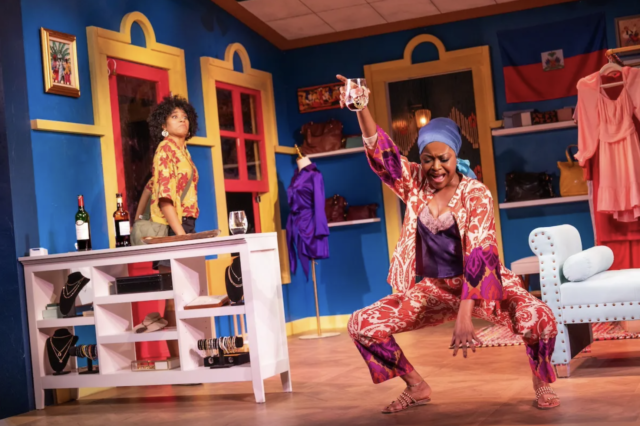
Cousins Simone (Kelly McCreary) and Gigi (Pascale Armand) try to reconnect in Dominique Morisseau’s Bad Kreyòl (photo by Matthew Murphy)

Over at the Signature, I was all set for Dominique Morisseau’s Bad Kreyòl, a coproduction with Manhattan Theatre Club that has been extended through December 1. The Detroit native has been on a thrilling roll with Pipeline in 2017, Paradise Blue in 2018, Skeleton Crew and Confederates in 2022, and Sunset Baby earlier this year. Maybe it was a bad night — critics generally have several performances to choose from, so they are not seeing the same exact show — but Bad Kreyòl felt like a work-in-progress, unfinished, its characters not yet fully developed.

Simone (Kelly McCreary), a Haitian American, is returning to the island for the first time in thirty years, staying with her cousin Gigi (Pascale Armand), who runs a boutique with the help of Pita (Jude Tibeau), a gay restavek whose rural family sent him to the city when he was a child in order to get an education and learn a trade. Simone is concerned that the restavek system means Pita is more like an indentured servant; she is also worried about Lovelie (Fedna Jacquet), who sews pillows, ties, scarves, and other items for an import-export company run by Thomas (Andy Lucien), who might be ignoring how women workers such as Lovelie are being abused by one of his male employees. Simone, Gigi, and Pita feel out of place in their dangerous country; they run into trouble as they try to firmly establish their identities and decide what they want out of life.

The night I went, the Irene Diamond Stage at the Signature was about half empty. The audience was almost too quiet during the show’s two hours and fifteen minutes (with intermission) as jokes fell flat and key moments flirted with clichés. Directed by Tiffany Nichole Greene, the play felt muted, lacking energy; I was more interested in the person sitting off to the side who kept taking photos and short videos of the drama.

Meanwhile, here’s what some of my colleagues had to say: “an illuminating reminder that Haiti and its people are much more than just bad headlines,” “a story told with care and intelligence, both warm-hearted and sharp-eyed,” and “confirms her as one of our most consistently interesting playwrights; where will she take us next?”

A young, energetic cast appears in the Lazours’ We Live in Cairo(photo by Joan Marcus)

In the early 2010s, I saw Stefano Savano’s intense documentary Tahrir: Liberation Square and Jehane Noujaim’s powerful fiction film The Square, extraordinary works about the 2010 Arab Spring in Egypt. So I was excited for New York Theatre Workshop’s We Live in Cairo, a musical by Daniel and Patrick Lazour, directed by Taibi Magar, that follows a group of twentysomethings risking their freedom and safety as they carefully take part in the resistance against President Hosni Mubarak and the Muslim Brotherhood during the revolution of 2011.

The score, performed by an onstage band, is sensational, and Tilly Grimes’s ramshackle set is evocative, as are David Bengali’s street-art projections. But the lyrics and staging are too plain, and the acting is merely standard — and I don’t know what I was going to do if one more character ran out in a tizzy through the door at stage left. At two and a half hours with intermission, the show is too long; perhaps it would have been more effective if it had been condensed into a streamlined ninety minutes.

While We Live in Cairo did not receive across-the-board raves, here are some of the favorable quotes from professional reviewers: “a welcome blast of excitement and intelligence,” “underscores the appeal, the importance — and the fragility — of democracy,” “pulses with the promise and enthusiasm of idealistic youth,” and “the most hypnotic, moving, and unique original score so far this year!”

Erika Sheffer’s Vladimir traces one journalist’s attempts to take on Putin (photo by Jeremy Daniel)

Although it closed November 10, MTC’s Vladimir also baffled me. The first act was so unsatisfying that I told my guest that I wouldn’t mind if she went home, but I had to stay for the second act, as is my responsibility. She stayed, and the second act was significantly better, but not enough so to recommend it.

Erika Sheffer’s play was inspired by the real-life story of Russian journalist Anna Politkovskaya, who continued to write negative reports about new Russian president Vladimir Vladimirovich Putin and his government even after she was poisoned. Mark Wendland’s overdesigned set with seemingly endless screens makes you wonder where you should be looking. Francesca Faridany is fine as Raya, but the rest of the cast — two-time Tony winner Norbert Leo Butz, Erin Darke, Erik Jensen, David Rosenberg, and Jonathan Walker — have trouble finding their way through numerous scenes, as Tony-winning director Daniel Sullivan attempts to figure out the convoluted stage. Everything becomes more assured after intermission, although a few of the key subplots border on the absurd.

What did my colleagues think? “Vladimir, beyond many other excellent qualities, feels distressingly current,” “as tough and uncompromising a piece of writing to be seen on a New York stage right now,” “accumulates enough awful truth to leave you sore and shaken,” and “Francesca Faridany and Norbert Leo Butz are towering in this Stoppardian Moscow-set drama.”

Darren Criss and Helen J Shen play Helperbots who fall in love in Maybe Happy Ending (photo by Matthew Murphy and Evan Zimmerman)

Which brings me to the reason I decided to write about this in the first place: Maybe Happy Ending. The instant-smash musical is about two retired Helperbots, Oliver (Darren Criss), a model 3, and Claire (Helen J Shen), the later model 5. They live across the hall from each other in a Seoul apartment complex where they are left to eventually power off forever. They meet-cute when Claire knocks on Oliver’s door because her charger is broken and can’t be fixed — replacement parts for both HBs are disappearing, so it’s clear, and very sad, that their time is limited, just like that of humans. “We have a shelf life, you know that,” Claire explains. “It’s the way that it has to be.”

When Oliver decides to return to his previous owner, James (Marcus Choi), he is joined by Claire for a road trip to Jeju Island; he is sure that James has been waiting years for him to come back because he needs him, while she wants to see the last colony of fireflies on the planet.

Director Michael Arden’s staging is nothing short of spectacular on Dane Laffrey’s magical set. Rectangular boxes open and close on a black screen, revealing the HBs’ differently decorated apartments similar to the way silent films irised in and out of scenes. Red LED lines stream across the screen. Crooner Gil Brentley (Dez Duron) rises from below to sing jazzy tunes. Round shapes are everywhere, representing the circle of life (for robots and humans), from windows, Claire’s soft and pillowy chair, and the moon to the HB logo, images on jazz posters, and Oliver’s beloved records, which he plays on an old-fashioned turntable. It might be 2064, but it’s jam-packed with nostalgic elements from the twentieth century, while George Reeves’s projections are filled with magic.

So why were my guest and I supremely bored through most of the show’s 105 minutes? The book, by Will Aronson and Hue Park, is littered with gaping plot holes that drain the narrative, while the music, by Aronson, and the lyrics, by Park, are more saccharine than sweet. Criss and Shen do an admirable job as the HBs, the former stiff and steady, the latter freewheeling, referencing how technology, especially AI, is becoming more human and personable. But I was not able to get past the numerous shortcomings and found the Brentley character wholly unnecessary and distracting.

Alas, nearly every other reviewer has been gushing with effusive praise: “In its gentle robot way, it helps us see ourselves through freshly brushed eyes,” “an undeniably moving, well-made, adorable musical,” “rapturous music and lyrics,” “an original show, charmingly acted and cleverly staged, with a touching take on love,” and “visually stunning, it epitomizes the journey of appreciation of the human world.”

Of course, when it comes right down to it, I’m right and they’re wrong, as any critic worth his salt should claim, even if, in some cases, I’m alone in, as HB3 calls it, “the world within my room.”

How’s that for a maybe happy ending?

[Mark Rifkin is a Brooklyn-born, Manhattan-based writer and editor; you can follow him on Substack here.]