this week in broadway

RIFF’S RANTS & RAVES: THE FACT OF THE MATTER ON BROADWAY

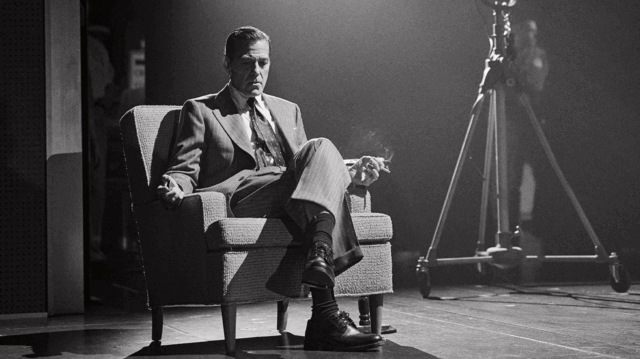
George Clooney stars as Edward R. Murrow in Good Night, and Good Luck at the Winter Garden (photo by Emilio Madrid)

GOOD NIGHT, AND GOOD LUCK
Winter Garden Theatre
1634 Broadway between 50th & 51st Sts.
Tuesday – Sunday through June 8, $329-$849
goodnightgoodluckbroadway.com

In 2005, Good Night, and Good Luck., a film directed by George Clooney and written by Clooney and Grant Heslov, was a big hit, earning six Oscar nominations, for Best Picture, Best Director, Best Original Screenplay, Best Cinematography, Best Production Design, and Best Actor, for David Strathairn’s portrayal of famed newsman Edward R. Murrow, focusing on his battles with Sen. Joseph McCarthy and his reckless search for communist sympathizers in politics and the entertainment industry. Clooney had a supporting role as Fred W. Friendly, coproducer of Murrow’s popular See It Now television program.

Heslov, Clooney, and Tony-winning director David Cromer have now adapted the film into a Broadway play — deleting the period at the end of the title — and for the most part it is an efficient, satisfying show, although it relies too heavily on the film rather than making the most of the opportunities live theater presents.

This time around Clooney takes on the starring role of Murrow, a cigarette-smoking investigative journalist who prefers hard-hitting news stories to celebrity fluff pieces, although he’s told he needs to do the fluff for ratings and to keep the network heads happy; Glenn Fleshler is Friendly, who offers as much support and advice as he possibly can. The narrative is bookended by a speech Murrow gave at the October 1958 Radio-Television News Directors Association Convention in Chicago, where he posits, “This just might do nobody any good. At the end of this discourse, a few people may accuse this reporter of fouling his own comfortable nest, and you all may be accused of giving hospitality to heretical and even dangerous thoughts. It is my desire, if not my duty, to try to speak to you with some candor about what is happening in our mass media. You should know at the outset that I appear here voluntarily, by invitation, and that these remarks are strictly of a do-it-yourself nature.”

The play, about actual events that occurred more than seventy years ago, could not be more relevant today, as the current administration sues television and print media for stories they view as unfavorable and seeks to deport legal and illegal immigrants while eliminating habeas corpus. The production makes its points but can get heavy-handed; what works onscreen does not always work onstage, even one dominated by screens. The projections, by David Bengali, range from archival footage of McCarthy to live video feeds of Murrow’s program. There’s always a lot happening on Scott Pask’s expansive studio set, so, combined with the projections, it is often difficult to know where to look. The musical interludes with Ella (Georgia Heers) singing such jazzy numbers as “When I Fall in Love” and “I’ve Got My Eye on You” help create atmosphere but feel extraneous in a one-hundred-minute show. And the subplots involving anchorman Don Hollenbeck (Clark Gregg) and secret romantic partners Shirley (Ilana Glazer) and Joe (Carter Hudson) get lost.

In his Broadway debut, Clooney is stellar as Murrow, capturing the newsman’s serious demeanor and dedication to his responsibility of telling the truth to the American public. It’s his show, and he commands the stage with grace and elegance. Good Night, and Good Luck has so much to say about then and now that it sometimes overplays its hand, as with an unnecessary political video montage. But it’s solid entertainment and a clarion call for all of us to stand up to bigotry and hatred before it’s too late.

The June 7 performance will be streamed live on CNN for free. In the announcement, Clooney stated, “It doesn’t matter what political bend you are on — when you hear things like, you know, ‘We must not confuse dissent with disloyalty. We must remember always that accusation is not proof and a conviction depends on evidence and due process of law, and we will not walk in fear of one another. We won’t be driven by fear into an age of unreason,’ I think those are extraordinarily powerful words for who we are at our best.”

As the play reveals, we’re going to need a lot more than good luck to get out of the mess we’re in.
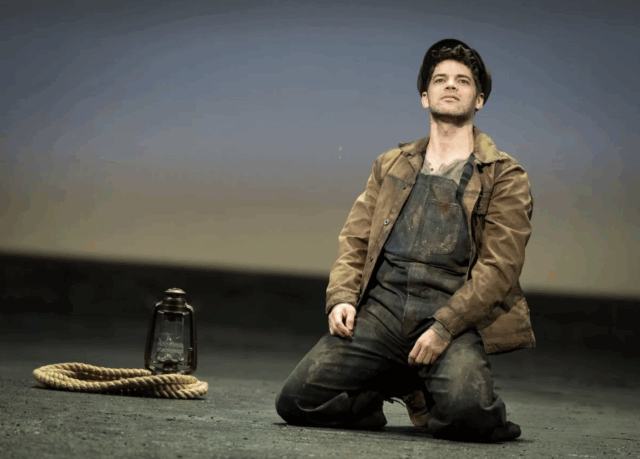
Jeremy Jordan stars as the title character in Floyd Collins at Lincoln Center (photo by Joan Marcus)

FLOYD COLLINS
Vivian Beaumont Theater at Lincoln Center Theater
150 West 65th St. between Broadway & Amsterdam Ave.
Tuesday – Saturday through June 22, $58-$299
www.lct.org

On January 30, 1925, while spelunking to find a cave that could be turned into a tourist attraction, thirty-seven-year-old William Floyd Collins got wedged into a small space, his foot caught under a rock. As members of his family and the community tried to rescue him, Bee Doyle’s farm became a media circus. The tale served as part of the inspiration behind Billy Wilder’s underrated 1951 masterpiece, Ace in the Hole, aka The Big Carnival, starring Kirk Douglas and Jan Sterling.

In February 1996, book writer and director Tina Landau and composer and lyricist Adam Guettel adapted the true story into the musical Floyd Collins, which had a short run at Playwrights Horizons. It is now dazzling audiences at Lincoln Center’s Vivian Beaumont Theater in a thrilling production, again directed by Landau, that has been nominated for six Tonys, including Best Revival of a Musical.

Jeremy Jordan is sensational as Collins, spending most of the show in the front corner of the stage, immobile on a rock shaped like a chaise longue. His brother, Homer (Jason Gotay), and sister, Nellie (Lizzy McAlpine), are desperate to save him, while his father, Lee (Marc Kudisch), is angry that Floyd has gotten into this predicament and his stepmother, Miss Jane (Jessica Molaskey), is concerned but won’t argue with her husband, except when he offers money to Dr. Hazlett (Kevyn Morrow) to go inside the cave. Engineer H. T. Carmichael (Sean Allan Krill) decides that he and his company, Kentucky Rock Asphalt, will handle the rescue, incorporating shafting efforts that Homer believes will be too dangerous and take too long to save his brother, while Lee wants him to stay out of it. Documenting it all is Louisville Courier-Journal reporter Skeets Miller (Taylor Trensch), who becomes deeply involved in the story, even risking his safety by going into the cave to attempt to free Collins himself.

The stage design, by dots, begins as a kind of obstacle course as Floyd makes his way deeper and deeper into the cave, with dark rocklike formations popping up and down as he calls into the void, listening for the echoes to let him know if he’s close to what he’s looking for. The eerie sound is by Dan Moses Schreier, with shadowy lighting by Scott Zielinski and projections by Ruey Horng Sun on a rear screen that change colors as the sun rises and sets. Bruce Coughlin’s bluegrass orchestrations maintain a country feel, save for a few traditional ballads that slow the narrative dramatically, and Anita Yavich’s costumes have an appropriately earthy palette.

Floyd Collins is an exemplary cautionary tale about capitalist greed and a predatory media as well as a tribute to American know-how and dedication, the importance of family, and how freedom can so often be just out of reach. It was a different time, but it still feels real as adults and children continue to get trapped in wells and caves, the world holding its collective breath as rescue is not always possible. It also serves as a potent metaphor for our ability to escape from certain situations we see no way out of, both individually and as a republic.

You can find out more about Collins by visiting the Sand Cave Trail in Kentucky, which leads you to Mammoth Cave National Park, where it all took place.
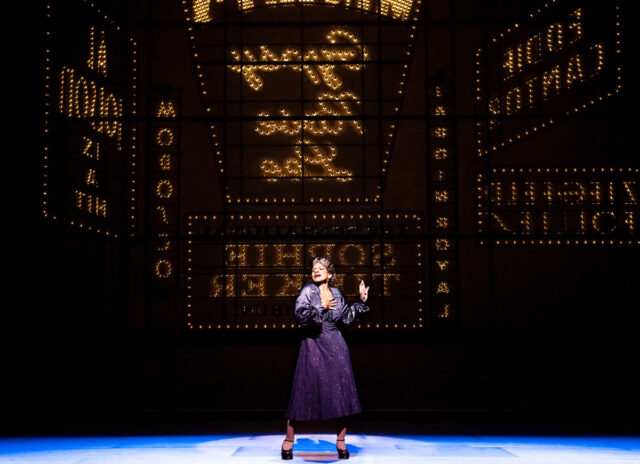
It’s Audra McDonald’s turn at an iconic role, and her performance is unforgettable (photo by Julieta Cervantes)

GYPSY
Majestic Theatre
247 West 44th St. between Broadway & Eighth Aves.
Tuesday – Sunday through August 17, $46-$421
gypsybway.com

Has there ever been more pressure on a performer taking on an iconic musical theater role? In George C. Wolfe’s splendid revival of Gypsy at the Majestic Theatre, six-time Tony winner Audra McDonald is not just following in the lauded footsteps of Ethel Merman, Betty Hutton, Angela Lansbury, Tyne Daly, Linda Lavin, Bernadette Peters, Patti LuPone, Imelda Staunton, Betty Buckley, Tovah Feldshuh, Leslie Uggams, and Beth Leavel in portraying the stage-mother-from-hell — not to mention Rosalind Russell in the 1962 film and Bette Midler in a 1993 TV movie — but her name is essentially part of the title: The marquee and all marketing materials declare: Audra Gypsy. Perhaps not surprisingly, just about everything comes up roses.

Featuring a book by Arthur Laurents, music by Jule Styne, and lyrics by Stephen Sondheim, Gypsy was “suggested” by the 1957 memoir by burlesque legend Gypsy Rose Lee, whose mother, Rose Evangeline Hovick, was obsessed with making her daughters, Rose Louise Hovick and June Havoc, show business superstars. The 1959 Broadway premiere and its numerous revivals have earned a multitude of Tony Awards, and this iteration has been nominated for five, including Best Revival of a Musical and Best Leading Actress for McDonald, the first Black woman to play the part in a major New York production. (Uggams portrayed Mama Rose in 2014 at the Connecticut Repertory Theatre.)

While the three most popular tunes from the show are “May We Entertain You,” “Together, Wherever We Go,” and “Everything’s Coming Up Roses,” the narrative reaches its apex with “Rose’s Turn,” in which Mama Rose grabs center stage and states her raison d’être. “You either got it / or you ain’t. / And boys, I got it! / You like it?” she sings. “Well, someone tell me, when is it my turn? / Don’t I get a dream for myself?” At the end of the song, she repeats over and over again, “For me!,” then takes a series of bows, but it’s not McDonald accepting rapturous applause from the electrified crowd at the Majestic; it’s Mama Rose, basking in the glow of an audience that exists only in her head. The vulnerability of both the performer and the character is almost too much to bear as she reaches out her hands, nods her head, and looks out over an all-encompassing emptiness.

It’s not Mama Rose as monster; it’s every one of us, wondering what could have been, perhaps even what should have been. It’s an unforgettable moment that cements this revival as a unique and celebratory experience.

JUST IN TIME
Circle in the Square Theatre
1633 Broadway at 50th St.
Tuesday – Sunday through December 27, $300 – $916
justintimebroadway.com
www.circlesquaretheatre.com

“I’m Jonathan. I’ll be your Bobby Darin tonight. How about these digs? Not bad for the basement of Wicked,” Jonathan Groff says after the opening medley of “This Could Be the Start of Something Big” and “Just in Time” that kicks off the electrifying biomusical Just in Time at Circle in the Square, underneath the Gershwin, where Wicked has been running for more than twenty years.

Developed and directed by two-time Tony winner and Emmy and Grammy nominee Alex Timbers, Just in Time tells Darin’s life story as if it’s a chronological nightclub act in a flashy, elegant space designed by Derek McLane. The band performs at one end, with a center section of audience members sitting at candlelit tables. Groff is spectacular as a version of himself, not impersonating Darin but embodying his spirit as he belts out such familiar songs as “Beyond the Sea,” “Splish Splash,” “Dream Lover,” and “Mack the Knife.” Andrew Resnick’s arrangements practically explode as the book, by Tony winner Warren Leight and Isaac Oliver, follows Darin, born Walden Robert Cassotto in 1936 in East Harlem, from his childhood, to his earliest songwriting, and through his personal and professional ups and downs in a career that found him going from one of the most popular entertainers on the planet to living alone in the woods, recording folksongs no one wanted to hear.

Darin, who had a weak heart as a result of rheumatic fever as a child, partnered with Don Kirshner (Caesar Samayoa), made records for Ahmet Ertegun (Lance Roberts), fell in love with Connie Francis (Gracie Lawrence), married Sandra Dee (Erika Henningsen), had a son, released more than two dozen albums, appeared in twelve movies (including garnering an Oscar nomination for Captain Newman, M.D.), and never stopped writing and singing right up until his death in 1973 at the age of thirty-seven.

He loved his mother, Polly Walden (Tony winner Michele Pawk), and had a difficult relationship with his sister, Nina Cassotto (Emily Bergl), at least until he found out a shattering truth about them. He hired Nina’s husband, Charlie Maffia (Joe Barbara), to go on the road with him.

While the first act unfurls at a ravishing pace, the show slows down considerably in the second act, when Darin’s troubles mount; there’s not much Leight and Oliver can do, since it’s a true story. But Shannon Lewis’s choreography, Catherine Zuber’s costumes, Justin Townsend’s lighting, and Peter Hylenski’s sound ensures that it all still looks and sounds grand.

The staging is magnificent as Groff and his fantastic trio of sirens (Christine Cornish, Julia Grondin, Valeria Yamin), serving as both backup singers and Greek chorus, roll through Darin’s impressive songbook. “They’re with me everywhere I go — stage left, stage right . . . They’re gonna help me out tonight — and boy, do I need their help — and boy, are they gonna get spat on. And sweated on,” Groff explains. “I’m a wet man, I’m just generally extremely very wet when I do this, and I’m sorry in advance.” He ain’t kidding; folks at the tables might want to cover their drinks when he floats by.

Tony winner and Emmy and Grammy nominee Groff (Merrily We Roll Along, Hamilton) is the heart and soul of the show, and he is utterly mesmerizing every step of the way. It’s a dazzling performance that will take you sailin’ up a lazy river and beyond the sea, splishing and splashing as you hold on to your dream lover and inhale the scent of eighteen yellow roses because Bobby’s back in town.
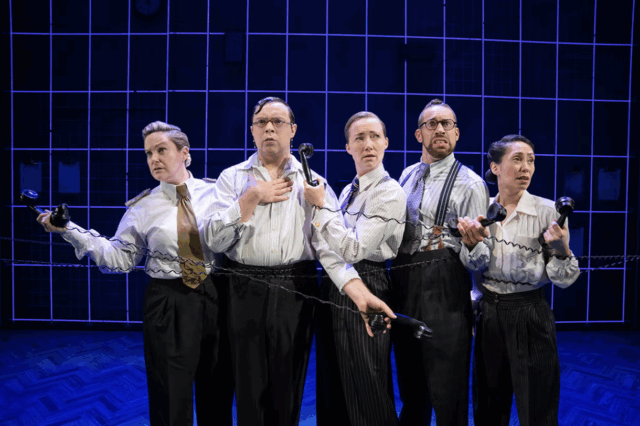
A cast of five tells the remarkable story of a secret Allied WWII mission in Operation Mincemeat (photo by Julieta Cervantes)

OPERATION MINCEMEAT
Golden Theatre
336 West 20th St. between Eighth & Ninth Aves.
Tuesday – Sunday through February 15, $59-$499
operationbroadway.com

The people behind Operation Mincemeat must have given one of the most bizarre pitches in the history of theater: a musical comedy based on a WWII military operation involving a corpse, written and performed by a brand-new madcap troupe of little-known comic thespians known as SpitLip. But it has succeeded magnificently, from its 2019 origins to its two 2024 Oliviers — for Best New Musical and Best Actor in a Supporting Role in a Musical, Jak Malone — and now its 2025 nominations for four Tonys, including Best Musical and Best Performance by an Actor in a Featured Role in a Musical, again for Malone.

It’s 1943, and the Allies are desperate to stop the Axis Powers’ march through Europe. Col. Johnny Bevan tells his MI5 Military Deception team, “Now, as we’re all painfully aware, Hitler’s boys have taken control of mainland Europe, which means the only route back in is through the islands to the South. So the next Allied invasion target is Sicily. And the key to invading Sicily is not invading Sicily. . . . We’re going to convince the Nazis that we’re headed for somewhere else instead. Sardinia, to be exact.”

Intelligence officers Charles Cholmondeley, Ewen Montagu, John Masterman, Reggie Tar, and aspiring spy novelist Ian Fleming submit their ideas to Bevan, who ultimately chooses a plan devised by Cholmondeley and coopted by Montagu with the assistance of clerk Jean Leslie: They handcuff a briefcase to the body of a dead man and have him wash ashore in Spain, with detailed papers revealing that the Allies will be attacking Sardinia, not Sicily.

Joined by MI5 employee Hester Leggatt, the trio of Meryl, Beryl, and Cheryl, pathologist Sir Bernard Spilsbury, submarine captain Bill Jewell, British vice consul Francis Haselden, pilot Willie Watkins, and others, the very strange Operation Mincemeat is underway, but it quickly becomes more complicated than they ever expected.

Boasting such songs as “Born to Lead,” “God That’s Brilliant,” and “Das Übermensch” — along with a glitzy finale titled, well, “A Glitzy Finale” — Operation Mincemeat is like Monty Python on speed, performed by an ultratalented company of only five playing all the roles: The book, music, and lyrics were written by David Cumming (Cholmondeley), Natasha Hodgson (Montagu), and Zoë Roberts (Bevan), and the cast also features Claire-Marie Hall (Leslie) and Malone (Leggatt). Director Robert Hastie somehow manages to have it all make sense amid Ben Stones’s fast-paced set and costume changes.

There have been numerous books written about the military operation, including Ben Macintyre’s 2010 Operation Mincemeat: How a Dead Man and a Bizarre Plan Fooled the Nazis and Assured an Allied Victory, which was first made into a documentary, then adapted into a 2021 film starring Colin Firth, Matthew Macfadyen, Kelly Macdonald, and Jason Isaacs. But none of those prepared anyone for this hilarious musical comedy, which the show references itself.

Hester: And yes it was true, though they’d never believe it.
Jean: They’ll say it’s all true, they’ll never believe it.
Hester: We did all we could do, and if they’d never see it,
Jean: We did what we do, and they’ll never see it.
Hester: We worked and we prayed and it wasn’t in vain.
Jean: And we’ll keep on going.
Hester: We knew pain could be strength and that strength could be pain.
Jean: Even though they’ll never know we . . .
Hester and Jean: . . . forced all their forces to fly!

Believe it or not, Operation Mincemeat flies high.

[Mark Rifkin is a Brooklyn-born, Manhattan-based writer and editor; you can follow him on Substack here.]
EVERYTHING’S NOT COMING UP ROSES: OLD FRIENDS ON BROADWAY

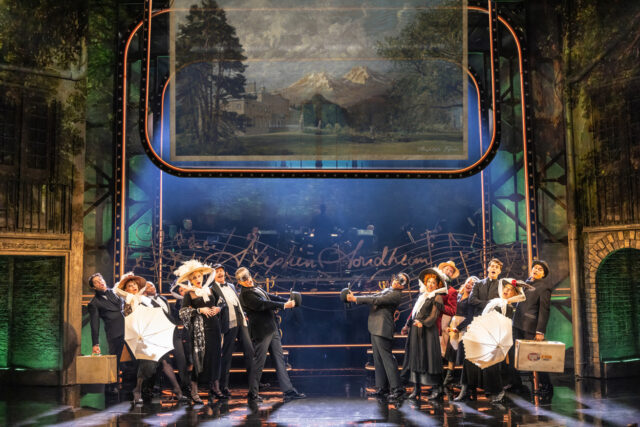
Stephen Sondheim’s Old Friends honors the theater legend on Broadway (photo by Matthew Murphy)

OLD FRIENDS
Samuel J. Friedman Theatre
261 West Forty-Seventh St. between Broadway & Eighth Ave.
Tuesday – Sunday through June 15, $110-$422
www.manhattantheatreclub.com

During intermission of Stephen Sondheim’s Old Friends at the Samuel J. Friedman Theatre, I thought about how much the surprisingly underwhelming MTC production felt more like a gala fundraiser than a fully fledged musical — especially one that bills itself as “a great big Broadway show.”

When I got home, I discovered that was precisely the case: It started out as a one-night-only concert presented on May 3, 2022, in London’s West End, a collaboration between Stephen Sondheim and producer Cameron Mackintosh to celebrate their long friendship. Sondheim had died on November 26, 2021, but the show went on, and the concert turned into a tribute to the eight-time Tony winner and New York City native. It was then adapted for a run at the Gielgud Theatre in London on its way to the Great White Way.

Old Friends is two and a half hours (with intermission) of Sondheim songs, performed by an ensemble of nineteen actors, highlighted by two-time Tony winner and four-time Emmy and Grammy nominee Bernadette Peters, who has appeared in five Sondheim shows, and Tony winner and two-time Grammy nominee Lea Salonga, whose only previous Sondheim credit is a 2019 Manila production of Sweeney Todd in which she played Mrs. Lovett. Peters and Salonga introduce the show to uproarious applause but neither is the standout, as a few others steal the spotlight.

The show consists of forty-two songs from fourteen musicals, mostly staged in front of a glittery raised bandstand where the fourteen-piece orchestra performs. The singers and dancers come out for each number in different costumes by Jill Parker, often inspired by the original production, and range from classy to silly. Matt Kinley’s set also features two sliding towers on either side; George Reeve adds projections of the New York City skyline, a forest, and other locations on the back brick wall and on small screens that descend from the ceiling.

Director Matthew Bourne and choreographer Stephen Mear are never able to achieve any kind of flow in the proceedings, primarily because the members of the cast all have distinct styles, vocal ranges, and physical abilities. In addition, the numbers just don’t stand up on their own; Peters tries to bring heft to “Children Will Listen” (Into the Woods), “Send in the Clowns” (A Little Night Music), and “Losing My Mind” (Follies) and Salonga belts out “Everything’s Coming Up Roses” (Gypsy), but it feels more like a cabaret revue with syrupy arrangements.

Faring much better are understudy Paige Faure, who is hilarious as the disgruntled bride-to-be in “Getting Married Today” from Company, Bonnie Langford, who nails “I’m Still Here” as Carlotta Campion from Follies, and Tony winner Beth Leavel, who knocks it out of the park as Joanne in “The Ladies Who Lunch” from Company.

The men, led by Gavin Lee (“Live Alone and Like It” from Dick Tracy), Jason Pennycooke (“Buddy’s Blues” from Follies), Jeremy Secomb (“My Friends” from Sweeney Todd), and Kyle Selig (“Everybody Ought to Have a Maid” from A Funny Thing Happened on the Way to the Forum with Lee and Secomb), all overplay their hand, trying too hard.

Songs from West Side Story, Sweeney Todd, Into the Woods, and Sunday in the Park with George receive more detailed stagings but get lost in the shuffle. There are also tunes from Anyone Can Whistle, Passion, Merrily We Roll Along, Bounce, and The Mad Show with such other performers as Jacob Dickey, Kevin Earley, Jasmine Forsberg, Kate Jennings Grant, Bonnie Langford, Joanna Riding, Maria Wirries, and Daniel Yearwood.

There’s an adorable clip of Sondheim at the piano with Andrew Lloyd Webber from the two-day June 1998 concert Hey, Mr. Producer!, which lauded Mackintosh’s career, but it also reinforces how bumpy and uneven the evening is and how much better it could have been. There’s a reason why Old Friends received no Tony nominations and only one Drama Desk nod, for Mick Potter’s sound design; I can confirm that the show sounds terrific.

[Mark Rifkin is a Brooklyn-born, Manhattan-based writer and editor; you can follow him on Substack here.]
SEARCHING FOR HAPPINESS: ANDREW SCOTT AND SARAH SNOOK GO SOLO

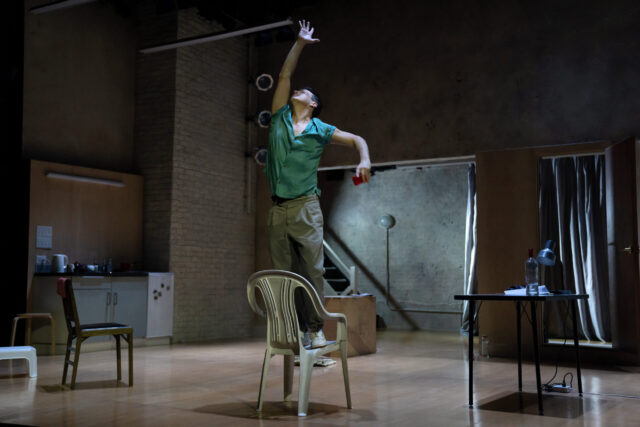
Andrew Scott reaches for dying hope in Vanya at the Lucille Lortel (photo by Julieta Cervantes)

VANYA
Lucille Lortel Theatre
121 Christopher St. between Bleecker & Hudson Sts.
Tuesday – Sunday through May 11
lortel.org/currently-playing

There are currently two extraordinary solo shows, one on Broadway, one off, based on classic literary works from the 1890s, and they could not be more different.

Both feature extremely talented and sexy award-winning actors from English-speaking countries overseas; in one, the performer creates a warm, intimate space, attempting to make individual eye contact with each of the 299 audience members, while in the other the star spends nearly the entire show looking directly into onstage cameras, although every one of the 1,025 audience members will feel the power and intelligence in that gaze.

At the Lucille Lortel in the West Village, Dublin-born Andrew Scott, a three-time Emmy nominee and two-time Olivier winner who has portrayed Moriarty in Sherlock, the hot priest in Fleabag, the title character in Ripley, and Adam in Andrew Haigh’s well-received 2023 film, All of Us Strangers, is taking on all eight roles in Simon Stephens’s adaptation of Anton Chekhov’s 1899 Uncle Vanya, called simply Vanya.

Meanwhile, Adelaide-born Sarah Snook, an Emmy and Olivier winner who is most well known as Siobhan “Shiv” Roy in Succession, plays all twenty-six parts in Kip Williams’s adaptation of Oscar Wilde’s 1890 novella, The Picture of Dorian Gray.

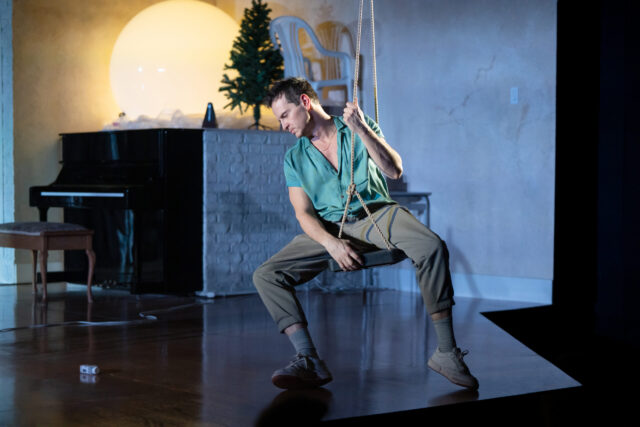
Under the whimsical direction of Sam Yates — who created the show with Scott, writer Stephens, and scenic designer Rosanna Vize — Scott, whose only previous New York stage appearance was in David Hare’s The Vertical Hour in 2006–7, employs only subtle shifts in his performance to indicate which character he is at any given moment, with slight vocal changes and the use of such objects as a tennis ball, sunglasses, a necklace, and a scarf. Vize’s attractive set includes a kitchen with a working sink, a door standing by itself in the center, a piano with a small Christmas tree on it, a glowing orb, a table with a lamp and bottle of booze, a large swing, and a curtained back wall that opens to reveal a mirror in which the audience can glimpse themselves, a way to combat the solitude of the solo performer and involve the audience even further.

It definitely helps to know the basics; as one colleague noted to me after the show, “I enjoyed it, but was it Uncle Vanya?” Over the years, the play has proved to be malleable, reshaped and reimagined into various time periods and locations and methods of storytelling. Tony winner Stephens, who has written such diverse presentations as The Curious Incident of the Dog in the Night-Time, Heisenberg, and Blindness, sets his version in an undefined time and place, although it seems to be the latter part of the twentieth century, before cell phones and home computers; he has Anglicized the names, added nearly three dozen F-bombs, and references the 1994 Johnny Depp movie Don Juan de Marco.

Ivan (Ivan Petrovich “Vanya” Voynitsky) and his niece, Sonia (Sofya Alexandrovna), run the family estate owned by Alexander (Aleksandr Vladimirovich Serebryakov), Sonia’s father; a pompous film director, he was married to Anna, Ivan’s late sister and Sonia’s mother. Alexander has arrived with his much younger second wife, Helena (Yelena Andreevna), who is lusted after by Ivan and the local country doctor and environmentalist, Michael (Mikhail Lvovich Astrov). Ivan’s cranky, well-read, aging mother, Elizabeth (Maria Vasilevna Voynitskaya), lives at the estate, along with the old nurse Maureen (Marina Timofeevna) and Liam (Ilya Ilich “Waffles” Telegin), a poor landowner and family friend who has not gotten over his wife’s desertion with another man years before, opting to remain faithful to her until her utterly unlikely return.

Andrew Scott takes a swing and scores as eight characters in solo Uncle Vanya (photo by Julieta Cervantes)

The play opens with a conversation between Michael and Maureen that relates to all the characters:

Michael: How long have we known each other, Maureen?
Maureen: Oh my god, Jesus. Let me think. You came here for the first time, when was it, when Anna, Sonia’s mother, was sick? Then you had to come again the next year. That was two visits in two summers before . . . before she died. So that’s eleven years, is it?
Michael: Have I changed, do you think?
Maureen: Oh god yeah. You have. You used to be so handsome. And you were so young then, Michael, and now you’re old. And of course you drink more than you used to, Michael.
Michael: Yeah . . . Yeah I’ve worked myself to the bone. I’m on my feet all day. I never rest. And then you get home and you pray to God a patient isn’t going to call you out again. But they do, they always do. So in all the time I’ve known you, Maureen. In the last decade. I’ve not had a single day off. What do you expect me to do but get old? And then you look around you and all you can see are lunatics. The people here are lunatics, Maureen. Every single one of them. And when you surround
yourself with lunatics, after a while, you become a lunatic too. I’ve started growing my own carrots. Little tiny carrots. How did that happen? See, I’ve become a lunatic too. It’s not that I’m losing my mind. My brain is still largely in the right place. But my feelings are dull and dead. I don’t want anything. I don’t need anything. I don’t love anybody. Except you. I love you, Maureen.
Maureen: Are you sure you don’t want a drink?

Shortly after that, Ivan, who deeply resents Alexander, explains to Michael and Maureen that he hasn’t been sleeping well, “ever since Alexander and his new wife got here. They’ve knocked our lives completely out of kilter. I sleep really deeply at absolutely the wrong times of day. I’m eating all this weird food. From, like, Kabul. I’m drinking wine in the day. It’s not good for me, Doctor. It’s not good for me at all. Before they got here I didn’t have a moment to spare, did I, Maureen? I was working all the time. Me and Sonia were. Preparing the harvest. Managing the orders. Making deliveries. Now it’s just Sonia that’s doing everything, because all I do is eat, sleep, drink, repeat, eat, sleep, drink, repeat!”

But when Alexander reveals his plans for the estate and Ivan catches Michael with Helena, one of the most famous guns in the history of theater explodes.

Vanya is a unique and thrilling experience. Scott is absolutely magnetic; you won’t be able to take your eyes off him, just as it feels like he can’t take his eyes off you. There are odd moments; turning Alexander into a film director feels unnecessary, and a sex scene is both steamy and awkward, given that Scott is playing both roles.

But overall, the hundred-minute show is as wistful and funny as it is heart-wrenching and touching. The incorporation of the piano to recall Anna is haunting, and the swing evokes a more innocent childhood for Ivan, Scott, and the audience.

Early on, Elizabeth tells Ivan, “You’ve changed, Ivan. Sorry, Sonia, but it’s true. You’ve become cynical. I barely recognize you these days. You had a good soul. You used to be so clear in your convictions. They used to shine from you. . . . What’s odd, Ivan, is that it’s like you blame your misery on your convictions. Your convictions aren’t the problem. You’re the problem. You never put your convictions into practice. You could have gone out and done something. You never did.” Vanya responds, “Done something? Do you have any idea, Mother, how difficult it is to go out and ‘do something’ nowadays?” That’s an exchange everyone can relate to in 2025.

So is it Uncle Vanya?

In Andrew Scott’s capable hands, does it matter?

Sarah Snook portrays all the characters in unique staging of Oscar Wilde classic (photo by Marc Brenner)

THE PICTURE OF DORIAN GRAY
Music Box Theatre
239 West 45th St. between Broadway & Eighth Aves.
Tuesday – Sunday through June 29, $74–$521
doriangrayplay.com

Sarah Snook is sensational in her New York stage debut, portraying all the characters in Kip Williams’s exciting solo adaptation of Oscar Wilde’s beloved homoerotic gothic horror morality tale, The Picture of Dorian Gray. For two hours without intermission, Snook, who won an Olivier for her performance in London, ambles across the stage, followed by several mobile cameras operated by Clew, Luka Kain, Natalie Rich, Benjamin Sheen, and Dara Woo, dressed in black, stopping behind and in front of several large screens hanging from the ceiling. A giant Snook is projected onto the screens, dominating the theater as she smiles, winks, and nods knowingly while the dark story unfolds.

The genius in the Sydney Theatre Company production is that the onstage Snook interacts with prerecorded versions of herself as the other characters; thus, the live Snook is seen having conversations with the others on the screens, sometimes several at a time, all aware that they are being looked at and reveling in that connection.

Artist Basil Hallward has painted a portrait of a beautiful young man named Dorian Gray. Showing the work to his aristocratic friend Lord Henry “Harry” Wotton, who wants it to be shown publicly at a prestigious event, Hallward declines, explaining, “I know you will laugh at me, but I really can’t exhibit it. I have put too much of myself into it. . . . Harry, every portrait that is painted with feeling is a portrait of the artist, not of the sitter. The reason I will not exhibit this picture is that I am afraid that I have shown in it the secret of my own soul.”

Dorian arrives at the studio to continue to pose for Basil, who does not want Lord Wotton to corrupt his innocent young model and new friend. He tells Harry to stay away from him, offering, “He has a very bad influence over all his friends, with the single exception of myself.” Dorian asks, “Have you really a very bad influence, Lord Henry? As bad as Basil says?” Lord Wotton replies, “There is no such thing as a good influence, Mr. Gray. All influence is immoral.” Saying he is glad to have met Lord Wotton, Dorian admits, “I wonder shall I always be glad?”

Upon seeing the finished portrait, Dorian is blissful yet taken aback. “How sad it is! How sad it is! I shall grow old, and horrible, and dreadful. But this picture will remain always young. It will never be older than this particular day of June,” he declares. “If it were only the other way! If it were I who was to be always young, and the picture that was to grow old! For that — for that — I would give everything! Yes, there is nothing in the whole world I would not give! I would give my soul for that!”

And thus, the deal is done.

Sarah Snook briefly takes a seat in The Picture of Dorian Gray (photo by Marc Brenner)

Dorian is taken under the wing of Lord Wotton’s aunt, Lady Agatha, and meets such high-society types as the Duchess of Harley, parliamentarian Sir Thomas Burdon, the charming gentleman Mr. Erskine of Treadley, and the silent Mrs. Vandeleur, an old friend of Lady Agatha’s who decided she had “said everything that she had to say before she was thirty.” Among the others who enter Dorian’s kaleidoscopic world are his housekeeper, Mrs. Leaf; actress and puppeteer Sibyl Vane; Francis Osborne, the doorman; chemist Alan Campbell; Dorian’s friend Adrian Singleton; and Sybil’s younger brother, sailor James Vane.

Murder, suicide, and other forms of mayhem ensue as Dorian’s bloom of youth and beauty never seem to fade despite his depravities while the portrait depicts an ever older and more decrepit figure.

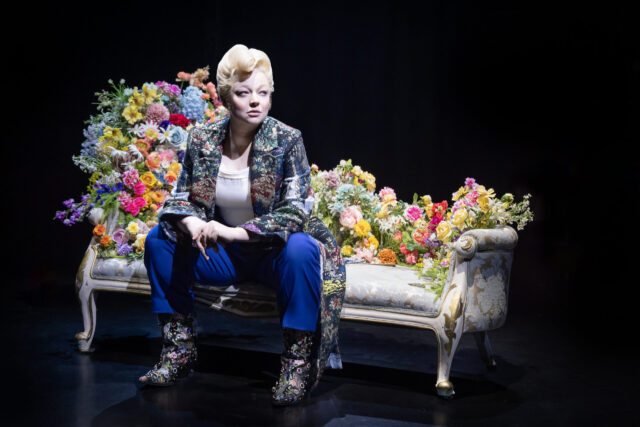
Marg Horwell’s set is mostly spare except for a few props that appear briefly, such as a long table, a puppet show, and an elegant couch with flowers; Horwell’s period costumes and the many wigs Snook wears are fanciful and ornate. The pinpoint precision of Nick Schlieper’s lighting, Clemence Williams’s sound and music, and David Bergman’s video makes it all feel real, especially one scene in which a group is seated at a long table; it is not immediately clear which Snook is the live one. Williams and Bergman also have fun using face filters as Snook cheekily poses for the camera.

The only time Snook is not looking directly into the camera is when she is in the nursery, admiring herself in a handheld mirror; in one corner is a collection of portraits based on paintings by such artists as Sebastiano del Piombo, Jean-Étienne Liotard, and Bronzino, but each now with Snook’s face.

Snook is remarkable as the narrator and all the characters, able to engage with an audience she never actually looks at, acting to be seen on a screen as if the audience is watching a morphing portrait. Despite our being well aware of the artificiality of it all, we fall for the gambit hook, line, and sinker, sucked into this technological marvel; it is a Dorian Gray made for 2025.

It is also an excellent companion piece to Andrew Scott’s Vanya. Just as multiple characters in Stephens’s Chekhov retelling discuss how much others have changed, that concept is key to Dorian Gray as well, and not just in how the man in the portrait deteriorates but Dorian does not. “It’s nigh on eighteen years since I met him. He hasn’t changed much since then. I have, though,” Violet acknowledges. “You are quite perfect, Dorian. Pray, don’t change,” Lord Wotton insists. And Dorian asks of himself, “Was it really true that one could never change?”

In addition, an elusive happiness hovers over Vanya. “I may not have my happiness, Ivan. But I’ve got my pride,” Liam says. Michael debates whether he is happy or not. Sonia asks Helena if she is happy and she answers no. And Alexander brags, “I’m the only happy one in this whole bloody house.” Meanwhile, Lord Wotton says, “Pleasure is Nature’s test, her sign of approval. When we are happy, we are always good, but when we are good, we are not always happy.” And Dorian admits, “I have never searched for happiness. Who wants happiness? I have searched for pleasure.”

In completely different ways, both shows offer pleasures galore, delivering a happiness that will stay with you long after you leave the theater.

[Mark Rifkin is a Brooklyn-born, Manhattan-based writer and editor; you can follow him on Substack here.]

RIFF’S RANTS & RAVES: SIX SHOWS TO SKIP

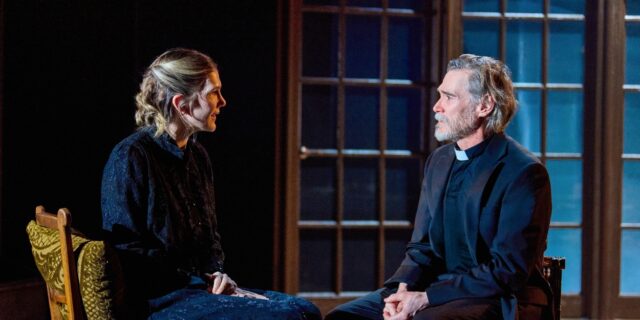
Lily Rabe and Billy Crudup star in Lincoln Center revival of Henrik Ibsen’s Ghosts (photo by Jeremy Daniel)

GHOSTS
Lincoln Center Theater at the Mitzi E. Newhouse
150 West 65th St. between Broadway & Amsterdam Ave.
Tuesday – Sunday through April 26, $98-$182.50
212-362-7600
www.lct.org

Lincoln Center Theater’s current revival of Ghosts, directed by three-time Tony winner Jack O’Brien from a new translation by Mark O’Rowe, begins with two actor/characters reading from the script, repeating lines with slight changes, as if rehearsing in front of the audience, before putting the pages away and starting the play proper. It’s an awkward start.

The play concludes, about 110 minutes later, with a painful, seemingly endless, overly melodramatic scene between a mother and her son, followed by the full cast returning their scripts to the center table. No, we did not just witness a dress rehearsal but a final presentation — one that seems to still need significant work.

In between is a clunky adaptation that is unable to capture the essence of Henrik Ibsen’s original 1881–82 morality tale, which has been seldom performed in New York, save for a Broadway run in 1982 and two versions at BAM, by Ingmar Bergman in 2003 and Richard Eyre in 2015.

The story unfolds on John Lee Beatty’s elegant dining room set. Painter Oswald Alving (Levon Hawke), the prodigal son, has returned home from Paris to his widowed mother, the businesslike Helena (Lily Rabe), who is in the process of signing over an orphanage to the church, represented by Pastor Manders (Billy Crudup). This man of the cloth has convinced Helena not to insure it because to do so would be evidence that she and the pastor “lack faith in God . . . in his divine protection.”

Oswald is attracted to the young maid, Regina (Ella Beatty), whose father, Jacob (Hamish Linklater), is a carpenter working for Mrs. Alving. Jacob’s goal is to open a classy boardinghouse for sailors on the mainland and have Regina join him there. Manders, who enjoys playing both sides against the middle, as if he knows things the others don’t and always has a secret up his sleeve, does not consider Jacob a man of the strongest character.

At one moment the pastor can praise someone, then tear them down in the next, as when he tells Helena, “Your impulses and desires have governed you all your life, Mrs. Alving. You’ve always resented authority and discipline, and as a result, you often rejected or ran away from things that were unpleasant to you. When being a wife became so, you abandoned your husband. When being a mother became so, you sent your son away to live with strangers … and as a result, you’ve become a stranger to him.”

A tragic event shifts the relationships as devastating facts explode all over.

Ghosts feels like a ghost of itself; while it has its moments, in the end nothing solid remains. The show merely dissipates into the air; failing to resonate today, it seems to get lost in the ether. The performances are uneven, and the conclusion is the final nail in the coffin.

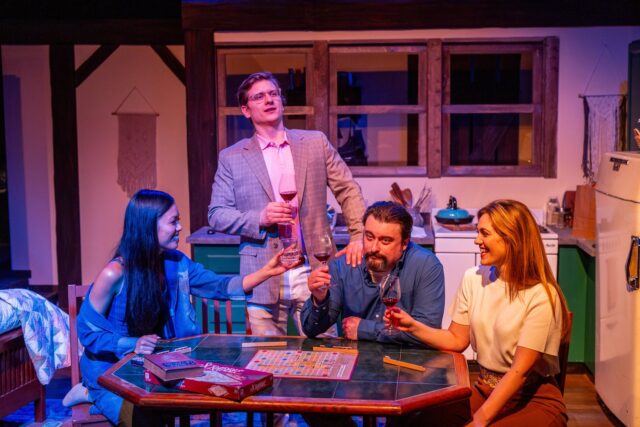
Two couples face a possible apocalypse in Eric Bogosian’s Humpty Dumpty (photo by Matt Wells)

HUMPTY DUMPTY
The Chain Theatre
312 West Thirty-Sixth St. between Eighth & Ninth Aves., third floor
Wednesday – Sunday through May 3, $35
www.chaintheatre.org

Written in 2000 in the wake of the Y2K fears that life as we knew it on planet Earth would end, Eric Bogosian’s Humpty Dumpty is finally getting its New York City premiere, at the Chain Theatre; it’s easy to see what took so long.

Two couples have decided to take a break from their busy lives and head up to a vacation house in upstate New York, in the middle of nowhere. First to arrive are book editor Nicole (Christina Elise Perry) and her novelist husband, Max (Kirk Gostkowski); they are soon joined by Max’s best friend, successful screenwriter Troy (Gabriel Rysdahl), and his actress girlfriend, Spoon (Marie Dinolan). Occasionally stopping by is the property’s handyman, Nat (Brandon Hughes).

“No cable up here. And no fax machine anywhere. Cell phone barely works. And how do we do email?” Nicole complains. Max responds, “We don’t. That’s the point. For one week, we don’t do anything. No faxes. No email.”

They get a whole lot more than they bargained for when the power goes out for an extended period of time and the world outside threatens to turn into a battle zone they have no idea how to deal with, or with all the eggs that come their way.

Soon the five characters are at one another’s throats, but you’re not likely to care, as there’s nothing you’d rather do less than spend any time with these five annoying, self-absorbed nut cases. Because we have no affection for them in the first place, there’s no change in their development as the inexplicable and ever-more-confusing crisis worsens, just more of the same. And there’s not much director Ella Jane New can do on David Henderson’s cramped set.

When Max screams, “Troy, will you shut the fuck up!,” it’s too bad they all don’t listen.

Leonard Bernstein (Helen Schneider), waiter Michael (Victor Petersen), and Herbert von Karajan (Lucca Züchner) share an odd evening in Last Call (photo by Maria Baranova)

LAST CALL
New World Stages
340 West Fiftieth St. between Ninth & Tenth Aves.
Wednesday – Monday through May 4, $39-$159
lastcalltheplay.com
newworldstages.com

Peter Danish’s Last Call is a befuddling new play about an accidental meeting between a pair of giant maestros for the first time in decades. In 1988, American conductor and composer Leonard Bernstein (Helen Schneider) bumped into Austrian conductor Herbert von Karajan (Lucca Züchner) at the Blaue Bar in the Sacher Hotel. The eighty-year-old Karajan was in Vienna to conduct Brahms’s Symphony Number One “for the millionth time,” while the seventy-year-old Bernstein was there to receive “some silly award” — and attend his longtime colleague/rival’s concert. Within two years, they would both be dead.

Their fictionalized conversation was inspired by the recollections of the waiter who served them that night, named Michael (Victor Petersen) in the play, who shared the tale with Danish. Over the course of ninety slow-moving minutes, Bernstein, a Jew who composed such scores as On the Town, Wonderful Town, and West Side Story and conducted extensively with the New York Philharmonic and the Vienna Philharmonic, and Karajan, a onetime member of the Nazi Party who had long associations with the Berlin Philharmonic and London’s Philharmonia Orchestra, needle and praise each other relentlessly; Bernstein tells Michael that Karajan “is the second greatest conductor in the world,” while Karajan suggests that Bernstein, who has stopped conducting because of prostate issues, “could wear a diaper.”

Here’s a sample exchange regarding how Karajan has cut his intake to only one cigarette and one shot of whiskey a day:

Lenny: I find your restraint positively —
Herbert: Admirable? Impressive?
Lenny: Unbearable.
Herbert: It’s called discipline, Leonard! You should try it.
Lenny: Discipline? Oh, please! I speak six languages, play a dozen musical instruments, and have half the classical repertory committed to memory.
Herbert: Only half?
Lenny: Anyway, at this point in my life, I certainly don’t need a lecture about discipline! Look where all your discipline has gotten you! A half dozen strokes, crippling arthritis, bum kidneys!

That might very well be the best moment of the play, which otherwise grows laborious fast. Krajan and Michael occasionally speak in German, with the English translation projected onto a back wall, but it was very difficult to read from my seat. Turning the bar into a urinal — twice — made little sense, especially when the actors portraying the conductors stood way too close to the porcelain, which might be explained at least in part because those actors are both, inexplicably, women. Bernstein repeatedly refers to his fellow conductor as “von Karajan” when it should have been just “Karajan.” And director Gil Mehmert cannot get the actors and action in sync, failing to make the best use of Chris Barreca’s long, narrow set.

It should be last call for Last Call.

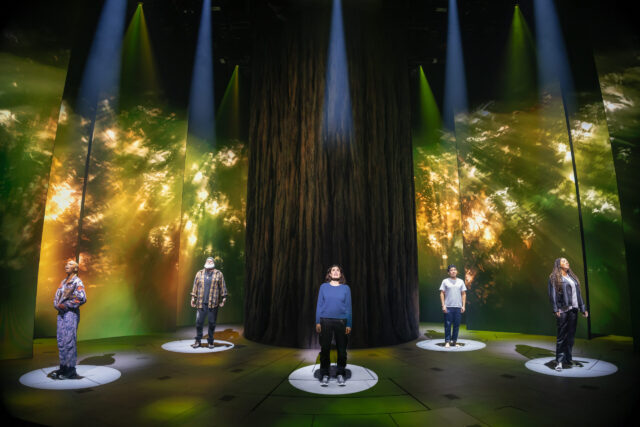
A cast of five tries to climb its way out of a deep hole in Redwood (photo by Matthew Murphy & Evan Zimmerman)

REDWOOD
Nederlander Theatre
208 West Forty-First St. between Broadway & Eighth Ave.
Tuesday – Sunday through May 18, $99.75-$397
www.redwoodmusical.com

Idina Menzel’s heavily anticipated return to Broadway after a ten-year absence is a major disappointment, a vanity project that looks great but never achieves the necessary narrative flow.

Tony winner Menzel (Rent, Wicked) conceived of the show with Tony-nominated director Tina Landau (SpongeBob SquarePants, Superior Donuts), inspired by the true story of Julia Butterfly, the American activist who lived in a giant California redwood tree for more than two years in the late 1990s. Menzel stars as Jesse, a middle-aged woman in need of healing who is escaping her hectic life in New York City and an undisclosed tragedy and fleeing across the country. “I have to find somewhere else to be / where I’m no longer me,” she sings. “So I will drive down these broken lines / past the endless signs — keep on going —” And keep on going she does, with Menzel showing off her truly spectacular pipes, although it seems that Jesse’s wife, Mel (De’Adre Aziza), was left with no explanation, much like the audience at this point.

When she finally makes it to the Redwood Forest, she can’t stop annoying a pair of canopy botanists, Finn (Michael Park) and Becca (Khaila Wilcoxon), who are working there. Stilted explicative dialogue (Landau wrote the stultifying book, with lyrics by her and Kate Diaz) ensues, such as the following:

Jesse: Oh, well, um . . . wow, speaking of color . . . How did all these tree trunks become this . . . deep, deep black? Charcoal, onyx, jet, licorice —
Finn: Excuse me?
Jesse: Eigengraui! Bet you never heard of that color. Oh, it’s a game we play at work — who can think of the most synonyms for a particular descriptor. I always win. I’m better than a thesaurus.
Finn: The trees are black because they’ve been burned. Wildfires and prescribed fires. Did you know that redwoods are one of the most fire-resistant species in the world?
Becca: (To herself) And so it begins . . .
Finn: The bark on that tree is over a foot thick —
Becca: He’d lecture a rock if it listened.
Finn: (To Jesse) Yeah, it holds water, and protects the inner heartwood —
Jesse: Heartwood?
Finn: The wood at the center of the tree —
Jesse: The tree has a heart? Like a heart heart?
Finn: Except it’s dead.
Jesse: Dead?
Finn: The heartwood doesn’t carry water or nutrients anymore, but — it’s the strongest part of the tree.
Becca: This is part of the spiel he gives on his tours — you could sign up for one online in the spring — but right now, I’m so sorry, we really do have to get to work.

The plot goes back and forth between the past and the present, from Jesse and Mel’s first date to Jesse’s relationship with her son, Spencer (Zachary Noah Piser), attempting to explain how Jesse ended up in an off-limits tree in a California forest. References to Jewish sayings and prayers, such as Lo Tash’chit (“Do not destroy nature. You must feel for the trees as you do for humans.”) and Tikkun Olam (“repair the world”), bring the proceedings to a head-scratching halt. Plot holes grow so big that you can, well, fit a giant redwood through them.

However, the production can be spectacular, anchored by a huge tree in the center of Jason Ardizzone-West’s tilting set, surrounded by screens on which Hana S. Kim’s immersive projections transport the audience into the forest, all beautifully lit by Scott Zielinski. Mezzanine seating is suggested to take it all in, but even the visuals start to feel repetitive as the story becomes more and more stagnant. The fine cast, also hindered by Diaz’s overbearing score, can’t save the show, which is in need of big-time repairs.

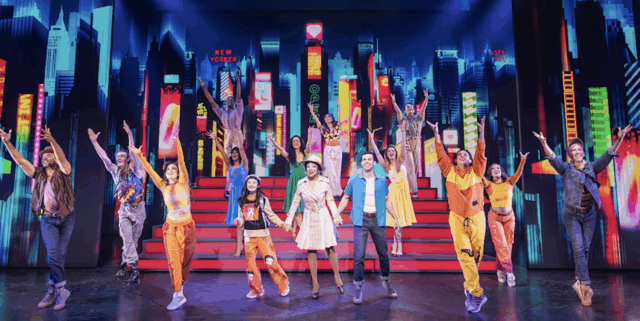
BOOP! The Musical gets off to a great start before falling apart (photo by Matthew Murphy and Evan Zimmerman)

BOOP! THE MUSICAL
Broadhurst Theatre
235 West Forty-Fourth St. between Broadway & Eighth Aves.
Tuesday – Sunday through July 13, $58-$256
boopthemusical.com

BOOP! The Musical opens with a spectacular series of scenes in which Betty Boop (Jasmine Amy Rogers), the classic star of 1930s animated black-and-white shorts, is filming Betty Saves the Day, singing, “I may be one of Hollywood’s ‘It’ girls / But when there’s trouble afoot / This tiny tornado in spit and curls / Goes at it till the trouble’s kaput.” She works with her loyal director, Oscar Delacorte (Aubie Merrylees), and his assistant, Clarence (Ricky Schroeder), and enjoys spending time with her fellow cartoon characters Grampy (Stephen DeRosa), an eccentric Rube Goldberg–esque inventor, and his dog, Pudgy (a puppet operated by Phillip Huber).

When reporter Arnie Finkle (Colin Bradbury) asks her, “Who is the real Betty Boop?,” Betty suddenly begins examining her life. She tells Grampy, “It’s not something a girl like me has any right to complain about. I just . . . well, the attention is getting to be a little much. I’m not talking about men chasing me around a room with drool spilling out of their mouths. A good heavy frying pan takes care of them. I’m talking about being famous. People staring at me, taking my picture and wanting my autograph, or one of my shoes.” She adds, “I’ve played so many roles, I don’t know who I am anymore!”

Dreaming of spending one ordinary day as “Miss Nobody from Nowhere,” she sneaks into Grampy’s trans-dimensional tempus locus actuating electro-ambulator and finds herself at Comic Con 2025 in the Javits Center, where everything is in full color, including her. As she deals with the shock, she is helped by a kind man named Dwayne (Ainsley Melham) and superfan Trisha (Angelica Hale). Everyone breaks out into the roof-raising “In Color,” featuring dazzling costumes by Gregg Barnes, superb lighting by Philip S. Rosenberg and sound by Gareth Owen, fab projections by Finn Ross, and exciting choreography by two-time Tony winner Jerry Mitchell, who also directs. “It’s gonna lift you ten feet off the ground!” an attendee dressed as the Scarlet Witch proclaims, and that’s just how the audience feels as well, being lifted above David Rockwell’s terrific sets.

However, it all comes crashing down back to earth, and the rest of the show is a disappointing slog as the narrative falls apart and book writer Bob Martin, who cowrote Smash, decides the plot doesn’t have to make a bit of sense. Grampy propels himself and Pudgy into the color-future, where he reconnects with his lost love, Valentina (Faith Prince). Trisha brings Betty — now calling herself Betsy, not admitting she is the real Betty Boop — back to her house in Harlem, where she lives with her aunt Carol (Anastacia McCleskey) and her jazz-loving older brother, Dwayne. Carol is the campaign manager for the slimy Raymond Demarest (Erich Bergen), a mayoral candidate obsessed with sanitation. “When you think of solid waste, think Raymond Demarest” is one of his slogans.

Jokes repeat. Songs are unnecessary. Plot twists meander and confuse.

Yes, Max Fleischer’s original Betty Boop films might not have had the tightest scripts, but they had to fill seven minutes; the musical runs two and a half hours (with intermission) and, despite a lovely lead performance by Rogers in her Broadway debut, is unable to sustain itself, losing focus again and again, choosing style over substance, trying to stuff too much into a show that had tremendous potential.

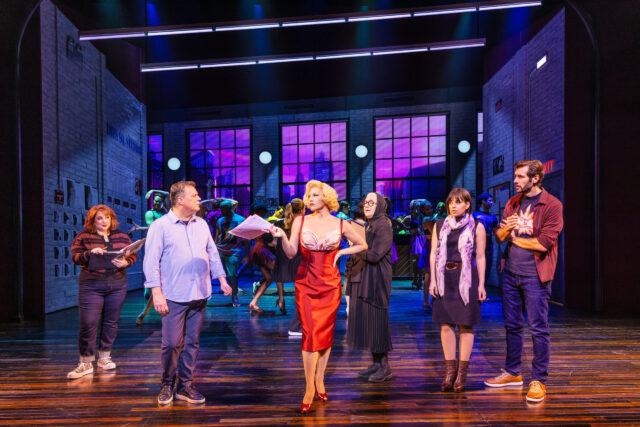
Smash ends up being more of a dud on Broadway (photo by Matthew Murphy)

SMASH
Imperial Theatre
249 West 45th St. between Broadway & Eighth Ave.
Tuesday – Sunday through June 22, $69-$321
smashbroadway.com

Is Smash a smash?

After seeing Smash on Broadway, I did some research on the 2012–13 series it is based on, which I had never watched. Created by Theresa Rebeck, who has written such plays as Seminar, Bernhardt/Hamlet, and I Need That, the NBC show offered a backstage look at the making of a musical based on Marilyn Monroe, called Bombshell, and featured a wide-ranging cast of theater performers, including Debra Messing, Christian Borle, Megan Hilty, Brian d’Arcy James, Jeremy Jordan, Leslie Odom Jr., Krysta Rodriguez, Will Chase, and Katharine McPhee. Rebeck got fired after the first season, and the program was canceled after the low-rated, problematic second season.

The criticisms about the Broadway musical that kept popping up in the reddit threads coalesced around major changes in the central plot, altering character motivations, keeping songs that were now irrelevant, and the inability to decide whether it is camp, a farce, or a more serious look at backstage shenanigans. Many fans also said they’d rather have seen Bombshell itself as a fully fledged Broadway musical instead of the current adaptation which they found undercooked and overwrought, in need of more tinkering and workshopping.

It wasn’t so much the content of the complaints that grabbed my attention as the general chaos they all alluded to and confirmed my thoughts that the Broadway Smash is a dud, a complete mess that is not ready for prime time on the Great White Way.

Robyn Hurder stars as Ivy Lynn, a Broadway fave who has been tapped to play Marilyn in Bombshell, which is being written by the married team of Tracy Morales (Krysta Rodriguez) and Jerry Stevens (John Behlmann) and directed and choreographed by Nigel Davies (Brooks Ashmanskas). Ivy Lynn’s longtime, loyal understudy is the extremely talented Karen Cartwright (Caroline Bowman), whose husband, Charlie (Casey Garvin), is playing Joe DiMaggio and likes to bring homemade cupcakes to the set; Nigel’s assistant, Chloe Zervoulian (Bella Coppola), is charged with trying to hold it all together; and producer Anita Molina Kuperman (Jacqueline B. Arnold) keeps her eyes on the budget, followed along by her social media assistant, Scott (Nicholas Matos).

It’s all thrown into disarray when Tracy and Jerry give Ivy Lynn a book on method acting by Susan Proctor (Kristine Nielsen), who Ivy Lynn hires as her coach; Susan, looking like a witch from The Crucible, convinces Ivy Lynn to remain in character 24/7 and whispers advice in ther ear, often contrary to what the director, cast, and crew are doing. As Ivy Lynn, who is popping pills Susan gave her, becomes more and more nasty and demanding, Karen spends more and more time in the limelight, along with Chloe, as they prepare for a critical dress rehearsal for investors and influencers.

The songs, by Marc Shaiman and Scott Wittman, are repurposed from the TV series but often feel out of place here, with uninspiring orchestrations by Doug Besterman. The book, by Bob Martin and Rick Elice, lacks any kind of cohesion, as characters repeat themselves, relationships grow stale, subplots come and go, jokes about drinking and drugging are offensive, and, basically, most of what happens is hard to swallow, as Tony-winning director Susan Stroman has no chance of making any of it work and choreographer Joshua Bergasse can’t kick it into high gear.

No, Smash is no smash.

[Mark Rifkin is a Brooklyn-born, Manhattan-based writer and editor; you can follow him on Substack here.]
FASHION TALKS AT SHINE BY RANDI RAHM: BROADWAY NIGHT WITH SIERRA BOGGESS AND LAURA BELL BUNDY

Who: Sierra Boggess, Laura Bell Bundy, Nicole Ryan
What: Live, unscripted conversation with drinks, snacks, shopping, and cocktail gathering
Where: Shine by Randi Rahm pop-up boutique, 501 Madison Ave. between Fifty-Second & Fifty-Third Sts.
When: Wednesday, April 2, free with RSVP, 5:30
Why: Randi Rahm’s Fashion Talks at Shine kicked off March 5 with Bachelor Night, featuring Golden Bachelorette Joan Vassos, Bachelorette Charity Lawson, and moderator Nicole Ryan from SiriusXM, followed by Music Night with Jillian Hervey of Lion Babe on March 19. The third edition of the live podcast takes place April 2 with Broadway Night, when Ryan will be joined by actor, singer, and figure skater Sierra Boggess, who has starred in such shows as The Little Mermaid, The Phantom of the Opera, School of Rock, and Harmony, and actor, singer, and Tony nominee Laura Bell Bundy, whose Great White Way career includes Hairspray, Legally Blonde, and The Cottage.

“I always say, I’m in the art of fashion. To me, that means creating something that tells a story — something that moves people,” Rahm said in a statement. “These talks are an extension of that. They’re about connection, creativity, and the courage it takes to share who you really are. Laura Bell and Sierra embody all of that. They’re not only incredible artists but women who lead with heart, humor, and authenticity — and I’m so honored to have them join me in this space.”

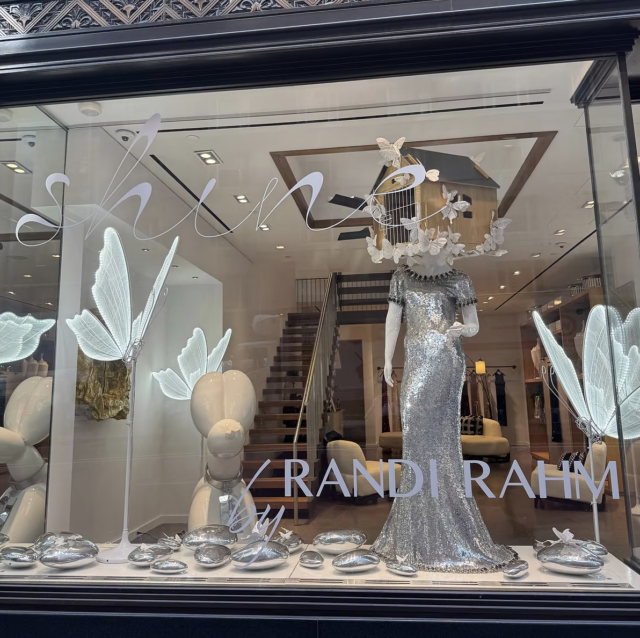
Randi Rahm is hosting a series of fashion talks at Shine pop-up boutique

The intimate, candid conversation will be preceded by a chance to explore Rahm’s new ready-to-wear Shine collection and followed by a cocktail reception and more shopping; tickets are free with advance RSVP.

[Mark Rifkin is a Brooklyn-born, Manhattan-based writer and editor; you can follow him on Substack here.]
BEAUTIFUL UNCERTAINTY: TOM SANTOPIETRO, AUDREY HEPBURN, AND DORIS DAY

TOM SANTOPIETRO AT B&N
Barnes & Noble
2289 Broadway at Eighty-Second St.
Monday, March 31, free, 6:30
212-362-8835
barnesandnoble.com
tomsantopietro.com

“When Audrey Hepburn died at 8 P.M. on January 20, 1993, at the age of sixty-three, she left behind one Academy Award, two Tony Awards, dozens of lifetime achievement awards, her beloved sons Sean and Luca, companion Robert Wolders, millions of fans, universal acclaim as an indefatigable activist on behalf of the world’s children, and one final surprise — a nearly empty closet.

“She had walked away from the church of fame that rules Hollywood and ever-increasing swaths of the general public yet held onto that fame without even trying. Her elusiveness only increased public interest in her films and clothes as well as her life and loves, but Audrey Hepburn had grown uninterested in rehashing old tales of Hollywood glamour and legendary friends. In an industry which based its self-image on endless awards shows, she was, it was safe to say, the only screen idol about whom a son could convincingly state: ‘Being away from home to win an award was really a lost opportunity. Walking the dogs with her sons was a personal victory.’”

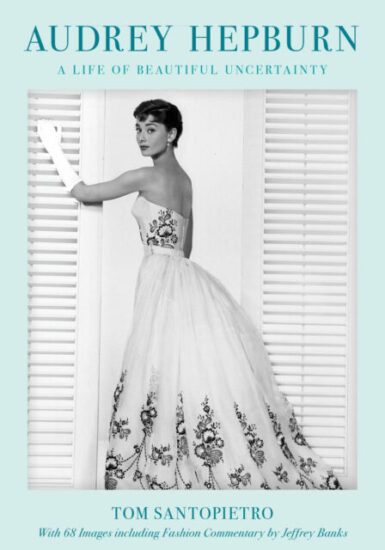
So begins Tom Santopietro’s latest book, Audrey Hepburn: A Life of Beautiful Uncertainty (Rowman & Littlefield, March 2025, $45). Born and raised in Waterbury, Connecticut, Santopietro attended Trinity College in Hartford, then went to the University of Connecticut Law School, also in Hartford.

“I always joke that law school was the three misbegotten years of my life,” Santopietro tells me in a phone interview. “I stayed, I graduated, and as soon as I graduated, I said, I’m never doing this ever. And I never have. You know why? Because I was uninterested. And when it comes to work, we’re all good at what we’re interested in.”

A few weeks before, I had met Santopietro at the Coffee House Club for an Oscars straw vote event he hosted with his friend Simon Jones, who has appeared in such series as Brideshead Revisited, The Hitchhiker’s Guide to the Galaxy, and The Gilded Age (as Bannister) and in New York in such shows as The Real Thing, Privates on Parade, and, most recently, Trouble in Mind.

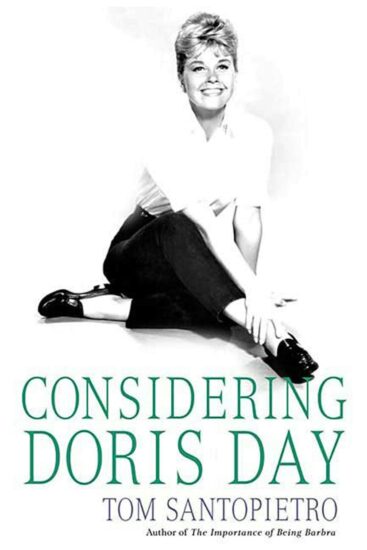
Santopietro is a lovely storyteller, in person and in print. Among his previous books are The Sound of Music Story: How a Beguiling Young Novice, a Handsome Austrian Captain, and Ten Singing von Trapp Children Inspired the Most Beloved Film of All Time; Considering Doris Day; The Way We Were: The Making of a Romantic Classic; The Importance of Being Barbra: The Brilliant, Tumultuous Career of Barbra Streisand; Why To Kill a Mockingbird Matters: What Harper Lee’s Book and the Iconic American Film Mean to Us Today; Sinatra in Hollywood; and The Godfather Effect: Changing Hollywood, America, and Me.

In A Life of Beautiful Uncertainty, Santopietro details Hepburn’s fascinating life and career in five acts comprising sixty-two chapters, including “What Price Hollywood,” “The Last Golden Age Star,” “A Star Is (Not Quite Yet) Born,” “Paris When It Fizzles — 1962–1964,” and “Everything Old Is New Again.” He explores Hepburn’s diverse filmography, from the many hits (Roman Holiday, Love in the Afternoon, The Nun’s Story, Charade, My Fair Lady, Breakfast at Tiffany’s, Funny Face) to a trio of what he calls “mistakes” (Green Mansions, The Unforgiven, Bloodline).

On March 13 at 6:30, Santopietro, who lives on the Upper West Side, will be at the Barnes & Noble on Broadway and Eighty-Second St. to discuss and sign copies of A Life of Beautiful Uncertainty. Below he talks about speaking with Doris Day and Alan Arkin, the decline of theater etiquette, celebrities’ charitable work, and his favorite Audrey Hepburn film.

Tom Santopietro will be at Upper West B&N March 31 for NYC launch of his latest book (photo by Joan Marcus)

twi-ny: Where did your love of movies come from?

tom santopietro: When I was a little kid, I always liked movies. But what really accelerated it was when I was at Trinity, I took film courses at Wesleyan, which is in Middletown, and their film department was headed by an incredible woman named Jeanine Basinger. Have you ever met Jeanine?

twi-ny: I haven’t, but I know of her.

ts: She was on the board of the AFI. She was an extraordinary teacher who ignited my love of old films and Hollywood. And that’s where it really took off. Jeanine showed me possibility, and that’s what’s so great. That’s what great teachers do. So anyway, that’s where it really took off. And then I came to New York and worked on several Broadway shows, which I still do, but about twenty years ago, I thought, I want to do something more creative. And that’s how I started to write.

twi-ny: That was your first book, The Importance of Being Barbra, which was published in 2006.

ts: I’ve been fortunate and lucky, and I always joke, I didn’t tell anybody I was writing a book because I thought, What if I don’t finish it? And what if it’s really bad? And then when it was done, I sent it to my oldest friend, and a couple of days later, he called me back. And in a voice of total surprise, he said, It’s good. So I still laugh about that. And that led to Doris Day, Frank Sinatra, and then the Godfather movies.

twi-ny: I’m looking at the books you have written and their subjects. This is something we talked about at the Coffee House, that they’re all beloved icons, beloved films, beloved characters; there’s a lot of love in the room. And one of the things you told me was that that’s one thing you do when choosing a subject.

ts: Yeah, I really do. Because I think, well, you know this, you are a writer. I always say I don’t want to write a book about Stalin because I don’t want that monster in my head for three years. So these are people whose talent I admire so much. And also what I realized, Mark, and this just came to me when the Audrey book was completed, I thought, Oh, I’ve completed a trilogy of books about enormous stars, all of whom are incredibly nice, which is so rare in Hollywood. And that’s Doris Day, Audrey Hepburn, and Julie Andrews, these women who are beloved by their costars. And in the same way, I also realized after it was completed, Oh, I wrote a trilogy of books about family, and those were The Godfather, The Sound of Music, and To Kill a Mockingbird.

So I didn’t even realize it until the trilogy had been completed, but whatever was inside of me clearly needed to be expressed.

twi-ny: In the case of Doris Day, you had a conversation with her.

ts: Yes, after the book came out. The phone rang very late one night. It was after eleven, and I answered the phone grumpily.

I hadn’t eaten dinner yet. I had just come in from work. And I said, Well, who is this? And she said, Well, I’ve been trying to reach you from Carmel, California, for a long time. And then I realized it was Doris. Everybody wants to know what it was like. We spoke for an hour; as nice as she was on the screen, she was even nicer on the phone. It’s extraordinary. She was so unbelievably honest and open; she talked about her failed marriages, her love of animals, and Hollywood. So yeah, she was pretty terrific. I wrote that book because I felt she was a huge star who never received her due.

twi-ny: She retired from movies so early in her career.

ts: Another thing in writing about Audrey Hepburn is Audrey Hepburn and Doris Day had a lot of similarities, which was they worked from when they were teenagers nonstop. And then they both walked away from their fame; Doris said, “It means much more to me to work for animal welfare.” And Audrey said, “I want to work for UNICEF.” So that interests me a lot, that in our fame-obsessed society, world-famous women would walk away from it.

twi-ny: Right. And someone like Doris Day — I bet a lot of people don’t realize that she died only in 2019. So there was a long time, even with social media and the internet and everything, that she still wasn’t around. People didn’t know her, except for her charity work, but she wasn’t flooding Facebook with it. So, she was a very private person.

ts: Yes, a very private person. And so was Audrey. And so what interests me, Mark, is we’re a fame-obsessed society today, right?

twi-ny: Oh, yes.

ts: That’s reality television, everybody demanding to be famous.

twi-ny: Even the president.

ts: That’s a really interesting dichotomy. One thing I discovered while researching the Audrey book is that who knew that Audrey Hepburn and Elizabeth Taylor were good friends? They were so opposite as people, but separately, toward the end of their lives, they used the exact same phrase: “At last, my fame makes sense to me.” And that’s because Elizabeth Taylor, with her AIDS activism, and Audrey, with UNICEF, that’s how they defined themselves. And I thought that was worth exploring.

twi-ny: That’s something that also happened and is still happening with Brigitte Bardot. She retired early to spend her life with animals and become an antifur activist. And I bet she would say the same thing as Audrey, Doris, and Elizabeth.

ts: I think that’s true. And because at a certain point, fame and money are nice, but how much does the acclaim of strangers really mean when you want to make a difference? And the difference comes through for these women through their social activism. Audrey was a kind of saint. She was such a good person.

twi-ny: All the people you spoke with, you probably never got a bad quote from anyone. Everybody just loved her. Is that right?

ts: That’s fair to say, and it’s not hyperbole. People who worked on the sets, everyone in the village in Switzerland where she lived, said she was unfailingly good to people. And I think after her war-torn, very disrupted childhood, I think she realized the value of family and the value of treating people with kindness. Because she said toward the end of her life, “The most important thing in life is being kind.” She really lived that.

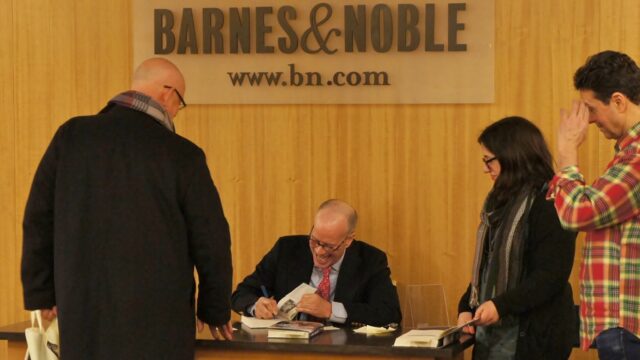
Tom Santopietro signs copies of The Sound of Music Story at B&N in 2015 (photo courtesy Tom Santopietro)

twi-ny: In doing your research and interviews, was there one moment that really struck you or surprised you?

ts: I think the biggest surprise for me is how she really — how do I want to answer this — the reason why I titled the book A Life of Beautiful Uncertainty is that her entire life, she was uncertain of herself. And that was surprising. She genuinely did not think she was pretty. She just saw flaws everywhere. She genuinely did not think she was a good actress. And that shocked me because she was beautiful. And she was a terrific actress. And I think it stems from when, in the span of two months, she won the Tony Award and the Academy Award, and her mother said to her, “It’s amazing how far you’ve gotten considering how little talent you have.” [ed. note: In 1954, Hepburn won the Tony for Ondine and the Oscar for Roman Holiday.]

twi-ny: That haunts people, that kind of stuff.

ts: Yeah. So I think it all comes back to childhood, right?

twi-ny: It so often does.

ts: Barbra Streisand grew those incredibly long fingernails because her mother said, “Well, you should be a typist.” She grew her fingernails so she couldn’t type.

I think the other thing is that because I love films, and this is circling back to what we said earlier, I felt Audrey had never received her due as to how good an actress she was. Everybody says she’s charming and beautiful, but you look at a movie like The Nun’s Story, directed by Fred Zinnemann — that is a spectacularly good performance; the whole performance is with her eyes. And I wanted people to realize how skilled she was, even if she didn’t think she was skilled.

twi-ny: One of my favorite movies, and I don’t know that it would always be at the top of her list, but I adore Charade, which you write about in the book. Even with Cary Grant, Walter Matthau, George Kennedy, James Coburn, all these popular men in the movie, it is all built around her face.

ts: That’s exactly right.

twi-ny: And it’s the best Hitchcock movie Hitchcock didn’t make.

ts: That sums up that movie perfectly.

twi-ny: Do you have a favorite film of hers?

ts: That’s a great question. I know this is a cop-out answer, but I have three favorite films: The Nun’s Story, because her performance is spectacular. And also it’s really interesting the way it grapples with issues of faith and higher powers. My second favorite movie is My Fair Lady, because it’s so beautiful to look at and listen to. And the third one is, believe it or not, Wait Until Dark, because it still scares the living daylights out of me.

twi-ny: Yes. And it’s still scaring us. People who love Alan Arkin don’t realize that he could be pretty threatening.

ts: Toward the end of his life, I was able to interview him over the phone for the book. The funny thing is, when I finally got him, he started the conversation by saying, “Well, I hear you’ve been looking for me.” What he said was that Audrey was so lovely and such a good person that twenty years later, when she received the Chaplin Award from Lincoln Center, he was one of the speakers. And when he saw her, he actually apologized to her and said, I’m so sorry I was so mean to you in that movie, which is sort of amazing.

twi-ny: Can you share publicly who or what your next subject might be?

ts: I actually haven’t really figured out who I’m writing about next because, well, this has taken a long time, but also I wrote a play and it was produced this past summer in Connecticut. So I want to spend time putting the play out in the world for other productions, and it sort of fits in with what I write about because it’s a one-woman play called JBKO, about Jacqueline Bouvier Kennedy Onassis. So that’s really what I’m going to work on next.

twi-ny: Well, this is a good transition, because my last question was going to turn back to theater. You work as a house manager part-time on Broadway.

ts: Yes. I’ve been a general manager, and these days I’m working as a house manager most of the time. I don’t know if you’ve found this too, but because writing is so solitary, it’s really good for me to be around people at night at the theater. So that socialization is great, as long as the audiences are behaving themselves, of course.

twi-ny: That’s where I was going with this. At the Coffee House, we discussed how, since the pandemic, the audience’s relationship with the theater experience, interacting with other people, isn’t the same as when they were going out for a night of theater years ago.

ts: Well, I think it’s a funny thing, but since the pandemic, when people go to the theater, on some level they still think they’re in their living room streaming a show. That’s the only way I can try to make sense of it. When you’re home, you talk, you eat. And it’s different in a Broadway theater. So that’s sort of my best explanation for it.

twi-ny: Right. As someone who goes to a lot of theater, I’ve seen some things that I never had before. It’s like, I paid for my ticket, I can do whatever I want. But no, you can’t. It’s sort of representative to me of how we deal with our fellow human beings in everyday life. Now we’re much more quickly agitated, and people don’t want anyone telling them what to do.

ts: Exactly. Yeah, that has all changed. What hasn’t changed, the positive thing for me, is that theater offers people the sense of being part of a family. Everybody’s there backstage to put on the best possible show. I always say you belong when you walk through the stage door. And that’s a great feeling. That’s the joy of theater for me.

[Mark Rifkin is a Brooklyn-born, Manhattan-based writer and editor; you can follow him on Substack here.]
ENGLISH FIRST: A TICKING TIME BOMB

Omid (Hadi Tabbal) and Marjan (Marjan Neshat) form an intimate bond in Sanaz Toossi’s English (photo by Joan Marcus)

ENGLISH
Todd Haimes Theatre
227 West Forty-Second St. between Broadway & Eighth Ave.
Tuesday – Sunday through March 2, $72-$313
www.roundabouttheatre.org

It might be difficult for non-English speakers to learn the world’s most spoken language, but Sanaz Toossi’s Pulitzer Prize–winning play, English, has made a smooth transition from the Linda Gross Theater to Broadway. In fact, the Atlantic-Roundabout coproduction is even more powerful now given the current US administration’s war on illegal (and legal) immigration and America First policies.

According to the Oxford Digital Institute, English “is the language of international communication,” spoken in more than one hundred countries even though it “is a hard language to learn due to its complex grammar rules, pronunciation variations, and vast vocabulary . . . riddled with exceptions and irregularities, making it difficult to master. Additionally, English has a diverse range of accents and dialects, making it challenging for nonnative speakers to understand and communicate effectively.”

Everything I wrote in my review of the off-Broadway premiere in February 2022 still holds true: Concepts of home and personal identity lie at the heart of Toossi’s poignant and involving work, which continues at the Todd Haimes Theatre through March 2. The play is set in a small classroom in Karaj, Iran, in 2008, where Marjan (Marjan Neshat) is teaching basic English to four students who are planning on taking the TOEFL, the Test of English as a Foreign Language, for different reasons. Marjan insists that they speak only English in the class rather than Farsi, their native tongue.

Roya (Pooya Mohseni) wants to be able to speak with her new granddaughter, who lives in Canada with Roya’s son and his wife, who are not teaching the child Farsi. “I hope you not forget. Nate is not your name,” she tells her son, who used to be known as Nader.

Elham (Tala Ashe) has passed her MCATs but needs to learn English so she can study gastroenterology in Australia. “My accent is a war crime,” she angrily admits.

Omid (Hadi Tabbal) has an upcoming green card interview in Dubai, but his English is already excellent, nearly accentless. When asked why people learn language, he says, “To bring the inside to the outside.”

Goli (Ava Lalezarzadeh) is an eighteen-year-old girl who believes Ricky Martin is a poet. “People like accent,” she says, not ashamed of who she is.

After a presentation by Goli doesn’t go particularly well, Marjan, a married woman who spent nine years in Manchester before moving back to Iran with her family, says, “Don’t be sorry! We were speaking English with each other. I think it’s one of the greatest things two people can do together.”

As Elham’s frustration with English builds — she repeatedly uses Farsi in class, accumulating negative points — she gets into disagreements with everyone else, speaking frankly, without apology. “Goli, people hear your accent and they go oh my god it is so funny you are so stupid. . . . Okay if I have accent, bad TOEFL score. Omid has accent, no green card. Roya’s accent? Disaster.” Some of them equate the attempted erasure of their Iranian accent when speaking English with the loss of their identity, as if they are surrendering their unique culture. “Don’t you think people can do us the courtesy of learning our names?” Elham says to Marjan, who went by “Mary” when she lived in England.

“English isn’t your enemy,” Marjan insists. “English is not to be conquered. Embrace it. You can be all the things you are in Farsi in English, too. I always liked myself better in English.” But Marjan won’t acknowledge to herself that that is exactly the problem. “I feel like I’m disappearing,” she says later to Omid.

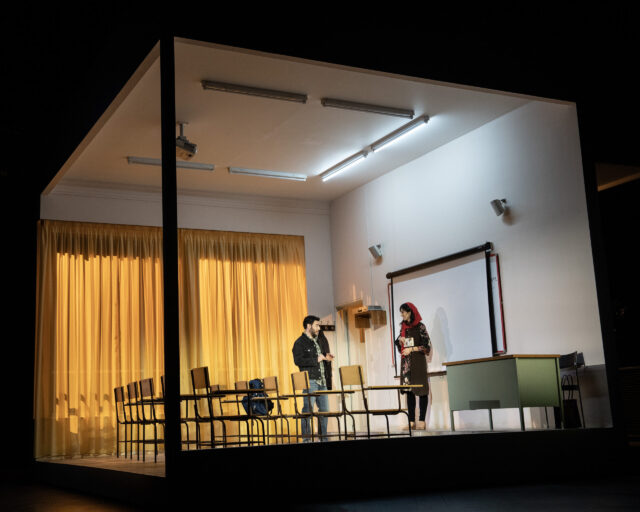
Four students and a teacher learn about life and language in English (photo by Joan Marcus)

English is beautifully written by Toossi (Wish You Were Here) and gracefully directed by Knud Adams (I’m Revolting, Pulitzer Prize winner Primary Trust), giving each character room to develop. Although they go back and forth between English and Farsi, whenever they speak English, the actors use Iranian accents, but when they talk in Farsi, they lose the accent, sounding like plain old longtime Americans, a device that serves as a metaphor for colonialism, nation-building, and ethnocentrism.

One of the only changes from the Atlantic version is that the song Goli plays for show-and-tell has switched from Shakira’s “Whenever, Wherever” to Martin’s “She Bangs,” in which the Puerto Rican heartthrob sings, “Talk to me. Tell me your name. / You blow me off like it is all the same. / You lit a fuse and now I’m ticking away like a bomb. / Yeah baby.”

Marsha Ginsberg’s revolving cube set is open on two sides, revealing the inside and the outside; the movement feels even stronger this time, more precarious. When the rotation stops so a scene can begin, a stanchion might block part of your view of a character, as if they are disappearing.

Enver Chakartash’s costumes meld traditional Iranian clothing, like head scarves, with American accents. The cast is exceptional, quickly forming a cohesive unit; it probably wouldn’t be too much of a stretch to assume they have each had to deal with the issue of making sacrifices to learn a new language and culture in some way, as all of them, in addition to the bilingual Toossi, were either born in Iran or Lebanon or their parents were. English was actually Toossi’s NYU thesis, written in response to Donald Trump’s Muslim travel ban and anti-immigration policies.

About halfway through the play, Marjan tells the class, “If you are here to learn English, I am going to ask you to agree that here in this room we are not Iranian. We are not even on this continent. Today I will ask you to feel any pull you have to your Iranian-ness and let it go. Keep it outside the wall of this classroom. In this room, we are native speakers. We think in English. We laugh in English. Our inhales, our exhales — we fill our lungs in English. No more Farsi. Can we agree to that?” Toossi understands the kind of sacrifices it takes to make a new life in a new country.

In the original production, Farsi was never actually spoken, but on Broadway, the final words are now in the Iranian tongue, a sharp parting shot at what’s happening in America and around the world.

[Mark Rifkin is a Brooklyn-born, Manhattan-based writer and editor; you can follow him on Substack here.]