this week in broadway

THE BLVD. OF BROKEN DREAMS: FADING INTO THE SUNSET

Nicole Scherzinger sizzles as Norma Desmond in Sunset Blvd. revival (photo by Marc Brenner)

SUNSET BLVD.
St. James Theatre
246 West Forty-Fourth St. between Broadway & Eighth Aves.
Tuesday – Sunday through July 6, $59-$424
sunsetblvdbroadway.com

In 2017, the most memorable part of Lonny Price’s Broadway revival of Andrew Lloyd Webber’s Tony-winning Sunset Boulevard took place offstage, when, just before curtain, Hillary Clinton arrived and sat in the orchestra, receiving a standing ovation. It had been less than a month since Donald Trump had taken the oath of office as the newly elected president of the United States, having defeated Clinton in the Electoral College (but not in the popular vote). Close had supported Clinton’s run, so the moment was a palpable one, especially at a show about a woman hell-bent on making a comeback.

The most memorable parts of Jamie Lloyd’s current revival also take place offstage. The second act begins with Tom Francis, who plays screenwriter Joe Gillis, emerging from his dressing room at the St. James Theatre — where he was watching Billy Wilder’s 1950 film version — then descending several flights of stairs, greeting members of the cast and crew, and heading outside to perform the title song while walking down Forty-Fourth St. and across Shubert Alley before returning to the theater with the ensemble behind him.

The other occurred when Nicole Scherzinger, who stars as Norma Desmond in the musical, responded to an Instagram post by Russell Brand on election night in which the Trump-supporting English comedian waved a red MAGA-style cap with the words “Make Jesus First Again” on it, asking where she could get that hat. A media firestorm erupted — how dare a Broadway actress possibly support Trump! — and Scherzinger ultimately deleted the comment and apologized, explaining that she was not taking political sides but sharing her beliefs in love, faith, and Jesus.

Okay, so what about what happens onstage? Well, it’s a confusing barrage of ear-piercing music and a giant screen that tries to make you forget how disappointingly mediocre the show is, although Scherzinger is electrifying.

Tom Francis, who plays Joe Gillis, operates a live-feed camera at the St. James Theatre (photo by Marc Brenner)

The plot takes a backseat to Lloyd’s overwrought staging, but it’s in there. Norma was a silent film star who has not made the transition to talking pictures; she’s holed up in her mansion, where her butler, Max Von Mayerling (David Thaxton), attends to her every need and fiercely defends and supports her. She is writing a script that she is sure Hollywood impresario Cecil B. DeMille (usually played by Shavey Brown, though I saw understudy Brandon Lavar) will make, returning her to the limelight.

Joe is a broke hack pitching his original screenplay, called Bases Loaded, to producer Sheldrake (Tyler Davis), whose assistant, Betty Schaefer (Grace Hodgett Young), is a fan of his and offers to help him. Betty is engaged to Joe’s friend and fellow screenwriter, Artie Green (Diego Andres Rodriguez). On the run from a pair of repo men who are after his car, Joe soon finds himself at Norma’s home, working with her on her screenplay (and in the bedroom), getting paid handsomely for his efforts. The narrative takes a dramatic shift when Norma and Joe visit DeMille at Paramount to discuss her movie.

Soutra Gilmour’s dark, bare set is often immersed in smoke, referring to both the cigarettes that were so prevalent in films noir as well as the hell that Norma and Joe are living in. Lloyd gets carried away with one of the greatest lines in cinema history; when Norma says, “I am big. It’s the pictures that got small,” it stands in stark contrast to the twenty-three-foot-tall screen on which the characters are too often projected. There are just so many nostril shots that one can forgive. (The in-your-face live video is designed by cinematographers Nathan Amzi and Joe Ransom.)

It is odd that the screen lowers at an angle, not straight up and down. It is even odder that in order to get the shots, camera operators with equipment strapped across their bodies, looking completely alien in what is supposed to be old-time Hollywood, crowd the stage; the actors don’t play to the audience but to the cameras. At times, if you watch the screen, it appears that Joe is speaking directly with Norma, but in actuality they are facing different directions on the set.

Multimedia Sunset Blvd. revival makes it hard for the audience to know where to look (photo by Marc Brenner)

This hybrid approach — Lloyd opens and closes the show with movielike credits projected on the screen — sacrifices theatrical elements in favor of cinematic effects that drain scenes of power, as if admitting that this is a flawed musical that can’t stand on its own. In honoring the movie version in this way, it is also a constant reminder that Thaxton is not Erich von Stroheim, Francis is not William Holden, and Scherzinger is not Gloria Swanson. The film, written by Wilder and Charles Brackett, is a masterpiece about the fickle Hollywood studio system and the allure, and cost, of fame and fortune. Two-time Tony nominee Lloyd is a minimalist who has directed exemplary versions of Cyrano de Bergerac, Betrayal, and A Doll’s House as well as the visually stunning The Effect. But he gets caught in the middle with Sunset Blvd. — he has abbreviated the second word of the title, as if emphasizing his minimalism while also acknowledging the way the title first appears in the film — leaving fans of the musical and the movie scratching their head.

Sunset Boulevard has what is considered one of Lloyd Webber’s best scores, but that doesn’t mean it’s exceptional. There’s not much anyone can do to save such clunkers as “Let’s Have Lunch,” “Every Movie’s a Circus,” and “This Time Next Year,” although Thaxton nails “The Greatest Star of All,” and Scherzinger sizzles on “With One Look” and “As If We Never Said Goodbye,” receiving scattered show-stopping applause. The book and lyrics, by Don Black and Christopher Hampton, are fraught with underdeveloped characters and clichés even as they try to remain faithful to the movie. Fabian Aloise’s choreography is daring, performed by a talented ensemble; most poignantly, Hannah Yun Chamberlain plays a younger version of Norma, occasionally echoing her movement as the older Norma recalls her past success. Gilmour dresses the full troupe in black-and-white costumes, furthering the noir feel, along with Jack Knowles’s lighting and Adam Fisher’s sound.

Scherzinger (Guys and Dolls, Chicago), former lead singer of the girl group the Pussycat Dolls, firmly steps into a role previously performed by Rita Moreno, Betty Buckley, Patti LuPone, Diahann Carroll, and Petula Clark, availing herself well. She’s a camp vamp version, wearing the same long, slinky black dress through the whole show, barefoot, contorting her face and body as she glides across the stage. At forty-six she’s equivalent in age to Close, who was forty-seven the first time she played the part, and to Swanson, who was fifty when she made the film. Scherzinger is a determinedly sexier Norma, who is still mad from the start, creating a compelling dichotomy. I’m not sure that’s enough to recommend the show; the night I went, when the audience erupted into a thunderous, extended ovation during the curtain call, my friend and I couldn’t help but wonder whether they saw the same musical that we did.

I also still have trouble with the final minute, when Norma delivers one of the greatest closing lines in cinema history — and Lloyd Webber follows it with a brief reprise of “With One Look.”

No. Just no, regardless of who this Norma might have voted for.

[Mark Rifkin is a Brooklyn-born, Manhattan-based writer and editor; you can follow him on Substack here.]
SUMP’N LIKE OUR TOWN: AMERICA ONSTAGE

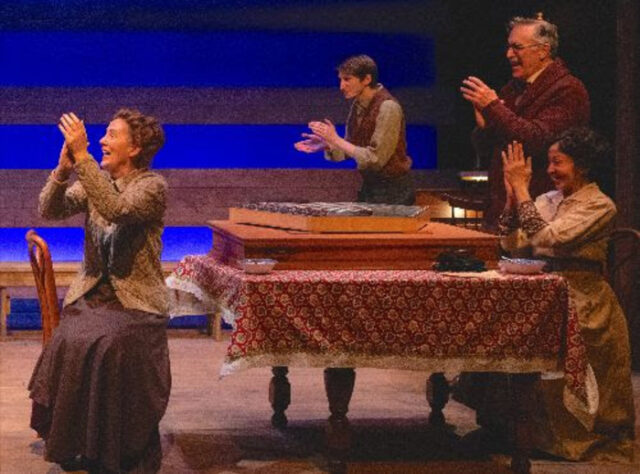
The Mint produciton of Lynn Riggs’s Sump’n Like Wings is worthy of much applause (photo by Maria Baranova)

SUMP’N LIKE WINGS
The Mint Theater at Theatre Row
410 West 42nd St. between Ninth & Tenth Aves.
Tuesday – Sunday through November 2, $39-$99
minttheater.org
www.theatrerow.org

In 1938, Thornton Wilder, who was born in Wisconsin in 1897, wrote what many consider one of the greatest American plays, the Pulitzer Prize–winning Our Town. The drama, a perennial favorite in high schools and community theater and off and on Broadway, is set in the small, fictional town of Grover’s Corners, New Hampshire, in 1901, where ordinary people go about their ordinary lives, including going to church, falling in love, and facing tragedy. It can currently be seen in an all-star version at the Ethel Barrymore through January 19. Wilder, who was gay, also won Pulitzers for his 1927 novel, The Bridge of San Luis Rey, and his 1942 play, The Skin of Our Teeth.

In 1925, Lynn Riggs, who was born in Oklahoma in 1899, wrote Sump’n Like Wings, a little-known play that was published in 1928 and premiered in 1931. The rarely performed drama is set in the small, fictional town of Claremont, Oklahoma, where ordinary people go about their ordinary lives, including going to church, falling in love, and facing tragedy. It concluded its too-short run at Theatre Row on November 2. Riggs, who was gay, also wrote the 1931 play Green Grow the Lilacs, which was the basis for the classic musical Oklahoma!, which won a Pulitzer in 1944 in addition to several Tonys and Oscars over the years.

The New York premiere of Sump’n Like Wings is presented by the Mint, the theater world’s finest purveyor of lost, forgotten plays, but this one is a welcome change of pace for the company, which specializes in British and American working-class tales and drawing-room comedies that often explore sociopolitical issues of their time. The splendid two-hour, two-act play takes place in the Old West of the 1910s, where the characters speak in western drawl and rhythm unusual for the Mint but as exquisitely rendered as ever.

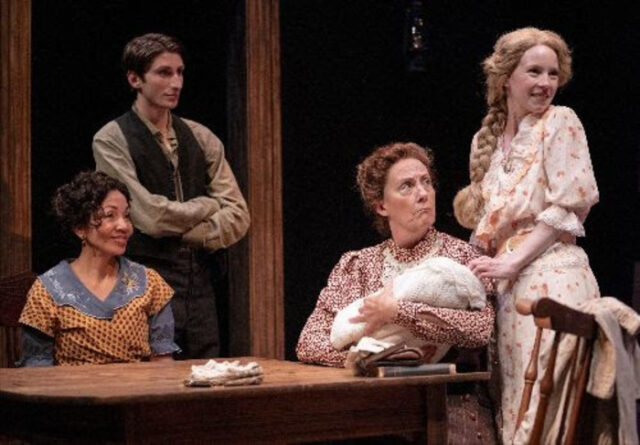
The strict Mrs. Baker (Julia Brothers), a widow, operates the dining room of the St. Francis Hotel for Ladies and Gents in Claremont, where she is raising her sixteen-year-old daughter, the wild child Willie (Mariah Lee), with the help of her brother, Jim Thompson (Richard Lear), who owns the hotel. The town is aghast when shoplifter Elvie Rapp (Lindsey Steinert) lets all the prisoners out of the local jail; to rehabilitate her, Sheriff Beach (Andrew Gombas) is forcing her to work for Mrs. Baker. Instead of going to school, Willie waits tables for her mother, but she is being pursued by the married Boy Huntington (Lukey Klein), who wants to run away with her. Judging them all is Jim’s housekeeper, Hattie (Joy Avigail Sudduth).

Talking about why she let the men go, Elvie tells Willie, “You don’t know whut it is to be locked up, locked up away from the sun and the air. You don’t know whut it means not to be free to go and come whenever you please — with no one to stop you, and no iron bars a-shuttin you in like a animal —.” Willie cuts her off, declaring, “I — do — too.” Elvis responds, “You don’t! You cain’t know! And you don’t know how fin’lly you git sick, sick inside of yer head, so you’d do anything — anything at all to git free, to git away. It ain’t that you wanta go anywheres. It’s the idy of the bars that makes you mad. The bars git in yer mind, and you’d do anything to break em down, to git rid of em —.”

Lynn Riggs’s Sump’n Like Wings explores life in a small Oklahoma town in the 1910s (photo by Maria Baranova)

Therein lies the theme of the play; nearly every character is trying to escape something, searching for freedom from the bars that have surrounded them. They hop railroad cars, go to church, fight over a game of checkers, fall in and out of love, bury themselves in the newspaper, or break the law, challenging societal norms or getting swept up in them. In the first scene, Mr. Clovis (Buzz Roddy), Mrs. Clovis (Traci Hovel), and Osment (Mike Masters) are eating in the dining room and gossiping about Elvie. While the Clovises see the former prisoners as “crimernals, ever one of em!,” cowman Osment insists, “They was men, Mis’ Clovis. They was men.”

They then hear fierce noises coming from behind a closed door; it’s Willie, screaming to be let out, threatening to kick the door down. Mrs. Baker yells right back at her, threatening her. It ultimately turns out that the door is not locked, that Willie could have opened it at any time by herself. But not everyone in Claremont — or anywhere, in the past, present, or future — knows that.

The Mint is justifiably renowned for its fashionably detailed sets, but Junghyun Georgia Lee keeps it relatively simple this time, employing a handful of unadorned wooden chairs and tables that are moved around as the scene shifts from the dining room to a hotel office to a rooming house, with a closed door at one end and an open one at the other. In the back are rows of horizontal slats with enough space between them that the outside world is temptingly visible, filled with both hope and fear. Emilee McVey-Lee’s period costumes maintain the mostly brown color palette. As always with the Mint, the cast is impeccable, transporting the audience to 1910s Oklahoma. Raelle Myrick-Hodges’s (Dirty White Teslas Make Me Sad, Flyin’ West) intricate direction adds contemporary relevancy to the play nearly a century after it was written; who isn’t seeking some form of escape from something these days?

Riggs, who was part Cherokee and served in the US military, died in New York City in 1954 at the age of fifty-four, leaving behind twenty-one full-length plays, about a dozen screenplays (The Plainsman, Sherlock Holmes and the Voice of Terror), and numerous short stories. He was inducted into the Oklahoma Hall of Fame in 1943 and deserves to be better remembered for more than just one play.

Jim Parsons stars as the Stage Manager in Broadway revival of Our Town (photo by Daniel Rader)

OUR TOWN
Ethel Barrymore Theatre
243 West Forty-Seventh St. between Broadway & Eighth Ave.
Through January 19, $74 – $321
www.ourtownbroadway.com

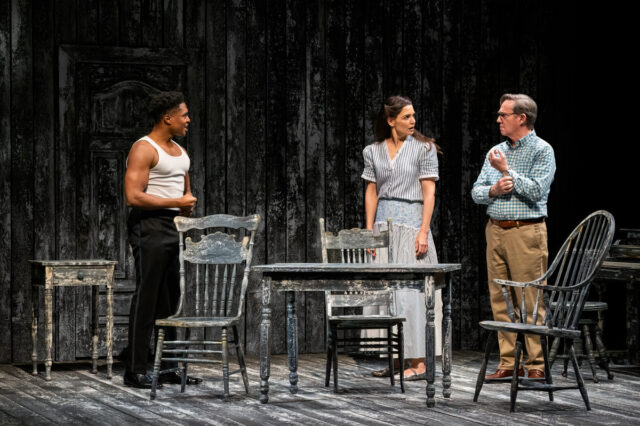
Two-time Tony winner Kenny Leon’s streamlined adaptation of Thornton Wilder’s Our Town suffers from trying too hard to be all things to all people. Like Sump’n Like Wings, it has a spare, rustic set, with various chairs and tables being moved around and a large distressed wood barn wall in the back, with one door and a pair of windows that open up like the Laugh-In joke wall. Fifteen audience members sit in boxes on either side of the stage, more like a jury than part of the neighborhood being celebrated between them. Meanwhile, rows of lanternlike lights extend like stars over the stage and the audience, as if we’re part of this neighborhood too. (The set is by Beowulf Boritt, with costumes by Dede Ayite, lighting by Allen Lee Hughes, and sound by Justin Ellington.)

The first words we hear are “Shema Yisrael,” which begins the Jewish prayer of affirmation, here from the 2019 Abraham Jam song “Braided Prayer,” which features sacred words from multiple religions; the cover of the album features three silhouetted figures in three doorways, holding different phases of the moon, surrounded by religious-tinged quotes in English, Hebrew, Arabic, and other languages. The Stage Manager, played with frantic charm by Jim Parsons as if he’s trying to end services early — Parsons previously played the Supreme Being in 2015’s An Act of G-d at Studio 54 on Broadway — points out, “Religiously, we’re eighty-five per cent Protestants; twelve per cent Catholics; rest, indifferent.” Thus, there appear to be no Jews (or Muslims) in 1901 Grover’s Corners, New Hampshire, although, near the end of the play, a Jewish star is visible on a gravestone in the cemetery.

In addition, the diverse casting is strongly evident, as if making its own case, including deaf milkman Howie Newsome (John McGinty), who communicates with his customers in sign language. And to insist on the play’s relevance in the twenty-first century — the time and setting in noted as “now” — two characters pull out cell phones, only to be chastised by the Stage Manager. It’s less cute than it is annoyingly disconcerting. And when a belligerent woman, portrayed by Bryonha Marie, who is Black, asks, “Is there no one in town aware of social injustice and industrial inequality?,” it takes on a different meaning today than it would have when performed by a white actor seventy-five years ago. (The question might sound like it’s been added for this production, but it’s in the original script, again revealing Wilder’s talent for the universal.)

George Gibbs (Ephraim Sykes) chats with Mr. and Mrs. Webb (Katie Holmes and Richard Thomas) in Kenny Leon’s Our Town (photo by Daniel Rader)

Wilder populates his imaginary world with mostly respectably people doing mostly respectable things. “Nice town, y’know what I mean?” the Stage Manager says. “Nobody very remarkable ever come out of it, s’far as we know.”

Dr. Gibbs (Billy Eugene Jones), the town MD, chats with the paper deliverer, Joe Junior, while Mrs. Gibbs (Michelle Wilson) tends to her garden and their son, George (Ephraim Sykes), dreams of being a baseball player and is falling for his next-door neighbor, Emily Webb (Zoey Deutch), who lives with her brother, Wallee (Hagan Oliveras), and their parents, Mrs. Webb (Katie Holmes), who also has a garden, and the knowledgeable Mr. Webb (a standout Richard Thomas, yet again), editor of the Grover’s Corners Sentinel. Shorty Hawkins flags the 5:45 train to Boston. The town drunk, Simon Stimson (Donald Webber Jr.), conducts the church choir. State university professor Willard (Shyla Lefner) encapsulates the town’s history.

Constable Warren (Bill Timoney) walks the beat, engaging in small talk with the citizenry. Mrs. Soames (Julie Halston) raves on and on about a wedding. Undertaker Joe Stoddard (Anthony Michael Lopez) hates to supervise when they’re burying a young person.

In Grover’s Corners, people live and people die. There are no spoiler alerts when the Stage Manager tells us what is going to become of some of the characters. Leon has eliminated the two intermissions; the three acts — “Daily Life,” “Love and Marriage,” and “Death and Eternity” — are identified by the Stage Manager, who hustles things along, getting the audience out in a mere hundred minutes. This Our Town is a pleasant experience; there are plenty of untidy edges and few lofty moments. But it doesn’t quite feel like real life either; the manipulation is evident, including at the end, where tears flow.

Wilder, who was Protestant and served in the military, died in Hamden, Connecticut, in 1975 at the age of seventy-eight, leaving behind dozens of full-length and short plays, seven novels, and one screenplay (Shadow of a Doubt), but he will forever be remembered first for Our Town.

[Mark Rifkin is a Brooklyn-born, Manhattan-based writer and editor; you can follow him on Substack here.]
GOOD BONES AND FIRM FOUNDATIONS ON AND OFF BROADWAY

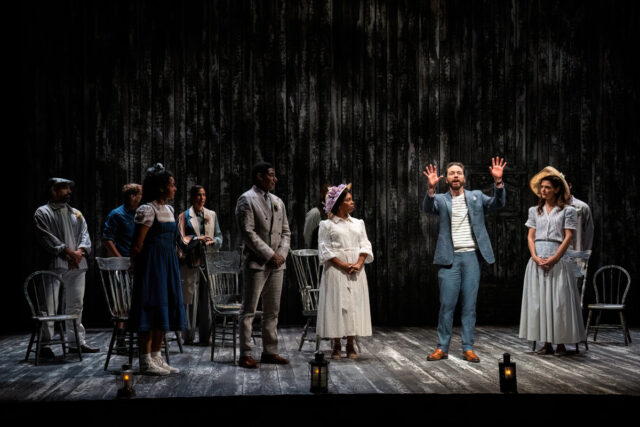
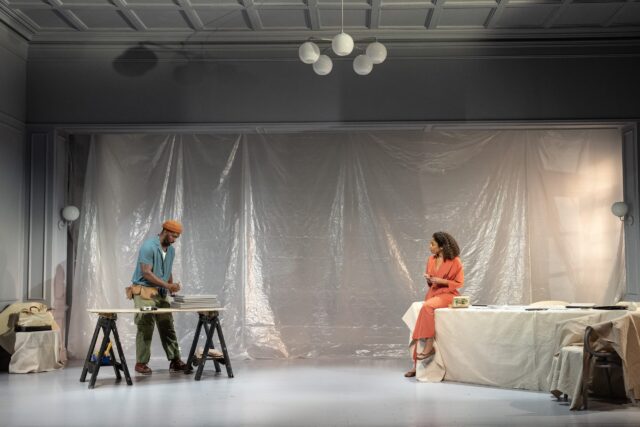
Mamoudou Athie, Susan Kelechi Watson, and Khris Davis star in Good Bones at the Public (photo by Joan Marcus)

GOOD BONES
Martinson Hall, the Public Theater
425 Lafayette St. at Astor Pl.
Tuesday through Sunday through October 27, $95
212-539-8500
publictheater.org

According to the Canadian website houseful, “‘Good bones’ refers to the core foundational elements of the home — a steady structure that can withstand time, wear, and elements. A home with good bones typically has a sturdy foundation, structural stability, and a strong roof. A well-staged home can hide imperfections with beautiful rugs, a fresh coat of paint, or features that pull your attention.”

Four current plays that take place primarily in a home struggle with the core foundational elements, with varying results.

Playwright James Ijames and director Saheem Ali follow up their Pulitzer Prize–winning Fat Ham, which ran at the Public’s Anspacher Theater before transferring to Broadway, with Good Bones, continuing at the Public’s Martinson Hall through October 27. Maruti Evans’s set is a skeletal house surrounded by plastic, undergoing renovation in an unidentified American city that itself is experiencing controversial gentrification.

Travis (Mamoudou Athie), who comes from money, and Aisha (Susan Kelechi Watson), who grew up in the projects, are a married couple who have moved back to her neighborhood and are considering having a baby. He is a chef preparing to open a restaurant, and she is working on a new sports complex she believes will vastly improve the community. Their contractor, Earl (Khris Davis), flirts with Aisha, who returns the interest, but when she shares the plans for the complex with him, he sees her as a traitor to her roots.

She explains, “We’re calling it the Jewel. It’s going to be kind of like a little village over there. This neighborhood has been abandoned to decay and atrophy. The Jewel will bring together the best of the old and the new. Will there be change? Yes. But change is the only thing consistent in this life. We have been sowing into this community. We have worked diligently to revitalize this neglected corner of the city. We’re changing this neighborhood for the better.” His quick response: “It’s the death star.”

James Ijames’s Good Bones is in need of further renovation (photo by Joan Marcus)

Remembering how he used to play in the very house he is now working in, Earl tells Aisha, “These houses are sturdy. Shit’s built like a ribcage. The bones are so good. If . . . uh . . . you sit really still in here, you can feel the walls breathing and the floors lifting to meet your feet. That’s why I love these old houses. I get to spend time in a lot of haunted places.”

Good Bones follows in the lofty footsteps of Lorraine Hansberry’s A Raisin in the Sun and Bruce Norris’s Clybourne Park, but it lacks the character development and depth of those two award-winning works. Watson (Eureka Day, Merry Wives) and Athie (The Mystery of Love and Sex) have little chemistry; it might be the relationship between Travis and Aisha that requires renovating, but it’s hard to root for them because their marriage has no firm foundation.

Davis (Fireflies, Sweat) steals the show as the honest, hardworking, well-meaning contractor who has a more realistic view of the world, the only one who can see the ghost in the machine, and Téa Guarino (A Hundred Words for Snow, Antony and Cleopatra) is charming as his daughter, Carmen. But Good Bones needs more work, more than just a fresh coat of paint.

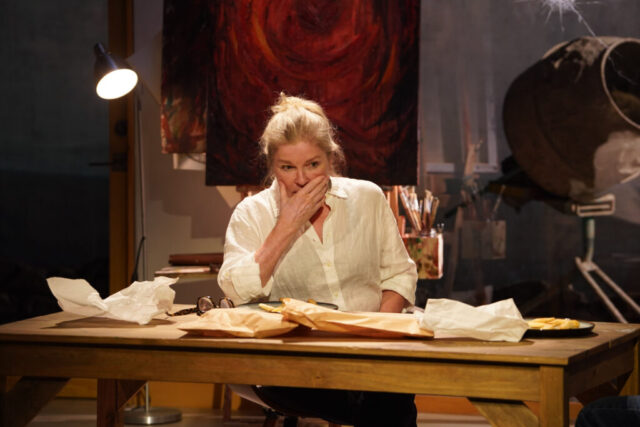
Kate Mulgrew outshines the material in Nancy Harris’s The Beacon at the Irish Rep (photo by Carol Rosegg)

THE BEACON
Irish Repertory Theatre, Francis J. Greenburger Mainstage
132 West Twenty-Second St. between Sixth & Seventh Aves.
Wednesday – Sunday through November 3, $60-$125
212-727-2737
irishrep.org

Obie winner and Emmy nominee Kate Mulgrew excels as an Irish abstract painter renovating her seaside home in Nancy Harris’s The Beacon, making its North American premiere at the Irish Rep through November 3. Mulgrew is Beiv (rhymes with gave), who is transforming her late husband’s cottage into a glass-enclosed space, as if she has nothing to hide — it has been long rumored that she might have had something to do with her spouse’s death.

She is surprised when her son, Colm (Zach Appelman), arrives with his new wife, Bonnie (Ayana Workman), who is a big fan of hers. Colm is surprised when he finds out that one of his old friends, Donal (Sean Bell), is helping with the renovation and has grown close to Beiv, who Colm always calls by her name, never “mom” or “mother.”

At the back of the room is Beiv’s most recent canvas, which is not quite finished yet. Examining it, Bonnie says, “You can really see the female rage. Like I’m instantly getting menstrual blood, the blood of childbirth, genital mutilation, hemorrhaging — pretty much all female suffering. Abortion is in there obviously . . . and repression and shame. But there’s also something really — tender too. Like there, in those softer shades, I see the vulva. And the clitoris, and this really female desire for pleasure, for sexual intimacy but also for like a really fucking explosive orgasm, you know. But yeah. No, it’s powerful. And brutal. And sad too.”

Beiv’s quick response: “It’s a blood orange.”

Of course, it’s actually something in between, and that “in between” is where the play, directed by Marc Atkinson Borrull, find itself stuck, unable to escape from its own trappings.

The Beacon is in need of more structure at the Irish Rep (photo by Carol Rosegg)

Beiv is a complex and fascinating character, superbly portrayed by Mulgrew (The Half-Life of Marie Curie, Tea at Five) with a compelling thread of intrigue. But when she’s not onstage, the narrative drags with didactic dialogue and meandering subplots, some of which feel completely unnecessary, such as the one involving Ray (David Mattar Merten) and Bonnie, although Ray overdramatizes things when he describes the house: “On one hand it looks like an idyllic little artist’s garret. Half-finished charcoal sketches sit scattered on a table. A large oil painting rests on an easel; there’s a huge glass window with sweeping views of the Atlantic. But the crack in the window from a recent break-in suggests another story. A darker story . . . a story of sex and violence and betrayal that’s hung around this cottage for over a decade.”

As always at the Irish Rep, the set, in this case by Colm McNally, is an impressive structure, but the story does not have the requisite good bones. It’s as if Harris and Borrull (Little Gem, Bedbound) knew where they wanted to end up but threw in too much as they get there.

Even the title is wasted on an unimaginative metaphor. Mulgrew herself is a beacon, but alas, in this production, she’s the only one who shines.

Martha Pichey’s Ashes & Ink trap the actors and characters in uncomfortable ways (photo by Thomas Mundell, Mundell Modern Pixels)

ASHES & INK
AMT Theater
354 West Forty-Fifth St. between Eighth & Ninth Aves.
Wednesday – Sunday through November 3, $39-$49
ashesink.ludus.com
www.amttheater.org

“‘Structure.’ Our lives need structure,” Molly (Kathryn Erbe) says early in the New York premiere of Martha Pichey’s Ashes & Ink. It’s a word that’s repeated several times in the play, which itself needs considerable rebuilding.

Running at the AMT Theater through November 3, Ashes & Ink moves between Molly’s apartment in New York City and her boyfriend Leo’s home in the country. Molly is a widow with a vast archive of birdsong she’s recorded and is categorizing with her sister, Bree (Tamara Flannagan); Molly’s teenage son, Quinn (Julian Shatkin), is an addict who has been in and out of rehab and is seeking a career in acting after having made an impact in a few movies. Leo is a widower raising his eight-year-old son, Felix (Rhylee Watson), by himself.

Quinn has once again left rehab, a place called Serenity House, so he can rehearse for his audition to get into the Royal Academy of Dramatic Arts in London. Prepared to do a monologue from Richard II — his father’s name was Richard — he instead does the classic, and obvious, “Tomorrow, and tomorrow, and tomorrow” soliloquy from MacBeth. The most important phrase is “signifying nothing,” to which he adds, “Nothing. Not a fucking thing.” That goes for the play as well, echoed later by Molly, who opines, “I am so deep inside my sucked dry bones sick and tired. I don’t know how to do this anymore. I don’t even know how to think anymore. I can’t remember anything.”

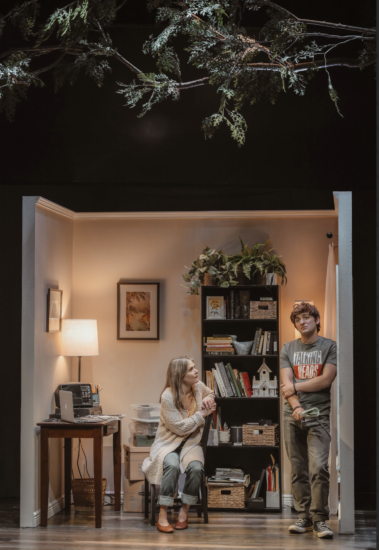
Tim McMath’s set switches from Molly’s cramped apartment, which resembles a psychiatrist’s office, where Quinn often sits in a chair complaining about his life, and the kitchen of Leo’s country house and under a tree on his property. The actors move the sets themselves; the first time they do it is fresh and exciting, but over the course of fifteen scenes, it grows tiresome, dragging down any pace the show is trying to achieve. For some reason, Molly leaves the window over the fire escape wide open, not the safest thing to do, especially when Quinn is running away from trouble.

Stagnantly directed by Alice Jankell, the play — Pichey’s debut — can’t get out of its own way as subplots turn ever-more ludicrous and the holes in the central story keep expanding. And I couldn’t help but cringe when Tony nominee Erbe (Something Clean, The Speed of Darkness, The Father) had to deliver the following lines: “If somebody told me my little boy would grow up to be an addict, I would’ve spat in their face. Aimed right for their mouth. . . . Take the lid off the pressure cooker, Molly! Watch it plaster the walls with all this gummy smelly stuff. Put your nose up to it, take a good whiff of this shit, this mix of ‘Could’ve done this,’ ‘Should’ve known that.’”

Without any kind of firm foundation, Ashes & Ink fails the smell test, among others.

Sisters Gloria (Leanne Best), Ruby (Ophelia Lovibond), Jill (Helena Wilson), and Joan (Laura Donnelly) reunite as their mother lies on her deathbed in The Hills of California (photo by Joan Marcus)

THE HILLS OF CALIFORNIA
Broadhurst Theatre
235 West 44th St. between Broadway & Eighth Ave.
Tuesday – Sunday through December 22, $58-$351
thehillsofcalifornia.com

Rob Howell’s magnificent multilevel set for Jez Butterworth’s new play, The Hills of California, is a character unto itself, an Escher-like maze of rooms and staircases that rise into a mystical darkness. The main floor switches between 1955 and 1976 at a family-run Victorian guesthouse on the outskirts of the seaside resort town of Blackpool on the Irish Sea, providing a firm foundation for the gripping, if overburdened, narrative.

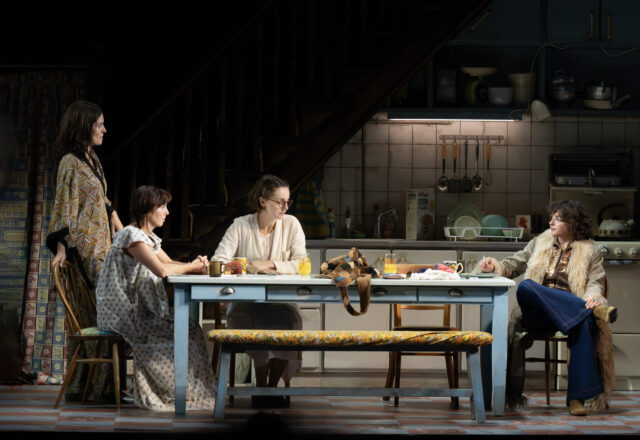
In 1976, sisters Gloria (Leanne Best), Ruby (Ophelia Lovibond), and Jill (Helena Wilson) have gathered at the fading Seaview Luxury Guesthouse and Spa because their mother, Veronica Webb, is dying in a room upstairs; they are waiting for their fourth sister, Joan (Laura Donnelly), who has not stepped foot in the house for twenty years, living in America. They are in what once was the private kitchen but is now a tiki bar with a one-armed bandit and broken jukebox that represent the siblings’ once-promising career. Their mother’s nurse, Penny (Ta’Rea Campbell), has offered the sisters the opportunity to bring in a doctor to end Veronica’s pain, but they don’t want to make any critical decisions until Joan arrives, something Gloria believes is highly unlikely.

“Times like these you find out who a body is. But go on. Stick up for her,” Gloria says sharply to Jill, who has spent her life taking care of the guesthouse and Veronica and is sure that Joan is on her way, exclaiming, “Well, I’m sorry. But it’s not Silly Jilly head-in-the-clouds, nor sticking up for no one. I know my sister. If Joan says she’s coming, she’s coming. There. I’ve said it.”

In 1955, single mother Veronica (Donnelly) is training young Gloria (Nancy Allsop), Ruby (Sophia Ally), Jill (Nicola Turner), and Joan (McDonnell) to become the next Andrews Sisters, rehearsing Johnny Mercer’s 1948 hit “The Hills of California,” which features the lines “The hills of California will give ya a start / I guess I better warn ya cuz you’ll lose your heart / You’ll settle down forever and never stray from the view / The hills of California are waiting for you.”

“What is a song?” Veronica asks, answering, “A song is a place to be. Somewhere you can live. And in that place, there are no walls. No boundaries. No locks. No keys. You can go anywhere.” A song is its own kind of structure, its own kind of home, meant to bring people together, but in The Hills of California, it tears a family apart.

Veronica Webb (Laura Donnelly) is a controlling British stage mother in Jez Butterworth’s The Hills of California (photo by Joan Marcus)

Tony winner Butterworth (The River, Jerusalem) and Oscar, Tony, and Olivier-winning director Sam Mendes (The Lehman Trilogy, Cabaret) previously teamed up on The Ferryman, which won four Tonys and boasted an ensemble of nearly three dozen performers including covers. The Hills of California is overstocked with minor male characters who disappear into the woodwork, even Luther St. John (David Wilson Barnes), who is involved in a key scene that influences the girls’ future and their relationship with their mother.

About fifteen minutes have been cut from the original three-hour London production and the early previews on Broadway, leaving some gaps in the narrative, along with several moments that feel extraneous, such as when Veronica forces a lodger (Richard Short) to take the long way home, barring him from the shortcut through the kitchen. But when the story focuses on the mother and her daughters, in both time periods, the play finds its foundation, with sharp, poignant dialogue, lovely music by Nick Powell, and pinpoint choreography by Ellen Kane.

Donnelly, who has appeared in several plays written by Butterworth, her partner (they have two children together), is whip-smart as Veronica, a controlling stage mother who recalls Rose Hovick in Gypsy, currently played by Audra McDonald right next door at the Majestic. (On the other side is another show about a mother and daughter and music, Hell’s Kitchen.)

America is not referenced just in the song; the rooms in the guesthouse are named after such US states as Colorado, Alabama, Indiana, Minnesota, and Mississippi, where the critical event happens in 1955 and where Veronica is dying in 1976, reminding the audience that this kind of tale can happen anywhere.

In her 2016 poem “Good Bones,” British actress Maggie Smith, who passed away in September at the age of eighty-nine, writes, “Any decent realtor, / walking you through a real shithole, chirps on / about good bones: This place could be beautiful, / right? You could make this place beautiful.” Even with its occasional skeletal forays, The Hills of California has good bones, filled with a glorious beauty.

[Mark Rifkin is a Brooklyn-born, Manhattan-based writer and editor; you can follow him on Substack here.]
BIG & SMALL SCREEN STARS ON BROADWAY: YELLOW FACE / THE ROOMMATE / McNEAL

Francis Jue and Daniel Dae Kim play father and son in Yellow Face (photo by Joan Marcus)

YELLOW FACE
Todd Haimes Theatre
227 West Forty-Second St. between Broadway & Eighth Ave.
Tuesday – Sunday through November 24, $70-$348
212-539-8500
www.roundabouttheatre.org

Three recently opened shows on Broadway feature television and movie stars either making their Great White Way debut or returning after a long absence, but, was we learn, success on the big and/or small screen does not always guarantee onstage triumph.

In an April 2021 interview in Vulture, actor and anti-Asian-hate activist Daniel Dae Kim said, “I take a great deal of pride in being Korean American. I know that not every representation is 100 percent something we can stand behind all the time, but I choose to look at things as whether they’re moving the needle of progress on a larger scale.” Talking about his and Grace Park’s departure from the successful Hawaii Five-O reboot in 2017 after the seventh season following a contract dispute — the two Asian Americans wanted equal pay with their Caucasian costars — Kim explained, “I had hopes that Hawaii Five-0 would be different because it was a show set in Hawaii, where the majority of people are not white. I thought it was going to be more of an ensemble show, and if you look at the early marketing and promotion for the show, where Grace Park and I were featured equally as prominently as anyone else, it led me to believe that it could be. I was proven to be wrong.”

In the article, he also discusses initially wanting to cast an Asian lead in the American version of the Korean television drama The Good Doctor, which his 3AD company produced, but eventually agreeing with showrunner David Shore and hiring white English actor Freddie Highmore.

Kim, who was born in South Korea, is now back on Broadway in the Great White Way debut of David Henry Hwang’s semiautobiographical 2007 Obie-winning Pulitzer finalist, Yellow Face, at the Todd Haimes Theatre through November 24. Kim plays a version of Hwang, known as DHH, a first-generation Chinese American playwright and activist who gets involved in a series of casting controversies. DHH makes a public stand against producer Cameron Mackintosh’s insistence on casting English actor Jonathan Pryce as a French-Vietnamese pimp known as the Engineer, altering his eyes and skin color to make him look more Asian; Pryce went on to win a Tony for his performance.

DHH, who won a Tony for his 1988 play, M. Butterfly, decides to write about “yellow face” in his next play, Face Value, choosing unknown actor Marcus G. Dahlman (Ryan Eggold) as the lead, believing he is at least part Asian. But when it turns out that the renamed Marcus Gee probably has no Asian blood in him at all, DHH convinces the actor that he must have had a Siberian Jewish ancestor, and things go haywire from there.

Yellow Face is told in flashback, with DHH often directly addressing the audience, guiding the tale while freely admitting the many mistakes he made. It starts with various public figures commenting on the Marcus Gee situation.

“Wow. That is one of the strangest stories I’ve ever heard,” Vice President Al Gore (Marinda Anderson) says.

“David Henry Hwang is a white racist asshole,” playwright Frank Chin (Kevin Del Aguila) declares.

“This is a tempest in an Oriental teapot,” Mackintosh (Shannon Tyo) insists.

DHH (Daniel Dae Kim) and Marcus Gee (Ryan Eggold) have different ideas of ethnic representation at Todd Haimes Theatre (photo by Joan Marcus)

Among the other real-life famous and not-so-famous people chiming in at one point or another are casting director Vinnie Liff, author Gish Jen, theater critics Frank Rich and Michael Riedel, New York City mayor Ed Koch, columnist George F. Will, talk show host Dick Cavett, Taiwanese American computer scientist Wen Ho Lee, actors B. D. Wong, Mark Linn-Baker, Lily Tomlin, Gina Torres, Jane Krakowski, and Margaret Cho, politicians Fred Thompson, Sam Brownback, Tom Delay, and Richard Shelby, and theater luminaries Bernard Jacobs, Joe Papp, and Jerry Zaks, all played by Anderson, Del Aguila, Tyo, and Francis Jue; Jue also portrays DHH’s father, HYH, an immigrant immensely proud of his success in the financial sector but whose bank finds itself in a bit of hot water with a congressional committee as the opening of Face Value approaches.

Kim is most well known for playing Jin-Soo Kwon on the seven seasons of Lost and Chin Ho Kelly for seven years on the Hawaii Five-O reboot; he has also appeared onstage in New York City, Los Angeles, and London since 1991, including Romeo and Juliet, A Doll’s House, The Tempest, The King and I, and Hwang’s Golden Child. He is amiable and confident as DHH, instantly gaining the audience’s faith as he balances the sublime and the ridiculous with acute self-awareness and self-deprecation; he’s particularly strong as DHH digs himself into a deeper and deeper hole. His casting in and of itself is fascinating; there’s been a recent movement for people of Asian descent not to be called “Asian” but to be identified by the specific country they or their ancestors come from; in this case, the South Korean Kim is playing the Chinese American Hwang.

Eggold (Dead End, All My Sons) is hilarious as Marcus, a regional actor who can’t believe how his stature has changed once he agreed to pretend to be Asian, getting hooked on the hoopla. Keller (Dig, Shhhh) excels as the announcer and a reporter identified as “Name withheld on advice of counsel,” Jue, who originated the role of HYH at the Public and played an alternate version of DHH in Hwang’s autobiographical soft power, is gleeful as the father, and Tyo (The Comeuppance, The Chinese Lady), del Aguila (Some Like It Hot, Frozen), and Anderson (Merry Me, Sandblasted) shift seamlessly from role to role.

Arnulfo Maldonado’s changing sets and Yee Eun Nam’s projections keep the audience fully engaged under the smooth-flowing direction of Leigh Silverman, who helmed the original production of Yellow Face as well as Hwang’s Chinglish, Kung Fu, and Golden Child, her familiarity with the material delivering a fun experience while making its important points.

Mia Farrow and Patti LuPone return to Broadway in Jen Silverman’s The Roommate (photo by Matthew Murphy)

THE ROOMMATE
Booth Theatre
222 West 45th St. between Broadway & Eighth Ave.
Tuesday – Sunday through December 15, $48 – $321
theroommatebway.com

The Broadway premiere of Jen Silverman’s 2015 play, The Roommate, dooms itself from the very start. Longtime friends Mia Farrow and Patti LuPone take the stage together, their names projected across the top of the set, and they bask in the uproarious applause of the audience. They exit, then return seconds later in character. While the laudatory moment removes the need for applause at the beginning of the actual narrative, it also makes sure we never forget we are watching a pair of superstar performers, even though the success of the play — any play — depends on our believing in the fiction that is about to unfold before us.

Two years ago, LuPone, who has won two Grammys and three Tonys, announced she was retiring from the Great White Way because of Actors’ Equity’s lack of support of its union members, writing on Twitter, “Quite a week on Broadway, seeing my name being bandied about. Gave up my Equity card; no longer part of that circus. Figure it out.” She later told People magazine, “I just didn’t want to give them any more money. . . . And I don’t know when I’m going to be back on stage.”

Meanwhile, Farrow, who has never been nominated for an Oscar or Tony, last appeared on Broadway in 2014 in Love Letters, sitting at a table with Brian Dennehy and reading A. R. Gurney’s epistolary play. Here only other Broadway appearance was costarring with Anthony Perkins in Bernard Slade’s 1980 Romantic Comedy. (She made her off-Broadway debut as Cecily Cardew in The Importance of Being Earnest in 1963.)

So there was a lot of buzz surrounding LuPone and Farrow teaming up at the Booth Theatre for a play about an odd couple living together in rural Iowa. Unfortunately, they lack any kind of chemistry, and three-time Tony-winning director Jack O’Brien (Shucked, The Invention of Love) can’t get around Jen Silverman’s inconsequential, clichéd script.

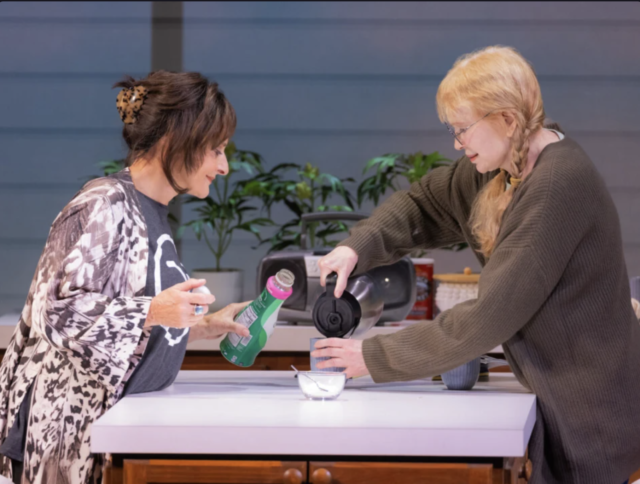
Farrow is Sharon, a divorced mother from Illinois who has made a peaceful life for herself in a large home in Iowa City. She likes things as they are, simple, without complications, but she seeks out a roommate, both for financial reasons and, perhaps, friendship.

LuPone is Robyn, a divorced mother from the Bronx who is ready for a major change. She is not exactly what Sharon expected: a tough-talking vegan lesbian whose black leather provides a sharp contrast to Sharon’s loose-fitting sun dresses. (The costumes are by Bob Crowley, who also designed the set, a skeletal house with a kitchen and a small staircase leading up.)

After learning these facts about Robyn, Sharon declares, “I mean. A roommate! I’ve never had a roommate. I’m sixty-five years old. A roommate!”

While there is no reason an actor can’t play well above or below their age, the line gets a curious stare from the audience, who know Farrow cannot be sixty-five. (In actuality, Farrow is seventy-nine and LuPone is seventy-five). In a script note, Silverman suggests, “In terms of age, you should feel free to adjust the character’s age to fit the actor.” Because the production made such a big deal of Farrow and LuPone’s star power when they first took the stage, the number sticks out as false.

Robyn (Patti LuPone) and Sharon (Mia Farrow) form an odd couple in The Roommate (photo by Matthew Murphy)

As the play continues, we learn more about both women, their prejudices, their pasts, and their futures. Each is dealing with not being on the closest of terms with their children. While Robyn knows about what’s going on around the world, Sharon seems to be happily stuck in an old-fashioned bubble straight out of a Norman Rockwell painting, oblivious to what is happening right outside her door, although that changes as she grows more and more intrigued with what she at least initially considers Robyn’s vices.

The Roommate is in part a riff on The Odd Couple, with Sharon a fuddy-duddy like Felix Ungar, Robyn a more coarse figure like Oscar Madison. (At the 2017 Williamstown Theater Festival, S. Epatha Merkerson was Sharon, and Jane Kaczmarek was Robyn.)

But the effects they have on each other are difficult to believe, not fully formed. Silverman (Collective Rage: A Play in 5 Betties, Spain) might have a lot to say about human vulnerability and morality and female friendship, but she goes too far off the rails in the play’s slow-moving ninety minutes.

Farrow is lovely as Sharon, every line delivered with a touch of wonder, going especially high and squeaky when something Robyn reveals surprises her. She handles Sharon’s absurd shifts in right and wrong with aplomb, just going with the flow, but LuPone (Company, Shows for Days) looks like she’d rather be just about anywhere else, as if she knows she made a mistake choosing this play as her return to the stage. Hopefully Farrow and LuPone will join forces again, only next time in a better piece of theater.

“There’s a great liberty in being bad,” Robyn tells Sharon, who repeats the line later on.

It’s a catchy phrase that never comes to fruition in The Roommate.

Jacob McNeal (Robert Downey Jr.) gets good and bad news from his doctor (Ruthie Ann Miles) in McNeal (photo by Matthew Murphy and Evan Zimmerman)

McNEAL
Vivian Beaumont Theater at Lincoln Center Theater
150 West 65th St. between Broadway & Amsterdam Ave.
Tuesday – Saturday through November 24, $195.50-$371
212-362-7600
www.lct.org

The night before I saw Ayad Akhtar’s McNeal at the Vivian Beaumont Theater at Lincoln Center, I watched Dario Argento’s 1982 giallo cult classic, Tenebrae, starring Tony and Oscar nominee and New York City native Anthony Franciosa as Peter Neal, a popular American novelist on a book tour in Italy, accompanied by his agent, Bullmer (John Saxon), and his assistant, Anne (Daria Nicolodi). One critical scene involves Neal sitting down for a television interview with superfan Christiano Berti (John Steiner). Fact and fiction start weaving in and out of the plot as violent scenes from his books come to life in a series of murders.

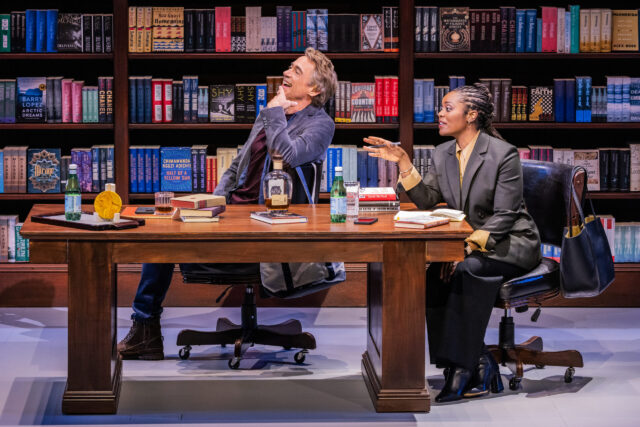
In McNeal, Oscar and Emmy winner and New York City native Robert Downey Jr. is the title character, Jacob McNeal, a popular American novelist who, while being examined by his doctor, Sahra Grewal (Ruthie Ann Miles), gets notified that he has won the Nobel Prize in Literature, an award he feels he deserved many years ago. His agent, Stephie Banic (Andrea Martin), immediately contacts his publisher to negotiate a new contract, and the Times finally agrees to do a front-page magazine profile of him, sending over New York Times journalist Natasha Brathwaite (Brittany Bellizeare), who is not planning on doing a puff piece. “Were you a diversity hire?” he asks her, kicking off an awkward interview. McNeal flirts with using AI for his Nobel acceptance speech, but soon he is counting on AI for much more as fact and fiction intermingle.

I prefer Tenebrae.

Jacob McNeal (Robert Downey Jr.) says way too much in interview with journalist Natasha Brathwaite (Brittany Bellizeare) (photo by Matthew Murphy and Evan Zimmerman)

In his Broadway debut, Downey, who first acted on the stage in Alms for the Middle Class in Rochester in 1983, delivers a solid performance as the self-destructive McNeal, who has a serious kidney issue but can’t stop going back to the bottle. (Downey himself has had problems with drugs and alcohol and has been drug-free for more than twenty years.) He looks completely comfortable in McNeal’s skin, playing a character who is adorable and unlikable at the same time, as it’s difficult to dismiss his misogyny as just exemplary of the way things used to be. The sets by Michael Yeargan and Jake Barton rise and lower from above and below as Barton’s projections beam out visual stimuli, from texts and close-ups to the spewing of words and letters.

In such previous works as Junk, The Invisible Hand, Corruption, and the Pulitzer Prize–winning Disgraced, Akhtar has proved to be a master of complex plots, tackling such issues as politics, race, religion, the financial industry, capitalism, and personal ambition. In McNeal, however, he takes on too much, straying from the central focus on the future of AI and its impact on literature and humanity itself to include scenes that feel like they’re from another play; even director Bartlett Sher (The King and I, Oslo), who has been nominated for eight Tonys and won one, is unable to weave together subplots involving McNeal’s son, Harlan (Rafi Gavron), with its bizarre revelation; McNeal’s flirtations with Banic’s assistant, Dipti (Saisha Talwar), and fondness for Harvey Weinstein, as his agent’s actions confound believability; his liberal use of the lives of his friends and relatives in his plots; and his relationship with journalist Francine Blake (Melora Hardin).

The 105-minute show does have a magical finale, but it’s not enough to save it. Near the end, a typing prompt acknowledges that the audience is “confused by what is real and what isn’t.”

There was no such problem in Tenebrae.

[Mark Rifkin is a Brooklyn-born, Manhattan-based writer and editor; you can follow him on Substack here.]

ONCE UPON A MATTRESS

Sutton Foster is an unstoppable force of nature in Once Upon a Mattress (photo by Joan Marcus)

ONCE UPON A MATTRESS
Hudson Theatre
141 West Forty-Fourth St. between Sixth & Seventh Aves.
Tuesday – Sunday through November 30, $89-$389
onceuponamattressnyc.com

Sutton Foster makes an entrance for the ages in Lear deBessonet and Amy Sherman-Palladino’s delightful revival of Once Upon a Mattress, which opened tonight at the Hudson Theatre for a limited run through November 30.

In 2022, deBessonet made her Broadway directorial debut with a spectacular, streamlined adaptation of James Lapine and Stephen Sondheim’s fairytale mashup, Into the Woods, which transferred from the popular “Encores!” series at City Center to the St. James. She should have another smash hit on her hands with her spectacular, streamlined adaptation of another fairytale classic, Once Upon a Mattress, the Tony-nominated 1959 show featuring music by Mary Rodgers, lyrics by Marshall Barer, and a book by Jay Thompson, Dean Fuller, and Marshall Barer, adapted here by Sherman-Palladino, the six-time Emmy-winning creator, writer, and producer of such series as Gilmore Girls, The Marvelous Mrs. Maisel, and Bunheads, which starred Foster.

Based on Hans Christian Andersen’s 1835 story “The Princess and the Pea,” Mattress is set “many moons ago,” in a medieval castle where Prince Dauntless the Drab (Michael Urie) is seeking a bride to become princess of the land. However, his strict mother, Queen Aggravain (Ana Gasteyer), has devised impossible tests for his suitors, as she doesn’t want her son to be betrothed. Meanwhile, his father, King Sextimus the Silent (David Patrick Kelly), has nothing to say on the matter, as he cannot speak because of a curse that can only be lifted when “the mouse devours the hawk.” Even if he could talk, it is unlikely he would be able to get a word in edgewise with his powerful, domineering wife.

The queen’s dismissal of princess after princess has a terrible impact on her subjects; no one else can marry until Prince Dauntless has been led to the altar. The law particularly hurts Lady Larken (Nikki Renée Daniels), who will be the new princess’s lady-in-waiting. Lady Larken is pregnant and is desperate to wed her true love, the handsome, brave, and not very bright Sir Harry (Will Chase), Chivalric Knight of the Herald, before she starts showing. Sir Harry — and his jangling spurs, which he is obsessed with — heads out to find a princess. And what a princess he brings back.

King Sextimus the Silent (David Patrick Kelly) and Queen Aggravain (Ana Gasteyer) oversee the potential marriage of their son, Prince Dauntless the Drab (Michael Urie) (photo by Joan Marcus)

Princess Winnifred the Woebegone (Foster) is everything the queen despises. She’s dressed in muddy rags, her hair is a mess, she’s utterly uncouth, and she is covered in leeches and other surprising creatures, as she swam the moat and climbed the wall to enter the castle. “What on earth are you?” the disgusted queen says to Winnifred. The princess wriggles around as if something is on her body and asks the queen, “It feels weird. Is it weird?” Queen Aggravain responds, “For you? I’m going to say no.”

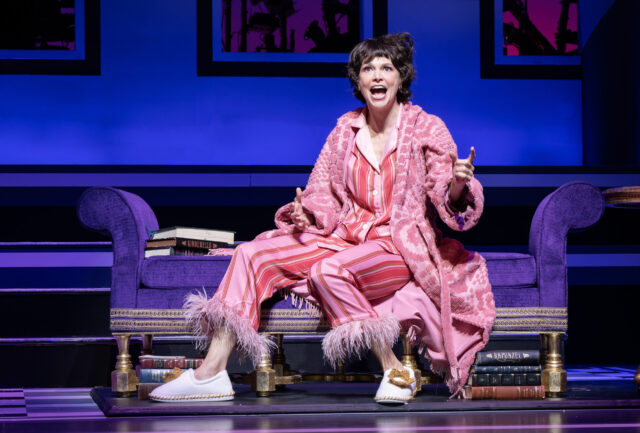
In a role originated by Carol Burnett and later played by such other comedic actors as Dody Goodman, Jo Anne Worley, Sarah Jessica Parker, Andrea Martin, Tracey Ullman, and Jackie Hoffman, Foster holds nothing back. She romps across the stage with infectious glee, singing, dancing, and telling jokes, a seeming free spirit who Dauntless is instantly smitten with, even as she claims, “Despite the impression I give, / I confess that I’m living a lie, / because I’m actually terribly timid, and horribly shy.” She continues her hilarious high jinks through to the adorable finale.

But before Fred, as she prefers to be called, can marry Dauntless, she has to pass the queen’s toughest test yet by proving she has the sensitivity of royalty. “Sensitivity, sensitivity, / I’m just loaded with that!” the queen tells her wizard (Brooks Ashmanskas). / “In this one word is / the epitome of the aristocrat / sensitive soul and sensitive stomach, / sensitive hands and feet. / This is the blessing, also the curse / of being the true elite. / Common people don’t know what / exquisite agony is / suffered by gentle people / like me!”

As the jester (Daniel Breaker), who serves as the narrator of the show, informed the audience at the beginning, the test will involve twenty down mattresses and a tiny pea.

Princess Winnifred the Woebegone (Sutton Foster) creates havoc after swimming a moat and climbing a castle wall (photo by Joan Marcus)

As with deBessonet’s Into the Woods, which was nominated for six Tonys, including Best Director and Best Revival of a Musical, Once Upon a Mattress is great fun, although the show lacks some of the serious edges that make Woods so special, instead concentrating on inspired goofiness. Two-time Tony winner Foster (Thoroughly Modern Millie, Anything Goes) is a force of nature, a whirling dervish of id; every bone and muscle in her body gets in on the action — and you might never look at a bowl of grapes the same way again. Urie (The Government Inspector, Buyer & Cellar) could not be any more charming as the prince, a man-child who has not learned how to walk up steps yet and doesn’t know how to stand up for himself. Just watching Urie’s and Foster’s eyes are worth the price of admission.

SNL veteran Gasteyer (The Rocky Horror Show, Wicked) is phenomenal as the nasty Queen Aggravain, nailing the Mamalogue; Tony nominee Chase (The Mystery of Edwin Drood, Nice Work If You Can Get It) has a ball portraying the dimwitted Sir Harry; Tony nominees Ashmanskas (Shuffle Along, Something Rotten!) and Breaker (Passing Strange, Shrek) form a fine duo as the wizard and the jester, who knows his secret; Kelly (An Enemy of the People, The Warriors) is wacky as the king, portrayed over the years by Jack Gilford, Buster Keaton, Milo O’Shea, Tom Smothers, and David Greenspan; and Daniels (Company, The Book of Mormon) is sweet and lovable as the endearing Lady Larken.

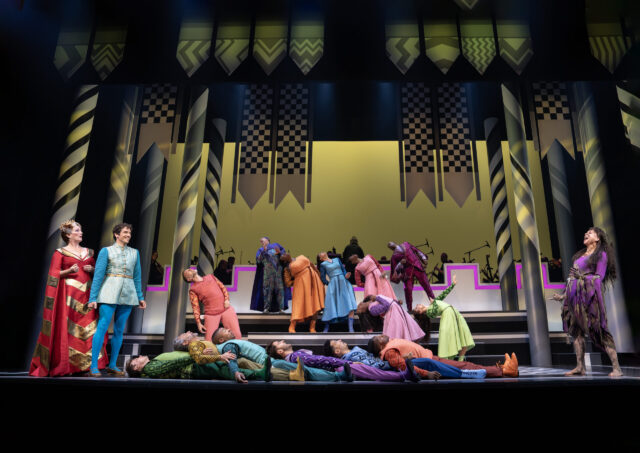
David Zinn keeps it simple with his set, consisting of vaguely medieval beribboned poles and family-crest-style banners slyly referenceing New York City; the orchestra plays in the back of the stage, performing Bruce Coughlin’s enchanting orchestrations. Lorin Lotarro’s playful choreography keeps up the often-frenetic pace, while Andrea Hood’s costumes add elegant color, all superbly lit by Justin Townsend, with expert sound by Kai Harada.

Sir Harry (Will Chase) and Lady Larken (Nikki Renée Daniels) share only part of their story with Queen Aggravain (Ana Gasteyer) and Prince Dauntless the Drab (Michael Urie) (photo by Joan Marcus)

Not everything works. Several songs feel extraneous, a handful of comic moments are repeated, and a few bows are left untied — the show could probably be trimmed down to a tight hundred minutes without intermission instead of two hours and twenty minutes with a break. But who’s to complain when that means more time with Foster and Urie, delivering such lines as “Alas! A lass is what I lack. / I lack a lass; alas! Alack!??” and “In my soul is the beauty of the bog. / In my mem’ry the magic of the mud.”

Early on, the jester asks, “What is a genuine princess?” It’s a question that relates more than ever to the state of the world in the twenty-first century. And one deBessonet, Sherman-Palladino, and Foster go a long way toward redefining.

[Mark Rifkin is a Brooklyn-born, Manhattan-based writer and editor; you can follow him on Substack here.]
A TALE OF TWO ACTORS: STEVE CARELL AND MICHAEL STUHLBARG ON BROADWAY

Steve Carell did not receive a Tony nod for his Broadway debut in Uncle Vanya (photo by Marc J. Franklin)

UNCLE VANYA
Vivian Beaumont Theater at Lincoln Center Theater
150 West 65th St. between Broadway & Amsterdam Ave.
Tuesday – Saturday through June 16, $104-$348
212-362-7600
www.lct.org

PATRIOTS
Ethel Barrymore Theatre
243 West Forty-Seventh St. between Broadway & Eighth Ave.
Tuesday – Sunday through June 23, $49–$294
patriotsbroadway.com

When the 2024 Tony nominations were announced on April 30, there were several notable names missing, particularly that of Steve Carell. The Massachusetts-born Carell, sixty-one, is currently finishing up his Broadway debut as the title character in Heidi Schreck’s muddled new translation of Anton Chekhov’s Uncle Vanya, running at the Vivian Beaumont through June 16. The show received a single nomination, for Carell’s costar William Jackson Harper as Best Actor in a Play, for his portrayal of Dr. Astrov; Schreck and director Lila Neugebauer focus so much on the doctor that the play ought to be renamed Dr. Astrov.

Carell, who cut his comic chops at Second City in Chicago and on The Daily Show with Jon Stewart, has been nominated for an Emmy eleven times for his role as Michael Scott on The Office, and he received a Best Actor Oscar nod for his portrayal of the real-life multimillionaire and murderer John Eleuthère du Pont in Foxcatcher. Carell has also appeared in such films and television series as The 40-Year-Old Virgin, Little Miss Sunshine, The Big Short, and The Morning Show as well as the very dark limited series The Patient.

One name that might have been a surprise was that of Michael Stuhlbarg. The California-born Stuhlbarg, fifty-five, is currently finishing up his role as the real-life Russian oligarch Boris Berezovsky in Peter Morgan’s bumpy but ultimately satisfying Patriots, running at the Ethel Barrymore through June 23. The nomination was the only one for the play, which is directed by Rupert Goold.

All five of the nominees are known for their work on television; in addition to theater veteran Harper, who played Danny Rebus on the reboot of The Electric Company and Chidi Anagonye on The Good Place, the nominees include Emmy winner Jeremy Strong of Succession for An Enemy of the People, nine-time Emmy nominee and Tony winner Liev Schreiber of Ray Donovan for Doubt: A Parable, and Tony and Grammy winner and Emmy and Oscar nominee Leslie Odom Jr. of Smash for Purlie Victorious (A Non-Confederate Romp through the Cotton Patch).

A two-time Emmy and Tony nominee and Obie and Drama Desk winner, Stuhlbarg has appeared in such films as A Serious Man, Call Me by Your Name, and The Shape of Water; has portrayed such villains on TV as Arnold Rothstein in Boardwalk Empire, Jimmy Baxter in Your Honor, and Richard Sackler in Dopesick; and has seven Shakespeare plays on his resume in addition to Cabaret, The Pillowman, and The Invention of Love on Broadway.

Michael Stuhlbarg received his second Tony nomination for his role as Boris Berezovsky in Patriots (photo by Matthew Murphy)

Uncle Vanya and Patriots are both set in Russia after the fall of the Berlin Wall, around the time of Mikhail Gorbachev’s perestroika program, although the exact time of Schreck’s narrative is never specifically stated. Vanya has sacrificed happiness in order to manage the family estate with Sonia (Alison Pill), his niece. When professor Alexander (Alfred Molina) — who was married to Vanya’s late sister, Sonia’s mother — and his younger, sexy wife Elena (Anika Noni Rose), arrive at the estate with plans to sell it, Vanya, who is in love with Elena and is not a terrific businessman, is forced to take stock of his life, and he doesn’t like what he sees.

Boris of Patriots is a stark contrast: He seeks out the many pleasures the world has to offer, determined, since childhood, to be a success with power and influence, unconcerned with the bodies he leaves in his wake. Cutting a deal with Alexander Stalyevich Voloshin (Jeff Biehl), Boris assures the politician that he is going to be a rich man. “No good being rich if I’m dead,” Voloshin says, to which Boris responds, “It’s always good being rich.” Boris believes he is in control of Russia when he chooses to groom a minor functionary as president, intending to make him his puppet, but the man, Vladimir Putin (Will Keen), ultimately has other ideas and soon becomes Boris’s hated enemy.

Carell hovers in the background of Uncle Vanya, giving the stage over to the other characters, similar to how Vanya has surrendered taking action in his life. He often sits and mopes on a couch in the back, fading into the shadows; even when he pulls out a gun, he is too meek and mild. For the play to work, the audience needs to connect emotionally with Vanya, but Carell can’t quite carry off the key moments.

Stuhlbarg leaps across Miriam Buether’s multilevel stage with boundless energy in Patriots as Boris battles Putin over the heart and soul of Russia. Boris has no fear, until he realizes that Putin is a lot more than he ever bargained for. “I will make sure the Russian people learn to love our little puppet,” Boris says, but it’s too late. “The fact is I am president,” Putin declares. Boris responds, “And I put you there!!!!!” To which Putin replies, “That’s opinion. Not fact.”

Carell may be more of a household name than Stuhlbarg, but the latter gained notoriety when, on March 31, a homeless man struck him with a rock near Central Park, and Stuhlbarg, much like Boris most likely would have done, chased after him until the police caught up with the attacker outside of the Russian consulate on East Ninety-First. The consulate was a fitting location for the two-time Tony nominee.

[Mark Rifkin is a Brooklyn-born, Manhattan-based writer and editor; you can follow him on Substack here.]
JUKEBOX HEROES 2: HELL’S KITCHEN / THE HEART OF ROCK AND ROLL

Ali (Maleah Joi Moon) and Knuck (Chris Lee) have each other’s back in Hell’s Kitchen (photo by Marc J. Franklin)

In 1981, Joan Jett shouted, “I love rock n’ roll / So put another dime in the jukebox, baby / I love rock n’ roll / So come and take your time and dance with me / Ow!”

When was the last time any of us put a dime — or quarter, or dollar, or credit card — into a jukebox? However, the jukebox musical, a show built around existing songs, usually by a specific artist, is thriving, and it costs a whole lot more than loose change to see one.

The genre kicked off as the ’80s began, shortly before Jett released “I Love Rock n’ Roll,” with such instant favorites as Beatlemania (the Beatles), Ain’t Misbehavin’ (Fats Waller), and Eubie! (Eubie Blake), but it really found its groove in the 2000s, with The Boy from Oz (Peter Allen), Jersey Boys (Frankie Valli and the Four Seasons), and king of them all, Rock of Ages, which created a compelling narrative based on songs by Styx, Journey, Bon Jovi, Pat Benatar, Foreigner, Twisted Sister, Steve Perry, Poison, Night Ranger, Europe, Whitesnake, and, well, Joan Jett and the Blackhearts.

There are several keys to a successful jukebox musical, whether biographical or fictional: It has to be able to attract fans and nonfans of the music or musician; it needs to sound more like a Saturday-night cover band than a traditional Broadway orchestra; and if it’s basically historical, it should be honest and thorough, while it should be clever and bold if telling a new tale. Biomusicals about Neil Diamond, Tina Turner, Carole King, Cher, Michael Jackson, Motown, and the Temptations all were lacking that certain something, if not more, while Head over Heels did a terrific job incorporating the songs of the Go-Go’s into a sixteenth-century romance, & Juliet extended Romeo and Juliet with the music of Swedish producer Max Martin (made famous by the Backstreet Boys, Britney Spears, Robyn, Demi Lovato, Katy Perry, *NSYNC, and Justin Timberlake, among others), and Jagged Little Pill used Alanis Morissette’s 1995 album to entertainingly explore a suburban family’s dysfunction.

This season saw the Broadway premiere of two exciting, though very different, jukebox musicals that stand apart from the pack. Although they showcase songs by artists I never play at home, I was thrilled to see them performed onstage by excellent casts.

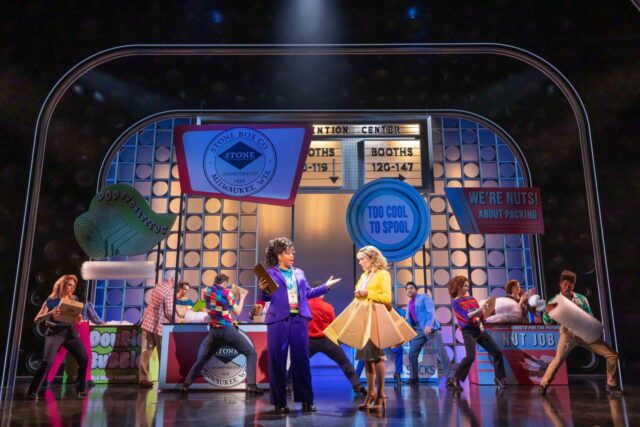
The Heart of Rock and Roll gives reason to jump for joy (photo by Matthew Murphy)

THE HEART OF ROCK AND ROLL
James Earl Jones Theatre
138 West Forty-Eighth St. between Sixth & Seventh Aves.
Tuesday – Sunday through June 23, $58-$288
heartofrocknrollbway.com

The music of Huey Lewis and the News is its own kind of ear candy. The San Francisco band, which started in 1979 and is still together — although they no longer tour because Lewis contracted Ménière’s disease, which causes severe hearing loss — has sold tens of millions of records, boosted by twenty top-fifty singles between 1980 and 1994. Among those to wax poetic about the group was fictional serial killer Patrick Bateman in Bret Eason Ellis’s 1991 novel, American Psycho, and the subsequent 2000 film starring Christian Bale and the 2016 Broadway musical with Benjamin Walker, the last of which features Lewis’s “Hip to Be Square.”

In 1985, Huey Lewis and the News garnered their sole Grammy, winning Best Music Video, Long Form for the single “The Heart of Rock and Roll.” Unfortunately, the new Broadway musical The Heart of Rock and Roll was snubbed by the Tonys and received a lone Drama Desk nomination, for Lorin Latarro’s delightful choreography. But don’t let that stop you from seeing this superfun show, now running at the James Earl Jones Theatre.

Jonathan A. Abrams’s book skirts around clichés in telling the story of Bobby Stivic (Corey Cott), a blue-collar dreamer who is forced to choose between a stable, professional career and playing in a band. When Bobby gets fired from his job on the factory floor of the family-run, Milwaukee-based Stone Box Co., which makes shipping supplies (boxes, tape, packing peanuts, bubble wrap), for cutting a bad deal with a stereo company in order to give every employee a Walkman to help boost productivity, he decides he has to make it right. He heads off to a conference in Chicago where he believes he will be able to get the keynote speaker, Swedish furniture mogul Otto Fjord (Orville Mendoza), to become a client.

Tough HR head Roz (Tamika Lawrence), the easygoing Mr. Stone (John Dossett), and his extremely efficient workaholic daughter, Cassandra (McKenzie Kurtz), see Bobby at the trade show, and, discovering that he is representing the company he no longer works for, are not exactly pleased. But when the ever-charismatic Bobby manages to get a meeting with Fjord — in the hotel sauna — Stone considers giving Bobby another chance.

Meanwhile, Bobby’s former bandmates and childhood friends, optimistic guitarist JJ (Raymond J. Lee), realistic drummer Eli (John-Michael Lyles), and fatalistic bassist Glenn (F. Michael Haynie), suddenly snag a gig that could put them on the map, but they need their lead singer and songwriter to return in order to have any potential shot at the big time. And Bobby and Cassandra might have to answer the big question: Do you believe in love? as her high school sweetheart, the smarmy, WASPy Tucker (Billy Harrigan Tighe), is back in town.

Roz (Tamika Lawrence) has some key words for Cassandra (McKenzie Kurtz) in Huey Lewis musical (photo by Matthew Murphy)

Director Gordon Greenberg (Working, Dracula, A Comedy of Terrors) strings it all together like a series of interrelated music videos, except with more depth — but not too much — with the help of Japhy Weideman’s lighting and John Shivers’s sound. Just because you don’t have Huey Lewis and the News on your digital playlist doesn’t mean you won’t be charmed by the poppy songs, performed by a crack eight-piece band. Music supervisor Brian Usifer’s arrangements and orchestrations stay true to the original tunes without getting Broadway-fied under Will Van Dyke’s solid musical direction. There are plenty of familiar hits (“If This Is It,” “Workin’ for a Livin’,” “I Want a New Drug,” “The Power of Love”) along with a new song written for the musical, “Be Somebody,” which is, well, a bit too square.

Derek McLane’s sets (with backdrops that pay homage to the game Connect Four), Jen Caprio’s costumes, and Nikiya Mathis’s hair, wigs, and makeup keep you firmly in 1987 middle America, from the factory to a nightclub to the convention, where Stone’s booth includes such signs as “Too Cool to Spool,” a riff on “Hip to Be Square.” Latarro wonderfully integrates her choreography into parts of the set, using a conveyor roller, lockers, and, most ingeniously, bubble wrap. (Now, that’s tap dancing!)

The Tucker subplot is stale from the get-go, but just about everything else succeeds, especially the various relationships: between father and daughter, bandmates, potential lovers, and ex-employee and HR diva. Lawrence has a field day as Roz, delivering one of the show’s best lines: “If you’re having a business meeting without your clothes on, then HR better be present.” Dossett is heartwarming as Stone, who evokes some of the dads in the 1980s John Hughes movies. Cott, looking like a young Hugh Jackman, is endearing as Bobby, who just wants everyone around him to be happy. And Kurtz is hilarious as the bumbling, adorable Cassandra, her facial gestures alone worth the price of admission.

“New York, New York / Is it everything they say,” JJ sings in the title song. In the case of The Heart of Rock and Roll on Broadway, it most assuredly is.

Hell’s Kitchen ups the ante on Broadway, earning thirteen Tony nominations (photo by Marc J. Franklin)

HELL’S KITCHEN
Shubert Theatre
225 West Forty-Fourth St. between Seventh & Eighth Aves.
Tuesday – Sunday through January 19, $74-$318
www.hellskitchen.com

When Hell’s Kitchen made its world premiere this past winter at the Public, there was something missing. In my review, I noted, “With some significant tweaking, Hell’s Kitchen has the chance to be both a critical and popular hit on the big stage.” That’s exactly what has happened. (Note: Much of that original review is repeated verbatim below, with some tweaks to emphasize how the Broadway production has improved.)

On Broadway at the Shubert, the semiautobiographical musical, inspired by the life of Alicia Keys — the singer-songwriter, producer, and art collector who has won sixteen Grammys and has been nominated for two Emmys and one Tony — is now a much tighter, fresher coming-of-age story set in mid-1990s Manhattan, thanks to small changes in Kristoffer Diaz’s book. In her first professional role, Maleah Joi Moon makes an explosive Broadway debut as Ali, a seventeen-year-old girl living with her extremely protective single mother, Jersey (Shoshana Bean), in a one-bedroom apartment “on the forty-second floor of a forty-four-story building on Forty-Third Street between Ninth and Tenth Avenues, right in the heart of the neighborhood some people know as Hell’s Kitchen.” The building is designated as artist housing, and it’s filled with a bevy of artists, including a trumpeter on thirty-two, a dance class on twenty-seven, opera singers on seventeen, poets on nine, painters on eight, a string section on seven through four, and a gospel pianist in the Ellington Room on the ground floor.

It’s summer, and Ali has decided it’s time for her to get busy with the older Knuck (Chris Lee), who drums on buckets in the street with his friends Q (Jakeim Hart) and Riq (Lamont Walker II). Ali and her homegirls, Jessica (Jackie Leon) and Tiny (Vanessa Ferguson), are sure the men are up to no good, but as Ali says, “We need that trouble in our lives.”

That’s the last thing Jersey wants for her daughter, so she enlists her besties, Millie (Mariand Torres) and Crystal (Crystal Monee Hall), and jovial doorman Ray (Chad Carstarphen) to keep an eye on Ali’s comings and goings. Jersey does not want what happened to her — an early, unwanted pregnancy by an unreliable man, a jazz musician named Davis (Brandon Victor Dixon) — to happen to her stubborn daughter.

As she prepares for her potential sexual awakening, Ali becomes intrigued by Miss Liza Jane (Kecia Lewis), the elderly woman who plays the piano in the Ellington Room and soon becomes Ali’s mentor. But the trouble that Ali soon encounters is not the trouble she needs.

Mother (Shoshana Bean) and daughter Ali (Maleah Joi Moon) share a poignant moment in Alicia Keys musical (photo by Marc J. Franklin)

Hell’s Kitchen is structured around two dozen Keys songs, from such albums as 2001’s Songs in A Minor, 2003’s The Diary of Alicia Keys, 2007’s As I Am, 2012’s Girl on Fire, 2020’s Alicia, and 2021’s Keys, and three new tunes written specifically for the show, “The River,” “Seventeen,” and “Kaleidoscope.” The orchestrations by Tom Kitt and Adam Blackstone are lively, and Camille A. Brown’s choreography captures the energy of the street on Robert Brill’s scaffold-laden set, enhanced by projections of the neighborhood by Peter Nigrini. The naturalistic costumes are by Dede Ayite, with lively lighting by Natasha Katz and spirited sound by Gareth Owen.

The show is directed with a vibrant sense of urgency by Tony nominee Michael Greif (Dear Evan Hansen, Next to Normal), even more exciting with Diaz’s (The Elaborate Entrance of Chad Deity, Welcome to Arroyo’s) revised book. Moon is magnetic as Ali; you can’t take your eyes off her for even a second. Tony nominee Bean (Mr. Saturday Night, Waitress) is engaging as the overwrought mother, shaking things up with “Pawn It All,” while Obie winner Lewis (Dreamgirls, Ain’t Misbehavin’) nearly steals the show as Miss Liza Jane, channeling Maya Angelou when she says such lines as “I will not allow you to let the pain win,” then bringing down the house with “Perfect Way to Die.” Lee (Hamilton) has just the right hesitation as Knuck, acknowledging the obstacles he faces every step of the way, and Carstarphen (Between the Bars, Neon Baby) is eminently likable as the adorable doorman.

Just as you don’t have to be a Huey Lewis fan to enjoy The Heart of Rock and Roll, you don’t have be an Alicia Keys devotee to get swept away by Hell’s Kitchen. In both cases, it’s well worth putting another dime (or more) in the jukebox, baby.

[Mark Rifkin is a Brooklyn-born, Manhattan-based writer and editor; you can follow him on Substack here.]