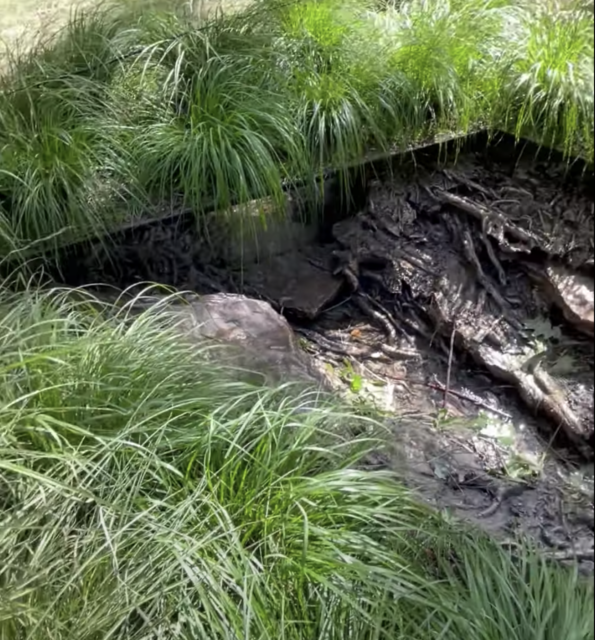
Who: Andy Goldsworthy, Brett Littman What: Live and livestreamed discussion about new Andy Goldsworthy exhibition, “Red Flags” Where:Galerie Lelong, 528 West Twenty-Sixth St. between Tenth & Eleventh Aves., and Zoom When: Saturday, April 23, free, 11:00 am (exhibition continues through May 7) Why: In September 2020, Cheshire-born, Scotland-based environmental artist Andy Goldsworthy installed 109 hand-painted “Red Flags” in Rockefeller Center, replacing state flags and now featuring the color of the earth from each state. “Collectively I hope they will transcend borders,” he said when he started the project. “The closeness of one flagpole to another means that in certain winds the flags might overlap in a continuous flowing line. My hope is that these flags will be raised to mark a different kind of defense of the land. A work that talks of connection and not division.” He also compared the red earth to the blood running through our veins.
Installation view, Andy Goldsworthy, Red Flags, 2020 (courtesy Galerie Lelong & Co., New York)
The installation has now been reconfigured as an indoor exhibit at Galerie Lelong in Chelsea — whittled down to fifty flags and accompanied by two related videos — where it will be on view through May 7. Goldsworthy’s work with natural materials is well documented, in such films as Thomas Riedelsheimer’s 2001 Rivers and Tides and 2016 Leaning into the Wind as well as Goldsworthy’s permanent Garden of Stones at the Museum of Jewish Heritage. “Red Flags may not have been conceived as a response to recent events, but it is now bound up with the pandemic, lockdown, division, and unrest,” Goldsworthy added back in September 2020. “However, I hope that the flags will be received in the same spirit with which all the red earths were collected — as a gesture of solidarity and support.”
In conjunction with Earth Day, the gallery is hosting a free conversation with Goldsworthy and Isamu Noguchi Foundation and Garden Museum director Brett Littman, taking place in Chelsea and Zoom on April 23 at 11:00; admission is free in person and online. You can also check out a September 2020 virtual interview Goldsworthy did with the Brooklyn Rail about his flags project and career here.
Gillian Wearing, Self-Portrait, framed chromogenic print, 2000 (collection of Sherry and Joel Mallin, New York)
GILLIAN WEARING: WEARING MASKS
Solomon R. Guggenheim Museum
1071 Fifth Ave. at 89th St.
Panel discussion: Thursday, April 21, free with RSVP, 2:00
Thursday – Monday through June 13, $18-$25, 11:00 am – 6:00 pm
212-423-3500 www.guggenheim.org
In her five-minute 2018 short film Wearing, Gillian, British artist Gillian Wearing repeats, “I’m Gillian Wearing.”
But who is Gillian Wearing? In the revealing exhibition “Gillian Wearing: Wearing Masks,” continuing at the Guggenheim through June 13, the fifty-eight-year-old Turner Prize winner explores the idea of “Gillian Wearing” through film, sculpture, photography, painting, and installation, putting viewers in the position of asking themselves who they are as well.
Part of the Young British Artists movement of the late 1980s and early ’90s, Wearing focuses on self-portraiture very differently from such near-contemporaries as Cindy Sherman, who disguises herself as real and fictional characters in cinematic and art-historical tableaux as she explores gender and identity, and Lucas Samaras, whose vast output includes an endless array of self-imagery in multiple formats.
Wearing often uses masks — the show was conceived well before the Covid-19 pandemic — on herself and others to challenge who we are and how we are seen. “I do not like to be on this side of the camera. I’d much rather be on the other side of the camera,” she says in Wearing, Gillian. “Watching me being me alienates me from me, and I don’t recognize myself.” In the film, performers, and Wearing herself, wear AI digital masks of her face. “It’s really about putting myself on the line, and that comes from the risk of being judged and laying myself bare to people’s judgments, but . . . such is life.” Those kinds of feelings are not unique to Wearing, particularly in the social media age, when so many people can engage in sophisticated self-display, creating whatever image they want and hiding behind it for myriad reasons.
Gillian Wearing, 60 Minutes Silence, color video projection, with sound, 1996 (Arts Council Collection, Southbank Centre, London)
Spread across four galleries, the exhibition welcomes you into Wearing’s intriguing world, where nothing is quite what it seems. For Signs that Say What You Want Them to Say and Not Signs that Say What Someone Else Wants You to Say, Wearing asked strangers on London streets to write down something about themselves on sheets of paper and then photographed them holding up the signs, which now evoke early Facebook posts. “Everything is connected in life,” one man writes. “The point is to know it and to understand it.”
At first, 60 Minutes Silence might appear to be a photograph of twenty-six uniformed police officers arranged in three rows, but it is actually an hourlong video in which the cops try to maintain their position, moving as little as possible. It’s a kind of reversal, since part of a police officer’s job is to keep a close eye on the public, but now we’re watching them. In addition, seeing the 1996 piece in 2022 makes us think not only of the raging controversy over police brutality but also of diversity: We also can’t help but notice that there are only five women and two people of color. In Confess All on Video. Don’t Worry, You Will Be in Disguise. Intrigued? Call Gillian . . . , people in masks and wigs share extremely personal stories on a split screen in a large booth, again presaging social media.
But Wearing most often is looking at herself. Me and My Ideal Self features photographs of Wearing placed under glass in a custom frame; on the front panel is an elongated photo of Wearing standing in heels on a wooden box, as if not wanting anyone to see what’s inside. She takes self-portraits of herself as her grandparents, her brother, and other family members, of herself at three, seventeen, and twenty-seven (portraits from fifty to seventy appear on the wallpaper), and of herself as seminal photographers Andy Warhol, Diane Arbus, Robert Mapplethorpe, Weegee, Claude Cahun, Henry Fox Talbot, and August Sander, the photographer who set out to document German society in People of the Twentieth Century.
There are also video portraits, a collection of masks, a pair of busts of Wearing nearly kissing each other, a prosthetic Wearing head dangling on an immense charm bracelet with other body parts, and Polaroids she took of herself in the 1990s, sans masks. Throughout it all, her eyes, or the eyes of others in masks of her face, are always visible, looking right at the viewer, a performative take on personal identity, memory, and connection.
On April 21 at 2:00, the Guggenheim will host the free, livestreamed panel discussion “Wearing Masks: The Performance of Identity in Contemporary Art,” with senior curator Jennifer Blessing, photographer and musician Farah Al Qasimi, visual artist Malik Gaines, and multimedia artist Colette Lumiere, moderated by Dr. Ksenia M. Soboleva.
Given the coronavirus crisis and the ongoing debate over mask mandates as variants keep emerging, Wearing has revisited her 2013 Me as Mask, now taking that wax mask of her face, placing a black-bordered blue mask over it, and having it held up on a stick by a disembodied hand, hollow eye holes staring back at us.
“We all wear masks. We’re all actors,” she says in Wearing, Gillian. “Do you feel that you know me a bit now?” The answer is a rousing yes and no.
DIANE ARBUS
Scholars’ Gate, Doris C. Freedman Plaza
Central Park entrance, 60th St. & Fifth Ave.
Through August 14, free www.publicartfund.org online slideshow
In conjunction with the Guggenheim retrospective, Gillian Wearing has gone one step beyond her 2008 self-portrait as photographer Diane Arbus, using the existing photo of Arbus that inspired her picture and transforming it into a life-size statue for the Public Art Fund. The work stands at the Scholars’ Gate entrance to Central Park, in Doris C. Freedman Plaza, on the pavement, not a plinth; she is one of us. The photo of Arbus is part of what Wearing refers to as her “spiritual family,” comprising artists that she has photographed herself in digital masks. As in the photo, the statue depicts Arbus with her medium-format Rolleiflex hanging from around her neck, looking for subjects; she is wearing a dark jacket and white shoes. “A photograph is a secret about a secret. The more it tells you the less you know,” Arbus said in 1971. Wearing now asks what kind of secrets a statue of a photo might hold.
In “An Interview with Myself,” Wearing’s catalog contribution to the Guggenheim show — which includes a thirteen-inch model of the statue and the Arbus quote “If you scrutinize reality closely enough, if in some way you really, really get to it, it becomes fantastic” — she writes about portraying herself as others, “The whole process takes several months, and I liken it to how an actor gets into character. By the time I am in full costume, I lose my actual self a bit. It can be disappointing when the mask comes off and it’s my face again.”
In this case, the mask comes off and it is Arbus, a New York City native who specialized in capturing the daily reality of ordinary folk as well as sideshow performers, strippers, female impersonators, freaks, and others on the fringe. “For me the subject of the picture is always more important than the picture. And more complicated,” Arbus said. That statement relates to Wearing’s work, and specifically her portrayals of Arbus, in beautifully complex ways.
Who: Jane Panetta, Jennifer Packer What: Video tour of “Jennifer Packer: The Eye Is Not Satisfied with Seeing” Where:Whitney Museum of American Art YouTube When: Exhibition continues through April 17 Why: While everyone else is crowding into the Whitney Biennial, you should break away from the pack and check out one of the best exhibitions in the city over the last six months, the revelatory “Jennifer Packer: The Eye Is Not Satisfied with Seeing,” on view at the museum through April 17. The Philadelphia-born, New York City–based artist uses painting and drawing to explore communal and personal memory through dramatic use of color while incorporating art historical tropes associated with portraiture and still-lifes.
In an interview with Hans Ulrich Obrist in the catalog, Packer explains, “I like the idea that I’m the only one who can make a certain painting, and I tend to want to push that, whether it’s technically, conceptually, or emotionally. What I also like about painting is, if I say a word, I can make an image that pertains to that word, and that’s my ideal version. I can paint anything and see anything I’d like to see, even things that I’m not sure I want to see. I saw Titian’s The Flaying of Marsyas (c. 1570–1576) when I was in Rome, where he’s strung upside down, and I was thinking about Titian painting this body and deciding how much care to give to Marsyas. I feel the same way: the idea of painting as an exercise in tenderness.”
In paintings such as The Body Has Memory,The Mind Is Its Own Place,Say Her Name,Blessed Are Those Who Mourn (Breonna! Breonna!),Vision Impaired, and A Lesson in Longing, Packer creates eye-catching imagery that demands careful attention from the viewer, as some mysteries are answered but many remain.
Packer, who had two works in the 2019 Whitney Biennial, continues in the interview, “I feel a kind of responsibility. Painting can go where photography cannot. I think my task as an artist is to be more attentive. Everyone should be attentive, but I ask myself to look and reap the benefits and witness pain with that consciousness. I think it’s impossible not to talk about politics, even in the most casual way. I’m thinking about Black representation in portraiture. I’m thinking about walking through the Met and looking at the Rubens, or any other large paintings of that nature, which are about a decadence that was funded through procuring riches from other parts of the world in questionable ways.”
Even if you can’t make it to the Whitney this weekend, there are several worthwhile videos available on YouTube that delve into the exhibit, including a thirteen-minute walkthrough with curator Jane Panetta and an hourlong conversation between Packer and Panetta from February. The title of the show comes from a quote from Ecclesiastes: “All things are full of weariness; a man cannot utter it; the eye is not satisfied with seeing, nor the ear filled with hearing.” Packer’s extraordinary work goes well beyond both those senses.
Who: Branjae, John Fullbright, David Amram, Red Dirt Rangers, Deana McCloud What: Livestreamed concert from the Woody Guthrie Center in Tulsa Where:Morgan Library & Museum online When: Wednesday, April 6, free, 7:00 Why: The Morgan Library exhibition “Woody Guthrie: People Are the Song” takes visitors on a deep dive into the life and career of Oklahoma-born singer-songwriter Woodrow Wilson “Woody” Guthrie, the folk music legend who fought for everyday Americans through his staunch activism and protest songs. The outstanding show, continuing through May 22, features hundreds of items, from Woody’s instruments, records, letters, and notebooks to photographs, postcards, lyrics, and artworks, including a rare painting. The audioguide is narrated by country folk rock troubadour Steve Earle and features snippets of songs and archival interviews with Guthrie. Talking about moving to the West Coast, Guthrie says, “They called us ‘dust bowl refugees.’ But then there’s more than one kind of a refugee. There’s refugees that take refuge under railroad bridges, and there is refugees that take refugee and . . . take refuge in public office. But when we was out in California, all that the native sons and daughters called us was just ‘dust bowl refugees.’”
Guthrie, who was born in the small town of Okemah on July 14, 1912, and died of Huntington’s disease on October 3, 1967, in Coney Island, left behind a legacy that reaches around the world, impacting such musicians as Bob Dylan, Bruce Springsteen, Billy Bragg, Wilco, John Mellencamp, Pete Seeger, and so many others. On April 6 at 7:00, the Woody Guthrie Center in Tulsa will present the live concert “Oklahoma Sings Woody!,” with performances by Branjae, John Fullbright, David Amram, and Red Dirt Rangers, playing three songs each, their own as well as Woody’s. While the in-person show is sold out, the event will be livestreamed for free by the Morgan, supplemented with a brief virtual tour of the center by founding executive director and chief curator Deana McCloud. Throughout his too-short career, Guthrie revealed the power that music can have on politics and the populace; as he famously carved into a guitar, “This machine kills fascists.” Yes, people are the song.
Dancer Kayla Hamilton is not about to let visual impairment get in the way of her career in Vision Portraits (photo by Kjerstin Rossi)
Who:Moving Body — Moving Image What:ScreenDance Film Festival Where: Barnard College Department of Dance Movement Lab, Glicker Milstein Theatre in the Diana Center, 3009 Broadway at 116th St., and online When: Sunday, April 3, free with advance RSVP, noon – 6:00 pm (festival continues through April 11) Why: The Moving Body — Moving Image Biennale Festival was founded in 2018 by choreographer, dancer, teacher, filmmaker, and curator Gabri Christa to “give voice to social and social justice themes,” two years before dance films began reaching new heights of creativity during the pandemic lockdown, with a concerted focus also on social justice. The third iteration, “The Moving Body with Disabilities,” is underway now at Barnard College, with an international collection of six installation films, eight shorts, one feature, and three online-only works. On Sunday, April 3, Barnard’s Glicker Milstein Theatre will host a full in-person afternoon at its Morningside Heights home, with screenings of all films in addition to a panel discussion. “We are stunned by how much demand there was for the festival films among the global audiences,” Christa, whose now-wheelchair-bound mother was a special ed teacher, said in a statement. “Also, I hope that the pandemic isolation brought greater awareness around social inequity and perhaps more understanding of racism, ageism, and ableism.” The themes of the previous festivals were “Moving Brown Body” in 2018 and “Aging & Othering” in 2020.
The festival begins at noon with welcome remarks, followed by two shorts programs, at 12:30 and 2:00. Part I consists of Robert Dekkers’s Flutter (with AXIS Dance Company and others), Stephen Featherstone’s Stopgap in Stop Motion (with Stopgap Dance Company), Katrina MacPherson’s Uath Lochans (with Marc Brew), and Karina Epperlein’s Phoenix Dance (with Homer Avila, Andrea Flores, and choreographer Alonzo King). The second program comprises Ralph Klisiewicz’s Moods in Three Movements (with Kris Lenzo), Pioneer Winter’s Gimp Gait (with Marjorie Burnett and Pioneer Winter), Alison Ferrao’s From Me (with the Dancer Development Course at Magpie Dance), and Katherine Helen Fisher’s One + One Makes Three (with Jerron Herman, Laurel Lawson, Brandon Kazen-Maddox, Catherine Nelson, and choreographer Alice Sheppard). The feature presentation at 3:00 is Rodney Evans’s 2019 documentary, Vision Portraits, about three artists with vision impairment, made by the blind Evans. Admission is free with advance registration. If you can’t make it to Barnard, all of the films and events will be available online through April 11, including Anna-Lena Ponath’s Eudaimonia, Yannis Bletas’s How to Train an Antihero, and Alexandros Chantzis’s Who Is Honorine Platzer?
Filmmaker Rodney Evans explores his increasing blindness in Vision Portraits (photo by Kjerstin Rossi)
VISION PORTRAITS (Rodney Evans, 2019)
Barnard College, Glicker Milstein Theatre in the Diana Center, 3009 Broadway at 116th St.
Sunday, April 3, free with advance RSVP, 3:00 www.thefilmcollaborative.org
“In a lot of ways, I feel like I’m just looking for guidance in how to be a blind artist,” filmmaker Rodney Evans says in Vision Portraits, his remarkable documentary. Evans follows three artists as they deal with severe visual impairment but refuse to give up on their dreams as he seeks experimental treatment for his retinitis pigmentosa. Manhattan photographer John Dugdale lost most of his eyesight from CMV retinitis when he was thirty-two but is using his supposed disability to his advantage, taking stunning photos bathed in blue, inspired by the aurora borealis he sees when he closes his eyes. “Proving to myself that I could still function in a way that was not expected of a blind person was really gonna be the thing,” he says. “It’s fun to live in this bliss.” Bronx dancer Kayla Hamilton was born with no vision in one eye and developed iritis and glaucoma in the other, but she is shown working on a new piece called Nearly Sighted that incorporates the audience into her story. “How can I use my art form as a way of sharing what it is that I’m experiencing?” she asks.
Canadian writer Ryan Knighton lost his eyesight on his eighteenth birthday due to retinitis pigmentosa, but he teaches at a college and presents short stories about his condition at literary gatherings. “I had that moment where I had a point of view now, like, I realized blindness is a point of view on the world; it’s not something I should avoid, it’s something I should look from, and I should make it my writerly point of view,” Knighton explains. Meanwhile, Evans heads to the Restore Vision Clinic in Berlin to see if Dr. Anton Fedorov can stop or reverse his visual impairment, which is getting worse.
Vision Portraits is an intimate, honest look at eyesight and art and how people adapt to what could have been devastating situations. Evans, who wrote and directed the narrative features Brother to Brother and The Happy Sad, also includes animated segments that attempt to replicate what the subjects see, from slivers of light to star-laden alternate universes. The Moving Body — Moving Image screening at Barnard will be followed by a discussion with Evans and Hamilton.
Who: Patricia G. Berman, MaryClaire Pappas, Edward Gallagher What: Live virtual discussion and exhibition tour Where: Scandinavia House YouTube When: Saturday, April 2, free, 1:00 (exhibition continues at 58 Park Ave. at 38th St. through June 4) Why: Norwegian painter and sculptor Edvard Munch “seems to have been one of the first artists in history to take ‘selfies,’” notes the introductory wall text to the Scandinavia House exhibition “The Experimental Self: Edvard Munch’s Photography.” As the free show — which has been brought back, with some wonderful design changes that provide deeper perspective, for an encore run extended through June 4 — reveals, that statement does not just refer to Munch’s penchant for self-portraiture, as demonstrated in the 2018 Met exhibit “Edvard Munch: Between the Clock and the Bed,” which included a detailed look at Munch’s depiction of himself over the years. “Munch painted self-portraits throughout his career, but with increased intensity and frequency after 1900,” Gary Garrels, Jon-Ove Steihaug, and Sheena Wagstaff write in the introduction to the Met catalog. “These ‘self-scrutinies,’ as he called them, provide insight into his perceptions of his role as an artist, as a man in society, and as a protagonist in his relationships with others, especially women. . . . Using himself as subject but always allowing technique to influence effect, Munch was able to powerfully investigate the interplay between depicting external reality and meditating on painterly means.”
Edvard Munch, “Self-Portrait at the Breakfast Table at Dr. Jacobson’s Clinic,” gelatin silver contact print, 1908-09 (courtesy of Munch Museum)
At Scandinavia House, this is evident in his fascination with photography, which he took up during two periods of his life that were fraught with physical and health issues. Munch snapped photographs between 1902 and 1910, after his lover, Tulla Larsen, shot him in the left finger, and again from 1927 to the mid-1930s, suffering a hemorrhage in his right eye in 1930. He also took home movies with a camera in 1927. As in his paintings and particularly his prints, Munch experimented with photographic images, playing with exposure length, camera angles, movement, and shadows for his Fatal Destiny portfolio and individual works. He is purposely blurry in “Self-Portrait in Profile Indoors in Åsgårdstrand,” “Self-Portrait at the Breakfast Table at Dr. Jacobson’s Clinic,” and “Self-Portrait ‘à la Marat,’ Beside a Bathtub at Dr. Jacobson’s Clinic.” He is completely naked, holding a sword in 1903’s “Edvard Munch Posing Nude in Åsgårdstrand,” a kind of companion piece to 1907’s “Self-Portrait on Beach with Brushes and Palette in Warnemünde,” in which he holds a paintbrush. The woman in “Nurse in Black, Jacobson’s Clinic,” from 1908-09, has a lot in common with Munch’s 1891 oil painting, “Lady in Black.” There are multiple, ghostly images of both subjects in 1907’s “Edvard Munch and Rosa Meissner in Warnemünde,” evoking the phantasmic bodies in several prints on view, including “Moonlight II.”
On April 2, American-Scandinavian Foundation president Edward Gallagher will moderate a special live, online presentation with curator Patricia G. Berman giving an up-close look at several photographs in the show, ASF Research Fellow MaryClaire Pappas talking about Munch’s self-portraiture, and a panel discussion on Munch’s relevance to twenty-first-century photography. You can check out the exhibit from home using the new virtual tour here.
Edvard Munch, “Self-Portrait on Beach with Brushes and Palette in Warnemünde,” Collodion contact print, 1907 (courtesy of Munch Museum)
In the Met catalog, in her essay “The Untimely Face of Munch,” Allison Morehead explains, “‘He is not attached to any school or any direction,’ wrote the Norwegian critic and art historian Jappe Nilssen in 1916, ‘because he himself is one of those who advances and creates his own school and forges his own direction.’ Surely with Munch’s complicity, Nilssen described his friend as both stereotypical avant-garde outsider and chronological anomaly, as an art history unto himself, his own school, his own doctrine, and his own teleology. Perhaps then it is little wonder that Munch made so many self-portraits from the beginning to the end of his career, regularly depicting himself in paintings, prints, drawings, and photographs, and also little wonder that art historians have found them so preoccupying.’”
The Scandinavia House show, which has added a case of vintage camera equipment and a short video by Berman and is divided into such sections as “Landscape of Healing,” “Munch’s Selfies,” and “The Amateur Photographer,” concludes with a short compilation of home movies Munch shot with a Pathé-Baby camera, in which the artist once again focuses on himself as his subject. “I have an old camera with which I have taken countless pictures of myself, often with amazing results,” he said in 1930. “Some day when I am old, and I have nothing better to do than write my autobiography, all my self-portraits will see the light of day again.” It’s fascinating to consider just what Munch, who died in 1944 at the age of eighty, would have thought of contemporary social media and the selfie, offering new opportunities to shine a light on himself.
Spiders and their webs are at the center of Tomás Saraceno’s immersive, multimedia exhibitions at the Shed and Tanya Bonakdar Gallery (photo by twi-ny/mdr)
TOMÁS SARACENO: PARTICULAR MATTER(S)
The Shed
545 West 30th St. at Eleventh Ave.
Tuesday – Sunday through April 17
Upper level + gallery: $42; lower level + gallery: $35; gallery exhibition only: $12
646-455-3494 theshed.org studiotomassaraceno.org
The integration of art, technology, nature, and the environment is central to Argentina-born artist Tomás Saraceno’s discipline, currently on display in a pair of complex immersive exhibitions in the city. In “Silent Autumn” at Tanya Bonakdar in Chelsea and “Particular Matter(s)” at the Shed in Hudson Yards, Saraceno investigates toxic air and water, the reuse of plastic bags, rampant consumerism, and, most of all, spiders though collaborations with MIT and NASA, among others, attempting to find ways to fix a broken planet in this out-of-control Capitalocene era.
In a 2014 lecture he gave at MIT, Saraceno discussed the “sociability” of spiders. “It’s very similar to humans,” he said. “Spiders are social because they have enough space and food. But if you put a lot of social spiders in a very tiny space, they are not social. They eat each other. They’re pretty much like humans. There are forty-three thousand species of spider and only twenty are social. Knowing that sociability is a big trend for the survival of the planet, no one really understands this. What we do is try to make [the spiders] operate and work, one with the other, the solitary and the social.” It sounds all too close as humanity emerges from a global pandemic.
Continuing through April 17, “Particular Matter(s)” leads visitors on an audiovisual journey through the kingdom of the spiders. Webs of At-tent(s)ion consists of seven encased hybrid spider webs, hanging in midair and lit so it appears that they’re glowing in the dark. Each case is like its own universe, with different species of spider building on what others started, resulting in magical architectural structures made of spider silk and carbon fibers.
Radio Galena turns a crystal into a wireless radio receptor. Printed Matter(s) reproduces cosmic dust from 1982 in a series of ten photos printed using black carbon PM2.5 pollution extracted from the air in Mumbai; they are arranged loosely on a wall, as if they might blow away and break up into shreds, like the atmosphere being destroyed by pollution. Particular Matter(s) is a light beam that reveals how much dust is in the air that we breathe, poisoned by the burning of fossil fuels.
Arachnomancy features a deck of thirty-three tarot-like meteorological “oracle” cards, printed on carbon-footprint-neutral paper, spread out across a table, based on the beliefs of the spider diviners of Somié, Cameroon, who make cards out of leaves, forecasting weather events. The cards include images of maps, plants, human figures, and webs, with such titles as “Bad News,” “Planetary Drift,” “Invertebrate Rights,” “Entanglement,” and “Fortunate Webbing.” Dangling above the table is a web built by two Cyrtophora citricola spiders that looks like you could rip it apart with a soft breath.
Inspired by the writings of science journalist Harriet A. Washington,We Do Not All Breathe the Same Air uses black carbon, soot, and PM2.5 and PM10 to reveal how pollution impacts air quality in different parts of the country, adversely affecting BIPOC and poorer areas. A red sliding sheet laser brings spider webs to life in a long horizontal window in How to entangle the universe in a spider/web,? which resembles a trip through the human circulatory system or into a far-off galaxy. The concept of spider ballooning and visitors’ movement combine to create music in Sounding the Air, an installation in which five threads of spider silk form an aeolian instrument that emits sonic frequencies when it encounters heat, wind, body movement, and other elements.
A Thermodynamic Imaginary is a room filled with many wonders of Saraceno’s oeuvre, a fantasy world comprising sculpture, projected video (Tata Inti and Living at the bottom of the ocean of air), shadows, reflections, large bubbles, and more, like its own galaxy in what the artist calls the Aerocene: “a stateless state, both tethered and free floating; a community, an open source initiative; a name for change, and an era to live and breathe in.”
On the fourth floor, you have to remove your shoes to walk into Museo Aero Solar, devised by Saraceno and Alberto Pesavento in 2007, an ecological balloon composed of plastic bags sewn together, their brands and trademarks visible, seeking to eventually eliminate the use of fossil fuels by providing sustainable, free-floating options. The gallery also includes documentation of the project and such items as an Aerocene Backpack and flight starter kits.
The centerpiece of “Particular Matter(s)” is Free the Air: How to hear the universe in a spider/web, a live eight-minute concert held in an almost blindingly white two-level, ninety-five-foot diameter floating sculpture, commissioned by the Shed for this exhibition. The limited audience gets misted as they enter the foggy space, which contains 450,000 cubic feet of air and features a large-scale net made of steel and thick wire that evokes a giant spider web on which people lie down; it’s a rather tenuous trampoline with gaps in it, so if you jump, it will affect not only your balance but others’ as well, so don’t play around too much. If you’re on the lower level, you can look up to see the people above you, almost walking on air.
Darkness ensues and the concert in four movements begins, prerecorded sound waves and vibrations of spiders interacting with their webs that are impacted by the audience’s presence, incorporating Sounding the Air,Webs of At-tent(s)ion, and other items in “Particular Matter(s).” It’s a welcoming atmosphere of interspecies communion and coexistence that plots a course for ways to save our increasingly fragile planet using our innate spider-sense and expanding our idea of what home is.
Advance tickets are necessary for the special experience and sell out quickly, so act fast. As part of the Shed program “Matter(s) for Conversation and Action,” on March 30 at 6:00 there will be a free Zoom panel discussion, “Invention, Experimentation, and Radical Imagination,” with MIT professor Caroline A. Jones, climate scientist Dr. Kate Marvel, and Vassar professor Molly Nesbit, moderated by designer, teacher, and entrepreneur Sandra Goldmark, followed on April 13 at noon by “Rights of Nature, Activism, and Change” with lawyer Alicia Chalabe, Dartmouth professor N. Bruce Duthu, and sociologist and writer Maristella Svampa, moderated by Columbia Law School professor Michael B. Gerrard.
Tomás Saraceno gallery show at Tanya Bonakdar complements Shed exhibition (photo courtesy Tanya Bonakdar Gallery)
TOMÁS SARACENO: SILENT AUTUMN
Tanya Bonakdar Gallery
521 West 21st St. between Tenth & Eleventh Aves.
Tuesday – Saturday through March 26, free, 10:00 am – 6:00 pm www.tanyabonakdargallery.com
In conjunction with the Shed show, Tanya Bonakdar is presenting “Silent Autumn” through March 26. The title plays off Rachel Carson’s seminal 1962 book, Silent Spring, a “fable for tomorrow” that called for the elimination of such chemicals as DDT in order to maintain a living, breathing Earth. The exhibit begins with An Open Letter for Invertebrate Rights, in which Spider/Webs explain, “Do not be afraid. Let us move from arachnophobia to arachnophilia by sensing new threads of connectivity, or else face the eternal silence of extinction.”
Visitors must put booties over their shoes in order to enter Algo-r(h)i(y)thms, a musical instrument comprising a vast network of webs, the strings of which make warming sounds when plucked. You can either create your own solo or work in tandem with others for a more ornate score. Surrounding the instrument are Arachne’s handwoven Spider/Web Map of Andrómeda, with a duet of Nephila inaurata — four weeks and ensemble of Cyrtophora citricola — three weeks and Cosmic Filaments, intricate black-and-white architectural drawings of web universes.
The title diptychs (and one triptych) pair framed leaves glued to inkjet paper next to framed photographs of the leaves; the two works initially look identical, but over time the real leaves will fade and disintegrate while the picture endures. Silent Spring comprises four panels of pressed poppy flowers from contaminated soil near Saraceno’s Berlin-Rummelsburg studio, with shutters that protect them from the sun, although they too will fade; the dirt was polluted by a photographic film and dye manufacturer, so the piece is very much part of Saraceno’s personalized mission of recycling and sustainability.
In the same room, three stainless-steel and wood sculptures hang from the ceiling at different heights, evoking the much larger structures Saraceno installed on the Met roof for “Cloud City” in 2012 as well as the Silent Autumn framed leaves. In a smaller room, the blown glass pieces Pneuma,Aeolus,Aeroscale, and Aerosolar Serpens probe breathing, physical presence, and the brittleness of existence. Other works continue Saraceno’s exploration of overconsumption, pollution, climate change, and the future of life on the planet — and throughout the universe.
Saraceno is a genius at bringing us into his world by creating fascinating objects that are ravishing to look at, then hitting us with the heavily researched science behind it all as he attempts to save the world. But he can only do it with our help.