this week in art

36.5 / A DURATIONAL PERFORMANCE WITH THE SEA: NEW YORK ESTUARY

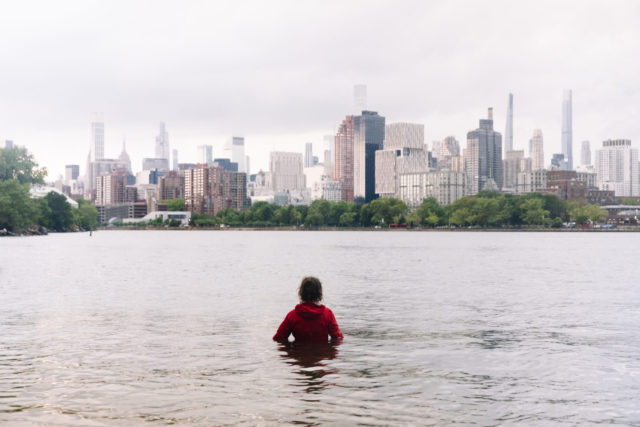
Sarah Cameron Sunde will conclude thirteen-year durational project in New York City on September 14 (photo courtesy Sarah Cameron Sunde)

Who: Sarah Cameron Sunde
What: Conclusion of nine-year artistic environmental journey
Where: Hallet’s Cove, special viewing areas, and online
When: Wednesday, September 14, free, 7:27 am – 8:06 pm
Why: Harlem-based interdisciplinary artist and director Sarah Cameron Sunde began 36.5 / A Durational Performance with the Sea back in 2013, in which she stands in bodies of water for full twelve-plus-hour tidal cycles, with the public invited to join her in person or online. The work, which has been performed on six continents, was inspired by the damage caused by Hurricane Sandy, to the community, humanity, and artists specifically. The piece comes to its conclusion on September 14 with 36.5 / New York Estuary, when Sunde will be at Hallet’s Cove at 31-10 Vernon Blvd.; you can go in the water with her, watch the livestream at home or with others at Brookfield Place, Manhattan West, Riverside Park Conservancy, Gallatin Galleries at NYU, Mercury Store in Brooklyn, the RISE center in Far Rockaway, or the Newhouse Center for Contemporary Art at Snug Harbor in Staten Island, or check it out from viewing stations on the northern tip of Roosevelt Island or the Upper East Side. There will also be remote participants from Bangladesh, Brazil, Kenya, the Netherlands, and Aotearoa—New Zealand. In conjunction with the finale, Sunde cofounded Kin to the Cove, a community organization that hosts site-specific workshops, discussions, and other events.

The work has previously been performed in Maine, Mexico, San Francisco Bay, the Netherlands, the Bay of Bengal in Bangladesh, the Bay of All Saints in Brazil, Bodo Inlet in Kenya, and Te Manukanukatanga ō Hoturoa in Tāmaki Makaurau. Sunde explained in a statement, “36.5 / A Durational Performance with the Sea is my attempt to translate the seemingly abstract idea of climate change and sea-level rise into our bodies. It’s also about Time on many different scales: a durational work that unfolds over thirteen hours that has taken nearly a decade to complete. The tide tracks time on my body viscerally, which functions as a metaphor for the changing environment. The water is my collaborator, and the risks are real. I stay present in the sensations, attempt to embody the ocean, and find a way to endure the struggle while decentering my human experience and acknowledging potential futures. The public is invited to stand in the water with me for however long they like and to participate in a series of artistic interventions from the shore, creating a human clock that communicates to me each hour as it passes.”

On October 6 at 6:00, NYU dean for the humanities Una Chaudhuri will moderate “Standing with the Sea: Reflections on Sarah Cameron Sunde’s 36.5 / A Durational Performance with the Sea” at Gardner Commons in Shimkin Hall, followed by a screening of an updated video on the outside Bobst Library wall.
DAKOTA MODERN: THE ART OF OSCAR HOWE

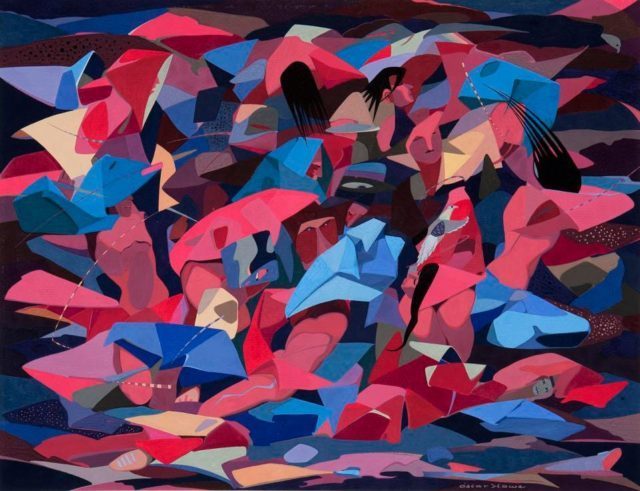
Oscar Howe, Dance of the Heyoka, casein on paper, 1954 (Philbrook Museum of Art, Tulsa, Oklahoma)

DAKOTA MODERN: THE ART OF OSCAR HOWE
National Museum of the American Indian
George Gustave Heye Center, One Bowling Green
Through Sunday, September 11, free
212-514-3700
americanindian.si.edu

In April 1958, after Oscar Howe’s work had been rejected by the Philbrook Art Center, the Yanktonai Dakota artist wrote a letter to curator Jeanne Snodgrass: “Who ever said that my paintings are not in the traditional Indian style has poor knowledge of Indian Art indeed. There is much more to Indian Art than pretty, stylized pictures. There was also power and strength and individualism (emotional and intellectual insight) in the old Indian paintings. Every bit in my paintings is a true studied fact of Indian paintings. Are we to be held back forever with one phase of Indian painting that is the most common way? We are to be herded like a bunch of sheep, with no right for individualism, dictated as the Indian has always been, put on reservations and treated like a child, and only the White Man knows what is best for him. . . . Well, I am not going to stand for it.”

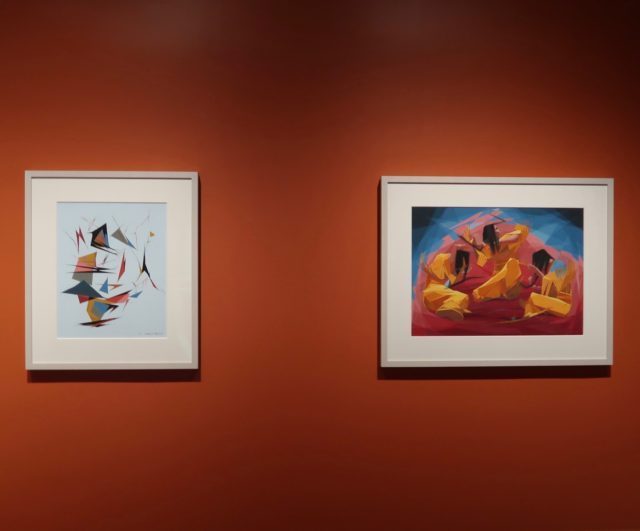
Born in 1915 on the Creek Sioux Reservation in South Dakota, Howe (his tribal name was Mazuha Hokshina) had a distinguished career as an artist, teacher, advocate, and activist. His life and work are explored in the sensational exhibit “Dakota Modern: The Art of Oscar Howe,” which continues at the National Museum of the American Indian through September 11. Howe’s canvases evoke the color and angular graphic style of Jacob Lawrence, but they depict the American Indian experience, particularly his Očhéthi Šakówiŋ (Sioux) culture, instead of that of African Americans. Many of the works, in watercolor, gouache, tempera, and casein on paper, require longer viewing as their subjects emerge from an initially abstract image.

“We are finally at a point in the twenty-first century where we can recognize the impact and complexity of Oscar Howe’s incredible work as both Native American and modern American art,” curator Kathleen Ash-Milby said in a statement. “This project is a long overdue recognition of his contribution to the field that we hope will establish Howe’s place as a twentieth-century modernist.”

Sensational Oscar Howe exhibit continues through September 11 (photo by twi-ny/mdr)

The show follows Howe from his high school years up to his death in 1983 at the age of sixty-eight. The paintings are supplemented with substantial biographical information, including archival film footage, highlighted by a 1960 appearance on This Is Your Life, the television series hosted by Ralph Edwards; Howe collector Vincent Price introduced the artist, who came to regret his participation because it only furthered stereotypes.

In Fleeing a Massacre, an Indian on horseback is caught within a swirling storm of ghosts and the American flag. Wounded Knee Massacre features armed American soldiers on land in the top half, with Indians flailing below in a bloody pit. At first, Fighting Bucks looks like a kind of acid trip until the antlers and bodies of two deer become evident. Dance of the Heyoka comes at you in a barrage of complex geometric shapes and bold colors.

“Dakota Modern: The Art of Oscar Howe” is an exceptional, revelatory show, arriving right on time as a reckoning is underway in the art world, reexamining work done by underrepresented and misrepresented creators. The rediscovery of Howe is nothing less than thrilling; the exhibition is accompanied by a deluxe catalog with essays by Janet Catherine Berlo, Christina Burke, Philip J. Deloria, Erika Doss, Emil Her Many Horses, John Lukavic, Inge Dawn Howe Maresh, Anya Montiel, Denise Neil, and Joyce Szabo that shed new light on this extraordinary artist.

CROSSING THE LINE FESTIVAL 2022

Fouad Boussouf’s Näss will be performed at the Joyce as part of FIAF fest (photo © Charlotte Audureau)

CROSSING THE LINE FESTIVAL
FIAF and other locations
55 East 59th St. between Madison & Park Aves.
September 9–October 28, free – $75
212-355-6100
fiaf.org

FIAF’s fifteenth annual Crossing the Line Festival is another journey into exciting, challenging, and experimental music, dance, and theater from the French-speaking world. Running September 9 through October 28, the programs take place at such venues as Abrons Arts Center, New York Live Arts, the Chinese Consolidated Benevolent Association, the Joyce, and BAM in addition to FIAF’s Gallery, Florence Gould Hall, and Skyroom.

“For our first year curating this festival, we wanted to honor its founding principles: presenting compelling multidisciplinary art forms throughout the city, bringing acclaimed cutting-edge French and Francophone productions to our shores, and nurturing dialogue between international and New York-based artists,” curators Mathilde Augé and Florent Masse write in a program note. “The fifteenth edition of the festival features a diverse group of audacious artists engaging with the most pressing issues of our time — including gender, sexuality, human connection, race, and climate change — and exploring new territories in performing arts.”

None of the nine live performances — there were supposed to be ten but Caroline Guiela Nguyen’s FRATERNITY, A Fantastic Tale had to be canceled because of visa problems — has ever been seen before in New York, including several North American, US, and world premieres. The mix of dance, theater, art, music, and literature hails from Senegal, France, South Africa, Rwanda, the United States, and Morocco, examining societal change, Vaslav Nijinsky, science, Cheikh Anta Diop, intergenerational culture, the political views of René Char and Frantz Fanon, and a Detroit rave.

In addition, FIAF is hosting the fall open house celebration Fête de la Rentrée, highlighted by an opening reception for Omar Ba’s “Clin d’oeil” art exhibition on September 9 at 6:00 (free with RSVP) and a Sunset Soirée at Le Bain on October 12 at the Standard Hotel (free with RSVP). Below is the full Crossing the Line schedule.

Helena de Laurens stars in Marion Siéfert’s _ jeanne_dark _ at FIAF’s Crossing the Line Festival (photo © Matthieu Bareyre)

September 9 – October 28
Exhibition: “Clin d’oeil,” by Omar Ba, FIAF Gallery, free

Wednesday, September 14, and Thursday, September 15
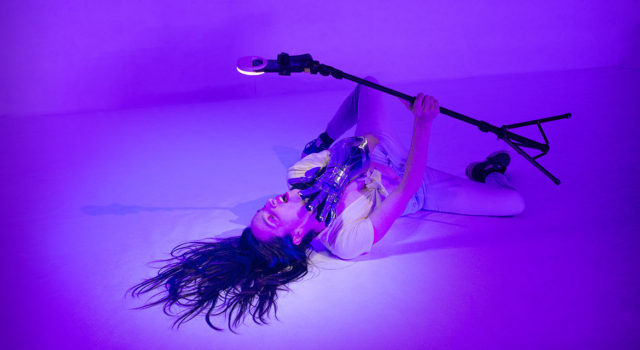
Theater: _ jeanne_dark _, by Marion Siéfert, starring Helena de Laurens, North American premiere, FIAF Florence Gould Hall, $40, 7:30

Wednesday, September 21
Theater: Traces – Speech to African Nations, by Felwine Sarr and Étienne Minoungou, with Étienne Minoungou and Simon Winsé, New York premiere, Abrons Arts Center, $25, 8:30

Thursday, September 22, through Saturday, September 24
Dance: And so you see… our honourable blue sky and ever enduring sun… can only be consumed slice by slice…, by Robyn Orlin, performed by Albert Ibokwe Khoza, US premiere, New York Live Arts, $15-$35, 7:30

Saturday, September 24
Theater: Freedom, I’ll have lived your dream until the very last day, by Felwine Sarr and Dorcy Rugamba, featuring Marie-Laure Crochant, Majnun, Felwine Sarr, and T.I.E., North American premiere, Florence Gould Hall, $40, 7:30

Bruno Latour and Frédérique Aït-Touati’s Terrestrial Trilogy closes out FIAF fest (photo © zonecritiquecie)

Thursday, September 29, and Friday, September 30
Performance: Fire in the Head, by Christopher Myers, world premiere, Chinese Consolidated Benevolent Association, $20, 7:30

Thursday, October 6, through Saturday, October 8
Dance: The Encounter, by Kimberly Bartosik, performed by Kimberly Bartosik, Claude “CJ” Johnson, Burr Johnson, Joanna Kotze, Ryan Pliss, Kalub Thompson, Mac Twining, River Bartosik-Murray, Logan Farmer, and Ellington Hurd, world premiere, FIAF Skyroom, $30, 7:30

Thursday, October 13, through Saturday, October 15
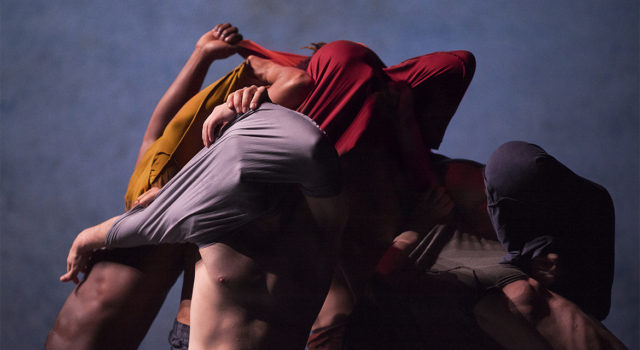
Dance: CROWD, by Gisèle Vienne, US premiere, BAM Howard Gilman Opera House, $35-$75, 7:30

Tuesday, October 18, through Sunday, October 23
Dance: Näss, by Fouad Boussouf, New York premiere, the Joyce Theater, $20-$55

Thursday, October 27, and Friday, October 28
Theater: The Terrestrial Trilogy, a Performance in Three Parts: Inside, Moving Earths, and Viral, by Bruno Latour and Frédérique Aït-Touati, with special guest Bruno Latour, North American premiere, FIAF Florence Gould Hall, $40

JEPPE HEIN: CHANGING SPACES

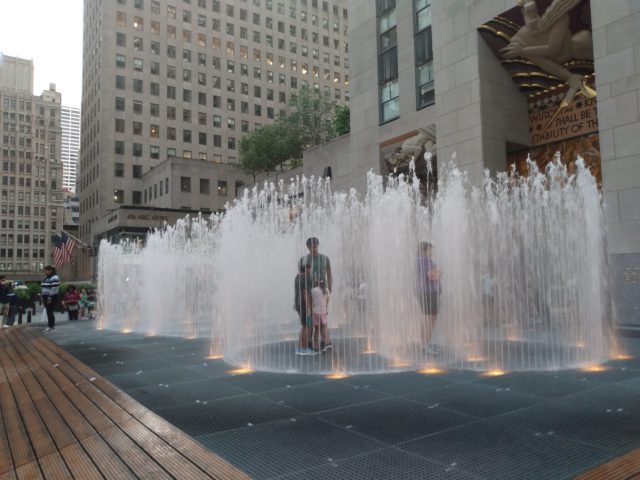
Changing Spaces gets people wet and keeps them dry at Rockefeller Center (photo by twi-ny/mdr)

CHANGING SPACES
Rockefeller Center
Forty-Ninth to Fiftieth Sts. between Fifth & Sixth Aves.
Daily through September 9, free
www.rockefellercenter.com
www.jeppehein.net
changing spaces slideshow

In 2015, Jeppe Hein installed the three-part interactive Please Touch the Art across Brooklyn Bridge Park, consisting of a water sculpture, social climbing bench, and circular mirrored maze. This summer, the Berlin-based Danish artist’s Changing Spaces has been delighting adults and children of all ages in Rockefeller Center. In the plaza right above the roller skating rink, Hein has placed “liquid architecture,” four intersecting circles that shoot up water at different times and heights. Visitors are encouraged to step into the circles before the jets shoot up and stay until they go down, which will not make you get wet. However, you can get as drenched as you want to if you run through the circles willy-nilly. But unlike rAndom International’s Rain Room at MoMA, Changing Spaces is not motion activated.

The installation, in which you will certainly end up touching the art, continues through September 9; it is open seven am to eleven pm daily and till midnight on Saturday and Sunday. “My aim is to exhibit artworks that approach visitors on different levels, awaken their senses, and touch their hearts, activate various emotions, and encourage mutual exchange,” Hein said in a statement. “Ideally, my work fosters communication and empathy that people will pass on to others. The shape was meant to contrast the rectangular layout of New York, embracing people in a circle of water.”

MATISSE: THE RED STUDIO

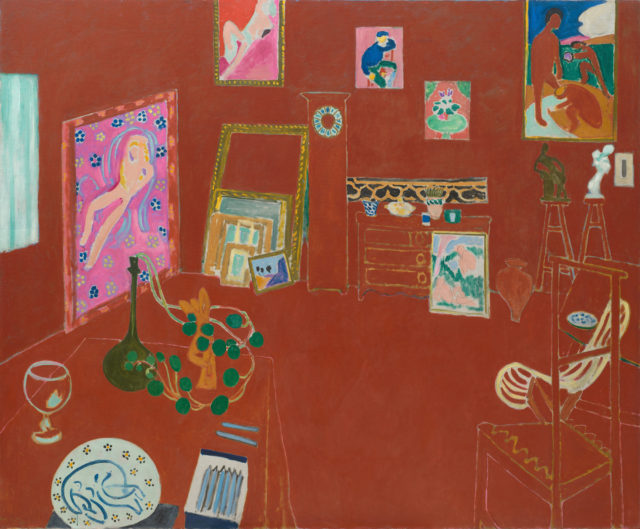
Henri Matisse, The Red Studio, oil on canvas, fall 1911 (Mrs. Simon Guggenheim Fund; © 2022 Succession H. Matisse / Artists Rights Society [ARS], New York)

MATISSE: THE RED STUDIO
MoMA, Museum of Modern Art
11 West 53rd St. between Fifth & Sixth Aves.
Through September 10, $14-$25 (sixteen and under free)
212-708-9400
www.moma.org

“It’s always been sort of a very mysterious painting,” MoMA senior paintings conservator Anny Aviram says in a short video (see below) about Henri Matisse’s The Red Studio. “He leaves clues, but at the same time he confuses you.” The 1911 masterpiece, a painting of the artist’s studio in the Parisian suburb of Issy-les-Moulineaux that includes miniature versions of other works and objects, is explored in extraordinary detail in “Matisse: The Red Studio,” on view at MoMA through September 10.

The exhibition is divided into two parts; one looks at the history behind the creation and presentation of the work, while the other gathers all the extant pieces that are depicted on the canvas. Thus, on one side, you’ll find detailed information about the construction of the studio itself; correspondence between Matisse and collector Sergei Shchukin, who is also seen in a charcoal sketch; photographs of Matisse and his family; a letter from David Tennant and Harry Rowan Walker to Matisse confirming their purchase of the painting for £806 for the Gargoyle Club; Roger Fry’s A Room at the Second Post-Impressionist Exhibition, in which a significant portion of The Red Studio can be seen on the back wall; Matisse’s lovely, claustrophobic The Studio under the Eaves; the marvelous The Studio, quai Saint-Michel, another interior with dramatic lines and canvases that mimic windows; and other ephemera.

In the other room, The Red Studio is surrounded by eleven of the works that appear in it, from paintings, sculpture, and a ceramic plate to drawings of one canvas that has been lost, in addition to tables, chairs, flowers, and design elements that can be found in works in the previous room. The painting wasn’t originally all Venetian red; as the above video reveals, tiny bits of the original colors are still visible, along with a few stray paintbrush bristles. Among the works are the bold sculpture Jeannette IV, the daring Nude with a White Scarf, the entrancing Le luxe (II), the intriguing Young Sailor II, and the rare Impressionistic landscape Corsica, the Old Mill. This is the first time the works have been together since they were in the studio when Matisse painted them, and the reunion is utterly thrilling.

Be sure to listen to the audioguide, which features commentary from curator Ann Temkin along with artists Faith Ringgold and Lisa Yuskavage, writers Siri Hustvedt and Claire Messud, and professor Mehammed Mack. “What we really wanted to do was bring visitors into Matisse’s world, first of all, into the studio that’s the subject of the painting, into the other artworks that are in the painting, and then into the events and artworks that relate to this work as it went on to live its life in the decades following its making,” Temkin explains. “The outrage caused by these images, their radicality when they were produced, is something that I think is good to recover,” Hustvedt explains. “That deconstruction of color, like disassociating color from the object, is a kind of revolutionary act,” Mack adds. “Matisse is so easy to think about as the maker of beautiful, relaxing pictures. We really wanted to try to re-create what extraordinary focus and effort and leaps of imagination and daring an artist goes through in making a work of radical innovation, like The Red Studio,” Temkin continues. “That, for me, is the fascination. It’s as if we have a glimpse inside his head,” Messud concludes. It’s quite a journey.

DEANA LAWSON

Deana Lawson solo show at MoMA PS1 continues through September 5 (photo by Steven Paneccasio)

DEANA LAWSON
MoMA PS1
22-25 Jackson Ave. at 46th Ave.
Through September 5, $5-$10
718-784-2084
www.momaps1.org

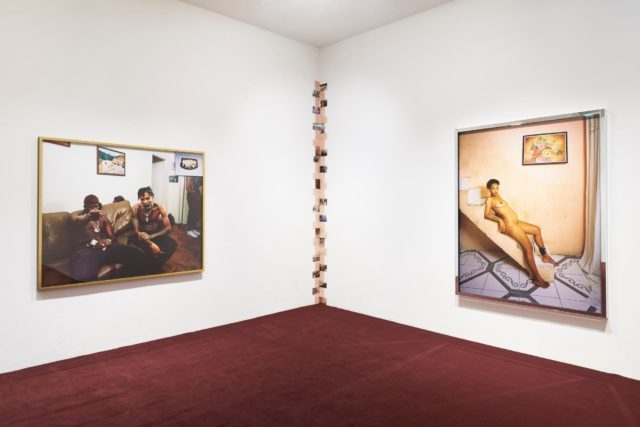
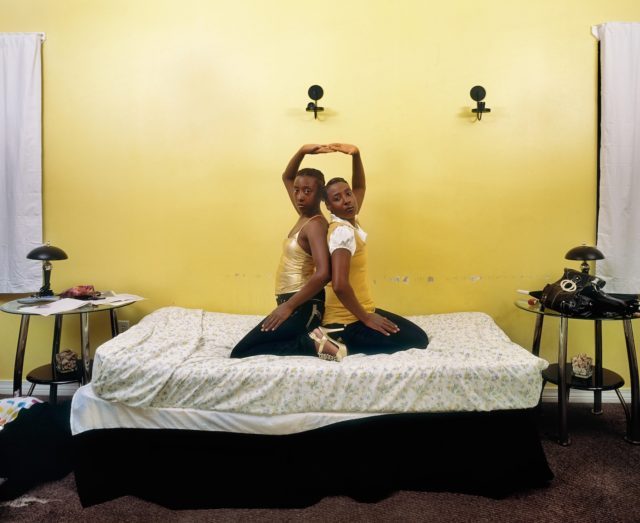
One of the most powerful painting exhibitions I’ve seen in the last few years was Jordan Casteel’s “Within Reach” at the New Museum, which comprised more than three dozen large-scale portraits of BIPOC men, women, and children, each made as realistically as possible from a photograph. Deana Lawson’s eponymously titled solo show at MoMA PS1 recalls Casteel’s canvases in more than fifty large-scale, carefully staged photographs of acquaintances and strangers she has met in Africa and across the African diaspora, in what the Rochester-born artist calls “a mirror of everyday life.”

Deana Lawson, Roxie and Raquel, New Orleans, Louisiana, pigment print, 2010 (courtesy the artist, Sikkema Jenkins & Co., and David Kordansky, Los Angeles / © Deana Lawson)

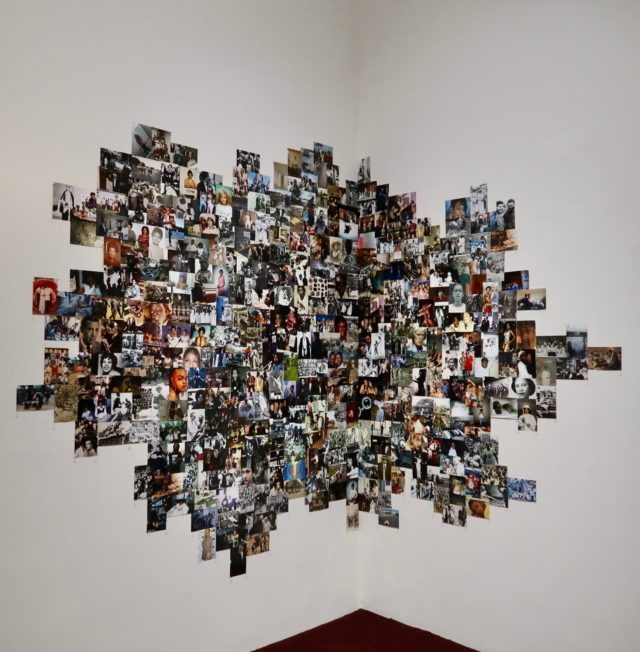
In Black Gold (“Earth turns to gold, in the hands of the wise,” Rumi), a man stands in a dark alley, holding out several crosses on chains, a projection of a sharecropper behind him. In Coulson Family, a mother and her two sons pose in front of a small Christmas tree, one child looking away from the camera, smiling at an unseen source. In Nation, a pair of shirtless men, one pointing at the camera, the other heavily tattooed and wearing a complex facial piercing, sit on a brown leather couch. And in Uncle Mack, a man with a scar down his stomach and holding a rifle stands in the corner of a room, under a picture of his family. Meanwhile, in a corner at PS1, Lawson has arranged more than a hundred small, unframed photographs. She has also placed crystal assemblages throughout the space.

Deana Lawson adds special bonuses in many of the corners of MoMA PS1 solo show (photo by twi-ny/mdr)

“It’s about setting a different standard of values and saying that everyday Black lives, everyday experiences, are beautiful, and powerful, and intelligent,” Lawson has said, depicting “the majesty of Black life, a nuanced Black life, one that is by far more complex, deep, beautiful, celebratory, tragic, weird, strange.” It’s a stunning show, on view through September 5.

LIMITLESS AI / FLIGHT / SÉANCE

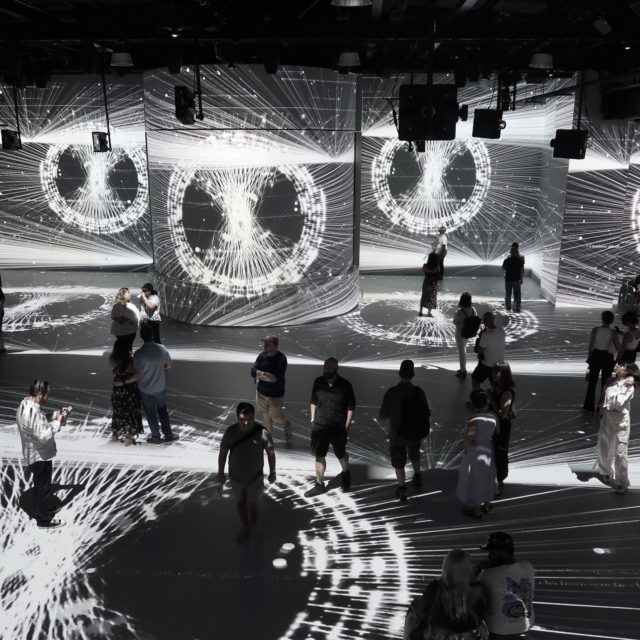
Limitless AI immerses audiences in a barrage of digital imagery (photo by twi-ny/mdr)

LIMITLESS AI
ArtsDistrict Brooklyn (AD/BK)
25 Franklin St., Brooklyn
Thursday – Sunday through November 20, $44.50 – $49.50
artsdistrict.live
online slideshow

There’s a big-time new artist in town, but it’s not a human being.

Apps such as DALL-E 2, Craiyon, Artbreeder, and Deep Dream offer anyone the opportunity to create a virtual masterpiece by feeding descriptive text into an artificial intelligence generator that then uses an algorithm to output a digital image. The app Midjourney recently found itself in the news when a user named #postpoopzoomies made a series of works in which Emmy-winning Last Week Tonight host John Oliver married a cabbage.

Meanwhile, immersive art experiences have taken off around the world, large-scale, Instagram-friendly installations in which canvases come to life, filling massive rooms with pieces by van Gogh, Magritte, Klimt, and other international favorites.

Turkish artists Ferdi Alici and Eylul Alici of Istanbul’s Ouchhh Studio take both to the next level with Limitless AI, the centerpiece of the new ArtsDistrict Brooklyn (AD/BK) in Greenpoint. The twenty-five-thousand-square-foot space on Franklin St. features three immersive experiences along with a café and an outdoor bar; the cofounders and executive producers of the NYC destination are the Toronto-based David Galpern and Charles Roy.

Limitless AI is a sixty-minute experience divided into five sections; visitors can sit on benches or movable chairs or wander around the ten-thousand-square-foot room, where an ever-changing panoply of spectacular images are splashed onto walls, pillars, and the floor by more than sixty 4K laser projectors. There’s also a mezzanine with a nifty view. Be sure to walk to the various corners to enjoy different perspectives, but be warned that if you look down at the floor as you proceed, you might get a little dizzy, but in a good way.

The show begins with “Poetic AI,” consisting of a barrage of words, letters, and phrases from Galileo, Sir Isaac Newton, Albert Einstein, Stephen Hawking, and others, in black-and-white. “Data is the paint. Algorithm is the brush. Architecture is the canvas,” a robotic voice announces. “Twenty million lines of visionary text, unspooled into data, processed by a mechanical mind.”

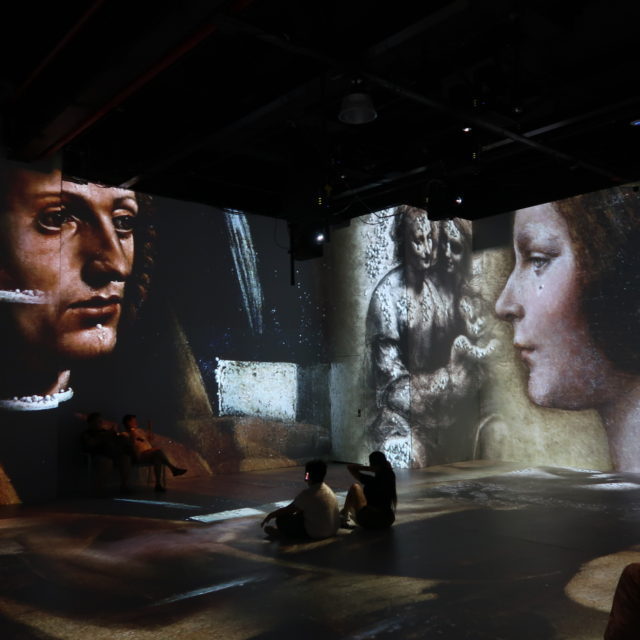
“Leonardo da Vinci: Wisdom of AI Light,” set to an original score by beloved Italian composer Ludovico Einaudi and multidisciplinary Turkish-Canadian musician, composer, and DJ Mercan Dede, celebrates the genius of Leonardo and such other Renaissance artists as Michelangelo and Caravaggio with digital re-creations, using billions of pieces of data from the paintings, of some of their most famous works, from the Mona Lisa to the Pietà to the ceiling of the Sistine Chapel; here, Michelangelo’s Creation of Adam, in which the fingers of God and the first man nearly touch, evoke the future of artificial intelligence, as if the Supreme Being is passing the torch.

Classic Renaissance paintings are re-created through AI algorithms for immersive Brooklyn installation (photo by twi-ny/mdr)

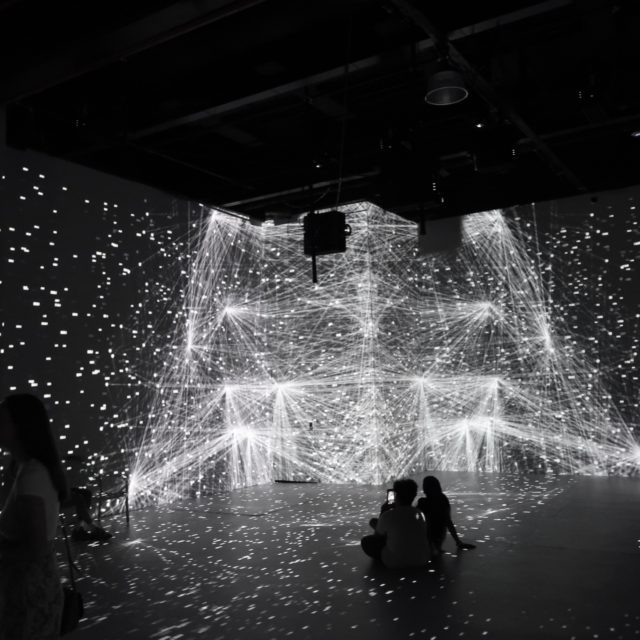
“Data Gate” repurposes millions of images taken by NASA’s Kepler space telescope, while “Dark Machine” uses data compiled by the CERN Large Hadron Collider. The voice asks, “What goes through the mind of an atom when it explodes? Maybe this.”

Limitless AI concludes with “Superstrings,” which adds a human component. A wide column opens up to reveal a three-piece band performing live; one of the instrumentalists is wearing a headset that monitors her real-time EEG brainwaves, while the algorithm is also picking up information from the people in the crowd, resulting in what the voice describes as “the flickering waves of human consciousness, transformed into light.” The finale is unique for every show.

As with the dueling immersive van Gogh presentations, I find it a strange way to experience classic art; even in the age of Instagram and TikTok, there’s still nothing quite like seeing the originals up close and personal in museums and churches. But the non-art sections of Limitless AI don’t have the same restrictions, letting loose with the unexpected.

It’s sort of like the old days of Laser Floyd and Laser Zeppelin, psychedelically grooving out at planetariums, but replacing rock and roll with visual and mathematical data as the baseline for the imagery. It can be ultracool and beautiful as well as repetitive and head-scratchingly bizarre; it’s best not to get too caught up in taking photos and videos and let the sound and images waft over you, literally.

There are two other immersive installations at AD/BK, set in a pair of side-by-side forty-foot-long white shipping containers in the outdoor back patio. Created by London’s Darkfield, Flight and Séance each takes place in complete darkness, with the audience wearing binaural headphones that make it seem like characters and events are actually present in the real space around you. The twenty-five-minute Flight is reminiscent of Martín Bondone’s Odd Man Out, in which the seated, blindfolded audience goes on a mock plane trip narrated by an Argentine guitarist returning home from America, as well as Simon Stephens’s Blindness, a postapocalyptic tale about strangers trying to survive after an epidemic robs most people of their sight.

Digital images flash on walls and floors in Limitless AI (photo by twi-ny/mdr)

Flight involves a meticulously constructed replica of a plane interior. The setup is definitely economy class, right down to the uncomfortably small distance between seats, but the production values are first class, with a series of sounds and videos that all-too-convincingly simulate a sketchy airline and life-changing outcome. Musings about Schrödinger’s cat and the nature of reality make for an enjoyable if puzzling ride.

For the twenty-minute Séance, the audience is arranged on two sides of a long, narrow table, with chandeliers hanging from above and lots of red velvet. Everyone has gathered to attempt to contact spirits; a medium guides the Victorian story as creepy things start to occur, and not just through your headphones. Be sure to sit near the end of the room if you think you might need to suddenly run out.

So, what’s the future of AI art? In 2019, the US Copyright Office ruled that AI art cannot be copyrighted because it “lacks the human authorship necessary to support a copyright claim.” Attorney Ryan Abbott, representing AI pioneer and Imagination Engines president and CEO Stephen L. Thaler in his request for a new hearing, recently told Artnet News, “We disagree with the Copyright Office’s decision and plan to appeal. . . . AI is able to make functionally creative output in the absence of a traditional human author, and protecting AI-generated works with copyright is vital to promoting the production of socially valuable content.”

If the flurry of immersive art presentations have proved anything, it’s that these experiences are all about socially valuable content, particularly when it comes to marrying a Brassica oleracea or other species of wild vegetable.