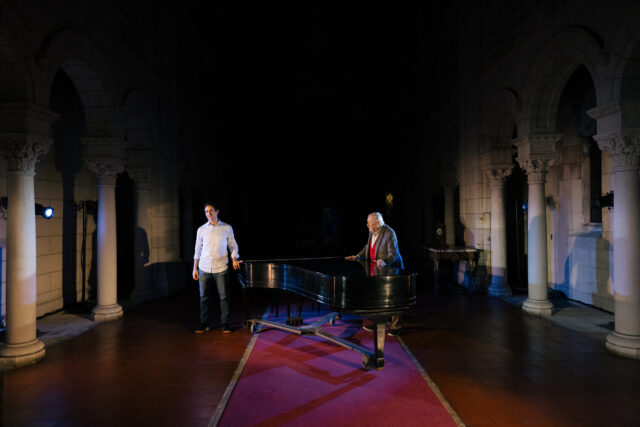
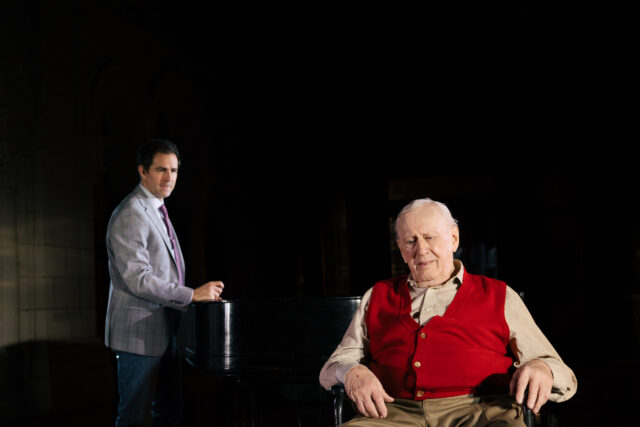
Chris Domig and Len Cariou star in touching revival of Tuesdays with Morrie (photo by Jeremy Varner)
TUESDAYS WITH MORRIE
St. George’s Episcopal Church
209 East Sixteenth St. at Rutherford Pl.
Through March 23, $20-$55 www.seadogtheater.org
“I never give advice,” Morrie Schwartz tells Mitch Albom in Tuesdays with Morrie.
Maybe not, but nearly everything that comes out of his mouth are words to live by — and die by.
Albom’s Tuesdays with Morrie, the true story of the friendship between sports reporter Albom and Brandeis professor Schwartz, started as a 1997 book, subtitled An Old Man, a Young Man, and Life’s Greatest Lesson. Mick Jackson turned it into a popular 1999 film, starring Jack Lemmon as Schwartz and Hank Azaria as Albom. It won four Emmys, including Outstanding Made for Television Movie, and put the memoir at the top of the bestseller list for a combined twenty-three weeks. In November 2002, Albom and Jeffrey Hatcher adapted the book into an off-Broadway play directed by Obie winner David Esbjornson.
The show is now back in a warm, intimate revival from Sea Dog Theater running in the long, narrow chantry at St. George’s Episcopal Church through March 23, anchored by two wonderful performances.
As the audience enters the space, Mitch (Chris Domig) is sitting behind a grand piano at the center of the room, playing jazz tunes. After a few songs, Morrie (Len Cariou) enters, joining Mitch on the piano bench and enjoying the music. The play proper soon begins, with Mitch directly addressing the audience, telling us about a college class he had taken with Morrie called “The Meaning of Life.” Mitch, the only student, remembers, “There was no required reading, but many topics were covered: love, work, aging, family, community, forgiveness . . . and death.” Those are the same topics covered in the play.
Mitch, who is thirty-seven, and Morrie, who is seventy-eight, switch back and forth between talking to the audience and reenacting scenes from their past together. Mitch took all of Morrie’s classes at Brandeis; the two became fast friends, with Mitch calling his mentor “Coach.” When Mitch graduates in 1979, he promises to keep in touch, but sixteen years pass with no contact, until he sees his old teacher on Nightline, explaining to Ted Koppel that he has ALS, or Lou Gehrig’s disease. Feeling guilty, Mitch goes to see Morrie; when his teacher asks him what happened, Mitch responds, “Life happened.”
What Mitch thought would be a one-time visit becomes a weekly event, and Mitch begins recording his Tuesday discussions with Morrie, who has found it somewhat surprising that people are so interested in him now. “I’m not quite alive, I’m not quite dead, I’m ‘in-between,’” he says. “I’m about to take that last journey into the great unknown. People want to know what to pack.”
Morrie might not ever give advice, but he speaks in memorable aphorisms that avoid being overly treacly:
“Dying is only one thing to be sad over. Living unhappily is something else.”
“Why be predictable?”
“Aging is not just decay . . . . A tree’s leaves are most colorful just before they die.”
“Age is not a competition.”
“There’s no ‘point’ in loving; loving is the point.”
Mitch (Chris Domig) worries about his dying friend, Morrie (Len Cariou), in Tuesdays with Morrie (photo by Jeremy Varner)
The two men share stories from their lives, delving into career choices, music, romantic partners, parents, and children. Initially, Mitch is tentative and anxious, regularly on his phone as he prepares for his next column, interview, or television appearance. He does slow down a bit as Morrie grows more and more ill, the end approaching, which makes Mitch more sad than Morrie. Mitch might have told us early on, “I don’t need a ‘life therapist,’” but he is learning so much from Coach — and so are we.
Tuesdays with Morrie feels right at home in St. George’s, even as it features two Jewish characters; Guy DeLancey’s set and lighting center around the piano and cast glows on the pillars, and Eamon Goodman’s sound, from the dialogue to actor and composer Domig’s expert keyboard playing to a snippet of a pop standard, are never lost in the high-ceilinged room over the course of the play’s easygoing hundred minutes.
Tony winner and Emmy nominee Cariou (Sweeney Todd,A Little Night Music) is gentle and touching as Morrie; at eighty-four, Cariou has both the stage and the life experience, and it shows in his every gesture and turn of phrase. You can’t help but love being in his presence, as actor and character.
Domig, the cofounder of Sea Dog Theater, is terrific as the self-involved, super-ambitious Mitch, who has never stopped and smelled the roses. Domig is almost too nice; Morrie tells Mitch that he can be “mean-spirited,” something I noticed while watching Albom for several years on the Sunday morning ESPN program The Sports Reporters. Cariou and Domig also dodge around some of the more clichéd and melodramatic aspects of the script with the help of director Erwin Maas; the trio has spent a lot of time working together on the project, beginning with a reading at St. George’s in 2021, and they clearly have developed an infectious camaraderie.
“Are you at peace with yourself?” Morrie asks Mitch.
After seeing this adaptation of Tuesdays with Morrie, your answer will be a lot clearer.
[Mark Rifkin is a Brooklyn-born, Manhattan-based writer and editor; you can follow him on Substack here.]
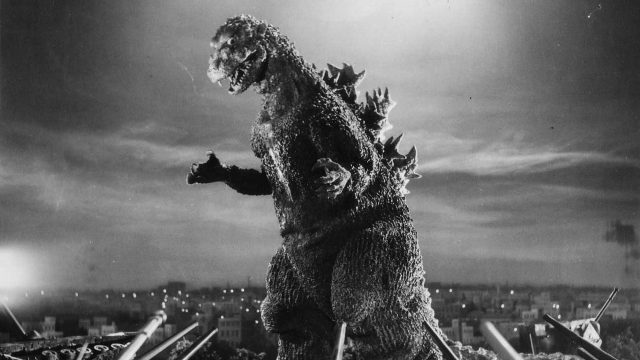
Godzilla emerges from the ocean after nuclear testing in classic monster movie
JAPANESE HORROR
Film Forum
209 West Houston St.
Through March 14
212-727-8110 www.filmforum.org
Wanna see something really scary? Then head over to Film Forum to see at least one of the two dozen fright flicks comprising “Japanese Horror,” continuing through March 14. No one makes scary movies like the Japanese do, and this series has a great mix of films as we spiral into an election year. You can’t go wrong with any of them; below is only some of the awesomeness. Also on the schedule are Ishirô Honda’s Mothra, Masahiro Shinoda’s Demon Pond, Teruo Ishii’s Horrors of Malformed Men, Mitsuo Murayama’s The Invisible Man vs. the Human Fly, and Kaneto Shindô’s Onibaba, among others.
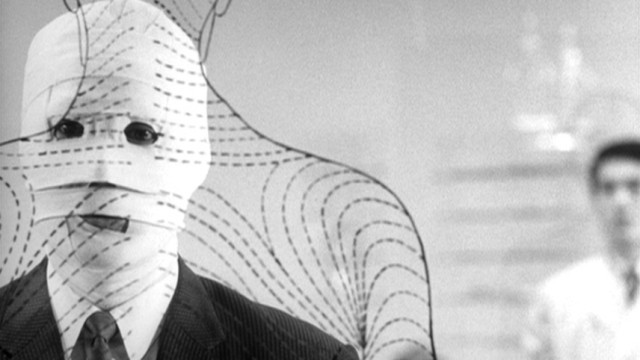
Hiroshi Teshigahara examines identity and more in The Face of Another
THE FACE OF ANOTHER (TANIN NO KAO) (Hiroshi Teshigahara, 1966)
Wednesday, March 6, 6:30 filmforum.org
Kôbô Abe and director Hiroshi Teshigahara collaborated on five films together, including the marvelously existential Woman of the Dunes in 1964 and The Face of Another two years later. In the latter, Tatsuya Nakadai (The Human Condition, Kill!) stars as Okuyama, a man whose face has virtually disintegrated in a laboratory accident. He spends the first part of the film with his head wrapped in bandages, a la the Invisible Man, as he talks about identity, self-worth, and monsters with his wife (Machiko Kyo), who seems to be growing more and more disinterested in him. Then Okuyama visits a psychiatrist (Mikijirô Hira) who is able to create a new face for him, one that would allow him to go out in public and just become part of the madding crowd again. But his doctor begins to wonder, as does Okuyama, whether the mask has actually taken control of his life, making him as helpless as he was before. Abe’s remarkable novel is one long letter from Okuyama to his wife, filled with utterly brilliant, spectacularly detailed examinations of what defines a person and his or her value in society.
Abe wrote the film’s screenplay, which tinkers with the time line and creates more situations in which Okuyama interacts with people; although that makes sense cinematically, much of Okuyama’s interior narrative, the building turmoil inside him, gets lost. Teshigahara once again uses black and white, incorporating odd cuts, zooms, and freeze frames, amid some truly groovy sets, particularly the doctor’s trippy office, and Tōru Takemitsu’s score is ominously groovy as well. As a counterpart to Okuyama, the film also follows a young woman (Miki Irie) with one side of her face severely scarred; she covers it with her hair and is not afraid to be seen in public, while Okuyama must hide behind a mask. But as Abe points out in both the book and the film, everyone hides behind a mask of one kind or another.
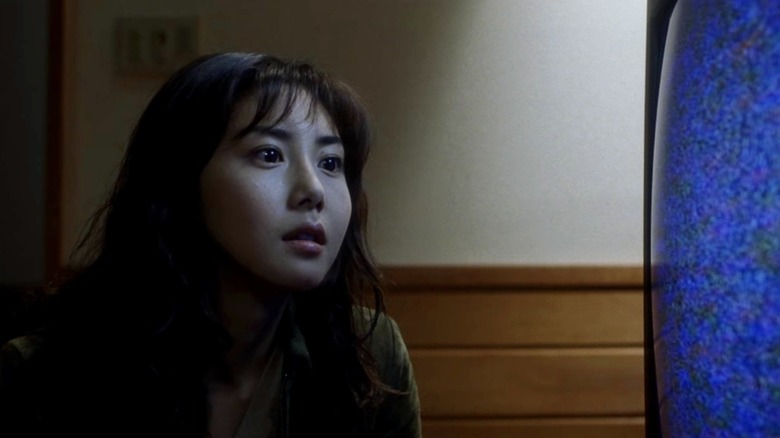
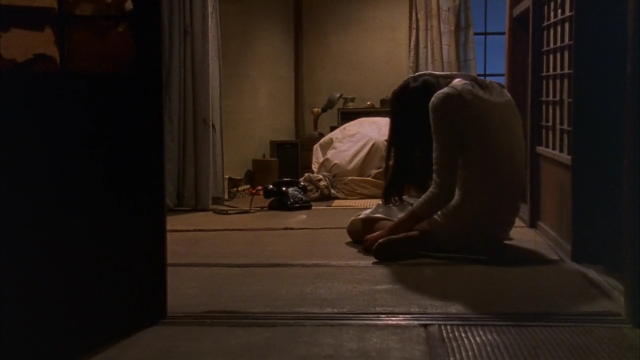
Reiko Asakawa (Nanako Matsushima) finds herself and her young son in danger in Ringu
RINGU (Hideo Nakata, 1998)
Thursday, March 7, 7:20 filmforum.org
In many ways, Hideo Nakata’s 1998 classic, Ringu, is the ultimate horror movie: a film about a film that scares people to death. But Ringu is not chock-full of blood, gore, and violence; instead it’s more of a psychological tale that plays out like an investigative procedural as two characters desperately search for answers to save themselves from impending death.
Journalist Reiko Asakawa (Nanako Matsushima) and her ex-husband, professor and author Ryūji Takayama (Hiroyuki Sanada), are both on tight deadlines — for their lives. After Reiko’s niece, Tomoko Ōishi (Yuko Takeuchi), suddenly dies, apparently from fright, Reiko discovers a rumor that Tomoko and some of her friends had watched a short video, then received a phone call in which an otherworldly voice told them they would die in a week. And they did.
Reiko tracks down the eerie videotape and watches it herself — a few minutes of creepy, hard-to-decipher grainy images — after which the phone rings, telling her she has one week to live. She shows the tape to Ryūji, who has extrasensory powers, and they start digging deep into who shown in the tape and what it is trying to communicate. As they begin uncovering fascinating facts, their son, Yōichi (Rikiya Ōtaka), gets hold of the video and watches it, so all three are doomed if they don’t figure out how to reverse the curse — if that is even possible.
Adapted by screenwriter Hiroshi Takahashi from the 1991 novel by Koji Suzuki, Ringu is a softer film than you might expect, maintaining a slow, even pace, avoiding cheap shocks as the relatively calm and gentle Reiko continues her research and is able to work together with her former husband, who has not been a father to Yoichi at all. The film gains momentum as Reiko and Ryūji learn more about the people in the video, but Nakata, who went on to make several sequels in addition to Dark Water,Chaos,The Incite Mill, and the Death Note spinoff L: Change the World, never lets things get out of hand. The supporting cast includes pop singer Miki Nakatani as Mai Takano, one of Ryūji’s students; the prolific Yutaka Matsushige (he’s appeared in more than one hundred films and television shows since 1992) as Yoshino, a reporter who assists Reiko; and Rie Inō as the strange figure hiding behind all that black hair. Oh, and just for the record, a “homomorphism” — the word is written on Ryūji’s blackboard of mathematical equations — is a map between algebraic objects that come in two forms, “group” and “ring,” the latter being a structure-preserving function.
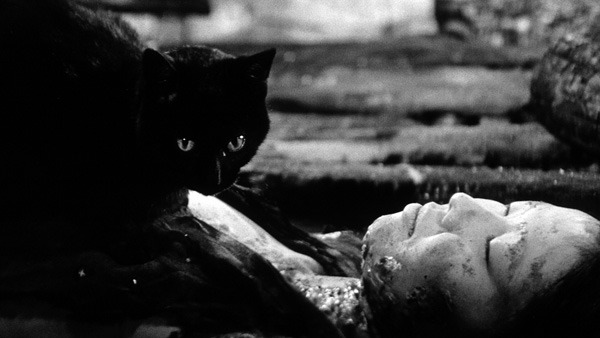
A black cat is not happy with the turn of events in Kaneto Shindô’s Kuroneko
KURONEKO (藪の中の黒猫) (Kaneto Shindô, 1968)
Thursday, March 7, 12:30
Monday, March 11, 7:40
Thursday, March 14, 9:10 filmforum.org
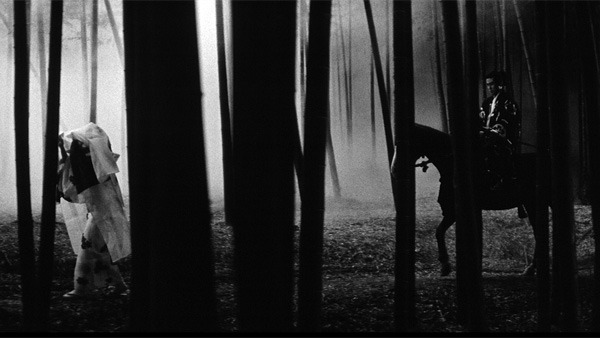
“A cat’s nothing to be afraid of,” a samurai (Rokkô Toura) says in Kaneto Shindô’s 1968 Japanese horror-revenge classic, Kuroneko. Oh, that poor, misguided warrior. He has much to learn about the feline species but not enough time to do it before he suffers a horrible death. In Sengoku-era Japan, a large group of hungry, bedraggled samurai come upon a house at the edge of a bamboo forest. Inside they find Yone (Nobuko Otowa) and her daughter-in-law, Shige (Kiwao Taichi), whose husband, Hachi (Kichiemon Nakamura), is off fighting the war. The men viciously rob, rape, and murder the women, but they leave behind a mewing black cat (“kuroneko”) that is not exactly happy with what just happened. Three years later, the aforementioned samurai is riding his horse on a dark night when he encounters, by the Rajōmon Gate, a young woman positively glowing in the darkness. She says she is frightened and asks if he can accompany her home; he claims he has met her before but can’t quite place her. He agrees to help her, and when they reach her abode he is treated to some tea served by an older woman and some fooling around with the younger one — until the latter creeps on top of him and turns into a menacing animal, biting into his throat and drinking his blood. One by one, the samurai are lured into this trap, until a surprise warrior arrives.
A bamboo forest leads to a kind of hell for samurai in Kuroneko
Written and directed by Shindô and based on an old folktale, Kuroneko is a tense, spooky film, with a foreboding score by Hikaru Hayashi (Shindô’s The Naked Island and Onibaba) and shot in eerie black-and-white by Kiyomi Kuroda (Shindô’s Mother, Human, and Onibaba). One of the great feminist ghost stories, it’s like the missing sequel to Masaki Kobayashi’s Kwaidan, with elements of Akira Kurosawa’s Hidden Fortress and Rashomon thrown in, along with echoes of flying ninja movies. Memorable images abound: The two women, in ghostly white, float in the air; the camera weaves through the bamboo forest; a gruesome killer is beheaded. The film also features Kei Satō as Raiko, Hideo Kanze as Mikado, and Taiji Tonoyama as a farmer, but Kuroneko belongs to Shindô regular — and his lover and, later, his wife — Otowa, who appeared in nearly two dozen of his films, and Taichi, who also worked with such other directors as Keisuke Kinoshita, Mitsuo Yanagimachi, Yôji Yamada, and Shintarô Katsu before dying in a car accident in 1992 at the age of forty-eight. The two women go about their business with a calm and somewhat placid demeanor until they pounce, like cats luring mice to certain doom.
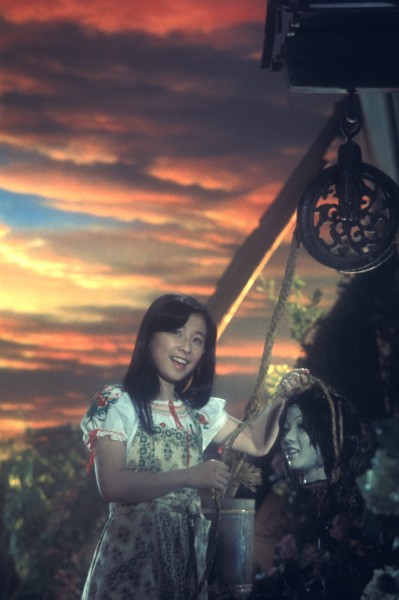
Nobuhiko Obayashi’s wild and crazy Hausu has to be seen to be believed
HOUSE (HAUSU) (Nobuhiko Obayashi, 1977)
Friday, March 8, 2:40
Tuesday, March 12, 7:00
Wednesday, March 13, 2:20 filmforum.org
Japanese experimental filmmaker Nobuhiko Obayashi’s House (Hausu) is one of the craziest movies ever made; the 1977 cult classic took more than three decades to get its U.S. theatrical release, but it’s been a must-see ever since. Truly one of those things that has to be seen to be believed, House is a psychedelic black horror comedy musical about Gorgeous (Kimiko Ikegami) and six of her high school friends who choose to spend part of their summer vacation at Gorgeous’s aunt’s (Yoko Minamida) very strange house. Gorgeous, whose mother died when she was little and whose father (Saho Sasazawa) is about to get married to Ryoko (Haruko Wanibuchi), brings along her playful friends Melody (Eriko Ikegami), Fantasy (Kumiko Oba), Prof (Ai Matsubara), Sweet (Masayo Miyako), Kung Fu (Miki Jinbo), and Mac (Mieko Sato), who quickly start disappearing like ten little Indians.
House is a ceaselessly entertaining head trip of a movie, a tongue-in-chic celebration of genre with spectacular set designs by Kazuo Satsuya, beautiful cinematography by Yoshitaka Sakamoto, and a fab score by Asei Kobayashi and Mickie Yoshino. The original story actually came from the mind of Obayashi’s eleven-year-old daughter, Chigumi, who clearly has one heck of an imagination. Oh, and we can’t forget about the evil cat, a demonic feline to end all demonic felines. The film was released in 2009 prior to its appearance on DVD from Janus, the same company that puts out such classic fare as Federico Fellini’s Amarcord, Akira Kurosawa’s Rashomon, Jacques Tati’s M. Hulot’s Holiday, François Truffaut’s Shoot the Piano Player, Jean Renoir’s The Rules of the Game, and Jean-Luc Godard’s Vivre sa Vie, so House has joined some very prestigious company. And who’s to say it doesn’t deserve it?
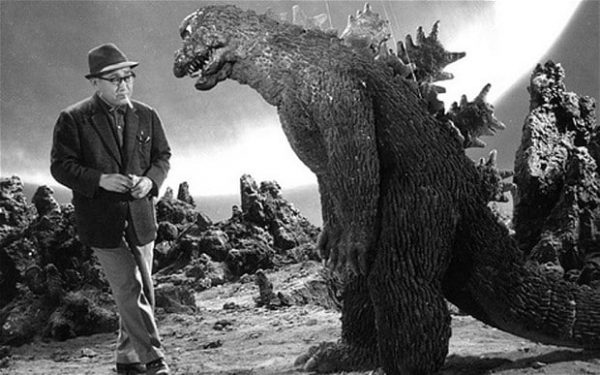
Ishirō Honda has a smoke with his atomic-gas-breathing monster on the set of Godzilla
GODZILLA (Ishirō Honda, 1954)
Friday, March 8, 4:40
Tuesday, March 12, 4:50 filmforum.org
More than two dozen sequels, prequels, remakes, and reboots have not diluted in the slightest the grandeur of the original 1954 version of Godzilla, one of the greatest monster movies ever made. If you’ve only seen the feeble, reedited, Americanized Godzilla, King of the Monsters!, made two years later with Canadian-born actor Raymond Burr inserted as an American reporter, well, wipe that out of your head. On March 8 and 12, Film Forum is screening the real thing, the restored treasure as part of “Japanese Horror.” The film was inspired by Eugène Lourié’s The Beast from 20,000 Fathoms and a real incident involving the Daigo Fukuryū Maru, a tuna-fishing boat that got hit by radioactive fallout in January 1954 from a U.S. test of a dry-fuel thermonuclear device in the Pacific Ocean. Writer-director Ishirō Honda and cowriter Takeo Murata expanded on Shigeru Kayama’s story, focusing on a giant dinosaur under the sea who comes back to life after H-bomb testing by the U.S.
Standing 165 feet tall and able to breathe atomic gas, Godzilla — known as Gojira in Japanese, a combination of gorira, the Japanese word for gorilla, and kujira, which means whale — wreaks havoc on Japanese towns as he makes his way toward Tokyo. While the military and the government want to destroy the creature — who is played by Haruo Nakajima and Katsumi Tezuka in a monster suit, tramping over miniature houses, streets, cars, trains, and buildings using the suitmation technique (both men also make cameos outside the costume) — Dr. Yamane (Takashi Shimura) wants to study Godzilla to find out how the radiation only makes it stronger instead of destroying it. (Throughout, Godzilla is referred to as “it” and not “he,” perhaps because the creature is in part a representation of America and what it wrought in Hiroshima and Nagasaki.) “Godzilla was baptized in the fire of the H-bomb and survived. What could kill it now?” Dr. Yamane asks. Meanwhile, one of Dr. Yamane’s assistants, Dr. Serizawa (Akihiko Hirata), is working on a secret oxygen destroyer that he will show only to his fiancée, Yamane’s daughter, Emiko (Momoko Kōchi), who is having trouble telling Dr. Serizawa that she is actually in love with salvage ship captain Hideto Ogata (Akira Takarada). “Godzilla’s no different from the H-bomb still hanging over Japan’s head,” Ogata tells Dr. Yamane, who is none too pleased with his take on the situation. Through it all, the media risks everything to get the story.
Even for 1954, many of the special effects, photographed by Masao Tamai, are cheesy but fun, and composer Akira Ifukube’s fiercely dramatic score goes toe-to-toe with the monster. The Toho film is no mere monster movie but instead is filled with metaphors and references about WWII and the use of atomic bombs, examining it from political and socioeconomic vantage points while questioning the future of technological advances. “But what if your discovery is used for some horrible purpose?” Emiko asks Dr. Serizawa, who wears an eye patch, as if he can only see part of things. Godzilla could only have come from Japan, much like King Kong was purely an American creation produced by Hollywood; in fact, the two went at it in Honda’s 1962 film, King Kong vs. Godzilla. The next year, Akira Kurosawa would make I Live in Fear (Ikimono no kiroku), an intense psychological drama about the nuclear holocaust’s effects on one man, a factory owner played by Toshirô Mifune — who meets with a dentist portrayed by Kurosawa regular Shimura — a kind of companion piece to Godzilla. Honda, who served as an assistant director to Kurosawa on many films before making his own pictures, would go on to make such other sci-fi flicks as Rodan, The H-Man, Mothra, and Destroy All Monsters, but it was on Godzilla that he got everything right, capturing the fate of a nation in the aftermath of nuclear devastation while still managing to gain sympathy for the monster. It is also difficult to watch the film today without thinking of America’s current debate over illegal immigration and fear of the other, particularly when Godzilla approaches an electrified fence meant to keep him out, as well as the threat of nuclear war.
Shirō Shimizu (Shigeru Amachi) is trapped in the realms of hell in Nobuo Nakagawa’s awesome Jigoku
JIGOKU (THE SINNERS OF HELL) (Nobuo Nakagawa, 1960)
Saturday, March 9, 9:10
Wednesday, March 13, 12:15 & 6:30 filmforum.org
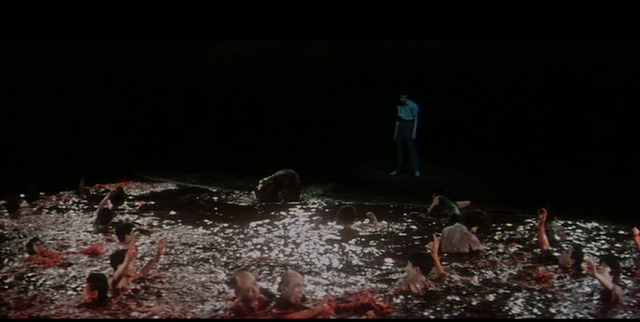
Nobuo Nakagawa’s Jigoku is a dark, demonic masterpiece, a descent into the deepest circles of hell, where sinners face the swirling vortex of torment and rivers of pus and blood. Jigoku goes places that would make even Dante and Hieronymus Bosch turn away in fear while Roger Corman and Mario Bava rejoice. In the film, seemingly everyone theology student Shirō Shimizu (Shigeru Amachi) comes into contact with dies a tragic death. He and Yukiko Yajima (Utako Mitsuya) become engaged, but their lives change forever when Shirō and his friend Tamura (Yōichi Numata), a sociopath of pure evil, go for a ride and Tamura, behind the wheel, runs over gangster Kyōichi “Tiger” Shiga (Hiroshi Izumida) and drives away, showing no remorse whatsoever, reminiscent of Artie Strauss (Bradford Dillman) and Judd Steiner (Dean Stockwell) in Richard Fleischer’s Compulsion. However, Kyōichi’s mother (Kiyoko Tsuji) witnessed the hit-and-run and is determined to exact revenge, joined by Yoko (Akiko Ono), Kyōichi’s girlfriend.
Nobuo Nakagawa’s Jigoku takes viewers on a dark journey through hell
Shirō is called home to visit his ill mother, Ito (Kimie Tokudaij), while his corrupt father, shady businessman Gōzō (Hiroshi Hayashi), shamelessly has an open affair with Kinuko (Akiko Yamashita). Shirō takes an instant liking to his mother’s nurse, Sachiko Taniguchi (Mitsuya), who looks almost exactly like Yukiko, but her father, painter Ensai Taniguchi (Jun Ōtomo), is being threatened by dirty Det. Hariya (Hiroshi Shingûji), who wants Sachiko for himself or else he will arrest Ensai for a long-ago crime. Sachiko’s appearance frightens Yukiko’s parents, Professor Yajima (Torahiko Nakamura), who is Shirō’s teacher, and his wife (Fumiko Miyata), who are shocked by the doppelgänger. Also hanging around are Dr. Kusama (Tomohiko Ōtani) and journalist Akagawa (Kôichi Miya), who have secrets of their own. As people start dropping like brutally swatted and electrocuted flies, Shirō takes all of the blame even though he does not cause any of the deaths directly. (Even the production studio, Shintoho, didn’t survive, declaring bankruptcy after releasing the film.)
But none of that matters once everyone is in hell, facing a series of horrific tortures that are spectacularly photographed by Mamoru Morita, who enjoys keeping the color red at or near the center of most images, along with occasional touches of blue and green. Inspired by the Ōjōyōshū, the tenth-century Buddhist text about birth, rebirth, and the realms of hell, Nakagawa cowrote the screenplay with Ichirō Miyagawa; Nakagawa made nearly one hundred films in just about every genre before he died in 1984 at the age of seventy-nine, but Jigoku is his crowning achievement. It’s horror of the highest order, immersed in a jaw-dropping madness. It’s also a warning, since everyone is a sinner in one way or another, and retribution awaits us all.
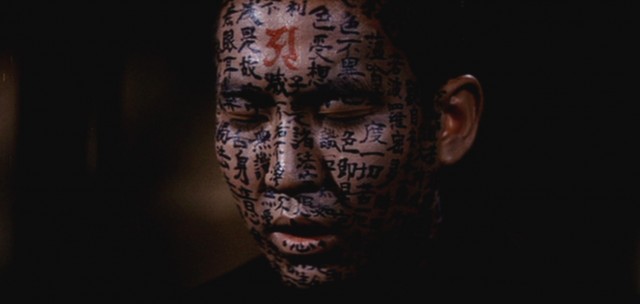
Masaki Kobayashi paints four chilling, ghostly portraits in Kwaidan, including “Hoichi, the Earless”
KWAIDAN (Masaki Kobayashi, 1964)
Sunday, March 10, 3:00 filmforum.org
In the mesmerizing Kwaidan, based on folkloric tales by Lafcadio Hearn, aka Koizumi Yakumo, Masaki Kobayashi (The Human Condition, Samurai Rebellion) paints four marvelous ghost stories, each one with a unique look and feel. In “The Black Hair,” a samurai (Rentaro Mikuni) regrets his choice of leaving his true love for societal advancement. Yuki (Keiko Kishi) is a harbinger of doom for a woodcutter (Nakadai) in “The Woman of the Snow.” Hoichi (Katsuo Nakamura) must have his entire body covered in prayer in “Hoichi, the Earless.” And Kannai (Kanemon Nakamura) finds a creepy face staring back at him in “In a Cup of Tea.” The four films subtly, and not so subtly, explore such concepts as greed and envy, love and loss, and the art of storytelling itself. Winner of the Special Jury Prize at Cannes, Kwaidan is one of the greatest ghost story films ever made, a quartet of chilling existential tales that will get under your skin and into your brain. The score was composed by Tōru Takemitsu, who said of the film, “I wanted to create an atmosphere of terror.” He succeeded.
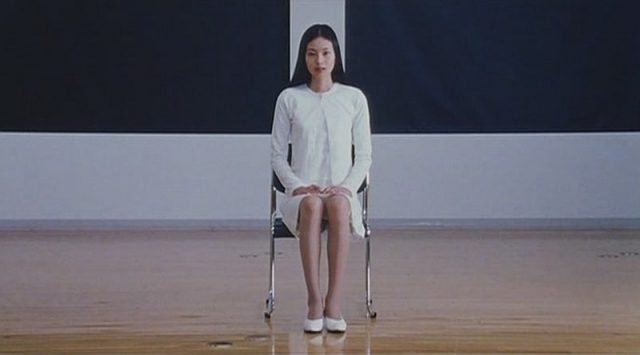
Model Eihi Shiina makes a stunning debut in Takashi Miike’s Audition
AUDITION (ÔDISHON) (Takashi Miike, 1999)
Sunday, March 10, 6:10 filmforum.org
When Audition opened in 1999 at Film Forum, it was New Yorkers’ major introduction to the work of Japanese director Takashi Miike — and some cineastes ran out of the theater faster than they lined up around the block to get in in the first place. The shocking, unconventional psychosexual horror classic, which won the FIPRESCI Prize and the KNF Award at the Rotterdam International Film Festival, will likely have people lining up at Film Forum again. But this is a different (#MeToo, social-media-obsessed) era, so don’t expect many walkouts, although there will be plenty of head-turning and face-covering. There also will be a critical reevaluation of the film’s central concept, a misogynistic male fantasy that evolves into torture/revenge porn.
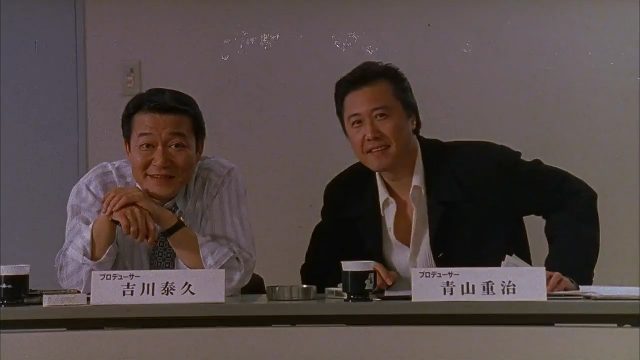
Yoshikawa Yasuhisa (Jun Kunimura) and Aoyama Shigeharu (Ryo Ishibashi) get more than they bargained for in Audition
Written by Daisuke Tengan based on the novel by Ryu Murakami, Audition begins like a Japanese family melodrama. The gentle-hearted Aoyama Shigeharu (Ryo Ishibashi) watches his wife, Ryoko (Miyuki Matsuda), die in a hospital, leaving him to raise their young son, Shigehiko. Seven years later, the teenage Shigehiko (Tetsu Sawaki) thinks it’s time for his father to find a new wife, as does Aoyama’s best friend, filmmaker Yoshikawa Yasuhisa (Jun Kunimura). Yoshikawa and Aoyama decide to hold fake auditions so the lonely widower can find just the right new romantic partner. He is immediately drawn to the younger, damaged Asami Yamazaki (Eihi Shiina in her stunning film debut), a suicidal former ballerina with a sketchy past filled with questions that worry Yoshikawa. But Aoyama starts dating her anyway, and what starts out sweetly ends up something entirely different as he meets a onetime music executive (Ren Osugi) and an old dance teacher (Renji Ishibashi) who — well, you’ll just have to see that for yourself. The last half hour is so brutal, so grotesque, so disturbing, so violent that you should hang on only at your own risk as it travels “deeper, deeper, deeper” into the psyche, among other things.
There’s something not quite right with Asami Yamazaki (Eihi Shiina) in Takashi Miike’s Audition
Intimately photographed by Hideo Yamamoto and featuring an ominous score by Kōji Endō, Audition has lost none of its power to thrill and chill, right down to the bone. The film has always raised issues of misogyny and male guilt, but, viewed in 2024, those elements come to the fore. The scene in which Yoshikawa and Aoyama interview numerous women contains more than a few cringeworthy stereotypes, and the flashbacks of the abuse suffered by Asami as a child feel more manipulative today. Essentially, Audition is a film that could spring only from a male brain. That said, it is still terrifying twenty-five years later. Miike (Ichii the Killer,The Happiness of the Katakuris), who has directed nearly a hundred films in his three-decade career, from Westerns and yakuza movies to children’s fare and superhero flicks, is best known for the graphic violence in his films, but he also has a wild sense of humor and a knack for making audiences think, “Oh no he won’t,” and then he does. And it’s Audition that cemented that well-earned reputation.
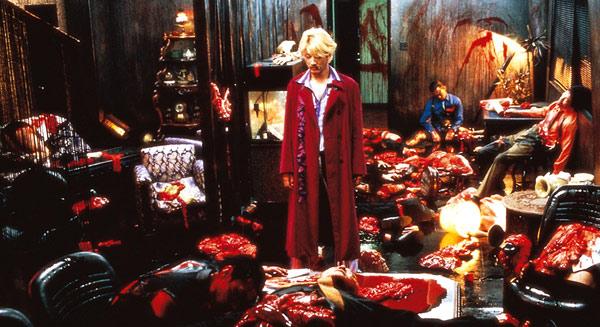
Kakihara surveys the damage in Takashi Miike’s ultraviolent cult classic Ichi the Killer
ICHI THE KILLER (Takashi Miike, 2001)
Sunday, March 10, 8:30 filmforum.org
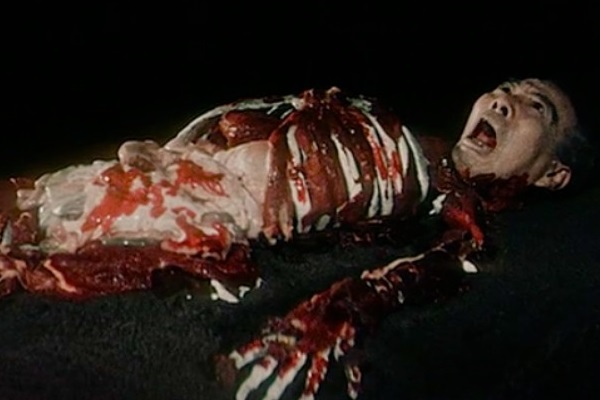
Takashi Miike, who had New York filmgoers rushing to Film Forum to see Audition — and then rushing to get out because of the violent torture scenes — did it again with Ichi the Killer, a faithful adaptation of Hideo Yamamoto’s hit manga. When Boss Anjo goes missing while beating the hell out of a prostitute, his gang, led by Kakihara (Tadanobu Asano), a multipierced blond sadomasochist, tries to find him by threatening and torturing members of other gangs. As the violence continues to grow — including faces torn and sliced off, numerous decapitations, innards splattered on walls and ceilings, body parts cut off, and self-mutilation — the killer turns out to be a young man named Ichi (Nao Omori), whose memory of a long-ago brutal rape turns him into a costumed avenger, crying like a baby as he leaves bloody mess after bloody mess on his mission to rid the world of bullies. This psychosexual S&M gorefest, which is certainly not for the squeamish, comes courtesy of the endlessly imaginative Miike, who trained with master filmmaker Shohei Imamura and seems to love really sharp objects. The excellent — and brave — cast also includes directors Sabu and Shinya Tsukamoto, composer Sakichi Satô, and Hong Kong starlet Alien Sun.
Washizu (Toshirô Mifune) and his wife, Asaji (Isuzu Yamada), reimagine Shakespeare tragedy in Kursosawa classic
THRONE OF BLOOD, AKA MACBETH (KUMONOSU JÔ) (Akira Kurosawa, 1957)
Tuesday, March 12, 12:20 filmforum.org
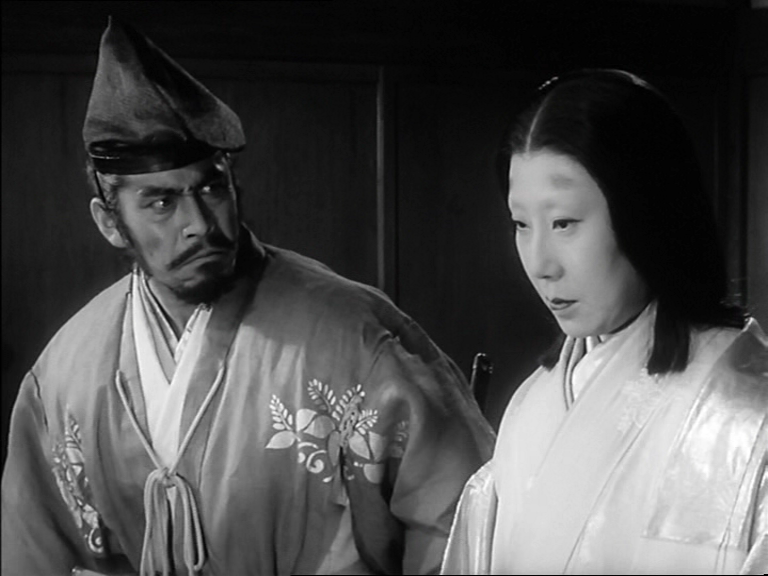
Akira Kurosawa’s marvelous reimagining of Macbeth is an intense psychological thriller that follows one man’s descent into madness. Following a stunning military victory led by Washizu (Toshirô Mifune) and Miki (Minoru Chiaki), the two men are rewarded with lofty new positions. As Washizu’s wife, Asaji (Isuzu Yamada, with spectacular eyebrows), fills her husband’s head with crazy paranoia, Washizu is haunted by predictions made by a ghostly evil spirit in the Cobweb Forest, leading to one of the all-time classic finales. Featuring exterior scenes bathed in mysterious fog, interior long shots of Washizu and Asaji in a large, sparse room carefully considering their next bold move, and composer Masaru Sato’s shrieking Japanese flutes, Throne of Blood is a chilling drama of corruptive power and blind ambition, one of the greatest adaptations of Shakespeare ever put on film.
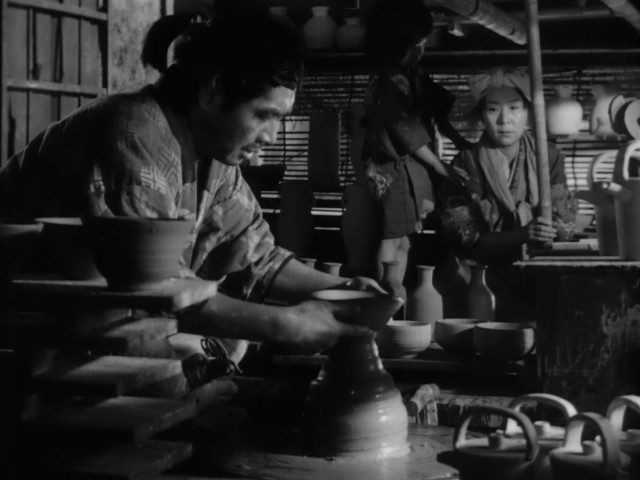
Genjurō (Masayuki Mori) makes his pottery as son Genichi (Ikio Sawamura) and wife Miyagi (Kinuyo Tanaka) look on in UGETSU
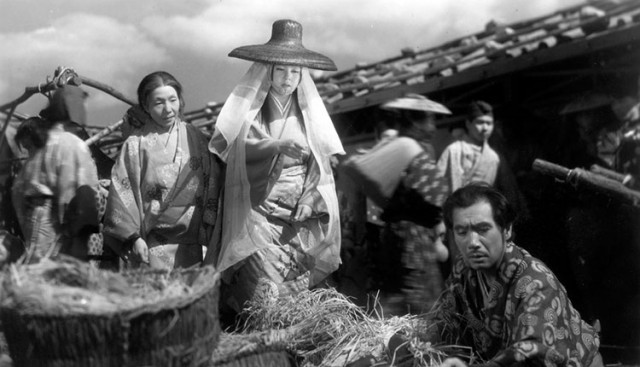
Ugetsu is one of the most important and influential — and greatest — works to ever come from Japan. Winner of the Silver Lion for Best Director at the 1953 Venice Film Festival, Kenji Mizoguchi’s seventy-eighth film is a dazzling masterpiece steeped in Japanese storytelling tradition, especially ghost lore. Based on two tales by Ueda Akinari and Guy de Maupassant’s “How He Got the Legion of Honor,” Ugetsu unfolds like a scroll painting beginning with the credits, which run over artworks of nature scenes while Fumio Hayasaka’s urgent score starts setting the mood, and continues into the first three shots, pans of the vast countryside leading to Genjurō (Masayuki Mori) loading his cart to sell his pottery in nearby Nagahama, helped by his wife, Miyagi (Kinuyo Tanaka), clutching their small child, Genichi (Ikio Sawamura). Miyagi’s assistant, Tōbei (Sakae Ozawa), insists on coming along, despite the protestations of his nagging wife, Ohama (Mitsuko Mito), as he is determined to become a samurai even though he is more of a hapless fool.
“I need to sell all this before the fighting starts,” Genjurō tells Miyagi, referring to a civil war that is making its way through the land. Tōbei adds, “I swear by the god of war: I’m tired of being poor.” After unexpected success with his wares, Genjurō furiously makes more pottery to sell at another market even as the soldiers are approaching and the rest of the villagers run for their lives. At the second market, an elegant woman, Lady Wakasa (Machiko Kyō), and her nurse, Ukon (Kikue Mōri), ask him to bring a large amount of his merchandise to their mansion. Once he gets there, Lady Wakasa seduces him, and soon Genjurō, Miyagi, Genichi, Tōbei, and Ohama are facing very different fates.
Lady Wakasa (Machiko Kyō) admires Genjurō (Masayuki Mori) in Kenji Mizoguchi postwar masterpiece
Written by longtime Mizoguchi collaborator Yoshitaka Yoda and Matsutaro Kawaguchi, Ugetsu might be set in the sixteenth century, but it is also very much about the aftereffects of World War II. “The war drove us mad with ambition,” Tōbei says at one point. Photographed in lush, shadowy black-and-white by Kazuo Miyagawa (Rashomon, Floating Weeds, Yojimbo), the film features several gorgeous set pieces, including one that takes place on a foggy lake and another in a hot spring, heightening the ominous atmosphere that pervades throughout. Ugetsu ends much like it began, emphasizing that it is but one postwar allegory among many. Kyō (Gate of Hell,The Face of Another) is magical as the temptress Lady Wakasa, while Mori (The Bad Sleep Well, When a Woman Ascends the Stairs) excels as the everyman who follows his dreams no matter the cost; the two previously played husband and wife in Rashomon Mizoguchi, who made such other unforgettable classics as The 47 Ronin, The Life of Oharu, Sansho the Bailiff, and Street of Shame, passed away in 1956 at the age of fifty-eight, having left behind a stunning legacy, of which Ugetsu might be the best, and now looking better than ever.
Who: The Black Keys, Hozier, Nile Rodgers, Tom Morello, Don Felder, Bettye Lavette, Joss Stone, Allison Russell, Emily King, Marcus King, Lucius, Dave Grohl, Larkin Poe, Trombone Shorty, Luke Spiller, Quinn Sullivan, Bernie Williams, Conan O’Brien, Jim Gaffigan, Tracy Morgan, Martin Short, Ivan Neville, Jimmy Vivino What: Benefit concert for God’s Love We Deliver Where:Beacon Theatre, 2124 Broadway at 75th St. When: Thursday, March 7, in person $284 – $1,252, livestream $19.99, 8:00 Why: A batch of new tickets has been released for the eighth annual Love Rocks NYC, an all-star benefit concert raising money for the New York City nonprofit, nonsectarian organization God’s Love We Deliver, which, since 1985, has dedicated itself “to improve the health and well-being of men, women, and children living with HIV/AIDS, cancer, and other serious illnesses by alleviating hunger and malnutrition.” Presented by fashion designer John Varvatos, real estate executive Greg Williamson, and events producer Nicole Rechter at the Beacon Theatre on March 7, the evening will feature performances by the Black Keys, Hozier, Nile Rodgers, Tom Morello, Don Felder, Bettye Lavette, Joss Stone, Lucius, Dave Grohl, Trombone Shorty, Bernie Williams, and more, with the house band consisting of music director and bandleader Will Lee, Michael Bearden, Steve Gadd, Shawn Pelton, Eric Krasno, Larry Campbell, Pedrito Martinez, and Jeff Babko. (A complete list can be found above.) This year’s hosts are Conan O’Brien, Tracy Morgan, and Jim Gaffigan, and there will be guest appearances by Martin Short, Ivan Neville, and Jimmy Vivino. The event will also be livestreamed over VEEPS for $19.99.
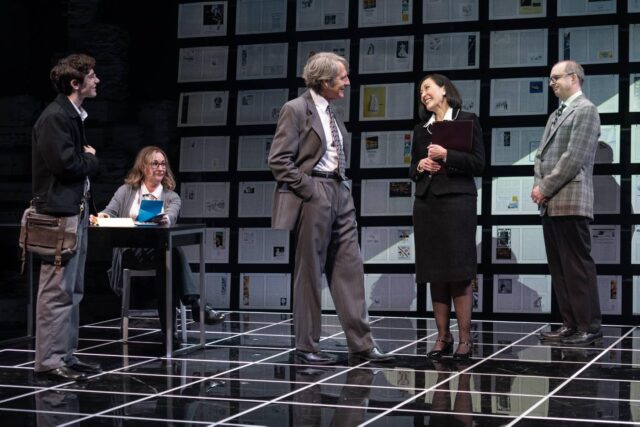
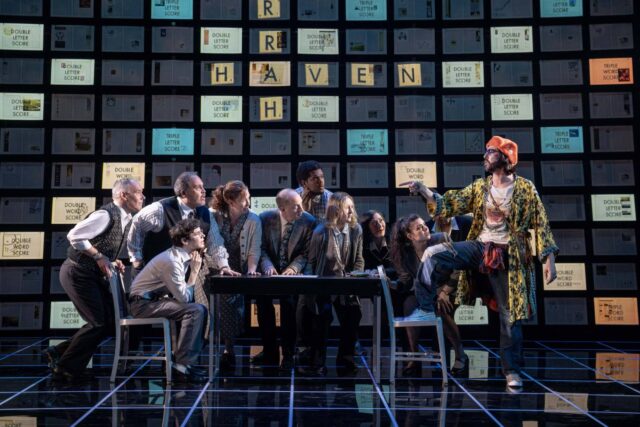
The Connector takes place at a New York City magazine publisher in the mid-1990s (photo by Joan Marcus)
THE CONNECTOR
The Robert W. Wilson MCC Theater Space
511 West Fifty-Second St. between Tenth & Eleventh Aves.
Tuesday – Sunday through March 17, $74-$139 mcctheater.org
Beowulf Boritt’s set is the star of The Connector, an otherwise hit-or-miss new musical conceived and directed by Daisy Prince, with a book by Jonathan Marc Sherman and music and lyrics by Tony winner Jason Robert Brown.
The show takes place in the offices of a well-respected magazine called the Connector. On the back wall is a rectangular grid of more than one hundred folded-over magazine spreads on which lighting designer Jeanette Oi-Suk Yew projects various images in addition to, for one fabulous scene, a Scrabble board; neon lights form multiple shapes in different colors on the black floor, also a grid. Off to the sides are mounds and mounds of paper. Tables, desks, and chairs are wheeled on an off to indicate trips to different offices and outdoors.
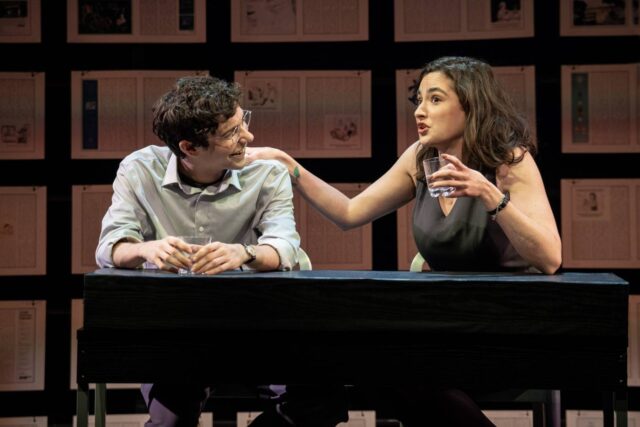
The magazine is run by Conrad O’Brien (Scott Bakula), who is determined to continue the legacy of the magazine’s founder, Aubrey Bernard, who started the Connector in 1946. It’s 1996, and the conglomerate VorschlagXE are their new partners. When enthusiastic young journalist Ethan Dobson (Ben Levi Ross) arrives, O’Brien is immediately impressed by the recent college grad and gives him a job. It isn’t long before Dobson is getting major stories published in the magazine, much to the chagrin of assistant copy editor Robin Martinez (Hannah Cruz), whose pieces keep getting rejected by O’Brien, and Tom Henshaw (Fergie Philippe), a dependable but unexciting writer.
As Dobson’s stories become more and more popular, fact checker Muriel (Jessica Molaskey) has more and more questions, as does loyal Connector reader Mona Bland (Mylinda Hull), who regularly sends in letters to the editor with praise and criticism, and Martinez, who is suspicious of how Dobson is writing so many articles so quickly.
Ethan Dobson’s first story is about the prowess of Scrabble mastermind Waldo Pine (Max Crumm) (photo by Joan Marcus)
The Connector was inspired by the fraud perpetrated by Stephen Glass at the New Republic in 1998. Much of the show rings true, but just as much doesn’t. From 2001 to 2004, I served as editor in chief of a free local New York City newsmagazine with a small staff, consisting of a news editor, a features editor, and a managing editor. We all proofread and fact-checked one another’s articles as best we could, right at the time that use of the internet exploded around the country. I just find it too difficult to buy how easily O’Brien falls under the spell of the overly cocky and annoying Dobson, ignoring all the warning signs, even as he is distracted by VorschlagXE executive Veronica (Ann Sanders).
One of the show’s aims is to relate its plot to the fake news that now dominates social media and overtly biased television programs and publications, but the connection doesn’t come through. When O’Brien makes a toast early on, proclaiming, “To our fabled history of writers and editors, who still search, reach, and fight for the truth. To our beloved, well-educated, politically active readers,” it’s as if they are already outliers, ill-prepared for what is to come. “Together, we shall thrive and grow for many more decades, pushing forward, staying true to the tenets Aubrey Bernard held so dear!” he adds.
The Connector is a musical, but it feels much more like a play with musical scenes, never quite cohering as a whole. Karla Puno Garcia’s choreography ranges from barely there in the introductory number to fun and fanciful in Waldo’s celebration to head scratching during Dobson’s visit to the Western Wall in Jerusalem. Brown’s (Parade,The Last Five Years) arrangements and orchestrations crackle, but the songs, performed by a small band behind the backdrop, lack consistency as they go from ballads to hip-hop to klezmer. Director Prince, who has previously helmed Brown’s The Last Five Years and Songs for a New World, is unable to get the scenes to smoothly flow into each other. And while there are laughs, a pair of cheap shots at Texas and New Jersey in “So I Came to New York” linger badly.
Ethan (Ben Levi Ross) and Robin (Hannah Cruz) become friends and rivals in The Connector (photo by Joan Marcus)
Bakula (Three Guys Naked from the Waist Down,Guys and Dolls), who was nominated for a Tony as Best Leading Actor in a Musical for 1988’s Romance/Romance, has a firm grasp of his character in his return to the New York stage, while Cruz (Only Gold,Suffs) excels as Martinez, Molaskey (A Man of No Importance,Sunday in the Park with George) is right on point as the fussy Muriel, and Crumm (Emojiland,Disaster!) nearly steals the show as Waldo.
The cast also includes Daniel Jenkins as Connector lawyer Zachary, Michael Winther as cable host Brian Lamb, Danielle Lee Greaves as Jersey City mayoral aide Sheryl Hughes, Ashley Pérez Flanagan as copy editor Florencia Moreno, and Eliseo Román as Nestor Fineman, the fictional head of the real-life New York Press, which was the archrival of the publication I ran twenty-plus years ago.
In the end, The Connector has some worthwhile articles but could use more editing to cut down on the excess.
[Mark Rifkin is a Brooklyn-born, Manhattan-based writer and editor; you can follow him on Substack here.]
Tobias Menzies stars as a man accused of a horrible crime in The Hunt (photo by Teddy Wolff)
THE HUNT
St. Ann’s Warehouse
45 Water St.
Tuesday – Sunday through March 24, $64-$84
718-254-8779 stannswarehouse.org
In 2012, St. Ann’s Warehouse presented the US premiere of Grzegorz Jarzyna’s mesmerizing adaptation of Thomas Vinterberg and Tobias Lindholm’s 1998 Dogme 95 film, Festen (The Celebration), about a birthday party at which the adult son of the honoree suddenly accuses his father of having sexually abused him and his twin sister when they were children.
That same year, Danish writer-director Vinterberg released his terrifying Oscar-nominated drama Jagten (The Hunt), in which Mads Mikkelsen stars as a kindergarten teacher falsely accused of sexually abusing a six-year-old student in a small, tight-knit town.
Writer David Farr and director Rupert Goold’s adaptation of The Hunt for the Almeida Theatre is now having its US premiere at St. Ann’s; it’s a haunting tale of hunters and their prey.
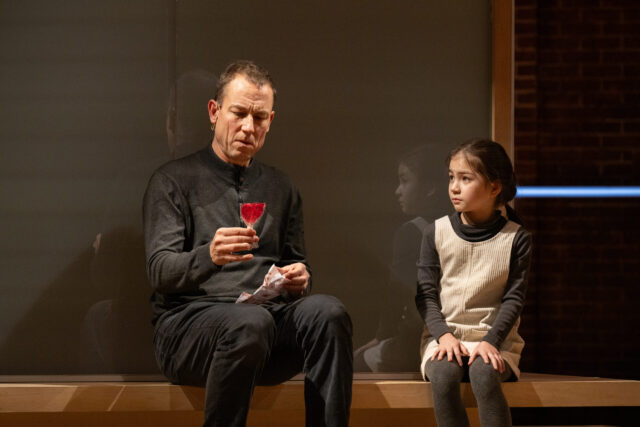
Tobias Menzies makes a dazzling US stage debut as Lucas Bruun, a forty-year-old educator who is teaching at the Sunbeam Infants School in an isolated village in Northern Denmark after his previous employer closed. He has separated from his wife, Susanne, and is frustrated that he is not getting enough time to spend with their sixteen-year-old son, Marcus (Raphael Casey).
A teacher (Tobias Menzies) is given a surprise present by one of his students (Aerina DeBoer) in The Hunt (photo by Teddy Wolff)
After a special event, his favorite student, five-year-old Clara Kallstrom (alternately played by Aerina DeBoer or Kay Winard), tells school head Hilde (Lolita Chakrabarti) that Lucas exposed himself to her, which is not true. Soon the entire town, including Clara’s parents, Mikala (MyAnna Buring) and Theo (Alex Hassell), who are Lucas’s closest friends, has turned against him, branding him a pariah.
Curiously, as his world crumbles around him, the fiercely private Lucas doesn’t stand up for himself, never proclaiming his innocence, even though we saw the encounter in question and know he did not do anything wrong. He begs the school and Clara’s parents to let him talk to the girl in order to straighten everything out, but no one wants him near her or the school. Even his buddies in the Men of the Lodge, a group of hunters who love singing, shooting, and boozing it up, immediately ostracize him, making him the hunted. The only support he receives is from his dog, Max, and Marcus, who shows up unexpectedly at his doorstep.
“Talking to you is like scaling a fucking castle wall. You know that?” Mikala tells him.
But he’s not about to let anyone in, even with his life in danger.
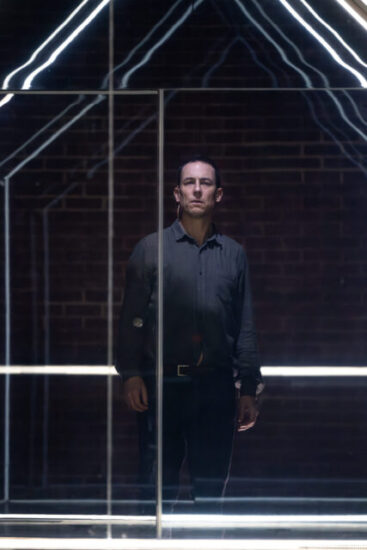
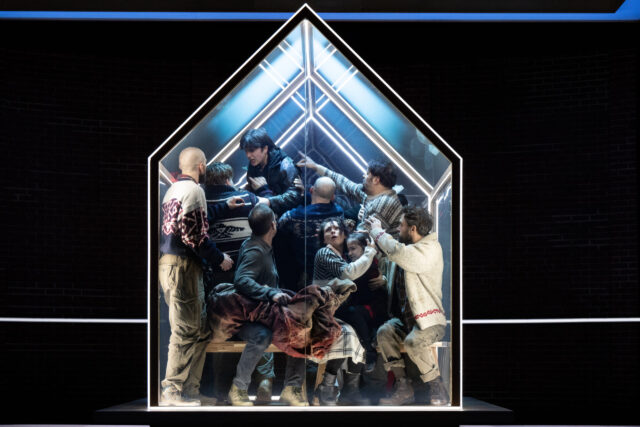
The Hunt takes place on Es Devlin’s fascinating set, a house-shaped cube that switches from transparent to opaque in a flash; it rests on a turntable, so it occasionally spins, and there is a trapdoor so characters can appear and disappear. Neil Austin’s lighting includes neon lines on the floor, ceiling, and wall and in and on the cube itself, while Adam Cork’s sound is highlighted by songbirds who represent the freedom that is just out of Lucas’s reach.
Despite the plentiful open space, the cube gives the show a claustrophobic feeling, whether it’s being used as a church or the men’s lodge, stuffed with people, or for a lone antlered forest creature signaling potential doom.
Es Devlin’s set is a character unto itself in US premiere of Almeida production at St. Ann’s (photo by Teddy Wolff)
Ritual and social convention hover over the narrative. The show opens with Hilde directly addressing the audience, introducing the children’s harvest festival play. “Welcome, everyone. It’s lovely to see so many familiar faces,” she says. “We are a small community. The happiness of our children is everything. Our hopes and dreams rest in these tiny souls. And to spend each day with them is a kind of heaven.”
In the next scene, the Men of the Lodge are in bathing suits, going for a manly swim, belting out, “Oh, eight men they go swimming / In the water oh so cold / The eight men they are hunters / The eight men they are bold / The eight men they are heroes / They never will grow old / Their bodies made of iron / Their hearts are made of gold / The hunters undefeated / Are mighty to behold. They dance in unison to Kel Matsena’s testosterone-filled choreography, which takes a darker path as Christmas approaches.
Emmy winner Menzies, best known in America for his roles on Outlander and The Crown, is riveting as Lucas, a highly principled man who has too much faith in others. He remains soft-spoken even as his freedom is being stolen. Buring and Hassell excel as Lucas’s best friends, who are not sure what or whom to believe. The rest of the ensemble is strong, including Chakrabarti as the school head whose job it is to protect the children, Casey as the son who has faith in his father, Howard Ward as a school administrator and the local pastor, Rumi C. Jean-Louis or Christopher Riley as Clara’s school pal Peter, and Adrian Der Gregorian, Ali Goldsmith, Shaquille Jack, Danny Kirrane, and Jonathan Savage as the other Men of the Lodge.
Farr (Night Manager,The Homecoming) and Goold (Patriots,Ink) occasionally stray from the film’s story, with uneven results; a few scenes are awkward, but they right the ship for a poignant finale.
At two points, characters suddenly appear at the back of the audience and make their way to the stage, as if any one of us could be them. Would we be the accused, the accuser, or the townspeople who have to look deep inside themselves? None will like what they find.
[Mark Rifkin is a Brooklyn-born, Manhattan-based writer and editor; you can follow him on Substack here.]
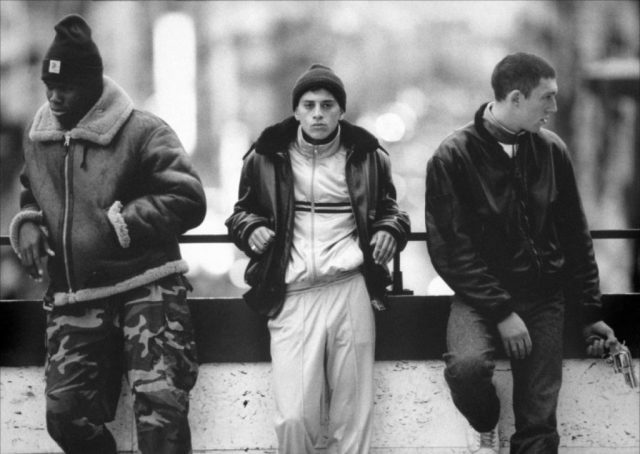
Hubert (Hubert Koundé), Saïd (Saïd Taghmaoui), and Vinz (Vincent Cassel) experience a wild and dangerous day in La haine
LA HAINE (HATE) (Mathieu Kassovitz, 1995)
Metrograph
7 Ludlow St. between Canal & Hester Sts.
March 1, 2, 4, 7, 9
Festival runs March 1-24
212-660-0312 metrograph.com
On March 1, Metrograph kicks off the series “Forever Young,” featuring fifteen international works with unique perspectives on youth culture. Among the selections are Terry Zwigoff’s Ghost World, Tsai Ming-liang’s Rebels of the Neon God, and Luis Buñuel’s Los Olvidados.
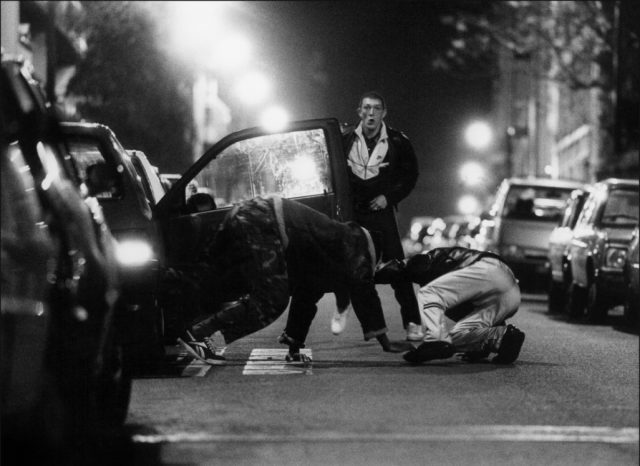
One of the highlights is Mathieu Kassovitz’s underseen incendiary 1995 stunner, La haine, inspired by the real-life stories of Makome M’Bowole and Malik Oussekine, two young men who were killed by police in 1993 and 1986, respectively. Kassovitz’s second feature film (following Métisse), La haine, which means “hate,” is set in the immediate aftermath of Paris riots as three friends —the Jewish Vinz (Vincent Cassel), the Afro-French Hubert (Hubert Koundé), and the Arab Saïd (Saïd Taghmaoui) — spend about twenty hours wandering the mean streets of their banlieue (suburban projects) and Paris, causing minor mayhem as they encounter skinheads, stop off for some wine at an art opening, try to get into a hot club, and, over and over, become embroiled with the police.
Vinz (Vincent Cassel) sees trouble coming in Mathieu Kassovitz’s explosive La haine
The disaffected youths are fed up with a system that continues to treat them as outsiders, assuming they are criminals. Hubert wants to get out of the banlieue through hard work, but he keeps running into obstacles that are out of his control; at one point, when something goes wrong, he closes his eyes as if he can wish it away. Saïd is an immature schemer who thinks he can slide out of any untoward situation, especially with the help of his much more grounded older brother. But Vinz is a significant problem; one of their friends, Abdel (Abdel Ahmed Ghili), was arrested at the riots and has been severely injured while in police custody. Vinz has sworn to kill a policeman if Abdel dies, something that becomes more possible when he picks up a gun an officer dropped. “I’m fuckin’ sick of the goddam system!” Vinz proclaims, filled with resentment. The three young men pass by a few signs that say “The World Is Yours,” a reference to Scarface, but that seems far out of reach for them.
Photographed in gritty black-and-white by Pierre Aïm and edited with a caged fury by Kassovitz and Scott Stevenson, La haine is electrifying cinema, a powder keg of a film ready to explode at any second. The time is shown onscreen before each scene, going from 10:38 to 06:00, like a ticking time bomb. The film has a documentary-like quality, complete with actual news footage of riots and violence. Kassovitz shows up as a skinhead, while his father, director and writer Peter Kassovitz, is a patron at the art gallery. The soundtrack features songs by French hip-hoppers Assassin; Cassel’s brother, Mathias Crochon, is a member of the group. And look for French star Vincent Lindon’s riotous cameo as a very drunk man.
Several times Vinz appears to be looking straight into the camera, pointing his gun accusingly at the audience; his complete disdain for all types of authority is reckless and dangerous but also understandable, and Kassovitz is extending that rage beyond the screen. In fact, during the November 2005 riots in France, people looked to Kassovitz for a response, and the writer-actor-director eventually got into a blog battle with Minister of the Interior Nicolas Sarkozy, who would later become prime minister. Kassovitz wrote, “As much as I would like to distance myself from politics, it is difficult to remain distant in the face of the depravations of politicians. And when these depravations draw the hate of all youth, I have to restrain myself from encouraging the rioters.”
Sarkozy replied, “You seem to be acquainted with the suburbs well enough to know, deep inside you, that the situation has been tense there for many years and that the unrest is deep-rooted. Your film La haine, shot in 1995, already showed this unease that right-wing and left-wing governments had to deal with, with varying results. To claim this crisis is down to the Minister of the Interior’s sayings and doings is yet another way of missing the point. I attributed this to an untimely and quick-tempered reaction.”
Have things gotten better in the last thirty years, or are governments still missing the point?
[Mark Rifkin is a Brooklyn-born, Manhattan-based writer and editor; you can follow him on Substack here.]
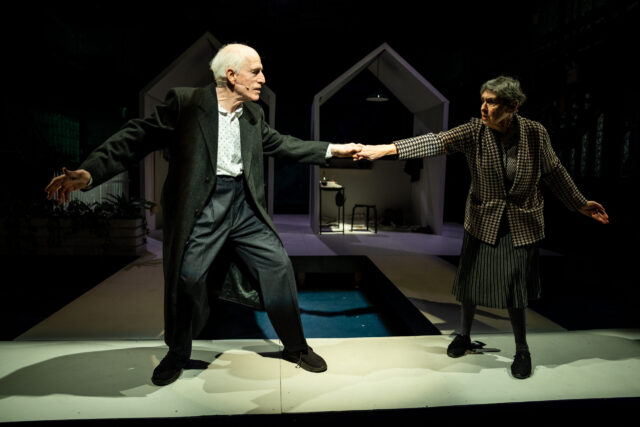
Husband-and-wife Ellen Maddow and Paul Zimet portray a married couple in Existentialism (photo by Maria Baranova)
EXISTENTIALISM
La MaMa Experimental Theatre Club
The Ellen Stewart Theatre
66 East Fourth St. between Second Ave. & Bowery
Wednesday – Sunday through March 10, $35-$40
212-475-7710 www.lamama.org talkingband.org
Early on in Talking Band’s gorgeously poetic two-character play Existentialism, the man says, “Choice is possible. / What is impossible is not to choose. / If I decide not to choose, / That still constitutes a choice.”
It would be a mistake not to choose to see one of the best shows of the year.
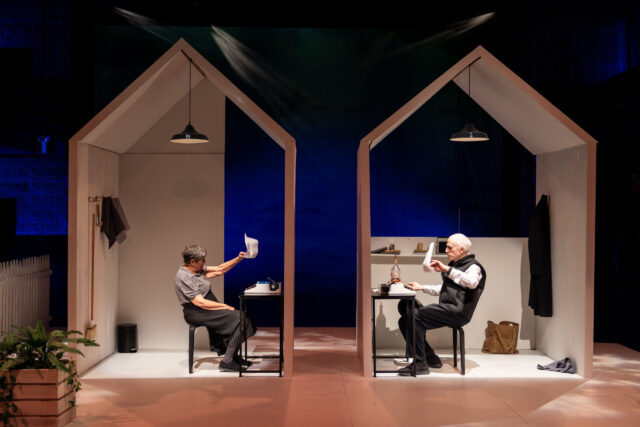
Existentialism is created and directed by former SITI Company head Anne Bogart specifically for Ellen Maddow and Paul Zimet in celebration of the fiftieth anniversary of Talking Band, the troupe Maddow and Zimet cofounded with Tina Shepard in 1974. The duo, who have been married since 1986, portray an unnamed woman and man living in a home on the beach. Anna Kiraly’s set features a pair of house-shaped structures, open in the front, each with the same overhead lamp and a small table with a backless chair and typewriter. Short walkways lead out of and around the rooms, with a small planting bed on the woman’s side. Brian Scott’s lighting casts warm red, yellow, orange, blue, and green glows on the structures, while Darron L West’s sound ranges from loud music to soft nature elements to the actors’ crystal-clear enunciations. Kiraly’s projections of waves on the shore and birds flying freely come and go on a large screen in the back.
The woman waters her plants with panache, raising the watering can high above her as the liquid drips out. She does the shopping and is agonized by a speck of dirt she cannot get clean on the path. The two sit at their respective desks on opposite sides of a wall and type in unison.
He saunters to the front of the stage and speaks directly to the audience: “There is a wall between us, but it is a wall we build together. Each of us puts a stone in the gap left by the other. / I’m going to smile, and my smile will sink down into your pupils, and heaven knows what it will become,” he says, sharing an intimate, funny smile. “I am no longer sure of anything. / Something has to snap. / Words are loaded pistols. / There may be more beautiful times, but this one is ours.” Throughout the show’s seventy minutes, we all fill the gaps with figurative stones (and smiles) of our own.
The dialogue is based on the writings of life partners Simone de Beauvoir and Jean-Paul Sartre in addition to Albert Camus, Martin Heidegger, Maurice Merleau-Ponty, Sarah Bakewell, Maggie Nelson, Octavia Butler, bell hooks, and Betty Friedan. The words form an enticing and gentle meditation on gender and aging, delivered in a soft, plain-spoken, but not dispassionate style. The text is all the more compelling because Maddow is seventy-five and Zimet eighty-one; however, they are imbued with an infectious youthfulness.
“My life is set within a given space of time: / It has a beginning and an end, / It evolves in given places, / Always retaining the same roots, / It spins an unchangeable past, / Its future is limited,” the woman says. “No one else is as old as I am. / How young everyone is!”
The man says, “I was young once.”
The man turns on the radio and listens to Dave Brubeck’s “Broadway Bossa Nova” and Beethoven’s “Moonlight Sonata.” The duo dances to the Jim Carroll Band’s punk anthem “People Who Died” blasting out of the speakers, a furious song about how more than a dozen men and women meet untimely ends. “They were all my friends and they died,” Carroll belts out. A New York City native, Carroll himself died of a heart attack in 2009 at the age of sixty; his most well known works include the novel The Basketball Diaries and the LP Catholic Boy.
Time moves on, but the man and the woman continue their daily existence, discussing life in abstract terms.
“No one will ever make sense of this mystery,” she says.
Paul Zimet and Ellen Maddow take a spin in Existentialism (photo by Maria Baranova)
Last month Maddow and Zimet appeared in The Following Evening at PAC NYC, a show written and directed specifically for them by Abigail Browde and Michael Silverstone of 600 Highwaymen, two married creators in their early forties paying tribute to the older couple and what they have accomplished both personally and professionally.
With Existentialism, Bogart is also celebrating Maddow and Zimet. Bogart last worked with Talking Band in 1988, winning the first of her three Obies for directing No Plays No Poetry but Philosophical Reflections Practical Instructions Provocative Prescriptions Opinions and Pointers from a Noted Critic and Playwright, incorporating the writings of Bertolt Brecht; Maddow and Zimet were part of an ensemble cast that also included Louise Smith and Shepard. Bogart has said that when Maddow and Zimet suggested they work together again, she instantly knew it would be called Existentialism; it’s a fitting title for the show, which has its own built-in meta.
Maddow and Zimet are utterly charming in this new piece, which continues at La MaMa through March 10. Although not much is revealed about their characters, you can’t help but fall in love with their relationship. They know they are in the sunset of their lives, but that isn’t stopping them from enjoying every moment. “Do you think that I count the days? There is only one day left, always starting over. It is given to us at dawn and taken away from us at dusk,” he says.
Bogart captures the essence of long-term love, with all its bumps and bruises. When the woman hides behind the wall, listening intently to the man typing away, you can feel how much they adore and need each other. It’s a tender moment that I won’t soon forget.
But right in front of the houses is a rectangular gap in the walkway, a small but constant threat, reminding us how easy it is to fall off one’s path, something Bogart, Maddow, and Zimet don’t have to worry about with this wonderful collaboration.
“Why do we even exist? Hahaha . . . ,” the woman asks. One reasonable answer could be so we could experience such shows as Existentialism.
[Mark Rifkin is a Brooklyn-born, Manhattan-based writer and editor; you can follow him on Substack here.]