twi-ny recommended events

KARA WALKER’S KATASTWÓF KARAVAN WITH JASON MORAN

Kara Walker, The Katastwóf Karavan, 2017 (Installation view, Prospect.4: The Lotus in Spite of the Swamp, Prospect New Orleans, New Orleans, Louisiana, 2018). Steel frame mounted to lumber running gear, aluminum, red oak and muslin wall panels, propane fired boiler, water tank, gas generator, brass and steel 38-note steam calliope, calliope controller panel with MIDI interface, iPad controller with QRS PNO software; 152 × 216 × 100 inches (386.1 × 548.6 × 254 cm). © Kara Walker. Image courtesy Sikkema Jenkins & Co., New York. Photograph by Alex Marks

Kara Walker, The Katastwóf Karavan, steel frame mounted to lumber running gear, aluminum, red oak and muslin wall panels, propane fired boiler, water tank, gas generator, brass and steel 38-note steam calliope, calliope controller panel with MIDI interface, iPad controller with QRS PNO software, 2017 (© Kara Walker. Image courtesy Sikkema Jenkins & Co., New York. Photograph by Alex Marks)

Whitney Museum of American Art
Pamella and Daniel DeVos Family Largo
99 Gansevoort St.
Saturday, October 12, free, 1:00 – 6:30
whitney.org
www.karawalkerstudio.com

Two years ago, Kara Walker’s site-specific Katastwóf Karavan nearly didn’t make it to New Orleans’ Prospect.4 Triennial: The Lotus in Spite of the Swamp because of disagreements over shipping costs. But it ultimately took its place on Algiers Point, and now the completely fabricated wagon will be pulling into the Pamella and Daniel DeVos Family Largo outside the Whitney, where it will perform for free from 1:00 to 6:30 on Saturday. The California-born, New York-based artist was inspired to construct the wagon after reading an insufficient, small historical plaque (see below) at Algiers Point identifying the location where enslaved Africans were “held before being ferried across the river to the Slave Auctions” as well as after hearing calliope music coming from the Natchez riverboat, a steamboat reminiscent of the kind used to transport the slaves. The four-wheeled, four-ton circus-style wagon features Walker’s trademark silhouette figures of slaves being abused by masters on all four sides in water-cut steel, with a loud, thirty-eight-note steam-powered calliope inside, custom made by Kenneth Griffard. The presentation is taking place in conjunction with jazz musician Jason Moran’s solo show at the Whitney, which continues through January 5; Texas native Moran will play the calliope at 6:00 on Saturday.

In the Prospect.4 performance handout, Walker, whose My Complement, My Enemy, My Oppressor, My Love ran at the Whitney in 2007-8, explained, “I was thinking a lot about music as the bearer of our emotional history, and about the way Jazz and gospel and African American Music are testaments to survival of our culture in the face of unrelenting, nihilistic ‘Progress’ and how it’s regarded as a monument in American History etc. But also thinking about how the Industrial Revolution, the Steam Engine and Cotton Gin were pivotal in usurping and grinding up the bodies of laborers and how much of that action, John Henry style, occurs today, with Humans fighting uphill battles to prove themselves against the latest technology. Steam engines are quaint things of the past, but industry presses on without us. The Machines have changed, but the action stays the same. How would it be if the old steam engines that ate us, swallowed too, our songs and pain, and what if, when its time was done, and slated for the scrapheap, the Steam Engine sang out in solidarity?”

algiers point

Incorporating the Haitian Creole word for “catastrophe” in its name, Katastwóf Karavan — “We simply say ‘Slavery’ as if that were a legitimate job instead of what it was, a Catastrophe for millions,” Walker explains — will also play such civil-rights-era, celebratory, and protest songs as “We Shall Overcome,” Aretha Franklin’s “Respect,” Prince’s “When Doves Cry,” and Marvin Gaye’s “What’s Going On?” Walker, whose Fons Americanus is currently wowing visitors at the Tate Modern and whose Domino Sugar Factory installation A Subtlety caused a sensation in New York five years ago, holds nothing back in her work, confronting racial prejudice and inadequate histories head-on. “Forgetting is preferable to remembering, as remembering stirs action,” she writes in the handout.

TWI-NY TALK: JOHN KELLY — UNDERNEATH THE SKIN

John Kelly takes on the persona of Samuel Steward in Underneath the Skin (photo by Josef Astor)

John Kelly takes on the persona of Samuel Steward in Underneath the Skin (photo by Josef Astor)

NYU Skirball Center for the Performing Arts
566 La Guardia Pl.
October 11-12, $35-$45, 7:30
212-992-8484
nyuskirball.org

“I like to move people. That’s my job, to move people. I’m not an entertainer; I’m an engager,” performance artist extraordinaire John Kelly told me in a phone interview earlier this week as he was hunkered down, preparing his latest show, Underneath the Skin, for its world premiere October 11-12 at NYU’s Skirball Center. For four decades, Kelly has been creating shows in which he takes on the persona of other artists, including Egon Schiele in Pass the Blutwurst, Bitte, Caravaggio in The Escape Artist, Joni Mitchell in Paved Paradise, and Antonin Artaud in Life of Cruelty. In the multimedia Underneath the Skin, Kelly, who is also a visual artist, filmmaker, dancer-choreographer, vocalist, songwriter, and author, explores the life and career of poet, professor, tattoo artist, novelist, diarist, and “sexual renegade” Samuel Steward. The Ohio-born Steward, who died in Berkeley in 1993 at the age of eighty-four, left behind a highly influential legacy despite constant systemic roadblocks because of his sexuality.

“Misfortune to a degree followed him, but maybe misfortune followed every gay man in those days,” said Kelly, who did extensive research for the show, which he wrote, directed, choreographed, produced, scored, designed the set and costumes for, and did the video editing. The piece, which is completely constructed of Steward’s words, also features Chris Harder, Alvaro Gonzalez, and Hucklefaery (ne’ Ken Mechler). “Every hour at this point is crucial,” Kelly noted, but he was still very generous with his time as we spoke about Steward, the AIDS epidemic, cultural amnesia, recalibration, and autobiography. Kelly will also be appearing at the Neue Galerie’s Café Sabarsky on November 26 in a cabaret concert of original music as well as songs by Bertolt Brecht, Kurt Weill, Charles Aznavour, Danny Elfman, and others.

twi-ny: Since the mid-1980s, you’ve been taking on the persona of other artists. What initially attracted you to do these kinds of character studies? As a child, were you doing impersonations, or were you drawn to artists?

John Kelly: I grew up assuming I’d be a visual artist. I could draw — I got that gift from my father. But then I switched to dance and ballet training, and modern when I was about seventeen. I came upon Schiele in art school and he became one of my early inspirations. So my performance work about him was a way of merging my dance background with my visual art practice, literally to embody an artist onstage, to see what that would look like.

The thing about the niche in my career focusing on the character of artists — my work has been fifty-fifty autobiographical or semiautobiographical or metaphorical, and then fifty percent focusing on actual characters from history, whether it was a real person or a mythological character like Orpheus. And I guess the reason with that is that when I do the autobiographical or metaphorical or semiautobiographical works, there’s an urgency in me that is wanting to get out. And then when I focus on an existing character, there’s something in their life story and work that speaks to me, and I’m able to embody them to some degree and also satisfy my need to express certain parts of myself and what I’m going through at any given moment.

(photo by Paula Court)

John Kelly traced his own life and career in the autobiographical Time No Line (photo by Paula Court)

twi-ny: When you were doing the autobiographical Time No Line, did you learn anything about yourself that you hadn’t realized before?

jk: I’ve been keeping journals since 1977, and I started scanning them because I wanted to get another copy, with an eye to an eventual memoir. But one of the things that fueled Time No Line was that I’m a survivor of my generation. My generation was pretty much wiped out by the AIDS epidemic, and I’m watching a couple of things: I’m watching the absence of my tribe in the world and the absence of those voices and the absence of our intergenerational dialogue between my generation and younger generations, and also I’m seeing my generation’s history being written by younger people who weren’t there and who probably had no way of really getting it.

I imagine they’re highly educated and well-intended — I just hope they get it right because they’re accessing the dead heroes, like David Wojnarowicz and Marsha P. Johnson; they’re not accessing the live heroes or the last survivors necessarily. With the world the way it is right now, there is a focus on activism in the kind of street sense of activism, but I embody a different kind of activism. I decided my place was on the stage, not on the streets, and that said, I made many pieces directly or tangentially about the AIDS epidemic and issues of survival and grief and all that.

It’s exacerbated by digital technology, it’s exacerbated by short attention spans, it’s exacerbated by a culture of narcissism and entitlement. Half the youth generally doesn’t really care to look back; they just assume that the ground they are standing on is solid and has always been there.

twi-ny: And they can like something on Facebook or post an article and then they’re done.

jk: Exactly. So it’s an uphill battle, and I do what I can to connect the dots. . . . But the upside of technology is that you can be on a platform like Facebook and connect and have dialogue and be reminded that our lives are still valid.

twi-ny: That leads us right into Underneath the Skin, about Samuel Steward, who, like you, was a diarist. What inspired you to take on his persona?

jk: I had read Justin Springs’s book [Secret Historian: The Life and Times of Samuel Steward, Professor, Tattoo Artist, and Sexual Renegade] about four years ago and I really loved it. Then Jay Wegman, who runs Skirball, said, “I want to commission you to make a piece about him,” and I was like, “Whoa. Hey, let me think about this.” So then I went to Steward’s actual writings and drawings and the rest, and I avoided Springs’s amazing take on Steward because I had to formulate my own relationship to this man and his work. And also to witness it in context; probably the most profound aspect of his whole thing is that he prevailed and he took enormous chances at a time when literally if you went to a gay bar, you couldn’t even face the person next to you; you had to face front, and there were police outside waiting to arrest you if you didn’t have payola. And if you were arrested, your name and address were put in the newspaper. Those were the decades in which he was functioning and flourishing, albeit behind closed doors.

twi-ny: A lot of people still don’t know about the cops waiting to arrest gay people, in bars right around where Skirball is now.

jk: Exactly. That’s cultural amnesia; it’s a sad history to be reminded of.

Samuel Steward is subject of John Kelly’s latest performance piece

Samuel Steward is subject of John Kelly’s latest performance piece

twi-ny: What do you think Steward would have thought about what’s going on today?

jk: From his vantage point between 1950 and 1984, he was already speaking to younger audiences and saying you have no idea what it was like. So to imagine him now, and maybe if he had survived the AIDS epidemic — he died December 31, 1993, at the height of the epidemic — I imagine he’d by joyful in the advancements that have occurred.

twi-ny: Do you think he would have taken quickly to the internet, which could have provided a forum for his different kind of works?

jk: The thing is, he wanted to write authentically and he couldn’t. I mean, he did, but he eventually maybe wrote most authentically when he wrote as Phil Andros for his erotic literature. I don’t call it pornography; I call it erotic literature because it’s beautifully written.

He wrote a novel, Angels on the Bough, in 1936, and he got fired from a teaching job for it because he had a positive presentation of a prostitute. He couldn’t be out. I think he might have a low tolerance for the minutiae of policing ourselves and the immediate vilification of any wavering from abject correctness, even with people who are coming from two generations earlier. He might have a hard time navigating that, or maybe he would endorse it. There’s no way of knowing. He was a smart man.

twi-ny: I don’t know if you’ve seen Dave Chappelle’s latest comedy special, but he does a bit about the LGBTQ community and how it overpolices itself, and some people find it very funny and others think it’s highly offensive.

jk: Basically, the whole planet is recalibrating; the whole culture is recalibrating. And we’re in the process of recalibrating what really wants to happen and what does not want to happen anymore. And it’s a learning curve. . . . Especially on the internet, where there’s maybe no real consequence attached to a response, which could have a ripple effect and have enormous consequences.

twi-ny: Do you see anybody today continuing his legacy?

jk: When I think of Samuel Steward, I think of a gentle soul who had to put a hardened shell around himself because he wasn’t able to — he lived life freely, but he couldn’t live his life completely freely. . . . His greatest contribution was that he kept all this stuff, and it comes down to us, and that the ephemera and the archives are what speak to a life pretty fully lived in a time when it was illegal to do any number of the things that he did.

THE SÉANCE MACHINE

The Séance Machine,

Ilana Gabrielle, Lisa Lamothe, and Jonathan Cruz star as three doctors trying to communicate with the dead in the world premiere of The Séance Machine (photo by Brandon James Gwinn)

The Tank
312 West 36th St. between Eighth & Ninth Aves.
October 10-31, $20-$30
thetanknyc.org
brandonjamesgwinn.com

Sitting around a table with a medium attempting to contact deceased loved ones took off in the mid-to-late-nineteenth century as people flocked to spiritualism. EllaRose Chary and Brandon James Gwinn take communicating with the dead to the next technological level in The Séance Machine, running October 10 through All Hallow’s Eve at the Tank. Cowriters Chary and Gwinn and director Julia Sears invite fifty-six guests a night to spend an hour with Dr. Carolyn Blau’s Mechanical Wave Reassembly Hypercardioid Sequencing Module, the latest in spiritual equipment to deal with ghosts and time travel. NEMOD Industries CEO Carly McPherson explains in a promotional video, “Dr. Blau had the vision for a device capable of letting us hear aspects of our own universe no human ears have ever heard before.”

The cast features Jonathan Cruz (The Hollywood Special Effects Show) as anthropologist and psychologist Dr. John Alvarez, Ilana Gabrielle (It’s a Man’s World, Coming: A Rock Musical . . .) as paleontologist and geologist Dr. Gabby White, and Lisa Lamothe (Incredibly Deaf Musical) as audio-physicist Dr. Blau, with set design by Susannah Hyde and lighting by Annie Garrett-Larsen. Chary and Gwinn have previously collaborated on Cotton Candy and Cocaine, Thelma Louise, Dyke Remix, Queer. People. Time., and other shows and also curate the monthly cabaret series Tank-aret, which returns to the Tank on November 26 with “Maybzgiving: A Queerucopia.”

JENNY HOLZER: VIGIL

mail

Rockefeller Center
30 Rockefeller Plaza
October 10-12, free, 8:00 – 10:00 pm
creativetime.org
projects.jennyholzer.com

For more than forty years, Jenny Holzer has been producing text-based art, carving words into marble, projecting them on walls and buildings, running them digitally across sculptural signs, compiling them in lists, and even stitching them onto a dress Lorde wore to the Grammys. Her work has been seen on Singapore’s city hall, Silo No 5. in Montreal, the Potomac River, NYU’s Bobst Library, the New York Public Library, the Guggenheim, and Rockefeller Center. Her latest project takes her back to Rock Center with “Vigil,” a commission from the public arts organization Creative Time, which will be holding its tenth annual summit next month, asking the question “Can speaking truth to power unravel the age of disillusion we find ourselves in?”

From 8:00 to 10:00 on the evenings of October 10-12, the Ohio-born, New York-based Holzer will zero in on the rise of gun violence in the US, projecting excerpts from the 2017 book Bullets into Bells: Poets & Citizens Respond to Gun Violence, which combines poetry from established writers with responses from gun control activists, politicians, survivors of mass shootings, and family members of victims; stories from the award-winning activist website Moments that Survive, collected by Everytown for Gun Safety, which is dedicated to ending gun violence; and poems by teenagers who refuse to be silent. Holzer previously collaborated with Creative Time on “For New York City: Planes and Projections” and “For the City” in 2004-5, and her ongoing “It Is Guns” series, featuring such statements as “Scream Again,” “The President Backs Away,” and “Too Late Now” on trucks, has traveled to Chicago, Miami, Atlanta, Tallahassee, New York, and other American cities.

NEXT WAVE 2019

(photo by Heidrun Lohr)

The Second Woman repeats the same scene from John Cassavetes’s Opening Night one hundred times (photo by Heidrun Lohr)

BAM Howard Gilman Opera House, Peter Jay Sharp Building, 230 Lafayette Ave.
BAM Fisher, Fishman Space, 321 Ashland Pl.
October 15 – December 15
718-636-4100
www.bam.org

Like myriad loyal BAMgoers, I look forward every year to the announcement of the Next Wave Festival at the Brooklyn Academy of Music, which has been presenting cutting-edge, experimental, and innovative dance, music, film, theater, opera, and hard-to-categorize multidisciplinary performances from around the world for nearly forty years. We eagerly scour the schedule to see when our longtime BAM favorites will be returning, scanning for such beloved names and companies as Robert Wilson, Sasha Waltz, Grupo Corpo, Batsheva, Philip Glass, Sankai Juku, Ivo van Hove, Mark Morris, Théâtre de la Ville, William Kentridge, Laurie Anderson, and the incomparable Pina Bausch, programmed by masterful executive producer Joe Melillo since 1999.

But this year’s lineup features nary a single familiar name, including that of Melillo, who retired after the Winter/Spring season. For his debut Next Wave Festival, new artistic director David Binder has opted to include a roster of performers all making their BAM debuts as well. But don’t be scared off by the lack of recognition. There was a time when no one in New York had ever seen Pina Bausch, Sankai Juku, Batsheva, Sasha Waltz, et al. And by its very nature, the Next Wave is all about the future of performance, delivered to an eager and intrepid audience open to anything and everything.

(photo by Ernesto Galan)

Dead Centre’s Hamnet tells the story of Shakespeare’s son (photo by Ernesto Galan)

“In programming my first season at BAM, I was inspired by the genesis of Next Wave and the groundbreaking work of my predecessors, Harvey Lichtenstein and Joe Melillo,” Binder said in a statement. “Next Wave is a place to see, share, and celebrate the most exciting new ideas in theater, music, dance, and, especially, the unclassifiable adventures. We’ve invited a slate of artists who have never performed at BAM. Each and every one of them is making a BAM debut, with artistic work that’s surprising and resonant. I’m excited to launch this season and to build BAM’s next chapter
with you.”

The 2019 Next Wave roster is an impressive one, kicking off October 15-20 with Michael Keegan-Dolan and Teaċ Daṁsa’s Swan Lake / Loch na hEala, about a young girl sexually assaulted by a priest. In The Second Woman, Alia Shawkat performs the same scene from John Cassavetes’s Opening Night one hundred times with one hundred different men over the course of twenty-four consecutive hours. Christiane Jatahy’s What if they went to Moscow? explores film and theater in a retelling of Anton Chekhov’s Three Sisters that takes place concurrently onstage at the BAM Fisher and onscreen at BAM Rose Cinemas, the audiences switching places as the performance repeats. In Dante or Die’s User Not Found, audience members sit in a café at the Greene Grape Annex on Fulton St., following the exploits of a man a few tables away. Dimitris Papaioannou breaks boundaries as he explores human existence in The Great Tamer. And Glenn Kaino’s When a Pot Finds Its Purpose will be the inaugural free exhibition at the new Rudin Family Gallery at BAM Strong.

(photo by Justin Jones)

Dante or Die’s User Not Found takes place in the Greene Grape Annex on Fulton St. (photo by Justin Jones)

The 2019 Next Wave Festival also includes Bruno Beltrão/Grupo de Rua’s Inoah, Dumbworld’s free outdoor art piece He Did What?, Selina Thompson’s free interactive installation Race Cards, Dead Centre’s Hamnet, Marlene Monteiro Freitas’s Bacchae: Prelude to a Purge, Untitled Projects/Unicorn Theatre, UK’s The End of Eddy, Peeping Tom’s 32 rue Vandenbranden, Fuel/National Theatre/Leeds Playhouse’s Barber Shop Chronicles, Kyle Marshall Choreography’s A.D. & Colored, Kate McIntosh’s In Many Hands, and Meow Meow’s A Very Meow Meow Holiday Show. Still worried about unfamiliarity? If you’ve been to BAM before, you should be ready, willing, and able to be surprised, and if you’ve never been to BAM, you should be preparing to make your debut.

HEROES OF THE FOURTH TURNING

(photo by Joan Marcus)

It’s Catholic conservative against Catholic conservative in world premiere of Will Arbery’s Heroes of the Fourth Turning at Playwrights Horizons (photo by Joan Marcus)

Playwrights Horizons, Mainstage Theater
416 West 42nd St. between Ninth & Tenth Aves.
Tuesday – Sunday through November 10, $49-$89
www.playwrightshorizons.org

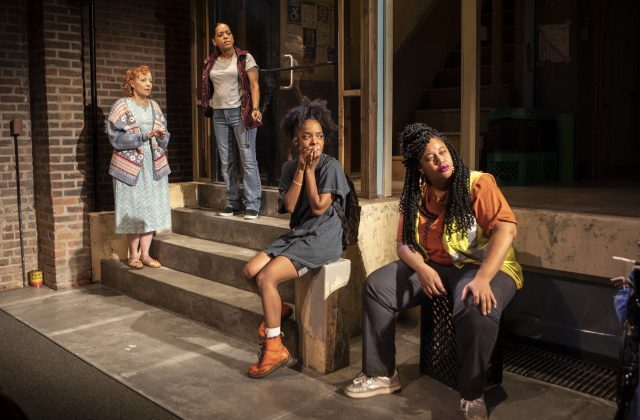
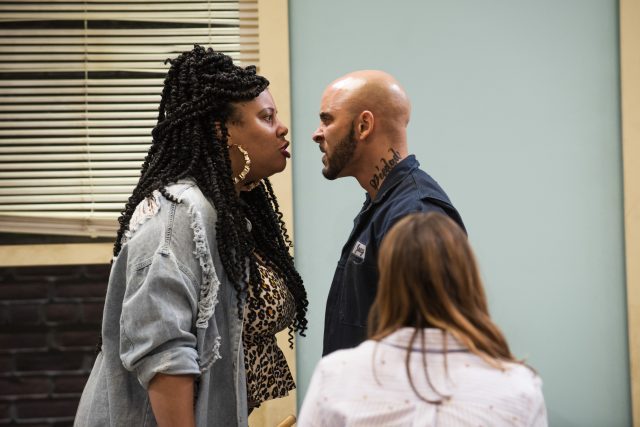
Almost every day we see news about the cannibalistic infighting among the Democrats as the moderate, liberal, and progressive wings argue over policy and identity politics while the original field of more than two dozen candidates to challenge President Donald Trump is whittled down. What appeared to be a slam dunk has been hampered by uncertainty and venomous attacks on their own. Tired of watching them yelling at one another? Then perhaps it’s time to hear some Republicans ripping each other apart, as playwright and filmmaker Will Arbery twists audience expectations in his unnerving and wickedly poignant Heroes of the Fourth Turning, making its world premiere at Playwrights Horizons through November 10. New York City theatergoers who are used to seeing liberal-minded works that attack, and often deride, religious conservatives and Trump supporters are in for a surprise as Arbery, who was raised in a Christian conservative home in Dallas, Texas, brings together five Republicans who are also hampered by uncertainty and let loose some venomous attacks. “We are living in barbaric times,” Justin says.

It’s August 19, 2017, one week after the Charlottesville riot and two days before the solar eclipse, and a group of friends are mingling in Justin’s backyard in the small town of Lander, Wyoming, pop. 7,000. (The cozy evening set is by Laura Jellinek.) He’s hosting a party for Dr. Gina Presson (Michele Pawk), who has just been inaugurated president of Transfiguration College of Wyoming, the alma mater of Justin (Jeb Kreager), Emily (Julia McDermott), Kevin (John Zdrojeski), and Teresa (Zoë Winters). They all graduated Transfiguration over the past fifteen years, and all are in the path of totality, a scientific term relating to the eclipse as well as a metaphor for their attempts to find their individual paths in the world. Although the Republicans control the White House and Congress, the friends are concerned about the Democrats. “There are more of them. We lost the popular vote, by a lot. And they’re mobilizing. In many ways, they are in power. And they’re trying to wipe us out,” Justin says. “There’s a war coming,” Teresa warns.

(photo by Joan Marcus)

Kevin (John Zdrojeski), Justin (Jeb Kreager), and Teresa (Zoë Winters) pray for better times in new political play (photo by Joan Marcus)

Kevin, who drinks, smokes, and snorts too much, is an off-balance clod who spurts out whatever’s on his mind, which pisses off the cold, calculating Teresa, who has moved to Brooklyn. “Don’t say gross things in a holy space,” Teresa declares after he makes a rude remark. “This isn’t a holy space; it’s just Justin’s house,” Kevin replies. “The panopticon, Kevin, Catholicism is the panopticon. This is a holy space,” Teresa explains. “It’s also a profane space,” Kevin responds.

They bicker over the Virgin Mary, morality, identity, the LGBT community, Trump, Hillary Clinton, Barry Goldwater, abortion, Patrick Buchanan, and more, making many of the same arguments that liberals do; in fact, if you were to switch a few names or words here and there, it could be a battle between lefties. There’s also a sexual energy that looms, from a past secret to possible future hook-ups.

The verbal sparring heats up when the distinguished Gina joins them and is not happy about Teresa’s unyielding support of far-right ideologues. Gina — a right-wing mirror of Hillary Clinton, down to her personal style — tells her, “These new people on the right, they’re not true conservatives. They’re charlatans, they’re hucksters. And honestly, darling, they’re a bit racist.” Meanwhile, Emily, who is very ill with what appears to be Lyme disease, is somewhere in the middle, searching for the human element. “Wow, she is . . . I’m sorry but she is such a hypocrite,” she says of Teresa. “At the ceremony, she had a little audience and she was trying to get me to admit that my liberal friend was a bad person. And I’m sorry, but I think it’s unfair to argue that I should cut ties with someone just because they’re on the other side. I can’t see things in black-and-white like that. I have a full faith, it’s my rock, it’s my pain, it’s my everything — and I also am friends with whoever I want to be friends with.”

(photo by Joan Marcus)

Kevin (John Zdrojeski) and Emily (Julia McDermott) discuss love and politics in Heroes of the Fourth Turning (photo by Joan Marcus)

Arbery (Plano, Evanston Salt Costs Climbing) was inspired by William Strauss and Neil Howe’s 1997 book The Fourth Turning: An American Prophecy — What the Cycles of History Tell Us About America’s Next Rendezvous with Destiny and his own family: He was raised in Texas by Catholic conservatives who were not a bunch of numbskull deplorables but fellow citizens with a different point of view. Teresa explains that there are four turnings, each one lasting about a generation: High, Awakening, Unraveling, and Crisis. In the play, as in America today, we are at Crisis mode. Not only won’t Republicans listen to Democrats, and liberals won’t listen to conservatives, but all the caterwauling within the same party is creating chaos; empathy and compassion have all but disappeared when it comes to politics. “Trump was made possible by the uneducated. . . . Liberty is being attacked, by both sides, and it’s tragic to see. Polarities make way for a tyrant,” Gina says, but Teresa proclaims, “Trump is a Golem molded from the clay of mass media and he’s come to save us all.”

Danya Taymor’s (Daddy, Pass Over) sharp, eagle-eyed direction smooths over some rough patches and carefully avoids turning the play into the kind of political posturing and manufactured conflicts we see on television news and social media, and monologues delivered by the three actresses are downright exhilarating, even if your personal opinions are completely contrary to theirs. In fact, the three female characters are stronger than the two males, and that shows in the acting; McDermott (Epiphany, Queens), Tony winner Pawk (A Small Fire, Hollywood Arms), and Winters (White Noise, An Octoroon) kick the men’s butts. But the real star of the show just might be sound designer Justin Ellington; the play begins with a blaring gunshot, and Ellington later lets loose a shrill, mysterious explosion of loud noise several times, a clarion call that perhaps is meant to wake us up to what is happening to every one of us, no matter who you plan to vote for in 2020.

NYFF57 SPOTLIGHT ON DOCUMENTARY: THE BOOKSELLERS

The Booksellers

Rare-book dealers such as Adam Weinberger scour through private homes to find buried treasure in The Booksellers

THE BOOKSELLERS (D. W. Young, 2019)
Film Society of Lincoln Center, Elinor Bunin Munroe Film Center
144 West 65th St. between Broadway & Amsterdam Ave.
Monday, October 7, Francesca Beale Theater, 6:00
Wednesday, October 9, Howard Gilman Theater, 8:30
Festival runs September 27 – October 13
www.filmlinc.org

“There’s so much more to a book than just the reading,” Maurice Sendak is quoted as saying in D. W. Young’s wonderfully literate documentary The Booksellers, screening at the New York Film Festival on October 7 and 9. I have to admit to being a little biased, as I work in the children’s book industry in another part of my life, and I serve as the managing editor on Sendak’s old and newly discovered works. The film follows the exploits of a group of dedicated bibliophiles who treasure books as unique works of art, buying, selling, and collecting them not merely for the money but for the thrill of it. “The relationship of the individual to the book is very much like a love affair,” Americana collector Michael Zinman explains.

Sisters Adina Cohen, Judith Lowry and Naomi Hample, owners of the Argosy Book Store, at the store on East 59th Street in Manhattan

Sisters Adina Cohen, Judith Lowry, and Naomi Hample of Argosy Book Store keep the family legacy alive

In the film, which features narration by executive producer Parker Posey, Young visits the Antiquarian Book Fair at the Park Avenue Armory and speaks with a wide range of intellectual characters, including author and cultural commentator Fran Lebowitz, who relates her experiences in rare-book stores; bestselling writer Susan Orlean, who discusses her archives; leather-bound connoisseur Bibi Mohamed of Imperial Fine Books, who talks about going to her first estate sale; late-twentieth-century specialist Arthur Fournier; Nicholas D. Lowry and Stephen Massey of Antiques Roadshow, the latter of whom was the auctioneer for the most expensive book ever sold, Leonardo Da Vinci’s Hammer codex; sci-fi expert and author Henry Wessells; Justin Schiller, who worked with Sendak and other children’s book authors; Rebecca Romney of Pawn Stars; Jim Cummins, who owns some four hundred thousand books; Erik DuRon and Jess Kuronen of Left Bank Books; Nancy Bass Wyden of the Strand; and Adina Cohen, Naomi Hample, and Judith Lowry, the three sisters who own the Argosy Book Store, continuing the family legacy.

But times have changed, for both good and bad. Dealer Dave Bergman complains, “The internet has killed the hunt,” comparing the excitement of live auctions and the detective-like chase for a title to the boredom of automated online searches and bidding. However, diversity is on the rise, as explored with Kevin Young of the Schomburg Center for Research in Black Culture; Caroline Schimmel, a leading collector of books by women; and hip-hop archivist and curator Syreeta Gates. “I think the death of the book is highly overrated,” Heather O’Donnell of Honey and Wax Booksellers declares. From her mouth. . . . The Booksellers, which is worth seeing solely for Antiques Roadshow appraiser and Swann Auction Galleries president Nicholas D. Lowry’s fab mustache, is screening October 7 at 6:00 and October 9 at 8:30, followed by Q&As with D. W. Young and producers Judith Mizrachy and Dan Wechsler.