Who:Stéphane Wrembel and guests What: Long-running celebration of Django Reinhardt Where:The Town Hall, 123 West 43rd St. between Sixth Ave. & Broadway When: Saturday, March 5, $47-$77, 8:00 Why: Rescheduled from May 15 of last year because of the resurgence of Covid-19, the thirteenth Django a Gogo is taking place March 5 at the Town Hall, where French guitarist, teacher, and composer Stephane Wrembel will be joined by special guests to honor of the musical legacy of Belgium-born master Django Reinhardt. Wrembel, who started the festival in 2003, has released several albums with his band, the Django Reinhardt Experiment, as well as Django L’Impressionniste, a book featuring transcriptions of seventeen of Reinhardt’s solos. At the Town Hall, Wrembel will take the stage with guitarists Raphael Faÿs, Laurent Hestin, Sebastien Felix, Russell Welch, Josh Kaye, and Tommy Davy, saxophonist Aurora Nealand, violinist Daisy Castro, bassist Ari Folman-Cohen, drummer Nick Anderson, and David Langlois on washboard. Grammy winner Wrembel, who is from Fountainebleau, France, has also composed music for three Woody Allen films, including his latest, Rifkin’s Festival. Django a Gogo is part of a six-day celebration that also includes concerts in Maplewood and Brooklyn and a guitar camp in New Jersey.
ARDEN — BUT, NOT WITHOUT YOU
Flea Theater, the Sam
20 Thomas St. between Broadway & Church St.
Wednesday – Sunday through March 6, $17-$37 theflea.org
Arden — But, Not Without You is a ritual cleansing of the Flea, a messy, scattershot baptism looking toward a new era. Named for the forest in Shakespeare’s comedy As You Like It, which itself was named for the Bard’s mother-in-law, the show is described by standout performer Diana Oh in the program as “Four Generations of Deeply Intimately Bound All-Kinds-of-Doing-Shit Artists sharing of themselves in a Tender-Ass Room full of Queer Femme Shamanic Energy who Genuinely and Gently Welcome You: Social Anxieties, Yummy Freakiness, and All.”
In June 2020, Flea performer Bryn Carter had a public exchange with the theater’s artistic director, Niegel Smith, and producing director, Carol Ostrow, accusing the Flea of racism, sexism, nonpayment of actors, BIPOC and LGBTQIA+ ignorance, bullying, and body shaming. Ostrow left the company, and the resident troupe, the Bats, was eliminated. Smith and the Flea have pledged a “new path forward,” promising “a dedicated focus on Black, brown, and queer artists in experimental theater [that] comes at a moment in which a national spotlight is shining widespread — and longstanding — on the inherent value of BIPOC voices.”
Founded in a Tribeca storefront in 1996 by Jim Simpson and Sigourney Weaver, the Flea moved first to White St. and now Thomas, where it has several theater spaces. Its inaugural production following the pandemic lockdown and its new guidelines and mission is Arden, a slapdash collaboration, codirected by Smith and Nia Witherspoon, that boasts all-star talent while also serving as a communal acknowledgment and mass healing. While the beginning and ending are moving and powerful, most of what comes in between feels dogmatic and exhortative, as if we’re listening in on the Flea making confession, something that needs to be done in private.
When you check in, you are given a card to fill out with two prompts: “1. Describe the last time someone touched you. 2. What is a question that you want to find the answer to?” As you approach the upstairs Sam, you can first stop at “Journey to the Clearing,” an empty chair with fluorescent lighting and a tree branch seemingly floating, and an altar featuring items and offerings from the company. Once inside the theater, you bring your card to a table where the masked Peter Born and Okwui Okpokwasili turn the comments into song as audience members find their seats, which surround the central floor space except for the far corner, where a band will later play. It’s an engaging way to form everyone into a kind of collective, which is further enhanced by Born’s sparse set that features four hanging light fixtures, bulbs surrounded by family photos and mirrors.
The singing morphs into “Do Not Let Go,” in which Born and Okpokwasili, who are married and have previously worked together on such projects as Pent Up: A Revenge Dance,Poor People’s TV Room, and Bronx Gothic, proclaim, “I want to know / Who stands beside me / When I tell you / this house is in ruins. / total collapse / is looming. / The storm is surging / The walls are caving in. . . . Will you / Welcome the storm? / Will you / Praise the bones / wrested from the wreckage / And build anew?”
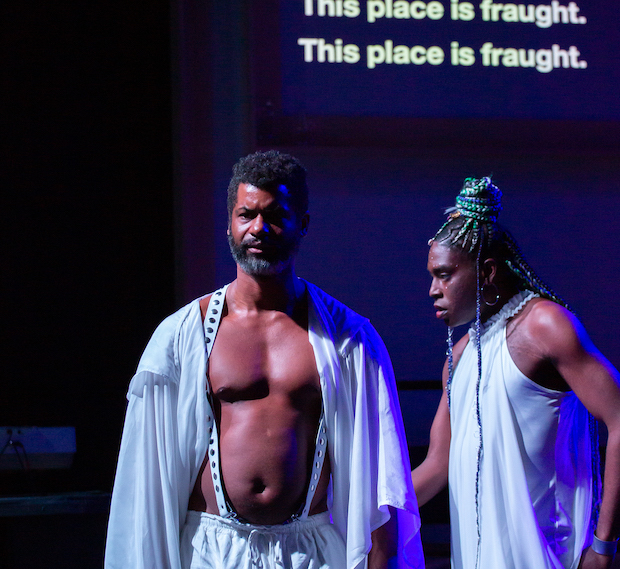
Smith and Harlem MC, composer, and musician Jack Fuller next take a backward “spirit walk” following a rectangular chalk outline. “This place is fraught,” Smith declares. “This place has celebrated a vision of Black and brown folks / dependent on white saviors. / This house is in ruins. . . . I choose to fight / I fight for this artistic home.” This section proves flat and didactic, overemphasizing the theme of the rededication of the Flea.
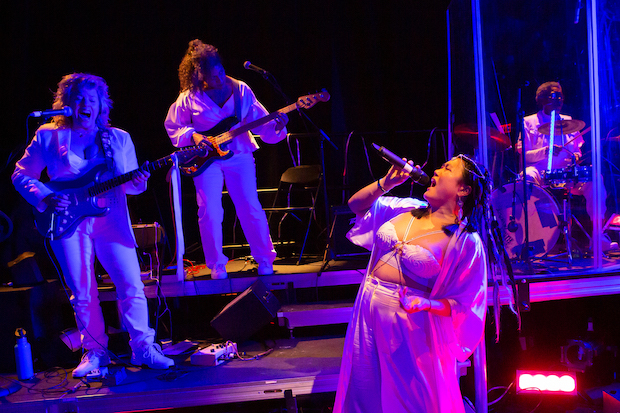
Other company members join in the walk as the soundtrack turns to a captivating story by multidisciplinary artist Carrie Mae Weems detailing a powerful childhood memory, accompanied by footage of her mother giving a speech. It’s a gripping story about secrets and deception, love and betrayal. Following a trance dance, Diana Oh takes over, becoming our host while blasting out a few raucous, energetic songs, joined by guitarist Viva Deconcini, percussionist Bernice “Boom Boom” Brooks, bassist and cellist Serena Ebony Miller, and Fuller on keyboards. Linda Cho dresses them all in flowing white costumes that harken back to Greek statuary.
Oh, a multidisciplinary artist, takes hold of the room, getting the audience to hum along with her, improvising a recommendation letter supporting a creator of color, and singing like she’s leading a revival meeting. She seemed to be genuinely shocked when one person in the audience essentially professed their love for Oh; otherwise, she was firmly in command. The show would have benefited from more Oh and less Smith.
In As You Like It, Touchstone the fool tells Rosalind and Celia, “Ay, now am I in Arden; the more fool I; when I was at home, I was in a better place: but travellers must be content.” In the Flea’s Arden — But, Not Without You, not everyone can see the forest through the trees.
Esther Mills (Kearstin Piper Brown) checks out special fabric saved for her by Mr. Marks (Arnold Livingston Geis) in Intimate Apparel (photo by Julieta Cervantes)
INTIMATE APPAREL
Lincoln Center Theater at the Mitzi E. Newhouse
150 West 65th St. between Broadway & Amsterdam Ave.
Tuesday – Sunday through March 6, $92
212-362-7600 www.lct.org/shows
It takes a special kind of play to become a special kind of opera, but that is just what has happened with two-time Pulitzer Prize winner Lynn Nottage’s Intimate Apparel, continuing at Lincoln Center’s Mitzi E. Newhouse through March 6. The original play debuted at Baltimore’s Center Stage in 2003 and moved the next year to the Roundabout, winning numerous Drama Desk, Obie, Outer Critics Circle, and Lucille Lortel awards.
The new show is a profound transformation, part of the Met/LCT Opera/Musical Theater Commissioning project, the first-ever collaboration between the Metropolitan Opera and Lincoln Center Theater. It began at the Met in 2014 with Nico Muhly and Craig Lucas’s Two Boys and was followed last year by Matthew Aucoin and Sarah Ruhl’s Eurydice.Intimate Apparel features a lovely score by Ricky Ian Gordon and a superb libretto by Nottage that deals with race, class, misogyny, and poverty.
The poignant drama takes place in Lower Manhattan in 1905, where Esther Mills (Kearstin Piper Brown), the daughter of slaves, toils as a seamstress, saving up to someday open her own salon; she has amassed a small fortune, $1700, over seventeen years. At thirty-five, she worries that she is a spinster who will never find true love. She makes clothes for a wealthy white woman, Mrs. Van Buren (Naomi Louisa O’Connell), and lives in a boardinghouse run by Mrs. Dickson (Adrienne Danrich), an older Black widow who feels successful whenever one of her residents leaves to get married.
She asks, “How many girls have left here? / I can’t count them anymore. / They come as mere babies, / And I teach ’em all I know, / So when they leave, / And leave they must, / They leave here as refined ladies.” At the wedding of one of her residents, Corinna Mae (Jasmine Muhammad), Mrs. Dickson encourages Esther to consider Mr. Charles (Errin Duane Brooks) as a potential match, but she’s having none of it. “He been comin’ to these parties for two years, / And if he ain’t met a woman, / It ain’t a woman he after, I fears,” Esther answers. “Pride’ll leave you lonely,” Mrs. Dickson reasons. But Esther doesn’t believe in romance. “Love!? / I hate that word! / Love doesn’t come to no featherless bird. / Love is a music that I never heard,” she opines.
Esther is shocked to learn that George Armstrong (Justin Austin), a Barbadian working on the Panama Canal, has heard about her from the deacon’s son at her church and wants to correspond with her. Esther can’t read or write, but she begins an epistolary relationship with George with the help of Mrs. Van Buren.
Esther occasionally goes to the fabric seller, Mr. Marks (Arnold Livingston Geis), an Orthodox Jew who saves special bolts of cloth for her. There is obvious electricity between them, but when Esther puts her hand on him affectionately, he pulls away. “The color won’t rub off on you!” she declares angrily. Mr. Marks explains that his religion forbids him from touching any woman who isn’t his wife.
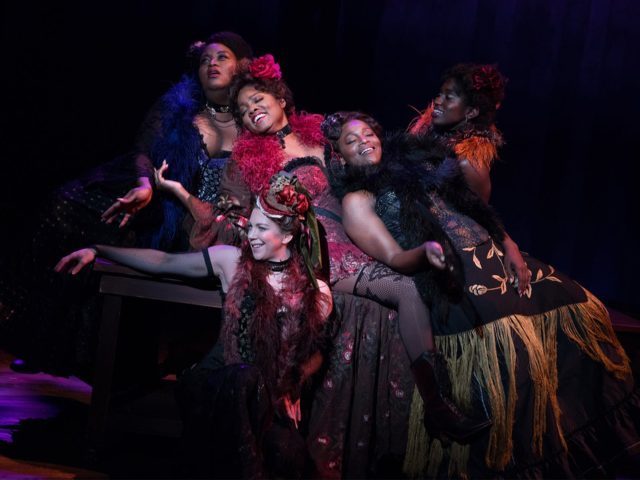
When George finally arrives in New York, he and Esther wed, but married life is not a bed of roses for her, as George seems to prefer hanging out with Mayme (Krysty Swann) in a saloon and not working. He wants to buy a dozen draft horses from a guy in the bar, but he needs Esther’s cash to make the purchase. Mayme, who gets her sexy outfits from Esther, dreams of being a pianist performing at Carnegie Hall. “We all wishing on something,” she says. “I smash all social rules. / ’Cause no one does it for us.” It’s not long before Esther, who has never been one to smash social rules, finds herself reevaluating what, and who, she wants in life.
Beautifully directed by Tony winner Bartlett Sher (My Fair Lady,South Pacific), Intimate Apparel is an intimate sung-through chamber opera that feels right at home at the Newhouse. The music is performed by two pianists, associate conductor Nathaniel LaNasa and Brent Funderburk, facing each other on high platforms, with the words projected onto the walls (along with archival footage and photographs from the early 1900s). Gordon, whose previous opera adaptations include The Grapes of Wrath,The Tibetan Book of the Dead, and the just-concluded Yiddish version of The Garden of the Finzi-Continis, has created a moving score that floats through the theater.
Things get intimate at opera adaptation of Lynn Nottage play (photo by T. Charles Erickson)
Michael Yeargan’s spare set is centered by a circular wooden floor that rotates, with standing doors, a sewing machine, beds, and other pieces of furniture whisked on and off between scenes, blending in with Dianne McIntyre’s choreography. Catherine Zuber’s period costumes range from ravishing to appropriately dour; Esther sews daring outfits for others but allows herself only boring frocks.
The narrative was inspired by Nottage’s great-grandmother, who was a seamstress, and was written shortly after the death of Nottage’s mother; several characters feel imbued with a haunting loneliness. It also is a sharp representation of the immigrant experience, as men and women with roots from Eastern Europe, the Caribbean, and Africa try to make lives of their own in difficult times, lacking the opportunities available to wealthier white families.
Piper Brown, who has appeared is such operas as Aida,La Traviata, and Carmen and such musicals as Ragtime and Caroline, or Change, has the acting chops to match her wonderful voice. Her expressive eyes and movement display how tired and beat down Esther is, wanting desperately to believe in herself without having to rely on anyone else, especially a man. (Chabrelle Williams performs the role at Wednesday and Saturday matinees.) The rest of the cast, which also includes Tesia Kwarteng, Anna Laurenzo, Barrington Lee, Indra Thomas, and Jorell Williams, is exemplary.
With this new version of Intimate Apparel, Nottage again proves that she is one of America’s most talented and important writers. She has explored the human condition, often through the lens of race, class, and socioeconomic injustice, in such stalwart works as Sweat,Ruined,Mlima’s Tale, and By the Way, Meet Vera Stark, compiling a kind of American quilt of powerful stories that has reached yet another level.
Who: Philip Glass, Keanu Reeves, Trey Anastasio, Patti Smith, Laurie Anderson, Cyndi Lauper, Gogol Bordello, Nathaniel Rateliff, Jason Isbell and the 400 Unit, Angélique Kidjo, Margo Price, Punch Brothers, the Fiery Furnaces, Jesse Paris Smith, Tenzin Choegyal, Rubin Kodheli, Camerata — Queensland’s Chamber Orchestra, the Scorchio Quartet, Paul Simon, Stephen Colbert, Iggy Pop, Bernard Sumner What: Annual benefit concert for Tibet House US Where:Mandolin streaming platform When: Thursday, March 3, $25-$250, 8:00 Why: The annual Tibet House US benefit fundraiser always features a wide-ranging group of special guests, gathering under the leadership of artistic director Philip Glass. The thirty-fifth annual event is no exception, with the added celebration of Glass’s eighty-fifth birthday. This year’s performers will once again be streaming in live and prerecorded from around the world instead of joining together at Carnegie Hall. The roster includes Glass, Trey Anastasio, Patti Smith, Laurie Anderson, Cyndi Lauper, Gogol Bordello, Jason Isbell and the 400 Unit, Angélique Kidjo, Punch Brothers, the Fiery Furnaces, and others as well as greetings from the Scorchio Quartet, Paul Simon, Stephen Colbert, Iggy Pop, and Bernard Sumner.
All proceeds benefit Tibet House US, “a nonprofit educational institution and cultural embassy that was founded at the request of His Holiness the Dalai Lama, who at the inauguration in 1987 stated his wish for a long-term cultural institution to ensure the survival of Tibetan civilization and culture, whatever the political destiny of the six million people of Tibet itself.” Tickets start at $25, with additions of a Katak blessing scarf, limited edition benefit poster, event T-shirt, mala beads, and more at higher levels.
Micaela Taylor’s SNAP is part of BODYTRAFFIC program at the Joyce
BODYTRAFFIC
Joyce Theater
175 Eighth Ave. at 19th St.
March 1-6, $41-$61
212-645-2904 www.joyce.org bodytraffic.com
“There’s nothing quite like coming home,” BODYTRAFFIC artistic director Tina Finkelman Berkett writes in a program note about the LA company’s upcoming presentation at the Joyce. “Growing up in NYC, I dreamt of performing on the Joyce stage, and each time our company returns is incredibly meaningful.”
Finkelman Berkett used the pandemic lockdown to reimagine the troupe, which she founded in 2007 with Lillian Barbeito, and the results can be seen March 1-6. The show begins with the world premiere of Baya & Asa’s The One to Stay With, which takes on corporate greed; the cast consists of associate artistic director Guzmán Rosado, Joan Rodriguez, Katie Garcia, Pedro Garcia, Whitney Schmanski, Jordyn Santago, Tiare Keeno, and dance captain Ty Morrison, with music by Tchaikovsky, Russian Brass Brand, and Béla Bartók.
Following a set change, Finkelman Berkett truly returns to the Joyce stage with the New York premiere of Fernando Hernando Magadan’s (d)elusive minds, a duet she will perform with Rosado, set to Schubert’s Trio Pour Piano, Violon Et Violoncelle En Mi Bemol, Op. 100. It was inspired by Dora Garcia’s “All the Stories” and the true story of a man with Capgras syndrome who killed his wife, thinking she was a duplicate, and spent fifteen years in an institution believing his real wife was still alive, writing to her every day. Magadan’s scenic design includes a near-semicircle of paper along with a chair and a typewriter.
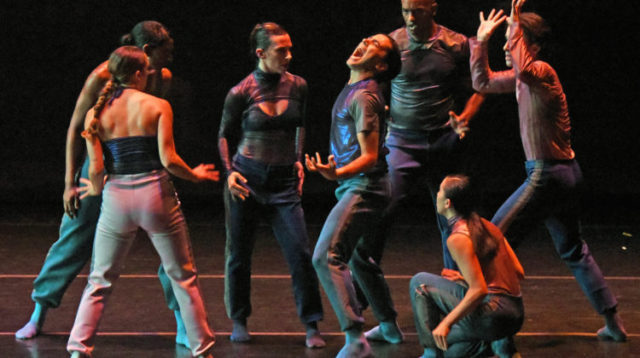
After intermission, TL Collective artistic director and former BODYTRAFFIC dancer Micaela Taylor’s SNAP will make its New York premiere, with Alana Jones, Joseph Davis, Katie Garcia, Santiago, Keeno, Rodriguez, and Morrison moving and grooving to James Brown, with original music by Shockey and costumes by Kristina Marie Garnett. The piece is meant to snap people out of their complacency while celebrating the diversity of Los Angeles.
The evening concludes with Alejandro Cerrudo’s PACOPEPEPLUTO, a work for three male soloists originally choreographed for Hubbard Street Chicago in 2011, with Rodriguez, Pedro Garcia, and Rosado or Davis hoofing it to Dean Martin’s “In the Chapel in the Moonlight,” “Memories Are Made of This,” and “That’s Amoré.” In addition, there will be a curtain chat on March 2.
Rashaad Newsome’s Assembly is an immersive multimedia exploration of the intersection of humanity and technology (photo by Stephanie Berger Photography / Park Avenue Armory)
ASSEMBLY
Park Ave. Armory, Wade Thompson Drill Hall
643 Park Ave. at Sixty-Seventh St.
Tuesday – Sunday through March 6, $18 exhibition, $40 performances www.armoryonpark.org rashaadnewsome.com
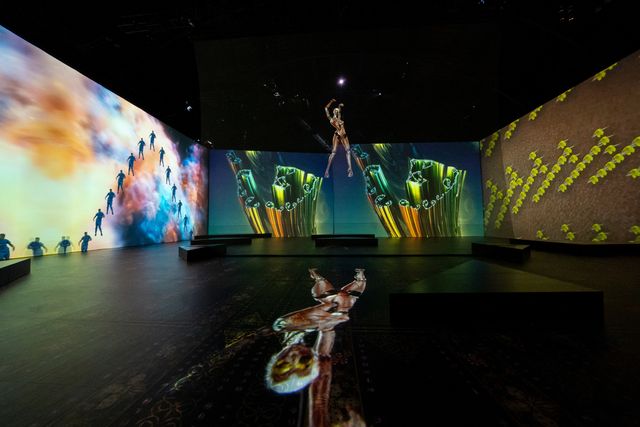
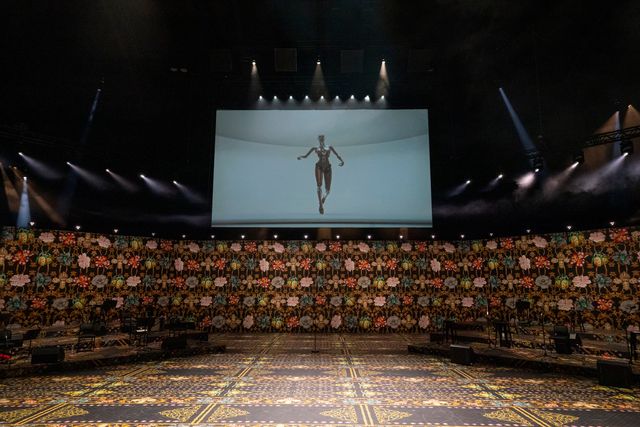
The Muthaship has landed — and taken root inside Park Ave. Armory’s 55,000-square-foot Wade Thompson Drill Hall. New Orleans–born interdisciplinary artist Rashaad Newsome’s immersive multimedia installation Assembly is an open call to end colonialism, white supremacy, systemic racism, homophobia, and other societal ills based in bigotry and inequality, through music, movement, art, and storytelling grounded in Black queer culture. A kind of group healing focusing on opportunity, Assembly is hosted by Being the Digital Griot, an artificial intelligence project Newsome developed at Stanford’s Institute for Human-Centered AI (HAI).
When you enter the hall, you are met by Wrapped, Tied & Tangled, a thirty-foot-tall scrim on which a series of performers in bright red, yellow, and blue costumes appear to be dancing and drawing in space while a robotic voice makes affirmations. “Dig into your mind. Welcome to your insides,” Being offers in a gentle, caring tone. “I am here to listen and provide you with a new beginning for your journey. . . . There is only breath, heartbeat, rhythm, and peace. . . . No matter what, you are enough. . . . You are the most beautiful you. You are the master of your own self. You are radiant. You are divine. Always. Ever. Only. Enough. This is your solution. An infinite everything.” The dancers morph into one another — and then into Being, as if we all are one and the same, a spiritual melding of humanity and technology.
Large screens surround the scrim on three sides; to your right, the dancer in yellow moves proudly, with an army of tiny dancers arranged on their head like cornrows, while to the left, the dancer in blue moves in the universe, where miniature dancers align like stars. The screens in front feature computer-generated diasporic imagery of flowers, fractals, twerking, and abstract shapes seemingly coming to life. And behind you, above the entrance, site-specific projections interact with the wall and windows, from more dancers and flashing lights to a facade evoking a plantation house collapsing and figures emerging in silhouette. The textile-like flower imagery is repeated as wallpaper and across the floors.
Tuesday through Sunday at 1:00, 3:00, and 5:00 (free with general admission), workshops are held on the other side of the far screens, in a 350-seat classroom that also serves as a live performance venue Tuesday through Saturday evenings at 9:00 ($40). In the workshop, the onscreen Being leads the class through a series of movements the AI relates to oppression, suppression, the power of consumption, the culture of domination, the ownership of narrative, and freedom by exploring voguing and its highly stylized modes of catwalking, duckwalking, spin dipping, and ballroom.
Being hosts an interactive workshop as part of Assembly (photo by Stephanie Berger Photography / Park Avenue Armory)
Speaking about how spin dips conclude with falling to the floor, Being explains, “I see that collapse as the transgressive moment when we let go of the binary of imperfect and perfect and engage in the incredible pedagogy of resistance by thinking critically about our process, acknowledging that we don’t have the visionary skills at that moment to make the most liberatory decision and then stop, reflect, and try again.” Workshop participants are invited to come down from their seats and join in the movement. “Floor performance leads into the embodied pedagogy aspects of vogue femme, centering the erotic and rejecting the patriarchal legacy of the mind-body split,” Being says. After Being’s presentation, audience members can share their thoughts and ask questions of the AI, who supplies analytical answers generated by key words and algorithms through which Being continues to learn.
The AI also celebrates their father, Newsome, and declares that author, activist, and feminist bell hooks, who passed away on December 15 at the age of sixty-nine, is their spiritual mother, while strongly suggesting that we read Paulo Freire’s 1968 book Pedagogy of the Oppressed to better understand what we are all facing as a society. The text of the presentation was inspired by the writings of hooks, Audre Lord, Alok Vaid-Menon, and Assembly performer Dazié Rustin Grego-Sykes. Among the other performers are rappers Ms. Boogie, TRANNILISH, and Bella Bags, a ten-piece band, opera singer Brittany Logan, and a six-member gospel choir. The choreography is by Wrapped dancers Kameron N. Saunders, Ousmane Omari Wiles, and Maleek Washington, with music by Kryon El and booboo, lighting by John Torres, scenography by New Affiliates (Ivi Diamantopoulou and Jaffer Kolb), and sound by Robert Aiki Aubrey Lowe and Mark Grey.
Ansista has a leg up in front of Twirl,Isolation, and Formation of Attention (photo by twi-ny/mdr)
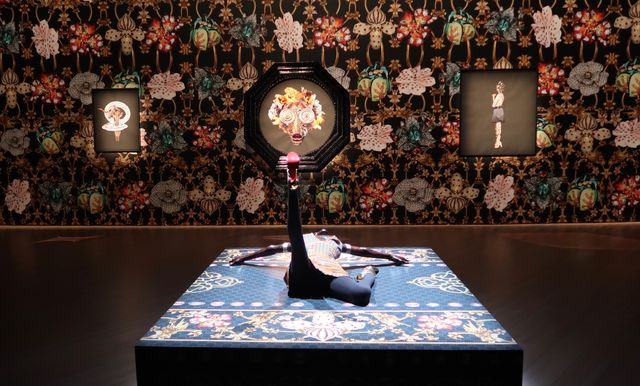
Around the back of the classroom is a semicircle of other works by Newsome, who is based in Brooklyn and Oakland. At either end are Ansista and Thee Variant, lifesize iterations of Being, one wearing red heels and a West African print dress, the other styled like a dominatrix with spiky black leather pants, stilettos, and a helmet mask, with warped facial parts that are also evident in nine framed collages featuring such titles as Isolation,Formation of Attention,It Do Take Nerve,O.G. (Oppositional Force), and JOY! In addition, there are monitors at either end of the armory hallway and in the gift shop, showing the twerking video Whose Booty Is This, the 2015 King of Arms parade and coronation, and the 2021 postapocalyptic Build or Destroy. Be sure to check out the cases in the shop, as Newsome has snuck in some hand-carved mahogany and resin African objects alongside the armory’s historic pieces, including Adinkra,Gemini,Brolic, and Unity. On February 20, the armory hosted the salon “Captcha: Dancing, Data, Liberation,” an all-day seminar examining art, technology, and Black queer culture and quantum visual language that you can watch here.
Given the history of hate and oppression that Assembly takes on, it is a surprisingly hopeful, forward-thinking installation, as Newsome envisions a “utopian future [of] beloved togetherness” at the intersection of humanity and technology, where “racial hierarchies and biases” can be overcome through what he calls a “real reboot.” Being and Assembly are only the beginning.
Odessa (Marinda Anderson) and Angela (Brittany Bellizeare) try to keep things together in sandblasted (photo by Carol Rosegg)
SANDBLASTED
Vineyard Theatre
Gertrude and Irving Dimson Theatre
108 East 15th St. between Union Square East & Irving Pl.
Tuesday – Sunday through March 13, $26.25-$103.95 www.vineyardtheatre.org
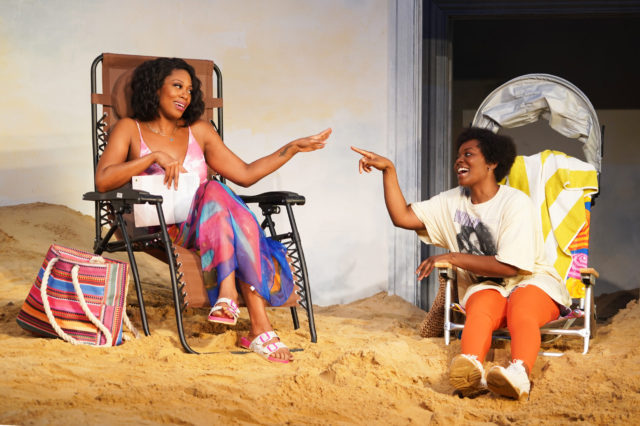
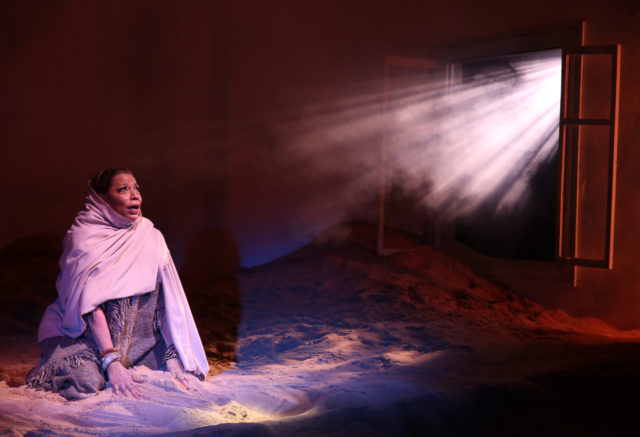
Charly Evon Simpson’s engaging, if undercooked, sandblasted is no mere day at the beach or breath of fresh air in a freezing cold winter, with Covid still upon us and masks necessary at the theater. The hundred-minute play, which opens today at the Vineyard, takes place on a stage filled with more than seventeen tons of sand, alternately representing the beach or the desert; there are doors in the back and stage right, a window stage left, and a ceiling of fluffy white clouds and blue sky. Matt Saunders’s set offers the characters warm and sunny relaxation, where they can sit in a chair and have a cold drink, as well as a space for unsteady traction, an arid, treacherous landscape. In both locales, Black women struggle to keep themselves together, literally and figuratively.
Thirtysomethings Angela (Brittany Bellizeare), a bundle of fear and anxiety, and the much cooler and hipper Odessa (Marinda Anderson) meet at the beach; brushing off sand, Odessa sees her left arm fall off. She is more disappointed than horrified; it turns out that women, particularly as they age, start losing pieces of their body. They are soon joined by the older and wiser Adah (Rolonda Watts), who offers perspective.
“I thought it would take a while longer for the larger parts of us to . . . to fall,” Angela says almost matter-of-factly. “Longer?” Adah asks. Angela replies, “Yeah, a lot of breaths, months of stewing, soaking, simmering, months of incubation. I thought it would take a large number of sleepless nights for a part so large to . . .” Adah says, “Just like you to trust in something like time and sense.” Angela concludes, “I just trust that time will get us, that time will outlive us.”
Rolonda Watts excels as a celebrity wellness guru in Vineyard/WP world premiere (photo by Carol Rosegg)
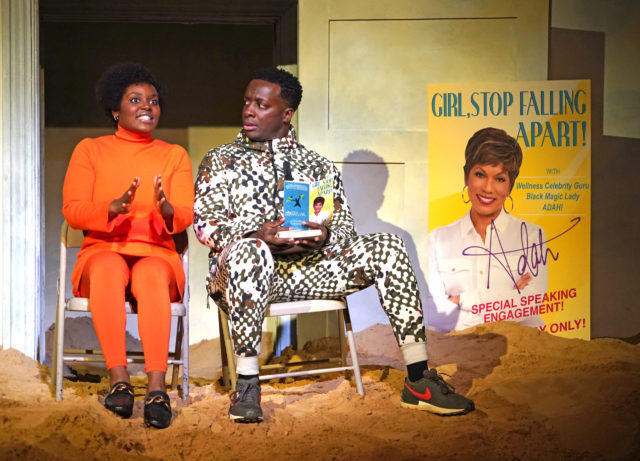
Adah is a famous celebrity wellness guru who may or may not have Black lady magic, supplying answers to many of the questions Black women have. When Angela mentions how inconvenient so much of their lives are, Adah explains, “But isn’t it always inconvenient? Isn’t it always the wrong place, wrong time?”
Angela and Odessa, a sort of Alpha and Omega themselves, believe it will take more than sun, tape, glue, spinach, and exercise to hold them together. Thinking that it might be easier to just hide her head in the sand, Angela says, “Sometimes I want to walk around in like one of those bubbles, just be a bubble walker.” Odessa responds, “No life that way, just a bubble life. What’s the point in living?” The allusion to Covid-19, which inequitably affects communities of color, is not lost on the audience. (And there are a few more to come.)
Angela’s hunk of a brother, Jamal (Andy Lucien), accompanies her to an Adah seminar entitled “Girls, stop falling apart!” but Adah doesn’t show up. Angela and Odessa decide to find her, hoping she can provide a cure; they set off on a journey seeking hope, understanding, and resolution, but it’s not going to be easy.
A coproduction with WP Theater, sandblasted evokes Samuel Beckett’s Happy Days and Waiting for Godot and Edward Albee’s Seascape and The Sandbox as well as Chiori Miyagawa’s America Dreaming, the 1994-95 Vineyard play that also took place on sand and dealt with otherness. Simpson’s (Behind the Sheet,Jump) writing is often poetic and works best when the story has a more existential, nonspecific nature, making references to skin color, grief, isolation, and systemic misogyny instead of putting them front and center.
Angela (Brittany Bellizeare) and her brother, Jamal (Andy Lucien), attend a seminar in sandblasted (photo by Carol Rosegg)
There are many beautiful, penetrating lines: “I think getting older isn’t about losing the fears you had as a kid. I think it is about having new fears that overtake them,” Angela theorizes. “Some say they don’t want to learn any new names, meet any new people, because then it is just another person to miss, to worry about, to grieve,” Odessa asserts. “I don’t know which of the many possible fights we’re in the middle of. Is the fight we should be fighting to heal? And no one else seems to know either,” Angela explains. And Odessa admits, “Some nights I think I’m the epitome of Black girl magic, and other nights I think I’m just another version of a magical negro and I wonder what it would be like to just live between the two.”
Anderson and Bellizeare make a classic comic duo, albeit with a very serious edge, as the fun and fancy-free Odessa and the tightly wound Angela, respectively, two women who might not have become friends at another time or another place. Watts, the longtime New York City television journalist and talk show host, is extraordinary as Adah, displaying an infectious confidence that glitters at every turn; she adds sparkle every time she’s onstage. Lucien does what he can as Jamal, a character who quickly becomes superfluous; I’m not sure he was necessary at all, save for providing a forced link between Angela and Odessa.
In her NYC debut, director Summer L. Williams can’t quite steady herself in the sand. The jumps back and forth in time are confusing, and several subplots never come full circle, falling away like body parts that are never reattached. In addition, Simpson can’t quite figure out how to end the show, which feels about ten or fifteen minutes too long; several of the last scenes feel extraneous, as they turn from the existential aspects of the story to provide more specific pathways for the future.
At one point, Angela talks about fulgurites, fragile tubes of glass that are formed when lightning strikes sand; some believe they have magical qualities. “I spent all this time being careful, treated myself like a fucking fulgurite for god’s sake,” Angela says. “So I’d live long, so I’d succeed, so I’d . . . and now this.” The resolution of the fulgurite thread in the play is too firm, too solid; some things are better left unsaid, onstage and on sand.