twi-ny recommended events

KURT VONNEGUT: UNSTUCK IN TIME

Kurt Vonnegut travels through his extraordinary life in Unstuck in Time,

KURT VONNEGUT: UNSTUCK IN TIME (Robert B. Weide & Don Argott, 2021)
IFC Center
323 Sixth Ave. at West Third St.
Opens Friday, November 19
www.ifccenter.com

“I had never seen him so at ease; they had found each other, as the subject and the filmmaker. It felt like a friendship,” Nanny Vonnegut says about her father, author Kurt Vonnegut Jr., and director Robert Weide in Kurt Vonnegut: Unstuck in Time, an extraordinary documentary opening November 19 at the IFC Center.

In 1982, twenty-three-year-old Weide wrote a letter to Vonnegut, wanting to make a film about him. Much to Weide’s surprise, the award-winning author of such novels as Slaughterhouse-Five and Cat’s Cradle wrote him back, agreeing to the project. Shooting began in 1988 and continued through Vonnegut’s death in 2007 at the age of eighty-four and beyond. During those years, the two men became good friends, so much so that Weide began doubting his ability to complete the film. “I don’t even like documentaries where the filmmakers has to put himself in the film. I mean, who cares?” he asks in one of several sections where he talks to the camera, concerned that he was becoming too much a part of the story.

After a moving moment in which he discusses putting the camera down and simply enjoying his time with Vonnegut, Weide admits, “Prior to that, I had always been concerned that the friendship might infringe on the film; this was the first time I realized that things had flipped so entirely now that I was worried about the film infringing on the friendship. That was a realization for me that I was maybe in trouble.”

Fortunately, however, Weide and codirector Don Argott, who was brought in to help navigate through Weide’s fears of having grown too close to Vonnegut, keep the main focus on Vonnegut, who opens up about his childhood, his schooling, his early jobs, and, ultimately, his writing career, reflecting on a life well lived yet filled with tragedy, from the death of his sister and her husband to his mother’s suicide and his experiences in Dresden during WWII. Vonnegut is shown giving a lecture in a church, taking a train with Weide, driving through his hometown of Indianapolis, visiting the house where he grew up — and getting sentimental when he sees the casts of his and his siblings’ hands on the top of a small cement wall — and attending his sixtieth high school reunion.

Vonnegut’s brother, Bernard, gives Weide boxes and boxes of home movies and slides, while their sisters, Nanny and Edie, and Vonnegut’s nephews, Jim, Steve, and Kurt Adams — who Vonnegut and his first wife, Jane Marie Cox, took in after the deaths of his beloved sister, Alice, and her husband, James Adams — speak openly and honestly about him, including their extreme disappointment when, upon finally gaining success as a writer, he dumped the devoted Jane for younger photographer Jill Krementz. Over the years, Vonnegut kept sending Weide tapes of his numerous public appearances, so the film includes a treasure trove of clips from speeches, television appearances, and commencement addresses as well as early, annotated drafts of Vonnegut’s writing.

The film discusses the aforementioned books in addition to The Sirens of Titan, Breakfast of Champions, and Mother Night, which was turned into a 1996 movie written by Weide, and explores such favorite Vonnegut characters as the author’s alter ego, Kilgore Trout, and Billy Pilgrim. The title of the film comes from the first line of the second chapter of Slaughterhouse-Five: “Listen: Billy Pilgrim has come unstuck in time.” The concept of time is a leitmotif of the documentary, highlighted by the comparison between the decades it took Weide to complete the film, which is significantly about the making of the film itself, and the years it took Vonnegut to finish his last novel, Timequake, which ended up being significantly about the writing of the book. And just as Vonnegut and his children share poignant memories, Weide inserts some of his own, particularly about his wife, Linda. The parallels between Weide and Vonnegut are striking. “How fucked up is that?” Weide says after noting another coincidence.

Robert B. Weide and Kurt Vonnegut became close friends while making documentary over several decades

Weide also speaks with Vonnegut’s friends and fellow writers John Irving and Sidney Offit, his publisher Dan Simon, his biographer Gregory Sumner, novelist Dan Wakefield, and In These Times editor Joel Bleifuss, who gave Vonnegut a forum in his final years. Actor Sam Waterston reads from several of Vonnegut’s works. “He made literature fun. That was huge,” critic David Ulin says.

Along the way, two elements stand out: Vonnegut’s love of laughing — his infectious laughter is sprinkled throughout the film — and his ever-present Pall Mall. In a cute touch, Emmy winner and Oscar nominee Weide (Curb Your Enthusiasm, Lenny Bruce: Swear to Tell the Truth) and Argott (The Art of the Steal, Believer) animate smoke coming out of his cigarettes in still photos.

On the first page of chapter two of Slaughterhouse-Five, Vonnegut also writes of Billy Pilgrim, “He has walked through a door in 1955 and come out another one in 1941. He has gone back through that door to find himself in 1963. He has seen his birth and death many times, he says, and pays random visits to all the events in between. He says. Billy is spastic in time, has no control over where he is going next, and the trips aren’t necessarily fun. He is in a constant state of stage fright, he says, because he never knows what part of his life he is going to have to act in next.” Weide and Argott have captured the essence of Vonnegut the person and Vonnegut the writer in Unstuck in Time, a must-see, utterly fun portrait of a man who never knew what part of his life he was going to have to act in next but always did so with a contagious sparkle.

BAD LUCK BANGING OR LOONY PORN: A SKETCH FOR A POSSIBLE FILM

Emi (Katia Pascariu) goes on a strange journey in Rade Jude’s Bad Luck Banging or Loony Porn

BAD LUCK BANGING OR LOONY PORN: A SKETCH FOR A POSSIBLE FILM (BABARDEALA CU BUCLUC SAU PORNO BALAMUC) (Radu Jude, 2021)
Film at Lincoln Center, Walter Reade Theater, Francesca Beale Theater
144/165 West Sixty-Fifth St. at Amsterdam Ave.
Film Forum, 209 West Houston St.
Opens Friday, November 19
www.filmlinc.org
filmforum.org

Radu Jude’s brilliantly absurdist Bad Luck Banging or Loony Porn lives up to its title, a wildly satiric takedown of social mores that redefines what is obscene. Winner of the Golden Bear for Best Film at the 2021 Berlinale, the multipart tale begins with an extremely graphic prologue, a XXX-rated homemade porn video with a woman and an unseen man holding nothing back. In the first main section, the woman, a successful teacher named Emi (Katia Pascariu), is distressed to learn that the video is threatening to go viral. She determinedly walks through the streets of Bucharest, buying flowers (which she holds upside down), discussing her dilemma with her boss, the headmistress (Claudia Ieremia), and calling her husband, Eugen, trying to get the video deleted before her meeting with angry parents at the prestigious private school where she teaches young children.

Jude and cinematographer Marius Panduru follow the masked Emi — the film was shot during the pandemic, so masks are everywhere — on her journey, the camera often lingering on the scene well after Emi has left the frame, focusing on advertising billboards, couples in the middle of conversations, people waiting for a bus, and other random actions, before finding Emi again. She sometimes fades into the background, barely seen through the windows of a passing vehicle or amid a crowd crossing at a light. She gets into an argument with a man who has parked on the sidewalk, blocking her way; she insists that he move the car, but he unleashes a stream of misogynistic curses. Swear words are prevalent throughout the film, mostly adding poignant humor.

The second segment consists of a montage of archival and new footage that details some of Romania’s recent history, involving the military, the government, religion, fascism, Nazi collaboration, patriotism, the two world wars, the 1989 revolution, Nicolae Ceaușescu, domestic violence, jokes about blondes, and the value of cinema itself. The bevy of images also points out which NSFW word is most commonly looked up in the dictionary, as well as which is second. (The film is splendidly edited by Cătălin Cristuțiu, with a fab soundtrack by Jura Ferina and Pavao Miholjević.)

It all comes together in the third section, in the school garden, where Emi faces a few dozen masked, socially distanced, very angry parents and grandparents who want her fired immediately, while the headmistress demands a calm discussion. The masked Emi is a stand-in for all of us, facing the wrath of the unruly mob forcing its sanctimonious platitudes on others when it really needs to look at itself. It’s a riotously funny sitcomlike debate in which Jude roasts many common, hypocritical beliefs held by Romanians (and people all over the world) that have not necessarily changed much from the news clips shown in the previous part.

The cartoonish cast, which includes Olimpia Mălai as Mrs. Lucia, Nicodim Ungureanu as Lt. Gheorghescu, Alexandru Potocean as Marius Buzdrugovici, and Andi Vasluianu as Mr. Otopeanu, really gets to strut its stuff while making sure their masks are properly covering their mouths and noses. They argue about beloved national poet Mihai Eminescu and Russian writer Isaac Babel, delve into various sexual positions, repeat Woody the Woodpecker’s trademark call, and quote long, intellectual passages from the internet as Jude (I Do Not Care If We Go Down in History as Barbarians, Aferim!) reveals where society’s true obscenities lie. It’s an irreverent tour de force that offers three distinct endings to put a capper on the strangely alluring affair, turning a scary mirror on the sorry state of twenty-first-century existence.

Playfully subtitled A Sketch for a Possible Film in a reference to André Malraux’s description of Eugène Delacroix’s belief that his sketches could be of the same quality as his paintings, Bad Luck Banging or Loony Porn, Romania’s official Oscars submission, opens November 19 at Lincoln Center and Film Forum.

IN THE SOUTHERN BREEZE

Four Black men from different times meet in unusual circumstances in Mansa Ra’s In the Southern Breeze

IN THE SOUTHERN BREEZE
Rattlestick Playwrights Theater
224 Waverly Pl.
Wednesday – Monday through December 12, $40 in person or livestreamed
www.rattlestick.org

The central section of Mansa Ra’s In the Southern Breeze, which opened last night at Rattlestick, is a compelling fever dream in which four Black men from different time periods meet in a kind of bardo, trying to make sense of their existential situation. Unfortunately, that narrative is framed by a moralizing, didactic story involving a contemporary Black man (Allan K. Washington) literally at the end of his rope, as he considers hanging himself, suffering from severe depression because of pandemic isolation and systemic racism in America.

“It’s so stressful being black. And I don’t mean in some hypothetical way,” he says. The confinement of lockdown is also getting to him. “I honestly have no idea what’s gonna happen anymore. It’s been a while since I’ve interacted with people. Like a super long time. I was already depressed before the ’rona. Everybody was freaking out about quarantine cooped up with nowhere to go. But I was glad. I finally had a real excuse for not leaving my apartment. I know a lot about isolation. It feels like the walls are closing in around you. All day. And all night.”

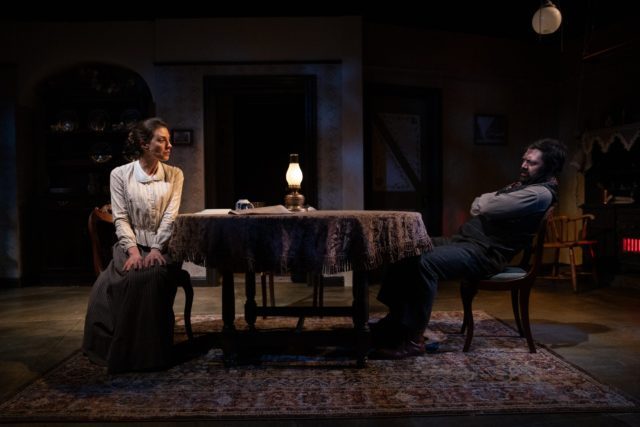
While he contemplates his fate (offstage), a barefoot man in tatters enters. Madison (Charles Browning) is a runaway slave, just trying to stay alive while looking for his wife. He is soon joined by Lazarus (Victor Williams), a sharecropper who wants to know where his family is. Next, a Black Panther named Hue (Biko Eisen-Martin) arrives, calling out desperately for his wife. And finally, gay activist Tony (Travis Raeburn) shows up fresh from a protest march. As a group they represent such societal ills as racism, homophobia, injustice, inequality, and disenfranchisement, in search of their identity, separated from their wives and children as so many Black men have been throughout the history of the United States. “Unnatural fo’ a man to be taken ’way from his family. Just unnatural,” Madison says. It is critical to note that there are no women in the play; they exist on the periphery, longed-for sources of strength and ancestral continuity. Emmie Finckel’s set is a series of ever-smaller white-framed doorways on lush green grass, the promise of freedom closing fast.

In the Southern Breeze looks at loneliness, depression, racism, and isolation

Earnestly directed by Christopher D. Betts, In the Southern Breeze’s frame story ends up feeling like a cliched diatribe of platitudes lacking dramatic nuance; what the man is experiencing is horrific, something that no one should have to endure, but it comes off as more of an intense therapy session. A rant about holes, from the noose to anal sex to the planet Saturn, feels forced and unnecessary. The body of the play is powerful; Mansa Ra (fka Jiréh Breon Holder) should have more faith in his audience. For example, there is a moment near the end that could have made a memorable conclusion, but instead the narrative extends with a coda that plots out too easy a path for what is a complicated future. One of the smartest choices is to never show an actual noose, serving as a potent metaphor for what has lurked dangerously for centuries.

In her essay “Moral Inhabitants,” which influenced Mansa Ra, Nobel Prize winner Toni Morrison writes, “Our past is bleak. Our future dim. But I am not reasonable. A reasonable man adjusts to his environment. And unreasonable man does not. All progress, therefore, depends on the unreasonable man. I prefer not to adjust to my environment. I refuse the prison of ‘I’ and choose the open spaces of ‘we.’” In the Southern Breeze works best when it deals with the “we” as opposed to the “I.”

In conjunction with the seventy-five-minute play, which runs through December 12 (both at the theater and streaming live) and is presented in partnership with Black Boys Do Theater, the Boys’ Club of New York, the Eastern Group Psychotherapy Society, and the National Alliance on Mental Illness, Rattlestick is hosting a series of community talks, on November 22 at 5:00 (on Zoom, before the livestream, about safe and private spaces), November 28 at 4:00 (an in-person postshow discussion exploring the intersection of mental health and the political and social climate), and December 6 at 5:00 (on Zoom, before the livestream).

TWI-NY TALK: STEPHEN PETRONIO / PETRONIO’S PUNK PICKS AND OTHER DELIGHTS

Stephen Petronio leads an open rehearsal in preparation for La MaMa shows (photo by Paula Court)

PETRONIO’S PUNK PICKS AND OTHER DELIGHTS
La MaMa Experimental Theatre Club
The Ellen Stewart Theatre
66 East Fourth St. between Second Ave. & Bowery
November 18-21, $21-$30
212-475-7710
www.lamama.org
petron.io/event/lamama

At a recent open rehearsal streamed on Zoom, Newark-born, Manhattan-based choreographer Stephen Petronio said, “Wouldn’t it be fun to look back at some of those works from some of those smaller little gems that we love.” The result is “Petronio’s Punk Picks and Other Delights,” running November 18–21 at La MaMa. The evening consists of eleven short solos and duets, going back to 1993, set to songs by the Stranglers, the London Suede, Anohni, Nick Cave, Elvis Presley, Yoko Ono, Rufus Wainwright, and Radiohead, as well as Igor Stravinsky’s “Le Sacre Du Printemps,” performed by Larissa Asebedo, Kris Lee, Jaqlin Medlock, Tess Montoya, Tiffany Ogburn, Ryan Pliss, Nicholas Sciscione, and Mac Twining. Petronio will also present the world premiere of Johnnie Cruise Mercer’s multimedia and then we hit the boundary where the sun’s wind ceases . . . , with music by LVDF, Heliopause, and Anne Müller.

Founded in 1984, the Stephen Petronio Company was one of the busiest troupes during the pandemic. Beaming in first from their individual homes, then gathering together at the Petronio Residency Center (PRC), a 175-acre haven in the Catskills, the tight-knit company performed new pieces, hosted online galas and master classes, put on a virtual season at the Joyce, and had a public birthday party for Petronio. Over that time, Petronio kept a quarantine journal that has been published in a deluxe hardcover limited edition, In Absentia, with lavish photos by Sarah Silver and Grant Friedman. In addition, Petronio is expanding his Bloodlines program, in which he restages classic works by such choreographers as Yvonne Rainer, Merce Cunningham, Martha Graham, and Trisha Brown, to include a “futures” section that so far has featured new commissions by Davalois Fearon and Mercer.

While preparing for SPC’s debut at La MaMa, the always engaging and candid Petronio answered questions about choreographing “when the world stopped,” returning to the stage, what music is on his current playlist, and more.

Stephen Petronio released the deluxe hardcover book In Absentia during the pandemic (photo by Sarah Silver)

twi-ny: Let’s start with perhaps the most obvious question: How does it feel to be back working in theaters? At your open rehearsal following Fall for Dance, you said “it was exciting and frightening and emotional.”

stephen petronio: It’s all of those things but particularly with this body of work, it’s like finally, we can really focus in with a microscope on some of the details that are the underpinnings of what is at the center of a particular body of work and the delicious focus of what we do in the studio.

twi-ny: SPC was one of the most active companies during the pandemic lockdown. How soon after March 2020 did you decide to forge ahead at such a pace online?

sp: I decided immediately because that’s my survival instinct. My legs kept moving and I felt that to stop, we would all be overwhelmed with uncertainty and fear. I thought it best to use our physical practice to keep us grounded.

twi-ny: How important was PRC to that decision?

sp: I don’t think we would have been able to do it without PRC. First of all, I had a completely safe space to work in and I immediately began teaching classes on Zoom to the dancers just as a way of being together and then we began making on Zoom as a way of staying in touch with our practice. Then I began to realize that we could actually make stuff to show other people. I could only do that because of PRC. And then when I was able to work out the finances, I was able to bring the company up fairly regularly for a few weeks at a time across those endless months of lockdown. We also quickly realized that we could be a haven for other choreographers who could make it up to us.

twi-ny: You really took advantage of everything that Zoom has to offer. What was it like choreographing such virtual works as #GimmeShelter and Are You Lonesome Tonight that way?

sp: A complete nightmare! I hadn’t seen Zoom before the pandemic and it took me time to understand the lag time in relationship to making movement with music. And I also began to see many other people working on Zoom and some it was really fun and inventive and I was looking for a way to use the technology in a method that was true to my own work.

twi-ny: You also celebrated your sixty-fifth birthday over Zoom; did you have a good time? It was fun to watch.

sp: I had an amazing time and it was very emotional because it was such a lonely and isolated time; it was really fun to be with people in a very relaxed way.

twi-ny: You kept a journal during the pandemic that you’ve released as a deluxe book, In Absentia. What spurred you to keep that kind of diary?

sp: When the world stopped, I began to do all the things that I do that remind me of myself, remind me of my body, my thoughts, my emotional life, and so I went to writing as a natural response to check in with myself in a regular way. I did a memoir, Confessions of a Motion Addict, about ten years back and so a writing practice is not new to me and it seemed like such an important event that we were living through that I wanted to mark it in some way.

Jaqlin Medlock dances from her home during online presentation (photo courtesy Stephen Petronio Company)

twi-ny: My two favorite dancers during the lockdown were Sara Mearns and Jaqlin Medlock. (I named them Best Solo Dance Performance in the twi-ny Pandemic Awards, along with Jamar Roberts.) You have such an amazing rapport with Medlock, which was evident in your recent open rehearsal; what makes her the ideal SPC dancer?

sp: She is sharp as a razor, I’ve known her for over ten years so we’re so fluid together in terms of my thought process and language, and she’s incredibly determined to get things exactly the way she wants it. She’s a monster for details, and watching that [#GimmeShelter] solo come into focus up to the final recording was such a delight.

twi-ny: SPC performed at Fall for Dance at City Center, and next up is La MaMa. You’ve never performed there before, although I believe you’ve lived near there for a long time. What made you want to perform there this time around?

sp: I moved onto St. Marks Place in 1979 and lived there for many, many years. Normally, it’s hard for me to figure out the finances for my company’s performance in a theater of that size. My executive director, Jonas Klabin, was having drinks with the director of programming, Nicky Paraiso, of La MaMa at a performance and began to open up a discussion about it. Of course, I’ve known Nicky for years. But this is a time to do things that we really want to and let the economics fall as they may. La MaMa is such a gem of a place to perform and this is the perfect moment.

twi-ny: I love La MaMa, and I see Nicky all over town, always checking out what’s going on. “Petronio’s Punk Picks and Other Delights” consists of eleven numbers set to music by a wide range of artists. You’ve previously done an evening of songs by Nick Cave, Underland; if you could choreograph a whole album by anyone, what would it be? Is there a specific song you’d love to choreograph but haven’t been able to?

sp: Nick Cave was a highlight. I did a work to a catalog of Lou Reed songs [The Island of Misfit Toys], which was another miraculous moment in my life. I’ve been tempted to tackle Leonard Cohen’s body of work but his poetry is so dense that I’ve been hesitant. Leonard Cohen’s song “Democracy” is an anthem I’d love to have a go at!

Stephen Petronio walks down the outside of the Whitney as part of Trisha Brown retrospective (photo by twi-ny/mdr)

twi-ny: I would love to see that! What kind of music do you listen to when you’re not thinking about songs for dances?

sp: I’m listening to Bach a lot, Billie Eilish; I’m very fond of female vocalists in particular. Lana Del Rey has a new album out that’s pretty damn good. And I’m loving St. Vincent.

twi-ny: Now that you’ve embraced the virtual world, do you see the future of SPC as a hybrid one, or are you going to concentrate solely on in-person shows?

sp: I think it’s inevitable that we’re going to become hybridized. We jumped in and we’re in. But it’s so delicious to be back in front of an audience. And the shows at La MaMa are a total love letter to the people that have been following me over the years. It’s really fun to make a show that’s so much about the joy of the work that I’ve made with incredible dancers over the years and to music that I completely love. This is music that has moved me, and to pass it to this current generation of titan dancers seems just right. We’re still here!

FIRST ANNUAL BATTERY DANCE GALLERY CRAWL

Who: Battery Dance
What: First annual Battery Dance Gallery Crawl
Where: Eight Tribeca galleries
When: Saturday, November 20, free with advance RSVP, 2:00 – 4:00
Why: Founded in 1976 by president and artistic director Jonathan Hollander, Battery Dance “envisions a time when the universal expression of dance will ignite a movement across geographic, social, and cultural boundaries to improve people’s quality of life.” The company has been doing just that with unique programming both inside and outdoors, in New York City and around the world. The company is adding to its central presentation, the free Battery Dance Festival, held downtown for forty years, with the first annual Battery Dance Gallery Crawl. On November 20 between 2:00 and 4:00, eight current and former Battery Dance members and a special guest will perform in eight galleries near its home base in Tribeca, reacting directly to the art on display; the shows are free with advance RSVP and proof of full vaccination. “Coming out of pandemic-enforced isolation, we saw a renaissance on our streets with empty, distressed storefronts remade into gorgeous spaces for art. It seemed like a beckoning for us — come, dance, bring the neighbors out, and let’s celebrate each other and our community,” Hollander said in a statement. Below is the full list of performers, galleries, and their current exhibitions.

Mira Cook at GRIMM
Condition Humaine
54 White St.

Sarah Housepian at Jane Lombard Gallery
Drawn Together
58 White St.

Vivake Khamsingsavath & Durgesh Gangani at R & Company
Marquiscarpa: Richard Marquis Works 1991-2011
64 White St.

Jillian Linkowski at Projekt 105
New Figurations
105 Hudson St.

Randall Riley at Kapp Kapp
In the Margins
368 Broadway

Sean Scantlebury at Andrew Kreps Gallery
Moshekwa Langa: The Sweets of Sin
22 Cortlandt Alley

Sara Seger at David Lewis
Claire Lehmann
57 Walker St.

Razvan Stoian at CHART Gallery
8 Americans
74 Franklin St.

OPERA AT HOME: OTELLO

Allison Charney and Errin Brooks star in virtual adaptation of Verdi’s Otello

Who: The Town Hall, PREformances Chamber Music Collaborative
What: Virtual performance of Giuseppe Verdi’s Otello
Where: The Town Hall online
When: November 18-25, $20-$35
Why: The Town Hall’s new Opera at Home series, consisting of abridged versions of classic works shot in quarantine during the pandemic lockdown, kicks off with Giuseppe Verdi’s 1887 Otello, an adaptation of one of Shakespeare’s most beloved tragedies that is streaming November 18-25. The Town Hall is teaming up with the PREformances Chamber Music Collaborative for the sixty-minute presentation, which features tenor Errin Brooks as Otello, soprano and PREformances artistic director Allison Charney as Desdemona, actor Jordan Charney (Allison’s father) as the Narrator, and Craig Ketter on piano. There will also be a live Zoom talkback with the artists and creative team on November 22 at 8:00.

“The Town Hall, once the home of the classical music debut, is very excited to bring accessible opera to the masses,” artistic director Melay Araya said in a statement. “The history of classical vocalists at the hall is one of great pride, and diversity in classical music has been a thread throughout the hall’s one-hundred-year history. With a legacy that includes the debuts of Marian Anderson and Leontyne Price, the Town Hall is excited to bring diverse voices and high-quality, accessible classical programming to a wider audience.” Brooks, the Charneys, and Ketter performed scenes from Otello as part of PREformances’ Like the Wind concert at Merkin Concert Hall in March 2020; in addition, during the pandemic, PREformances and the Town Hall collaborated on the seven-part online free series The Season of Hope.

GENEALOGY: A SATIRE OF INCONVENIENT FAMILY TIES

Genealogy will stream for free from Wisconsin on November 19 (photo by Steve Noll)

Who: Broom Street Theater, Knowledge Workings Theater
What: Free livestream of Genealogy
Where: Broom Street Theater YouTube
When: Friday, November 19, free with RSVP (donations accepted), 9:00
Why: The latest play by T. J. Elliott and Joe Queenan of Knowledge Workings Theater is currently being performed live at Broom Street Theater in Madison, Wisconsin, but the November 19 performance will be streamed live, and for free, on YouTube. Directed by Dana Pellebon, Genealogy is about a podcast, Chasing the Dead, that one night reveals ancestral connections that shake up the guests, a pair of married couples, one a former football player and his activist professor wife, the other a homemaker and former prosecutor and her high-powered lawyer husband. The cast of the show, which is subtitled A Satire of Inconvenient Family Ties and delves into slavery and reparations, features Karl Reinhardt, Jamie England, Quanda Johnson, Atticus Cain, and Jackson Rosenberry.