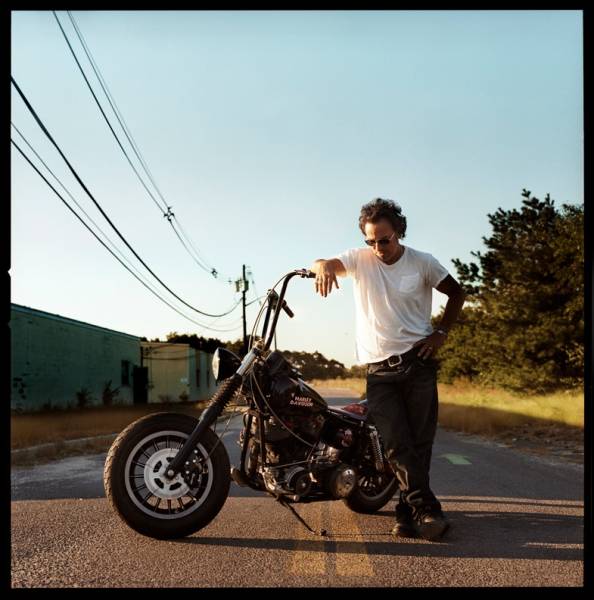
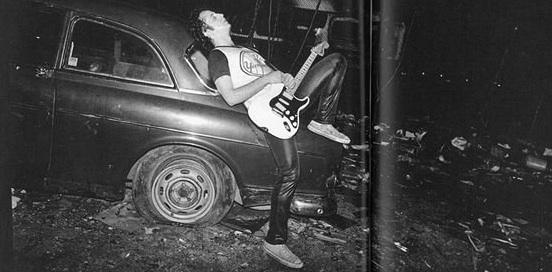
Danny Clinch, “Harley, Allaire Industrial Park, Wall Township, NJ 2007” (© Danny Clinch, 2007)
FROM DARKNESS TO A DREAM
Morrison Hotel Gallery
124 Prince St.
October 15 – November 7, free
212-941-8770
www.morrisonhotelgallery.com
The Boss might be off the road and in between albums right now, but that doesn’t mean there isn’t plenty of Bruce Juice to be devoured these days. Bruce Springsteen was recently in Toronto for the world premiere of THE PROMISE: THE DARKNESS ON THE EDGE OF TOWN STORY, Thom Zimny’s behind-the-scenes documentary of the making of the seminal 1978 album, and the film is currently being aired on HBO prior to the release of the highly anticipated DARKNESS boxed set on November 16. On October 15, the Morrison Hotel Gallery’s SoHo branch looks back at those glory days and beyond with “From Darkness to a Dream,” an exhibit of familiar and never-before-seen photographs of Springsteen taken by Frank Stefanko, who shot the covers for DARKNESS and THE RIVER, and Danny Clinch, who has been shooting Bruce since 1999, including the covers for THE RISING, MAGIC, and WORKING ON A DREAM. Stefanko, who met Springsteen through Patti Smith, captures Bruce at a pivotal time in his career, during the three-year hiatus following the breakout success of BORN TO RUN, when Bruce’s future was in doubt. Clinch, who met Springsteen while an assistant for Annie Liebovitz during the TUNNEL OF LOVE sessions, reveals a more mature, relaxed Bruce, whether onstage, in the studio, or hanging around with his motorcycles. Stefanko and Clinch recently discussed with twi-ny their involvement with Springsteen and the upcoming SoHo show.
twi-ny: Frank, you photographed Bruce during a turning point in his career, when it took him three years to release DARKNESS ON THE EDGE OF TOWN and another two-plus years to make THE RIVER. In your book DAYS OF HOPES AND DREAMS, Bruce wrote that you “latched onto the very conflicts and ideas I was struggling to come to terms with: Who am I? Where do I go now? He showed me the people I was writing about in my songs. He showed me the part of me that was still one of them.” What do you think it was about the two of you that made you instantly click?
Frank Stefanko: I think the most important thing we did, before ever putting a roll of film in the camera, was to sit down in my living room and chat. In our “getting to know each other” conversation, we found out we had a lot in common. We both came from working-class families. Bruce’s mother was Italian and his father was Dutch Irish. My mother was also Italian and my father was Czechoslovakian. We had families that worked hard, and there was a sense of honesty and dignity. The best of these cultures — honesty, dignity, work ethic — seemed to rub off on us. It helped me to understand the character of the young man I was to capture on film. There were other similarities between us. We both were New Jerseyians, we both loved the Jersey Shore, and we both grew up with the same music around us, so this guy who was about to stand before my lens seemed very familiar to me.
twi-ny: Danny, as evidenced by your December 2008 show at the Morrison Hotel Gallery on Bowery, you’ve taken pictures of such musical icons as Johnny Cash, Lucinda Williams, Neil Young, Joan Jett, Tupac Shakur, Radiohead, Norah Jones, Michael Stipe, Kanye West, Tom Waits, and James Brown. How does Bruce Springsteen compare as a photographic subject with these other superstars, both shooting him in a prepared, posed setting as well as when he’s performing onstage?
Danny Clinch: Honestly, Bruce is a great subject; he gets the process. A subject has to participate in some way for the photograph to be successful. Also, as a photographer you have to be ready to get it when it’s there. He also understands that giving me great access backstage or onstage will result in good photographs. But it takes time to get that trust.
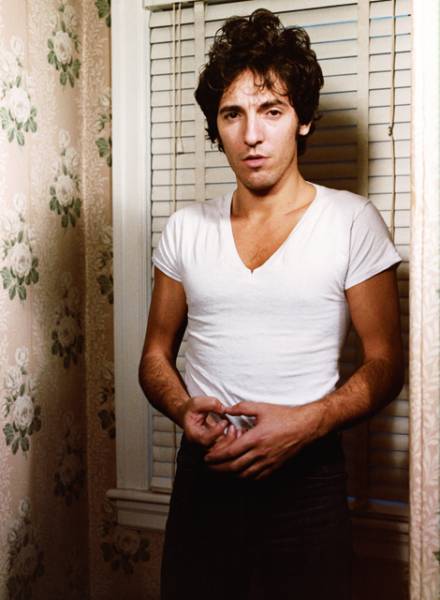
Bruce Springsteen, “Darkness,” Back Cover / Album Square (© Frank Stefanko, 1978)
twi-ny: In the 1970s and ’80s, Bruce was notoriously protective of his career, from the songs he would put on record to the album covers and promotional photographs he would allow to be seen by the public. In the 2000s, he seems to be much more relaxed about both, releasing several records in a relatively short period of time and being seen much more often in photo spreads. Would you both agree that there has indeed been such a change in Bruce’s attitude about his image, and if so, why do you think that is? How do you think your two sets of images, from completely different periods, will either complement or compete with each other when hung together in the gallery?
DC: What I remember about the ’70s and ’80s were the Springsteen album photographs that are ingrained in my memory. Some of them were Frank’s. But if you look at Frank’s photographs from back then, it seems Bruce was already open to having Frank come hang where the band was, a diner, on the street, leaning on his car. These weren’t glamour photos; these were documents of who he was at the time. And he has given me the same opportunities. Although I am often hired to do these shoots, sometimes Bruce and I come up with some ideas/inspiration and just get together and shoot some photographs, knowing that we’ll use ’em down the road. This is why I think our photographs will complement well in the gallery show. It’s a different era, but the same trust was given to get these great opportunities.
FS: I have noticed a loosening of restrictions over the years regarding Bruce’s images. Some of it may be because Bruce and his management may be more comfortable with the fact that there is nothing to hide. I think Bruce has matured, and those issues have become less important, while other issues affecting humanity and the planet have become more important. In general, however, I just think that because he is one of the most photographed performers alive today, with his images everywhere, you start to get a sense of . . . well, this is part of the legacy and it’s OK. Regarding Danny Clinch’s images and mine hanging together in our show, Danny and I have talked about this and we both agree. The fact that these images have been taken with thirty years between them, they work beautifully together. There is a common thread that weaves these images together . . . they have soul. There is a moody, soulful quality in both of our work that has transcended time and space. You will see a younger, DARKNESS-era Bruce and a more mature, contemporary Bruce; however, we both are able to show the soul, moods, and essence of the artist that is Bruce Springsteen.
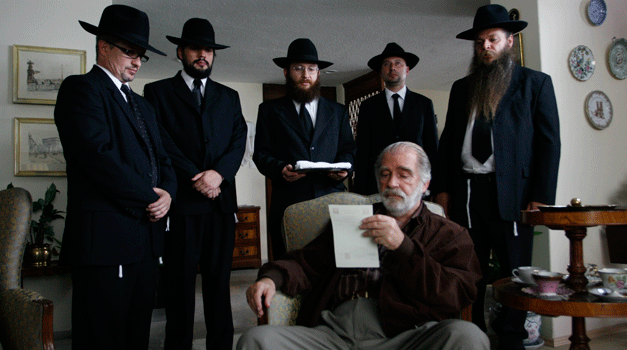
 Mariana Chenillo’s debut feature, NORA’S WILL, is an endearingly bittersweet black comedy about family and forgiveness. As the film opens, Nora (Silvia Mariscal) is carefully organizing her home, putting cards and letters away and setting an ornate table for the first night of Passover. Then, after more than a dozen prior attempts, she successfully commits suicide. Her ex-husband, José (Fernando Luján), who lives across the street, discovers her, but with their son, Rubén (Ari Brickman), and his family in Texas, José suddenly finds himself responsible for the body. Before José can make any decisions, Rabbi Jackowitz (Max Kerlow) arrives, telling him that because of the holiday and the Sabbath, the body will have to remain in Nora’s apartment for five days before burial and that Moisés (Enrique Arreola) will continually pray over Nora until they can proceed with the funeral, which is further complicated because of how she died. None of this sits well with José, a cynical atheist who quickly orders a Christian wake and offers the rabbi a piece of ham, bacon, and sausage pizza. But when José comes upon a postcard Nora had accidentally dropped during her obsessive preparations, he thinks he might have uncovered a mystery that shakes him from his apathy. Luján is absolutely marvelous as the well-bearded José, making subtle gestures and hysterically offensive comments as if they were nothing, insulting just about everyone with a bored look in his eye, as if he’d rather be anywhere than where he is. Angelina Peláez is a hoot as Nora’s very Catholic housekeeper, Fabiana, who insists on making up Nora’s face and praying over her with rosary beads. Winner of seven Mexican Ariel Awards including Best Picture, NORA’S WILL is a splendidly told tale with tongue firmly implanted in cheek. Just like Nora does, writer-director Chenillo keeps everything in its proper place — after all, “seder” does mean “order” — never going over the top even when slapstick beckons. The film’s Mexican title, CINCO DIAS SIN NORA, translates as FIVE DAYS WITHOUT NORA, but Nora is ever-present in all the hijinks, not only through her corporeal body in the bedroom but via the will she continues to impose on everyone even after death.

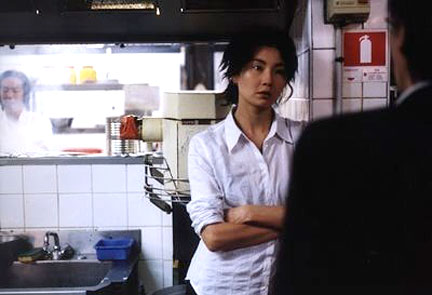
 With their divorce pending, writer-director Olivier Assayas and Hong Kong superstar Maggie Cheung wish each other a fond farewell in the moving drama CLEAN. Named Best Actress at the 2004 Cannes Film Festival for her extraordinary performance, Cheung (HERO, IN THE MOOD FOR LOVE) stars as Emily Wang, a junkie trying to resuscitate the fading music career of her heroin-addicted lover, Lee (British musician James Johnston). Their life together is so screwed up that they rarely see their son, Jay (James Dennis), who lives in Vancouver with Lee’s parents (Nick Nolte and Martha Henry). On the road, Emily scores some drugs, fights with Lee, goes out for a ride, then returns to find him dead from an overdose and the cops waiting to arrest her. After six months in prison, she gets out to find that her life has changed more than she could ever have imagined. Cheung is effervescent every step of the way, lighting up the screen despite playing a very hard-to-like character; her tender scenes with the soft-spoken, grizzled Nolte are particularly gentle and touching. Unfortunately the subplot set in the music world is clichéd, annoying, and mostly unnecessary, everything that the rest of the film is not. The stunt casting is particularly irritating: Tricky, the band Metric, and Mazzy Star’s David Roback all play themselves. The otherwise fine cast also includes Béatrice Dalle, Jeanne Balibar, Don McKellar, and Laetitia Spigarelli, with a soundtrack dominated by ethereal songs by Brian Eno. The film is being shown as part of “Post–Punk Auteur: Olivier Assayas” at BAM, consisting of seventeen films by the French writer-director, continuing through October 28.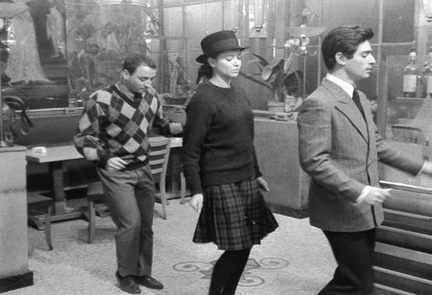
 When a pair of disaffected Parisians, Arthur (Claude Brasseur) and Franz (Sami Frey), meet an adorable young woman, Odile (Anna Karina), in English class, they decide to team up and steal a ton of money from a man living in Odile’s aunt’s house. As they meander through the streets of cinematographer Raoul Coutard’s black-and-white Paris, they talk about English and wealth, dance in a cafe while director Jean-Luc Godard breaks in with voice-over narration about their character, run through the Louvre in record time, and pause for a near-moment of pure silence. Godard throws in plenty of commentary on politics, the cinema, and the bourgeoisie in the midst of some genuinely funny scenes. BAND OF OUTSIDERS is no ordinary heist movie; based on Dolores Hitchens’s novel FOOL’S GOLD, it is the story of three offbeat individuals who just happen to decide to attempt a robbery while living their strange existence, as if they were outside from the rest of the world. The trio of ne’er-do-wells might remind Jim Jarmusch fans of the main threesome from STRANGER THAN PARADISE (1984), except Godard’s characters are more aggressively persistent. BAND OF OUTSIDERS is screening as part of Film Forum excellent series “The Heist,” in a double feature with Jean-Pierre Melville’s BOB LE FLAMBEUR.