Alejandro Jodorowsky takes viewers on quite an acid trip in surreal Western EL TOPO
RABBIT MOVIE NIGHTS: EL TOPO AND THE HOLY MOUNTAIN
Rabbitholestudio
33 Washington St., Brooklyn
Wednesday, October 13, 7:00
Admission: free (two beers for $3)
718-852-1500
www.rabbitholestudio.com
EL TOPO (Alejandro Jodorowsky, 1970)
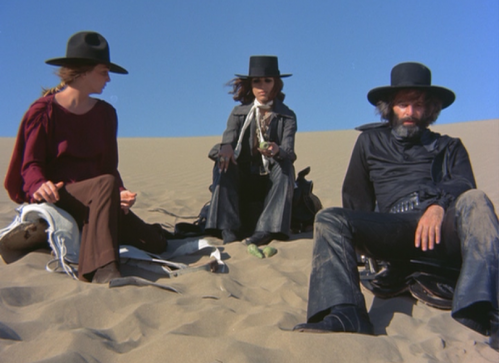
 Following the screening of several of his films and a personal appearance by the man himself at the Museum of Arts & Design, the New York City celebration of all things Alejandro Jodorowsky continues with a free double feature at Rabbitholestudio in DUMBO. It begins with the Chilean-born Mexican filmmaker’s acid Western EL TOPO, a psychedelic head trip that will blow your mind. Jodorowsky stars as the title character, a gunslinger traveling through a deserted landscape accompanied by his naked young son, who already knows his way around a firearm. After coming upon a town that has been decimated by a nasty group of marauders working for the Colonel, El Topo seeks violent revenge, eventually taking off with a woman and leaving his boy behind as he meets four masters on his path to proving he is the best there is. But soon El Topo is praying for redemption with a community of inbred cripples trapped in a cave. EL TOPO is a wild and bizarre journey through religious imagery, romance, and vengeance, a surreal spaghetti Western strained through the mad mind of Jodorowsky, widely hailed as the creator of the midnight movie. The film melds Bergman with Leone, Tod Browning’s FREAKS with Hiroshi Inagaki’s Samurai Trilogy, filtered through Kazuo Koike and Goseki Kojima’s LONE WOLF AND CUB. It’s like nothing you’ve ever seen before and, despite your better instincts, will lure you into the cult of Jodorowsky.
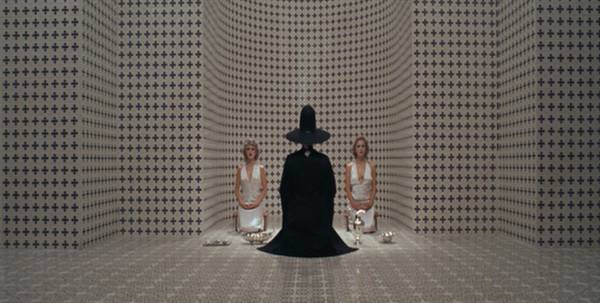
The beautiful weirdness never ends in Jodorowsky cult classic THE HOLY MOUNTAIN
THE HOLY MOUNTAIN (Alejandro Jodorowsky, 1973)
Rabbit Movie Night concludes with one of the strangest films ever made. Inspired by Rene Daumal’s MOUNT ANALOGUE: A NOVEL OF SYMBOLICALLY AUTHENTIC NON-EUCLIDEAN ADVENTURES IN MOUNTAIN CLIMBING, Alejandro Jodorowsky’s THE HOLY MOUNTAIN also involves symbolically non-Euclidean adventures in mountain climbing, funneled through Carlos Castaneda, Stanley Kubrick’s 2001: A SPACE ODYSSEY, and magic mushrooms and LSD galore. What passes for narrative follows a Jesus look-alike thief (Horacio Salinas) and an alchemist with a thing for female nudity (Jodorowsky) on the path to enlightenment; along the way they encounter the mysterious Tarot, stigmata, stoning, eyeballs, frogs, flies, cold-blooded murder, naked young boys, chakra points, life-size plaster casts, Nazi dancers, sex, violence, blood, gambling, turning human waste into gold, death and rebirth, and the search for the secret of immortality via representatives of the planets, each with their own extremely bizarre story to tell. Jodorowsky, who is credited with having invented the midnight movie with the acid Western EL TOPO (1970), literally shatters religious iconography in a kaleidoscopic whirlwind of jaw-droppingly gorgeous and often inexplicable imagery composed from a surreal color palette, set to a score by free jazz trumpeter Don Cherry and Archies keyboardist Ron Frangipane. (Frangipane also worked with John Lennon and Yoko Ono, who produced this film with their business manager, Allen Klein.) THE HOLY MOUNTAIN — which brings a whole new insight to Matthew Barney’s Cremaster Cycle — is filled with psychedelic mysticism centered around the human search for transcendence in a wilderness of the sacred and profane. Jodorowsky’s work can move you deeply, but don’t expect it to make much sense. Sit back and let in pour in and over you — you’ll feel it. You may hate it, but you’ll feel it. Although you’ll definitely hate the very end.
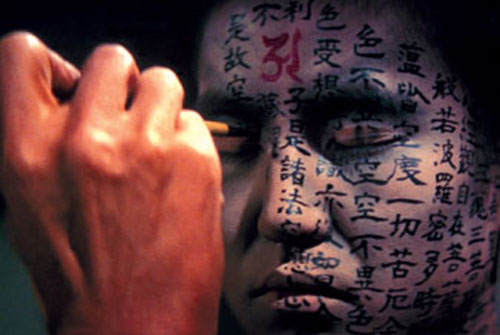
 Masaki Kobayashi paints four marvelous ghost stories in this eerie collection that won a Special Jury Prize at Cannes. In “The Black Hair,” a samurai (Rentaro Mikuni) regrets his choice of leaving his true love for advancement. Yuki (Keiko Kishi) is a harbinger of doom in “The Woman of the Snow.” Hoichi (Katsuo Nakamura) must have his entire body covered in prayer in “Hoichi, the Earless.” And Kannai (Kanemon Nakamura) finds a creepy face staring back at him in “In a Cup of Tea.” Winner of the Special Jury Prize at Cannes, KWAIDAN is one of the greatest ghost story films ever made, four creepy, atmospheric existential tales that will get under your skin and into your brain. KWAIDAN kicks off the Japan Society’s “Zen & Its Opposite: Essential (& Turbulent) Japanese Art House,” comprising six films that illustrate the Six Planes of Existence, or the Six Paths of Samsara. The series continues on November 12 with ONIBABA (Kaneto Shindo, 1964), December 10 with FIRES ON THE PLAIN (Kon Ichikawa, 1959), January 12 with HELL (Nobuo Nakagawa, 1960), and February 18 with SWORD OF DOOM (Kihachi Okamoto, 1966).