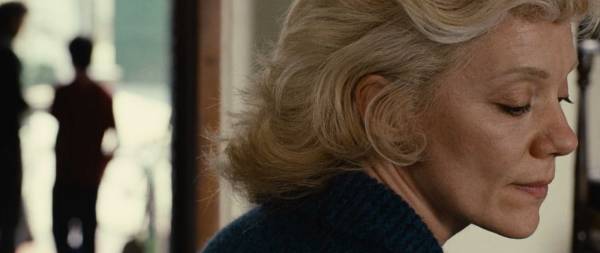
María Onetto is lost deep in thought through most of Argentine drama
THE HEADLESS WOMAN (LA MUJER SIN CABEZA) (Lucrecia Martel, 2008)
IFC Center
323 Sixth Ave. at Third St.
Tuesday, October 19, 6:00
212-924-7771
www.ifccenter.com
www.strandreleasing.com
 Inspired by nightmares she has in which she commits murder, Lucrecia Martel’s THE HEADLESS WOMAN details a woman’s emotional and psychological reaction after having possibly killed someone. María Onetto gives a mesmerizingly cool, distant performance as Veronica, a middle-aged, upper class wife and mother whose biggest worry appears to be the turtles that have infested the new pool built behind a veterinary office. But one afternoon, while out driving carelessly in her Mercedes along a twisting, barren road, she hits something. Not sure if it was a child, an adult, or an animal, she decides to continue on, telling no one what she has done. But when a poor, local boy goes missing, she begins to suspect that she might have killed him. An intriguing mix of Buñuel’s class-consciousness and Poe’s flair for suspense, THE HEADLESS WOMAN is an unusual kind of murder mystery. In Veronica, Argentine writer-director Martel (LA CIENAGA, THE HOLY GIRL) has created a compelling protagonist/villain, played with expert calm and faraway eyes by Onetto.

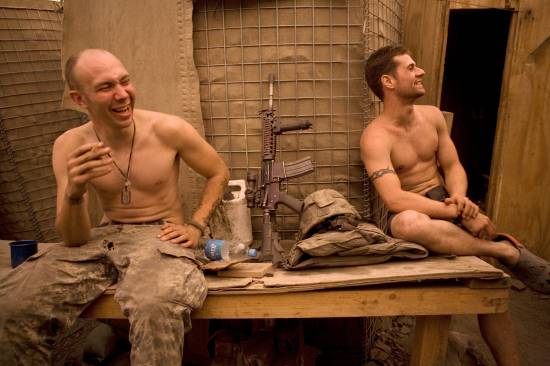
 From June 2007 to July 2008, journalists Sebastian Junger (THE PERFECT STORM) and Tim Hetherington (LIBERIA: AN UNCIVIL WAR) made a total of ten trips to the dangerous Korengal Valley in Afghanistan, documenting the full deployment of Battle Company of the 173rd Airborne Brigade. With snipers hidden all around them, the fifteen soldiers of Second Platoon built a remote, strategic outpost they named Restrepo after PFC Juan Restrepo, the well-liked company medic who was killed early on. Junger and Hetherington film such men as Captain Dan Kearney, Staff Sergeant Kevin Rice, and Sergeant Brendan C. O’Byrne as they go about their daily duties, joking around, playing the guitar, meeting with Afghan locals to get information about the Taliban, and digging trenches while prepared to be shot at at any moment. The journalists took more than 150 hours of footage, supplemented with interviews with several of the soldiers after they were safely back at home base in Italy, talking about what they went through. There is nothing political about RESTREPO, nor does it pull at the heartstrings with melodramatic, overemotional scenes; instead, it depicts the harsh realities of battle, including the long stretches of boredom punctuated by sudden life-or-death situations. There is no narration, no one discusses the possible merits of the war, and no generals or politicians are on hand to defend America’s involvement in the region. There’s no ethnocentric yahooism, nor is there racist treatment of the mostly unseen enemy. It’s just war, pure and simple, seen from the perspective of men who chose to join the army and risk their lives for their country. The film won the documentary Grand Jury Prize at this year’s Sundance Festival and recently screened at the Human Rights Watch Film Festival at Lincoln Center.
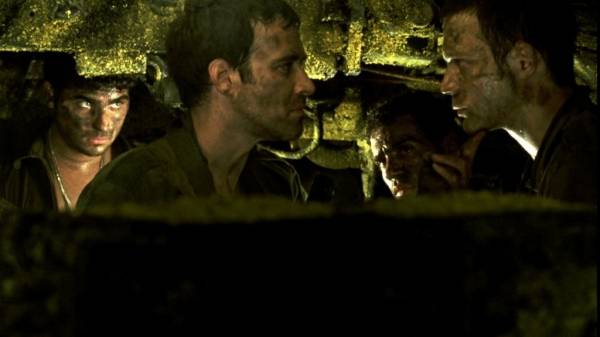
 Claustrophobics, beware. Nearly all of Samuel Moaz’s microcosmic examination of the first day of the 1982 Israel-Lebanon war — the same struggle recently tackled by Ari Folman in the animated WALTZ WITH BASHIR — takes place within a dark, grungy tank. In this tiny space, audiences get to experience the fear building inside company leader Yigal (Michael Moshonov), driver Hertzel (Oshri Cohen), weapons loader Assi (Itay Tiran), and gunner Shmulik (Yoav Donat) as they are suddenly put in the middle of a secret, dangerous mission by commander Jamil (Zohar Strauss) and meet action head-on almost immediately, having to deal with the prospects of killing for the first time. The world outside the tank is seen only through the cross-hairs of Shmulik’s telescopic lens, making everyone outside a potential victim. At times the tension mounts at a breathtaking pace, although the film gets bogged down in too much melodrama as the characters get further developed. As a teenager, writer-director Moaz actually fought in the war, and it was his memories of having killed a man on that very day — June 6, 1982 — that led him to make the movie, which won the Silver Bear at the Venice Film Festival. LEBANON is quite a ride.