live performance

DanceAfrica 2022: HOMEGROWN

Asase Yaa African American Dance Theater will perform at BAM’s annual DanceAfrica festival

Who: Asase Yaa African American Dance Theater, Bambara Drum and Dance Ensemble, Farafina Kan, Harambe Dance Company, LaRocque Bey School of Dance, BAM/Restoration Dance Youth Ensemble, DanceAfrica Spirit Walkers, more
What: DanceAfrica Festival 2022
Where: BAM Howard Gilman Opera House, 30 Lafayette Ave.
When: May 21 – June 2, many events free, Gilman dances $12.50 – $85, film screenings $16
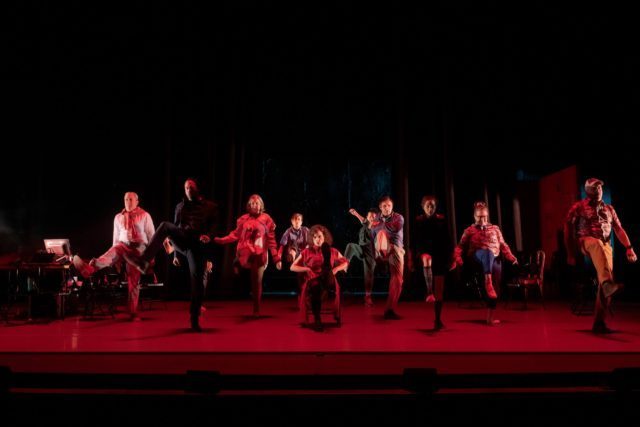
Why: The coming of summer means the arrival of one of the best festivals of every year, BAM’s DanceAfrica. The forty-fifth annual event features the theme “Homegrown,” with five companies making return visits to BAM’s Howard Gilman Opera House: Asase Yaa African American Dance Theater, Bambara Drum and Dance Ensemble, Farafina Kan, Harambe Dance Company, and LaRocque Bey School of Dance, along with the BAM/Restoration Dance Youth Ensemble and DanceAfrica Spirit Walkers, highlighting movement and music from Nigeria, Ghana, Guinea, Mali, and the Caribbean, accompanied by Arkestra Africa. Curated by artistic director Abdel R. Salaam, the festival also includes the Tribute to the Ancestors, Community Day, a Memorial Room, the DanceAfrica Bazaar with more than 150 vendors, dance workshops and master classes in Brooklyn Bridge Park and the Mark Morris Dance Center, the Water Your Roots Youth Dance Expo & Talent Show, the Council of Elders Roundtable “Legacy & Preservation,” Christopher Myers’s stained-glass work Be Lost Well (Stay in the House All Day), and a late night dance party with DJ YB.

FilmAfrica runs May 27 to June 2, consisting of more than two dozen films, from Moussa Touré’s 1997 TGV (followed by a Q&A with Touré and Amy Andrieux), Raymond Rajaonarivelo’s 1996 When the Stars Meet the Sea, and Amleset Muchie’s 2019 Min Alesh! to Mahamat-Saleh Haroun’s 2008 Sex, Okra, and Salted Butter, Balufu Bakupa-Kanyinda’s 2006 Juju Factory, and Dumisani Phakathi’s Don’t F*** with Me, I Have 51 Brothers and Sisters.

THE GREAT DUMBO DROP

THE GREAT DUMBO DROP
DUMBO, Brooklyn
Saturday, May 21, free, 3:00 – 8:00
dumbo.is

DUMBO Drop 2022 is set for May 21, a block party with live music, food and drink, art, prizes, the testing of the wind, and elephants falling from the sky. Among this year’s performers and activities are a sing-along with the New York City Kids Club, tap-dancing by Camila Aldet, Glam Expressway, cheerleading, a fashion show, dancing to a brass band, DJ Kyndal Marie, jugglers, an FDNY photo zone, Melissa Joy Manning, Fogo Azul NYC, wine tastings, boxing demonstrations, face painting, archery, biking, and more. Such galleries as A.I.R. Gallery and Undercurrent Gallery will be hosting exhibitions and walkthroughs, along with an art wall curated by CAM and Jaimie Walker (who designed the 2022 souvenir elephant parachute), Talking Portraits with Doménica García, and raffles benefiting DUMBO’s Title I public schools, the Dock Street Middle School and PS307 Elementary School.

Among the participating eateries are Seamore’s, Superfine, Westville, Butler, Randolph Bar, Bread and Spread, Em Vietnamese Bistro, and Time Out Market. Be sure to get there by 5:00 when the elephants float through the air around Washington St., followed at 7:45 by the Disco Drop. You can get raffle tickets from $20 to $3,000 here, making you eligible for such prizes as a shopping spree, an ice-cream party, jewelry, a hotel staycation, and a rooftop party.

“BACK TO THE STREETS” DANCE PARADE

Who: Eduardo Vilaro, Heidi Latsky, Rich Medina, more
What: Sixteenth annual Dance Parade and DanceFest
Where: Parade starts at Twentieth St. & Broadway, DanceFest in Tompkins Square Park
When: Saturday, May 21, free, noon – 7:00
Why: After two years off because of Covid, Dance Parade has returned. On May 21 from noon to seven, more than ten thousand dancers and musicians will participate in the sixteenth event, aptly dubbed “Back to the Streets.” The 2022 grand marshals are Eduardo Vilaro of Ballet Hispánico, Heidi Latsky of Heidi Latsky Dance, and DJ Rich Medina. “I’m proud to headline New York City’s largest dance event focused on cultural representation and diversity,” Vilaro said in a statement. “Movement and community is so vital to our well being which the pandemic stole from us. We look forward to being a part of Dance Parade’s citywide celebration.”

The parade kicks off at Twentieth St. & Broadway, with the viewing stand located at Fourth Ave. & Eighth St. DanceFest takes place from three to seven in Tompkins Square Park, with dozens of performers on three stages from across the dance spectrum and the globe (Ukranian folk dance, Afro-Brazilian percussion, Argentine tango, Chinese classical, hip-hop, street jazz, breakdancing, flamenco, belly dance, Afro-Caribbean, majorette, Indonesian, Bolivian, Mexican, ballet, Bollywood, more) along with dance demonstrations, education outreach, dance battles, a Soul Train line, and other activities, all free and open to everyone.

GOLDEN SHIELD

Anchuli Felicia King’s Golden Shield questions language and communication by individuals, corporations, and governments (photo by Julieta Cervantes)

GOLDEN SHIELD
Manhattan Theatre Club
MTC at New York City Center – Stage I
131 West 55th St. between Sixth & Seventh Aves.
Tuesday – Sunday through June 12, $59-$89
www.manhattantheatreclub.com

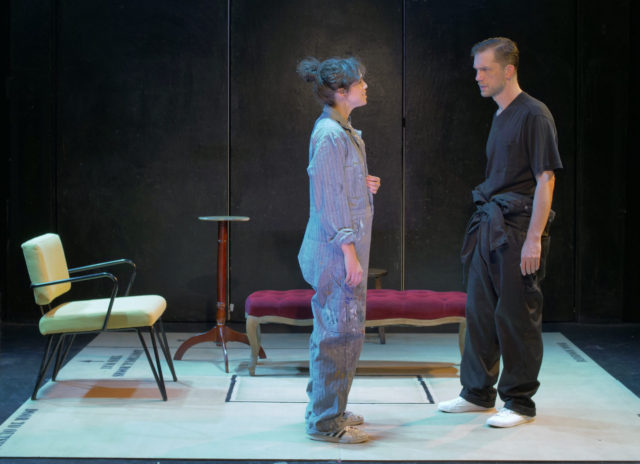
Anchuli Felicia King uses a volatile court case as a battleground for complex ideas about communication and translation involving family, corporations, governments, and the internet in Golden Shield, which opened tonight at MTC at New York City Center – Stage I.

The two-and-a-half-hour play (including intermission) begins with the Translator (Fang Du) laying some of the ground rules. Discussing the difficulty of translating a Chinese proverb into English, he tells the audience, “I can try to find an English equivalent, if one exists. But of course, I risk making false parallels, unwittingly engaging in an act of . . . linguistic imperialism. Or I can really spell it out. . . . But you do lose some of the beauty of the original. It’ll be much the same with this job, I suspect. . . . Just settle into it. Trust that your mind is a machine. Eventually, it’ll find a focal point. Having said that, it is essential that you concentrate.”

The Translator is speaking about the language in the play as much as the language of the play, which takes place nonchronologically between 2006 and 2012 in Washington DC, Beijing, Yingcheng, Dallas, Palo Alto, and Melbourne. In fact, he’s only a character in the plot a few times; instead, he is primarily an observer, standing off to te side, making certain things clearer for the audience, including filling in details of some characters’ pasts. He also has the innate ability to know when someone is lying.

As lawyer Julie Chen (Cindy Cheung) points out, “There’s a lot of jargon in this case. A lot of legal jargon and a lot of technical jargon.” She’s not kidding, so we need the Translator.

Julie, a managing partner in a firm with Richard Warren (Daniel Jenkins), also needs a translator, for a class-action lawsuit in which eight Chinese dissidents are charging ONYS Systems with criminal collusion with the Chinese government, based on a single bullet point in a document regarding the Golden Shield, a real-life surveillance project involving the Great Firewall of China.

Sisters Eva (Ruibo Qian) and Julie Chen (Cindy Cheung) consider working together in Golden Shield (photo by Julieta Cervantes)

Julie wants to hire her younger sister, Eva (Ruibo Qian), who is in the midst of a long bad streak, as her translator. Eva balks at first — something happened at their mother’s recent funeral that has driven them further apart than they already were — but she ultimately signs on. Their main task is to find one of the eight dissidents to be willing to testify in the United States; their last hope is Li Dao (Michael C. Liu), a professor at the Beijing Institute of Science and Technology who has kept his actual activities secret from his devoted wife, Huang Mei (Kristen Hung). Accompanying the legal team as an adviser on their journey is Amanda Carlson (Gillian Saker) of the Digital Freedom Fund.

The trial is scheduled to be held in Dallas, using the Alien Tort Statute in the Judiciary Act of 1789, implemented, in part, because of piracy on the seas. ONYS is attempting to avoid responsibility — the “onus,” as it were — for its part in the creation of a decentralized firewall that was ultimately, surprise surprise, used by the government to track down citizens they believe to be traitors.

Marshall McLaren (Max Gordon Moore), the smarmy ONYS president of China operations, has no respect for the Chinese and their culture and traditions, refusing to keep quiet even when his VP, Larry Murdoch (Daniel Jenkins), begs him to stay in line as they meet with deputy minister of public security Gao Shengwei (Kristen Hung). He’s the classic ugly American, looking to profit off of others, no matter the cost. “They’re giving us shit,” he tells Larry. “It’s polite Chinese shit, but it’s shit nonetheless, and what I’m saying is, is — if we could have a meeting, one meeting, in an office, in an office with desks, I don’t need another, another fucking five pots of steamed whatever or a fucking egg that’s been fermented for a hundred years in a silk basket at the foothills of Mountain Fing-fong-fang.”

Li Dao (Michael C. Liu) and Huang Mei (Kristen Hung) face dangerous consequences in MTC world premiere (photo by Julieta Cervantes)

ONYS’s chief legal officer, Jane Bollman (Gillian Saker), wants to just buy off the plaintiffs, but Julie wants this case to make a point, to have an impact on international law and take big business and big government to task.

Through it all, the Translator keeps the audience apprised of what is really going on. When Eva tells her sister in English, “Like, I’m okay,” he translates that to “I’m not okay.” When Larry, listening to Marshall read from the document in question, says, “I think it’s a bit of a mistranslation,” the Translator says to us, “It’s not.” As the trial continues, the importance of language and communication remain at the heart of the play and not just from a legal standpoint. “There’s enough miscommunication in the world,” Amanda tells Eva. “I don’t want to spend all night reading between the lines and, like, searching for a sign, or symbol, like, a sexual visual metaphor, because if you just like say, upfront, what you mean, then like, you don’t need to translate, you know?”

Developed at MTC’s Australia-based Next Stage Writers’ Program, Golden Shield is masterfully directed by May Adrales (Vietgone, Letters of Suresh), guiding us through the ever-shifting time periods and locations, with scene changes indicated by furniture rolling on- and offstage and different colors flashing behind walls with cut-out patterns. (The set design is by Dots, with lighting by Jeanette Oi-Suk Yew, original sound and music by Charles Coes and Nathan A. Roberts, and costumes by Sara Ryung Clement.)

King (White Pearl) does an excellent job defining the characters and sifting through the jargon to make her points about communication, and not just in the digital age. There’s a kind of poetry to the language, a melding of corporate- and tech-speak, legalese, English, Chinese, and everyday talking. King has called the play itself “a valuable political act,” and that’s just what it is.

The Translator (Fang Du) keeps the audience informed as he watches the action onstage (photo by Julieta Cervantes)

And it all starts with Fang Du (Golem, Low Power), who is eminently likable as the Translator, a kind of version of the Stage Manager in Thornton Wilder’s Our Town. If he doesn’t capture our attention, it becomes a completely different experience. In the script, King notes, “The Translator is an intermediary between the audience and the action. They intervene in the action only when their presence becomes essential. They are otherwise engaged in an act of self-abnegation.” That self-abnegation stands in direct counterpart to the desires of most of the characters, who can be selfish, grating, mean-spirited, uncaring, passive-aggressive, and self-defeating. In this digital surveillance age where less and less communication occurs in person, face-to-face, Fang Du’s good-natured portrayal of the bright and cheery, ever-smiling Translator is a necessary respite from the hard points the narrative makes. That’s why we need the Translator.

DANCE WITH BACH

After two years, Dance with Bach is back (photo courtesy the Sebastians / Christopher Caines Dance)

Who: The Sebastians, Christopher Caines Dance
What: Music and dance celebrating Johann Sebastian Bach
Where: Good Shepherd-Faith Presbyterian Church, 152 West Sixty-Sixth St. between Amsterdam & Columbus Aves.
When: Friday, May 20, and Saturday, May 21, $20 virtual, $30-$50 in-person and virtual
Why: In 2014, the Sebastians, a chamber ensemble named after Johann Sebastian Bach, joined forces with Christopher Caines Dance to present Henry Purcell’s 1692 opera, The Fairy Queen, an adaptation of William Shakespeare’s A Midsummer Night’s Dream, merging baroque music with modern dance. Following a two-year delay because of the pandemic, the two companies are back together for Dance with Bach, a trio of Bach suites choreographed by Christopher Caines, taking place May 20-21 at the Good Shepherd-Faith Presbyterian Church by Lincoln Center as well as streaming online, photographed by multiple cameras. The program begins with Jean-Marie Leclair’s Ouverture from Deuxième récréation de musique d’une execution facile, Op. 8, followed by Bach’s Cello Suite No. 6 in D major, BWV 1012, performed on viola da spalla; English Suite No. 5 in E minor, BWV 810 for harpsichord; and Orchestral Suite No. 2 in B minor, BWV 1067 for flute, strings, and continuo.

“We are thrilled to finally bring Dance with Bach to fruition,” Sebastians artistic director Jeffrey Grossman said in a statement. “Christopher and the dancers had put in countless hours of rehearsal when we were forced to cancel our May 2020 performances. We discussed ways of producing the project virtually, with recorded music and dancers wearing masks, but decided there would be too many compromises. After such a long journey, the experience of being back in the same room with the dancers, to feel their energy and respond musically to their physicality, is incredible.” Caines added, “I am one lucky choreographer to have had this band really throw down the gauntlet by asking me to choreograph three iconic masterpieces by their namesake master composer. What a challenge! And my dancers could not be more thrilled at the prospect of taking the stage backed up by one of the finest baroque ensembles anywhere.”

The works will be danced by CCD members Michael Bishop, Elisa Toro Franky, Genaro Freire, Jeremy Kyle, Michelle Vargo, and Leigh Schanfein in addition to student dancers from New York Theatre Ballet School (Charlotte Anub, Audrey Cen, Josephine Ernst, Madeline Goodwin, Clara Rodrigues-Cheung, Emely Leon Rivas, Eva Sgorbati). The ensemble consists of David Ross on flute, Nicholas DiEugenio on violin, Daniel Lee on viola da spalla and violin, Jessica Troy on viola, Ezra Seltzer on cello, Nathaniel Chase on violone, and Grossman on harpsichord.

HBO’s SCENES FROM A MARRIAGE: SPECIAL SCREENING AND CONVERSATION

Jessica Chastain and Oscar Isaac will talk about their HBO series at the 92nd St. Y

Who: Jessica Chastain, Oscar Isaac, Hagai Levi, Amy Herzog, Michael Ellenberg
What: Screening and discussion
Where: 92nd St. Y, Kaufmann Concert Hall, 1395 Lexington Ave. at Ninety-Second St.
When: Thursday, May 19, $27-$45, 7:00
Why: If you missed HBO’s English-language adaptation of Ingmar Bergman’s six-part Scenes from a Marriage, you can get a special chance to watch one of the 2021 episodes on the big screen, followed by a conversation with members of the creative team, at the 92nd St. Y on May 19. Bergman’s 1973 miniseries detailed the slow, heart-wrenching fracture of the relationship between Marianne (Liv Ullmann) and Johan (Erland Josephson). Directed and executive produced by Hagai Levi (The Affair, In Treatment) and written by Levi and playwright Amy Herzog (4000 Miles, Mary Jane), the remake turns the tables on such issues as infidelity, truth, gender, responsibility, and identity, with Oscar Isaac as Jonathan and Jessica Chastain as Mira. The 92Y screening will be followed by a discussion with Isaac, Chastain, Levi, Herzog, and producer Michael Ellenberg that goes behind the scenes of the making of the almost painfully intimate show.

WHO KILLED MY FATHER (QUI A TUÉ MON PÈRE)

Édouard Louis’s Who Killed My Father makes its US premiere at St. Ann’s this week (photo by Jean-Louis Fernandez)

WHO KILLED MY FATHER (QUI A TUÉ MON PÈRE)
St. Ann’s Warehouse
45 Water St.
Tuesday – Sunday, May 18 – June 5, $49-$59
718-254-8779
stannswarehouse.org
www.schaubuehne.de

In November 2019, St. Ann’s Warehouse presented History of Violence, a radical, highly inventive multimedia interpretation of the 2016 nonfiction novel by activist and artist Édouard Louis, directed by Thomas Ostermeier for Schaubühne Berlin. Ostermeier and Louis return to St. Ann’s with the US premiere of Who Killed My Father (Qui a tué mon père), an adaptation of Louis’s 2018 book, starring the twenty-nine-year-old Paris-based Louis himself in his debut as a professional performer. A coproduction of Schaubühne Berlin and Théâtre de la Ville Paris, Who Killed My Father deals with how the French government’s treatment of the working class broke Louis’s alcoholic, conservative, homophobic father. “Throughout my entire childhood, I hoped you’d disappear,” Louis writes. “You can no longer get behind the wheel, are no longer allowed to drink, can no longer shower unaided without it presenting an enormous risk. You’re just over fifty. You belong to the precise category of people for whom politics has envisaged a premature death.”

Ostermeier always brings something new to the table, as displayed in such works as Returning to Reims and Richard III, so prepared to be awed in many ways. Who Killed My Father features video design by Sébastien Dupouey and Marie Sanchez, stage design by Nina Wetzel, costumes by Caroline Tavernier, lighting by Erich Schneider, and music by Sylvain Jacques.