live performance

STEPHEN PETRONIO COMPANY AT THE JOYCE

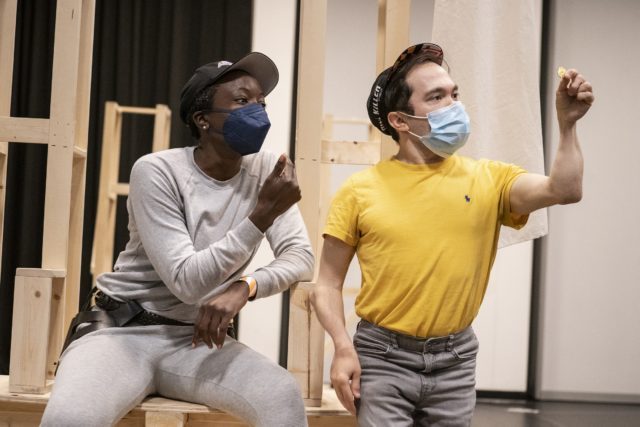
Stephen Petronio Company rehearses at Snug Harbor for Joyce season (photo by Lance Reha)

STEPHEN PETRONIO COMPANY
Joyce Theater
175 Eighth Ave. at 19th St.
May 17-22, $10-$71
212-645-2904
www.joyce.org
petron.io

“What does it mean to be out in front of you tonight, to show up for you after so long?” Stephen Petronio asks in a program note for his company’s upcoming season at the Joyce, running May 17-22. “SPC has been coming to the Joyce each spring for almost forty years — a rite, a contract as celebration. To have that interrupted by Covid is like having our oxygen taken away. We are back and breathing now! We come before you tonight to show you that we have survived, that we are still here, in some ways stronger than ever, and that dance is a kind of social glue that keeps us all connected.”

SPC’s Joyce program begins with the world premiere of New New Prayer for Now, created as a virtual piece for the company during the lockdown to celebrate online collaboration, set to original music by Monstah Black and renditions of “Balm in Gilead” and “Bridge Over Troubled Water” recorded with the Young People’s Chorus of New York City (YPC), directed by Francisco J. Nuñez; the costumes are by Marine Penvern, with lighting by Ken Tabachnick. Following a pause, SPC continues its “Bloodlines” series honoring important choreographers who influenced Petronio with his mentor Trisha Brown’s 1973 Group Primary Accumulation, restaged by Shelley Senter. The online version with four dancers in white on a wooden bridge was breathtaking, so it will be fascinating to see it now live indoors.

After an intermission, the company presents a restaging of Petronio’s Bloom, which premiered at the Joyce in 2006 and features music by Rufus Wainwright based on the poetry of Walt Whitman (“Unseen Buds,” “One’s-Self I Sing”) and Emily Dickinson (“‘Hope’ is the thing with feathers”) and the Latin Mass, sung live by YPC, with choral arrangements by Nuñez; the costumes are by Rachel Roy, with lighting by Tabachnick. The May 19 performance will be followed by a Curtain Chat with members of the company, which consists of Jaqlin Medlock, Kris Lee, Larissa Asebedo, Liviya England, Mac Twining, Nicholas Sciscione, Ryan Pliss, Tess Montoya, and Tiffany Ogburn. “It’s an emotional time,” Petronio says in the above preview of the Joyce season. If you haven’t yet seen this extraordinary company, you have only yourself to blame.

DONNA UCHIZONO COMPANY: WINGS OF IRON

Donna Uchizono’s Wings of Iron will have its world premiere this week at BAC (photo courtesy Donna Uchizono Company)

Who: Donna Uchizono Company
What: World premiere of Wings of Iron
Where: Baryshnikov Arts Center, Howard Gilman Performance Space, 450 West 37th St. between Ninth & Tenth Aves.
When: May 18-21, $25, 7:30
Why: For more than thirty years, Donna Uchizono has been creating innovative dance works that dig deep into the mind and human emotions while exploring the limits of our physical body. In such pieces as State of Heads, Thin Air, longing two, and Out of Frame, Uchizono, who was born on a US Army base in Tokyo and is proudly “the first and only American-born choreographer of Asian ancestry in the history of modern dance,” has developed a unique movement language that is as unpredictable as it is thrilling.

Her latest evening-length piece, Wings of Iron, has been in the works since 2017 and was originally scheduled to premiere at Baryshnikov Arts Center in May 2020 but was delayed because of the pandemic. A copresentation with the Chocolate Factory, Wings of Iron will now have its world premiere May 18-21 at BAC’s Howard Gilman Performance Space. “Listening is a key to my creative practice,” Uchizono said in a statement. “My creative research takes two to four years to develop a new work with its own physical vocabulary and structure. Dedicated to charting new territory with each dance, my process involves ‘hearing’ the work. I shape conceptual ideas into a physical language specific to each piece, carefully ‘listening’ as the dialogue with the dance itself is revealed. As that dialogue unfolds, a new dance vocabulary emerges that has the imprint of my own history while remaining highly specific to the work itself. My work demands a physical and mental rigor and I am drawn to a redefined sense of ‘virtuosity’ that extends the markers of skill and excellence to push against human standards of patience, duration, and minute, intensely detailed movement. My embrace of unseen undercurrents leads to the unexpected that traverses a spectrum of the discovery of the extraordinary in the vulnerable human experience.”

Wings of Iron will be performed by Bria Bacon, Natalie Green, Molly Lieber, and Pareena Lim, with an original score by okkyung lee and lighting by Joe Levasseur. The visual design features chairs and giant portraits of the dancers. “It is with worried excitement, hopeful relief, and a tinge of cautiousness that we announce the world premiere,” Uchizono wrote in an email blast. Wings of Iron “examines what it takes to remain humane in these charged times, providing a forum for both performer and audience to share in the weight of a vulnerability that is simultaneously public and private.”

CITY LYRIC OPERA: THE GARDEN OF ALICE

Who: City Lyric Opera
What: American premiere of Elizabeth Raum’s The Garden of Alice
Where: Blue Building, 222 East Forty-Sixth St.
When: May 17-21, $35
Why: During the pandemic, City Lyric Opera staged a hybrid, interactive version of The Threepenny Opera that people could watch and participate in from the comfort of their homes. Now CLO returns to in-person events with the US premiere of Canadian composer Elizabeth Raum’s The Garden of Alice, an immersive, interactive, multisensory show that takes Alice, and the audience, down a digital rabbit hole of social media and into a hybrid Wonderland of live performances and kaleidoscopic landscapes. Despite the connection to Lewis Carroll’s beloved tale, this production is not meant for kids. Alice will be played by soprano Laura Soto-Bayomi, with bass-baritone Nate Mattingly as the White Rabbit, mezzo-soprano Kelly Guerra as the Duchess and the Queen, soprano Gileann Tan as the Doormouse, and tenor Ryan Lustgarten, baritone Steve Valenzuela, bass Robert Feng, tenor Ramon Gabriel Tenefrancia, and mezzo-soprano Mary Rice in multiple roles.

“We wanted to pick an opera that is cheerful and colorful yet edgy and thought provoking,” CLO cofounder and executive director Megan Gillis said in a statement. “The Garden of Alice merges both the adult and child worlds in a mesmerizing, strange, and beautiful way. Alice finds herself alone, bored, and afraid — a frightening place we all recently visited collectively.” Raum has rescored the 1983 opera for a small chamber orchestra, featuring piano, violin, cello, clarinet, bassoon, and percussion. The presentation consists of an installation of prerecorded material and projections and the ninety-minute opera. “Similar to Alice, we are all entranced by the illusion of an idyllic place, only to discover it’s all fake and convoluted,” Gillis added. “Like Alice’s rabbit hole, we have all begun the journey into the metaverse with so much of today’s digital interactions.” The opera is directed by Attilio Rigotti, with music direction by Danielle Jagelski, video by Orsolya Szánthó, sets and costumes by Gaya Chatterjee, lighting by Jessica Wall, and sound by Evan Tyor.

HOW I LEARNED TO DRIVE

David Morse, Mary-Louise Parker, and Johanna Day (center three) reprise their roles in Broadway debut of How I Learned to Drive (photo © Jeremy Daniel 2022)

HOW I LEARNED TO DRIVE
Samuel J. Friedman Theatre
261 West Forty-Seventh St. between Broadway & Eighth Ave.
Tuesday – Sunday through June 12, $79-$299
www.manhattantheatreclub.com

“I’m just a very ordinary man,” Peck says in Paula Vogel’s How I Learned to Drive, making its stunning Broadway debut at MTC’s Samuel J. Friedman Theatre through June 12.

“I’ll bet your mother loves you, Uncle Peck,” his teenage niece, Li’l Bit, replies.

The beauty of Vogel’s Pulitzer-winning drama is in its simplicity, the very ordinariness of a complex story about child sexual abuse and its lasting effects on the survivor.

In 1997, forty-three-year-old David Morse and thirty-two-year-old Mary-Louise Parker starred in How I Learned to Drive, he as Peck, she as Li’l Bit, both named after their genitalia. The play primarily takes place in backward chronology from 1969, when he is fifty-two and she is seventeen, except for two key detours to 1970 and 1979. Twenty-five years later, the actors have returned to the parts they originated, joined by the same director, Mark Brokaw, and Johanna Day, who, as Female Greek Chorus, also portrays Li’l Bit’s mother; joining the cast is Alyssa May Gold as Teenage Greek Chorus and Li’l Bit’s grandmother, and Chris Myers as Male Greek Chorus and Li’l Bit’s grandfather, among other characters.

Having Morse and Parker reprise their roles is a stroke of genius; over the last quarter century, their stature as consummate actors has grown, so we are immersed in their characters immediately. Parker, in particular, is a wonder, embodying the teenage Li’l Bit with small gestures and movements that make us forget that she is some forty years older. But the casting also reminds us that in the last twenty-five years, child abuse and pedophilia is still one of society’s most shameful ills, brought to light again in the #MeToo era.

When Peck tells Li’l Bit, “I have loved you every day since the day you were born,” the audience lets out an audible gasp.

Li’l Bit (Mary-Louise Parker) gets life lessons from Female Greek Chorus (Johanna Day) and Teenage Greek Chorus (Alyssa May Gold) (photo © Jeremy Daniel 2022)

Inspired by Nabokov’s Lolita as well as the sexual abuse that she herself suffered, Vogel uses driving lessons as a metaphor for Peck’s grooming of Li’l Bit as his potential victim. The Greek Chorus announces shifts in scenes with such phrases as “Safety First — You and Driver Education,” “Idling in the Neutral Gear,” “You and the Reverse Gear,” and “Implied Consent,” along with subtle changes in lighting by Mark McCullough and sound and original music by David Van Tieghem.

Rachel Hauck’s streamlined set features constantly changing furniture — chairs, tables, a bed — with the only constant a tall wooden post that evokes telephone poles along the road as well as a cross. Dede Ayite’s costumes are straightforward dress; the characters can be anyone, at any recent time.

Li’l Bit’s dilemma is exacerbated when she begins growing breasts, larger than her classmates’. She is teased and made fun of not only by the boys and girls in school but by her own family, who sexualize her with dangerous lessons. “I told you what my mother told me! A girl with her skirt up can outrun a man with his pants down!,” her grandmother says. Her grandfather warns, “If Li’l Bit gets any bigger, we’re gonna have ta buy her a wheelbarrow to carry in front of her.” Her mother teaches her, “Never mix your drinks. Stay with one all night long, like the man you came with . . . damn the torpedoes, full speed ahead!”

Li’l Bit knows from the very start that what Uncle Peck is doing is wrong, but he is so calmly persuasive that she keeps sticking around him. In a key scene, she watches as Peck teaches her cousin Bobby how to fish, essentially a primer for how a man can lure a woman into something she doesn’t want to do. “We’re going to aim for some pompano today — and I have to tell you, they’re a very shy, mercurial fish. Takes patience, and psychology. You have to believe it doesn’t matter if you catch one or not,” he says.

In a car, Uncle Peck tells Li’l Bit, “Put your hands on the wheel. I never want to see you driving with one hand. Always two hands.” After hesitating, she replies, “If I put my hands on the wheel — how do I defend myself?”

Uncle Peck (David Morse) grooms Li’l Bit (Mary-Louise Parker) in powerful revival of Paula Vogel’s Pulitzer winner (photo © Jeremy Daniel 2022)

Peck is a knowledgeable fisherman, understanding just how to approach his prey. Tony nominee Morse (The Iceman Cometh, The Unavoidable Disappearance of Tom Durnin) is so successful in the role that, at the talkback that followed the matinee I saw, several women embarrassingly admitted that they were taken in by his character, that they had trouble seeing him as a predator but instead thought he was just a nice guy. That’s precisely what sexual abusers do, fool the observers, and Morse nails it. We want to like him, want him to be our cool uncle too, until we don’t.

Tony winner Parker (The Sound Inside, Proof) is astonishing as Li’l Bit; her timeless, youthful qualities once again shine as she ages seventeen years in the play. Our hearts ache for Li’l Bit as her uncle’s pursuit of her intensifies, but Parker, as ravishingly beautiful as ever, uses her age and experience to give the teenage girl added depth; the audience can’t help but feel her every emotion and search their own lives to examine mistakes they might have made or situations in which they looked the other way. It’s one of the best performances of an adult as a child you’re ever likely to see.

Day (Sweat, The Nap) is excellent as always as the enabler in all of us, while Gold (Taking Woodstock, Our Dear Dead Drug Lord) is a marvel in multiple roles, including a powerful surprise at the end.

Vogel (Indecent, The Baltimore Waltz) and Brokaw (Heisenberg, The Lyons) have done a superb job reimagining this hard-hitting yet delicate, crucial work for these times, a play that in itself is a primer for how to recognize sexual abuse and, hopefully, be able to reach for the brakes. As Li’l Bit warns us, “Sometimes to tell a secret, you first have to teach a lesson.”

VOICES FROM THE GREAT HALL WITH SAM WATERSTON

Who: Sam Waterston, the New York Philharmonic, the Resistance Revival Chorus, Harold Holzer
What: A celebration of the Cooper Union’s new Voices from the Great Hall Digital Archive
Where: The Cooper Union, 7 East Seventh St. between Third & Fourth Aves.
When: Tuesday, May 17, free with advance RSVP, 7:00
Why: The Cooper Union celebrates the opening of its Voices from the Great Hall Digital Archive with a special free program on May 17 at 7:00, hosted by actor Sam Waterston; several times, the Emmy winner and Oscar nominee has portrayed Abraham Lincoln, who delivered one of his most memorable speeches in the Great Hall on February 27, 1860, in which he declared, “Let us have faith that right makes might, and in that faith, let us, to the end, dare to do our duty as we understand it.” Waterston reprised that speech in the Great Hall in 2004. The program will feature multimedia excerpts of original recordings of politicians, Supreme Court Justices, and others, with live presentations from the New York Philharmonic, the Resistance Revival Chorus, and Lincoln expert and author Harold Holzer. The archive goes back as far as 1859 with a copy of Frederick Douglass’ Paper and includes lectures, commencement addresses, music exhibitions, political pamphlets, campaign speeches, memorials, drawings, forums, audio and video recordings, and much more.

POTUS: Or, Behind Every Great Dumbass Are Seven Women Trying to Keep Him Alive

Ann all-star cast of women create mayhem in Selina Fillinger’s POTUS(photo by Paul Kolnik)

POTUS: OR, BEHIND EVERY GREAT DUMBASS ARE SEVEN WOMEN TRYING TO KEEP HIM ALIVE
Shubert Theatre
225 West Forty-Fourth St. between Broadway & Eighth Ave
Tuesday – Sunday through August 14, $39-$250
potusbway.com

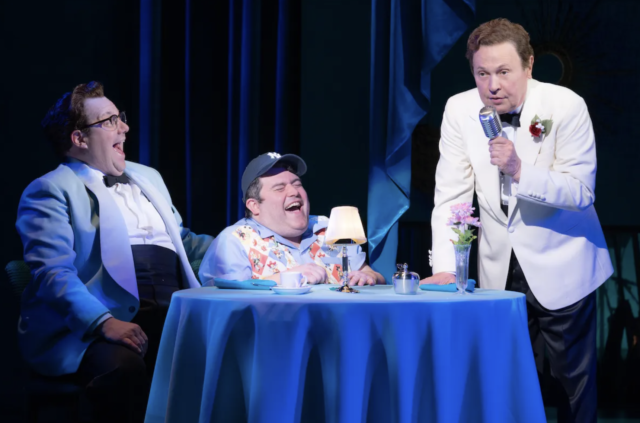
I can’t remember the last time I consistently laughed so long and hard at the theater. For 110 minutes — including an intermission during which the joyous tears kept falling as we rehashed what we had just experienced in the first act — Selina Fillinger’s outrageous farce, POTUS: Or, Behind Every Great Dumbass Are Seven Women Trying to Keep Him Alive, had everyone in the Shubert Theatre rolling in the aisles. It’s the funniest play on Broadway in years, but what makes it truly exceptional is that it also has a lot to say about the potential end of the white male patriarchy in America.

The very first word of the play is the “c” slur, the most derogatory term a woman can be called. That’s what the president called his wife, Margaret (Vanessa Williams), at a press conference in front of the world — and the first lady herself. His casual insult sets into motion the behind-the-scenes machinations inside the White House, which is run by his harried chief of staff, Harriet (Julie White), a “walking kegel” with a mannish haircut, and his humorless press secretary, Jean (Suzy Nakamura), who finds turtlenecks to be universally flattering. They rev up to deal with the immediate fallout, but that’s only the start of their berserk day.

Time magazine journalist Chris (Lilli Cooper) is in the West Wing, breast pumps pumping away, as she prepares to interview Margaret for the Women of Excellence series. The young and perky Dusty (Julianne Hough) is wandering around spewing blue vomit and explaining that the president is waiting for her, but no one knows who she is. Stephanie (Rachel Dratch), his hapless secretary and the low dog in the pack, has a photographic memory and speaks five languages, but she’s terrified that Dusty has been called in to replace her. And then Bernadette (Lea DeLaria), the president’s drug-dealing sister and Jean’s former lover, surprises everybody when she suddenly arrives from prison with an ankle monitor, claiming that her brother has pardoned her.

“We’ve talked about this! You can’t pardon someone just because she’s your baby sister!” Margaret says to Harriet. “Our ratings would plummet! We would be crucified! She’s wanted in three countries, Harry. . . . Not to mention all the holidays we’d have to start spending with her if she were to get out — You know, Bernadette bought my daughter a dildo for her sixteenth birthday? And stole my ruby earrings, probably wears them as nipple piercings now.”

Harriet (Julie White) and Jean (Suzy Nakamura) have to negotiate around presidential ass play in Broadway farce (photo by Paul Kolnik)

Harriet and Jean are also dealing with an important endorsement POTUS is scheduled to make, a speech he has to give to the FML (er, Female Models of Leadership Council), and the anal abscess that is preventing him from sitting down.

Jean: How does a person even get an anal abscess?
Harriet: Jerry told him it can happen sometimes from ass play. . . . Ass play. When it’s rough. Ass play.
Jean: I know what ass play is
Harriet: When it’s rough ass play.
Jean: Stop saying ass play. . . . Is that particular activity a plausible cause for this anal abscess?
Harriet: How would I know?
Jean: You’re his right-hand.
Harriet: Not for that activity.

Soon Stephanie is floating through the White House covered in post-it notes and blood with a pink inflatable donut around her waist as the seven women have to band together if they ever want to get out of the West Wing alive, or at least with any remaining stitch of dignity.

Dusty (Julianne Hough), Bernadette (Lea DeLaria), and Jean (Suzy Nakamura) all have different agendas in hysterical comedy (photo by Paul Kolnick)

In a script note, Fillinger (Something Clean, Faceless, The Armor Plays: Cinched/Strapped), who is only twenty-eight, writes, “At least three of these women should be WOC. Actors can be cis, trans, or non-binary. Age is flexible. Beauty is subjective. So long as they’re fast, fierce, and fucking hilarious.” All seven actors are indeed fast, fierce, and fucking hilarious as the nonstop laughs keep swirling past at such a dizzying pace that you’re likely to miss more than a few. Bernadette, upon meeting Dusty, who has a blue mouth: “What’d you do — blow a Smurf? . . . I banged one of those Blue Man guys once — you know, in my experimental phase: stamina like a bull but I was queefing cobalt for days.” Jean: “Is this day about to become an oozing pustule on the anus of my week?” Margaret to Bernadette: “I should have known you were here by the smell of lies and yeast infection.”

But they’re also not past criticizing their own administration. “I don’t think a government as cozy with Saudi Arabia as Bahrain’s can really pass judgment on ours,” Jean says after hearing that “Bahrain is pissy” about the president’s use of the “c” word about his wife.

Five-time Tony winner Susan Stroman, who has directed and/or choreographed such musicals as Crazy for You, Show Boat, The Music Man, and The Producers, brings that sensibility to Potus; the actors’ movements are so carefully choreographed that it’s almost like a whirlwind dance, and several times, during extremely frantic moments, the performers, in Linda Cho’s colorful costumes and Cookie Jordan’s fab hair and wigs, aren’t afraid to put their bodies in harm’s way if they don’t hit their marks just right, filling each minute with added tension. Beowulf Boritt’s spectacular revolving set takes us from the press briefing room to the bathroom to various offices — but never inside the Oval itself, a space that is sadly still occupied by men only.

Chris (Lilli Cooper) and Margaret (Vanessa Williams) are not sure what Stephanie (Rachel Dratch) is up to in the West Wing (photo by Paul Kolnik)

In their Broadway debuts, Emmy winner Hough (Footloose, Dancing with the Stars) holds her own with the all-star veteran cast, Nakamura (Dr. Ken, The West Wing) stands tough even when up against the wall, and Dratch (SNL, Ripcord) nearly steals the show as she roams the White House on puppy uppers and doggie downers. But Fillinger and Stroman allow plenty of room for anyone to steal any scene, which leads to glorious mayhem from Grammy, Emmy, and Tony nominee Williams (Into the Woods, The Trip to Bountiful), spoofing Michelle Obama; DeLaria (Orange Is the New Black, The Rocky Horror Show) living up to her title of go-to raging butch; Cooper (Tootsie, The Wildness) as a single mother trying to keep her life and career in balance; and Tony winner White (The Little Dog Laughed, Airline Highway) as Harriet, who sacrificed it all so she can now steer a sinking ship. “Room full of men, talking about weapons and war, not a woman in sight,” Harriet points out.

The atmosphere in the Shubert is electric from the very second you enter, with pop songs by woman superstars blasting through the speakers, from Rihanna, Heart, and Annie Lennox to Pat Benatar, L7, and Bikini Kill, a playlist that is referred to as BitchBeats in the show; the centerpiece is Joan Jett’s “I Hate Myself for Loving You,” in which the rock goddess screams out, “Hey man, bet you can’t treat me right / You just don’t know what you was missin’ last night / I wanna see you beggin’, say, ‘Forget it’ just for spite / I think of you every night and day / You took my heart, and you took my pride away.” After POTUS, 1600 Pennsylvania Ave., and Broadway, might never be the same again.

THE MINUTES

Assalone (Jeff Still), Superba (playwright Tracy Letts), and Breeding (Cliff Chamberlain) form a decidedly white triumvirate in The Minutes (photo by Jeremy Daniel)

THE MINUTES
Studio 54
254 West 54th St. between Eighth & Ninth Aves.
Tuesday – Sunday through July 24, $39-$249
212-719-1300
theminutesbroadway.com

Tracy Letts skewers tribal politics and political correctness in the cancel culture age in his acerbic black comedy The Minutes, running on Broadway at Studio 54 through July 24. Letts, who won the Pulitzer Prize for August Osage Country, which deals with a dysfunctional family and a missing patriarch in Oklahoma, now turns his razor-sharp pencil — which the character he portrays, Mayor Superba, actually sharpens during The Minutes — on the small Midwest town of Big Cherry, where truth appears to be a Kafka-like concept.

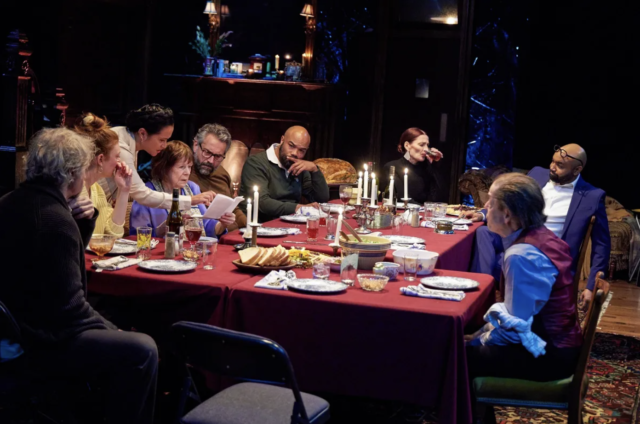
The ninety-minute play takes place at a city council meeting, where the members are arranged in a semicircle; they are like a dysfunctional family with Superba at the head of the table. Mr. Oldfield (a riotous Austin Pendleton) is the curmudgeony, doddering grandfather, Ms. Innes (Blair Brown) is the Dianne Feinstein–like matronly grandmother, Mr. Superba is the strict father, Mr. Matz (Sally Murphy) is the disheveled, ditzy sister, Mr. Breeding (Cliff Chamberlain) is the snooty, privilege-flaunting younger brother, Mr. Assalone (Jeff Still) is the unscrupulous older brother, Mr. Hanratty (Danny McCarthy) is the good-natured but misguided uncle, Mr. Blake (K. Todd Freeman) is the oddball uncle unable to make decisions for himself, and administrative assistant Ms. Johnson (Jessie Mueller) is the niece trying to keep the family together.

The newest councilmember, the fresh-faced Mr. Peel (Noah Reid), has returned to the chambers after having attended his mother’s funeral; he arrives like it’s the first day of school, bright-eyed and bushy-tailed. But he is taken aback when he sees that Mr. Carp’s (Ian Barford) space at the table is empty and no one will tell him why. “I’m sure you’ll learn what you need to know,” Johnson tells him before things get underway.

Hanratty is looking for support for his accessible public fountain restoration project, which will be highlighted by a bronze statue of a local war hero. Blake is pushing his Lincoln Smackdown idea. Innes wants to read into the record a statement about the Big Cherry Heritage Festival.

Peel (Noah Reid) shares his issues with Johnson (Jessie Mueller) in sharp Tracy Letts satire (photo by Jeremy Daniel)

Peel is intent on finding out why Carp is no longer part of the council, but no one is sharing any details. When Superba skips over the reading of the minutes from the prior week, Peel pushes back, determined that the rules of order be followed and the information be made available. It’s clear that something bad happened that the others have decided to bury, so he attempts to rectify it. However, getting to the bottom of things is not going to be easy, but as secrets are revealed, bit by bit, a clearer picture of what went on the prior week starts coming into focus, a stark portrait of where America is today in 2022, where facts are just another opinion.

Letts, who has written such previously plays as Mary Page Marlowe and Man from Nebraska and starred on Broadway in such classics as All My Sons and Who’s Afraid of Virginia Woolf?, tweaked The Minutes, which debuted at Steppenwolf in 2017, during the pandemic; the play had just begun previews at the Cort in March 2020 when Broadway closed down.

It now feels up to the moment as the play turns toward such controversies as whitewashing history, the validity of monuments, colonialism, and cultural appropriation. In addition, the show replaced the original Peel, scandal-ridden Armie Hammer, with Reid, making his splendid Broadway debut as an idealist who believes that he and the council can really make a difference. (Ha!)

Letts nails the constant frustration of government as the council goes about its activities, which are filled with personal and financial interest and a complete lack of care for the public good. The often surreal conversations reveal the utter hypocrisy and endless nonsense underlying it all as the characters pretend to discuss the underrepresented and argue over nomenclature. Peel regularly corrects the others for strange mispronunciations; “I’m not sure you’re saying that right,” he tells several of the others, but they ignore him as he learns that both what they say and how they say it just doesn’t matter.

When Breeding suggests that it is not the right time for her to read her statement, Innes declines to wait. “It is a statement I’d like to read to the council. About the council,” she says. Breeding responds, “I wonder if it might be more appropriate to read in a meeting of the Council Rules Committee.” Everyone looks at Matz, who has a problematic attention span. “Ms. Matz?” Superba says. “Yes?” she answers. Superba: “You’re chairperson of the Council Rules Committee.” Matz: “Yes, I am.” Superba: “Is there a committee meeting scheduled in the near future?” Matz: “That would depend on your definition of future.” Superba: “‘Events that will happen in the time to come.’” Matz: “Then yes, of course.”

Peel (Noah Reid) finds out more than he ever wanted to know about local politics in The Minutes (photo by Jeremy Daniel)

Another hysterical exchange, which would make Beckett proud, occurs between Superba and Oldfield:

Superba: Before we begin, any announcements?
Oldfield: I have an announcement.
Superba: All right, go ahead.
Oldfield: Well, let’s talk about parking.
Superba: Is that an announcement?
Oldfield: I’m announcing that I’d like to talk about parking.
Superba: George, that’s not an announcement.
Oldfield: I believe it is.
Superba: Announcing what you’d like to talk about is not an announcement, any more than announcing that you’re going to the bathroom.
Oldfield: Well, that’s embarrassing. I didn’t think when I came in here tonight I would have to hear the word “bathroom.”
Superba: That might not be the last time tonight you hear that word.
Oldfield: Let me go on the record as saying, “I hope it is.”
Superba: Are there any other announcements?
Oldfield: I would like to announce that there is an unclaimed empty parking space available to this council.
Superba: What are you saying, that you want the parking space?
Oldfield: No, I’m not saying that. Even though I most definitely want the parking space. . . . .
Superba: I still don’t consider this even remotely in the realm of “announcements.”

Over the course of the last few years, with the proliferation of smartphone cameras and the need to record everything, Americans have been privy more than ever to the circuslike atmosphere of town meetings, statehouse discussions, and congressional debates. We see elected representatives butcher the English language, deliver grandstand speeches chock-full of inaccuracies, and misinterpret the law every day. In The Minutes, Letts and director Anna D. Shapiro (Straight White Men This Is Our Youth), who helmed August Osage Country, present the Big Cherry council meeting as if we’re watching C-SPAN, with David Zinn capturing the essence of a council meeting chamber, complete with ridiculous local art, framed proclamations and photographs of former members, and a large U.S. flag. (The costumes are by Ana Kuzmanić, with lighting by Brian MacDevitt and sound and original music by André Pluess.)

In his superbly understated Broadway debut, Reid, the Canadian singer and actor best known for his role as Patrick Brewer on Schitt’s Creek, is a stand-in for the audience, as if he’s our elected representative (voted in by our ticket purchases?), aghast at what he’s seeing; democracy is unraveling right before his, and our, eyes, and no one else in the room seems to care.

Every word matters to Peel, as it does to Letts the playwright, who leaves us with a bizarre finale that is likely to leave your mouth agape, at a loss for words. The title applies not only to the omitted meeting records but also to the short time we have left to fix the mess we’ve made of the great American experiment.