this week in theater

AN AMERICAN TRAGEDY: AXIS THEATRE’S SPECIMEN

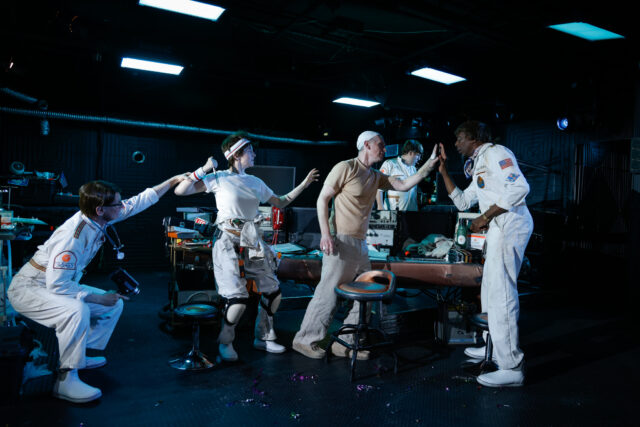
Mayhem ensues when a surprise being appears on board a corporate research vessel in Axis Theatre’s Specimen (photo by Regina Betancourt)

SPECIMEN
Axis Theatre Company
One Sheridan Sq. between West Fourth & Washington Sts.
Wednesday – Saturday through June 6, $10-$40, 7:00
www.axiscompany.org

Randall Sharp’s Specimen is not a cautionary tale of where America is heading; instead, it’s a frenetic sci-fi satire warning us that it’s already too late to save the ship and its crew.

“We are dead in the water. We’re just floating. Communication is out,” Overholser (Britt Genelin), an engineer aboard the US VitaNavis Nomad, says early on in the seventy-five-minute play. “All we need is a little push to get to the earth-pull zone for home. I hope we don’t just smash into it! Plus I could use a decent med clinic. And a haircut. I feel sick. I feel tired.”

The corporate research vessel Nomad, named after people who move around from place to place — for example, undocumented immigrants and refugees — is on a mission to collect valuable living specimens more for their potential financial value rather than their scientific worth. The crew is a ragtag “bunch of morons,” as Lt. Commander Gordon (Julian Rozzell Jr.) refers to them. Gordon has annoyed his team because he has fudged critical reports. The ambitious and energetic Overholser has been beaten up by the severely ill King (Spencer Aste, only seen on video). Dr. Gardener (Andrew Dawson), the chief medical officer, says, “I know what I’m doing” without any evidence to support that. Medical assistant Longshore (Jon McCormick) asks a lot of questions but provides no answers. Louden’s (Jim Sterling) primary responsibility is to greet newcomers, but he can’t get anything to work. And Capt. Gonickeau (Lynn Mancinelli) is hiding in sick bay, not wanting to confront any kind of problem at all.

An endless stream of glitches plagues the Nomad: Ironic, familiar pop songs come and go on the speaker system. The monitors flash on and off with reckless abandon, broadcasting a bright, sunny commercial with the VitaNavis president (Robert Ierardi) that quickly goes bad, as well as private video diaries that are not meant to be seen by others, a melding of the captain’s log and social media posts. The food supply, from saltines to what they call “SUP,” is running dangerously low. And various odd smells are wafting about. Patience is wearing thin even with Earth so close.

The Nomad’s archnemesis, the stellar Jericho, is nearby, rumored to have a pair of prize specimens that are likely to make them win the battle once again. (In the lobby case is a previous trophy the Jericho won, along with a roster of its crew, featuring one member who becomes central to the plot.) It seems like the Jericho, whose name in Arabic means “fragrant” and the Bible calls “the City of Palms,” can do no wrong, the polar opposite of the Nomad, as if one is the dream of America, the other the current reality, one an oasis, the other a boiling inferno.

But when a mysterious being (Brian Barnhart) suddenly arrives in a pod, all hell breaks loose as the crew fights over whether the creature is a fabulous Andro-Primatus specimen worth millions or jokester Jay Marlin, a doctor from the Jericho who is in need of medical help. The doctor’s last name could be a sly reference to the large fish Santiago catches and struggles to bring back in Ernest Hemingway’s The Old Man and the Sea, believing it will turn his luck around. “It is good that we do not have to try to kill the sun or the moon or the stars. It is enough to live on the sea and kill our true brothers,” Santiago says to himself.

The ramshackle set, by Sharp, McCormick, and Mancinelli, is like a bizarro-world merging of the starship Enterprise, the Discovery from 2001, and the Nostromo from Alien, with a nod to Tom Sachs’s DIY NASA installations. The white uniforms, designed by Karl Ruckdeschel, have fun touches, such as the character’s job stenciled on the back in big letters. David Zeffren’s lighting and Paul Carbonara’s sound and original music, along with Nicholas Guldner’s video design, maintain the low-tech atmosphere of impending doom.

The exemplary ensemble, consisting of Axis company members and returnees, somehow manages to keep straight faces despite all the absurdist mayhem taking place, led by Rozzell Jr. (Our Planet, Father Comes Home from the Wars) as the determined lieutenant and Genelin (Twelfth Night, Washington Square) as a kind of bruised and battered ingénue in an ill-fitting spacesuit. Each actor also sports fantabulous hair, riffing on the obvious wigs worn by the cast of the original Star Trek movies.

Sharp, who has previously adapted such classics as High Noon and Dead End and written and directed such new works as Worlds Fair Inn and Last Man Club, orchestrates a clever balance between farce and fright as the proceedings continue and the crew has to figure out who or what the specimen is and what to do with it.

It’s a subtle but ripe parody of a bumbling administration that prefers money over science, with little interest in aiding immigrants, giving their employees proper training or affordable health care, or fixing a spacecraft that is falling apart.

When the pod first pulls into the port, there is no sign of anyone there. “Hello!! Maybe . . . maybe it’s not American?” Dr. Gardener asks. Gordon replies, “Of course it’s American. What else would it be.”

Oh, this is America all right.

Over and out.

[Mark Rifkin is a Brooklyn-born, Manhattan-based writer; you can follow him on Substack here.]
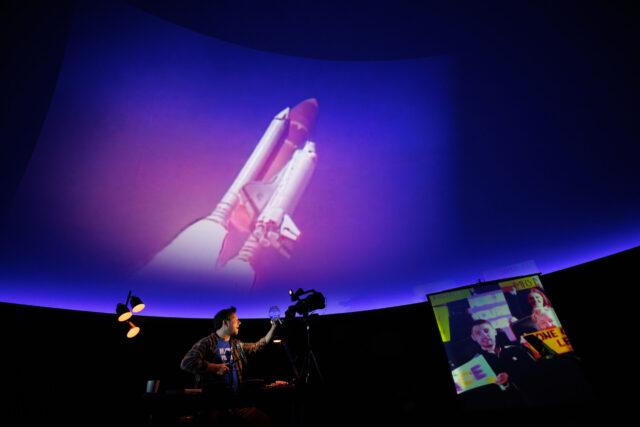
EXPLODING INTO SPACE: 73 SECONDS IN THE LOWER EASTSIDE GIRLS CLUB PLANETARIUM

The Challenger disaster offers new insight into Jared Mezzocchi’s relationship with his mother in 73 Seconds (photo by Maria Baranova)

73 SECONDS
Lower Eastside Girls Club
402 East Eighth St. at Ave. D
Thursday – Monday through May 18, $70-$140
www.engardearts.org/73seconds

“You remember where you were when it happened,” Jared Mezzocchi says in his multimedia solo show 73 Seconds. “What do you do when there is no explosion?”

I remember exactly where I was when it happened — Mezzocchi is referring to the Challenger disaster, when the space shuttle carrying a crew of seven, including the first teacher in space, Christa McAuliffe, broke apart seventy-three seconds into its flight on January 28, 1986. I was picking up my sister from high school, sitting in the car, listening to the radio when the news hit.

We went straight home, and I watched for hours as Dan Rather talked and talked about solid rocket boosters and McAuliffe and CBS showed the explosion over and over again.

“The thing about explosions is that it’s something you can point at,” Obie-winning director, actor, playwright, associate professor, and designer Mezzocchi adds. “There’s before the explosion, the explosion, and then after the explosion. It happens quickly.”

In 73 Seconds — which takes place in an actual working planetarium at the Lower Eastside Girls Club — Mezzocchi turns his attention to his mother, Rosemary, a popular teacher who, at a restaurant celebrating his high school graduation, casually mentions that she once worked for NASA. The revelation blows the space-obsessed Mezzocchi’s mind, and it gets even more complicated when she describes her connection to the Challenger.

It is such a shock to his system that he wonders if it’s actually true, especially as his mother contracts Alzheimer’s. “What am I doing, memorializing someone who’s still alive?” he asks.

It’s territory he’s explored before: In his deeply personal 2021 virtual On the Beauty of Loss, Mezzocchi related the deaths of his father and grandfather.

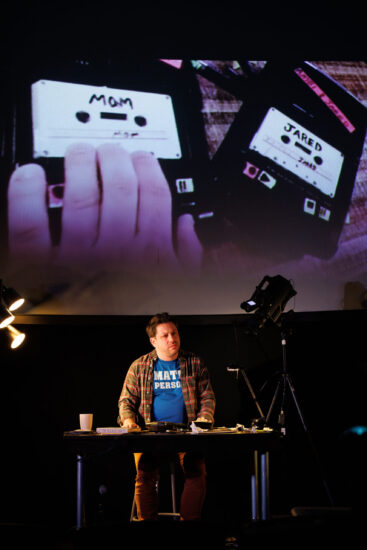
Jared Mezzocchi integrates old technology into his new solo show (photo by Maria Baranova)

Mezzocchi shares his mother’s story — which can often get too intimate and explanatory, as if he’s speaking with his therapist instead of a theater audience — using a mix of technology, much based on what was available in the 1980s, including an overhead projector, cassette tapes, poorly composed family photographs, and scratchy audio. He occasionally projects the universe onto the planetarium dome, but not quite enough. The sound is by Ryan Gamblin, with lighting and video by Jeanette Oi-Suk Yew and production design by Calvin Anderson.

Directed and co-created by the always inventive Aya Ogawa (The Nosebleed, Meat Suit, or the shitshow of motherhood), the narrative hits some bumpy snags — it’s by no means a smooth ride, but it does echo what appears to be going on inside Mezzocchi’s head as he deals with this surprising new family information, from small explosions to bigger ones — but it cleverly explores the never-ending, complex relationships between parents and children. It also answers some questions that Mezzocchi (The Wind and the Rain, Vietgone) raised in On the Beauty of Loss, when he races to the hospital after being told his father has been admitted there.

Ultimately, 73 Seconds is a touching experience, one that will have you thinking about your own relationship with your parents. It’s about how we grieve, the secrets we keep, and the connections we need to move forward.

And it’s another unique piece from En Grade Arts, which specializes in presenting work in unusual spaces, from a Brooklyn bar and New York City apartments to Brookfield Place and Hudson River Park — and now a surprise planetarium in an unexpected location.

[Mark Rifkin is a Brooklyn-born, Manhattan-based writer; you can follow him on Substack here.]
THE PLAY’S THE THING: PAYING ATTENTION TO HAMLET AND OTHELLO

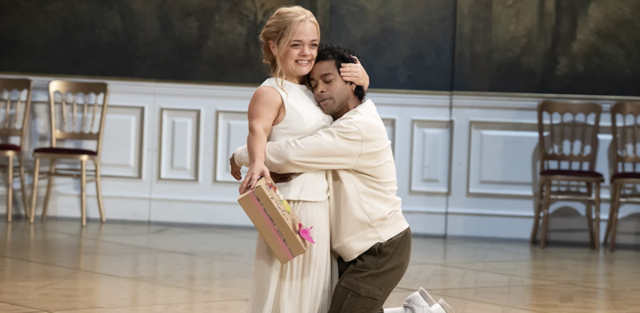
Ophelia (Francesca Mills) and Hamlet (Hiran Abeysekera) try to hold on to their love in National Theatre production at BAM (photo by Julieta Cervantes)

HAMLET
Brooklyn Academy of Music
BAM Strong Harvey
651 Fulton St.
Through May 17, $46-$226
www.bam.org/hamlet

One of the myriad great things about Shakespeare’s plays is their adaptability; they can be done as straightforwardly as possible or be transplanted into an endless number of settings, changing the time and place while staying true to the Bard’s words. Nevertheless, some productions get so caught up in their tinkering that they lose sight of the play itself.

Two current shows in New York City take different approaches to a pair of Shakespeare’s most popular tragedies, but each is a celebration of the language. I found myself discovering details in the National Theatre’s Hamlet at BAM and Bedlam’s Othello at the West End Theatre that made each work feel fresh and new across their nearly three hours.

BAM has a long history with Hamlet; it was their inaugural theatrical presentation, in 1861. It was also the National’s first play in London, in 1963. Continuing at the Harvey through May 17, director Robert Hastie (Operation Mincemeat) reimagines the dour Dane for the modern era in a dark and funny version with numerous delicate touches.

Hiran Abeysekera portrays Hamlet as a kind of nepo baby trying to find his way in a world that has suddenly shifted for him following the death of his father, the king (a terrific Ryan Ellsworth, also the Player King and the gravedigger), followed by his mother’s (Ayesha Dharker) almost immediate marriage to the king’s brother, Claudius (a splendid Alistair Petrie), who now wears the crown. It gets even more complicated when his father’s ghost appears and reveals that uncle Claudius poisoned him in order to ascend to the throne.

With vengeance on his mind, Hamlet doesn’t have enough room in his life for Ophelia (a sprightly Francesca Mills, donning angel wings), who loves him deeply. Her father, Polonius (Matthew Cottle), is Claudius’s chief counselor, and her brother, Laertes (Tom Glenister), is determined to defend her honor at any cost.

Hamlet finds comfort in his closest friend, Horatio (a delightful Tessa Wong), but is suspicious when two of his best buds from childhood, Rosencrantz (Hari Mackinnon) and Guildenstern (Joe Bolland), suddenly arrive; it’s not long before he gets them to admit that they were brought to Denmark by Gertrude to spy on him because of his recent odd behavior.

When a traveling theater troupe arrives to put on a play, Hamlet convinces the First Player (Maureen Beattie) to stage The Mousetrap with a bonus passage by Hamlet, telling the story of a man who kills his brother, the king, exactly how Claudius murdered his sibling, in order to wed his widow and become king himself. “The play’s the thing / Wherein I’ll catch the conscience of the King,” Hamlet says.

As Hamlet descends into madness, Fortinbras (Kiren Kebaili-Dwyer), the crown prince of Norway, prepares his troops to invade Denmark and bodies start piling up.

Hamlet begins in an elegant ballroom with realistic forest wallpaper and transforms into a theater for the fabulous play-within-a-play and a graveyard; the sets are by Ben Stones, who also designed the modern costumes, which for Hamlet includes a Blockbuster Video sweatshirt, a nod to Michael Almereyda’s 2000 film version in which Ethan Hawke delivers the “To Be or Not to Be” monologue while walking through a Blockbuster store, and a “Tobacco and Boys” T-shirt that references the unconfirmed Christopher Marlowe quote “All they that love not Tobacco and Boys are fools”; the phrase was also used by Shakespearean actor Stephen Fry in the title of his 1979 play, Latin! or Tobacco and Boys.

Hastie makes small tweaks to the script that practically leap off the page. Polonius tells Laertes, “To thine own selves be true,” altering “self” to “selves”; Ophelia loudly joins in when Polonius advises his son, “Neither a borrower nor a lender be”; and the “To Be or Not to Be” soliloquy is moved to later in the play, at a crucial point. The language is so front and center that the nearly endless stream of familiar phrases that became names of books, plays, and movies jumps out, from Infinite Jest and What Dreams May Come to The Undiscovered Country and Sleep No More.

As adorable as he is melancholic, Abeysekera (Life of Pi) grabs the audience’s attention from the beginning and never lets go, regularly making faces and gesturing at the crowd. When another character delivers a monologue directly to the audience, Abeysekera looks at them, and us, as if wondering what is going on, believing that only he can see and talk to us. And when he does speak to us, he has us in the palm of his hands, even with his millennial flourishes as he delivers some of Shakespeare’s most unforgettable soliloquies in his own style. He may not be Olivier, Burton, Branagh, Bernhardt, or Gielgud, but he doesn’t have to be; he just has to be Abeysekera, putting his own stamp on the part.

Through it all, the words stand tall, even conquering a few scenes that linger too long or go a bit off-kilter.

Of course, the play’s the thing.

Susannah Millonzi, Susannah Hoffman, Ryan Quinn, and Eric Tucker play all the roles in Bedlam’s stripped-down Othello (photo by Ashley Garrett)

OTHELLO
West End Theatre at St. Paul & St. Andrew United Methodist Church
263 West Eighty-Sixth St. between Broadway & West End Ave.
Tuesday – Sunday through May 30, $24-$86
bedlam.org/w-o/othello

In the National Theatre’s Hamlet, eighteen actors take on twenty-six roles on multiple sets. In Bedlam’s Othello, a cast of four performs more than a dozen parts in a bare white space, with only a handful of small props: Susannah Hoffman is Desdemona and Cassio, Susannah Millonzi is Roderigo and Emilia, Ryan Quinn is Othello and Bianca, and director Eric Tucker is Iago. As with Hamlet, Shakespeare’s words take center stage, for nearly three captivating hours.

Angry that Othello named Cassio his first lieutenant instead of him, Iago is intent on bringing Othello down, through trickery and deceit. He conspires with the Venetian gentleman Roderigo to convince everyone that the Moorish general Othello used evil witchcraft to force Senator Brabantio’s daughter, Desdemona, into a secret marriage. “Your daughter and the Moor are now making the beast with two backs,” Iago tells the powerful politician, using race as a sword.

When Othello and Desdemona publicly declare their love for each other, Iago concocts a diabolical plan to persuade Othello that his beloved is having an affair with Cassio, thus ruining the general and his lieutenant, lifting Iago’s station, and allowing Roderigo to pursue his own lust for Desdemona.

“O beware, my lord, of jealousy! / It is the green-eyed monster which doth mock / The meat it feeds on,” Iago says to Othello. “That cuckold lives in bliss / Who, certain of his fate, loves not his wronger; / But O, what damnèd minutes tells he o’er, / Who dotes yet doubts, suspects yet soundly loves!”

To achieve his revenge, Iago must also pull the wool over the eyes of his wife, Emilia, who is Desdemona’s maidservant; Bianca, Cassio’s lover; the Duke of Venice; Gratiano, Brabantio’s brother; Lodovico, Desdemona’s cousin; and Montano, the governor of Cyprus.

“Reputation, reputation, reputation!” Cassio declares.

That’s precisely what Iago seeks to destroy in anyone who gets in his way.

Othello (Ryan Quinn) and Desdemona (Susannah Hoffman) face doom and dread in Bedlam production (photo by Ashley Garrett)

The first act of Othello takes place with the actors performing on a dirty white floor in front of an unsteady white wall; initially, the only props are a bell and a black rope/noose, but a string of Christmas lights and a microphone are added for a karaoke scene. For the second act, the three rafters of seating are rearranged to form a circle closing in on the middle, where most of the action occurs, although the actors also stomp around behind the audience and up and down the aisles. Cheyenne Sykes’s lighting gets much darker, the characters at times using flashlights. The actors usually but not always make tiny adjustments to Sam Debell’s contemporary costumes to indicate when they are a different character, which can get a little awkward. The karaoke scene is awkward as well, straying from the simpler beauty of the rest of the show.

Hoffman and Millonzi excel in their multiple roles, and Quinn is an admirable, heart-wrenching Othello, but the key to the narrative lies in the hands of Iago, and Tucker, who also designed the tense sound, is a slyly devious master manipulator, his tongue often in his cheek as his plot unfolds; possessed of a rapier wit, he thinks quick on his feet, like an improv comic who’s not about to lose control of the upcoming punch line.

Bedlam’s first two productions, back in 2013, were four-actor versions of Bernard Shaw’s Saint Joan and Hamlet, so this Othello is a return to its roots following such other successful shows as Sense & Sensibility, Arcadia, The Good John Proctor, and Are the Bennet Girls OK? Because of the minimal staging, the words flow beautifully; you have to listen closely, resulting in picking up small elements you may have missed in bigger adaptations with major stars.

Through it all, the words stand tall, even conquering a few scenes that linger too long or go a bit off-kilter.

Of course, the play’s the thing.

[Mark Rifkin is a Brooklyn-born, Manhattan-based writer; you can follow him on Substack here.]

INCONCEIVABLE! WALLACE SHAWN AT METROGRAPH

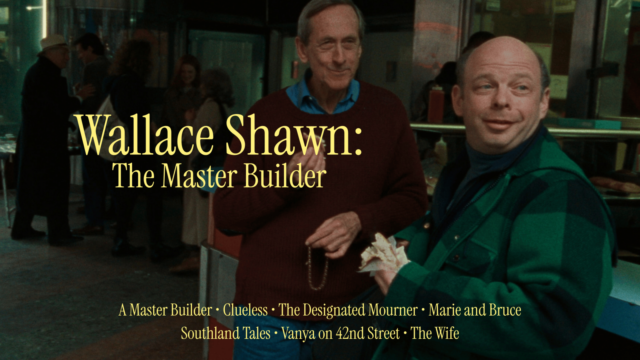
WALLACE SHAWN: THE MASTER BUILDER
Metrograph
7 Ludlow St. between Canal & Hester Sts.
May 8-22
metrograph.com

It’s inconceivable that there can ever be too much Wallace Shawn.

The eighty-two-year-old native New Yorker has written nine full-length plays, appeared in more than two hundred movies and TV series, published three books of essays, and cowritten several screenplays. Among my favorite acting roles of his are in 1981’s My Dinner with André, 1985’s Heaven Help Us, 1987’s Radio Days and The Princess Bride, and, for obvious reasons, 2020’s Rifkin’s Festival. In addition, I thoroughly enjoyed him in his 2017 play Evening at the Talk House; his current show, the terrific three-hour What We Did Before Our Moth Days, directed by André Gregory, continues through May 24 at Greenwich House Theater, where he and his longtime partner, Deborah Eisenberg, recently substituted for two ill actors and where, on Monday nights through May 18, he performs his 1991 Obie-winning monologue The Fever; and I’ve had the pleasure of bumping into him a handful of times around the city, and he has been nothing less than charming and adorable at each encounter.

Next he will be at Metrograph for “Wallace Shawn: The Master Builder,” an eight-film retrospective curated by actor and comedian John Early, who portrays Tim in Moth Days, and Lucas Kane, the play’s stage manager and assistant director; the selections are a mix of Shawn in major and minor roles or works based on his plays, in which he does not appear.

“The two of us have been lucky enough to spend the last two years steeping in this side of Wally’s practice, working on his most recent theatrical masterpiece, What We Did Before Our Moth Days,” Early and Kane said in a statement. “In awe of his particular blend of poetry and politics, we put together a program that centers around his writing — featuring two rarely seen filmic adaptations of his plays — while also celebrating his sometimes overlooked roles as a leading man, typified in his collaborations with Gregory and the late Tom Noonan. And yet! Lest we neglect his unforgettable ability to breathe life into pop films and cult classics, we’ve included a couple of films that highlight his character acting, in part, because it’s also roles like these which have helped fund his brilliant playwriting. We are proud to present these films and we hope it reveals a new side of our beloved Wally Shawn.”

The program kicks off May 8 with Amy Heckerling’s 1995 Clueless (“lt’s time for your oral.”), followed by a Q&A with Shawn, Heckerling, Early, and Kane, and Richard Kelly’s 2006 Southland Tales, introduced by Shawn and the curators. Shawn will talk with filmmaker and podcaster Theda Hammel after the May 9 screening of Tom Cairns’s 2004 Marie and Bruce, join Gregory for a Q&A after the May 15 screening of Louis Malle’s Vanya on 42nd Street, speak with Hammel and Early after the May 15 screening of David Hare’s 1997 The Designated Mourner, and, on May 22, introduce Woody Allen’s Radio Days (“Beware, evildoers, wherever you are!”) and Jonathan Demme’s 2014 A Master Builder and participate in a Q&A following a screening of Noonan’s 1995 The Wife.

“I have more free time than a lot of individuals, so, instead of talking, I sometimes write,” Shawn has said.

He clearly does a whole lot more than that.

[Mark Rifkin is a Brooklyn-born, Manhattan-based writer; you can follow him on Substack here.]
MAKING IT NEW: TALKING BAND CLIMBS THE MAGIC MOUNTAIN AT LA MAMA

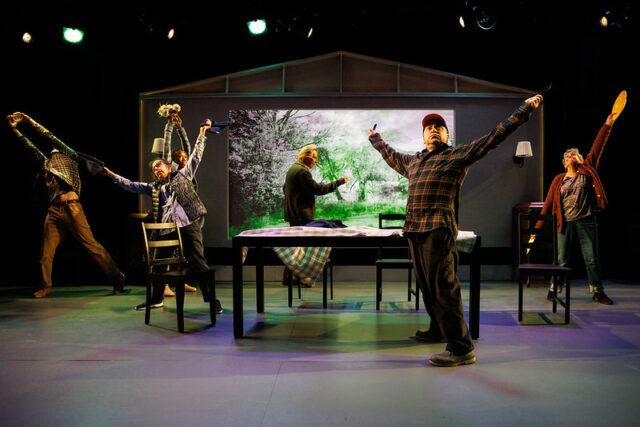
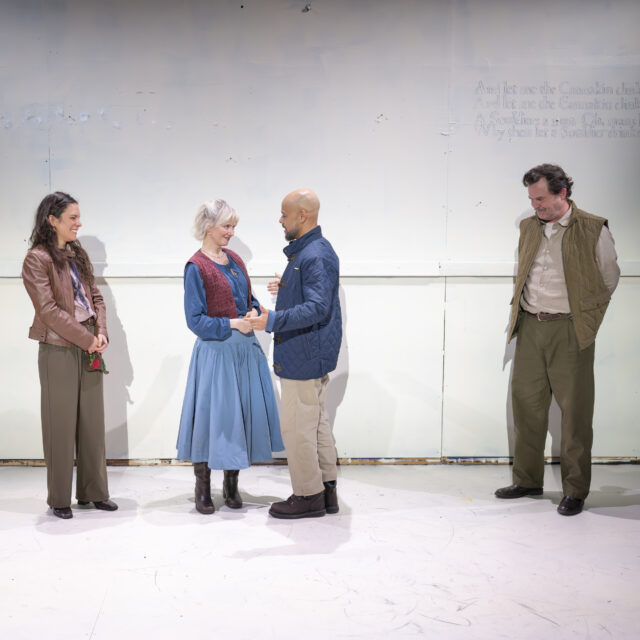
Talking Band explores the magical world of Thomas Mann’s The Magic Mountain in latest production (photo by Maria Baranova)

THE DOOR SLAMS, A GLASS TREMBLES
La MaMa Experimental Theatre Club, the Downstairs
66 East Fourth St. between Second Ave. & Bowery
Wednesday – Sunday through May 9, $35-$40
www.lamama.org
talkingband.org

“All sorts of personal aims, hopes, ends, prospects, hover before the eyes of the individual, and out of these he derives the impulse to ambition and achievement,” Thomas Mann writes in his 1924 novel The Magic Mountain, which serves as the inspiration for Talking Band’s latest play, The Door Slams, a Glass Trembles. He continues, “Now, if the life about him, if his own time seems, however outwardly stimulating, to be at bottom empty of such food for his aspirations; if he privately recognizes it to be hopeless, viewless, helpless, opposing only a hollow silence to all the questions man puts, consciously or unconsciously, yet somehow puts, as to the final, absolute, and abstract meaning in all his efforts and activities; then, in such a case, a certain laming of the personality is bound to occur, the more inevitably the more upright the character in question; a sort of palsy, as it were, which may extend from his spiritual and moral over into his physical and organic part.”

Mann’s intellectual satire about time, love, and tuberculosis at the Berghof sanatorium in Davos in the Swiss Alps, influenced by his wife’s battle with the disease, forms the basis of the new play, written and directed by Paul Zimet and composed by and starring Ellen Maddow, cofounders of Talking Band in 1974 with Tina Shepard, who also appears in the seventy-five-minute intellectual satire.

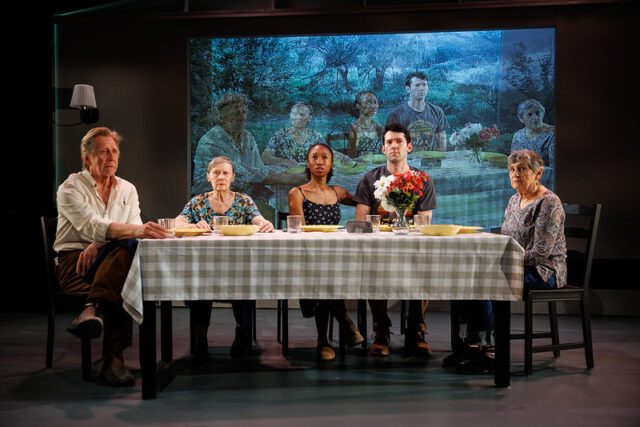
The Door Slams . . . takes place in and around the Berghof. Marc (Jack Wetherall) and Clara (Maddow) live in the area, where they are visited by their son, Norm (Patrick Dunning), a teacher, and his wife, Jenny (Amara Granderson), who have recently had a baby, Abby. Also stopping by are friends Rick (Steven Rattazzi), a podcaster, and his wife, Rita (Lizzie Olesker), who teaches after-school programs, as well as Oona (Shepard), the town tax collector.

Their movements, particularly when setting the table for a meal, break out into exquisite dances choreographed by Flannery Gregg that make inventive, if repetitive, use of the table- and silverware. As the characters discuss the moon, memory, kairos, hummingbirds, loggers, pencils, tapeworms, and dementia and play charades, Anna Kiraly’s projections on the screen behind them switch from mountains to the forest to the sea. Dream sequences based on scenes from Mann’s novel add a love interest for Marc: his old flame, Anne (Delaney Feener), who becomes the mysterious Clavdia, with Joachim (Norm), Maryusya (Jenny), Dr. Leo Blumenkohl (Rick), Miss Robinson (Rita), Frau Stohr (Oona), and Fraulein Englehart (Clara).

“I used to love to walk along the shore,” Fraulein Englehart tells the doctor. “I could walk for miles with the waves rolling in, the clumps of seaweed on the sand, the vast grey-green water stretching to the horizon. Time drowns in the monotony of space.” The thought matches what Clara later opines: “I never thought we’d be here for so long. But I got used to it. The pace, the quiet, the routine. That’s what worried me. I felt I was becoming . . . dull.”

Meanwhile, Norm is the doomsayer, adding such dark lines as “Just another sign that we’re fucked.” and “I can hardly see the trees. Everything’s about to vanish.” When Oona says that Abby, noticing the baby monitor in her room, knows she is being watched, Norm replies, “Good preparation for the future.”

The Door Slams, a Glass Trembles takes place at a sanatorium in the Swiss Alps (photo by Maria Baranova)

Norm’s foreboding highlights the critical part of The Door Slams . . . that doesn’t work: in such recent triumphs as Triplicity, Existentialism, and Lemon Girls or Art for the Artless, Talking Band beautifully danced around didacticism while exploring the human condition. In The Door Slams . . . they make a number of comments about the Trump administration, without mentioning anyone by name, but the clearer they are, the more they stick out and call attention to themselves. For example, at one point Rick argues, “I tell Rose things could get a lot worse if we just sit on our butts and don’t do anything. Rita and I went to jail protesting nuclear weapons. We got teargassed demonstrating against the Iraq War. Rose just says, ‘And look where we are now.’”

In addition, the character of Anne/Clavdia feels out of place, and certain little touches, such as Norm and Rick wearing the same T-shirt, can cause confusion.

The narrative hits its stride whenever it finds its way into the poetic. “At my age there’s a lot of past in front me,” Marc says as the rain falls. When Clara is watching Marc looking out at the world from the porch, she narrates, “He’s watching dark clouds move across the sky from south to north and he thinks that’s curious. Usually they move from west to east, and then he thinks, What will happen if she dies before I do? What will I do to fill my life? He hears the rain approaching and wonders if he should close the windows.” It’s a stunning, gorgeous moment.

Even with its shortcomings, The Door Slams . . . is still unlike anything else on or off Broadway, exemplified by a brief conversation between Anne and Marc. “‘Make it new!’ Ezra Pound. That’s what I want to do, Marc,” she states. He asks, “Make what new?” She replies, “Everything. What I write, what I read, what I see.”

I can’t wait to see what Talking Band has in store for us next.

[Mark Rifkin is a Brooklyn-born, Manhattan-based writer; you can follow him on Substack here.]
LIFE IS NO PICNIC: YOU GOT OLDER AT THE CHERRY LANE

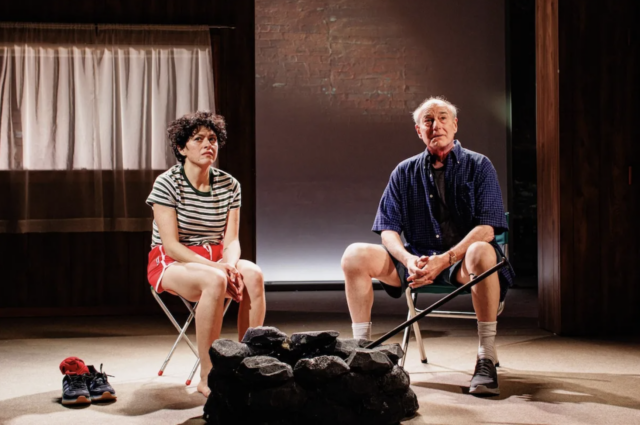
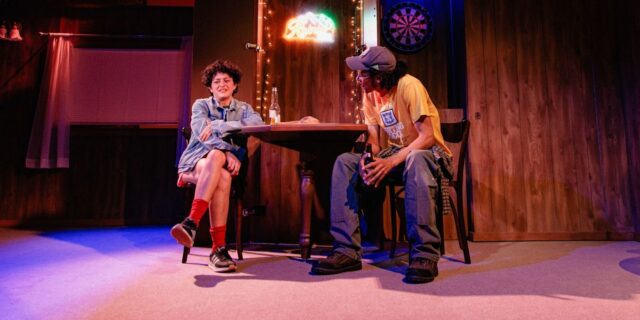
Alia Shawkat and Peter Friedman star as a daughter and father who reconnect in Clare Barron’s You Got Older (photo by Marc J. Franklin)

YOU GOT OLDER
Cherry Lane Theatre
38 Commerce St.
Tuesday – Sunday through May 3, $89-$189
www.cherrylanetheatre.org

Alia Shawkat makes an exciting theatrical stage debut as a single woman having “like the second worst moment of my life so far” in the stirring revival of Clare Barron’s You Got Older at the Cherry Lane.

After losing her job and her boyfriend at the same time — she was sleeping with her boss — the thirty-two-year-old Mae, a Minneapolis lawyer, has returned to the family home in a small agricultural town in eastern Washington State. Not only does she need a respite, but her father (Peter Friedman) has cancer of the larynx, so she can help out at least for a while.

Nearly everyone in their circle seems to be having issues with physical bodies. In addition to their father’s illness, Mae, who no longer has health insurance, has a lump in her throat and a large, ugly rash that requires special ointment; her sister Jenny (Nina White) has a pericardial cyst and can’t eat meat or gluten; her sister Hannah’s (Nadine Malouf) ex-boyfriend died of a rare blood cancer, and she thinks she may be passing bad skin, cancer, Alzheimer’s, Parkinson’s, and male pattern baldness to her son; her brother, Matthew (Misha Brooks), might have a weird penis; her old schoolmate Mac (Caleb Joshua Eberhardt) admits to liking pus, scabs, and flaky skin; Mae’s fantasy lover, Luke the Canadian Cowboy (Paul Cooper), has weeping lesions from his neck to his groin; and the entire Hardy family suffers from acidic mouths and body odor.

Mae wants to move forward but inner and outer forces seem hell-bent on preventing that. In addition to having to move back to the house where she grew up, she has been told by her dentist that she should use a child-size toothbrush, she’s horny like she way when she was in high school, and she sneaks Mac into her bedroom to hide him from her father. She also has a cat named, appropriately enough, Murphy, hinting that everything that could go wrong just might.

Mae (Alia Shawkat) and Mac (Caleb Joshua Eberhardt) share their likes and dislikes in revival at the Cherry Lane (photo by Marc J. Franklin)

“I hate it when I feel helpless,” she tells her father, who doesn’t mind occasionally not being in control. “I love it when you just get to lie back and let people take care of you,” he says to Mae, who can’t understand that.

When the whole family is finally together, Jenny proclaims, “It’s like we’re on a picnic.”

Not quite.

Barron (Shhhh, Dance Nation), who won an Obie for the play, wrote You Got Older after her father was diagnosed with cancer and she went through a breakup. In a program note, she writes, “This play was written and finished in the middle of a personal crisis — before anything was resolved. And so, for me it remains a kind of play without perspective. The characters are so far inside of something that they don’t know how to explain what’s happening to them. The result is a lot of avoidance.”

While there is plenty of psychological avoidance — most of the characters exist in their own private space — the act of physically touching occurs over and over again, whether it is the application of ointment, hugging a stranger who may be crying, or having sex. The father is the only one who likes to get his hands dirty, as evidenced by the garden he has started where he grows peppers and other plants.

Anne Kaufman (Mary Jane, The Nether) helmed the 2014 premiere, which included Obie winners Brooke Bloom and William Jackson Harper and Tony winners Reed Birney and Miriam Silverman, and she directs the revival as well, keeping things dark and mysterious, alternating between fantasy and reality as Mae tries to find her way in a world that’s letting her down but she can’t get back on track. The transitions between scenes on Arnulfo Maldonado’s ever-morphing set can be as bumpy as some of the subplots, but the challenging narrative makes it all worthwhile.

Shawkat (Arrested Development, Search Party) is alluring as a woman who is as unpredictable as she is appealing. Friedman (Job, The Nether) once again is masterful as a sweet man who remains upbeat as he faces the end, exemplified by the theme song he has chosen for himself, Regina Spektor’s “Firewood,” in which she sings, “Rise from your cold hospital bed / I’ll tell you, you’re not dying / Everyone knows you’re going to live / So you might as well start trying.”

Even as we get older, it’s never time to stop trying.

[Mark Rifkin is a Brooklyn-born, Manhattan-based writer; you can follow him on Substack here.]
HERE’S TO THE EXTRAS: WHAT HAPPENED WAS . . . AT AUDIBLE’S MINETTA LANE

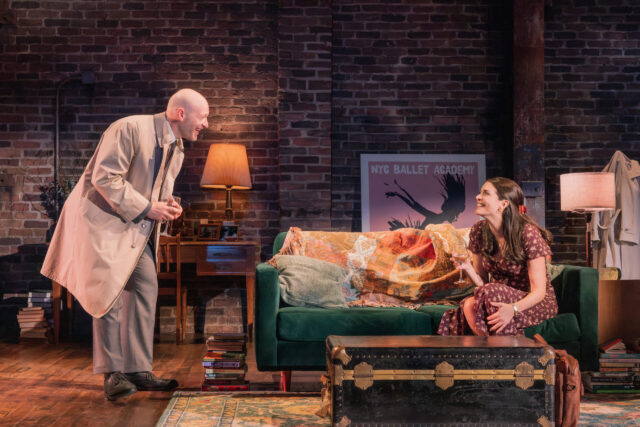
Michael (Corey Stoll) and Jackie (Cecily Strong) are on a first date in revival of Tom Noonan play (photo by Evan Zimmerman for MurphyMade)

WHAT HAPPENED WAS . . .
Audible’s Minetta Lane Theatre
18 Minetta Lane between Sixth Ave. and MacDougal St.
Through May 28, $55-$236.50
www.audible.com

“It’s weird . . . sometimes when I’m on the subway and people are whirring by me — lots of them — or on a bus looking out at the crowded sidewalks — it’s hard to believe that I have a life like all those people — that I am going through all this stuff, you know — that we’re all just not like extras,” Jackie says in Tom Noonan’s What Happened Was . . . “You mean like on a movie?” Michael responds. Jackie answers, “Yeah, it’s like we’re not here — that we don’t really have lives.”

It’s a feeling most everyone has had at one time or another, especially in New York, where both Jackie and Michael, two unusual, lonely people, work at the same law firm, she an executive assistant, he a paralegal. Of course, they don’t really have lives; they’re characters that first appeared in a 1992 play that debuted in the round at the Paradise Theater, which Noonan founded, on East Fourth St., followed by a highly influential 1994 indie film that gained great acclaim. Both were written and directed by Noonan, who also starred as Michael opposite Karen Sillas as Jackie onstage and on the big screen.

Those roles are now being performed by Corey Stoll and Cecily Strong, respectively, in a sparkling revival at Audible’s Minetta Lane Theatre, part of the company’s collaboration with Hugh Jackman and Sonia Friedman’s Together, which began last year with Ella Hickson’s Sexual Misconduct of the Middle Classes and August Strindberg’s Creditors in repertory. This spring, What Happened Was . . . is running in repertory with Sexual Misconduct through April 30, then with Hickson’s New Born, featuring Jackman, Marianna Gailus, and Sepideh Moafi. All are directed by Ian Rickson.

What Happened Was . . . takes place in real time on one night. Jackie has invited Michael over to her apartment for dinner, a first date, although Michael seems a bit clueless initially. They gossip about people at work, discuss music, and talk about their apartments — Jackie’s studio has a great view on the west side, while Michael lives in a one-bedroom on the east side. She comes from a big family on Long Island, while he was raised in Westchester.

He is tightly wound, moving stiffly, complaining about words that bother him (ritzy, seafood), explaining how birds are dinosaurs, and grimacing when Jackie announces they’ll be eating frozen scallops she’s heating up in the microwave, leading him to describe just how the appliance works. He keeps his briefcase nearby and doesn’t seem to be comfortable in his own skin.

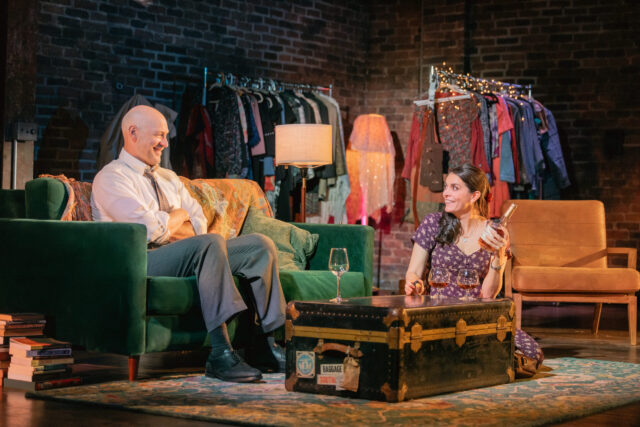
Corey Stoll and Cecily Strong are terrific in Audible/Together production of What Happened Was . . . (photo by Evan Zimmerman for MurphyMade)

Walking around barefoot, she is a freer spirit who shares what’s on her mind without a filter, although she wants everything to go right with Michael. She comments on how the suits he wears at the office make him look like a partner; meanwhile, in the corner opposite the kitchen are several racks of clothes, as if Jackie’s wardrobe is a theatrical costume room. (Brett J. Banakis and Christine Jones’s cozy set also features a pull-out sofa, a record player, wooden floors, small tables with lamps, a black chest, and a New York City Ballet Academy poster.)

As Jackie keeps pouring more wine, the two lost souls connect and disconnect as Michael goes into detail about the novel he is writing and Jackie is tempted to read her latest children’s story, which turns out to be utterly unforgettable. Having worked in children’s publishing for more than twenty-five years, I can say that I’ve never heard anything like it before.

Deftly directed by Rickson, What Happened Was . . . is a compelling adult tale boasting two outstanding performances; Stoll (Plenty, Othello), who chose not to watch the film version before doing the play, and Strong (Brooklyn Laundry, The Search for Signs of Intelligent Life in the Universe) once again prove that they are among our finest actors, each adding small touches of nuance and detail that give depth to their characters. You have to watch them every second to catch it all.

It’s a shame that Noonan, who also made such films as The Wife and The Shape of Something Squashed and had recurring roles on such series as The Beat, Damages, and 12 Monkeys, will be unable to see the production; he passed away on Valentine’s Day at the age of seventy-four.

In the early scene cited above, Michael continues, “I would have thought you’d feel real and that everyone else was an extra.” Jackie responds, “Yeah, I guess, but not really.” A moment later Michael makes a toast: “Here’s to the extras.”

Amen to that.

[Mark Rifkin is a Brooklyn-born, Manhattan-based writer; you can follow him on Substack here.]