Tag Archives: william shakespeare

BAM NEXT WAVE FESTIVAL: RICHARD III

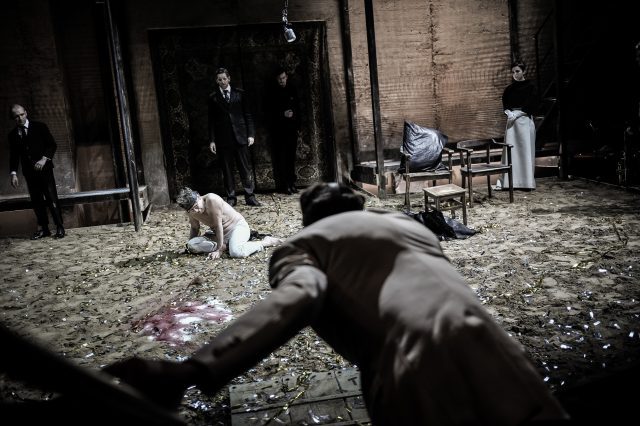
(photo by Arno Declair)

Thomas Ostermeier transforms Richard III into a glittery spectacle in German production (photo by Arno Declair)

Brooklyn Academy of Music
BAM Harvey Theater
651 Fulton St.
October 11-14, $35-$115, 7:30
718-636-4100
www.bam.org
www.schaubuehne.de

German director Thomas Ostermeier and Schaubühne Berlin return to BAM with a wildly unpredictable, glittery, contemporary take on William Shakespeare’s paean to power and ego, Richard III, running October 11-14 at the BAM Harvey as part of BAM’s 2017 Next Wave Festival. Last at BAM in 2013 with An Enemy of the People —his previous shows at BAM include Nora in 2004, Hedda Gabler in 2006, and The Marriage of Maria Braun in 2010 — Ostermeier now presents the Bard as if caught up in endless expressionistic glam decadence. Lars Eidinger plays the hunchbacked villain, with Moritz Gottwald as Buckingham, Eva Meckbach as Elizabeth, and Jenny König as Lady Anne. The pulsating soundtrack is by Nils Ostendorf, with songs by Tyler Gregory Okonma, Laurie Anderson, Iannis Xenakis, and Thomas Tomkins and Andrew John Powell; Thomas Witte provides live drumming. The luxuriously gaudy visual style comes courtesy of set designer Jan Pappelbaum, with costumes by Florence von Gerkan, video by Sébastien Dupouey, dramaturgy by Florian Borchmeyer (who adapted An Enemy of the People), and lighting by Erich Schneider. On October 12 at 6:00 ($25) at BAM Rose Cinemas, Ostermeier will sit down for an “Iconic Artist Talk” with playwright Branden Jacobs-Jenkins (Everybody, An Octoroon), who is adapting Ostermeier and Borchmeyer’s An Enemy of the People for a Broadway run later this season.

BAM NEXT WAVE FESTIVAL 2017

(photo by Bo Lahola)

Tanztheater Wuppertal/Pina Bausch’s Café Müller returns to BAM for Next Wave Festival (photo by Bo Lahola)

BAM Harvey Theater, 651 Fulton St.
BAM Howard Gilman Opera House, 30 Lafayette Ave.
BAM Fisher, 321 Ashland Pl.
September 14 – December 16
718-636-4100
www.bam.org

As usual, we are considering moving in to the Brooklyn Academy of Music for three months after the announcement of the lineup for the thirty-fifth BAM Next Wave Festival, running September 14 through December 16 at the Harvey, the Howard Gilman Opera House, and the Fisher. “This year’s Next Wave showcases artists from Switzerland to Senegal in creative dialogue with historic events, personal histories, and the present moment,” longtime BAM executive producer Joe Melillo said in a statement. The roster includes old favorites and up-and-comers from around the world, with several surprises. Dance enthusiasts will be particularly impressed with the schedule, which begins September 14-24 with a superb double bill of Tanztheater Wuppertal/Pina Bausch’s Café Müller and The Rite of Spring, which were part of the first Bausch program at BAM back in June 1984. For The Principles of Uncertainty (September 27-30), Maira Kalman teams up with John Heginbotham, Dance Heginbotham, and the Knights to bring her online graphic diary to life. New York Live Arts artistic director and cofounder Bill T. Jones returns to BAM with the Bill T. Jones/Arnie Zane Company and composer Nick Hallett for A Letter to My Nephew (October 3-7), about his nephew, Lance T. Briggs, who battled illness and addiction. Senegalese artist Germaine Acogny takes center stage for the emotional solo piece Mon élue noire (My Black Chosen One): Sacre #2 (October 4-7), choreographed specifically for her by Olivier Dubois of Ballet du Nord, set to music by Stravinsky. Also on the movement bill are Joshua Beamish/MOVETHECOMPANY’s Saudade, Cynthia Oliver’s Virago-Man Dem, ODC/Dance, Brenda Way, and KT Nelson’s boulders and bones, David Dorfman Dance’s Aroundtown, Hofesh Shechter Company’s Grand Finale, Xavier Cha’s Buffer, Big Dance Theater’s 17c, and Tesseract, a multimedia collaboration between Charles Atlas, Rashaun Mitchell, and Silas Riener.

(photo by Arno Declair)

Schaubühne Berlin presents the U.S. premiere of its unique take on Richard III at BAM Next Wave Festival (photo by Arno Declair)

The festival also boasts impressive theater productions, kicking off October 11-14 with Schaubühne Berlin’s tantalizing version of Shakespeare’s Richard III, translated and adapted by Marius von Mayenburg, directed by Thomas Ostermeier, and starring Lars Eidinger. Théâtre de la Ville, Paris is back November 2-4 with Albert Camus’s State of Siege, directed by Emmanuel Demarcy-Mota. Tony-winning Belgian director Ivo van Hove takes on Ayn Rand in Toneelgroep Amsterdam’s four-hour The Fountainhead November 28 to December 2. Rachel Dickstein and Ripe Time bring Naomi Iizuka’s adaptation of Haruki Murakami’s Sleep to the Fisher November 20 to December 2. Fresh off her Broadway stint in Marvin’s Room, Lili Taylor stars in Farmhouse/Whorehouse: An Artist Lecture by Suzanne Bocanegra, directed by Lee Sunday Evans (December 12-16). Geoff Sobelle, who went solo at BAM for The Object Lesson, is joined by an ensemble of designers and dancers for Home (December 6-10). And be on the lookout for Manfred Karge, Alexandra Wood, and Wales Millennium Centre’s Man to Man, Thaddeus Phillips and Steven Dufala’s A Billion Nights on Earth, the Cameri Theatre of Tel-Aviv’s adaptation of Etgar Keret’s Suddenly, directed by Zvi Sahar and PuppetCinema, Manual Cinema’s Mementos Mori, Marc Bamuthi Joseph/The Living Word Project’s /peh-LO-tah/, and James Thierrée and Compagnie du Hanneton’s La grenouille avait raison (The Toad Knew).

Music aficionados have plenty to choose from, with Olivier Py Sings Les Premiere Adieux de Miss Knife, Kronos Quartet, Rinde Eckert, and Vân-Ánh Võ’s My Lai, Bang on a Can All-Stars, Michael Gordon, David Lang, Julia Wolfe, and Michael Counts’s Road Trip, Gabriel Kahane’s Book of Travelers, Rithy Panh, Him Sophy, Trent Walker, Jonathan Berger, and Harriet Scott’s Bangsokol: A Requiem for Cambodia, Wordless Music Orchestra and Chorus’s two-part John Cale: The Velvet Underground & Nico, and the New York premiere of American Repertory Theater’s Crossing, an opera inspired by Walt Whitman’s “Crossing Brooklyn Ferry,” composed, written, and conducted by Matthew Aucoin and directed by Diane Paulus. The season is supplemented with several postperformance talks and master classes.

SHAKESPEARE IN THE PARK: A MIDSUMMER NIGHT’S DREAM

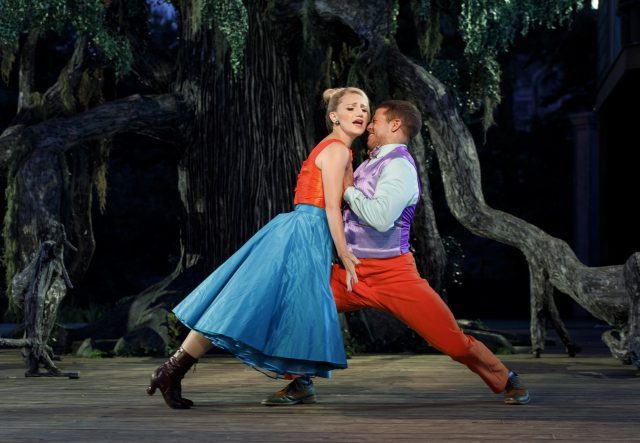
(photo by Joan Marcus)

Annaleigh Ashford steals the show as Helena in Shakespeare in the Park presentation of A Midsummer Night’s Dream (photo by Joan Marcus)

Central Park
Delacorte Theater
Tuesday-Sunday through August 13, free, 8:00
shakespeareinthepark.org

Since 2013, Public Works founder and resident director Lear deBessonet has presented special short-run summer productions of classic works at the Delacorte Theater consisting of professional and nonprofessional actors, with casts of more than two hundred men, women, and children, from community organizations from all five boroughs in addition to theater veterans. The Public Theater initiative has included musical adaptations of The Tempest, The Winter’s Tale, Twelfth Night, and The Odyssey. DeBessonet also directed Bertolt Brecht’s Good Person of Szechwan indoors at the Public’s Martinson Hall. But now the thirty-something Baton Rouge native and longtime Brooklynite is moving to one of the Public Theatre’s largest and best-loved programs, making her Shakespeare in the Park directorial debut. She’s helming the Bard’s A Midsummer Night’s Dream, which would appear to be a terrific vehicle for her sensibilities but which turns out to be a mixed bag, though still fun. The romantic comedy is one of Shakespeare’s most delightful and well-structured plays, with four intersecting plots dealing with the notion of love in all its forms. Theseus, the Duke of Athens (Bhavesh Patel), is preparing to wed Hippolyta, queen of the Amazon (De’Adre Aziza). Hermia (Shalita Grant) is in love with Lysander (Kyle Beltran), but her father, Egeus (David Manis), insists that she marry Demetrius (Alex Hernandez) or face severe punishment. Helena (Annaleigh Ashford) is madly in love with Demetrius, who has no interest in her. Meanwhile, an acting troupe of artisans known as the Mechanicals — carpenter Peter Quince (Robert Joy), weaver Nick Bottom (Danny Burstein), bellows mender Francis Flute (Jeff Hiller), tinker Snout (Patrena Murray), joiner Snug (Austin Durant), and tailor Robin Starveling (Joe Tapper) — have come to Athens to put on a production of Ovid’s Pyramus and Thisbe, about a pair of Babylonian lovers, a wall, and a lion, but professionalism is not their forte. And deep in the forest are the Fairies, including King Oberon (Richard Poe) and Queen Titania (Phylicia Rashad), who are battling over a changeling boy (Benjamin Ye), along with Robin Goodfellow, better known as Puck (Kristine Nielsen), Peaseblossom (Vinie Burrows), Cobweb (Manis), and Mustardseed (Warren Wyss). Magical elixirs, mistaken identity, and animal transformation ensue. “The course of true love never did run smooth,” Lysander tells Hermia. And Puck declares, “Lord, what fools these mortals be!”

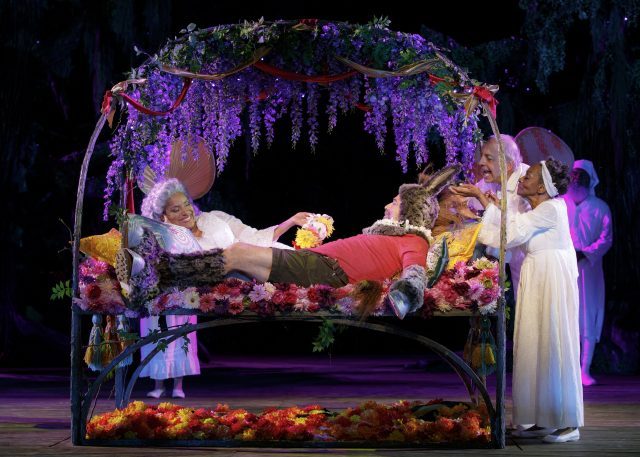
(photo by Joan Marcus)

Titania (Phylicia Rashad) finds a strange bedfellow in Nick Bottom (Danny Burstein) in Bard show at the Delacorte (photo by Joan Marcus)

A Midsummer Night’s Dream practically demands to be performed outside, and the Delacorte is a splendid home for it. Tony winner David Rockwell’s (She Loves Me) fairy-tale set features three lush green trees, a movable stone wall entranceway, a tree house where the band plays, and a playground slide amid the clouds, stars, flying insects, and backstage raccoons. The fab costumes, including a glamorous shout-out to Beyoncé, are by Tony winner Clint Ramos (Eclipsed). Tony winner Ashford (Kinky Boots, You Can’t Take It with You) steals the show as Helena, once again displaying her spectacular aptitude for physical comedy; her line deliveries, facial expressions, and wacky movements make the production worthwhile all on their own. Six-time Tony nominee Burstein (Fiddler on the Roof, Cabaret) has a ball as Bottom, who is turned into a donkey, although the play-within-a-play drags on a bit too long. Casting senior citizens as the fairies, dressed in white night clothing, is cute at first but eventually slows things down, and not even the always outstanding Nielsen can turn it around. And there’s usually sexual tension surrounding the changeling, but deBessonet has made him a young boy searching for a home. Marcelle Davies-Lashley belts out some hot New Orleans–tinged R&B as a fairy singer in a glitzy gown, but her appearances are disruptive to the narrative, taking the audience out of Shakespeare’s fantasy world. (The band consists of music director Jon Spurney on keyboards and guitar, Jeremy Chatzky on bass, Christian Cassan on drums and percussion, Andrew Gutauskas on reeds, Freddy Hall on guitar, and Matt Owens on trumpet and flugabone.) Despite the production’s disjointedness, there is nary a better way to spend a night outdoors in New York City, especially for free. As Puck relates, “If we shadows have offended, / Think but this, and all is mended, / That you have but slumbered here / While these visions did appear.”

SHAKESPEARE IN THE PARK: JULIUS CAESAR

(photo by Joan Marcus)

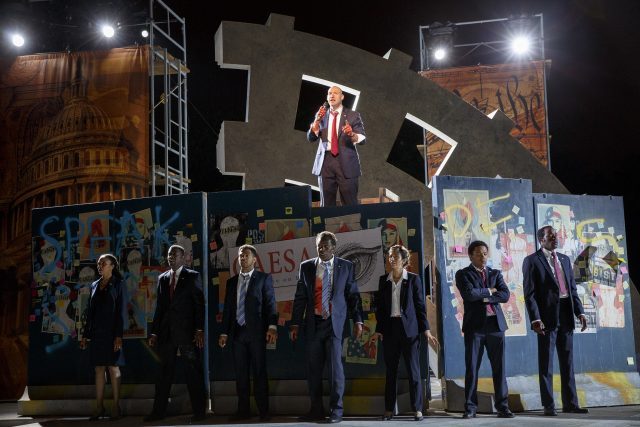
Marc Antony (Elizabeth Marvel) bows down to Julius Caesar (Gregg Henry) in controversial Shakespeare in the Park staging (photo by Joan Marcus)

Central Park
Delacorte Theater
Through June 18, free, 8:00
shakespeareinthepark.org

In his October 14, 2016, opinion piece “Donald Trump is America’s Julius Caesar” for the Daily Caller, Moses Apostaticus wrote, “Every so often in history a man comes along who overthrows a corrupt elite and resets the political establishment. We live in such a time. In our time that man is Donald Trump.” Freelance writer Apostaticus came to praise Trump, not to bury him, explaining, “Trump’s similarities to Caesar are striking. . . . Like Caesar, Trump has become a lightning rod for the growing discontent of the American people.” In 1864, in a one-time-only benefit to raise funds for a statue of William Shakespeare to be placed in Central Park, the three Booth brothers staged the Bard’s 1599 tragedy, Julius Caesar. John Wilkes Booth wanted to play Brutus, but the meaty part went to Edwin; John played Marc Antony, while Junius portrayed Caius Cassius. John Wilkes Booth might not have gotten to stab the Roman leader onstage, but the following year he assassinated President Abraham Lincoln in Ford’s Theatre. Which brings us to Public Theater artistic director Oskar Eustis’s controversial Shakespeare in the Park version of Julius Caesar, which opened tonight at the Delacorte a day after Delta Airlines and Bank of America pulled their sponsorship of the beloved Public Theater summer series. Eustis has transformed Caesar into Trump: Gregg Henry, who portrayed Trump-like presidential contender Hollis Doyle on Scandal, wears a blue suit with an overlong red tie and is accompanied by his wife, Calpurnia (Tina Benko), who swats his hand away when he tries to hold it. Calpurnia looks and speaks like Melania but has Ivanka’s blond hair, while tribune Marullus (Natalie Woolams-Torres) resembles Trump aide Omarosa Manigault. This Caesar tweets from the bathtub, but his smart, strong right-hand woman, Marc Antony (Elizabeth Marvel), is no mere Kellyanne Conway in a track suit.

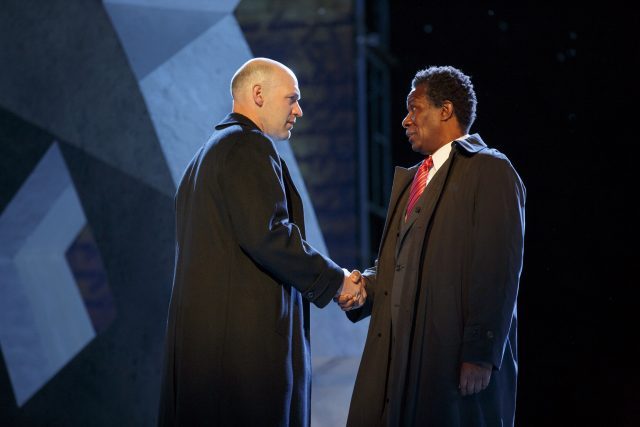
(photo by Joan Marcus)

Brutus (Corey Stoll) and Cassius (John Douglas Thompson) conspire in Julius Caesar at the Delacorte (photo by Joan Marcus)

In some ways, the play recalls Orson Welles’s 1937 Mercury Theatre production, in which Caesar was based on Italian Fascist dictator Benito Mussolini ruling in modern-day Rome. Eustis sets his story in the Occupy world; before the show starts, the audience is invited up to the stage to add their views on the state of the country on a post-it and stick it onto a kind of anarchist wall. In the back of David Rockwell’s stage are three large depictions of the U.S. Capitol, a piece of the Constitution, and George Washington, along with two broken, movable sections of what could be a large crown or ancient architectural structure. The cast is dressed in contemporary clothing designed by Paul Tazewell. Caesar has just taunted the Roman rabble with the possibility he may accept their adulation and become emperor of Rome, leading a group of powerful senators — Marcus Brutus (Corey Stoll), Caius Cassius (John Douglas Thompson), Casca (Teagle F. Bougere), Decius Brutus (Eisa Davis), Cinna (Christopher Livingston), Metullus Cimber (Marjan Neshat), Trebonius (Motell Foster), and Ligarius (Chris Myers) — to bring him down in order to save the republic. So, about halfway through the intermissionless two-hour play, Caesar is brutally murdered, lying on his back as the killers wash their hands in a pool of his blood. It’s a horrifically difficult scene to watch, since Eustis is so clear that his Caesar represents Donald Trump. (A line of dialogue is even changed to include Fifth Ave., where Trump Tower is.) Like Kathy Griffin holding up an art piece of Trump’s bloodied head, Eustis has gone too far, past the bounds of thoughtful, provocative theater into a dangerous and extremely disconcerting realm. Staging such a blatant mock assassination of the president of the United States is completely unjustified and indefensible.

Brutus (Corey Stoll) addresses the people of Rome in Oskar Eustis adaptation of Shakespeare tragedy (photo by Joan Marcus)

Brutus (Corey Stoll) addresses the people of Rome in Oskar Eustis’s adaptation of Shakespeare tragedy (photo by Joan Marcus)

Other than that, how was the play, Mrs. Lincoln? Well, in the first half, when Caesar is offstage, it is very good. The relationship between Brutus and Cassius is well developed by a calm, soft-spoken Stoll and a bold, dynamic Thompson. Nikki M. James is moving as Brutus’s concerned wife, Portia, and Nick Selting is engaging as Lucius, Brutus’s dedicated servant. Even the murder scene itself is splendidly choreographed, were it not for whom the victim represents. And once Caesar is dead, the play falls apart, and not only because of the Trump references. Marvel’s delivery of Marc Antony’s famous speech gets lost in a murmuring crowd that is dispersed throughout the Delacorte, Roman guards have been turned into evil, robotlike cops running rampant on protesters, and, for some reason, Brutus sleeps in an insipid yellow college dorm room. In a promotional statement before previews began on May 23, Eustis, who last directed Hamlet at the Delacorte in 2008, said, “Julius Caesar can be read as a warning parable to those who try to fight for democracy by undemocratic means. To fight the tyrant does not mean imitating him.” It also does not mean staging his assassination, even in the name of art.

OTHELLO

(photo by Chad Batka)

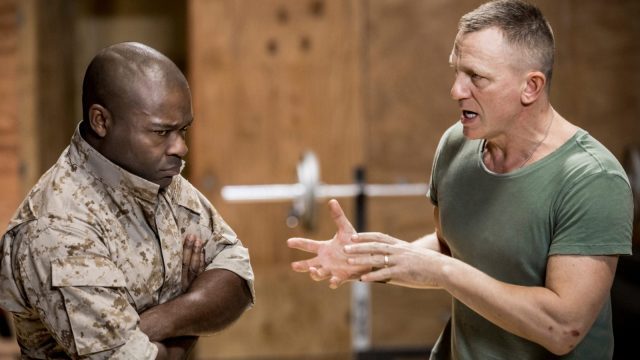
Iago (Daniel Craig) makes his case to Othello (David Oyelowo) in gripping NYTW production (photo by Chad Batka)

New York Theatre Workshop
79 East Fourth St. between Second & Third Aves.
Tuesday – Sunday through January 18, $129
Thursday, January 12 benefit, $1,500 – $2,500
www.nytw.org

“Were I the Moor I would not be Iago. In following him, I follow but myself. Heaven is my judge, not I for love and duty,” Iago (Daniel Craig) says in the first scene of William Shakespeare’s Othello. “I am not what I am.” What he is is a villain, one of the most devious in the Bard’s canon, and in Sam Gold’s captivating, intense production at New York Theatre Workshop, the audience is also Iago’s judge. Set designer Andrew Lieberman has transformed NYTW into a plywood-encased military barracks where the audience sits on benches on three sides of the action, the main sections holding rows of twelve people, like courtroom juries. The soliloquies are delivered as if closing statements in a trial, the characters trying to convince the audience of their innocence — or guilt. Reminiscent of Nicholas Hytner’s 2013 National Theatre production set in a contemporary military base (among other locations), NYTW’s version is sparer, the long, narrow stage area featuring mattresses and lights on the floor. Iago, ensign to military hero and Moor Othello (David Oyelowo), is determined to exact revenge on Othello for an unproved slight by sabotaging his marriage to Desdemona (Rachel Brosnahan), the daughter of Venetian senator Brabantio (Glenn Fitzgerald). With the help of his naïve friend Roderigo (Matthew Maher), Iago concocts a plan to drive Othello mad with jealousy, trying to convince him that Desdemona is in love with Michael Cassio (Finn Wittrock), Othello’s dedicated captain. “Thou art sure of me. I have told thee often, and I retell thee again and again, I hate the Moor,” Iago says to Roderigo. “My cause is hearted; thine hath no less reason. If thou canst cuckold him, thou dost thyself a pleasure, me a sport,” he adds, explaining how he will get even with Othello, believing that the Moor might have bedded his wife, Emilia (Marsha Stephanie Blake). After Roderigo exits, Iago states his case to the audience-jury: “And it is thought abroad that ’twixt my sheets ’has done my office. I know not if ’t be true, but I, for mere suspicion in that kind, will do as if for surety. He holds me well. The better shall my purpose work on him.” As Othello falls for the ruse, tragedy awaits.

(photo by Chad Batka)

New York Theatre Workshop is transformed into military barracks in Sam Gold’s OTHELLO (photo by Chad Batka)

Royal Shakespeare Company veteran Oyelowo (Volpone, Prometheus Bound) and Craig (A Steady Rain, Casino Royale) make a formidable duo as Othello and Iago, roles previously played by such pairs as Paul Robeson and José Ferrer, Richard Burton and John Neville (alternating parts), Laurence Olivier and Frank Finlay, Chiwetel Ejiofor and Ewan McGregor, and Laurence Fishburne and Kenneth Branagh. Craig is tough and determined as Iago, dead-set on succeeding in his evil goal, while Oyelowo combines an engaging ardor with a heartbreaking vulnerability. Emmy nominee Brosnahan (The Big Knife, House of Cards) plays Desdemona with a strong independence, Blake (Joe Turner’s Come and Gone, Hurt Village) brings depth to Emilia, and Wittrock (Death of a Salesman, American Horror Story) is firm and solid as the loyal Cassio. Through much of the play, other soldiers (Blake DeLong, Anthony Michael Lopez, Kyle Vincent Terry, Slate Holmgren) roam the stage, carrying machine guns, as if violence can explode at any moment, always on the verge of war, keeping things tense as well as frighteningly contemporary, given the state of the world today. Tony winner Gold (Fun Home, The Flick) keeps the racial aspect of Othello simmering just below the surface, ever-present but not overwhelming, casting a black Othello and Emilia and a white Iago and Desdemona among the multiracial cast. (Surprisingly, for most of the twentieth century, Othello was played by white men in major productions, sometimes in blackface.) Gold occasionally breaks the tension with drinking songs led by DeLong on guitar, the characters declaring at one point, “We are, we are, we are, we are the Engineers. / We can, we can, we can demolish forty beers. / Drink up, drink up, drink up and come along with us / ’Cause we don’t give a damn about any old man who don’t give a damn about us.” They’re odd but necessary sidebars in this powerful and intimate three-hour show that grabs you and never lets you go.

KINGS OF WAR

(photo by Richard Termine)

Henry V (Ramsey Nasr) doesn’t take kindly to French threats in Ivo van Hove’s KINGS OF WAR (photo by Richard Termine)

BAM Howard Gilman Opera House
Peter Jay Sharp Building
230 Lafayette Ave.
November 3-6, $30-$130
718-636-4100
www.bam.org
tga.nl/en

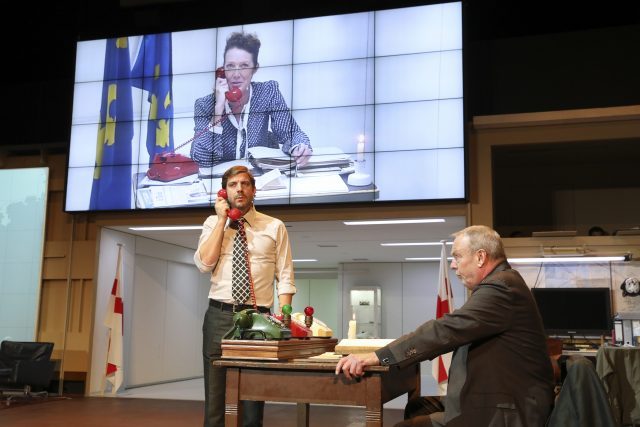
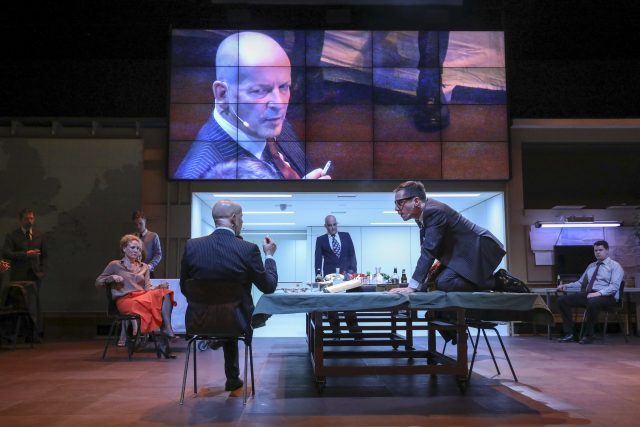
If you’ve ever wondered just what all the fuss is about Ivo van Hove, then hustle over to BAM’s Howard Gilman Opera House and see the Dutch-based Belgian theater director’s latest wonder, Kings of War. A follow-up of sorts to Roman Tragedies, van Hove’s five-and-a-half-hour merging of Shakespeare’s Julius Caesar, Antony and Cleopatra, and Coriolanus that played at BAM in November 2012, Kings of War seamlessly combines the Bard’s Henry V, Henry VI Parts I, II, and III, and Richard III into a dazzling four-and-a-half-hour multimedia extravaganza. The Toneelgroep Amsterdam production opens with a projection on a video screen of every English king or queen starting with Queen Elizabeth II and going backward to Henry IV, immediately linking the past to the present. Jan Versweyveld’s set and An D’Huys’s costumes bring them together further, with the characters dressed in contemporary clothing — the men in suits, the women in dresses, pantsuits, and heels — while the stage, inspired by Winston Churchill’s WWII War Room, features modern computers and old television monitors playing scenes from war movies. Translated into Dutch by Rob Klinkenberg and freely adapted by Bart van den Eynde and Peter van Kraaij, the play focuses on the kings and their thirst, or lack thereof, for power and the awesome responsibility they take on when deciding to go to war or not, exploring the psychological battles going on inside their head. Henry V (Ramsey Nasr) becomes a fast learner as he attempts to negotiate with the dauphin of France (Robert de Hoog) and his liaison (Chris Nietvelt) to prevent a war, but soon he is claiming the hand of Katharina (Hélène Devos) from her father, Charles VI (Leon Voorberg), in order to establish peace. Henry VI (Eelco Smits) is not quite as successful, a whimpering coward who does not want to be king; his feeble wooing of Margareta (Janni Goslinga) is hysterical. And then comes the dastardly Richard III, portrayed with a captivating bravado by Hans Kesting, sporting a hump and an ugly birthmark on his face; his bold pursuit to marry Lady Anne (Devos) after having just killed her beloved husband is utterly thrilling.
(photo by Richard Termine)

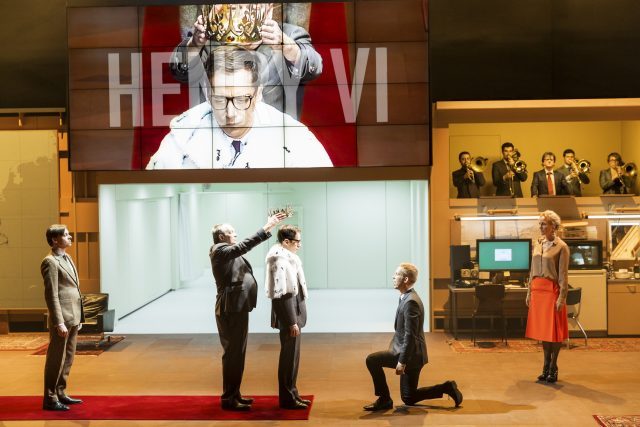
Henry VI (Eelco Smits) is not quite up to being king in four-and-a-half-hour extravaganza (photo by Richard Termine)

In a program note, van Hove, who recently directed the back-to-back Arthur Miller plays A View from the Bridge and The Crucible on Broadway and the David Bowie / Enda Walsh collaboration Lazarus at New York Theatre Workshop, explains, “It is fascinating to witness how crucial decisions about life and death are made. This play shows man at his most noble and at his most perverse. . . . It is inspiring to discover Shakespeare as a contemporary who is dealing with the type of events we see on the news every day: the dark machinations of the people in power and the violence that their decisions bring about.” Also inspiring is van Hove’s brilliant staging. The War Room changes with each new king, who is crowned in a stylistic manner as a brass band (Konstantin Koev, Charlotte van Passen, Daniel Quiles Cascant, Daniel Ruibal Ortigueir) plays and contratenor Steve Dugardin sings. The back of the set leads to morgue-like white corridors where various men meet their fate; the behind-the-scenes action is shown live on a large screen divided into rectangular grids, as a cameraman roams across the stage, getting up close and personal with the characters. (The video is by Tal Yarden.) It’s particularly effective during the spectacular Richard III section; as the king tries to convince the widowed Lady Anne that he is in love with her, her dead husband can be seen both on the screen as well as at the very back, on a gurney, his presence looming over them. Later, when Richard examines himself in a full-size mirror, the multiple images are breathtaking as van Hove reveals the villain’s many faces.

(photo by Richard Termine)

Richard III (Hans Kesting) takes a strange path in wooing Lady Anne (Hélène Devos) in Ivo van Hove epic at BAM (photo by Richard Termine)

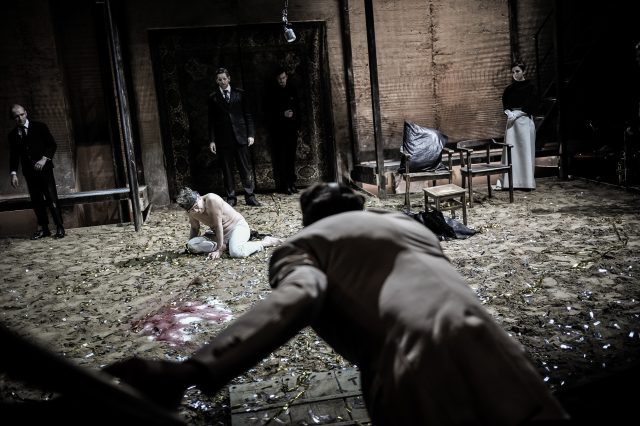
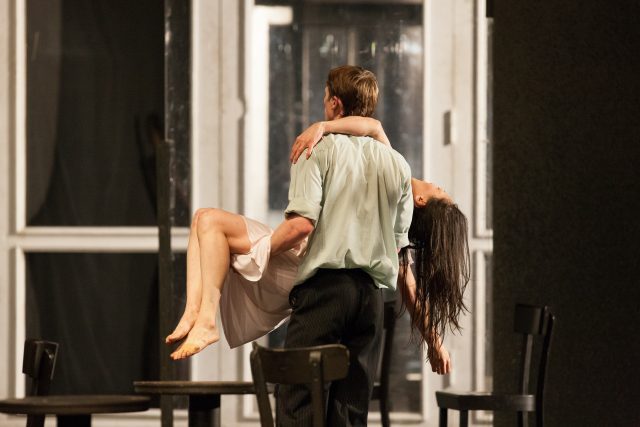
Most members of the terrific cast play multiple roles, with Nasr as Henry V and Richmond, Eelco Smits as Henry VI and Grey, Bart Siegers as Edward IV, York, and Henry V’s chief of staff, Leon Voorberg as Charles VI, Warwick, and Stanley, Aus Greidanus Jr. as Gloucester and Buckingham, and de Hoog as the dauphin, Suffolk, and Clarence. The language has been modernized, which might at first bother Shakespeare purists, especially when reference is made to the current political situation in America, but that’s yet another way van Hove fuses the past with the present, as the fight for supremacy in the corridors of power is, of course, timeless and universal. (Thus, the ticking of metronomes as the finale approaches.) The nearly 270 minutes, with one intermission, fly by fairly quickly, as the play hits all the high notes at a gripping pace, zeroing in on deaths and coronations. Van Hove excels at adaptations, preferring them to new works; the Obie and Tony winner has previously been at BAM with Ingmar Bergman’s Cries and Whispers, Tony Kushner’s Angels in America, John Cassavetes’s Opening Night, and Sophocles’s Antigone, in addition to Roman Tragedies, continually coming up with remarkably innovative ways to tell stories, taking audiences to places they have never been before. Kings of War is another grand triumph, a staggering achievement from a true creative genius.
BAM NEXT WAVE FESTIVAL: KINGS OF WAR

(photo by Jan Versweyveld)

Innovative director Ivo van Hove merges four Shakespeare plays into one monumental production in KINGS OF WAR at BAM (photo by Jan Versweyveld)

BAM Howard Gilman Opera House
Peter Jay Sharp Building
230 Lafayette Ave.
November 3-6, $30-$130
718-636-4100
www.bam.org

This past spring, BAM presented the Royal Shakespeare Company’s “King and Country: Shakespeare’s Great Cycle of Kings,” four Bard plays — Richard II, Henry IV Part I, Henry IV Part II, and Henry V — done in repertory over more than five weeks. Now superstar director and BAM fave Ivo van Hove, who just staged Arthur Miller’s A View from the Bridge and The Crucible back-to-back on Broadway in addition to Lazarus at New York Theatre Workshop, returns to Brooklyn with Kings of War, a 264-minute extravaganza that merges Henry V, Henry VI Parts I, II & III, and Richard III in contemporary surroundings. The cast features Ramsey Nasr as Henry V, Hans Kesting as Richard III, Eelco Smits as Henry VI, Hélène Devos as Lady Anne, Bart Siegers as Edward IV, Marieke Heebink as the Duchess of York, Leon Voorberg as Charles VI, and Alwin Pulinckx as the Prince of Wales. The Toneelgroep Amsterdam production, in a Dutch translation by Rob Klinkenberg adapted by Bart van den Eynde and Peter van Kraaij, is designed and lit, as always, by Jan Versweyveld, with costumes by An D’Huys and projections by Tal Yarden. There will also be a live brass band along with contratenor Steve Dugardin performing music by Eric Sleichim. Van Hove has previously staged Antigone, Angels in America, Opening Night, Cries and Whispers, and Roman Tragedies at BAM. Despite his innovative, often multimedia staging, both experimental and awe-inspiring, Van Hove is not just about dazzling production values. As BAM’s Christian Barclay notes in his BAMblog essay “Tragedy, Power, and Catharsis: Ivo van Hove’s Theatrical Humanism,” “At BAM, Van Hove’s intuitive, visionary approach to theater has now struck five times over just the past eight years (with all but one of the productions staged with his Dutch company, Toneelgroep Amsterdam). While certainly diverse in scope, from minimalist reimaginings of classic texts to wholly original screen-to-stage adaptations, all of Van Hove’s work could be said to proffer an acute examination of human behavior.” Kings of War will play a mere four performances at BAM’s Howard Gilman Opera House, running November 3-6, and according to the program there is only one intermission. Consider yourselves warned.