Tag Archives: william shakespeare

ASHITA NO MA-JOE: ROCKY MACBETH

Shakespeare meets manga in Ashita no Ma-Joe: Rocky Macbeth at Japan Society (photo by Takashi Ikemura)

Shakespeare meets manga in the boxing ring in Ashita no Ma-Joe: Rocky Macbeth at Japan Society (photo © Takashi Ikemura)

Japan Society
333 East 47th St. at First Ave.
May 15-18, $28
212-715-1258
www.japansociety.org

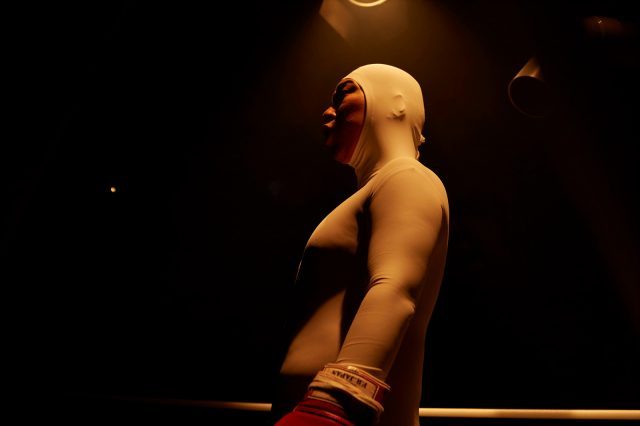
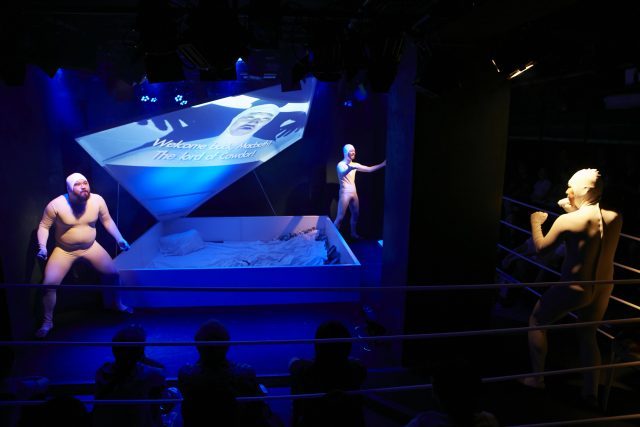
Theater Company Kaimaku Pennant Race founder Yu Murai transforms Japan Society into a boxing arena in Ashita no Ma-Joe: Rocky Macbeth, running May 15-18. The sixty-minute show is a seriocomic mash-up of William Shakespeare’s Macbeth and the late 1960s manga Ashita no Joe (“Tomorrow’s Joe”), written by Ikki Kajiwara (Asao Takamori) and illustrated by Tetsuya Chiba and which was turned into several anime series and anime and live-action films. The title translates roughly to “Tomorrow No Witch,” referencing the witches of Macbeth as well as one of the play’s most famous monologues. The protagonist is Joe Yabuki, aka Rocky Macbeth, an ambitious troubled teen who finds success in the ring — and there will be an actual boxing ring onstage, with an audience of only sixty people sitting around it. The boxers wear funky-weird head-to-toe costumes over five rounds of battles as Macbeth seeks the crown, as king and champion.

(photo © Takashi Ikemura)

Ashita no Ma-Joe: Rocky Macbeth moves reimagined Shakespeare tale to a boxing ring (photo © Takashi Ikemura)

“We also have been believing in a false sense of security / that is nothing more than a prophecy. / The Birnam Wood has already started to move. / What will the witches whisper to us, / the people who have been pretending not to notice? / What will we whisper to the future Macbeths to come?” Yu Murai writes, fusing themes of postwar Japan with the 1960s counterculture, one of his specialties. (At the 2009 Fringe Festival, the company had fun with Romeo and Toilet, complete with toilet paper rolls and bathroom humor.) The cast features Takuro Takasaki, G. K. Masayuki, and Kazuma Takeo, with video design and operation by Kazuki Watanabe; opening night will be followed by a Meet-the-Artists reception. The presentation is being held in conjunction with the Japan Society exhibition “Radicalism in the Wilderness: Japanese Artists in the Global 1960s,” which continues through May 31; Ashita no Ma-Joe: Rocky Macbeth tickets get you half off gallery admission.

KING LEAR ON BROADWAY

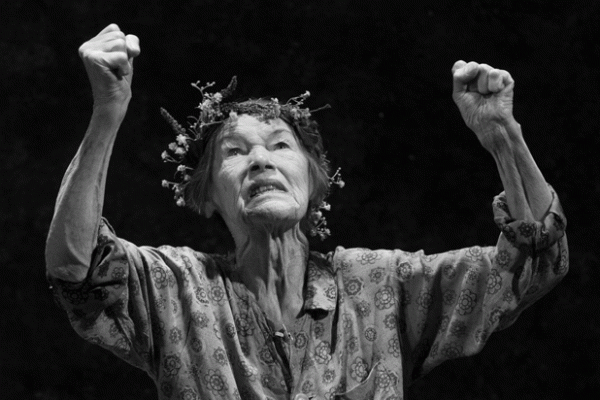
(photo by Brigitte Lacombe)

Glenda Jackson wonders where it all went wrong in King Lear revival on Broadway (photo by Brigitte Lacombe)

Cort Theatre
138 West 48th St. between Sixth & Seventh Aves.
Tuesday – Sunday through June 9, $35-$129
www.kinglearonbroadway.com

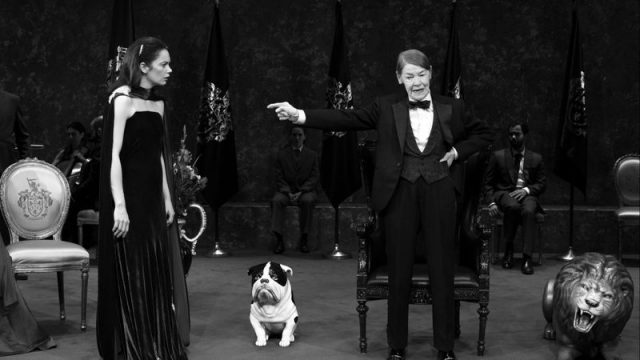
Theater aficionados would likely pay good money to watch the inimitable Glenda Jackson read the phone book, as the proverbial platitude goes. But director Sam Gold challenges that now-outdated cliché with his misguided production of King Lear, which boasts the remarkable actress and former longtime British MP as Shakespeare’s declining ruler. On the night I attended, early in the show a valet bringing Lear the crown stumbled and dropped the prop. Jackson let out an angry howl that echoed throughout the Cort Theatre in what looked to be an ad-lib, but it summed up everyone’s frustration with Gold’s handling of the tragedy. The usually dependable and insightful Tony and Obie winner (Fun Home, Circle Mirror Transformation) seems to be going out of his way to unnecessarily complicate virtually every aspect of this consistently awkward staging.

(photo by Brigitte Lacombe)

King Lear (Glenda Jackson) has something to say to his youngest daughter, Cordelia (Ruth Wilson) (photo by Brigitte Lacombe)

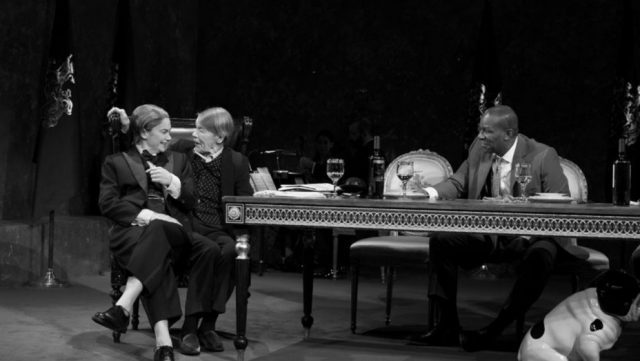
The story takes place in a gold-plated rectangular, horizontal space, with characters in relatively modern dress. (The set is by Miriam Buether, with costumes by Ann Roth.) Ruth Wilson is excellent as both Cordelia and the Fool, although it is sometimes hard to tell when she is one or the other. John Douglas Thompson is stalwart as Kent, his authoritative voice booming, but the rest of the cast seems lost, seeking Gold to guide them not unlike poor Tom (Sean Carvajal) leading his blinded father, Gloucester (Jayne Houdyshell), to the edge of a precipice. The Duke of Cornwall is portrayed by Russell Harvard, a deaf actor who is followed around by Michael Arden, who translates for him in American Sign Language. Philip Glass has composed a lovely score, performed by violinists Cenovia Cummins and Martin Agee, violist Chris Cardona, and cellist Stephanie Cummins; when they unobtrusively play in the far back corner, all is well, but later they come to the front and mingle with the actors, which is unnerving and off-putting. Goneril (Elizabeth Marvel) at first shows empathy for Cordelia, but that changes fast, leading to a sexual expression that made the audience gasp in horror. Pedro Pascal is ineffective as the devious Edmund, while Carvajal is too plain as his too-trusting half-brother, Edgar. The cast also includes Dion Johnstone as the Duke of Albany, Aisling O’Sullivan as a vicious Regan, Ian Lassiter as the King of France, and Matthew Maher as a creepy Oswald. Oh, and there are gunshots.

(photo by Brigitte Lacombe)

Ruth Wilson, Glenda Jackson, and John Douglas Thompson are the bright spots in Sam Gold’s revival of King Lear (photo by Brigitte Lacombe)

Fortunately, watching Jackson for nearly three and a half hours — she does take that long break at the beginning of the second act, and the play suffers even further in her absence — makes this Lear worth it; Jackson, now eighty-two, might be a wisp of a thing, but she radiates intense strength and greatness every step of the way. But be advised that this is not Deborah Warner’s 2016-17 version that took London by storm. I am no traditionalist by any means — for example, I adore what Daniel Fish has done with Oklahoma! — but Gold has deconstructed the play only to reconstruct it with, dare I say, a Lear-like madness that just too often is baffling if not downright annoying. New York has seen many a Lear over the last dozen years — Sir Ian McKellen, Sir Derek Jacobi, John Lithgow, Frank Langella, Sir Antony Sher, Michael Pennington, and Sam Waterston — and Jackson is a worthy addition to that list, but it is telling that she received neither a Tony nor a Drama Desk nomination for her performance, and the production also did not get nods for Best Revival. It’s like an imperfect storm, with Jackson at the center, trying to survive the downpour, along with the rest of us.

SHAKESPEARE IN THE PARK: TWELFTH NIGHT

(photo by Joan Marcus)

Sir Toby Belch (Shuler Hensley) and Feste (Shaina Taub) argue over who is the worst in Twelfth Night at the Delacorte (photo by Joan Marcus)

Central Park
Delacorte Theater
Tuesday-Sunday through August 19, free, 8:00
shakespeareinthepark.org

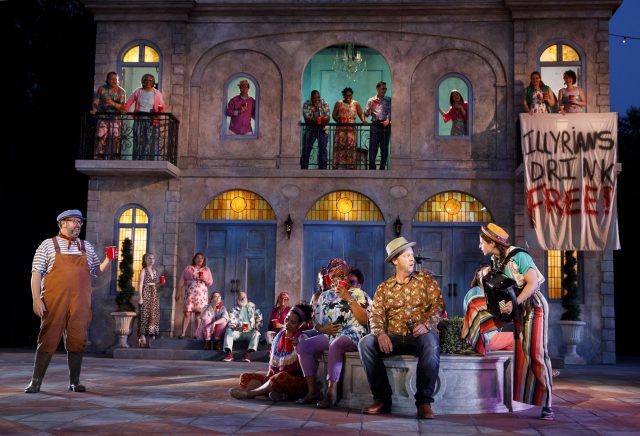
“Shall we set about some revels?” Sir Toby Belch asks in Twelfth Night. “I do delight in masques and revels, sometimes altogether,” responds Sir Andrew Aguecheek. There is much to revel in at the Public Works presentation of William Shakespeare’s 1601-2 comic romance, continuing at the Public Theater’s Delacorte through August 19. Since 2013, the annual Shakespeare in the Park summer festival has concluded with a musical version of a classic tale, performed over Labor Day weekend following the two main productions. Adapted by either Todd Almond (The Tempest, The Odyssey) or Shaina Taub (The Winter’s Tale, As You Like It with Laurie Woolery) and under the leadership of Public Works founder and director Lear deBessonet, the shows feature top-tier actors (Laura Benanti, Christopher Fitzgerald, Lindsay Mendez, Brandon Victor Dixon, Norm Lewis) joined by some two hundred men, women, and children from community organizations across all five boroughs. In 2016, Taub staged Twelfth Night, which is now back for an ecstatic full run in Central Park, spreading Joe Papp’s belief that theater is for all people. This production is totally committed to that vision; before the show starts, the entire audience is encouraged to hang out onstage and interact with members of the enormous cast and crew, playing checkers and other games, sitting for caricature sketches, eating free popcorn, singing with a small band, and posing for pictures in front of the set. (Yes, that man handing out glow sticks is Shuler Hensley, the Tony-winning star of Young Frankenstein, Les Misérables, and Oklahoma!)
(photo by Joan Marcus)

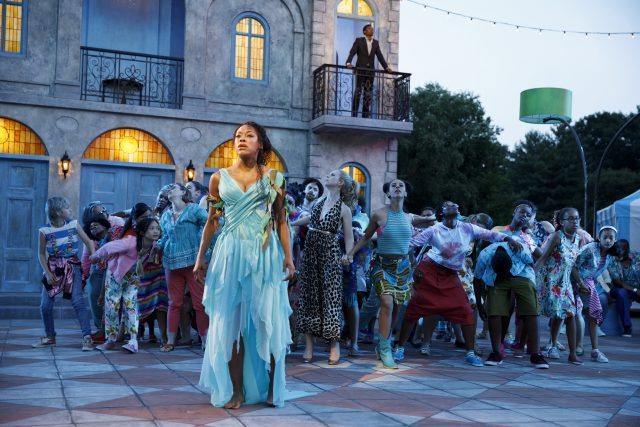
Viola (Nikki M. James) and Duke Orsino (Ato Blankson-Wood) are desperate for love in musical adaptation of Shakespeare play (photo by Joan Marcus)

The ninety-minute show is a pure delight. After a shipwreck in which she believes her twin brother, Sebastian (Troy Anthony), must have been killed, Viola (Tony winner Nikki M. James) winds up in Illyria, where the grief-stricken Countess Olivia (Nanya-Akuki Goodrich) is mourning the loss of her own brother. Disguising herself as a man named Cesario, Viola gets a job working for the lovesick Duke Orsino (Ato Blankson-Wood), who has the hots for Olivia, but she wants no part of him. In fact, Olivia is attracted to Cesario, while Viola has fallen for Orsino. The absurdly proper steward Malvolio (Andrew Kober) is also in love with his ladyship, Olivia. Through it all, Olivia’s uncle, the drunken wastrel Sir Toby Belch (Hensley), and his bestie, Sir Andrew Aguecheek (Daniel Hall), flit about Illyria, getting drunk, making jokes, and causing trouble, including teaming up with Olivia’s gentlewoman, Maria (Lori Brown-Niang), to pull off a rather mean-spirited prank. As Sebastian and his friend, Antonio (Jonathan Jordan), enter Illyria, the mistaken identity, screwball love triangles, and general mayhem ratchet way up.
(photo by Joan Marcus)

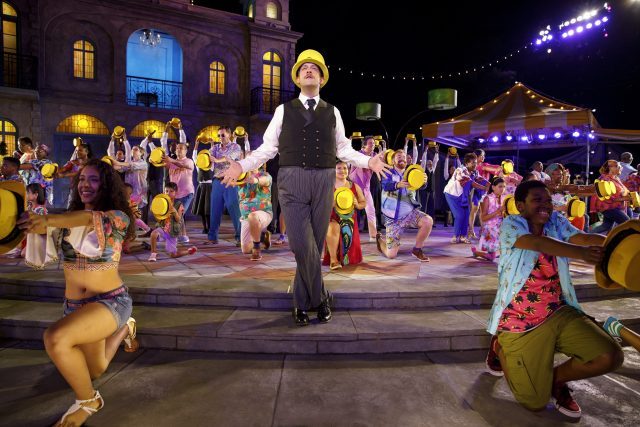
Malvolio (Andrew Kober) brings down the house with some vaudevillian shtick in Public Works presentation in Central Park (photo by Joan Marcus)

In addition to writing the music and lyrics for the show, which she conceived with Kwame Kwei-Armah (the new artistic director of the Young Vic), the Vermont-raised, New York City–based Taub (Old Hats; Natasha, Pierre & the Great Comet of 1812) introduces it, portrays Feste the fool, and leads the band at her piano. She’s sort of like a sprite, prancing about with her accordion; even when she accidentally tripped, she declared her instrument fine and continued the scene in excellent form, wearing a huge smile. The songs not only propel the plot and deepen character development but also relate wonderfully to Shakespeare’s language; the opening number is “Play On” (“If music be the food of love, play on!”), and Kober has a blast chewing up the showstoppers “Count Malvolio” (“I could be Count Malvolio! / Lord of the estate / Dressed in all the finest silk and master of my fate / I’d summon all my minions in a most majestic tone / Then once they all arrived / I’d tell them, ‘Leave me alone!’”) and “Greatness” (“If some are born great / And some achieve greatness / And some have greatness thrust upon them / Then I can’t help that I was born great! / I didn’t ask to be the best / Things would be much easier being average like the rest”). Feste kicks off “You’re the Worst,” in which Fabian (Patrick J. O’Hare), Sir Andrew, Sir Toby, and Feste roast one another (“You try too sincerely to please every crowd / You play the accordion, for crying out loud! / So let me tell you first / That you are the worst!”) before ganging up on poor Malvolio. The score also features “If You Were My Beloved,” “Is This Not Love?” and “Word on the Street,” as Taub and her band go from New Orleans jazz and pop to R&B and hip-hop.
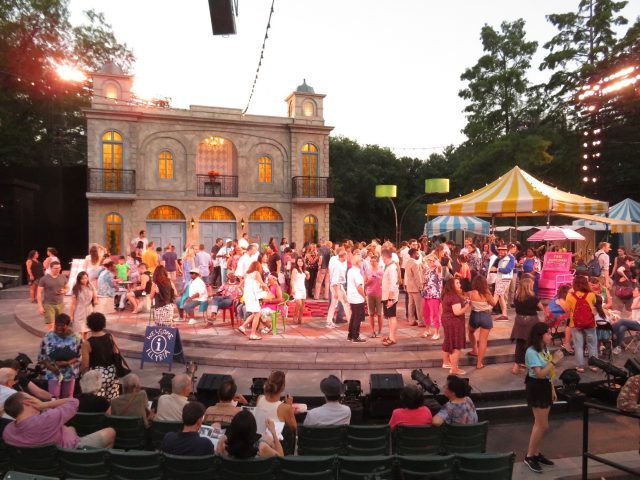
The audience is encouraged to (photo by twi-ny/mdr)

The audience is encouraged to mingle with cast and crew and play onstage before show (photo by twi-ny/mdr)

For Twelfth Night, the Public has partnered with Brownsville Recreation Center, Casita Maria Center for Arts and Education, Center for Family Life in Sunset Park, DreamYard Project, Fortune Society, Military Resilience Project, Children’s Aid Society, and Domestic Workers United, with cameos from people from COBU, Jambalaya Brass Band, the Love Show, New York Deaf Theatre, Ziranmen Kungfu Wushu Training Center, and even the US Post Office. Every participant, regardless of theatrical experience, is given equal billing both on the official poster and in the Playbill. Public Theater artistic director Oskar Eustis has taken the helm from Kwei-Armah, directing the rather large cast on Rachel Hauck’s welcoming, carnivalesque set, which is backed by the facade of Olivia and Orsino’s homes. Eustis and choreographer Lorin Latarro do a superb job, avoiding having everyone just run into each other everywhere, keeping the narrative flowing as more and more folks enter and leave. Andrea Hood has a field day with the costumes, ranging from Elizabethan dress to modern-day summer wear; at one early point the night I went, when Sebastian and Antonio approach the edge of the stage, nearly in the audience, a man and woman in blue nurse’s clothes slowly got up right in front of them and started pushing a man on an extended gurney-like contraption to the right. I closely watched their path, expecting them to go up the ramp and onto the stage, but it turned out that it must have been a real emergency as they headed out of the Delacorte with their patient. It was an unexpected turn of events, but it also proved how unpredictable this production is, where anything can happen. As Fabian says, “If this were played upon a stage now, I could condemn it as an improbable fiction.”
KING LEAR

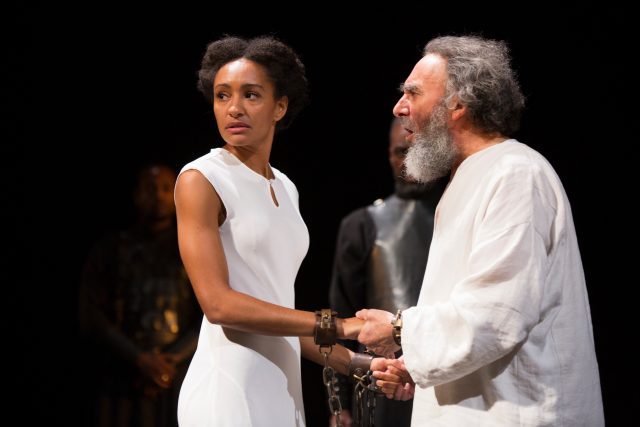
(photo by Ellie Kurttz)

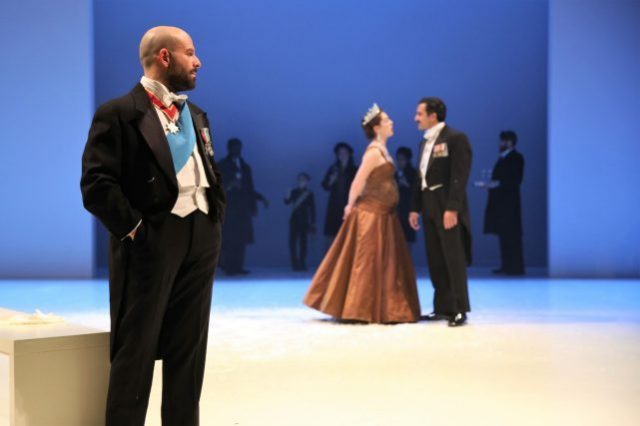
Sir Antony Sher bids William Shakespeare adieu in final Bard role (photo by Ellie Kurttz)

Brooklyn Academy of Music
BAM Harvey Theater
651 Fulton St.
April 7-29, $35-$125, 7:30 (plus 1:30 and 3:00 weekend matinees)
718-636-4100
www.bam.org

The Brooklyn Academy of Music has a thing for King Lear. Since 2007, it has presented three major productions, starring Sir Ian McKellen, Sir Derek Jacobi, and Frank Langella. During that time period, New York has also seen the tragic ruler portrayed by John Lithgow at the Delacorte, Michael Pennington at TFANA, and Sam Waterston and Kevin Kline at the Public. Now comes sixty-eight-year-old South African-born English actor Sir Antony Sher, in what is being billed as his final Shakespeare role. The two-time Olivier Award winner, Tony nominee, and longtime Royal Shakespeare Company member has previously played the Fool in Lear, Shylock in The Merchant of Venice, Prospero in The Tempest, Falstaff in both parts of Henry IV at BAM, Leontes in The Winter’s Tale, and the title characters in Richard III, Titus Andronicus, and Macbeth. The RSC production runs at the BAM Harvey April 7-29, directed by Gregory Doran (Sher’s longtime partner), with sets by Niki Turner, lighting by Tim Mitchell, and music by Ilona Sekacz. The cast also features Nia Gwynne as Goneril, Kelly Williams as Regan, Mimi Ndiweni as Cordelia, and Graham Turner as the Fool. In conjunction with the show, RSC assistant director Anna Girvan and members of the company will give a class on April 24 at 1:00 ($25) at the Mark Morris Dance Center “for emerging professional actors,” and Girvan and company members will lead the open workshop “Inside the Storm” on April 26 at noon ($20) at Mark Morris “for curious adult (18+) theatergoers of all abilities.”

THE WINTER’S TALE

(photo by Carol Rosegg)

Leontes (Anatol Yusef) grows suspicious of Hermione (Kelley Curran) and Polixenes (Dion Mucciacito) in The Winter’s Tale at TFANA (photo by Carol Rosegg)

Theatre for a New Audience, Polonsky Shakespeare Center
262 Ashland Pl. between Lafayette Ave. & Fulton St.
Tuesday – Sunday through April 15, $90-$125
866-811-4111
www.tfana.org

Theatre for a New Audience resident director Arin Arbus approaches William Shakespeare’s The Winter’s Tale — a tragicomedy and late romance that is considered one of the Bard’s problem plays — with sharp teeth and claws bared, like a grizzly bear just awakened from hibernation. In fact, a bear — well, a man in a bear suit (Arnie Burton) — is a key character in the nearly three-hour production, which opened Sunday night at the Polonsky Shakespeare Center in Fort Greene. The bear, who lives under the stage, impacts the narrative in each of the very different two acts, which are famously separated by a sixteen-year gap in the story, another kind of hibernation. With snow falling in Sicilia, King Leontes (Anatol Yusef) is hosting Polixenes (Dion Mucciacito), the king of Bohemia, When Polixenes considers leaving for home, Leontes suddenly, and without reason, becomes convinced that his pregnant wife, Hermione (Kelley Curran), and the Bohemian leader are in love and have made a cuckold of him. Leontes’s trusted friend, Camillo (Michael Rogers), assures the king that no such treachery has occurred, but the king refuses to listen to him, declaring, “Is whispering nothing? / Is leaning cheek to cheek? Is meeting noses? / Kissing with inside lip? Stopping the career / Of laughter with a sigh? — a note infallible / Of breaking honesty. Horsing foot on foot? / Skulking in corners? Wishing clocks more swift? / Hours minutes? Noon midnight? And all eyes / Blind with the pin and web but theirs, theirs only, / That would unseen be wicked? Is this nothing? Why, then the world and all that’s in ’t is nothing, / The covering sky is nothing, Bohemia nothing, / My wife is nothing, nor nothing have these nothings, / If this be nothing.” In accusing his wife, the king has also deeply troubled their young son, Maximillius (Eli Rayman). Leontes orders Camillo to kill Polixenes, but instead Camillo flees to Bohemia with him. In prison, Hermione gives birth to a girl, and Leontes tells Lord Antigonus (Oberon K. A. Adjepong), the husband of Hermione’s dedicated lady-in-waiting, Paulina (Mahira Kakkar), to take the baby away and abandon it. After heartbreaking tragedy, the baby is found on the shores of Bohemia by a shepherd (John Keating) and his clownish son (Ed Malone), who bring the infant, whom they name Perdita, home.

(photo by Carol Rosegg)

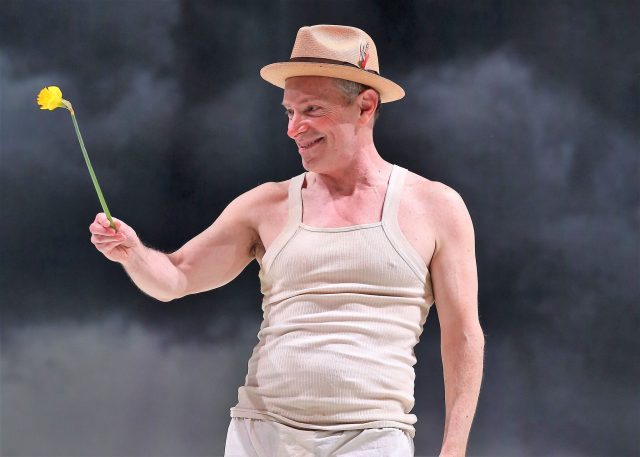
Autolycus (Arnie Burton) offers a phallic flower in Arin Arbus’s latest Shakespeare adaptation (photo by Carol Rosegg)

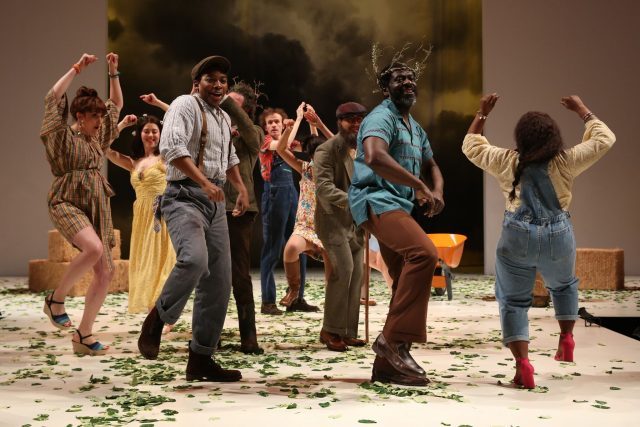
After intermission, the dire, dour mood changes dramatically. Father Time (Robert Langdon Lloyd) walks with a cane onto the stage as green leaves fall in Bohemia, announcing spring. Time, representing the chorus, explains that sixteen years have passed, filling in the details of what has become of the main characters. Most important, Perdita (Nicole Rodenburg) is now a teenager who is close with Florizel (Eddie Ray Jackson), the son of Polixenes, although no one knows her true lineage. As the region prepares for a sheep-shearing feast, Autolycus (Burton), a former servant of Florizel’s who has gone rogue, picks a few pockets, including that of an audience member in the first row. “Ha, ha, what a fool Honesty is! And Trust, / his sworn brother, a very simple gentleman! I have sold all my trumpery,” Autolycus, who serves as the play’s turning point, admits. Through a series of events, everyone winds up back in Sicilia, where a little bit of magic eases much, but not all, of the pain that spread through the first act and the bitterness of winter turns into the hopeful blossoming of spring as time marches ever forward.

(photo by Carol Rosegg)

Bohemians celebrate at the sheep-shearing fest (photo by Carol Rosegg)

Arbus (King Lear, The Skin of Our Teeth) juggles the play’s so-called problems deftly, balancing the darkly serious with the lightly comic, moving things relatively briskly on Riccardo Hernandez’s spare but austere, at times almost blindingly white set, which features a large arch in the back, behind which projections change from ominous clouds to blue skies. Emily Rebholz’s contemporary costumes take some getting used to, although they do shift from dignified black, white, and brown in the first act to a more casual look with splashes of color in the second. Much of the cast, which also includes Maechi Aharanwa as Mopsa, Liz Wisan as Dorcas, cellist Zsaz Rutkowski, and multi-instrumentalist Titus Tompkins, is allowed a wide berth, especially during the wacky sheep-shearing festival, but Curran (Present Laughter, Sense & Sensibility), Rogers (The Call, Sucker Punch), and RSC vet Yusef (Hamlet, Boardwalk Empire) keep it grounded just enough. The Winter’s Tale might be a lesser-performed Bard work, but it still has its gems. “If powers divine / Behold our human actions, as they do, / I doubt not then but innocence shall make / False accusation blush and tyranny / Tremble at patience,” Hermione says, speaking for all truths. And of course, the play also boasts perhaps Shakespeare’s most famous stage direction: “He exits, pursued by a bear.”

MUGEN NOH OTHELLO

(photo by Richard Termine)

Desdemona (Micari) tells her sad tale to a traveling pilgrim (Maki Honda) from Venice (photo by Richard Termine)

Japan Society
333 East 47th St. at First Ave.
January 11-14, $35
Under the Radar continues through January 15
212-715-1258
www.japansociety.org
www.publictheater.org

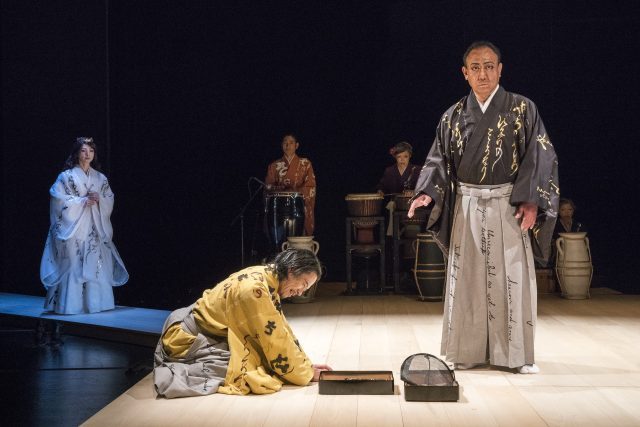
Japan Society concludes its “NOH NOW” series with Satoshi Miyagi’s unique, hypnotic adaptation of William Shakespeare’s Othello, which is also part of the Public Theater’s Under the Radar festival and Japan Society’s 110th anniversary. In Mugen Noh Othello, Miyagi and his Shizuoka Performing Arts Center apply traditional mugen noh narrative structure and Miyagi’s own innovative techniques to the Bard’s story of jealousy and betrayal, condensing and refocusing the tale so it feels both fresh and contemporary as well as age-old and sadly familiar. Mugen noh stories are often told by a departed spirit in flashback, confessing to a secondary character who is a stand-in for the audience, in the hopes of gaining release to the afterlife. Miyagi’s surprise is to have a single character performed by two actors: One moves on the stage, the other sits along the right side, delivering the dialogue. Miyagi and writer Sukehiro Hirakawa also twist genre conventions by having Desdemona (mover Micari, speaker Haruyo Suzuki) as the storytelling spirit, not Shakespeare’s protagonist, Othello (Kazyniru Abe). The set is a square, slightly raised wooden platform, with an angled walkway where characters enter and exit. In the back are musicians Sachiko Kataoka, Yukio Kato, Yoneji Ouchi, Yu Sakurauchi, Junko Sekine, and Ayako Terauchi, playing traditional noh percussive instruments. (The tense score is by Hiroko Tanakawa.) On the right of the stage are a row of women and a row of men serving as a kind of Greek chorus, chanting and performing many of the lines of the play, which are translated in English surtitles on two screens. When a traveling pilgrim (Maki Honda) from Venice arrives in Cyprus, he meets a trio of Italian women (Ayako Terauchi, Sachiko Kataoka, and Yu Sakurauchi, voiced by Asuka Fuse, Kotoko Kiuchi, and Fuyuko Moriyama, respectively) who tell him how Cyprus fell to the Ottoman Turks.

(photo by Richard Termine)

Iago (Yuya Daidomumon) has some bad news for Othello (Kazyniru Abe) as Desdemona (Micari) looks on in Mugen Noh Othello (photo by Richard Termine)

“But alas, how fickle is the hearts of men,” one says. “Cyprus has turned into an island of pagans.” The pilgrim wants to know the details and is soon joined by Desdemona, who declares, “Upon meeting you, a fellow Venetian, I yearn for the world of the living.” And so she relates what happened between her husband, Othello; his trusted right-hand ensign, Iago (Yuya Daidomumon); his loyal captain, Cassio (Yoneji Ouchi); Desdemona’s father, Brabantio (Soichiro Yoshiue); the Duke of Venice (Keita Mishima); and Iago’s unknowing henchman, Roderigo (Yukio Kato), a story that leads to murder most foul. (The Tokyo-born Miyagi has also directed versions of Hamlet and A Midsummer Night’s Dream for SPAC.) “I return to tell the tale of a man trapped in a delusion,” she explains. Mugen Noh Othello features very slow, deliberate movement, with relatively sparse dialogue. Facial expressions are often exaggerated, and some characters wear masks and fab hats. Kayo Takahashi’s costumes, which come in a wide range of colors and include long, elegant, and spare lines of Japanese writing, are extraordinary, particularly Desdemona’s elaborate ghostly white and golden kimono. The play has been condensed to eighty minutes, cutting out various characters, instead concentrating on the critical, emotional high points surrounding the commission or omission of sin. It’s a lovely production rich with tender, scary, and funny moments, emphasizing the art of storytelling itself. Shakespeare purists will not find all of their favorite lines here, but there is still much poetry to revel in.

MEASURE FOR MEASURE

(photo by Richard Termine)

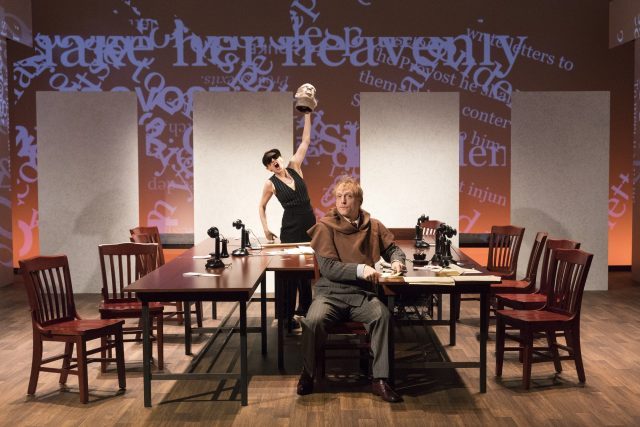
Shakespeare’s words fly by in a fury in Elevator Repair Service’s frenetic Measure for Measure (photo by Richard Termine)

The Public Theater, LuEsther Hall
425 Lafayette St. by Astor Pl.
Tuesday – Sunday through November 12, $75
212-967-7555
www.publictheater.org

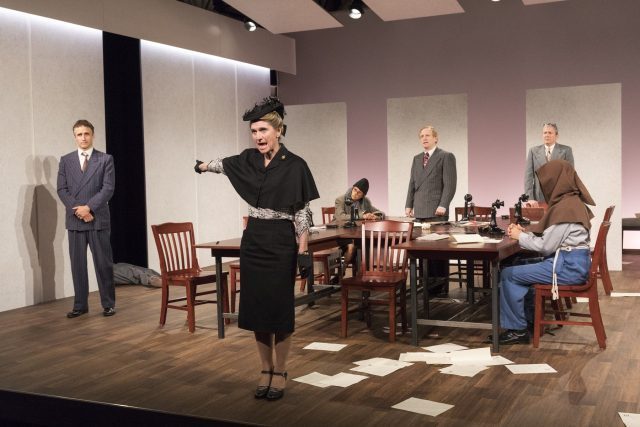
There’s a frenetic, anarchic pace to Elevator Repair Service’s Indy 500 version of Measure for Measure, running at the Public Theater’s LuEsther Hall through November 12. It’s like Howard Hawks’s His Girl Friday on speed, the dialogue whizzing by, in sound and images, as the characters, in a bizarre array of costumes ranging from contemporary suits to hippy outfits to strange fake underpants worn over clothing, engage in corny but funny slapstick and often converse using antique Candlestick telephones even when they are sitting right across the H-shaped table from one another. The play includes every single word of Shakespeare’s script, which is occasionally projected in large letters all across the stage, but it still scrolls past so quickly there is not enough time to read it all. To maintain the verbal madness, which slows down only for one key scene, there is a Teleprompter behind the audience that guides the actors primarily for speed, employing software designed by ERS member Scott Shepherd, who also plays the Duke. (Shepherd and ERS founding artistic director John Collins, the director of Measure for Measure, are veterans of the Wooster Group, which also incorporates unique visuals using monitors in their shows.) You might not clearly understand everything everyone says, but you’ll be able to follow the general shenanigans as the Bard takes on sex, mortality, morality, fidelity, virtue, virginity, marriage, religion, pregnancy, prison, and capital punishment.

In Vienna, the Duke is about to head out of town for a while, leaving his deputy, Angelo (Pete Simpson), in charge. However, the Duke hovers around, disguised as a friar, as the story unfolds, involving Juliet (Lindsay Hockaday), who is having a child with Claudio (Greig Sargeant); brothel manager Mistress Overdone (Susie Sokol); Claudio’s sister, Isabella (Rinne Groff), a religious novice; the nun Mariana (April Matthis); the young nobleman and lowlife Lucio (Mike Iveson); the Provost (Maggie Hoffman), who runs the prison; aged adviser Escalus (Vin Knight); constable Elbow (Gavin Price, who also is the sound designer); and various other characters of ill and not-so-ill repute. The plot centers on Angelo’s arrest of Claudio for impregnating Juliet out of wedlock and the deputy’s offer to release him from prison only if Isabella will sleep with him. It’s quite a moral dilemma — especially as more and more men in positions of power in America today are discovered to be sexual predators — and one that is not resolved very easily. “Death is a fearful thing,” Claudio tells Isabella, who responds, “And shamed life a hateful.”

(photo by Richard Termine)

Brothel manager Mistress Overdone (Susie Sokol) has something to say in ERS adaptation of Measure for Measure (photo by Richard Termine)

At a talkback following the October 18 performance, the audience was asked if it was anyone’s first time at the Public, and no hands went up. They were next asked if it was anyone’s first time seeing Shakespeare, and a few hands went up. They were then asked if it was anyone’s first time seeing Measure for Measure, and more than half the hands went up. It is also ERS’s first time doing the Bard, following well-received, original adaptations of F. Scott Fitzgerald’s The Great Gatsby (Gatz), William Faulkner’s The Sound and the Fury, and Ernest Hemingway’s The Sun Also Rises (The Select), among other presentations. Founded in 1991 by artistic director John Collins, ERS leans heavily toward the experimental over the traditional, and that is as evident as ever in this exciting version of one of Shakespeare’s seldom-performed problem plays.

Director Collins and ERS have chosen to make the ribald shenanigans take a backseat to the staging, which is filled with delightful contradictions and decisions that go from the sublime to the ridiculous. “I’ve come to appreciate that Shakespeare’s densely layered metaphors and dizzying grammatical constructions can’t possibly be thoroughly understood and processed in real-time by any but the Elizabethan scholar. But maybe that doesn’t matter,” Collins writes in a program note. It might have been very different if he had chosen to do a more familiar Shakespeare play, in which much of the audience might already know the main aspects of the plot, so selecting Measure for Measure, which zooms by in an intermissionless 135 minutes, is a curious decision. Of course, opera is not exactly plot-friendly to those who don’t know the story either. In preparing for the show, Collins had the cast and crew watch Howard Hawks’s His Girl Friday along with Hands on a Hardbody and the Marx Brothers, elements of which help propel this version to another level that Shakespeare purists might wag a finger at but more adventurous theatergoers will end up clapping wildly at.