Tag Archives: william shakespeare

WILLIAM SHAKESPEARE’S CORIOLANUS

(photo by Carol Rosegg)

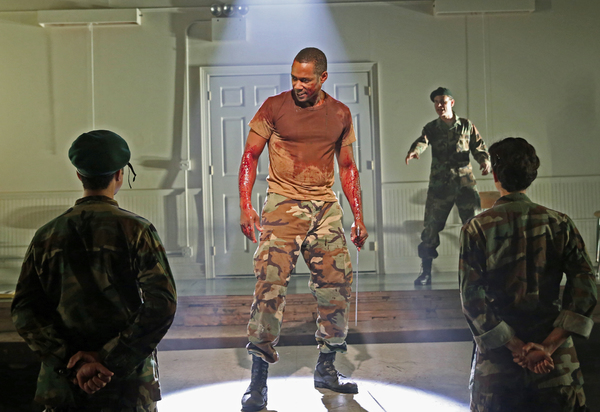
Dion Johnstone is fierce as Coriolanus in bloody Red Bull production (photo by Carol Rosegg)

Barrow Street Theatre
27 Barrow St. at Seventh Ave. South
Tuesday – Sunday through November 20, $80-$100
www.redbulltheater.com
barrowstreettheatre.com

Director Michael Sexton and Red Bull Theater transport one of William Shakespeare’s lesser-known, lesser-performed plays, Coriolanus, to up-to-the-minute contemporary times in a fast and furious immersive adaptation bursting with passion and energy. Set and lighting designer Brett J. Banakis has transformed the Barrow Street Theatre into the site of an Occupy movement in Rome, where hungry young citizens (Edward O’Blenis, Olivia Reis, and others) are protesting the government’s control of corn. “We are accounted poor citizens, the patricians good. What authority surfeits on would relieve us,” one citizen proclaims. “If they would yield us but the superfluity, we might guess they relieved us humanely. But they think we are too dear. The leanness that afflicts us is as an inventory to particularize their abundance. Our sufferance is as a gain to them. Let us revenge it with our pikes ere we become rakes; for the gods know I speak this in hunger for bread, not in thirst for revenge.” While patrician Menenius Agrippa (Patrick Page) understands their complaints, his good friend, Roman general Cauis Martius (Dion Johnstone), dismisses the Occupiers as “dissentious rogues” and “fragments.” Later, when Martius returns a hero in the battle against Corioles and his archenemy, Tullus Aufidius (Matthew Amendt), earning him the new name Coriolanus, the citizens, spurred on by manipulative tribunes Brutus (Merritt Janson) and Sicinius (Stephen Spinella), decide to do whatever they can to prevent him from becoming elected consul, taking up weapons and smashing ballot boxes. As Coriolanus’s pride and power grow, his mother, Volumnia (Lisa Harrow), his wife, Virgilia (Rebecca S’manga Frank), their son (Reis), and family friend Valeria (Christina Pumariega), a chaste lady of Rome, try to tone down the rhetoric and focus on his humanity, but there appears to be no stopping an inevitable, and bloody, conclusion.
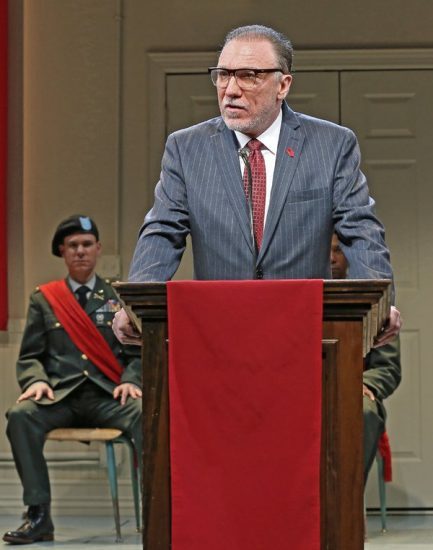
The exquisite Patrick Page is once again at his best as Menenius Agrippa in CORIOLANUS (photo by Carol Rosegg)

The exquisite Patrick Page is once again at his best as Menenius Agrippa in CORIOLANUS (photo by Carol Rosegg)

It might be Rome, 493 BCE, but it could just as easily be America, 2016, inside the Barrow Street Theatre. A platform juts out from the stage, with the audience sitting around three sides. The characters enter and leave by weaving through the aisles, often interacting with the crowd, shaking hands, giving them a balloon, or handing out ballots. The immersive structure helps cover up some of the play’s difficulties and deficiencies, particularly after Coriolanus is banished and considers joining up with Aufidius to take Rome forcefully. In his U.S. debut, Stratford Festival star Johnstone is fierce and aggressive in a challenging role that does not offer much subtlety; it is easier to get frustrated by Coriolanus’s choices than to get behind him as a heroic figure. Page (Casa Valentina, Spring Awakening), one of New York City’s finest and most natural stage actors, nearly steals the show as Menenius, his dialogue rolling eloquently off his tongue in a thrilling baritone that rattles through the theater; his Menenius is like a modern-day campaign manager unable to rein in his boss from certain self-destruction. Janson (TFANA’s Tamburlaine the Great, Notes from Underground) and two-time Tony winner Spinella (Angels in America, Red Bull’s Volpone) evoke a devious teaming of Nancy Pelosi and Mitch McConnell, taking dastardly delight as political puppeteers fomenting rebellion. Harrow (Wit, Last Days of Chez Nous) is divinely elegant as Coriolanus’s distressed though determined mother, while Aaron Krohn is strong and stalwart as Coriolanus’s devoted right-hand man, General Cominius; Zachary Fine is a hoot as Titus Lartius and several others; and Amendt plays Aufidius like he’s a wasted British rock star. And costume designer Ásta Bennie Hostetter has fun with the outfits, from bold military uniforms to dapper suits, from hoodies to an Occupier’s T-shirt that says, “There is no capitalism without racism.” Longtime character actor Dakin Matthews, who has appeared in such recent political plays as The Audience and All the Way and was formerly artistic director of the Berkeley Shakespeare Festival, serves as dramaturg, noting in the program that Coriolanus “must appear before the people in humble garb, displaying his wounds and getting their ‘voices’ (votes), and then have their election confirmed by the people’s tribunes, who are so opposed to his elevation that they conspire to deny it to him by manipulating the people’s affections,” which sounds eerily familiar given what is happening in the current presidential campaign. Sexton (Shakespeare’s Margaret for Red Bull, Titus Andronicus at the Public), artistic director of the Shakespeare Society, keeps things chaotically orderly and involving, although a drug-party scene goes a bit over the top even as it adds needed humor. Red Bull excels at reviving seventeenth- and eighteenth-century plays (Volpone, The School for Scandal, ’Tis Pity She’s a Whore), and Coriolanus is yet another triumph for this always inventive and extremely talented company.

PUBLIC WORKS: TWELFTH NIGHT

public works twelfth night

Central Park
Delacorte Theater
September 2-5, free tickets available day of show, 8:00
publictheater.org

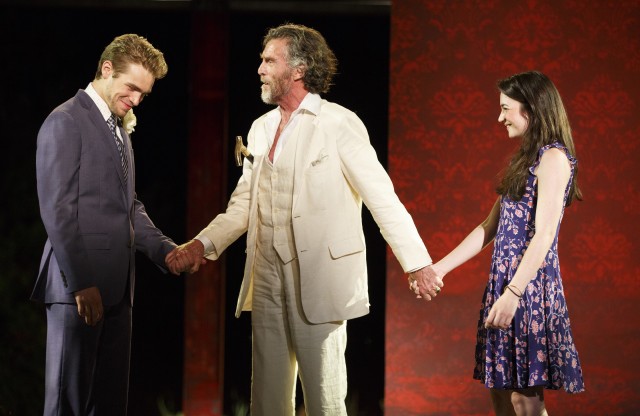
In 2013, the Public Theater initiated its Public Works program, an annual free Shakespeare production at the Delacorte that would bring together the community from all five boroughs in unique ways. “Public Works seeks to engage the people of New York by making them creators and not just spectators,” the mission statement explained. “Public Works deliberately blurs the line between professional artists and community members, creating theater that is not only for the people but by and of the people as well.” This year the Public is presenting a musical adaptation of William Shakespeare’s Twelfth Night, directed by actor, playwright, and director Kwame Kwei-Armah (Elmina’s Kitchen, Let There Be Love) and featuring music and lyrics by singer-songwriter Shaina Taub (Old Hats, Natasha, Pierre & the Great Comet of 1812), with choreography by Lorin Latarro (Waitress, Queen of the Night). The cast includes Nikki M. James as Viola, Andrew Kober as Malvolio, Jose Llana as Orsino, Jacob Ming-Trent as Sir Toby Belch, and Taub as Feste, along with some two hundred men, women, and children from primary participants Brownsville Recreation Center, Casita Maria Center for Arts and Education, Center for Family Life in Sunset Park, DreamYard Project, Fortune Society, Military Resilience Project, Children’s Aid Society, and Domestic Workers United and cameos by COBU, Jambalaya Brass Band, the Love Show, New York Deaf Theatre, Ziranmen Wushu Training Center, and a United States postal carrier. Free tickets, two per person, will be available beginning at 12 noon at the Delacorte and the Public the day of the show as well as via a daily virtual ticketing lottery online.

SHAKESPEARE IN THE PARK: TROILUS AND CRESSIDA

(photo by Joan Marcus)

Pandarus (John Glover) brings together Troilus (Andrew Burnap) and Cressida (Ismenia Mendes) in new Shakespeare in the Park production (photo by Joan Marcus)

Central Park
Delacorte Theater
Through August 14, free, 8:00
publictheater.org

For the third time in the fifty-six-year history of Shakespeare in the Park, the Public Theater is taking on the seldom-performed, less-than-popular Troilus and Cressida at the Delacorte. One of William Shakespeare’s so-called problem plays, the work has fairly obvious issues, including convoluted story lines, subplots that never get resolved or have bleak conclusions, and a narrative that uneasily shifts between comedy, tragedy, history, and romance. In 1965, Public Theater founder Joseph Papp directed a production starring Richard Jordan as Troilus, Flora Elkins as Cressida, and James Earl Jones as Ajax, and thirty years later Mark Wing-Davey helmed a version with Neal Huff as Troilus, Stephen Spinella as Pandarus and Calchas, Elizabeth Marvel as Cressida, Catherine Kellner as Cassandra, and Tim Blake Nelson as Thersites. Shakespeare director extraordinaire Daniel Sullivan is firmly in charge of this latest adaptation, set in modern times, complete with contemporary military weapons and clothing, pounding music by Dan Moses Schreier, and blazing strobe lights by Robert Wierzel. David Zinn’s stark red set features a movable wall of doors in the back, small caged rooms at either side, and detritus composed of old chairs and other items at front stage left and right. (Zinn also designed the cool costumes.) The great John Glover begins and ends the play as Pandarus, the hobbled uncle of the lovely Cressida (Ismenia Mendes), daughter of Trojan priest Calchas (Miguel Perez), who has defected to the Greeks. Pandarus serves as a kind of matchmaker for his niece, who is coveted by Troilus (Andrew Burnap), son of Priam (Perez), king of Troy. (Yes, the word “pander” came from the character Pandarus.) Troilus and Cressida seal their true love with a night of passion, but the next day she discovers that she is to be sent to the Greeks, and back to her traitorous father, in exchange for a Trojan captive, Antenor (Sanjit De Silva). At the Greek camp she is wooed by Diomedes (Zach Appelman) while trying to remain faithful to her beloved Troilus. Meanwhile, after seven years of the Trojan War, both sides seek one-on-one combat, with first dimwitted warrior Ajax (Alex Breaux) and then hunky fighter Achilles (Louis Cancelmi), who has a thing for the effeminate Patroclus (Tom Pecinka), taking on one of Troilus’s brothers, the brave and true Hector (Bill Heck). Watching over it all are the leaders of the Greeks, general Agamemnon (John Douglas Thompson), elderly mentor Nestor (Edward James Hyland), the cuckolded Menelaus, Agamemenon’s brother (Forrest Malloy), and sly, clever adviser Ulysses (Corey Stoll). Lust, jealousy, pride, and power drive the mishmash story to its violent finale.

(photo by Joan Marcus)

Ulysses (Corey Stoll) tries to explain things to the none-too-bright Ajax (Alex Breaux) in TROILUS AND CRESSIDA at the Delacorte (photo by Joan Marcus)

Inspired by Chaucer’s poem “Troilus and Criseyde” and Homer’s The Iliad, Shakespeare’s play, which scholars believe was a late, unpaginated addition to the first folio, is all over the place, unable to find a central focus. But six-time Tony nominee (and one-time winner) Sullivan (The Merchant of Venice, Proof) manages to keep a precarious balance among the kitchen-sink events while also making it relevant to today’s ongoing wars in the Middle East, helped by fine performances by Burnap, who just graduated from the Yale School of Drama; Mendes (The Wayside Motor Inn, Family Furniture), who plays Cressida with a tentative, nuanced charm; Breaux (Red Speedo, Much Ado About Nothing), who brings a humorous doofiness to Ajax; Max Casella (The Lion King, Timon of Athens), who relishes his role as Thersites, the nasty fool, who declares, “The common curse of mankind, folly and ignorance”; Heck (The Merchant of Venice, Night Is a Room) as the honorable warrior Hector; and most especially Delacorte veteran, five-time Emmy nominee, and Tony winner Glover (Much Ado About Nothing, Love! Valour! Compassion!) as Pandarus, who immediately has the audience eating out of the palms of his very able hands. Troilus and Cressida might not be one of Shakespeare’s best works, but Sullivan and his excellent cast have turned it into a very welcome and entertaining production, despite its many flaws.

SHAKESPEARE IN THE PARK: THE TAMING OF THE SHREW

(photo by Joan Marcus)

Katerina (Cush Jumbo) is not about to be tamed by men in all-female production of THE TAMING OF THE SHREW in Central Park (photo by Joan Marcus)

Central Park
Delacorte Theater
Through June 26, free, 8:00
publictheater.org

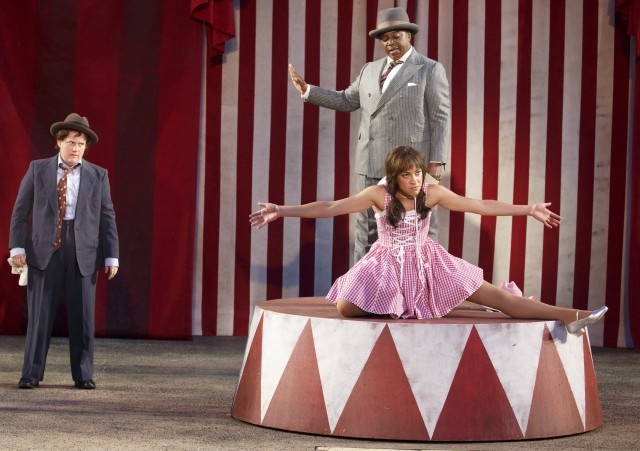
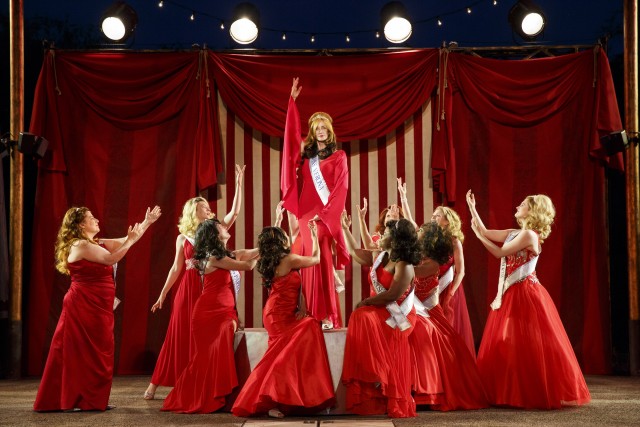
William Shakespeare, protofeminist? Well, not exactly. But in the hands of Tony-nominated director Phyllida Lloyd, Bard fans are offered a new way to look at Shakespeare’s troubling play about women’s submission at the hands of devious men. Lloyd, who previously helmed all-woman versions of Julius Caesar and Henry IV at St. Ann’s (as well as Mamma Mia! on Broadway), now takes the same route with The Taming of the Shrew, continuing at the Public’s Delacorte Theater in Central Park through June 26. Mark Thompson’s set and costumes create a kind of traveling circus atmosphere as a Donald Trump sound-alike introduces beauty-pageant contestants, instantly demeaning women in multiple ways. The women, who come in all the shapes and sizes that the presumptive Republican nominee for president would clearly not approve of, sing and dance, wearing giant smiles on their faces. But Katherina (Cush Jumbo), whose sister is the beautiful, ditzy blonde Bianca (Gayle Rankin), wants no part of this sideshow, demanding to make her own decisions and refusing to kowtow to any man.

(photo by Joan Marcus)

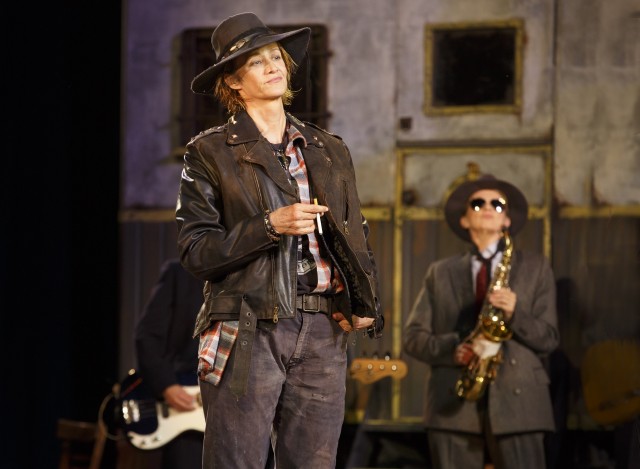
The tough-talking Petruchio (Janet McTeer) is ready for a challenge in THE TAMING OF THE SHREW (photo by Joan Marcus)

Her words are so harsh and brutal that the men in Padua treat her as a kind of laughingstock, wanting nothing to do with her. But when her wealthy father, Baptista (LaTanya Richardson Jackson), declares that until Katherina, his eldest daughter, is wed, his younger daughter, Bianca, an object of sexual desire among all the men, is off limits. So several of Bianca’s suitors, including Gremio (Judy Gold), Lucentio (Rosa Gilmore), and Hortensio (Donna Lynne Champlin), get involved in an elaborate scheme of lies, deception, and mistaken identity to convince Petruchio (Janet McTeer) to wed and bed the untamable Katherina so Bianca becomes fair game. But Kate is not about to fall for their tricks, until she has little choice, resulting in some very difficult scenes as Petruchio essentially starves and tortures Kate to force her to become his obedient sex slave. But Lloyd has a surprise in store that provides a conclusion that might not sit well with either Shakespeare or Trump.

(photo by Joan Marcus)

A beauty pageant sets the stage for a unique battle of the sexes at the Delacorte Theater (photo by Joan Marcus)

The cast, which also features Adrienne C. Moore as Tranio, Teresa Avia Lim as Biondello, Stacey Sergeant as Grumio, Candy Buckley as Vincentio, Leenya Rideout as a wealthy widow, and Morgan Everitt, Anne L. Nathan, Pearl Rhein, Jackie Sanders, and Natalie Woolams-Torres, has an absolute ball, seemingly enjoying every second of the show. Jumbo (Josephine and I, The River) stomps and shrieks around with fiery glee as Kate, while Tony-winning, Oscar-nominated British actress McTeer (God of Carnage, Tumbleweeds) channels a dirtbag Crocodile Dundee as Petruchio. Gold (The Judy Show — My Life as a Sitcom, 25 Questions for a Jewish Mother) stands tall as Gremio, replacing what she calls a boring speech with a brief stand-up routine that, the night we attended, referenced a raccoon that was sneaking around backstage. And Moore (Black Cindy on Orange Is the New Black) is delightful as Tranio, firmly entrenched right in the middle of all the shenanigans. Lloyd infuses the festivities — which actually do nearly fall apart during the wedding scenes and when Petruchio is “taming” Kate — with a feminist energy that nearly explodes to songs by Pat Benatar and Joan Jett. Of course, this production of an outdated, sexist play — which inspired the Cole Porter musical Kiss Me, Kate — comes along at an opportune moment in American history, as Hillary Clinton has a legitimate chance to become the first woman U.S. president, violence and discrimination against the LGBTQ community remain prevalent, and even discussions over bathroom usage have resulted in fear and loathing. In the program, Public Theater artistic director Oskar Eustis notes that Shrew “is the only major Shakespeare play which I have never produced or directed. . . . The reason is simple: I have never been able to get behind the central action of the play, which is, well, taming a woman. . . . But then I listened to Phyllida Lloyd.” We are all very glad that he did.

PERICLES

(photo by Gerry Goodstein)

Pericles (Christian Camargo), the prince of Tyre, has tough times trying to find love and family in Trevor Nunn TFANA production in Brooklyn (photo by Gerry Goodstein)

Theatre for a New Audience, Polonsky Shakespeare Center
262 Ashland Pl. between Lafayette Ave. & Fulton St.
Tuesday – Sunday through April 10, $75-$85
866-811-4111
www.tfana.org

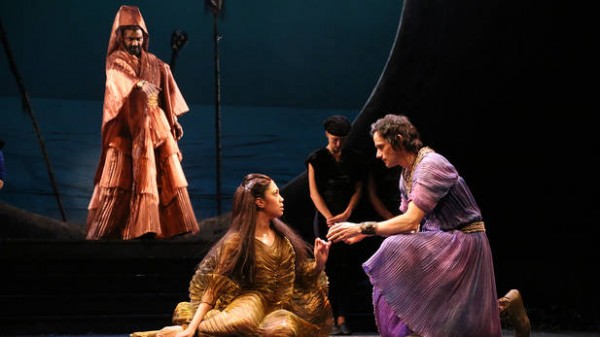
There’s a reason why so many theater lovers, and even Shakespeare aficionados, have never seen or even read Pericles: It’s not a very good play. In addition, the general consensus among scholars is that it’s only one-third Shakespeare anyway: Most think pamphleteer and innkeeper George Wilkins, a friend of Shakespeare’s, wrote the first two acts and that Shakespeare penned the third. The play has never been performed on Broadway, has never been made into a film, and has been presented only once at the Public’s Shakespeare in the Park outdoor summer festival at the Delacorte, in 1974, with Mary Beth Hurt and Randall Duk Kim. (However, in the fall of 2014, the Public did take a trimmed-down version of Pericles on the road in its Mobile Shakespeare Unit.) Now award-winning British director Sir Trevor Nunn, who has brought us The Life and Adventures of Nicholas Nickleby, Arcadia, Copenhagen, and, yes, Cats, Les Misérables, and Starlight Express, is tackling Pericles for the first time, the thirty-fifth Shakespeare play he has directed. (He is planning on completing all thirty-seven from the first folio with upcoming productions of King John and A Midsummer Night’s Dream.) In his first show initiated in the United States with an American cast, Nunn is directing a rousing version of Pericles at Theatre for a New Audience’s (TFANA) Polonsky Shakespeare Center, where it has been extended through April 10. The play is narrated by real-life fourteenth-century English poet John Gower (Raphael Nash Thompson), serving as a kind of one-man Greek chorus. Pericles (Christian Camargo), the prince of Tyre, has traveled to Antioch to solve a riddle that will win him the hand of the daughter (Sam Morales) of King Antiochus (Earl Baker Jr.); if he fails, he will be killed. Realizing that the riddle is about incest between the king and the princess and that he will be slain even if he gives the right answer, Pericles asks for more time, and the king grants him his request while also sending his henchman, Thaliard (Oberon K. A. Adjepong), to murder the prince. Pericles flees home, where his trusted adviser, Helicanus (Philip Casnoff), tells him he must leave at once, certain that King Antiochus will do anything to see him dead. And so Pericles sets out on a series of Odysseus-like adventures that include several shipwrecks as he marries Thaisa (Gia Crovatin), daughter of Simonides (John Rothman), the king of Pentapolis; has a daughter, Marina (played as a teenager by Lilly Englert), who is raised by Cleon (Will Swenson), the governor of Tarsus, and his wife, Dionizya (Nina Hellman); and mourns the passing of his wife, who dies in childbirth.

Nunn’s Pericles takes place on a relatively empty stage with minimal props; scenic designer Robert Jones’s backdrop features a ritualistic large circle that occasionally opens up to introduce characters and shine bright colors (or the sun or moon) onto the otherwise stark setting. PigPen Theatre Co. founding members Alex Falberg, Ben Ferguson, Curtis Gillen, Ryan Melia, Matt Nuernberger, Arya Shahi, and Dan Weschler are joined by musicians Haley Bennett, John Blevins, Philip Varricchio, and Jessica Wang to perform a medieval dumb show throughout the play (they are playing when the house opens, so arrive early to get right into the mood); the delightful period music is by Shaun Davey, who also composed the score for the 2002 Royal Shakespeare Company production of Pericles, during Nunn’s stint as artistic director of the RSC. Camargo (Dexter, The Hurt Locker), who has previously played Coriolanus and won an Obie as Hamlet at TFANA, is at first forthright as Pericles, then heartbreaking as the prince’s life takes dark turn after dark turn. Englert, who made her stage debut in Julie Taymor’s TFANA production of A Midsummer Night’s Dream and followed that by playing Cordelia in Arin Arbus’s King Lear at TFANA, is strong and confident as Marina as she faces personal danger. The rest of the cast, which also includes John Keating, Zachary Infante, and Ian Lassiter as the three fishermen; Adjepong and Patrice Johnson Chevannes as brothel owners; Keating as Boult, their bawdy, gangly servant; Lassiter as their main customer, Lysimachus, governor of Mytilene; and Baker Jr. as Cerimon, the physician, are in full sync throughout the two-hour, forty-five-minute show, but it’s TFANA regular Constance Hoffman’s mind-blowing costumes that rule the day, a wild and thrilling mix of Greek classical, African, street-corner bum, and Goth, balancing glorious pinks, deep oranges, purples, and white with black, brown, and gray. Dionyza’s hat and the bawd’s outfit are unforgettable, drawing the audience’s attention away from the huge holes in the story; Nunn does some patching as well, fiddling around with the kitchen-sink-mishmash of a narrative by moving things around and adding elements of Wilkins’s novel The Painful Adventures of Pericles. It all might not make for a great play itself, but it is quite a grand entertainment, and about as good an introduction to this work as you’re likely to get. (On April 10, following the last performance of Pericles, the musicians from PigPen Theatre will give a concert that is free to TFANA season subscribers and anyone who purchased a ticket to see Pericles between March 29 and April 10; premium $125 tickets are also available, which come with various bonuses.)

STRATFORD ON HOUSTON: OTHELLO

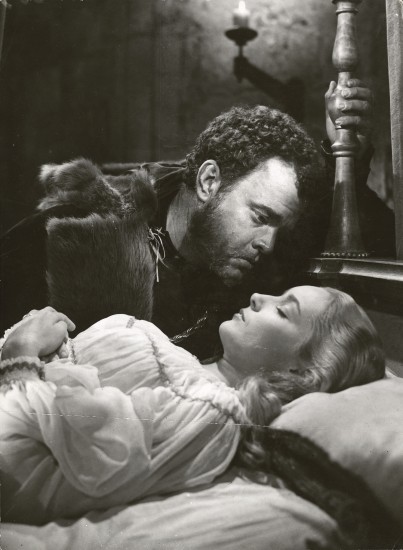
OTHELLO (courtesy Carlotta Films)

Orson Welles’s OTHELLO kicks off Film Forum series commemorating the four hundredth anniversary of the death of the Bard (courtesy Carlotta Films)

OTHELLO (Orson Welles, 1952)
Film Forum
209 West Houston St.
Wednesday, January 13, 12:30, 4:40, 9:15
Series runs January 13-21
212-727-8110
filmforum.org
www.carlottafilms-us.com

Film Forum follows up its two-week presentation of the restored version of Orson Welles’s spectacular Shakespearean adaptation, Chimes at Midnight, by kicking off its commemoration of the four hundredth anniversary of the death of the Bard, “Stratford on Houston,” with Welles’s Othello and the director’s cut of his Macbeth on January 13. Filmed in black-and-white over three years in multiple locations and ultimately employing five cinematographers, four editors, three Desdemonas, and two scores, it’s rather amazing that Welles’s 1952 independent production of William Shakespeare’s Othello was ever completed — of course, many Welles projects were not. That the final work turned out to be a masterpiece that won the Palme d’Or at Cannes speaks yet more to Welles’s genius. Welles, who directed the picture and plays the title character, streamlined the story into ninety-five minutes, getting to the heart of the most intense tale of jealousy and betrayal ever told. The film opens with shadowy shots of the dead Othello and his deceased wife, Desdemona (Suzanne Cloutier), carried aloft on biers at their dual funeral, to the sounds of an ominous piano and a mournful vocal chorus. The credits soon follow, after which Welles returns to the beginning, as the villainous ensign Iago (Micheál MacLiammóir) plots with Roderigo (Robert Coote) to convince Othello that his loyal and devoted wife is actually in love with the heroic soldier Michael Cassio (Michael Laurence).
At first Othello brushes away Iago’s concerns, but soon he is caught in Iago’s trap and starts to question the fairy-tale love he shares with his beautiful and trusting bride. As the story proceeds, characters are shown in extreme close-up, in narrow passages and doorways, amid medieval rooms with large columns and intricately designed windows, shadows looming everywhere; the stunning architecture, shot at disorienting angles, is a character unto itself. Welles did whatever it took to finish the film, including using his own funds from acting jobs and filming a scene in a bathhouse when costumes were unavailable, lending the proceedings a fragmented feel that evokes the mirrors in the finale of The Lady from Shanghai. Unfortunately, the syncing of the dialogue track is still often off and numerous cuts are too shaky, but they detract only a bit from the overall power and majesty of the film, a bold and brave take on a familiar Shakespeare tale given a dark new life by a master auteur. “Stratford on Houston” continues through January 21 with such other Shakespeare and Bard-related films as Laurence Olivier’s Hamlet, Richard III, and Henry V, Fred McLeod Wilcox’s sci-fi classic, Forbidden Planet, Franco Zeffirelli’s Romeo and Juliet, and Roman Polanski’s Macbeth.

THESE PAPER BULLETS!

(photo by Ahron R. Foster)

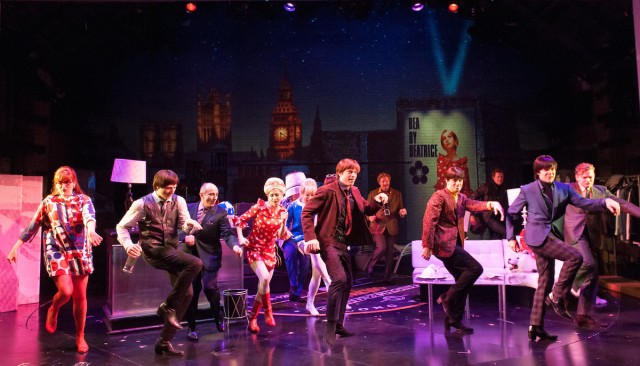
THESE PAPER BULLETS! mixes Shakespeare with the Fab Four at the Atlantic (photo by Ahron R. Foster)

Atlantic Theater Company
Linda Gross Theater
336 West 20th St. between Eighth & Ninth Aves.
Tuesday – Sunday through January 10, $75
866-811-4111
atlantictheater.org

These Paper Bullets!, Rolin Jones’s Yale Rep transport of Shakespeare’s Much Ado About Nothing to swinging 1964 London, looks and sounds great. Jessica Ford’s Mary Quant-inspired Mod costumes feature polka dots, brightly colored miniskirts, and fashionable boots and shoes, while Billie Joe Armstrong’s Beatlesque songs offer a fun twist on the Fab Four’s musical style. Unfortunately, the rest of this overly silly frenetic farce is dreadfully unfunny, a Monty Python-like sketch that in this case goes on for a long, drab two hours. The Quartos — Ben (Justin Kirk), Claude (Bryan Fenkart), Balth (Lucas Papaelias), and Pedro (James Barry) — are England’s hottest band, making women swoon wherever they go. Claude has fallen for Twiggy-esque model Higgy (Ariana Venturi), the daughter of hotel owner Leo Messina (Stephen DeRosa), while Ben and fashion designer Bea (Nicole Parker) develop a kind of love-hate relationship. Everything threatens to come crumbling down when fired drummer Don Best (Adam O’Byrne), Pete’s brother, decides to exact revenge on the Quartos and their manager, Anton (Christopher Geary), with the help of reporter Boris (Andrew Musselman). Meanwhile, Scotland Yard is suspicious of the Quartos and their success, so Mr. Berry (Greg Stuhr) sends Mr. Cake (Tony Manna) and Mr. Urges (Brad Heberlee) undercover to find out what the band is really up to. The shenanigans are annoyingly detailed throughout by TV journalist Paulina Noble (Liz Wisan), including a ridiculous appearance by the queen (Geary). These Paper Bullets! is supposed to be a madcap romp melding Shakespearean iambic pentameter with the sheer glee of Richard Lester’s Beatles films, but it falls flat again and again, despite a game cast. Jackson Gay, who will be directing Much Ado About Nothing this spring at Cal Shakes, can’t make heads or tails of Jones’s nonsensical script (the two previously collaborated on The Intelligent Design of Jenny Chow and The Jammer, both at the Atlantic), getting a total of two chuckles out of me as the Bard and Beatles references zoom by at a groaning pace. In a nice touch, the Quartos perform such songs as “Give It All to You” and “Love Won’t Wait” on a rotating stage in the shape of a vinyl record; Green Day’s Armstrong, whose American Idiot ran on Broadway five years ago, knows his Mop Tops, but most of the rest of These Paper Bullets! shoots nothing but blanks, desperately in need of some real help.