Tag Archives: william shakespeare

TIMON OF ATHENS

(photo by Henry Grossman)

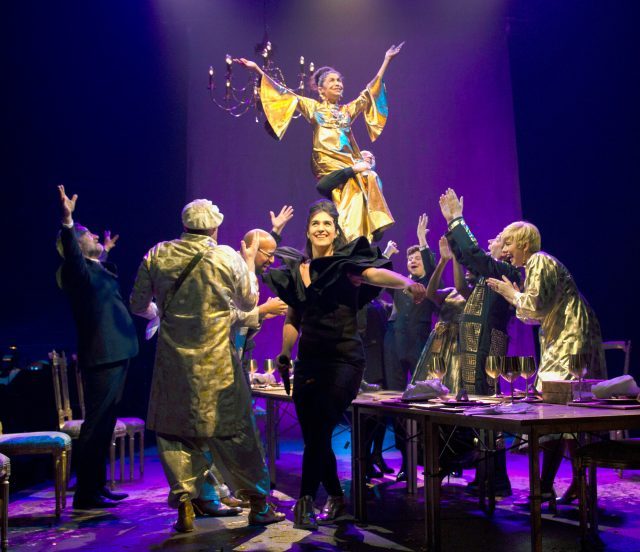
Timon (Kathryn Hunter) throws a feast fit for a queen in Timon of Athens (photo by Henry Grossman)

Theatre for a New Audience, Polonsky Shakespeare Center
262 Ashland Pl. between Lafayette Ave. & Fulton St.
Tuesday – Sunday through February 9, $90-$115
866-811-4111
www.tfana.org

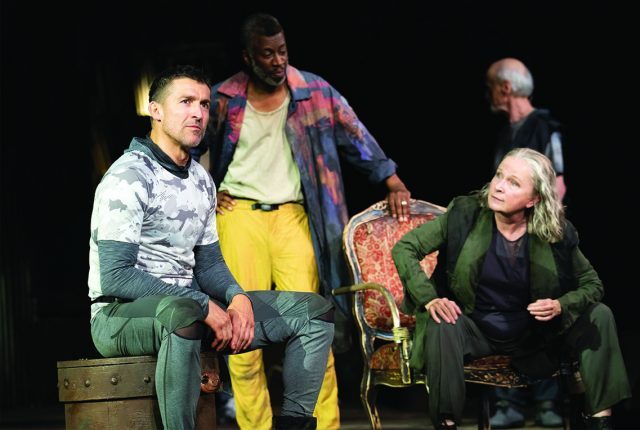
New York-born British actress Kathryn Hunter glitters and glows in William Shakespeare and Thomas Middleton’s Timon of Athens, which opened tonight at Theatre for a New Audience’s Polonsky Shakespeare Center in Fort Greene. Simon Godwin’s production, initiated at the Royal Shakespeare Company and presented here in association with DC’s Shakespeare Theatre Company, should become the gold standard for the rarely performed play, a penetrating and very funny evisceration of greed and true friendship centered around a lust for jewels above all things. The text has been edited by Emily Burns and Godwin to make the lead character female, and TFANA regular Hunter runs with it, delivering an unforgettable, voracious performance as Timon (rhymes with Simon), a widowed noblewoman who loves to host feasts in her mansion where guests bring her trinkets and flatter her to no end and she gives them piles of cash and valuable gems. Painter (Zachary Fine) gives her an absurd portrait, Poet (Yonatan Gebeyehu) heaps words of praise on her, and Jeweller (Julia Ogilvie) offers her a fine stone, and she recompenses them manyfold. Sempronius (Daniel Pearce) insists that Timon not allow one of her servants, Lucilius (Adam Langdon), to marry his daughter despite their being in love, but he changes his mind quickly when she promises him money as a kind of dowry/bribe.

Her loyal steward, Flavius (John Rothman), notifies her that her wealth is dwindling, and the cynical philosopher, Apemantus (Arnie Burton), warns her not to put her faith in these false friends, but she is too caught up in the revelry to pay attention. “I wonder men dare trust themselves with men, / Methinks they should invite them without knives — / Good for their meat and safer for their lives,” Apemantus, the only character not wearing shimmering black or gold but instead a Patti Smith T-shirt, tells the audience. A few moments later, after Timon asks him to be silent, he says, “So. / Thou wilt not hear me now; thou shalt not then. / I’ll lock thy heaven from thee. / O, that men’s ears should be / To counsel deaf, but not to flattery!” When she finally understands that her coffers are empty, she sends out Flaminia, Lucilius, and Flavius to Lucullus (Dave Quay), Sempronius, and Lucia (Shirine Babb), asking for loans, but the trio is cruelly denied. Furious at this drastic change of events, the formerly happy-go-lucky Timon turns her back on the life she so treasured and shared with others. “Nothing I’ll bear from thee / But nakedness, thou detestable town,” she says of Athens. “Take thou that too, with multiplying bans. / Timon will to the woods, where she shall find / Th’unkindest beast more kinder than mankind. / The gods confound — hear me, you good gods all! — / The citizens both within and out that wall, / And grant as Timon grows her hate may grow / To the whole race of mankind, high and low! / Amen.” In the second act, Timon, now in tattered rags, is a bitter woman who spends most of her days digging her own grave until she is discovered by visitors from her past, including Alcibiades (Elia Monte-Brown), who has become the leader of an angry mob protesting the Athenian government.
(photo by Henry Grossman)

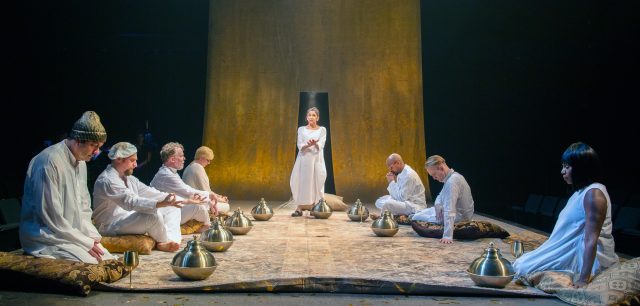
Timon of Athens is regendered in Simon Godwin’s glittering production at TFANA (photo by Henry Grossman)

Godwin’s sublime and timely interpretation of Timon of Athens addresses homelessness, income inequality, the dispossessed, an unsympathetic state, and humankind’s propensity for greed. Timon is a complex character, both antihero and cautionary figure of what can happen if wealth is all that matters and friends are available for purchase. I would say that Hunter is a revelation in the title role, but she’s been a revelation in almost everything I’ve seen her in, from Peter Brook and Marie-Hélène Estienne’s The Valley of Astonishment and Fragments to Hideki Nota’s The Bee and Colin Teevan’s The Emperor. Here she displays a ruggedly coarse physicality that is utterly majestic and downright enthralling, a force of nature unto itself, whether she’s being lifted by her sycophantic, hypocritical guests or carving her own epitaph. The glorious costumes, which range from ostentatious dresses to sleek black suits and, eventually, sackcloth and ashes, are by Soutra Gilmour, who also designed the impressive sets; the stage juts out far into the audience, who sit on three sides, with ramps leading off through two corners.

In the first act, opulence is on view, with a festive table, a large gold backdrop that serves as a doorway, and, later, a rug that apparently needs to be fastened more securely to the floor, as several actors tripped over different parts the night I went. The transformation to a forest for the second act is so dramatic you might want to stay in your seats and watch it instead of hurrying out for the restroom or a drink. At rear left, guitarist and bouzuki player Christopher Biesterfeldt, percussionist Philip Coiro, clarinetist Joshua Johnson, and singer Kristen Misthopoulos perform music by composer Michael Bruce, including one piece based on a Cretan peasant hymn and another from Shakespeare’s fifty-third sonnet. Monte-Brown and Rothman stand out in a strong cast, but it’s Hunter, who has previously portrayed King Lear, Richard III, and Cyrano, who will take your breath away while also making you wonder why you’ve never read or seen this play before.
CLASSIC STAGE COMPANY: MACBETH

(photo by Joan Marcus)

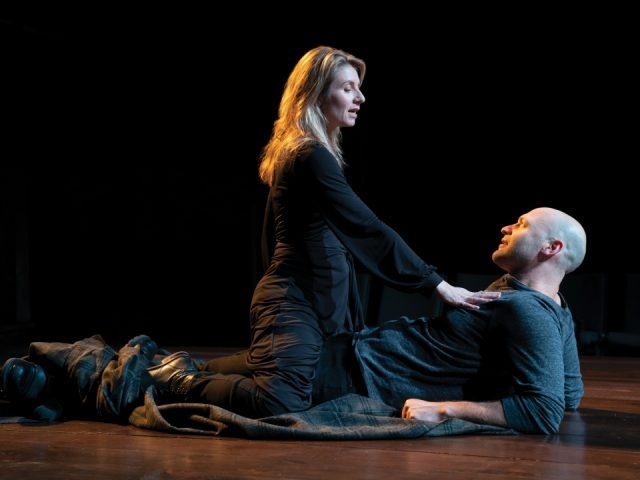
Married couple Nadia Bowers and Corey Stoll star as a sexy married couple with devilish ambitions in Classic Stage adaptation of Macbeth (photo by Joan Marcus)

Classic Stage Company, Lynn F. Angelson Theater
136 East 13th St. between Third & Fourth Aves.
Tuesday – Sunday through December 15, $82-$127
classicstage.org/shows/macbethcsc

Manhattan native and NYU grad Corey Stoll has quickly become a go-to Shakespearean actor in the city, playing Ulysses in Troilus and Cressida in 2016, Brutus in Julius Caesar in 2017, and Iago in Othello in 2018, all for Shakespeare in the Park at the Delacorte. His easygoing manner brings a compelling humanity to his performances, which also include runs in Law & Order: LA, House of Cards, The Strain, and The Deuce. And that humanity is again evident as he stars as the title character in John Doyle’s streamlined adaptation of the Bard’s Macbeth, continuing at Classic Stage through December 15.

Doyle’s spare set is a rectangular platform with a large wooden throne at one end; above it is a balcony. The actors are always visible, either onstage or standing in the back, watching and waiting. They are dressed in Ann Hould-Ward’s dark Tartan costumes, although it is difficult to tell the individual clans apart or when an actor is playing a different role, as several have multiple parts without costume changes. (The witches are played by most of the company, not a trio of actors.) Lady Macbeth is played by Nadia Bowers (Describe the Night, Life Sucks.), Stoll’s real-life wife, lending a sweet intimacy to their scenes together even as they plot murder most foul. Their sexuality heats up the stage, even as some sly jokes might be a bit much; for example, when Lady Macbeth says, “Come you spirits / That tend on mortal thoughts, unsex me here, / And fill me from the crown to the toe, top-full / Of direst cruelty. Make thick my blood, / Stop up th’access and passage to remorse,” Bowers, sitting on the floor, grabs her crotch in a rather un-Shakespearean manner.

(photo by Joan Marcus)

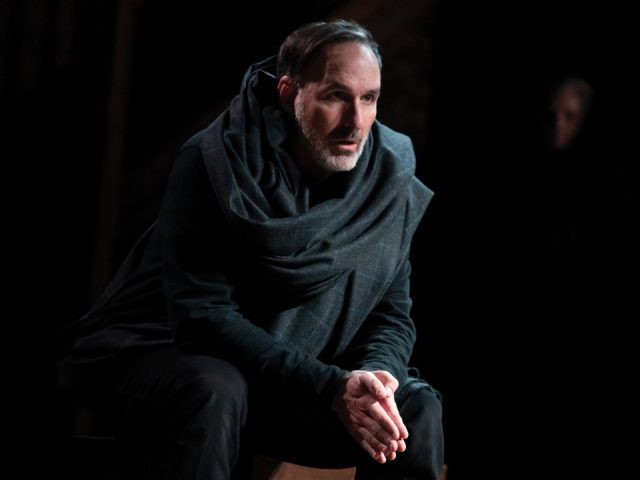
Erik Lochtefeld plays a contemplative Banquo in John Doyle’s Shakespeare adaptation (photo by Joan Marcus)

Barzin Akhavan is a fine Macduff, Erik Lochtefeld a touching Banquo, Tony nominee Mary Beth Peil a quietly regal Duncan, and Raffi Barsoumian a solid Malcolm; the cast also features N’Jameh Camara as Lady Macduff, Barbara Walsh as Ross, and Antonio Michael Woodard as Fleance, but it’s harder for them to establish their characters, who get lost in the shuffle. Tony winner Doyle (Sweeney Todd, Company), the Scottish director who went to school near Cawdor Castle, where much of the play takes place, has trimmed the show to a muddled hundred minutes, sacrificing too much of its necessary building energy as evil ambition overwhelms Macbeth. Even such a flourish as a bowl of water where Macbeth and Lady Macbeth wash the blood off their hands remains onstage too long, going impossibly unseen in front of others.

There are various versions of the Scottish play one can experience now or soon, including the Roundabout’s musical adaptation, Scotland, PA, at the Laura Pels through December 8, the long-running Sleep No More at the McKittrick Hotel, a return engagement of Erica Schmidt’s Red Bull schoolgirl version by the Hunter Theater Project starting in January, and Primary Stages’ Peerless, set in the world of college admissions, next spring. But you won’t go wrong with Stoll, who rises above Doyle’s messy confusion, delivering a compelling and even cathartic Macbeth, who could be any of us, lured in by power. When he says, “Is this a dagger which I see before me, / The handle toward my hand? Come, let me clutch thee,” we all see it, and consider reaching for its glittering promise.

BAM NEXT WAVE: HAMNET / HE DID WHAT?

(photo by Ed Lefkowicz)

Dead Centre makes its BAM debut with Hamnet (photo by Ed Lefkowicz)

HAMNET
BAM Fisher, Fishman Space
321 Ashland Pl.
Through November 3, $25
718-636-4100
www.bam.org/hamnet
www.deadcentre.org

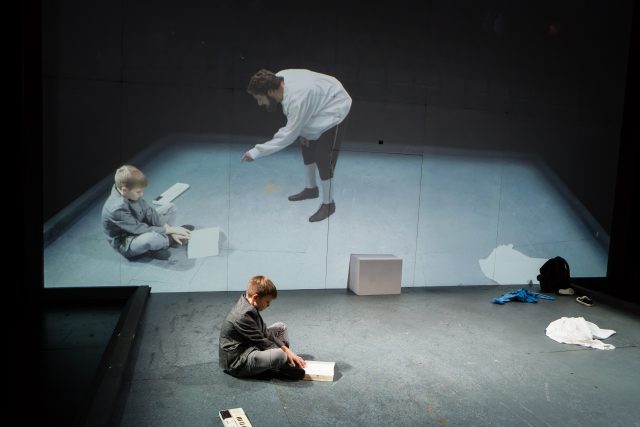
What is a son without a father? What is a father without a son? Those questions are at the heart of Dead Centre’s Hamnet, making its New York premiere this week at BAM. The sixty-minute multimedia show is part of new BAM artistic director David Binder’s inaugural Next Wave Festival consisting exclusively of BAM debuts, and this one is highlighted by a dynamite performance by Aran Murphy as the title character, in his professional acting debut. Murphy is a contemporary Hamnet, William Shakespeare’s only son, who died tragically in 1596 at the age of eleven. The boy is dressed in modern clothes, carries around a backpack, and regularly asks Google for information; it’s as if he’s been searching for his father, who abandoned him and his twin sister, Judith, and their mother, Anne Hathaway, in order to write his plays, for more than four hundred years. “To be, or not to be,” he declares several times, hoping that maybe his dad’s writings will help him find him.

Written and directed by Dead Centre founders Bush Moukarzel and Ben Kidd, Hamnet features a large screen at the back of the stage, where the audience is live-streamed through most of the show. Jose Miguel Jimenez’s innovative video design and Liv O’Donoghue’s choreography form a kind of magic as Hamnet roams Andrew Clancy’s set, sometimes disappearing onscreen even though he is right in front of us, or vice versa, and growing even more complex and eerie when the ghost of his father (Moukarzel) appears. The narrative at times becomes murky and confusing, but the technical wizardry and Murphy’s astounding portrayal overshadow its shortcomings. “Who would fardels bear, / To grunt and sweat under a weary life, / But that the dread of something after death, / The undiscovere’d country, from whose bourn / No traveller returns, puzzles the will, / And makes us rather bear those ills we have / Than fly to others that we know not of?” Hamlet asks. Hamnet is a hypnotic puzzle about death, grief, and personal identity, albeit one that is not easily unravele’d.

(photo by twi-ny/mdr)

BAM presents free animated street opera on building facade (photo by twi-ny/mdr)

HE DID WHAT?
Peter Jay Sharp Building
30 Lafayette Ave. at St. Felix St.
Through November 2, free, 7:00 – 10:00
718-636-4100
www.bam.org
www.dumbworld.co.uk

After seeing Hamnet, make your way around the corner to BAM’s main home, the Peter Jay Sharp Building, which houses the Howard Gilman Opera House, to catch the world premiere of Dumbworld and Irish National Opera’s He Did What? The ten-minute animated film, conceived and created by Brian Irvine and John McIlduff with video by Killan Waters and Conan McIvor, is projected onto the facade of the building at the corner of Lafayette Ave. and St. Felix St. The audience is given headsets through which they hear the hysterical story of three alter kockers with walkers parading slowly down the street, a man followed by two women. The two women are gossiping about him, as his wife recently caught him in bed with another woman and is deciding what to do about it. The characters are sung by Doreen Curran, Sylvia O’Brien, and Dan Reardon, with music composed by Irvine and played by the RTE Concert Orchestra, conducted by Fergus Shiel. The piece was written and directed by McIlduff; the riotous words also appear on the wall in goofy, graffiti-like type, complementing KAWS’s BAM mural and David Byrne’s bike rack across the street. While Hamnet will have you wondering, “How did they do that?,” the free presentation of He Did What?, running 7:00 to 10:00 nightly through November 2, will have you saying again and again, “He did what?” as well as “Oh no she didn’t. Oh yes she did.”

BAM NEXT WAVE FESTIVAL: HAMNET

(photo by Ernesto Galan)

Dead Centre makes its BAM debut with Hamnet (photo by Ernesto Galan)

BAM Fisher, Fishman Space
321 Ashland Pl.
October 30 – November 3, $25
718-636-4100
www.bam.org/hamnet
www.deadcentre.org

New BAM artistic director David Binder continues his season of BAM debuts with Hamnet, presented by Ireland’s Dead Centre. In 1585, William Shakespeare’s wife, Anne Hathaway, gave birth to twins, son Hamnet and daughter Judith. Hamnet died tragically in 1596 at the age of eleven; three years later, the Bard wrote perhaps his greatest play, Hamlet, at least partly about a young man haunted by the death of his father. Founded in 2012 by Bush Moukarzel and Ben Kidd and based between Dublin and London, Dead Centre has previously staged Beckett’s Room, Lippy, (S)quark!, Souvenir, Chekhov’s First Play, and Shakespeare’s Last Play; all but Lippy deal with writers, including James Joyce and Marcel Proust in addition to Samuel Beckett, Anton Chekhov, and Shakespeare. It has long been debated whether Shakespeare wrote Hamlet specifically in reaction to the death of his son, or whether Hamnet also inspired part of other works. For example, in King John, published in 1623, Constance says, “Grief fills the room up of my absent child.”

“Over centuries of feverish speculation, the most compelling reflections on the presence of Shakespeare’s emotional life in his plays — preeminently, James Joyce’s brilliant pages in Ulysses, but there are many others — have focused on Hamlet,” Shakespeare expert Stephen Greenblatt wrote in 2014 in the New York Review of Books. “This biographical attention to a work deriving from recycled materials and written for the public stage would seem inherently implausible, were it not for the overwhelming impression on readers and spectators alike that the play must have emerged in an unusually direct way from the playwright’s inner life, indeed that at moments the playwright was barely in control of his materials. I will attempt in what follows to trace Hamlet back to a personal experience of grief and to sketch a long-term aesthetic strategy that seems to have emerged from this experience.” The sixty-minute multimedia piece, running October 30 to November 3 at BAM Fisher, features text and direction by Moukarzel and Kidd, with dramaturgy by Michael West, set design by Andrew Clancy, costumes by Grace O’Hara, lighting by Stephen Dodd, sound by Kevin Gleeson, video by Jose Miguel Jimenez, and choreography by Liv O’Donoghue. Aran Murphy plays Hamnet, addressing the audience directly as he shares his tragic tale.

SHAKESPEARE IN THE PARK: CORIOLANUS

(photo by Joan Marcus)

Coriolanus comes to Shakespeare in the Park for the first time in forty years (photo by Joan Marcus)

Central Park
Delacorte Theater
Tuesday – Sunday through August 11, free, 8:00
shakespeareinthepark.org

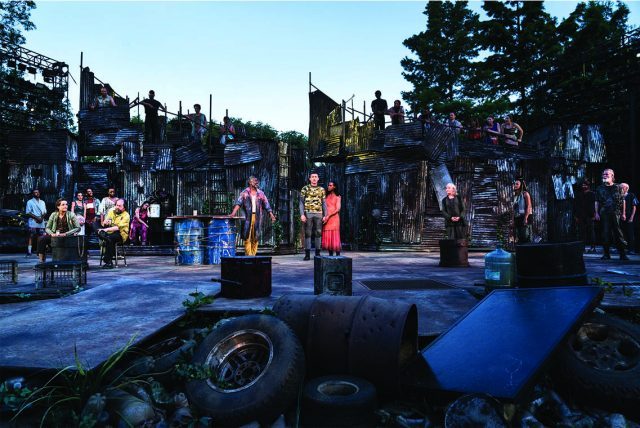
Jonathan Cake portrays Shakespeare’s brash antihero, Coriolanus, like a mix between superstar New England Patriots quarterback Tom Brady and Keanu Reeves in Bill & Ted’s Excellent Adventure in Daniel Sullivan’s riveting version, which opened tonight at the Public’s Delacorte Theater. The first Shakespeare in the Park production of the 1607 play since Wilford Leach’s staging in 1979 with Morgan Freeman — James Earl Jones starred as the title character in the only other Delacorte presentation of the work, Gladys Vaughn’s 1965 adaptation — Sullivan sets the play in a contemporary junkyard strewn with old tires, a burned-out car, random detritus, and a rickety steel gate. (The postapocalyptic design is by Tony winner Beowulf Boritt.)

(photo by Joan Marcus)

Martius (Jonathan Cake) gets a talking-to from his mother (Kate Burton) in Daniel Sullivan’s latest Shakespeare adaptation (photo by Joan Marcus)

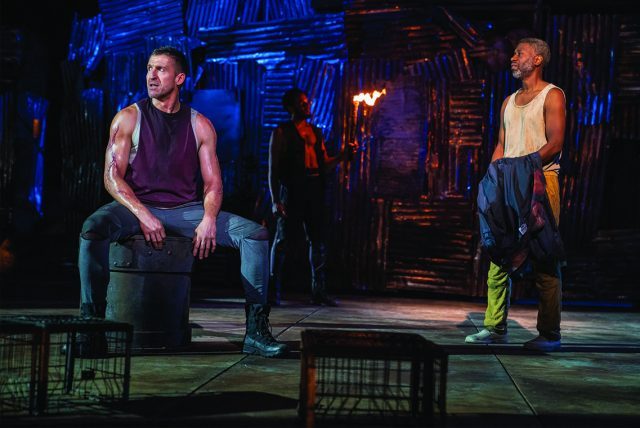
Caius Martius (Cake) has returned to Rome after singlehandedly defeating the Volscians, who are led by his longtime nemesis, General Tullus Aufidius (Louis Cancelmi). Rechristened Coriolanus after his victory, Martius has nothing but disdain for the common folk, who are starving, scavenging for food on the streets. The conquering hero is soon the centerpiece of a power struggle in pre-imperial Rome, championed by the upper classes as their savior against the rabble. While his patrician supporters, including Senator Menenius Agrippa (Teagle F. Bougere), army commander Cominius (Tom Nelis), and General Titus Lartius (Chris Ghaffari), want him to run for consul to gain political power over the “beastly plebians,” the people’s tribunes Junius Brutus (Enid Graham) and Sicinius Velutus (Jonathan Hadary) are suspicious of him and so attempt to turn the starving mob against him in the upcoming election. Martius, who is married to the pregnant Virgilia (Nneka Okafor), father to Young Martius (Emeka Guindo), and son to the forceful, determined Volumnia (Kate Burton), is a fiery, insolent, and almost monstrously arrogant character, and he can’t keep his mouth shut; all too soon he comes up with a dangerous plan of revenge that threatens everything, and everyone, he loves.

(photo by Joan Marcus)

Martius (Jonathan Cake) and Menenius (Teagle F. Bougere) have a tense moment in Shakespeare in the Park presentation (photo by Joan Marcus)

At more than two and a half hours (with intermission), Coriolanus is long and drawn out, with a compelling main storyline but mundane, barely there subplots, perhaps because this tale is entirely fictional, not based on actual historical events. The play has never been brought to Broadway, and it is rarely revived; Michael Sexton’s 2016 Red Bull production found a way in by setting it during the Occupy movement and placing the audience in the center of the action. However, on a more conventional stage, it can prove significantly problematic, although Sullivan does a good job navigating through the bumps. The acting is inconsistent, although Public Theater mainstay Bougere (Cymbeline, Is God Is) is excellent as Martius’s right-hand man, Nelis (Girl from the North Country, Indecent) is a fine Cominius, and three-time Tony nominee Burton (The Elephant Man, The Constant Wife) is brilliant as Martius’s strong-willed mother. Tony winner Sullivan (Proof, The Comedy of Errors) makes the most of Volumnia’s line about her son being a man-child; the warrior Martius often turns into a little boy when speaking to his mommy, eliciting major laughs. It’s a stark counterpoint to his bravery in battle and his burgeoning frenemy bromance with Aufidius. It’s also a keen look at the voting process, particularly now that election season is under way in the United States, as the people and the pundits debate over who’s worthy and who’s not, who’s genuine and who is a power-hungry, mean-spirited liar.

GARY: A SEQUEL TO TITUS ANDRONICUS

(photo by Julieta Cervantes)

Gary (Nathan Lane) and Janice (Kristine Nielsen) have got quite a cleaning job ahead of them in Taylor Mac’s Gary: A Sequel to Titus Andronicus (photo by Julieta Cervantes)

Booth Theatre
222 West 45th St. between Broadway & Eighth Ave.
Tuesday – Sunday through June 16, $39 – $169
shubert.nyc/theatres/booth

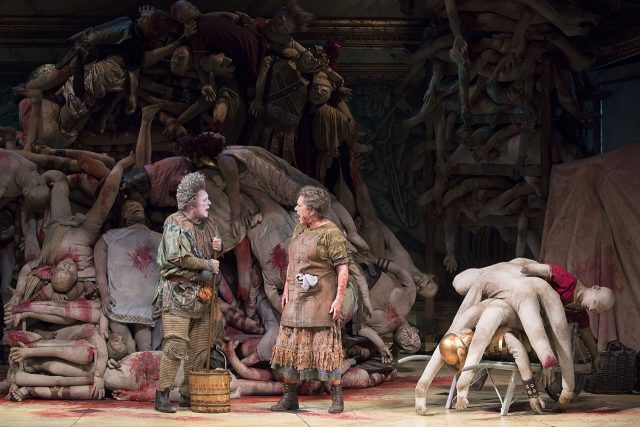
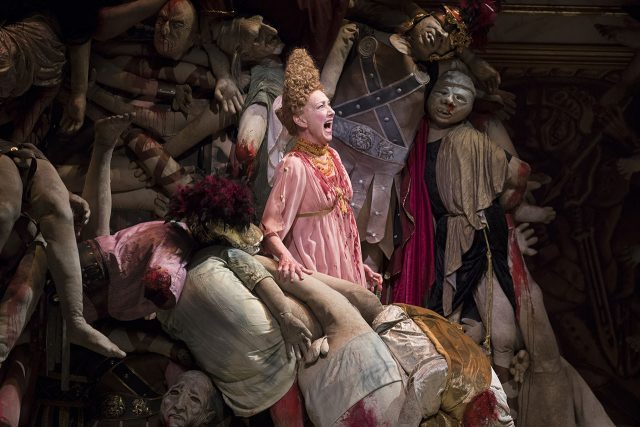
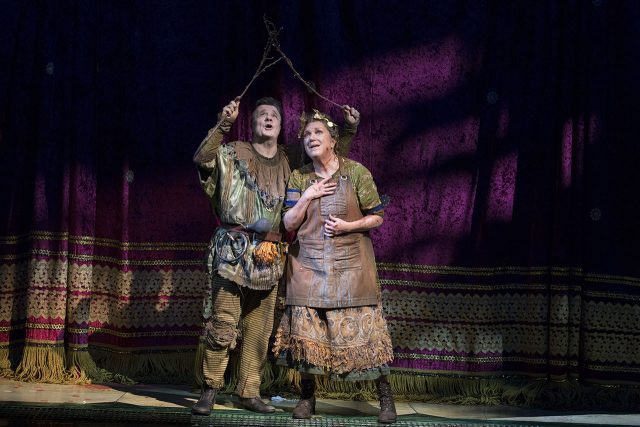
Downtown fave Taylor Mac makes quite an impression with his Broadway debut, the eminently strange and hysterically funny Gary: A Sequel to Titus Andronicus. The play is set just after the bloodbath that concludes Shakespeare’s violent tragedy and is prefaced by a monologue by a midwife named Carol (Julie White), who self-referentially explains directly to the audience, “Like God, a sequel hides inside an ending: / When time is up you pray that it’s extending. / For life, to the cultured, and to the philistine / Once felt, is craved ’til thrills become routine. / But once routine the thrills, to thrill, must grow. / And if they don’t, an outrage starts to show. / So double up on savagery and war: / To satisfy you multiply the gore.” She introduces not only the rhythmic nature of the dialogue and the British accents all three characters will speak in but also the Monty Python-like comedy of spurting blood in which anything goes and no joke is too high or low. The Clown (named Gary by Mac and portrayed with extra relish by Nathan Lane), who had delivered a letter to Saturninus in the original Bard play, has avoided execution by agreeing to become a maid. Little does he know that he will have to work with the stern, humorless Janice (Kristine Nielsen) to clean up more than a thousand ragged bodies piled high in the royal banquet room, a fate perhaps worse than death.

(photo by Julieta Cervantes)

Carol (Julie White) find herself in an icky predicament in Gary: A Sequel to Titus Andronicus (photo by Julieta Cervantes)

“I always was a clown who hated clowns,” Gary, who used to juggle pigeons on the street, confesses to the bodies. Belittled by Janice, he tells her he is “more like an everyman who’s a nobody else” and shares his dream of becoming a fool, which he describes as “a clown with ambition.” (Master clown and actor Bill Irwin is credited with the movement.) Janice teaches him the ropes, which involves thoroughly eliminating the remaining gas from each victim and then sucking out their innards and blood using two separate hoses. Mac includes a parade of flatulence and penis jokes that are not the usual Broadway fare while also taking on the current political climate in America. “Ya think the streets are all clean and nifty? Ya know as well as I it’s a hell on earth out there and only getting worse, what with the autocracy turned to a democracy turning back to an autocracy, as we speak,” Janice, who refuses to talk in rhymes or Iambic pentameter, says. A moment later, Gary bursts into tears and Janice uncaringly asks, “What ya crying for?” He answers, “The state of the world.”

The puns and buffoonery keep on coming as Pulitzer Prize finalist Mac (A 24-Decade History of Popular Music) and five-time Tony Award-winning director George C. Wolfe (Angels in America, Topdog/Underdog) push Janice, Carol, and Gary deeper into the mess left behind by the powers that be. The near-endless supply of dead people on Santo Loquasto’s imaginative set evokes the casualties of wars waged by tyrannical governments. “Seems the casualty is how casual it is,” Gary opines. But there are also glimmers of hope. Explaining the surprising emotions he experienced when he was barely saved from being hanged and saw the sky as if for the first time, Gary says to Janice, “Once ya feel that, it’s proof, aint’ it? Proof ya don’t gotta live your life accepting the muck.” He believes he can save the world, which Mac thinks everyone is capable of. Referring to the court, Gary says, “If two maids could turn the hopelessness of a massacre into a coup of beauty, they too can imagine a better world.”

(photo by Julieta Cervantes)

Gary (Nathan Lane) impresses Janice (Kristine Nielsen) for a moment in Broadway comedy (photo by Julieta Cervantes)

Tony winners Lane (Angels in America, The Producers) and White (The Little Dog Laughed, Airline Highway) and Tony nominee and Obie winner Nielsen (Vanya and Sonia and Masha and Spike, Dog Opera) have a blast together. At the last moment, Andrea Martin, who was cast as Janice, got hurt and had to leave the show, so Nielsen moved from Carol to Janice and White came on as Carol, creating a formidable comic trio with a lot to say about society while making the audience laugh itself silly.

Mac, who uses the gender pronoun “judy,” delivers some grand pronouncements without becoming preachy, getting right to the point when Gary declares that the next step should be “not a violent coup. An artistic one. An onslaught of ingenuity that’s a transformation of the calamity we got here. A sort of theatrical revenge on the Andronicus revenge. A comedy revenge to end all revenge. Well, not just a comedy. A sorta folly. Not a spectacle. Or a comedy folly that is a spectacle. Sorta a machination. That’s full of laughter. But more than laughs. But with the laughs. Well, sorta a thinking man’s laughter. But could be a knee-slapper.” Which is just what Mac’s play is.

ASHITA NO MA-JOE: ROCKY MACBETH

(photo © Richard Termine)

Theater Company Kaimaku Pennant Race give a unique twist to Macbeth at Japan Society (photo © Richard Termine)

Japan Society
333 East 47th St. at First Ave.
May 15-18, $28
212-715-1258
www.japansociety.org
www.kpr.tokyo

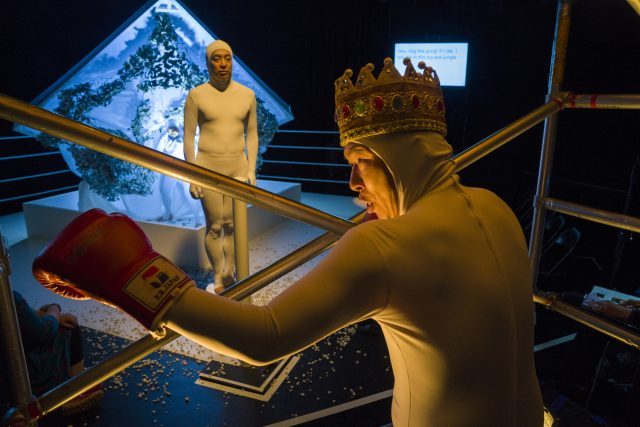
Theater Company Kaimaku Pennant Race founder Yu Murai’s Ashita no Ma-Joe: Rocky Macbeth is silly fun, a goofy comic mash-up of William Shakespeare’s Macbeth and the late 1960s manga Ashita no Joe (“Tomorrow’s Joe”). Continuing at Japan Society through May 18, it’s a riotous twist on both stories that creates something fresh and new — and completely wild and unpredictable. The show takes place in and around a light-blue boxing ring onstage, open on two sides, along which the audience of no more than sixty sits. Inside the ring is a second, much smaller ring, with a malleable, flexible mat that occasionally is lifted to reveal various characters, bits of scenery, and video of a koi pond by Kazuki Watanabe. To get you in the mood as you enter the empty theater, audio plays of Steve Albert, Dr. Ferdie Pacheco, and former champ Bobby Czyz calling the November 1998 championship bout between Ricardo “Finito” Lopez and Rosendo Alvarez. Beer, wine, and popcorn is available for purchase and can be consumed during the performance, as if you’re in a boxing arena. The three actors, Takuro Takasaki (Macbeth), G. K. Masayuki (Banquo), and Kazuma Takeo (Lady Macbeth), wear absurdly tight head-to-foot costumes that are a mix of wrestling uniforms and the sperm characters from Woody Allen’s Everything You Ever Wanted to Know About Sex.

(photo © Richard Termine)

Macbeth faces his destiny in Japanese mashup (photo © Richard Termine)

The dialogue can be seen on two monitors — unfortunately placed at angles that make it difficult to read and follow the action onstage simultaneously — but it’s not critical to catch every word, as there is a lot of repetition and exposition. The sixty-minute show features key plot points and quotes from Macbeth, including the witches’ prophecies and Macbeth’s rise to the top — to become both king and yokozuna — as he goes after King Duncan, Banquo, and Macduff; however, in this version, Lady Macbeth is not as central to his quest. There are also elements of Ashita no Joe, with such characters as Woolf and Joe, as well as tips of the hat to legendary sumo wrestler Kitanoumi and boxer Wajima Koichi. Along the way, Macbeth displays his boxing skills with the “back-spinning uppercut,” “triple cross counter,” and other punches and jabs and starts seeing apparitions of the men he has vanquished. “The boxing ring howls and calls for fresh blood,” one declares. There are also anachronistic pop culture references, a shaky-looking scaffold that serves as the castle (and where writer-director Murai runs things), and a battle scene in which six members of the audience need special protection. (We strongly suggest you sit in the seats warning about pebbles.) As with even the best boxers, not everything hits its mark, but more than enough does to score a knockout, a crazy, unusual immersive Shakespeare adaptation from a company that previously brought us Romeo and Toilet and King Lear, Sadaharu. There’s no telling what wonderful nonsense they’ll be up to next, but we’ll be there.