Takashi Miike’s fantasy for families is only five bucks at Lincoln Center matinee
13 FROM TAKASHI MIIKE: THE GREAT YOKAI WAR (YÔKAI DAISENSÔ) (Takashi Miike, 2005)
Film Society of Lincoln Center, Walter Reade Theater
165 West 65th St.
Sunday, March 20, $5, 2:00
Series runs March 16-20
212-875-5610
www.filmlinc.com
www.yokai-movie.com
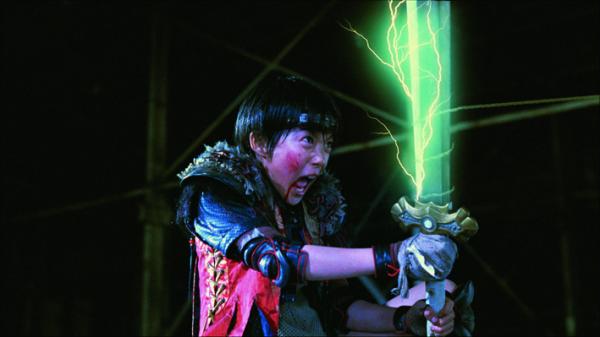
 Mixing in a liberal amount of Time Bandits with The Wizard of Oz, throwing in a little Hayao Miyazaki, and adding dashes of Raiders of the Lost Ark, The Lord of the Rings, Gremlins, Return of the Jedi, Labyrinth, and even Kill Bill, Takashi Miike has wound up with an entertaining fantasy film for both kids and adults. Known more for such ultraviolent, hard-to-watch frightfests as Audition and Ichi the Killer, Miike reveals his softer side in this genre film based on yokai manga by Shigeru Mizuki (who also plays the Demon King). Ryunosuke Kamiki is splendid as Tadashi, a young city boy taking care of his grandfather (Hiroyuki Miyasako) in a country village, where he is chosen at a local festival as the mythical Kirin Rider, the guardian of peace and friend of justice. Soon he finds himself in a real battle between good and evil, taking him from the heights of the Great Goblin’s mountain cave to the depths of a seedy underworld run by the very white Agi (Chiaki Kuriyama) and powerful mastermind Katou Yasunori (Etsushi Toyokawa). Joined by yokai spirits Kawahime (Mai Takahashi), Kawatarou (Sadao Abe), and the oh-so-cute Sunekosuri (we’d buy one of these in a second if they ever hit the market), Tadashi fights to save the human world, wielding his special sword against a phalanx of mechanical robots and other villainous creatures. At more than two hours, The Great Yokai War is at least twenty minutes too long and would have greatly benefited by the excision of one very silly subplot. But it is still a charming tale from the reigning master of horror. The Great Yokai War is screening for only $5 as part of the Film Society of Lincoln Center series “Shinjuku Outlaw: 13 from Takashi Miike,” being held March 16-20 in conjunction with Subway Cinema and also including such Miike films as Fudoh: The New Generation (1996), The Bird People in China (1998), Shangri-la (2002), and the awesome new 13 Assassins (2010). Miike was originally scheduled to appear at the Walter Reade Theater to introduce several screenings but has had to cancel because of the catastrophic events occurring in Japan.
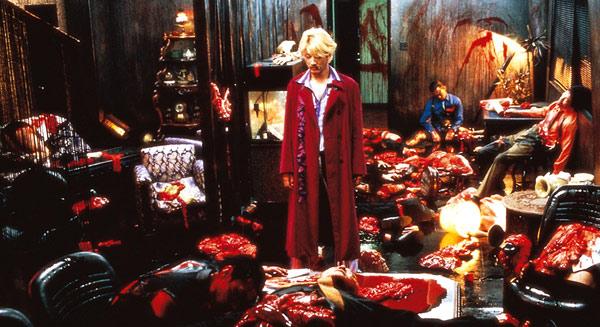
 Takashi Miike, who about ten few years ago had New York filmgoers rushing to Film Forum to see Audition — and then rushing to get out because of the violent torture scenes — did it again with Ichi the Killer, a faithful adaptation of Hideo Yamamoto’s hit manga. When Boss Anjo goes missing while beating the hell out of a prostitute, his gang, led by Kakihara (Tadanobu Asano), a multipierced blond sadomasochist, tries to find him by threatening and torturing members of other gangs. As the violence continues to grow — including faces torn and sliced off, numerous decapitations, innards splattered on walls and ceilings, body parts cut off, and self-mutilation — the killer turns out to be a young man named Ichi (Nao Omori), whose memory of a long-ago brutal rape turns him into a costumed avenger, crying like a baby as he leaves bloody mess after bloody mess on his mission to rid the world of bullies. This psychosexual S&M gorefest, which is certainly not for the squeamish, comes courtesy of the endlessly imaginative Miike, who trained with master filmmaker Shohei Imamura and seems to love really sharp objects. The excellent — and brave — cast also includes directors Sabu and Shinya Tsukamoto and Hong Kong starlet Alien Sun. The film is screening as part of the Film Society of Lincoln Center series “Shinjuku Outlaw: 13 from Takashi Miike,” being held March 16-20 in conjunction with Subway Cinema and also including such Miike films as Fudoh: The New Generation (1996), Agitator (2001), Crows Zero II (2009), and the awesome new 13 Assassins (2010). Miike was originally scheduled to appear at the Walter Reade Theater to introduce several screenings but has had to cancel because of the catastrophic events occurring in Japan.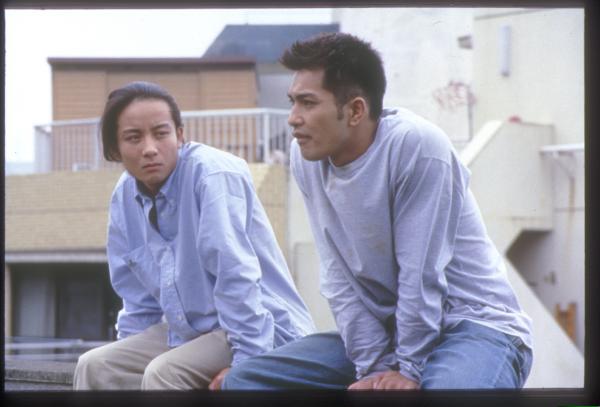
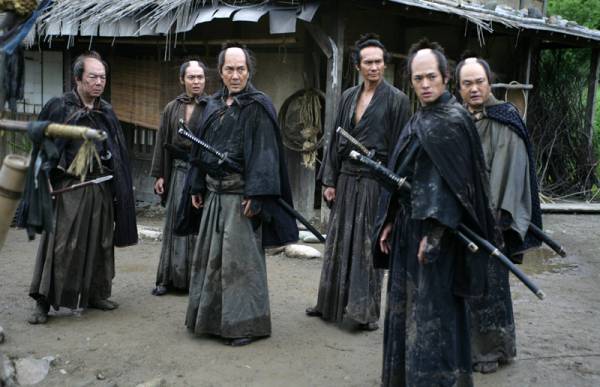
 Japanese director Takashi Miike’s first foray into the samurai epic is a nearly flawless film, perhaps his most accomplished work. Evoking such classics as Kurosawa’s Seven Samurai, Mizoguchi’s 47 Ronin, Aldrich’s The Dirty Dozen, and Eastwood’s High Plains Drifter, 13 Assassins is a thrilling tale of honor and revenge, inspired by a true story. In mid-nineteenth-century feudal Japan, during a time of peace just prior to the Meiji Restoration, Lord Naritsugu (Gorô Inagaki), the son of the former shogun and half-brother to the current one, is abusing his power, raping and killing at will, even using his servants and their families as target practice with a bow and arrow. Because of his connections, he is officially untouchable, but Sir Doi (Mikijiro Hira) secretly hires Shinzaemon Shimada (Kôji Yakusho) to gather a small team and put an end to Naritsugu’s brutal tyranny. But the lord’s protector, Hanbei (Masachika Ichimura), a former nemesis of Shinzaemon’s, has vowed to defend his master to the death, even though he despises Naritsugu’s actions. As the thirteen samurai make a plan to get to Naritsugu, they are eager to finally break out their long-unused swords and do what they were born to do. “He who values his life dies a dog’s death,” Shinzaemon proclaims, knowing that the task is virtually impossible but willing to die for a just cause. Although there are occasional flashes of extreme gore in the first part of the film, Miike keeps the audience waiting until he unleashes the gripping battle, an extended scene of blood and violence that highlights death before dishonor. Selected for the 2009 Cannes Film Festival and nominated for the Silver Lion at the 2010 Venice Film Festival, 13 Assassins is one of Miike’s best-crafted tales; nominated for ten Japanese Academy Prizes, including Best Picture, Best Director, Best Screenplay (Daisuke Tengan), Best Editing (Kenji Yamashita), Best Original Score (Koji Endo), and Best Actor (Yakusho), it won awards for cinematography (Nobuyasu Kita), lighting direction (Yoshiya Watanabe), art direction (Yuji Hayashida), and sound recording (Jun Nakamura). 13 Assassins is the centerpiece of the Film Society of Lincoln Center’s “Shinjuku Outlaw: 13 from Takashi Miike” series, running March 16–20 at the Walter Reade Theater and held in conjunction with Subway Cinema; Miike will be at the March 17 screening, which will be followed by a reception. [Ed. note: Miike was originally scheduled to appear at the Walter Reade Theater to introduce this and several other screenings but has had to cancel because of the catastrophic events occurring in Japan.]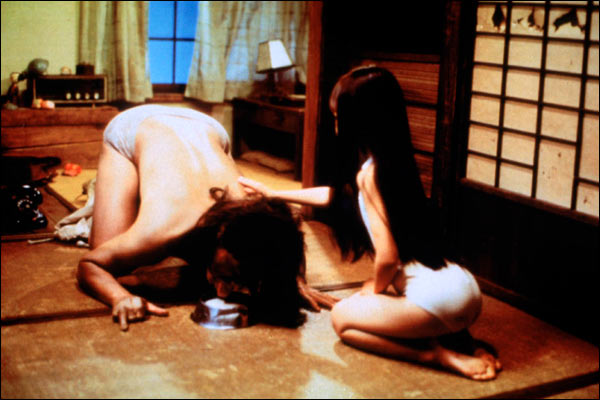
 This is one sick flick. Aoyama (Ryo Ishibashi) has been lonely since his beloved wife died seven years earlier, and on the advice of his best friend (Jun Kunimura) he holds a fake audition to find himself the perfect romantic partner. He is immediately drawn to Asami (Eihi Shiina in her stunning film debut), but after they get together once, various events keep them from going out again, and Asami starts taking it pretty personally. So when they eventually do meet up…. This unconventional Japanese horror film, which won two awards at the Rotterdam International Film Festival, had some people running out of Film Forum faster than they lined up around the block to get in in the first place—the last half hour is so brutal, so grotesque, so disturbing, so violent that you should hang on only at your own risk. Audition was New York’s major introduction to Japanese director Takashi Miike, who has made more than ninety films since the early 1990s, including such fab efforts as The City of Lost Souls (2000), Ichi the Killer (2001), Izo (2004), and The Great Yokai War (2005), all of which are part of “Shinjuku Outlaw: 13 from Takashi Miike,” a five-day Lincoln Center tribute, held in conjunction with Subway Cinema, celebrating the New York premiere of his latest, the brilliant samurai drama 13 Assassins. Most well known for the graphic violence in his films, Miike also has a wild sense of humor and a knack for making audiences think, “Oh no he won’t,” and then he does. Miike will be on hand to introduce several of the Walter Reade screenings as well as the March 15 showing of Dead or Alive (1999) that is part of Japan Society’s