Andy Lau stars as Di Renjie in Tsui Hark's impressive DETECTIVE DEE AND THE MYSTERY OF THE PHANTOM FLAME
DETECTIVE DEE AND THE MYSTERY OF THE PHANTOM FLAME (DI RENJIE) (Tsui Hark, 2010)
Film Society of Lincoln Center, Walter Reade Theater
165 West 65th St. at Amsterdam Ave.
Monday, July 11, $13, 9:00
Series runs through July 14
212-875-5601
www.filmlinc.com
www.subwaycinemanews.com
 During the early Tang Dynasty in the late seventh century, Wu Zetian (Carina Lau sporting some great hairdos) is about to become the first empress of China. In preparation for her ascendance to the throne, architect Shatuo (Tony Leung Ka Fai) is leading the construction of a two-hundred-foot Buddha statue with her face, a massive structure that is like its own city inside. But when people start spontaneously combusting after a pair of amulets in the statue are moved, Wu calls in Detective Dee (Andy Lau sporting some great facial hair), who has been in prison for eight years for previously opposing her, to find out who is behind the horrific deaths. Dee is teamed up with Wu’s right-hand woman, Shangguan Jing’er (Li Bingbing), and albino warrior Donglai Pei (Deng Chao) to get to the bottom of the killings, which many believe is a curse not being perpetrated by humans. As the unlikely threesome gets closer to the answers, they become enmeshed in a series of battles featuring unusual weapons and unexpected twists and turns, not knowing whom they can trust, their lives in constant danger. Nominated for the Golden Lion at the 2010 Venice Film Festival and winner of six Hong Kong Film Awards (including Tsui Hark for Best Director, Carina Lau for Best Actress, and Phil Jones for Best Visual Effects), Detective Dee and the Mystery of the Phantom Flame is a fun and exciting old-fashioned wuxia tale, with exciting if repetitive action scenes directed by Sammo Hung and sumptuous production design by James Chiu. The inner workings of the enormous statue is a thing of beauty that has to be seen to be believed. A mix of actual and invented characters — there really was a Judge Dee (Di Renjie), who was turned into a detective hero in a series of novels by Dutch author Robert van Gulik — the film is a thrilling historical mystery epic that could have used a little more back story but is still a return to form for Hark. Detective Dee and the Mystery of the Phantom Flame will be screening July 11 at 9:00 as part of the Wu Xia Focus at the New York Asian Film Festival at Lincoln Center, and as a special bonus director Tsui Hark will be on hand to talk about the film and receive the Star Asia Lifetime Achievement Award (at 8:30, with all ticket holders welcome).
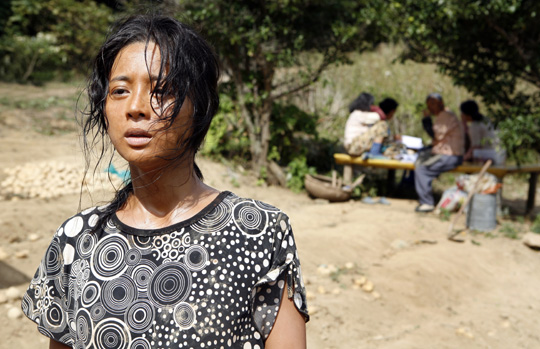
 Jang Cheol-su, who trained under Kim Ki-duk, has garnered several Best New Director awards for his powerful debut, Bedevilled, a story that would make Park Chan-wook proud. After her boss at the bank forces her to go on vacation following her awful public behavior, selfish, mean-spirited, and just plain nasty Hae-won (Ji Seong-won) decides to return to the small, isolated island village where her grandmother lived and she used to visit as a child. There she reconnects with Kim Bok-nam (Seo Yeong-hee), her best friend when they were kids. Bok-nam is treated like a slave by the tiny, extremely strange, and fiercely private community; the elderly women make her do all the work in the fields, and her husband, Man-jong (Park Jeong-hak), regularly beats her when he’s not carousing with a prostitute (Je-min). Her only solace is her young daughter, Yun-hui (Lee Ji-eun), until Hae-won arrives; her old friend represents the possible escape to freedom that Seoul offers. But when even Hae-won chooses not to help her out of her miserable life, Bok-nam takes matters into her own hands. The first half of Bedevilled, which reaches infuriating (and often hard-to-believe) depths, is reminiscent of Aki Kaurismäki’s The Match Factory Girl, as troubles are just heaped on top of poor Bok-nam, who seems unable to do anything about it. But in the furious second half, she more than makes up for that. The film is no mere revenge drama; instead, it focuses on the actions one chooses to take — or not to — in life. Bedevilled is screening July 6 at 8:45 and July 10 at 7:00 as part of the Sea of Revenge Focus at the New York Asian Film Festival at Lincoln Center.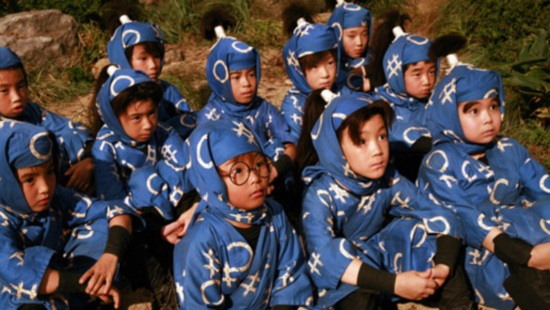
 Japanese director Takashi Miike might be most well known for such wild and crazy violence-filled works as Ichi the Killer, Audition, and the recent 13 Assassins, but among the ninety films he has made during his twenty-year career are a handful of kids movies, from the charming (Zebraman) and the fantastical (The Great Yokai War) to the overwrought (Yatterman) and now, with Ninja Kids!!!, to the relatively mundane. Based on the long-running Japanese children’s program Rantaro the Ninja Boy, which began in 1993 and is now approaching 1,500 episodes, Ninja Kids!!! follows the trials and tribulations of young Rantaro, played by Japanese child star Seishirô Katô (wearing oversized glasses that make him look like a cross between Poindexter and the Warner Bros. bookworm), who is sent off by his farmer parents to ninja school. There he encounters fellow students dripping snot and baby-sitting, a crazy master who continually challenges death, a teacher who is more like a drill sergeant, a big-headed villain who keeps falling over, an old woman who can change appearance at will, and other oddities as he trains to become the master ninja his father never was. The film is composed of a series of vignettes, some that work, many that don’t, but they never come together to form a cohesive narrative. The costumes are colorful and the hairstyles brilliant, but just as with Yatterman, the look of the film clearly trumps the story, which is disjointed and way too over the top, even though it’s supposed to be cartoonish. Ninja Kids!!! is having its world premiere July 3 at the Walter Reade Theater, a joint presentation of the New York Asian Film Festival and Japan Cuts: The New York Festival of Contemporary Japanese Cinema.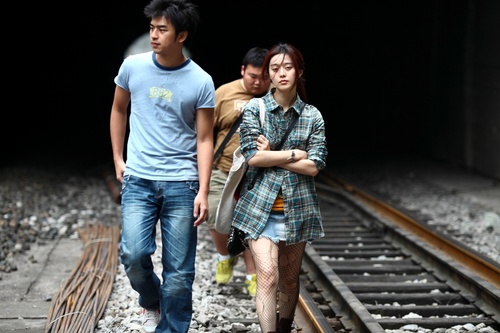
 Li Yu’s Buddha Mountain clocks in at 105 minutes, but the predictable, repetitive, and often ludicrous story of three disenchanted youths feels at least twice as long. When best friends Nan Feng (Fan Bingbing), Ding Bo (Wilson Chen), and Fatso (Fei Long) move in with Sylvia Chang (Chang Yueqin), an older woman having trouble dealing with a personal tragedy hinted at by a severely damaged car locked away in the garage, it is initially a bad match, as the teens like to hang out, sleep late, cause trouble, and show no consideration for others, while Master Chang sings opera at the break of day, enforces a laundry list of rules, and does not tolerate selfishness. Li (Lost in Beijing) fills Buddha Mountain with set pieces that feel like they are from different movies, trying to cram too much in; the journey to the title location is particularly forced. She also enjoys showing Nan, Ding, and Fatso walking down railroad tracks and standing atop moving trains, experiencing a freedom they have definitely not earned. But the biggest problem with Buddha Mountain is that it’s difficult to like or care about the four protagonists, so by the time they start appreciating one another, it’s too late. A veteran of numerous international fests, including Cannes, Tokyo, and Deauville Asian, the dreary Buddha Mountain will make its North American premiere July 3 & 5 at the New York Asian Film Festival at Lincoln Center. Keep watching twi-ny for more reviews from our favorite festival of the year.