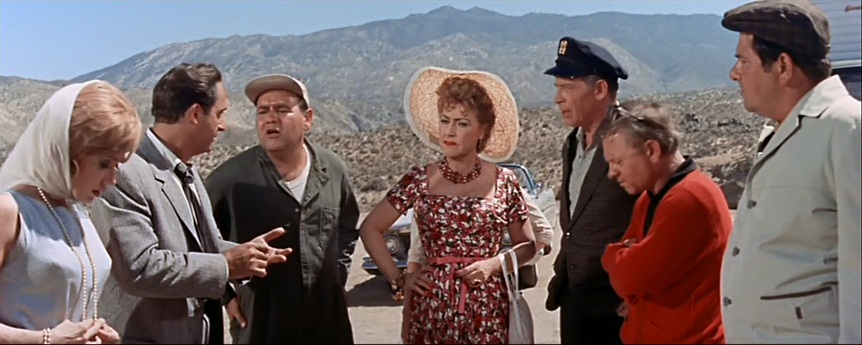
Comedic giants come together for quite a wild ride in Stanley Kramer’s IT’S A MAD, MAD, MAD, MAD WORLD
IT’S A MAD, MAD, MAD, MAD WORLD (Stanley Kramer, 1963)
Film Society of Lincoln Center, Walter Reade Theater
165 West 65th St. at Amsterdam Ave.
Saturday, December 22, 2:00, and Friday, December 28, 6:00
Series runs December 21 – January 1
212-875-5601
www.filmlinc.com
 They don’t come much crazier than the madcap 1963 comedy It’s a Mad Mad Mad Mad World. Producer-director Stanley Kramer takes a sharp turn with the wacky film, clearly needing a laugh following his rather serious string of issue pictures: The Defiant Ones, On the Beach, Inherit the Wind, and Judgment at Nuremberg. As he lays dying after a car crash, master thief Smiler Grogan (Jimmy Durante) tells a group of onlookers that there is $350,000 buried under a “big W” in Santa Rosita State Park. And off they go in search of the prize, willing to do just about anything and everything in order to get their greedy hands on the money. Hot on their trail is police captain T. G. Culpeper (Spencer Tracy), trying to solve one last case before he retires. It’s a Mad, Mad, Mad, Mad World lives up to its title, a mad, mad, mad, mad epic featuring the greatest all-star comedic cast ever assembled, including Sid Caesar, Edie Adams, Mickey Rooney, Buddy Hackett, an absolutely lunatic Jonathan Winters, Terry-Thomas, Phil Silvers, Dick Shawn, Peter Falk, Eddie “Rochester” Anderson, and Ethel Merman in addition to cameos by Jerry Lewis, Jack Benny, Joe E. Brown, Howard Da Silva, Andy Devine, Norman Fell, Selma Diamond, Leo Gorcey, Jim Backus, Marvin Kaplan, Stan Freberg, Arnold Stang, Jesse White, Carl Reiner, Don Knotts, Buster Keaton, and the Three Stooges. Basically, you can’t blink during the film’s 161 minutes or you’ll miss someone or some incredibly silly slapstick moment. And the ending is a laugh riot — literally. It’s a Mad, Mad, Mad, Mad World is screening December 22 and December 28 as part of the Film Society of Lincoln Center series “See It in 70MM!,” comprising fifteen films being shown in their original 70mm glory, beginning December 21 with Stanley Kubrick’s 2001: A Space Odyssey and continuing through January 1 with such other works as Ron Fricke’s Baraka, John Ford’s Cheyenne Autumn, Kenneth Branagh’s Hamlet, Basil Dearden’s Khartoum, Richard Brooks’s Lord Jim, and Jacques Tati’s Playtime.
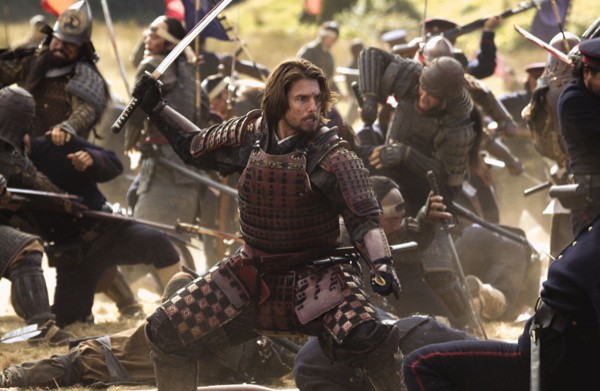
 The guys who gave the world Thirtysomething (director Edward Zwick and producer Marshall Herskovitz) head to the hills of Japan for this ridiculously sappy and melodramatic piece of tripe starring Tom Cruise as a wayward Civil War hero who rediscovers himself and learns the way of the samurai as modernity threatens to bury the past in a battle of guns versus swords, power versus honor, the government versus the individual. Cruise dances with warriors through this pathetic excuse for an American samurai epic that reduces everything to annoying clichés. It’s an embarrassment from start to finish; at least a sequel is pretty much out of the question. And it’s painful how the film misuses the talent of Hiroyuki Sanada, who was so good in Yoji Yamada’s The Twilight Samurai, his previous film. This mess was written by John Logan, who is responsible for such other duds as Martin Scorsese’s vastly overrated The Aviator and Nemesis, perhaps the worst of all the Star Trek films. The Last Samurai is screening on December 20 at 3:30 as part of the Film Society of Lincoln Center series “All the Right Moves: The Films of Tom Cruise,” comprising seven Cruise favorites, including Risky Business, Rain Man, Jerry Maguire, Mission: Impossible, Born on the Fourth of July, and Top Gun.
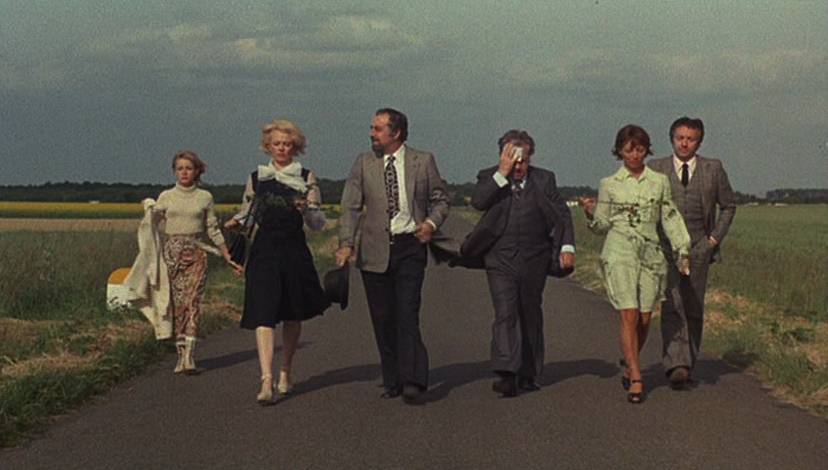
 Winner of the 1972 Oscar for Best Foreign Language Film, Luis Buñuel’s The Discreet Charm of the Bourgeoisie is a sharp, cynical skewering of the European power structure, taking on the high-falutin’ hypocrisy of the government, the military, religion, and, primarily, the wealthy class in hysterical vignettes that center around a group of rich friends trying to sit down and enjoy a meal. But every time they get close, they are ultimately thwarted by miscommunication, a corpse, army maneuvers, terrorists, and, perhaps most bizarrely, fake stage chicken. Buñuel regular Fernando Rey is a hoot as Rafael Acosta, the cocaine-dealing ambassador of Miranda who doesn’t take insults well. Stéphane Audran and Jean-Pierre Cassel play the Sénéchals, a lustful couple desperate to finish a romantic rendezvous even as their guests wait, Julien Bertheau is the local bishop who moonlights as a gardener, Claude Piéplu is an erudite colonel not afraid to share his opinion at a haughty cocktail party, and Maria Gabriella Maione is a sexy stranger who might or might not be a revolutionary after Acosta. Meanwhile, Acosta doesn’t mind making a play for Simone Thévenot (Delphine Seyrig) right under her husband’s (Paul Frankeur) nose. And Ines (Milena Vukotic), one of the Sénéchals’ maids, watches it all with a wonderfully subtle disdain. As if the first half of the film were not surreal enough, the second half includes a series of riotous dream sequences involving ghostly apparitions and a bit of the old ultra-violence, either outwardly related by characters or as cinematic surprises dished out by the masterful Buñuel. None too discreet about its myriad charms, The Discreet Charm of the Bourgeoisie is having a week-long fortieth-anniversary engagement at the Film Society of Lincoln Center in advance of the annual Spanish Cinema Now series, which runs December 7-16 and includes a special sidebar of Buñuel’s Land Without Bread, Tristana, and Viridiana; when you buy a ticket to Discreet Charm, you can get tickets for any Spanish Cinema Now screening for nine dollars by selecting the “Affiliate” option online or showing your ticket stub at the box office.