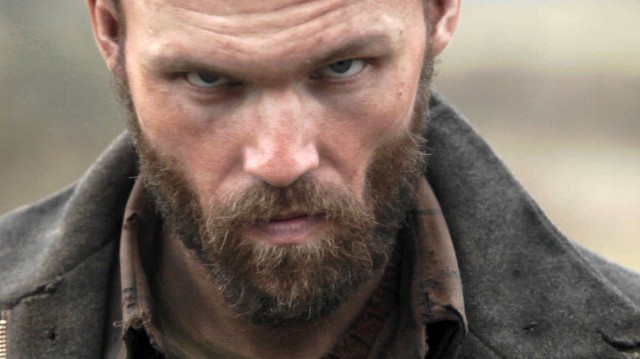
Scott Haze plays a deeply disturbed man trying to get what he believes is his in CHILD OF GOD
CHILD OF GOD (James Franco, 2013)
Film Society of Lincoln Center
Walter Reade Theater, 165 West 65th St. between Broadway & Amsterdam Ave.
Sunday, September 29, 10:15 pm
Francesca Beale Theater, 144 West 65th St. between Broadway & Amsterdam Ave.
Tuesday, October 1, 12 noon
Festival runs September 27 – October 13
212-875-5601
www.filmlinc.com
 In James Franco’s faithful, brutally compelling adaptation of Cormac McCarthy’s third novel, 1973’s Child of God, Scott Haze gives a courageous, unforgettable performance as Lester Ballard, a deeply disturbed man wreaking havoc on his small rural community in Sevier County in the Tennessee mountains. “His name was Lester Ballard, child of God, much like yourself, perhaps,” a narrator intones as the film opens. But Lester is not like everyone else. He is almost more animal than man, his speech hard to understand, his face hairy and rough, his gait hurried and uneven, a reclusive soul with no ability to differentiate between right and wrong, more at home in the woods and in caves than living among other people. When he lowers his head slightly and stares right into the camera, he evokes Charles Manson filtered through Charles Bukowski, with more than a touch of Jack Nicholson in The Shining; there doesn’t seem to be an ounce of humanity in him. (McCarthy has noted that Ballard was inspired at least in part by real-life serial killer Ed Gein, who also inspired Old Leatherface in The Texas Chainsaw Massacre and Norman Bates in Psycho.) Having been kicked off his family’s land, an angered Lester sleeps in a ramshackle cabin, venturing out primarily to kill an animal for food or to seek other carnal pleasures in his own, primal way. When he sees a young couple having sex in a car, his instinct is to get rid of the boy and take the girl for himself, with no thought of the consequences.
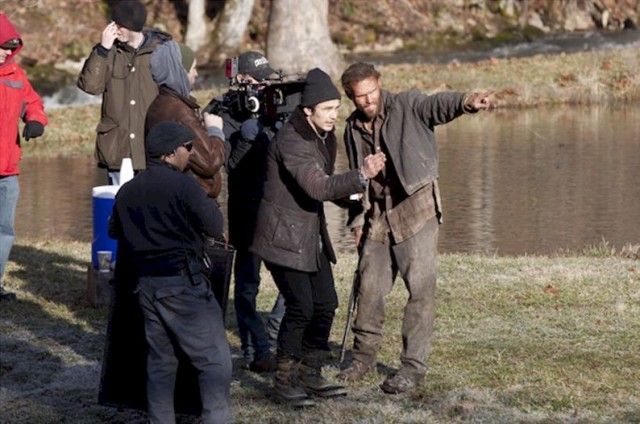
Director and cowriter James Franco discuss a scene in adaptation of Cormac McCarthy’s CHILD OF GOD
Lester is being watched closely by the aptly named Sheriff Fate (Tim Blake Nelson) and Deputy Cotton (Jim Parrack), but there’s no predicting what he will do next, and to whom. He’s a danger to everyone he meets, yet Franco, who cowrote the script with his friend and producer Vince Jolivette, manages to make Lester a somewhat sympathetic figure, despite his horrific existence, which soon includes necrophilia. No matter how despicable his actions are, it is hard not to want him to get away with it all, as Franco builds a shocking compassion for Lester from the very first scene, when John Greer (Brian Lally), a neighbor who is determined to buy the Ballard property at auction, viciously bashes in Lester’s skull. The highly literate, ubiquitous Franco, who has also adapted William Faulkner’s As I Lay Dying and is in preproduction on The Sound and the Fury, stays true to both the spirit and the intricacies of McCarthy’s story; every scene but one was taken directly from the book, which Franco fell in love with when he read it in graduate school. Child of God is by no means an easy film to watch, and it is sure to elicit a multitude of extreme reactions, both positive and negative, reminiscent of the response to Lars von Trier’s controversial 2009 New York Film Festival selection, Antichrist. But no matter where you stand on the film itself, it’s impossible not to be blown away by Haze’s remarkably intense performance, his every word and movement absolutely thrilling to behold. Child of God, in which both Franco and Jolivette play small roles, will screen twice at the fifty-first New York Film Festival, on September 29 at the Walter Reade Theater, followed by a Q&A with Jolivette and Haze, and again on October 1 at the Francesca Beale Theater.
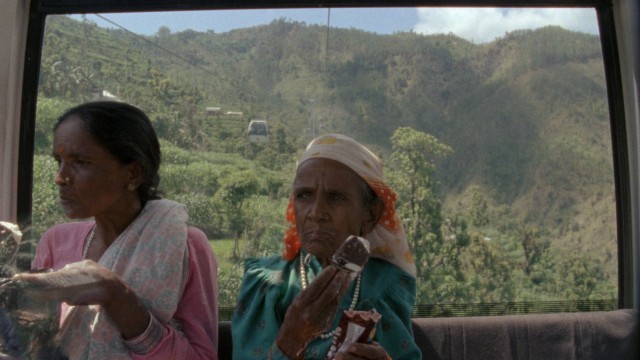
 If you’re an adventurous filmgoer who likes to be challenged and surprised, the less you know about Pacho Velez and Stephanie Spray’s Manakamana, the better. But if you want to know more, here goes: Evoking such experimental films as Michael Snow’s Wavelength, Hollis Frampton’s Zorns Lemma, and Andy Warhol’s Screen Tests as well as the more narrative works of such unique auteurs as Jim Jarmusch and Abbas Kiarostami, Manakamana is a beautiful, meditative journey that is sure to try your patience at first. The two-hour film, which requires a substantial investment on the part of the audience, takes place in a cable car in Nepal that shuttles men, women, and children to and from the historic Manakamana temple, on a pilgrimage to worship a wish-fulfilling Hindu goddess. With Velez operating the stationary Aaton 7 LTR camera — the same one used by Robert Gardner for his 1986 documentary Forest of Bliss — and Spray recording the sound, the film follows a series of individuals and small groups as they either go to or return from the temple, traveling high over the lush green landscape that used to have to be traversed on foot before the cable car was built. A man and his son barely acknowledge each other; a woman carries a basket of flowers on her lap; an elderly mother and her middle-age daughter try to eat melting ice-cream bars; a pair of musicians play their instruments to pass the time.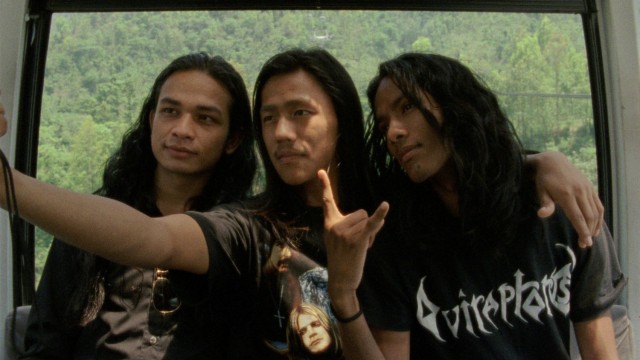
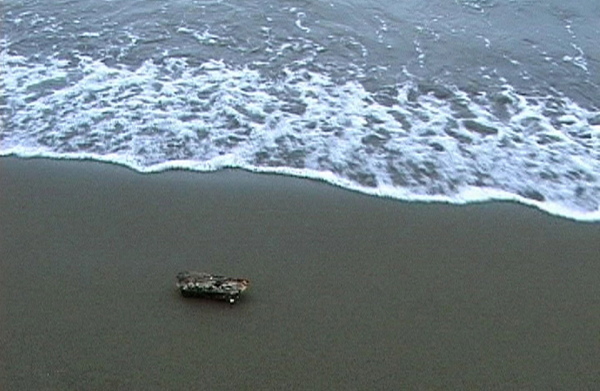
 We first saw Abbas Kiarostami’s gorgeous five-part film Five Dedicated to Ozu at the Iranian director’s 2007 multidimensional MoMA exhibit, “Image Maker,” where all five segments ran continuously and simultaneously in five semiprivate partitioned spaces, each with its own comfy bench. The film as a whole, which is composed of static shots on a beach in Galicia, are dedicated to Japanese director Yasujiro Ozu, whose films attempted to catch the reality of human existence in all its simplicity. In the first episode, the coming waves threaten a piece of driftwood; we dare you not to create your own narrative in your head once the wood is split apart. (By the way, this is the only part of the film that includes any camera movement at all, as Kiarostami opts to follow the driftwood for one short moment.) For the second scene, the camera is moved to the boardwalk, with people passing to the right and left as the surf continues to crash onto the shore; this is the least compelling of the five pieces. Back on the beach for the third part, the camera finds a group of stray dogs in the distance, nestled together by the water; again, as one dog gets up and moves away, left to himself, you’ll create your own ideas about what is really happening. Next is the funniest section of the movie, as a long line of ducks don’t know whether they’re coming or going, but they do so determinedly. Finally, the last scene takes place at night, as the moon glistens in a dark sky as the sounds of frogs and nature envelop this small part of the earth. Relax and let your mind wander during this fascinating and fun cinematic experience that we found exhilarating as a single work — but we also loved how it was installed at MoMA, where you could sit down with any of the films at any time and just let them take you away. Five Dedicated to Ozu is screening Thursday, February 14, at 8:45 with Kiarostami’s 2006 short Roads of Kiarostami at the Walter Reade Theater as part of the Film Society of Lincoln Center series “A Close-Up of Abbas Kiarostami,” which continues through February 17 with such other films as 10 on Ten, Fellow Citizen, Life and Nothing More, Through the Olive Trees, and more works by the master Iranian director in celebration of his latest, Like Someone in Love, which opens theatrically February 15.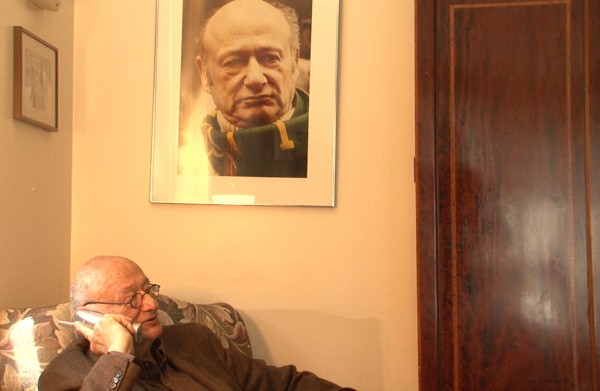
 A bunch of people have a whole lot to say about Ed Koch in a new documentary about the charming yet irascible former three-term mayor of New York City, but none of them goes on quite so eloquently as Hizzoner himself. Longtime journalist and first-time filmmaker Neil Barsky delves into the man behind the legend, the upstart politician who helped save New York from the debt- and crime-ridden 1970s through, among other things, the sheer force of his immense will. Barsky combines new interviews with such political journalists as Michael Goodwin, Sam Roberts, and Wayne Barrett, along with former comptroller Carl McCall and the Rev. Calvin O. Butts, to paint a portrait of Koch as both mensch and meanie, a bully who always speaks his mind and never backs down from a challenge. Barsky and editor Juliet Weber include archival photographs and old film footage of Koch in the 1960s and early 1970s as he first takes on Democratic Party boss Carmine DeSapio, then runs for city council and Congress before getting into a heated seven-person race for mayor in 1977. The present-day Koch is filmed tinkering around in his small kitchen, breaking the Yom Kippur fast with his family, and relaxing in his office, sharing his views on his legacy, his battles with the black community over Sydenham Hospital, and even questions of his sexuality — but only up to a point — that have followed him throughout his career. Although Barsky claims in his director’s statement that “with the exception of one former governor and one former mayor, virtually everyone we reached out to agreed to be interviewed,” the film suffers in that it does not exactly boast an all-star lineup of pundits talking about Koch– but it of course has Koch himself, and that is more than enough. Koch, which opens theatrically February 1, is screening January 10 and 13 at the twenty-second annual New York Jewish Film Festival, presented by the Jewish Museum and the Film Society of Lincoln Center, with Barsky on hand for the January 10 show and the now-eighty-nine-year-old Koch in attendance January 13.