Tag Archives: Roundabout at Laura Pels Theatre

LAST CHANCE: SIX MISS AND DON’T-MISS SHOWS CLOSING THIS WEEKEND

Laurie Metcalf can’t believe another Broadway show she’s in is closing early (photo by Julieta Cervantes)

LITTLE BEAR RIDGE ROAD
Booth Theatre
222 West 45th St. between Broadway & Eighth Ave.
Tuesday – Sunday through December 21, $74–$206
littlebearridgeroad.com

For me, the biggest disappointment of the year in theater is the early closing of Samuel D. Hunter’s sensational Little Bear Ridge Road. Originally scheduled to run until February 14, it is instead closing December 21, after opening on October 30 to a bevy of rave reviews. The play is a gripping ninety-five minutes of nonstop tension, brilliantly directed by two-time Tony winner Joe Mantello on Scott Pask’s beautifully minimalist set. On a couch on a round, carpeted platform, Sarah (Laurie Metcalf) and her nephew, Ethan (Micah Stock), spend a lot of time watching TV and complaining about their lives following the passing of Sarah’s brother, Ethan’s estranged father, a drug addict who died a miserable death. It’s a fabulous Broadway debut for Hunter, whose previous superb works include A Bright New Boise, The Whale, Lewiston/Clarkston, Greater Clements, A Case for the Existence of God, and Grangeville. I apologize for all the superlatives, but each one is well deserved.

Perhaps it’s what I’ve just dubbed the Metcalf curse.

Despite having earned four Emmys (out of twelve nominations), two Tonys (out of six nominations), and an Oscar nod, Metcalf has been in several shows that have shut their doors early, although not because of her performance. For every success like Three Tall Women and A Doll’s House, Part 2, there’s Hillary and Clinton, Grey House, The Other Place, and the aptly titled Misery.

In Little Bear Ridge Road, Metcalf plays Sarah, a nurse and loner who seems to be mad at the world, ripping off such one-liners as “Just because it’s so complicated that you have to watch an episode recap every week doesn’t mean it’s better,” “Why are you still here?!,” and “All this time you’ve thought I had an issue with you being gay? That’s the most interesting thing about you.” Ethan is a wannabe writer who is deeply uncomfortable in his own skin and exploring a potential relationship with an astrophysicist named James (John Drea) he met online. The narrative takes place between 2020 and 2022, and the pandemic plays a key role in how characters interact with each other, whether out at a bar or sitting home watching television, especially Extraterrestrial. Heather Gilbert’s intimate lighting is exceptional, making the audience feel like it’s on the couch, hanging out with Sarah, Ethan, and James.

Talking about the Orion constellation, James tells Ethan, “Okay, so — all three stars in the belt look like they’re in a line, but they’re actually spread out over about eight hundred light years. The closest is like twelve hundred light years away and the farthest is like two thousand.” It’s a clever metaphor that relates to how far away people can be even when they’re right next to each other — or conversing online. It’s both hilarious and meaningful when Sarah thinks she is texting Kenny, a handyman who is helping them with Ethan’s father’s house, but instead finds that she has accidentally FaceTimed him.

Hunter, who wrote the play specifically for Metcalf’s return to Chicago’s Steppenwolf company after a fourteen-year absence, brings it all together in a poignant finale that incorporates so many major and minor details and what seemed to be asides but then form a cohesive and thought-provoking whole, like a musical composition without a note out of place.

So why is it closing so early?

If I knew that, I’d be a producer.

James Corden, Neil Patrick Harris, and Bobby Cannavale star as three friends reaching a crisis point in Art (photo by Matthew Murphy)

ART
Music Box Theatre
239 West 45th St. between Broadway & Eighth Aves.
Tuesday – Sunday through December 21, $136.10 – $371.10
artonbroadway.com

One of my favorite theatrical moments of 2025 occurred at the end of the matinee of Art I attended. As the curtain closed, James Corden gave a little hop, skip, and jump, grabbing onto the shoulders of his two costars, Bobby Cannavale and Neil Patrick Harris, as a wide, childlike smile broke out across his face. It was one of the most happy-making things I’d seen all year.

It made the whole experience that much more enjoyable, helping me forget some of the holes in what is a pleasurable if not nearly as deep as it wants to be show. What are these men doing in Paris? Were they ever really close friends? Can Marc (Cannavale) and Serge (Harris) just leave poor Yvan (Corden) alone already?

When the audience enters the Music Box Theatre, they are greeted by a framed white rectangle on the red curtain, not only representing the white painting that Serge has paid three hundred thousand dollars for, but also the blank slate we all come into the world with, onto which we project our personal likes and dislikes, including how we appreciate, or don’t, art itself. When the play is over, some will have loved it, some will have despised it, and other, perhaps most, will find themselves in between. Friends will defend their views, just as Serge defends his purchase to Marc, who is insulted that Serge spent so much money on a white canvas, while Yvan is caught in the middle.

After Marc calls the painting “shit,” Serge tells the audience, “He doesn’t like the painting. Fine . . . But there was no warmth in the way he reacted. No attempt. No warmth when he dismissed it without a thought. Just that vile pretentious laugh. A real know it all laugh. I hated that laugh.”

Marc decides to get Yvan’s opinion, explaining, “Yvan’s a very tolerant guy, which of course, when it comes to relationships, is the worst thing you can be. Yvan’s tolerant because he couldn’t care less. If Yvan tolerates the fact that Serge has spent three hundred grand on some piece of white shit, it means he couldn’t care less about Serge. Obviously.”

Are we nothing more than our thoughts about art — or, for that matter, politics or other loaded subjects? Can each one of us see a white painting differently without casting aspersions?

Art was written in French by Yasmina Reza and premiered at Comédie des Champs-Élysées in Paris in 1994. Christopher Hampton’s English translation debuted in London two years later, with Albert Finney, Tom Courtenay, and Ken Stott, and made it to Broadway in 1999 with Alan Alda, Victor Garber, and Alfred Molina. It’s a star-driven vehicle, so director Scott Ellis gives each actor the chance to shine, and Cannavale, Harris, and Corden chew up the scenery with glee, especially Corden, whose Yvan is a kind of everyman not wanting to fight with his besties, more concerned about his impending wedding, which has reached the crisis-level planning stage. When Marc asks Yvan if he would be happy if Serge gave the painting to him and his bride as a present, he says to the audience, “Of course it doesn’t make me happy. It doesn’t make me happy, but, generally speaking, I’m not the sort of person who can say I’m happy, just like that. . . . You’re either happy or you’re not happy, what’s why wouldn’t I be got to do with it?”

Exactly.

A senior retirement community is clouded with an air of mystery in Everything Is Here (photo by Mari Eimas-Dietrich)

EVERYTHING IS HERE
59E59 Theaters
59 East 59th St. between Park & Madison Aves.
Tuesday – Saturday through December 20, $75.50
www.59e59.org

One of my favorite plays of 2023 was Annie Baker’s Infinite Life, which takes place at a Northern California clinic that treats chronic pain sufferers, mainly women.

One of my favorite plays of 2025 was Talking Band’s Triplicity, an experimental work about the interconnected, overlapping lives of four strangers in New York City.

Peggy Stafford’s Everything Is Here is a charming and gentle tale that is like Talking Band’s version of Infinite Life.

Bev (Jan Leslie Harding), Janice (Mia Katigbak), and Bonnie (Petronia Paley) live at a senior community retirement facility, where they participate in programs, sit around and discuss personal issues, and are taken care of by a young nurse named Nikki (Susannah Millonzi). The play begins with Grant (Pete Simpson), who runs several of the programs, asking the women to lie down on the floor and follow his instructions:

“There are these huge old trees that you don’t even know how old they really are / Maybe they’re ancient? / You’re not sure but this thought crosses your mind: ANCIENT TREES,” he says. “You stop dead in your tracks / Stop right now / Everybody stop / Don’t move / Okay, good / Something is gone that should be there / And it was there / In your pocket and now it’s not.” The audience falls under his spell as well.

For the next eighty minutes, the characters converse about dogs and cats, Salisbury steak, the large garden gnome just outside the window, Middle Earth, assisted suicide, and trust. They feed the fish, worry about a dangerous tree branch that could fall at any moment, and help Grant audition for a local production of A Streetcar Named Desire. (The curiously comforting set is by Richard Hoover.)

We soon learn that Bev is considering leaving, Janice is a kleptomaniac, Bonnie is a fine Blanche DuBois, and Nikki and Grant take a liking to each other.

But at the center of it all is a constant feeling of loss, of something that’s missing, physically, emotionally, and psychologically, with a hovering sense of impending doom.

Everything Is Here is worth seeing for the excellent cast alone, a joy to behold, whether they’re arguing, getting their vital signs checked, or dancing in their chairs to Lisa Fagan’s minimalist choreography. (Note: Simpson and Katigbak were in Infinite Life, and Simpson and Millonzi were in Berlindia!, which also used a goldfish tank as a metaphor, so the closeness of the actors is palpable.) Finn (The Invention of Tragedy, Doomocracy) adds just the right touches, and Stafford (Motel Cherry, 16 Words or Less with Katigbak) maintains a level of mystery around the proceedings, providing no easy answers in her abstract narrative.

On the way out, don’t be surprised if you reach into your pockets, wondering if something is missing, if everything is where it’s supposed to be.

Archduke takes some playful liberties with famous assassination (photo by Joan Marcus)

ARCHDUKE
Roundabout at Laura Pels Theatre
Harold and Miriam Steinberg Center for Theatre
111 West 46th St. between Sixth & Seventh Aves.
Tuesday – Sunday through December 21, $69-$102
www.roundabouttheatre.org

On June 28, 1914, nineteen-year-old Gavrilo Princip assassinated Archduke Franz Ferdinand of Austria, which led directly to the start of WWI. Pulitzer Prize finalist and Obie winner Rajiv Joseph, who has written such complex and intriguing shows as Gruesome Playground Injuries, Describe the Night, and Dakar 2000, imagines the events leading up to that fateful day in Archduke, a delicious, if slight, dark comedy.

The assassination plot is orchestrated by Dragutin “Apis” Dimitrijevic (a scenery-gobbling Patrick Page), a real-life Serbian military officer and cofounder of the Black Hand, a secret society dedicated to “Unification or Death.” With the help of a doctor, Apis convinces three young men, Gavrilo (Jake Berne), Trifko (Adrien Rolet), and Nedeljko (Jason Sanchez), that they have tuberculosis and should accomplish one last heroic deed before they die: murder the archduke.

“I never had no meaning. Not in my life. Never had it. Never will have it,” Nedeljko says to Gavrilo. “I wasted my life.” But given a new sense of purpose, the three men go to Apis’s resplendent home, highlighted by a huge wall map of Eastern Europe, are served by Apis’s dotty housekeeper, Sladjana (Kristine Nielsen), and plan the attack.

Joseph and Tony- and Obie-winning director Darko Tresnjak mix in a little of the Three Stooges’ You Nazty Spy! here, a touch of Charlie Chaplin’s The Great Dictator there, along with a dash of Stanley Kubrick’s Dr. Strangelove. At just over two hours with an intermission, Archduke is too long, and some of the slapstick grows repetitive and falls flat, such as Sladjana’s efforts to find Apis’s “special box.” It probably would have benefited from being streamlined to a tighter ninety minutes.

That said, it’s still an enjoyable take on an international tragedy with far-reaching ramifications while also commenting on disaffected, angry, aimless young men and political violence, no laughing matter in the United States today.

“Cats do not lay eggs,” Apis says at one point. “Never let anyone ever tell you that they do.”

Yes, the Habsburg hegemony can be funny.

Oklahoma Samovar shares the story of five generations of a Jewish family in America (photo by Marina Levitskaya-Khaldey)

OKLAHOMA SAMOVAR
The Downstairs at La MaMa Experimental Theatre Club
66 East Fourth St. between Second Ave. & Bowery
Thursday – Sunday through December 21, $25-300
www.lamama.org

Prior to seeing Oklahoma Samovar at La Mama, all I knew about Jews in the American West I learned from Blazing Saddles and The Frisco Kid, two comedies starring Gene Wilder that feature a bit of Yiddish. In 1987, award-winning author, teacher, and playwright Alice Eve Cohen met her eighty-seven-year-old great-aunt Sylvia, who shared with Cohen her family’s remarkable history fleeing from persecution in Latvia and starting a farm during the 1889 Oklahoma Land Run, the only Jews to do so. Cohen has been working on the play, which won the 2021 National Jewish Playwriting Contest, since 1987, and it is now making its world premiere at La MaMa through December 21.

Directed by Eric Nightengale, the play begins in 1987, when twenty-one-year-old Emily travels from Brooklyn to an Oklahoma farm where Sylvia lives, bringing with her an urn with her mother’s ashes. She also has a tape recorder to document Sylvia’s answers to her many questions, most importantly: Why did her mother want her ashes spread over the farm, which Emily knew nothing about? Sylvia shares her story as the play goes back and forth between eras and several actors switch among multiple roles: Nadia Diamond is Emily and Rose, her maternal great-grandmother; Seren Kaiser is Clara, Emily’s mother as a little girl; Sahar Lev-Shomer is Jake, Rose and Sylvia’s pioneer father; Alex J. Gould is Ben, Rose’s husband, and Max, Jake’s best friend; Sarah Chalfie is Hattie, Rose and Sylvia’s mother, and Maxine, Ben’s gallivanting, bisexual sister; and the scene-stealing Joyce Cohen is Sylvia at ages four, fourteen, forty-five, and eighty-seven as well as some minor characters.

The narrative follows Jake as he emigrates from Latvia to New York to avoid fighting in the Russian army; meets Max, who helps him find a job; is joined by his fiancée, Hattie, who is not keen on moving to Chandler, Oklahoma, where there is no synagogue and no other Jews; and begins raising a family. Emily is initially tight on time; like Hattie, Chandler is not at first her cup of tea — she believes that Sylvia is living on stolen land — but she soon becomes enthralled with learning about her ancestors. At the center of it all is a Russian samovar that Hattie brought from the old country.

“Look at this samovar. It’s the family heirloom,” Sylvia tells Emily, continuing, “Mom and I were starting to – we were just beginning to make a connection, and — suddenly she’s gone. She wanted me to come here with her ashes, and I have to know I’m doing the right thing. Sylvia, you’ve told me stories, but not what I need to know. Could you fast-forward a few decades?” Sylvia cautions, “You’re in a big rush. Try switching from coffee to tea, might help ya slow down.”

The first act sets everything up well, but the second act slows it all down. Characters and relationships get confusing, the set changes involving colored windows/walls feel extraneous, and standard melodrama takes over. It probably would have worked much better as a streamlined ninety-minute one-act.

There are lovely, touching moments throughout and creative staging, but it tries too hard to be an epic while raising all-too-relevant issues such as immigration, assimilation, and bigotry. “There’s no antisemitism in Chandler,” Rose asserts. Ben replies, “Where there are Jews, there is antisemitism.” It ends up being not quite enough to sustain its length, although it’s nearly worth it just to watch the wonderful Cohen, who is endearing as Sylvia.

Even Kristin Chenoweth can’t save The Queen of Versailles from getting high on its own supply (photo by Julieta Cervantes)

THE QUEEN OF VERSAILLES
St. James Theatre
246 West Forty-Fourth St. between Broadway & Eighth Aves.
Tuesday – Sunday through December 21, $88.48-$441.28
queenofversaillesmusical.com

It’s never fun writing a review for a show that is closing early; it’s sort of like that old saying, Don’t speak ill of the dead.

When I went to the St. James Theatre to see The Queen of Versailles, a musical based on the hit documentary, I was fully prepared to find something to like about it despite all the negative chatter that was circulating. And indeed, I thoroughly enjoyed the first scene, which takes place in Paris in 1661, as Louis XIV (Pablo David Laucerica) is getting ready to move to his new home in Versailles.

“I am the king, Louis Quatorze / My life is shinier than yours / In fact, I am the living proof / That life is quite unfair / I am the Sun King, like Apollo, / But with better hair,” Louis sings in an extravagantly decorated room. “And now that I am twenty-three / And fin’lly firmly in command / To celebrate the glory that is I, / I want to build a palace / Splendiferous and grand, / The grandest palace ever to be seen in any land, / In a little country village called Versailles!”

I also was all in on the second scene, with the action moving to Florida in 2006, where Jackie Siegel (Kristin Chenoweth) is overseeing the construction of her own Versailles with her fabulously wealthy, much older husband, David (F. Murray Abraham).

“We didn’t know we would need / The biggest home in America / That was never part of our plan,” Jackie sings. “But ev’ryone has needs to be filled, / Add ’em all up and we’ve got to build / The biggest home in America, / Because we can.”

After that, well, I just couldn’t.

Jackie and David live with Jackie’s daughter, the cynical Victoria (Nina White), and are soon joined by Victoria’s cousin, Jonquil Peed (Tatum Grace Hopkins). Also hovering around are Gary (Greg Hildreth), David’s business associate, and Sofia Flores (Melody Butiu), the Siegels’ nanny. The story devolves quickly into tawdry melodrama, along with clunky staging and less-than-compelling musical numbers. The book, which refuses to decide whether Jackie is a strong woman, a greedy socialite, or a misunderstood wife and mother, is by Olivier nominee Lindsey Ferrentino, the director is Tony winner Michael Arden, and the music and lyrics are by Oscar winner Stephen Schwartz, all of whom should have known better.

Tony and Emmy winner Chenoweth powers through the one hundred and fifty minutes with grit and determination — and, of course, fanciful costumes (by Christian Cowan) — and it’s always a treat to see the now-eighty-six-year-old Abraham, even if it turns out that he’s not exactly a song-and-dance man. But it’s impossible to care about anything that happens on Tony winner Dane Laffrey’s often elegant set (but the less said about his video projections, the better) or about any of the characters, particularly Jackie herself.

In a script note, Ferrentino explains, “The Queen of Versailles is the story of one family that reflects an entire country — a modern fable about the American Dream and what it has become in contemporary America. Our main character does what America teaches: work harder, want bigger, never stop. Her unfinished palace becomes a mirror to a culture that mistakes accumulation for meaning. Jackie is as complicated as the nation that created her.”

Not quite, especially as the country is mired in another economic crisis propelled by the growing wealth gap between the 1% and everyone else.

[Mark Rifkin is a Brooklyn-born, Manhattan-based writer and editor; you can follow him on Substack here.]

PRIMARY TRUST

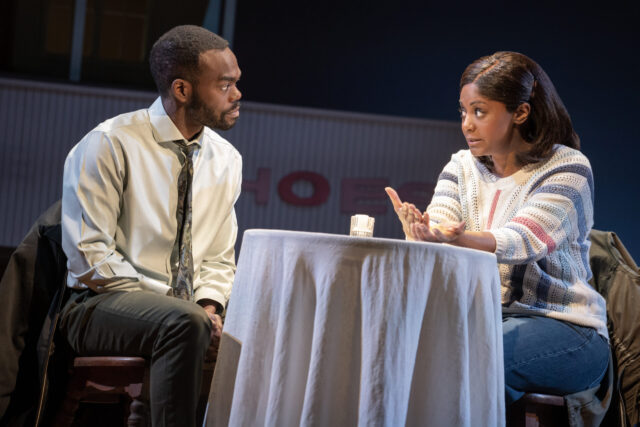
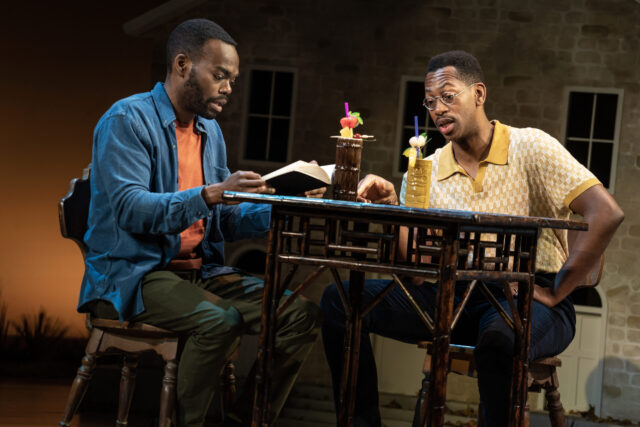
Kenneth (William Jackson Harper) has difficulty facing reality in Eboni Booth’s Primary Trust (photo by Joan Marcus)

PRIMARY TRUST
Roundabout at Laura Pels Theatre
Harold and Miriam Steinberg Center for Theatre
111 West 46th St. between Sixth & Seventh Aves.
Tuesday – Sunday through July 2, $56-$147
212-719-1300
www.roundabouttheatre.org

Eboni Booth’s sensational Primary Trust is an Our Town — or, more accurately, a My Town — for this very moment in time, in the twenty-first century. It beautifully captures the feelings of longing and loneliness so many of us experience in this digital age, especially coming out of a global pandemic permeated by isolation. Instantly a Best Play of the Year favorite, the ninety-five-minute show is anchored by a gorgeous performance by William Jackson Harper as Kenneth, our thirty-eight-year-old unreliable narrator and protagonist.

Primary Trust unfolds in the fictional community of Cranberry, New York, forty miles east of Rochester. Marsha Ginsberg’s lovely set is a miniature version of the town, with a bank, a tiki bar, a vacant shoe store, and a church; it is essentially Anywhere, USA. As the audience enters the theater, Chicago-born singer-songwriter and actor Luke Wygodny, is onstage, playing guitar. He later moves to keyboards off stage left, where he serves as the piano player at Wally’s and adds incidental music throughout.

The play begins with Kenneth addressing the audience. “This is what happened,” he says tentatively but with immense charm. “This is the story of how if you had asked me six months ago if I was lonely, I would have said . . . This is the story of a friendship. Of how I got a new job. A story of love and balance and time. And the smallest of chances.”

It’s clear from the start that Kenneth has social issues and is not well educated. He is haunted by the death of his mother, who died when he was only ten years old; he was raised in an orphanage and several foster homes. But instead of being angry or looking for excuses for his relative lack of success — he doesn’t see himself as a failure, seemingly enjoying his simple life — he is a gentle soul with a tender view of the world, or at least Cranberry, which is his entire world.

He’s been working as a clerk at a bookshop on Main St. for twenty years; his boss, Sam (Jay O. Sanders), treats him well. Every night, Kenneth goes to Wally’s, a tiki hut where he drinks mai tai after mai tai until the bar closes. He orders for two; he is always there with Bert (Eric Berryman), a married man with two daughters. Kenneth is not religious, but he explains, “I don’t really believe in God or heaven or hell, but I do believe in friends, and Bert is the best friend around.” They do just about everything together, but there’s one problem.

Kenneth (William Jackson Harper) spends most of his nights in a tiki bar with his best friend, Bert (Eric Berryman) (photo by Joan Marcus)

Bert is imaginary, and Kenneth knows it.

“He exists only in my head,” Kenneth reveals. “But that doesn’t make him any less real. He has arms and legs. A face, a heart — a good heart.”

Kenneth is generally an easygoing guy, but he becomes distressed when Sam tells him that he and his wife have sold the bookstore and are moving to Arizona. Desperate to find a job, he learns from Corinna (April Matthis), a waitress at Wally’s, that there’s an open position at the Primary Trust bank; Kenneth is interested because his mother used to work at Mutual Loan. Kenneth has trouble making important decisions without Bert, so he brings him along on the interview with Clay (Sanders), a good-natured bear of a man who takes a shine to Kenneth, as we all do, wanting him to succeed. “I have a brother,” Clay tells him. “Got into a car accident in high school, hit his head pretty bad. You remind me of him.”

Kenneth gets the job, but when he has one awful day, he’s not sure he’ll ever get over it as the careful life he’s created in his head is suddenly thrown off-kilter.

Kenneth’s (William Jackson Harper) life takes a new turn when he meets Corinna (April Matthis) (photo by Joan Marcus)

The Bronx-born Booth, who worked in bars and restaurants and has spoken about having a drinking problem, appeared in the terrific Dance Nation and Fulfillment Center, and her previous play, Paris, was set in a superstore in the fictional Paris, Vermont; she writes in a clear, familiar style that sucks you right in, offering a sweet affection for small-town living. In Primary Trust, she takes great care in every detail; even the names of the banks offer insight into Kenneth’s situation: His mother worked at Mutual Loan, evoking his need to be with her and not be alone, while he gets a job at Primary Trust, where he has to build confidence that he can handle life on his own and trust others.

Director Knud Adams, who helmed Paris and such other ensemble pieces as Sanaz Toossi’s Pulitzer Prize–winning English and Gracie Gardner’s hard-hitting I’m Revolting, guides the narrative with a touching and warmhearted hand that will have even the most cynical city dwellers feel sentimental about small town life, at least for an hour and a half. Qween Jean’s costumes, Isabella Byrd’s lighting, and Mikaal Sulaiman’s sound further immerse you into the bittersweet ups and downs of Cranberry.

Berryman (Toni Stone, The B-Side: Negro Folklore from Texas State Prisons) plays the kind of imaginary friend anyone would be lucky to have, even as we learn about where he came from. The always stalwart Sanders (Uncle Vanya, King Lear) is superb as Sam and Clay, two understanding father figures to Kenneth, as well as a funny garçon. Matthis (Help, Toni Stone) is a whirlwind playing multiple Wally’s waitresses and bank customers. Wygodny gets bonus time by occasionally interacting with Kenneth.

Harper (After the Blast, All the Way) is unforgettable as Kenneth, instilling in him a childlike sense of wonder and innocence; in many ways Kenneth is still that ten-year-old boy even as he realizes that he needs to start becoming an adult and accept his own responsibilities. Harper was nominated for an Emmy for his role on The Good Place portraying Chidi Anagonye, a moral philosopher and bundle of neuroses unable to make a decision; Kenneth feels like a natural progression for him. Kenneth is such a nice, well-meaning guy that you’ll want to be by his side, go with him to Wally’s and gulp a few mai tais, then comfort him when his loneliness overtakes him. You don’t have to have lost a parent, a job, or a best friend in order to relate to the isolation that envelops him. You just have to have empathy and compassion for other human beings, as well as yourself. There’s a reason why this town’s motto is “Welcome, Friend, You’re Right on Time!”

THE WANDERERS

Abe (Eddie Kaye Thomas) and Sophie (Sarah Cooper) share a rare fun moment in Anna Ziegler’s The Wanderers (photo by Joan Marcus)

THE WANDERERS
Roundabout at Laura Pels Theatre
Harold and Miriam Steinberg Center for Theatre
111 West 46th St. between Sixth & Seventh Aves.
Tuesday – Sunday through April 2, $91-$174
212-719-1300
www.roundabouttheatre.org

“There’s no remaking reality,” Nancy remembers her father saying to her in Philip Roth’s Everyman. “Just take it as it comes. Hold your ground and take it as it comes. There’s no other way.”

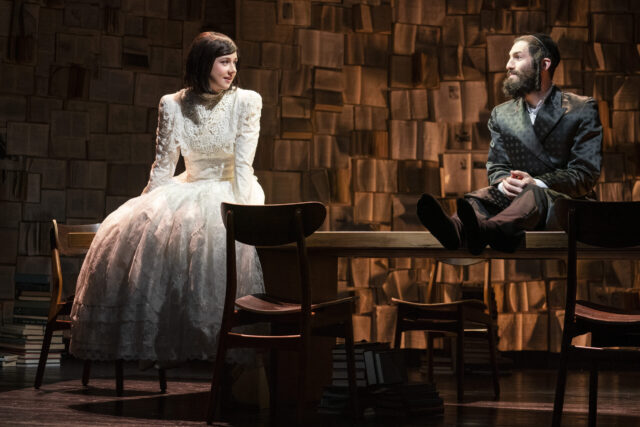
Roth’s career and writings about Jewish parents and children are pivotal in Anna Ziegler’s The Wanderers, which opened last night at Roundabout’s Laura Pels Theatre. The play is almost too literary for its own good: Marion Williams’s set consists of about a dozen piles of books on the floor, a long library-style table, and several back walls completely covered in open books, their pages pleading to be read; some of the characters enter and leave through gaps in the walls, as if they’re walking in and out of novels. Kenneth Posner’s lighting often casts the books on the wall and the floor in heavenly glows, including a neon blue. The scenes unfold in chapters with such titles as “Marriage,” “Children,” “Boredom,” “Destruction,” and “Fiction.”

The Wanderers, a name that evokes the forty years the Jews spent in the desert searching for the Promised Land after escaping slavery in Egypt, goes back and forth between 1973–82 and 2015–17, primarily in Brooklyn. Abe (Eddie Kaye Thomas) is a dour but extremely successful and self-absorbed writer, having won two National Book Awards and the Pulitzer Prize (as did Roth); among his popular tomes are The Theory of Milk (as in a mother’s nurturing?) and Orphan. His wife, Sophie (Sarah Cooper), is considering writing a second novel but she’s tentative because her first book, published ten years earlier, was poorly reviewed. Abe’s parents, Esther (Lucy Freyer) and Schmuli (Dave Klasko), were Satmar Jews living in Williamsburg; Sophie is biracial and half Jewish (on her father’s side).

After giving a book reading at which Hollywood superstar Julia Cheever (Katie Holmes) — a nod to Pulitzer Prize–winning author John Cheever — sat rapt with attention right up front, Abe is contacted by the glamorous actress over email; she’s starring in an adaptation of Roth’s Everyman, and the two kick off a flirtatious online friendship. Initially, Abe reads the emails out loud off his laptop by himself (or to Sophie), but soon he and Julia are both onstage, as if involved in face-to-face conversations. The more time he spends with Julia, the less time he has for Sophie and their two (unseen) kids.

Esther (Lucy Freyer) and Schmuli (Dave Klasko) prepare to comsummate their arranged marriage in Roundabout production (photo by Joan Marcus)

Meanwhile, some forty years before, Esther and Schmuli are commencing their life together through an arranged marriage; as the babies begin coming, Esther imagines a life where she has more choice, where she is not restricted by the draconian Hasidic rules, which are particularly fierce and limiting on women. As a child, Esther would sneak off with her best friend to read books in the library, and as a mother she wants her children to read books other than the Torah, but it is forbidden.

The parallels between Esther and Schmuli’s marriage and Abe and Sophie’s increase as The Wanderers heads to its final chapters, even if we are well aware of certain conclusions. “I was seventeen when I realized I was going to marry Abe,” Sophie explains in her opening monologue. “I was almost forty when I realized I would leave him.”

Listening to characters pontificate about art and the creative process, whether writing or acting, can get didactic and pretentious, and Ziegler (Boy, Actually) is guilty of that while also recognizing it. “Okay, I know you hate hearing my dreams —” Sophie divulges. “When did I say that?” Abe responds. “It’s the look on your face when I start to tell one,” she says, the same look audience members get when a show becomes preachy. But Ziegler is able to work her way around that with other dialogue that is subtly powerful. After telling Abe her dream, Sophie admits, “And when I woke up, you were gone.” He explains, “I couldn’t sleep so I went for a run.” She says softly, “No . . . that’s not what I meant.”

Hollywood superstar Julia Cheever (Katie Holmes) checks her phone while Abe (Eddie Kaye Thomas) pines for her (photo by Joan Marcus)

Barry Edelstein’s (The Underpants, The Misanthrope) direction tends toward the languid as actors walk onstage, talk, then walk offstage, except for Thomas (Golden Age, The Submission), who when not in a scene is watching it from the sides, taking notes for his next book. Unfortunately, Abe is such an unpleasant character that being in his presence is a downer; when he declares, “People hate me. . . . They’re offended by my very existence,” we understand why. Cooper, an author (100 Tricks to Appear Smart in Meetings, How to Be Successful without Hurting Men’s Feelings) and stand-up comic who gained notoriety for her TikTok videos in which she lip synced to statements by Donald Trump, is strong in her off-Broadway debut; the show would have benefited from more of her and her character, who is more intriguing than the others.

Holmes (All My Sons, Dead Accounts) brings a sweet innocence to her portrayal of the captivating Hollywood star, wearing fashionable white outfits that make Julia an angelic figure. (The costumes are by David Israel Reynoso.) Freyer (Romeo & Juliet, Malefactions) and Klasko (Gordy Crashes, King Lear) are effective in roles that are becoming all too familiar (and are all too real), a Hasidic wife who wants more out of life but is trapped by the suffocating intolerance of her husband and community.

Ultimately, The Wanderers is an homage to Roth, almost to a fault, as Ziegler features quotes from his books, right from the opening dialogue, when Sophie tells the audience, “Abe loved to read to me. Mostly his own writing, but also passages from his favorite novels; once, at a Foot Locker, he recited the last lines of Sabbath’s Theater by Philip Roth over and over. ‘And he couldn’t do it. He could not fucking die. How could he leave? Everything he hated was here.’” It’s hard to compete with that.

THE UNAVOIDABLE DISAPPEARANCE OF TOM DURNIN

(photo by Joan Marcus)

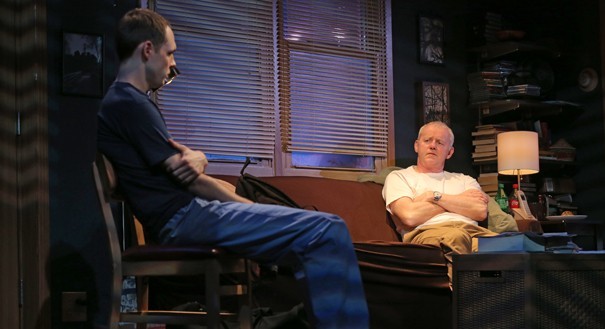
Father (David Morse, r.) and son (Christopher Denham) have a serious chat in THE UNAVOIDABLE DISAPPEARANCE OF TOM DURNIN (photo by Joan Marcus)

Roundabout at Laura Pels Theatre
Harold and Miriam Steinberg Center for Theatre
111 West 46th St. between Sixth & Seventh Aves.
Tuesday – Sunday through August 25, $71-$81
212-719-1300
www.roundabouttheatre.org

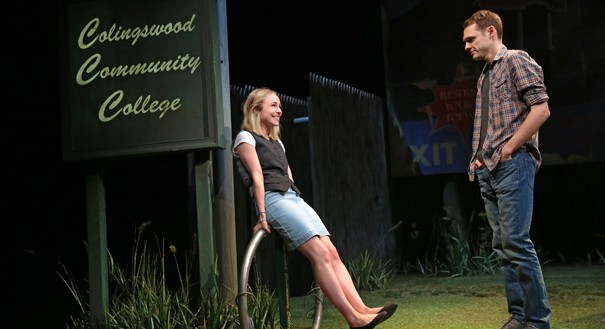
After serving five years in prison for Madoff-like financial wrongdoings, disbarred lawyer Tom Durnin (David Morse) thinks he can just walk right back into his family’s life, but his wife, Karen (Lisa Emery), has left him, his daughter wants nothing to do with him, and his son, James (Christopher Denham), is torn when his father suddenly shows up in his ramshackle house, in a dilapidated would-be neighborhood that was also a victim of the mortgage crisis. His father’s fall from grace has shattered James, who had to leave Yale and now is studying fiction writing at a local college, where he meets the emotionally injured Katie (Sarah Goldberg), who has family issues of her own. Tom, who is working as a barista at a Borders bookstore — which itself would go out of business shortly — tries to find out from James where Karen is, but he’s not telling. Meanwhile, Tom meets with his son-in-law, Chris (Rich Sommer), whom he helped set up in the law firm where he was once a partner, trying to convince him to get him any job with the company, but the meek Chris, who has been told by his wife not to talk to Tom, is not about to risk his career by endorsing Tom’s return to the firm where he committed his dirty dealings.

James (Christopher Denham) and Katie (Sarah Goldberg) deal with difficult family issues in play about financial crisis (photo by Joan Marcus)

James (Christopher Denham) and Katie (Sarah Goldberg) deal with difficult family issues in play about financial crisis (photo by Joan Marcus)

The Unavoidable Disappearance of Tom Durnin takes place in June 2009 in “the American exurbs, Sam’s Clubs and SUVs and Caribou Coffee and the eerie, shuttered windows of foreclosed strip malls,” representing the America that was devastated by the financial meltdown. Morse is excellent as the determined title character, who believes that he has done his time and can now get back on the path he was on, both personally and professionally, unable to recognize the continuing results of his actions. The play, written by Steven Levenson (The Language of Trees, Core Values) and directed by Scott Ellis (The Mystery of Edwin Drood, Harvey), works best when Morse is onstage, his steely gaze and solid posture revealing a man who firmly believes he has paid his price and can’t understand why everyone has turned their back on him. The scenes in which James and Katie read their writings come off as gimmicky, a too-easy way to show these characters’ twisted emotions. The country is still recovering from the financial crisis brought on by men like Tom, and Levenson’s play does a good job using the Durnin family as a microcosm of the ongoing fall-out — in which very few people have actually gone to prison for what they have wrought. (There will be free talkbacks with members of the cast following the 2:00 performance on July 13 and 21 and August 4, 10, and 17.)

TALLEY’S FOLLY

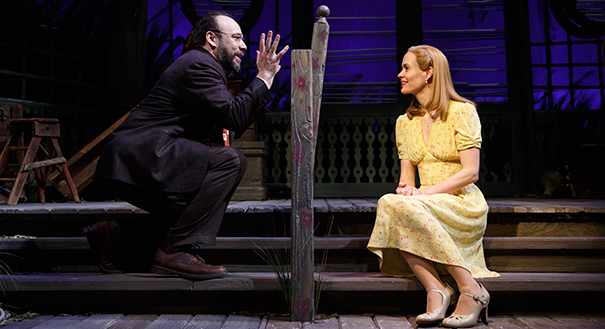
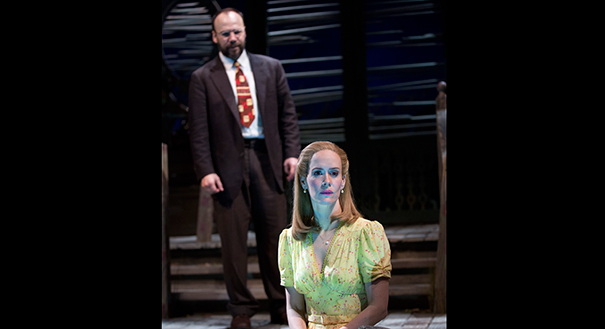
Matt Friedman (Danny Burstein) please his case to Sally Talley (Sarah Paulson) in revival of TALLEY’S FOLLY (photo by Joan Marcus)

Matt Friedman (Danny Burstein) pleads his case to Sally Talley (Sarah Paulson) in new production of TALLEY’S FOLLY (photo by Joan Marcus)

Roundabout at Laura Pels Theatre
Harold and Miriam Steinberg Center for Theatre
111 West 46th St. between Sixth & Seventh Aves.
Tuesday – Sunday through May 12, $91
212-719-1300
www.roundabouttheatre.org

Danny Burstein gives one of the best performances of the season in the first-ever New York revival of Lanford Wilson’s Pulitzer Prize–winning Talley’s Folly. Burstein (Company, Golden Boy) stars as Matt Friedman, a Jewish accountant from St. Louis who has come to Lebanon, Missouri (Wilson’s hometown), in 1944 to declare his love for southern belle Sally Talley (Sarah Paulson), with whom he had a brief flirtation the previous summer. As the show starts, Friedman bursts down the aisle and onto the stage, directly addressing the audience. “If everything goes well for me tonight,” he says in a Jewish accent, “this should be a waltz, one-two-three, one-two-three; a no-holds-barred romantic story, and since I’m not a romantic type, I’m going to need the whole valentine here to help me: the woods, the willows, the vines, the moonlight, the band — there’s a band that plays tonight, over in the park. The trees, the berries, the breeze, the sounds: water and crickets, frogs, dogs, the light, the bees, working all night.” The crowd instantly on his side — he even promises that it will all take place within a brisk ninety-seven minutes — Matt is soon joined by Sally, a nurse’s aide who is helping take care of wounded soldiers at a local hospital. More than a decade younger than Matt, Sally is not thrilled to see him, begging him to leave before her anti-Semitic Ozark family does something bad to him, but Matt is not about to take off without speaking his mind — and trying to convince Sally that she feels the same way he does, which clearly won’t be easy. “You do not have the perception God gave lettuce,” she tells him. “I did not answer but one letter and in that one short note I tried to say in no uncertain terms that I didn’t want you to write to me. You have sent me an almost daily chronicle of your life in your office. The most mundane details of your accounting life. Why did you come back here?”

Matt experiences a bump in the road while wooing Sally in Roundabout revival (photo by Joan Marcus)

Matt experiences a bump in the road while wooing Sally in Roundabout revival (photo by Joan Marcus)

As he continues to woo Sally despite her protestations, Matt makes full use of designer Jeff Cowie’s dilapidated Victorian boathouse set, which has a nostalgic charm to it while also representing the changing of the Old South and the new America that will arise out of World War II. Little by little, the repressed Sally begins to open up and the captivating waltz grows ever-more complex, one-two-three, one-two-three, as it heads to its beautiful conclusion, exactly ninety-seven minutes after it started. Director Michael Wilson (Gore Vidal’s The Best Man, Enchanted April) keeps things moving at an engaging pace, with just the right balance of humor, warmth, and conflict, bringing a vibrancy and freshness to the thirty-three-year-old play, the middle part of a trilogy that began with Talley & Son and concludes with Fifth of July. Paulson (American Horror Story, Collected Stories) is excellent as Burstein’s shiksa dance partner, standing appropriately stiff and tall in her yellow dress and blonde hair, the prim-and-proper polar opposite of the dark-suited, thickly bearded, no-holds-barred Burstein, the two claiming as their own roles originated by Trish Hawkins and Judd Hirsch. This Roundabout Theatre production, immersed in a sweet, contagious innocence, is a fitting tribute to Wilson, who passed away in 2011 at the age of seventy-four, leaving behind a legacy that also includes The Hot l Baltimore and Burn This. (Wilson’s 1975 play, The Mound Builders, is currently being revived at the Signature Theatre, where it has been extended through April 14.)

LOOK BACK IN ANGER

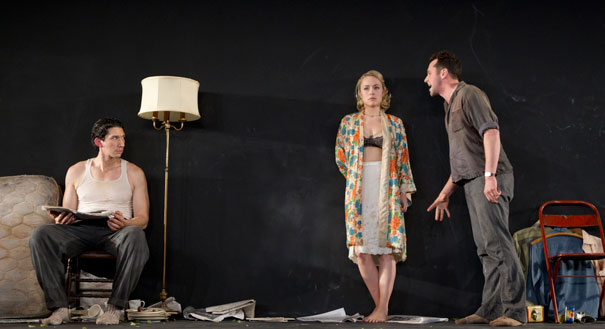
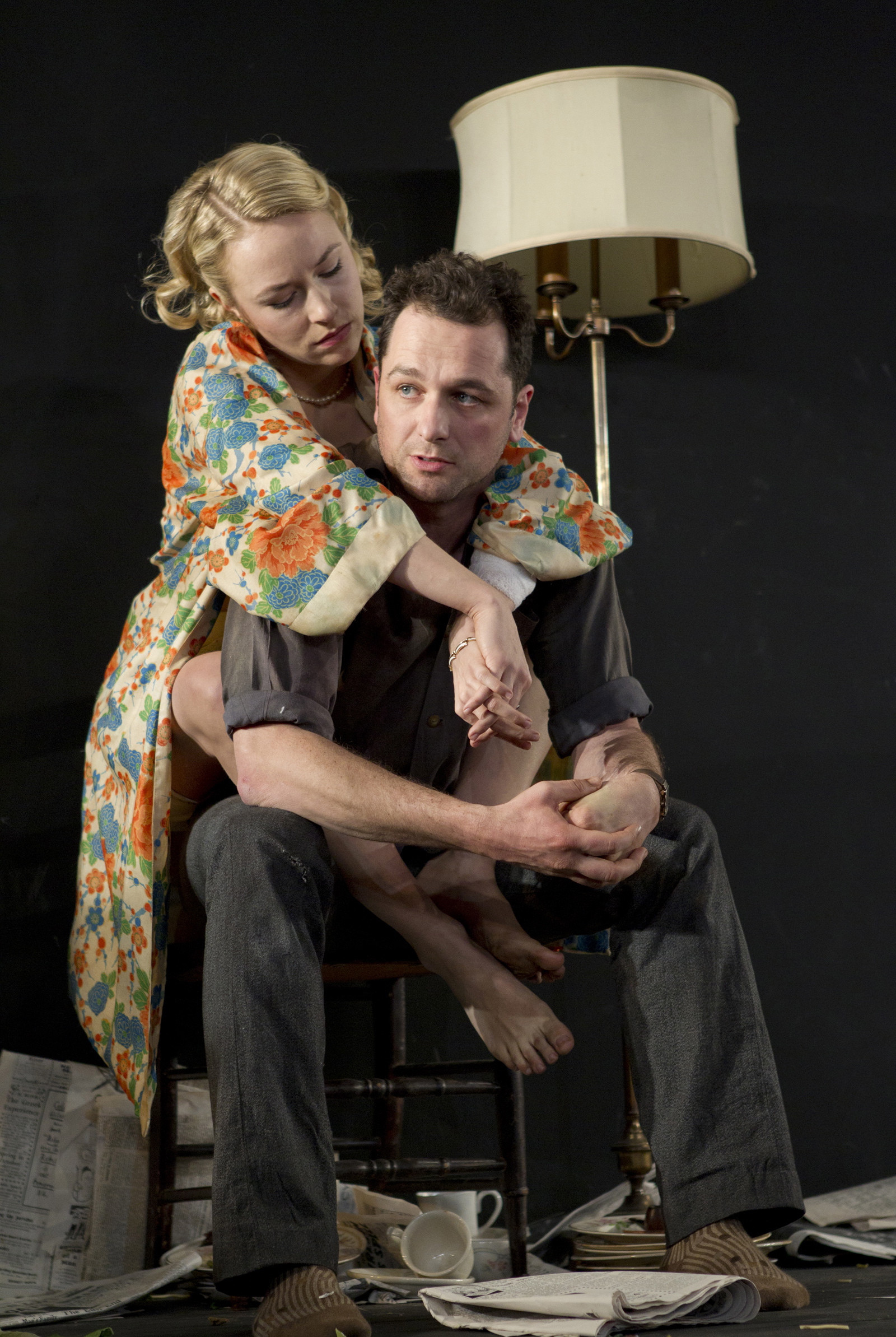
Cliff (Adam Driver), Alison (Sarah Goldberg), and Jimmy (Matthew Rhys) are rather intimate roommates in Roundabout revival (photo by Joan Marcus)

Roundabout at Laura Pels Theatre
Harold and Miriam Steinberg Center for Theatre
111 West 46th St. between Sixth & Seventh Aves.
Through April 8, $71-$81
212-719-1300
www.roundabouttheatre.org

In 1956, John Osborne’s autobiographical Look Back in Anger exploded onto the British theater scene, taking the familiar English drawing-room comedy and turning it inside out and upside down, railing about class warfare, politics, sex, family, and social structure in a less-than-polite manner. It was written by an angry young man, Osborne, about an angry young man, Jimmy Porter, who spewed venom at every opportunity. The original stage production moved to Broadway in 1957, where it was nominated for a Tony for Best Play, and the next year it hit the big screen with Richard Burton playing Jimmy; all three versions were directed by Tony Richardson, who went on to make such highly regarded films as The Entertainer (cowritten by Osborne), Tom Jones, and The Border. (A 1989 television movie directed by Judi Dench starred Kenneth Branagh and Emma Thompson.) Upon being named associate artist at the Roundabout, director Sam Gold (Seminar, August: Osage County) decided that his first production would be an updated version of the controversial drama, which makes an immediate impact via Andrew Lieberman’s powerful set, which transforms the Laura Pels Theatre into an intimate black box, with the stage a long, narrow horizontal platform only several feet deep, backed by a floor-to-ceiling black wall. Strewn about the stage are empty cans, half-eaten bites of food, and ragged clothing. When the cast enters, they’re nearly sitting on the audience’s lap; Gold leaves the lights on at first, as if everyone is inside this fleabag attic apartment. As Jimmy (Matthew Rhys) and his best friend, Cliff (Adam Driver), read the papers, argue, and wrestle, Jimmy’s wife, Alison (Sarah Goldberg), is busy at an ironing board, her shirt open to reveal her bra as if it’s no big deal. At the start, it’s hard to tell which of the men, if not both, is with Alison; while Jimmy goes on and on about British society, Cliff lays a flurry of kisses on Alison, who happily accepts them. But it soon becomes apparent that the loud, ranting Jimmy and the sweetly innocent, well-born Alison are indeed husband and wife, although perhaps not for long if Jimmy cannot control his nasty temper. And when Alison’s friend Helena (Charlotte Parry) arrives, she drives a wedge between the married couple that sets up a heated second act.

Alison and Jimmy share a rare quiet moment in LOOK BACK IN ANGER (photo by Joan Marcus)

Making his New York theater debut, the Welsh Rhys is a commanding force onstage, searing with electric energy while hiding a subtle vulnerability looming just beneath his angry veneer. The play has lost some of its punch over the years; the original’s attack on British society is much tamer and too general in a world all too familiar with such public criticism. Gold’s direction overcomes many of those flaws, adding a suprising intimacy; when Jimmy and Cliff fight, it feels like they could fall off the stage at any moment. And the night we saw the show, when Jimmy slams a drawer against the back wall, one of the resulting pieces of broken wood nearly struck a man sitting in the first row. Gold has also eliminated one of the main characters, Colonel Redfern, which turns out to be a wise decision, as he’s not missed at all. But this is Rhys’s show all the way; his Jimmy is a compelling character who initially does not elicit sympathy for all his mean-spirited mad ramblings, but by the end it is clear why Alison, Cliff, and Helena are so drawn to him, as you will be too. Look Back in Anger might not be quite as angry as it once was, but it is still well worth a look back in this strong, fiery production.